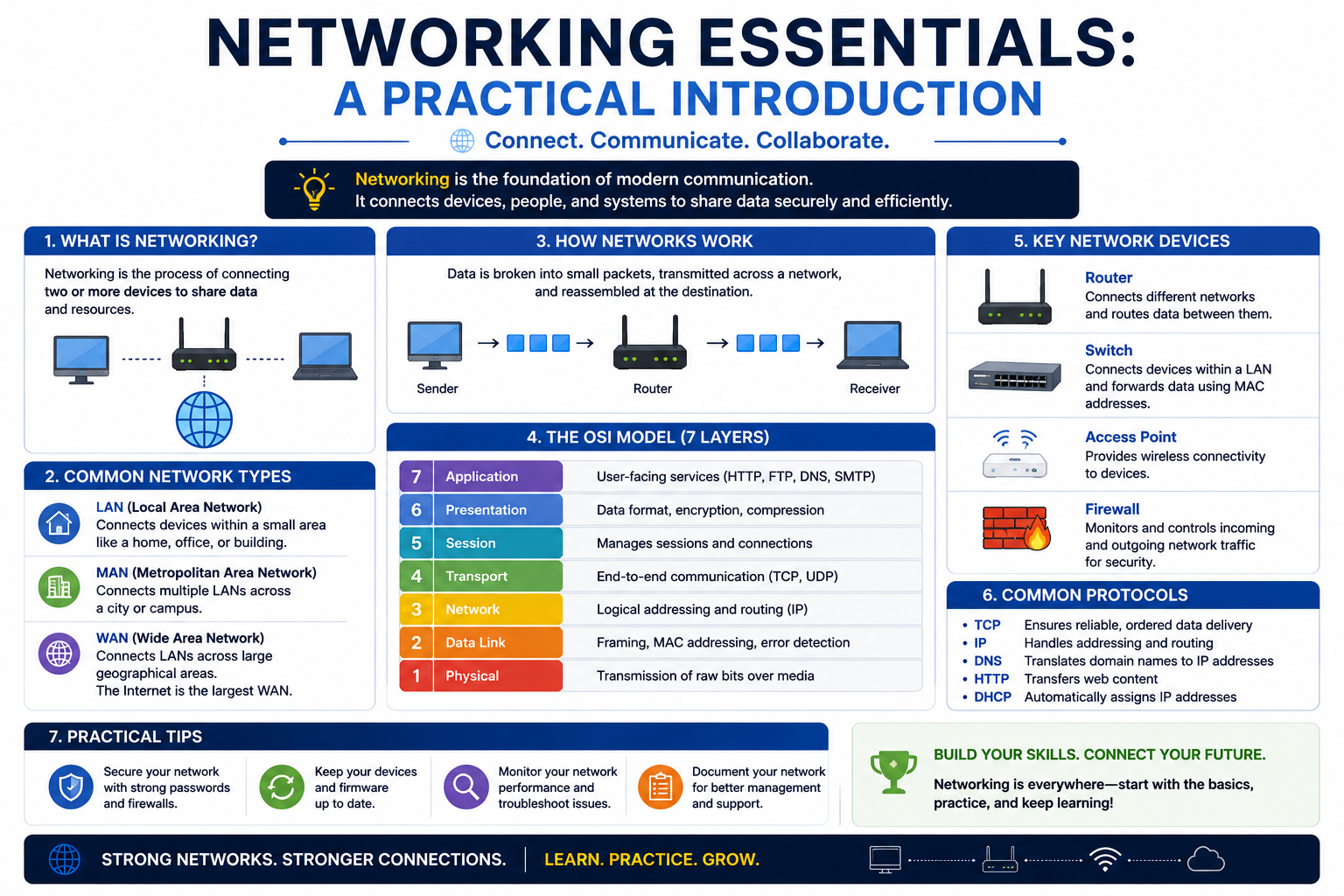
Networking is one of the most important technologies in the modern world. Every digital interaction people experience each day depends on networks operating behind the scenes. Whether someone is sending an email, watching online videos, attending virtual meetings, shopping online, or using cloud applications, networking systems make those activities possible.
At its core, networking is the process of connecting computers and devices so they can communicate and share information. Devices connected through a network can send and receive data almost instantly, even when separated by vast distances. This ability to exchange information efficiently has transformed communication, business, education, entertainment, healthcare, and countless other industries.
Over the last several decades, networking has evolved from simple local connections between a few computers into massive global systems supporting billions of devices simultaneously. Modern networks now handle enormous amounts of data every second while maintaining high levels of speed, reliability, and security.
Understanding networking fundamentals is essential for anyone interested in information technology because networking serves as the backbone of nearly every digital system in use today.
What Networking Means
Networking involves creating communication pathways between devices. These devices may include computers, servers, smartphones, tablets, printers, gaming systems, smart appliances, and industrial equipment.
The goal of networking is to allow these systems to exchange information and share resources. Data travels through networks in digital form, enabling communication between users, applications, and devices.
A network may exist inside a home, office, school, city, or across the entire world. Some networks are small and simple, while others are extremely large and complex.
The internet itself is the largest example of networking. It connects millions of individual networks together to create a global communication system.
Networking also enables resource sharing. Multiple users can access shared printers, storage systems, applications, and internet connections through a network. This improves efficiency and reduces operational costs.
In addition to communication and resource sharing, networking allows centralized management of systems and data. Organizations can maintain servers, applications, and security systems that users access remotely through the network.
How Networking Changed the World
Before networking became widespread, computers often operated independently. Sharing information between systems required physical storage devices such as floppy disks or external drives.
As networking technologies improved, organizations gained the ability to connect multiple computers together. Employees could now share files, communicate electronically, and access common resources within the same building.
The development of the internet dramatically expanded these capabilities. Businesses became capable of operating globally, consumers gained access to online shopping and entertainment, and communication became nearly instant worldwide.
Networking also revolutionized education. Students can now access online courses, virtual classrooms, research materials, and collaboration tools from virtually anywhere with internet access.
Healthcare systems use networking to transfer patient records, support remote consultations, and connect medical devices. Financial institutions rely on networking for secure transactions and banking systems.
Streaming services, social media platforms, cloud computing, online gaming, and remote work environments all became possible because of networking advancements.
Today, networking influences almost every aspect of modern life.
Understanding Data Communication
Networks exist primarily to transfer information between devices. This process is known as data communication.
When someone sends a message or opens a website, the data is divided into smaller pieces called packets. These packets travel through networking systems until they reach their destination.
Each packet contains both the information being sent and instructions describing where the packet should go. Networking devices examine this information and determine the best route for delivery.
Once packets arrive at the destination device, they are reassembled into the original message, file, or media content.
This process occurs extremely quickly. Millions of packets move across global networks every second, enabling instant communication and digital interaction.
Data communication may occur through wired or wireless methods depending on the environment and technology being used.
Reliable communication depends on properly functioning networking hardware, software, and protocols.
The Basic Components of Networking
Every network contains several essential components working together to support communication.
Devices represent the endpoints of a network. These include computers, servers, smartphones, printers, and other connected systems.
Networking hardware manages the movement of data across the network. Common devices include routers, switches, modems, and wireless access points.
Transmission media provide the pathways for communication. These may include Ethernet cables, fiber optic cables, or wireless radio signals.
Protocols establish communication rules that devices follow when exchanging information.
Addressing systems identify devices so data reaches the correct destination.
Security technologies help protect networks from cyber threats and unauthorized access.
Together, these components create the infrastructure supporting modern digital communication.
The Role of Networking Hardware
Networking hardware plays a critical role in moving information between devices.
Routers connect different networks together and determine how traffic should travel between them. Home routers connect local devices to internet service providers, while enterprise routers manage large-scale organizational infrastructure.
Switches connect devices within local networks and direct data efficiently to the correct destination.
Wireless access points allow smartphones, laptops, and other devices to connect through Wi-Fi instead of physical cables.
Modems convert communication signals between local networks and internet service providers.
Firewalls help secure networks by monitoring traffic and blocking suspicious activity.
Servers store files, applications, databases, and websites accessed through the network.
Large organizations may operate thousands of interconnected networking devices supporting global operations.
Understanding Network Protocols
Protocols are standardized communication rules that devices use when exchanging information across networks.
Without protocols, devices made by different manufacturers would not understand each other.
Protocols define how data should be formatted, transmitted, received, and interpreted.
Transmission Control Protocol and Internet Protocol form the foundation of internet communication. These protocols help manage addressing, reliability, and routing.
Hypertext Transfer Protocol supports website communication between web browsers and servers.
Secure protocols such as HTTPS and SSH encrypt communication to improve security.
Simple Mail Transfer Protocol manages email transmission.
Domain Name System protocols translate website names into IP addresses that computers understand.
File Transfer Protocol supports file sharing between systems.
Protocols allow modern networking environments to operate consistently and efficiently.
IP Addressing and Device Identification
Every device connected to a network requires a unique identifier called an IP address.
An IP address functions similarly to a mailing address. It tells networking systems where data should be delivered.
When devices send information, networking hardware examines destination IP addresses and determines the correct route for transmission.
Two primary versions of IP addressing exist today: IPv4 and IPv6.
IPv4 addresses remain widely used but have limited capacity because of the growing number of internet-connected devices.
IPv6 was introduced to support a much larger number of addresses and improve modern networking capabilities.
Networks may assign addresses automatically through services such as DHCP or configure them manually when necessary.
Understanding IP addressing is considered one of the most important networking fundamentals.
Different Types of Networks
Networks exist in many forms depending on their purpose, size, and geographic coverage.
Local Area Networks connect devices within smaller environments such as homes, schools, and offices.
Wide Area Networks connect multiple local networks across larger geographic regions. The internet is the largest example of a wide area network.
Wireless networks allow devices to communicate without physical cables through Wi-Fi technologies.
Virtual Private Networks create secure encrypted connections over public internet infrastructure.
Cloud networks allow users to access remote applications and storage systems through internet connectivity.
Metropolitan Area Networks connect systems across cities or urban areas.
Personal Area Networks support short-range communication between personal devices such as smartphones and wearable technologies.
Each network type serves specific communication needs and presents unique management challenges.
Wired Networking Technologies
Wired networking remains extremely important because of its speed, reliability, and security advantages.
Ethernet is the most common wired networking technology used in homes and businesses.
Ethernet cables connect devices to switches and routers, providing stable communication pathways.
Different cable categories support different performance levels and transmission speeds.
Fiber optic cables use light signals instead of electrical signals, allowing extremely high-speed communication across long distances.
Many enterprise environments rely heavily on fiber optic infrastructure to support large volumes of traffic.
Wired networking is often preferred for servers, gaming systems, and critical business infrastructure because it provides lower latency and more stable performance than wireless communication.
Although wireless networking continues growing rapidly, wired technologies remain essential in modern networking environments.
Wireless Networking Technologies
Wireless networking has transformed how people connect to digital systems.
Wi-Fi technologies allow devices to communicate through radio signals instead of physical cables.
Wireless networking provides mobility and convenience, allowing users to move freely while remaining connected.
Wireless access points transmit signals that devices use to connect to the network.
Modern wireless standards support high speeds, large numbers of connected devices, and improved efficiency.
Wireless networking also introduces challenges related to signal interference, coverage limitations, and security risks.
Networking professionals carefully design wireless environments to optimize performance and minimize connectivity problems.
Wireless security technologies such as WPA3 encryption help protect communication from unauthorized access.
The growing popularity of smartphones, tablets, and smart devices continues driving wireless networking expansion.
Networking and the Internet
The internet is a massive collection of interconnected networks operating together globally.
When users access websites or online services, their devices communicate with remote servers through multiple networking systems.
Data travels across routers, switches, fiber optic infrastructure, and internet service providers before reaching its destination.
The internet enables communication, entertainment, education, business operations, cloud computing, and countless other digital services.
Search engines, streaming platforms, social media, online banking, and e-commerce all rely heavily on internet networking infrastructure.
The scale of the internet is enormous, with billions of devices exchanging information constantly.
Networking professionals help maintain the infrastructure supporting internet communication worldwide.
The Importance of Network Security
As networking became more important, cybersecurity also became increasingly critical.
Cybercriminals frequently target networks to steal information, spread malware, disrupt services, or gain unauthorized access to systems.
Network security technologies help protect communication systems and sensitive data.
Firewalls monitor traffic and block suspicious activity.
Encryption secures information during transmission so unauthorized users cannot read it.
Authentication systems verify user identities before granting access to resources.
Intrusion detection systems monitor networks for signs of attacks or unusual behavior.
Organizations also implement security policies, access controls, and monitoring systems to improve protection.
Strong network security is essential for businesses, governments, healthcare systems, and consumers alike.
Why Networking Skills Matter
Networking knowledge is valuable because nearly every modern technology system depends on communication infrastructure.
Businesses require professionals who can install, configure, troubleshoot, optimize, and secure networks.
Networking skills also support many other technology careers including cybersecurity, cloud computing, systems administration, and technical support.
As organizations continue adopting cloud services, remote work environments, and advanced digital systems, demand for networking expertise continues increasing.
Networking professionals often enjoy strong career opportunities and long-term job stability because infrastructure remains essential for modern operations.
Learning networking fundamentals also helps individuals better understand the technologies they use daily.
From home Wi-Fi troubleshooting to enterprise infrastructure management, networking knowledge provides practical value across many situations.
The Future of Networking
Networking continues evolving rapidly to support modern technological demands.
5G wireless technologies promise faster communication speeds and lower latency.
Cloud computing continues expanding, increasing demand for scalable networking solutions.
Software-defined networking allows infrastructure to be managed more efficiently through centralized software platforms.
Automation technologies reduce manual configuration work and improve operational consistency.
Artificial intelligence systems are beginning to assist with network monitoring, optimization, and security analysis.
The Internet of Things continues adding billions of connected devices to global networks.
As technology advances, networking will remain one of the most important foundations of the digital world.
Understanding Network Infrastructure
Network infrastructure is the complete system of hardware, software, communication technologies, and services that allow devices to connect and exchange information. Every modern organization relies on network infrastructure to support communication, applications, internet access, cloud computing, and data sharing.
Infrastructure forms the foundation of all networking operations. Without reliable infrastructure, devices would not be able to communicate efficiently, businesses would struggle to operate, and digital services would fail to function correctly.
Network infrastructure includes physical equipment such as routers, switches, servers, cables, wireless access points, and firewalls. It also includes virtual systems such as cloud platforms, software-defined networking solutions, and security applications.
As technology environments become more advanced, infrastructure continues growing in complexity. Organizations must support increasing numbers of users, mobile devices, cloud applications, and internet-connected systems while maintaining performance and security.
Strong infrastructure planning is essential because network performance directly affects productivity, communication, and customer experience.
The Purpose of Routers in Networking
Routers are among the most important networking devices because they connect different networks together and direct traffic between them.
Whenever data travels across the internet or between separate organizational networks, routers determine the best path for communication. They examine destination IP addresses within data packets and forward traffic toward the correct location.
Home routers typically connect local devices to internet service providers. Enterprise routers support much larger environments containing multiple offices, departments, cloud systems, and remote users.
Routers also help separate networks into smaller sections known as subnets. Subnetting improves organization, security, and traffic management.
Modern routers often include advanced features such as traffic prioritization, VPN support, firewall capabilities, intrusion prevention systems, and performance monitoring.
Large organizations rely heavily on high-performance routers capable of processing massive amounts of traffic while maintaining low latency and reliable connectivity.
Routing technology continues evolving as networking demands increase globally.
How Switches Improve Network Communication
Switches are networking devices designed to manage communication within local area networks.
Their primary role is connecting devices and directing data efficiently between them. Unlike older networking technologies that broadcast information to every device, switches send traffic only to the intended destination.
Switches identify devices using hardware addresses called MAC addresses. By examining these addresses, switches determine exactly where information should be forwarded.
This selective forwarding process reduces unnecessary traffic and improves overall network performance.
Switches are commonly used in homes, offices, schools, data centers, and enterprise environments where many devices require communication simultaneously.
Managed switches provide advanced configuration capabilities including VLAN support, traffic monitoring, security controls, and quality of service settings.
Unmanaged switches offer simpler plug-and-play functionality suitable for smaller environments.
Switching technology plays a major role in enabling fast and efficient communication inside modern networks.
Wireless Networking and Wi-Fi Systems
Wireless networking has become one of the most widely used forms of communication technology in the world.
Wi-Fi systems allow devices such as smartphones, laptops, tablets, gaming consoles, and smart appliances to connect without physical cables.
Wireless access points transmit radio signals that devices use to communicate with the network. These access points connect wireless devices to wired infrastructure and internet services.
Wireless networking offers flexibility and mobility, allowing users to remain connected while moving throughout homes, offices, campuses, and public spaces.
Businesses rely heavily on wireless networking to support employees, customers, and mobile devices.
However, wireless environments introduce unique challenges. Signal interference, physical obstacles, bandwidth limitations, and security risks can affect performance.
Networking professionals carefully design wireless systems to optimize coverage, minimize interference, and support growing numbers of connected devices.
Modern wireless standards continue improving speed, efficiency, and reliability to meet increasing communication demands.
Understanding Network Cables
Although wireless networking is extremely popular, wired connections remain essential in many environments because of their speed and stability.
Network cables physically carry data between devices and networking equipment.
Ethernet cables are among the most common networking cables used today. Different categories such as Cat5e, Cat6, and Cat6a support different transmission speeds and capabilities.
Fiber optic cables use light instead of electrical signals to transmit information at extremely high speeds across long distances. These cables form much of the global internet backbone infrastructure.
Coaxial cables continue serving specialized communication purposes, particularly in broadband internet and television systems.
Proper cabling infrastructure is critical because damaged or poorly installed cables can cause connectivity issues and performance problems.
Large organizations often maintain extensive cabling systems supporting offices, data centers, and communication rooms.
Cabling remains one of the foundational elements of modern networking infrastructure.
Network Topologies and Design Structures
Network topology refers to the arrangement of devices and communication pathways within a network.
Different topologies affect network performance, reliability, scalability, and troubleshooting complexity.
Star topology is one of the most common designs. In this arrangement, devices connect to a central switch or hub. This design simplifies management and isolates failures effectively.
Bus topology connects devices along a shared communication line. Although historically important, this design is less common in modern networking because of performance limitations.
Ring topology arranges devices in a circular communication pattern where data travels around the network sequentially.
Mesh topology creates multiple connections between devices, improving redundancy and fault tolerance. This design is often used in critical infrastructure environments.
Wireless mesh systems are increasingly popular for expanding Wi-Fi coverage in large areas.
Selecting the correct topology depends on organizational needs, budget, scalability requirements, and desired performance levels.
Understanding Communication Protocols
Protocols are standardized rules that define how devices exchange information across networks.
Every networking process depends on protocols functioning correctly. Without protocols, devices made by different manufacturers would not understand one another.
Transmission Control Protocol and Internet Protocol form the core foundation of internet communication.
TCP helps ensure reliable delivery of data, while IP handles addressing and routing.
Hypertext Transfer Protocol supports website communication between browsers and web servers.
HTTPS adds encryption to improve security and protect sensitive information during transmission.
Simple Mail Transfer Protocol manages outgoing email communication.
Dynamic Host Configuration Protocol automatically assigns IP addresses to devices joining a network.
Domain Name System protocols convert website names into IP addresses that computers can understand.
Networking professionals must understand protocols thoroughly because communication depends heavily on proper protocol operation.
Ports and Network Services
Ports help organize communication between applications and services running on network-connected devices.
A port acts as a logical communication endpoint associated with a specific service or application.
For example, web traffic commonly uses ports 80 and 443, while email services use different designated ports.
Ports allow multiple applications to communicate simultaneously on the same device without conflicts.
Network administrators often configure firewalls to allow or block traffic based on specific port numbers.
Understanding ports becomes especially important during troubleshooting and cybersecurity operations.
Cybersecurity professionals frequently monitor ports to identify unauthorized services or suspicious activity.
Correct port management improves both network functionality and security.
Local Area Networks and Internal Communication
Local Area Networks connect devices within relatively small geographic areas such as homes, offices, schools, or campuses.
LANs enable users to share resources including printers, internet connections, files, and applications efficiently.
Most LAN environments provide high-speed communication because devices are located close together.
Switches play a major role inside local area networks by directing traffic efficiently between connected systems.
Organizations often divide large LANs into smaller segments called VLANs to improve security and traffic management.
Home networks are usually simple LAN environments consisting of routers, wireless access points, and connected devices.
Business LANs can be far more complex, supporting hundreds or thousands of users simultaneously.
LANs remain one of the most common and important networking environments worldwide.
Wide Area Networks and Global Connectivity
Wide Area Networks connect multiple local networks across larger geographic distances.
The internet itself is the largest example of a wide area network.
Organizations use WAN technologies to connect branch offices, remote employees, cloud platforms, and data centers located in different cities or countries.
WAN communication often relies on telecommunications infrastructure such as fiber optic systems, leased lines, satellite links, or internet-based connectivity.
Because WAN traffic travels longer distances, latency and bandwidth management become important considerations.
Modern organizations increasingly adopt software-defined wide area networking technologies to improve performance, flexibility, and cost efficiency.
Wide area networking enables global communication and supports international business operations.
Cloud Networking and Virtual Infrastructure
Cloud computing has transformed networking significantly over the last decade.
Instead of storing applications and data entirely on local systems, organizations now use remote cloud platforms accessible through internet connectivity.
Cloud networking involves managing communication between users, local infrastructure, and remote cloud services.
Major cloud providers operate enormous global networking infrastructures supporting millions of users and applications.
Cloud networking introduces concepts such as virtual networks, software-defined infrastructure, load balancing, and cloud security groups.
Organizations often operate hybrid environments combining local infrastructure with cloud-based systems.
Cloud networking professionals must understand connectivity, scalability, performance optimization, and security management.
As cloud adoption continues expanding worldwide, cloud networking skills remain highly valuable.
Virtual Private Networks and Secure Access
Virtual Private Networks create encrypted communication tunnels across public networks such as the internet.
VPNs allow users to access private organizational resources securely from remote locations.
Remote employees often use VPN technologies to connect safely to company systems while working outside the office.
VPN encryption protects sensitive data from interception during transmission.
Organizations also use VPNs to connect branch offices securely across long distances.
Different VPN protocols offer varying levels of security, compatibility, and performance.
VPN technologies became increasingly important as remote work environments expanded globally.
Although VPNs improve security significantly, they require proper configuration and monitoring to avoid vulnerabilities.
Network Performance and Traffic Management
Network performance directly affects productivity, communication quality, and user experience.
Slow or unstable networks can disrupt operations and frustrate users.
Bandwidth refers to the amount of data a network can transmit within a specific period. Higher bandwidth supports faster communication and more simultaneous users.
Latency measures communication delays between devices. Low latency is especially important for real-time applications such as online gaming and video conferencing.
Packet loss occurs when data fails to reach its destination correctly, often causing interruptions or degraded performance.
Traffic prioritization technologies allow critical applications to receive higher communication priority during periods of heavy usage.
Networking professionals use monitoring tools to identify bottlenecks and optimize infrastructure performance.
Effective performance management helps organizations maintain reliable communication systems.
Network Security Fundamentals
Security is one of the most critical aspects of modern networking.
Cybercriminals constantly target networks to steal information, spread malware, disrupt services, or gain unauthorized access.
Firewalls help protect networks by filtering traffic and blocking suspicious communication.
Encryption technologies secure sensitive data during transmission.
Authentication systems verify user identities before allowing access to resources.
Intrusion detection and prevention systems monitor networks for signs of attacks or unusual behavior.
Network segmentation separates sensitive systems from general user environments to reduce security risks.
Security policies and access controls help organizations manage permissions and protect infrastructure effectively.
Networking and cybersecurity are deeply connected because most cyber threats involve communication systems directly.
Common Networking Challenges
Modern networking environments face many ongoing challenges.
Growing numbers of connected devices increase demands on bandwidth and infrastructure management.
Cloud integration introduces additional complexity related to security, latency, and hybrid connectivity.
Wireless networking environments must support high device density while maintaining strong performance.
Cybersecurity threats continue evolving rapidly, requiring constant monitoring and updated defense strategies.
Organizations must balance performance, scalability, reliability, and cost efficiency when designing infrastructure.
Hardware failures, software bugs, cable damage, and configuration errors can all cause connectivity issues.
Networking professionals must troubleshoot problems quickly to minimize downtime and maintain operational continuity.
Strong planning, monitoring, and maintenance practices help reduce many networking challenges.
The Growing Importance of Networking Skills
Networking skills remain highly valuable because nearly every organization depends on communication infrastructure.
Businesses require professionals capable of installing, configuring, securing, optimizing, and troubleshooting network systems.
Networking knowledge also supports careers in cybersecurity, cloud computing, systems administration, and technical support.
As digital transformation continues expanding across industries, demand for networking expertise continues growing.
Professionals who understand modern networking technologies often enjoy strong career opportunities and long-term job stability.
Learning networking fundamentals also helps individuals better understand the technology systems they use every day.
From home Wi-Fi troubleshooting to enterprise infrastructure management, networking knowledge provides practical value across many environments.
Building a Career in Networking
Networking is one of the largest and most important career fields in information technology. Every modern organization depends on reliable communication systems to support operations, connect employees, provide online services, and maintain digital infrastructure. Because of this dependence, networking professionals remain in high demand across nearly every industry.
A networking career offers many opportunities for growth and specialization. Some professionals focus on maintaining business infrastructure, while others work with cybersecurity, wireless systems, cloud environments, or enterprise architecture. Networking skills also create pathways into many other areas of technology, including cloud computing, DevOps, cybersecurity, and systems administration.
One of the reasons networking careers remain attractive is the constant evolution of technology. New communication methods, security challenges, cloud services, and automation systems continue changing how networks operate. Professionals who enjoy solving problems and learning new technologies often find networking both rewarding and intellectually engaging.
Networking careers also provide opportunities to work in many different industries. Hospitals, universities, financial institutions, telecommunications companies, retail organizations, manufacturing facilities, and government agencies all require networking professionals to support their infrastructure.
As digital transformation continues worldwide, networking expertise becomes even more valuable.
Entry-Level Networking Opportunities
Many people begin their networking careers in entry-level support positions. These jobs help individuals build practical experience while learning how real-world networks operate.
Help desk technicians often assist users with connectivity issues, device configurations, password resets, and troubleshooting tasks. Although these roles may appear basic, they provide valuable exposure to networking environments and user support processes.
Technical support specialists work with customers or internal employees to diagnose communication problems and resolve infrastructure-related issues. These positions often involve working with routers, switches, wireless networks, and internet services.
Junior network administrators support senior IT staff by monitoring systems, configuring devices, updating software, and assisting with maintenance tasks. These positions provide hands-on experience with enterprise networking environments.
Entry-level networking jobs teach important skills such as troubleshooting, communication, documentation, and infrastructure management. These foundational experiences help professionals prepare for more advanced roles later in their careers.
Many successful network engineers and architects began their careers in support positions before advancing into specialized technical roles.
The Role of Network Administrators
Network administrators are responsible for maintaining the daily operation of networking systems.
Their duties often include configuring networking devices, monitoring performance, troubleshooting connectivity problems, managing user access, and ensuring infrastructure remains operational.
Administrators frequently work with switches, routers, wireless access points, firewalls, and servers. They may also manage software updates, security settings, backup systems, and network documentation.
One important responsibility of network administrators is minimizing downtime. Businesses rely heavily on communication systems, so administrators must respond quickly when problems occur.
Administrators also help implement organizational policies related to security, remote access, and device management.
In smaller organizations, a network administrator may manage nearly all aspects of infrastructure. In larger enterprises, administrators often specialize in specific technologies or departments.
Strong troubleshooting skills, communication abilities, and technical knowledge are essential for success in this role.
The Responsibilities of Network Engineers
Network engineers typically focus on designing, implementing, optimizing, and upgrading networking infrastructure.
Unlike administrators who often manage daily operations, engineers frequently work on larger projects and more advanced technical challenges.
Network engineers configure routing systems, switching environments, wireless infrastructure, VPN solutions, and security technologies. They also optimize network performance and plan for future growth.
Engineers often analyze traffic patterns, identify bottlenecks, and implement solutions that improve reliability and efficiency.
Large organizations may employ specialized engineers focused on wireless networking, data center infrastructure, cloud networking, or security systems.
Network engineers require strong technical expertise because modern infrastructure environments can become extremely complex.
Problem-solving abilities are especially important because engineers must diagnose difficult communication issues and design scalable solutions capable of supporting organizational growth.
As networking technologies continue evolving, engineers must continuously learn new systems and technologies.
Understanding Network Architecture
Network architects are senior-level professionals responsible for planning and designing large-scale networking environments.
Architects evaluate organizational requirements and create infrastructure strategies that support performance, scalability, reliability, and security goals.
Their work often involves designing enterprise networks, cloud connectivity systems, data center infrastructure, and disaster recovery solutions.
Network architects must understand both technical and business requirements. They frequently collaborate with executives, engineers, cybersecurity teams, and cloud specialists.
Architects also help organizations prepare for future technological growth by selecting scalable and flexible networking solutions.
Because of the complexity involved, network architecture positions usually require extensive experience and advanced technical expertise.
Architects often influence major technology decisions that affect organizational operations for many years.
Networking Certifications and Their Importance
Certifications play a major role in networking careers because they help validate technical skills and demonstrate industry knowledge.
Many employers prefer hiring certified professionals because certifications show that candidates understand important networking concepts and technologies.
One of the most widely recognized networking certifications is the Cisco Certified Network Associate certification. This certification covers networking fundamentals including routing, switching, IP addressing, wireless networking, and security basics.
CompTIA Network+ certifications focus on vendor-neutral networking knowledge applicable across many technologies and environments.
Juniper certifications validate expertise with Juniper networking systems and infrastructure management.
Palo Alto certifications emphasize firewall technologies and network security concepts.
More advanced certifications focus on enterprise infrastructure, wireless networking, cloud systems, and cybersecurity technologies.
Although certifications alone do not replace practical experience, they improve career opportunities and help professionals structure their learning.
Continuous certification and education also help networking professionals remain current with evolving technologies.
The Importance of Hands-On Practice
Networking is a highly practical field where real-world experience matters significantly.
Reading about networking concepts is important, but hands-on practice helps professionals understand how systems behave in actual environments.
Many learners build home labs containing routers, switches, wireless access points, and virtual machines for experimentation and practice.
Simulation software also allows individuals to practice configurations and troubleshooting without requiring expensive physical hardware.
Hands-on experience teaches professionals how to configure devices, diagnose problems, monitor traffic, and test communication systems.
Employers often value practical abilities highly because networking professionals frequently encounter real-world issues that require immediate solutions.
Practical experience also helps build confidence when managing enterprise infrastructure.
The combination of theoretical knowledge and hands-on skills creates a strong foundation for long-term success in networking careers.
Understanding Troubleshooting Skills
Troubleshooting is one of the most essential abilities for networking professionals.
Networks contain many interconnected components, and failures can occur for numerous reasons including hardware malfunctions, cable damage, software bugs, configuration errors, and security incidents.
Effective troubleshooting requires logical thinking and systematic analysis.
Networking professionals often follow structured troubleshooting methods that involve identifying symptoms, isolating possible causes, testing solutions, and verifying results.
Diagnostic tools such as ping, traceroute, packet analyzers, and monitoring systems help technicians investigate communication problems.
Strong troubleshooting abilities reduce downtime and improve operational continuity for organizations.
Because businesses depend heavily on reliable communication systems, professionals who can solve problems quickly are extremely valuable.
Troubleshooting also helps professionals develop deeper technical understanding of how networking systems function.
Networking and Cybersecurity
Networking and cybersecurity are closely connected because most cyber threats target communication systems in some way.
Attackers often attempt to steal data, disrupt services, spread malware, or gain unauthorized access through network vulnerabilities.
Networking professionals help protect infrastructure by implementing firewalls, encryption technologies, access controls, intrusion prevention systems, and monitoring tools.
Understanding network traffic is essential for identifying suspicious behavior and potential attacks.
Security-focused networking professionals may specialize in firewall management, secure remote access, VPN technologies, network monitoring, or incident response.
Cybersecurity threats continue evolving rapidly, increasing the importance of secure networking practices.
Organizations now invest heavily in protecting communication infrastructure because network breaches can cause financial losses, reputational damage, and operational disruptions.
Professionals who understand both networking and cybersecurity often enjoy strong career opportunities.
Cloud Networking and Modern Infrastructure
Cloud computing has transformed modern networking significantly.
Organizations increasingly use cloud platforms to host applications, databases, storage systems, and virtual infrastructure.
Cloud networking involves managing communication between local systems, users, and cloud environments.
Networking professionals working with cloud technologies must understand virtual networking, cloud security groups, load balancing, hybrid connectivity, and internet-based infrastructure management.
Major cloud providers operate enormous global networks designed to support scalability, redundancy, and high availability.
Organizations often use hybrid environments combining local infrastructure with cloud services.
Cloud networking expertise has become one of the most valuable skills in modern IT because businesses continue expanding cloud adoption.
Professionals with both networking and cloud knowledge are highly sought after across many industries.
Wireless Networking Careers
Wireless networking has become an essential part of modern communication infrastructure.
Organizations rely heavily on Wi-Fi systems to support employees, mobile devices, customers, and smart technologies.
Wireless networking specialists design, deploy, optimize, and troubleshoot wireless environments.
Their responsibilities may include access point placement, signal optimization, interference management, security configuration, and capacity planning.
Wireless environments can be challenging because physical obstacles, neighboring networks, and high device density often affect performance.
Modern wireless systems must support increasing numbers of devices while maintaining reliable connectivity.
Wireless professionals frequently work in offices, hospitals, universities, stadiums, airports, and large public venues.
As mobile technologies continue expanding, wireless networking expertise remains highly valuable.
Data Centers and Enterprise Networking
Large organizations often operate data centers containing servers, storage systems, virtualization platforms, and networking equipment.
Enterprise networking environments are usually far more complex than small office or home networks.
These infrastructures may support thousands of devices, multiple geographic locations, cloud integrations, and advanced security systems.
Data center networking focuses heavily on performance, redundancy, scalability, and reliability.
High-speed switches and routers help manage enormous amounts of traffic efficiently.
Redundant infrastructure reduces the risk of downtime affecting business operations.
Enterprise networking professionals often work with technologies such as virtualization, software-defined networking, automation systems, and advanced monitoring tools.
Managing enterprise infrastructure requires strong technical expertise and careful planning.
Automation and the Future of Networking
Networking is becoming increasingly automated as infrastructure environments grow larger and more complex.
Traditional networking often required administrators to configure devices manually using command-line interfaces.
Modern automation technologies allow organizations to deploy configurations, monitor systems, and manage infrastructure more efficiently.
Software-defined networking enables centralized management through software platforms rather than device-by-device configuration.
Automation reduces human error, improves consistency, and increases operational efficiency.
Artificial intelligence and machine learning technologies are also beginning to assist with network monitoring, performance optimization, and threat detection.
Automated systems can identify unusual activity, detect failures, and recommend solutions faster than manual processes alone.
Networking professionals increasingly benefit from learning scripting and automation skills alongside traditional infrastructure knowledge.
Soft Skills for Networking Professionals
Technical expertise alone is not enough for success in networking careers.
Communication skills are extremely important because networking professionals frequently interact with users, managers, vendors, and other IT teams.
Professionals must often explain technical issues clearly to non-technical individuals.
Documentation skills help organizations maintain accurate records of configurations, policies, and troubleshooting procedures.
Time management and organizational abilities become especially important when handling multiple projects or responding to urgent infrastructure issues.
Teamwork also plays a major role because networking professionals often collaborate with cybersecurity teams, cloud administrators, developers, and systems engineers.
Strong soft skills help technical professionals become more effective and advance into leadership positions.
Challenges Facing Modern Networks
Modern networking environments face many ongoing challenges.
Cybersecurity threats continue increasing in sophistication and frequency.
Cloud integration introduces additional complexity involving hybrid connectivity and security management.
Organizations must support remote workers securely while maintaining strong performance.
Wireless networks must handle growing numbers of devices and higher bandwidth demands.
Internet-connected devices continue increasing through the growth of smart technologies and the Internet of Things.
Bandwidth requirements also continue expanding because of streaming services, cloud applications, and data-intensive workloads.
Networking professionals must balance performance, scalability, reliability, security, and cost efficiency when designing and managing infrastructure.
Strong planning, monitoring, and continuous learning help organizations address these challenges effectively.
The Future of Networking Technology
The future of networking will involve faster communication systems, increased automation, and deeper integration with artificial intelligence technologies.
5G wireless infrastructure promises lower latency and higher speeds capable of supporting advanced applications such as autonomous transportation and smart cities.
Edge computing will process data closer to users and devices, improving performance for real-time applications.
Artificial intelligence systems may increasingly automate network optimization, monitoring, and cybersecurity analysis.
The Internet of Things will continue expanding the number of connected devices worldwide.
Quantum networking research may eventually revolutionize secure communication technologies.
As technology continues evolving, networking will remain one of the most essential foundations of modern digital infrastructure.
Conclusion
Networking is one of the most important components of the modern technological world. It enables communication between devices, supports businesses and organizations, powers the internet, and allows digital services to function efficiently across the globe.
From home Wi-Fi systems to massive enterprise infrastructures, networking technologies connect people, applications, and devices in ways that shape everyday life. Businesses rely on secure and reliable networks for communication, cloud computing, data sharing, and operational continuity.
The field of networking also offers excellent career opportunities for individuals interested in technology, problem-solving, cybersecurity, cloud systems, and infrastructure management. As digital transformation continues expanding worldwide, demand for skilled networking professionals will remain strong.
Learning networking fundamentals provides valuable knowledge for understanding how modern communication systems operate. With continuous learning, hands-on experience, and technical curiosity, networking can become both a rewarding career path and a powerful foundation for success across many areas of information technology.