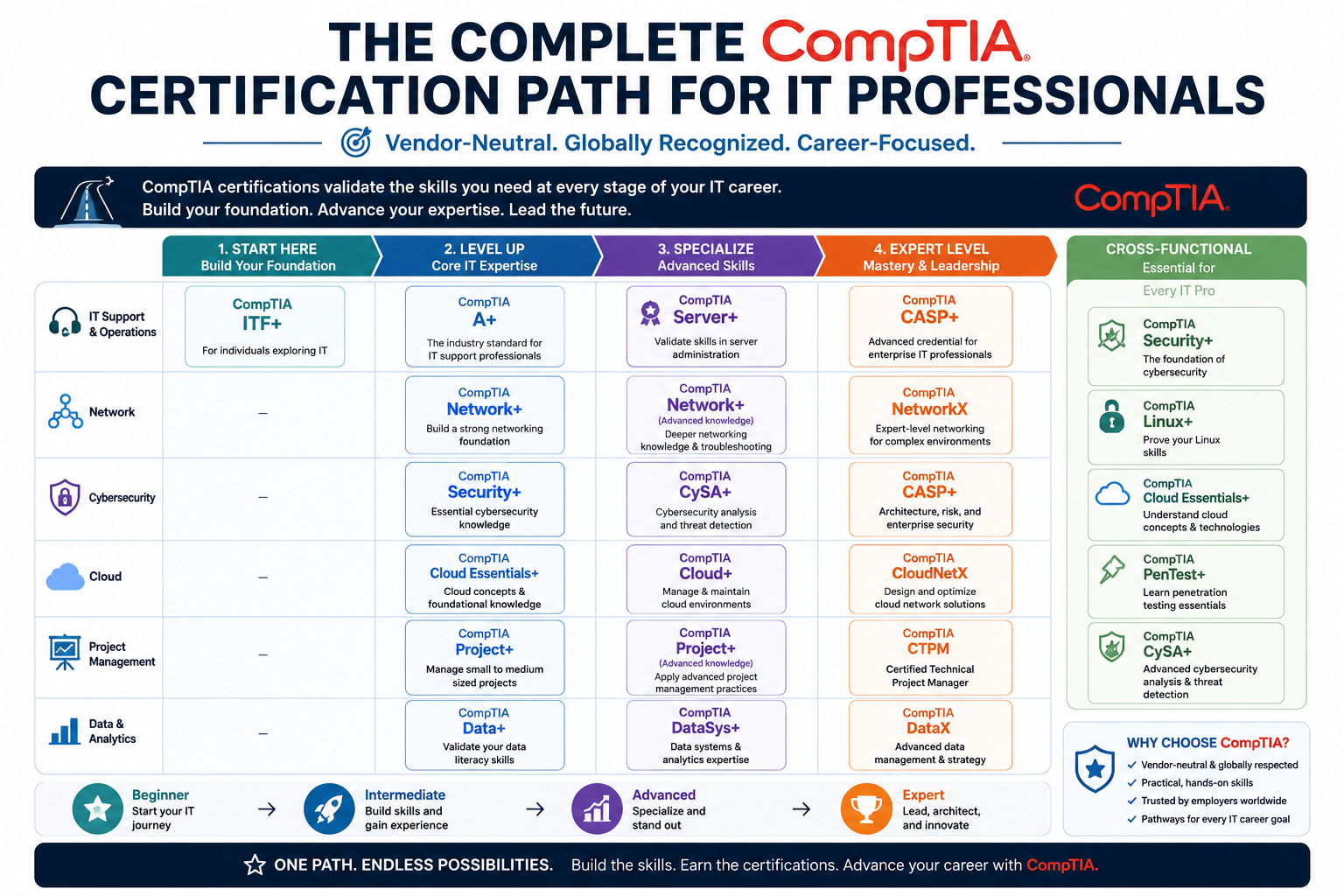
CompTIA is one of the most respected organizations in the global information technology industry. The organization has helped millions of professionals develop technical skills and validate their knowledge through vendor-neutral certifications. Unlike certifications that focus on a single company’s technologies, CompTIA certifications teach skills that can be used across multiple platforms, systems, and environments. This flexibility has made CompTIA certifications extremely popular among beginners, experienced IT professionals, employers, and government organizations.
The primary purpose of CompTIA certifications is to create a standardized method for validating technical expertise. Employers often struggle to measure whether a candidate truly understands networking, cybersecurity, operating systems, troubleshooting, or cloud infrastructure. Certifications help solve that problem by proving that candidates have passed industry-recognized exams designed to test practical and theoretical knowledge.
CompTIA certifications are widely recognized because they cover foundational concepts that apply to real-world IT jobs. Instead of focusing only on memorization, many CompTIA exams evaluate problem-solving skills, troubleshooting abilities, and practical understanding of technology systems. This approach makes certified professionals more valuable in workplace environments where hands-on knowledge is essential.
The certification program is divided into several categories, including Core Certifications, Infrastructure Certifications, Cybersecurity Certifications, and Professional Certifications. These categories allow learners to follow structured career pathways depending on their interests and long-term goals.
CompTIA certifications are commonly used by individuals entering IT for the first time. They are also used by professionals seeking promotions, career changes, or specialized technical roles. Employers frequently list CompTIA certifications in job requirements because the certifications demonstrate dedication, technical competency, and industry-standard knowledge.
Another reason for CompTIA’s popularity is its global recognition. Professionals with CompTIA certifications can pursue career opportunities in many countries and industries. Whether someone works in healthcare, education, finance, government, telecommunications, or cloud computing, the knowledge gained through CompTIA certification remains relevant.
Technology changes rapidly, and CompTIA continually updates its certification exams to match modern industry demands. Cloud computing, cybersecurity, virtualization, automation, networking, and infrastructure management are all areas that evolve frequently. By updating exam objectives, CompTIA helps ensure certified professionals remain current with industry standards.
Many organizations trust CompTIA certifications because they are vendor-neutral. This means candidates are not limited to understanding only one company’s products. Instead, they learn broader concepts that can apply to many environments. For example, networking knowledge learned in Network+ can apply to Cisco, Juniper, HP, or other networking platforms.
CompTIA certifications are also valuable because they create clear learning pathways. Beginners can start with introductory certifications and gradually progress toward advanced cybersecurity or infrastructure certifications. This progression helps learners build confidence while developing technical expertise over time.
The organization also offers stackable certifications that combine multiple certifications into specialized career pathways. These stackable certifications help employers identify professionals who possess broader expertise across related technical areas.
CompTIA plays an important role in government and defense hiring as well. Several CompTIA certifications are approved under Department of Defense standards, making them valuable for professionals pursuing federal government or military-related positions.
Certifications can also improve earning potential. While salary depends on many factors such as experience, location, and industry, certified professionals often earn higher salaries than non-certified peers because employers value validated skills.
Preparation for CompTIA certifications typically involves hands-on practice, training courses, labs, practice exams, and self-study. Since many exams emphasize troubleshooting and real-world application, practical experience is highly beneficial.
The CompTIA certification roadmap is designed to guide learners through different stages of professional growth. Entry-level certifications focus on support and foundational skills, while advanced certifications address cloud infrastructure, penetration testing, analytics, and enterprise security management.
Understanding the structure of the certification program is important before choosing a path. Some professionals may prefer networking and infrastructure, while others focus on cybersecurity or cloud technologies. CompTIA offers pathways for nearly every major IT career field.
The certifications also encourage continuous learning. Because many certifications expire after several years, professionals must renew their certifications through continuing education or updated exams. This process helps ensure certified individuals maintain current technical knowledge.
CompTIA training materials are widely available, including online courses, books, practice tests, labs, and instructor-led programs. This accessibility allows learners from different backgrounds and experience levels to pursue certification preparation at their own pace.
The demand for skilled IT professionals continues to increase as businesses become more dependent on technology. Cybersecurity threats, cloud adoption, remote work, and digital transformation all require trained professionals capable of managing and protecting technology systems. CompTIA certifications help prepare individuals to meet these growing demands.
For many professionals, CompTIA certification serves as the first major milestone in their IT careers. The knowledge gained from these certifications often becomes the foundation for future specialization and long-term professional success.
Understanding the CompTIA Certification Structure
CompTIA organizes its certification program into several major categories to help professionals build skills progressively. Each certification category targets different career levels and technical disciplines. This structured approach allows learners to choose certifications based on their interests, experience, and professional goals.
The first category includes Core Certifications. These certifications focus on foundational IT skills and are primarily designed for beginners and entry-level professionals. Core certifications teach essential concepts related to technical support, networking, operating systems, troubleshooting, and cybersecurity fundamentals.
The next category is Infrastructure Certifications. These certifications focus on technologies that support enterprise systems, including servers, cloud environments, Linux administration, and infrastructure management. Infrastructure certifications are designed for professionals who want to manage enterprise computing environments and support organizational operations.
Cybersecurity Certifications form another major category. These certifications address security analysis, penetration testing, incident response, and advanced enterprise security practices. Cybersecurity certifications are generally intended for professionals with prior technical experience who want to specialize in protecting systems and networks.
CompTIA also offers Professional Certifications. Unlike technical certifications, these programs focus on project management, technical training, and business-related technology knowledge. Professional certifications support individuals who work in management, education, or operational roles connected to technology environments.
CompTIA certifications are designed to complement one another. For example, an individual might begin with A+, continue to Network+, then pursue Security+, and eventually move into CySA+ or PenTest+. This layered structure helps professionals build increasingly advanced technical knowledge.
The roadmap also supports multiple career directions. Someone interested in technical support may focus on A+ and Server+, while another individual pursuing cybersecurity may prioritize Security+, CySA+, and CASP+. Cloud-focused professionals might combine Network+, Cloud+, and Linux+.
One of the most valuable aspects of the CompTIA certification structure is flexibility. Learners are not required to follow a rigid sequence. While some certifications naturally build on others, professionals can choose certifications that align with their immediate career needs.
CompTIA certifications also emphasize transferable skills. Because the certifications are vendor-neutral, professionals gain knowledge that applies across many technologies and environments. This flexibility makes certifications useful in diverse workplaces and industries.
Another important aspect of the certification structure is the emphasis on practical abilities. Many exams include performance-based questions that simulate real-world troubleshooting scenarios. Candidates must demonstrate their ability to analyze problems, configure systems, and apply technical solutions.
CompTIA certifications also encourage specialization. While foundational certifications provide broad knowledge, advanced certifications allow professionals to focus deeply on areas such as cloud infrastructure, penetration testing, vulnerability management, and enterprise security operations.
Employers often use the certification structure to evaluate job candidates. Entry-level certifications may qualify individuals for support roles, while advanced certifications demonstrate readiness for senior technical positions. Certifications therefore serve both educational and professional purposes.
The organization also updates certification objectives regularly to reflect changing industry requirements. Technologies such as cloud computing, virtualization, automation, and cybersecurity evolve rapidly, and CompTIA continuously revises exams to remain aligned with current industry standards.
Many certifications are recognized internationally, making them valuable for professionals seeking global career opportunities. Since technology principles remain largely universal, certified professionals can apply their knowledge across different organizations and countries.
The certification structure also supports lifelong learning. As professionals gain experience, they can continue earning additional certifications to expand their expertise. This continuous development helps professionals remain competitive in evolving technology markets.
CompTIA certifications often serve as prerequisites or preparation for vendor-specific certifications. For example, Network+ knowledge can help professionals prepare for Cisco networking certifications, while Security+ supports later study in advanced cybersecurity programs.
The structured certification pathways also benefit employers by helping organizations build skilled technical teams. Companies can encourage employees to follow certification tracks aligned with organizational needs, improving workforce capabilities and operational efficiency.
Overall, the CompTIA certification structure provides a comprehensive framework for developing technical skills, validating expertise, and supporting long-term career growth in information technology.
CompTIA IT Fundamentals+ Certification
CompTIA IT Fundamentals+, commonly called ITF+, is designed for individuals who are new to technology and want to explore the field of information technology. It serves as an introductory certification that teaches the basic concepts of computing, software, networking, security, and databases.
Unlike advanced technical certifications, ITF+ focuses on helping learners understand how technology systems operate. The certification is ideal for students, career changers, business professionals, and individuals considering entering the IT industry for the first time.
One of the primary goals of ITF+ is to build confidence. Many beginners feel overwhelmed by the complexity of information technology, and ITF+ introduces concepts in a structured and approachable way. The certification provides a strong foundation for future technical learning.
The certification covers essential computing concepts, including hardware components, operating systems, applications, and file management. Learners gain an understanding of how computers process information and interact with software programs.
Networking basics are another important part of ITF+. Candidates learn how devices connect to networks, how the internet functions, and how data moves between systems. These foundational concepts prepare learners for more advanced networking studies later.
Security awareness is also introduced through ITF+. Candidates learn about passwords, malware, safe browsing practices, and basic cybersecurity principles. Since cybersecurity affects every technology environment, early exposure to these topics is highly valuable.
Database concepts are included as well. Learners study how organizations store, organize, and manage information using databases. Understanding data management is important because businesses rely heavily on digital information systems.
Software development basics are another topic within ITF+. Candidates are introduced to programming logic, application development concepts, and problem-solving techniques used in software creation. While the certification does not require programming expertise, it helps learners understand how software is developed.
One advantage of ITF+ is that there are no prerequisites. Anyone interested in learning about technology can pursue the certification regardless of previous experience. This accessibility makes it especially useful for beginners exploring career possibilities.
The certification requires passing one exam that evaluates understanding of computing fundamentals, infrastructure concepts, applications, security awareness, and databases. The exam is designed to measure broad knowledge rather than advanced technical specialization.
ITF+ can also help non-technical professionals who work closely with technology teams. Business managers, sales representatives, marketing staff, and administrative personnel often benefit from understanding basic IT terminology and concepts.
Many educational institutions use ITF+ as an introduction to information technology programs. Students pursuing computer science, cybersecurity, networking, or systems administration may begin with ITF+ before advancing toward more specialized certifications.
Although ITF+ alone may not qualify candidates for advanced technical jobs, it provides a valuable stepping stone toward certifications such as A+, Network+, and Security+. The knowledge gained helps learners transition smoothly into more challenging technical studies.
The certification also helps individuals determine whether they enjoy working with technology. Some learners discover a passion for networking or cybersecurity after studying ITF+, while others realize they prefer business-oriented technology roles.
Hands-on practice remains important during preparation. Learners benefit from experimenting with computer hardware, operating systems, applications, and simple networking tasks while studying certification materials.
Because technology literacy is increasingly important in modern workplaces, ITF+ provides valuable knowledge even for individuals outside traditional IT careers. Understanding basic technology concepts improves communication, productivity, and digital awareness in many industries.
ITF+ demonstrates that technology education does not need to begin with advanced topics. By introducing foundational concepts gradually, the certification creates a strong starting point for future professional development in information technology.
CompTIA A+ Certification
CompTIA A+ is one of the most recognized entry-level certifications in the information technology industry. For decades, it has served as the starting point for individuals beginning careers in IT support, help desk operations, desktop administration, and technical troubleshooting. Many employers consider A+ certification proof that a candidate understands the practical skills required to support modern computer systems and users.
The certification focuses heavily on real-world troubleshooting and hands-on technical knowledge. Instead of concentrating only on theoretical concepts, A+ teaches professionals how to diagnose issues, repair hardware, configure operating systems, and assist users in professional environments. This practical focus has helped make A+ one of the most respected foundational IT certifications available.
A+ certification covers a wide range of technologies and concepts. Candidates learn about computer hardware, operating systems, networking, mobile devices, virtualization, cloud computing, cybersecurity basics, and troubleshooting methodologies. Because modern IT professionals often work across multiple technologies, this broad coverage is extremely valuable.
Hardware support is one of the core areas of A+. Candidates study internal computer components such as motherboards, processors, memory modules, power supplies, storage devices, and expansion cards. Understanding how these components interact is essential for diagnosing and repairing computer systems.
The certification also teaches candidates how to install and configure operating systems. Windows remains a major focus, but A+ also introduces Linux, macOS, and mobile operating systems. Candidates learn how to perform installations, manage configurations, update systems, and resolve software-related problems.
Networking concepts are another important part of the certification. A+ introduces basic networking principles such as IP addressing, routers, switches, wireless networks, and internet connectivity. Candidates learn how devices communicate and how to troubleshoot common networking issues.
Cybersecurity awareness is heavily integrated throughout the certification objectives. Candidates learn about malware, phishing attacks, password security, user permissions, authentication methods, and device protection. Since every IT professional must understand basic security practices, these topics are critical.
Troubleshooting methodology is one of the most valuable skills taught through A+. Candidates are expected to identify problems systematically, gather information, test possible solutions, and verify successful resolutions. Employers highly value structured troubleshooting because it reduces downtime and improves support efficiency.
Mobile device support has become increasingly important in modern workplaces, and A+ addresses this need by covering smartphones, tablets, laptops, and mobile operating systems. Candidates learn how to configure mobile devices, troubleshoot connectivity issues, and support remote users.
Cloud computing and virtualization concepts are also included in the certification. Candidates gain introductory knowledge of cloud services, virtual machines, and remote computing technologies. These concepts prepare learners for future specialization in cloud administration and infrastructure management.
CompTIA A+ certification requires candidates to pass two separate exams. The first exam focuses on hardware, networking, mobile devices, and cloud technologies. The second exam emphasizes operating systems, security, software troubleshooting, and operational procedures.
Although there are no official prerequisites, CompTIA recommends that candidates gain several months of practical experience before attempting the exams. Hands-on practice with computer systems, operating systems, and troubleshooting tasks significantly improves preparation.
Many professionals use A+ certification to secure entry-level jobs such as help desk technician, IT support specialist, desktop support analyst, field technician, and junior systems administrator. These positions often provide the experience needed to pursue more advanced certifications and specialized roles later.
A+ also serves as a foundation for future certifications. Many learners continue toward Network+, Security+, or Server+ after earning A+. Because A+ introduces fundamental concepts across multiple technology areas, it prepares professionals for continued learning and career growth.
Employers value A+ because certified professionals can contribute immediately to support environments. Organizations rely heavily on IT support staff to maintain productivity, resolve technical issues, and assist employees with technology systems. A+ certification demonstrates readiness for these responsibilities.
The certification remains relevant because businesses continue to depend on reliable technology infrastructure. Computers, mobile devices, operating systems, and networks remain essential to daily operations, creating ongoing demand for skilled support professionals.
For individuals entering the IT field, A+ provides both technical knowledge and professional credibility. It demonstrates commitment to learning and validates practical skills that employers recognize worldwide.
CompTIA Network+ Certification
CompTIA Network+ is designed for IT professionals who want to develop networking expertise and work with network infrastructure technologies. Networking forms the foundation of modern information technology because nearly every device, application, and service depends on reliable connectivity. As a result, networking skills are valuable across many technical roles.
The certification validates a candidate’s understanding of network architecture, protocols, cabling, wireless technologies, troubleshooting, and security. Unlike highly specialized networking certifications, Network+ focuses on broad foundational networking knowledge applicable across different vendors and environments.
One of the major strengths of Network+ is its vendor-neutral approach. Candidates learn networking concepts that apply to many platforms rather than focusing exclusively on one company’s equipment. This flexibility allows professionals to adapt to different workplace environments more easily.
The certification introduces candidates to network infrastructure components such as routers, switches, firewalls, wireless access points, and network cables. Understanding how these devices interact is essential for designing, maintaining, and troubleshooting networks.
IP addressing and subnetting are critical networking topics covered by Network+. Candidates learn how devices communicate using IP addresses and how networks are segmented for efficiency and security. These concepts are fundamental to all networking environments.
Wireless networking has become increasingly important in modern businesses, and Network+ covers wireless standards, configurations, security methods, and troubleshooting techniques. Candidates learn how organizations deploy and secure wireless networks for employees and customers.
Network+ also teaches network protocols and services. Candidates study technologies such as DNS, DHCP, TCP/IP, routing protocols, and VPNs. Understanding these protocols helps professionals analyze network behavior and resolve connectivity problems.
Network troubleshooting is one of the most practical components of the certification. Candidates learn structured methods for identifying connectivity issues, diagnosing performance problems, and restoring network functionality. Effective troubleshooting skills are highly valued by employers because network downtime can impact entire organizations.
Security concepts are deeply integrated into Network+ objectives. Candidates learn about network attacks, segmentation, access control, wireless security, and firewall technologies. Since cyber threats frequently target networks, understanding security fundamentals is critical.
Business continuity and disaster recovery concepts are also included. Candidates learn how organizations maintain network availability, implement redundancy, and recover from outages or failures. Reliable infrastructure planning is essential for enterprise operations.
Virtualization and cloud networking technologies are increasingly important in modern IT environments, and Network+ introduces these concepts as part of the evolving networking landscape. Candidates gain familiarity with virtual networks, cloud connectivity, and remote infrastructure management.
The certification requires passing one comprehensive exam. Although there are no mandatory prerequisites, CompTIA recommends that candidates first earn A+ certification and gain networking experience before attempting Network+.
Professionals with Network+ certification often work in positions such as network support specialist, junior network administrator, infrastructure technician, cable technician, systems support analyst, and IT operations technician.
Many learners use Network+ as preparation for more advanced networking certifications from companies such as Cisco or Juniper. The certification provides foundational knowledge that supports deeper study of routing, switching, and enterprise networking technologies.
The demand for networking professionals continues to grow as organizations expand digital operations, cloud services, and remote connectivity solutions. Businesses require skilled professionals capable of managing reliable and secure networks.
Network+ certification also supports careers outside traditional networking roles. Systems administrators, cybersecurity professionals, cloud engineers, and technical support specialists all benefit from understanding networking concepts.
The certification demonstrates that a professional can work with real-world network environments, troubleshoot issues effectively, and contribute to infrastructure operations. Employers value these abilities because modern businesses rely heavily on uninterrupted network communication.
As technology continues evolving, networking remains central to enterprise infrastructure. From cloud computing to cybersecurity, nearly every technology discipline depends on strong networking knowledge, making Network+ an important certification for long-term IT career development.
CompTIA Security+ Certification
CompTIA Security+ is one of the most respected entry-level cybersecurity certifications in the world. It validates the foundational security knowledge required for protecting systems, networks, applications, and data from cyber threats. Because cybersecurity has become essential for organizations of every size, Security+ certification is highly valued across many industries.
The certification focuses on practical security skills rather than purely theoretical concepts. Candidates learn how to identify threats, manage vulnerabilities, implement security controls, and respond to security incidents. This practical approach helps professionals prepare for real-world cybersecurity responsibilities.
One of the reasons Security+ remains popular is its broad coverage of security topics. The certification addresses network security, identity management, cryptography, risk management, secure architecture, governance, and incident response. This balanced coverage provides a strong cybersecurity foundation.
Threat detection is a major component of the certification. Candidates study malware, ransomware, phishing, social engineering, denial-of-service attacks, insider threats, and advanced persistent threats. Understanding attack methods helps professionals recognize and mitigate security risks.
Vulnerability management is another important focus area. Candidates learn how organizations identify weaknesses within systems, applications, and networks. They also study vulnerability scanning, patch management, and remediation processes used to improve security.
Identity and access management concepts are heavily emphasized throughout the certification objectives. Candidates learn about authentication methods, authorization controls, multi-factor authentication, permissions management, and account security practices.
Network security technologies are also covered extensively. Candidates study firewalls, intrusion detection systems, intrusion prevention systems, VPNs, segmentation, and secure communication protocols. Since many cyberattacks target networks, these technologies are critical for organizational security.
Security+ also introduces cryptography and encryption principles. Candidates learn how encryption protects sensitive information during storage and transmission. Topics include certificates, hashing, public key infrastructure, symmetric encryption, and digital signatures.
Secure architecture concepts are another important part of the certification. Candidates learn how organizations design secure systems, implement layered defenses, and reduce attack surfaces. Understanding secure architecture helps professionals support long-term cybersecurity strategies.
Incident response and disaster recovery are key topics as well. Candidates study how organizations detect security breaches, contain threats, recover systems, and investigate incidents. Effective incident response minimizes operational disruption and financial damage.
Risk management concepts help candidates understand how organizations evaluate and prioritize security risks. Security professionals must balance protection measures with business requirements, budgets, and operational needs.
Security+ also addresses governance, compliance, and security policies. Candidates learn about regulatory requirements, security frameworks, and organizational policies used to maintain secure environments.
The certification requires passing one exam that evaluates practical understanding of cybersecurity concepts and technologies. Although there are no official prerequisites, CompTIA recommends that candidates possess networking knowledge and some IT security experience before taking the exam.
Security+ certification is approved under Department of Defense standards, making it particularly valuable for professionals pursuing government or defense-related careers. Many federal contractors require employees to hold Security+ certification.
Professionals with Security+ certification commonly work as security administrators, SOC analysts, systems administrators, network security specialists, junior penetration testers, and cybersecurity support technicians.
The certification also serves as a foundation for more advanced cybersecurity certifications. Many learners continue toward CySA+, PenTest+, CASP+, or vendor-specific security programs after earning Security+.
Cybersecurity demand continues growing because organizations face increasing threats from cybercriminals, ransomware groups, and nation-state attacks. Businesses require skilled professionals capable of protecting critical systems and sensitive data.
Security+ certification demonstrates that an individual understands essential cybersecurity principles and can contribute to organizational security operations. Employers value this certification because it validates both technical knowledge and security awareness.
As cybersecurity becomes integrated into every aspect of technology infrastructure, Security+ remains one of the most valuable certifications for professionals seeking long-term careers in information security.
CompTIA Infrastructure Certifications
After building foundational knowledge through Core Certifications, many IT professionals continue toward CompTIA Infrastructure Certifications. These certifications focus on technologies that support enterprise operations, including servers, cloud platforms, virtualization, and Linux systems. Infrastructure professionals are responsible for maintaining the systems organizations depend on every day.
Infrastructure certifications are especially important because modern businesses rely heavily on stable and secure technology environments. Servers, cloud services, data centers, storage systems, and enterprise applications all require skilled professionals who understand how to deploy, manage, and troubleshoot infrastructure technologies.
CompTIA Infrastructure Certifications are designed for professionals who want to specialize in systems administration, cloud engineering, Linux administration, server support, and enterprise infrastructure management. The certifications help learners build advanced technical skills beyond entry-level support and networking.
The three primary infrastructure certifications include Cloud+, Linux+, and Server+. Each certification focuses on a different area of enterprise infrastructure while still supporting broader IT career development.
Infrastructure certifications also help professionals transition into higher-paying technical roles. Organizations constantly seek individuals capable of managing mission-critical systems, maintaining uptime, and ensuring reliable operations.
Because cloud computing and virtualization continue transforming the IT industry, infrastructure expertise has become increasingly valuable. Companies are migrating applications, storage, and services to cloud environments, creating demand for professionals with modern infrastructure skills.
Infrastructure certifications also support cybersecurity careers. Security professionals must understand how servers, operating systems, virtualization platforms, and cloud technologies function in order to secure them effectively.
Another advantage of infrastructure certifications is their flexibility. Professionals can specialize in Linux systems, cloud administration, or server management depending on career interests and industry demands.
Many organizations view infrastructure professionals as essential operational personnel. Without properly managed infrastructure, businesses can experience outages, security vulnerabilities, data loss, and productivity disruptions.
CompTIA infrastructure certifications emphasize practical administration skills. Candidates are expected to understand configuration, troubleshooting, monitoring, security, and operational management rather than only memorizing technical terminology.
The certifications also encourage familiarity with automation and modern enterprise technologies. As infrastructure environments become more complex, automation and orchestration tools play increasingly important roles in system administration.
Infrastructure certifications provide strong preparation for advanced technical careers in enterprise IT environments. Many professionals use them as stepping stones toward cloud architecture, DevOps engineering, cybersecurity operations, and systems engineering positions.
Because businesses continue investing in digital transformation, infrastructure specialists remain critical for maintaining operational efficiency and supporting organizational growth.
CompTIA Cloud+ Certification
Cloud computing has become one of the most important technologies in modern enterprise environments. Organizations now rely on public, private, and hybrid cloud platforms to host applications, manage data, and deliver services. As cloud adoption increases, the demand for cloud professionals continues growing rapidly.
CompTIA Cloud+ is designed for professionals responsible for deploying, maintaining, securing, and troubleshooting cloud infrastructure environments. Unlike cloud certifications tied to specific vendors, Cloud+ focuses on broader cloud concepts that apply across multiple platforms.
The certification validates skills related to cloud architecture, virtualization, resource management, automation, security, and troubleshooting. Because many organizations use multi-cloud environments, vendor-neutral cloud knowledge is highly valuable.
One of the major topics covered in Cloud+ is cloud deployment models. Candidates learn about public clouds, private clouds, hybrid clouds, and community cloud environments. Understanding the advantages and limitations of each model helps professionals support business requirements effectively.
Virtualization technologies are also heavily emphasized. Candidates study virtual machines, hypervisors, virtual networking, storage virtualization, and resource allocation. Virtualization forms the foundation of most cloud environments, making these concepts essential.
Cloud+ teaches candidates how to analyze workload requirements and migrate systems to cloud environments successfully. Planning migrations carefully helps organizations minimize downtime and maintain operational continuity.
Automation and orchestration are increasingly important in cloud operations. Candidates learn how automation tools streamline deployments, improve consistency, and reduce manual administrative tasks.
Security remains one of the most critical aspects of cloud computing. Cloud+ covers access management, encryption, identity services, compliance, monitoring, and cloud security controls. Organizations require cloud professionals who understand how to protect sensitive data and maintain secure operations.
Performance monitoring and troubleshooting are also major certification topics. Candidates learn how to identify resource bottlenecks, analyze system performance, and resolve cloud infrastructure problems.
Cloud+ also addresses storage technologies and capacity planning. Candidates study storage allocation, redundancy, backups, and disaster recovery concepts within cloud environments.
Business continuity is another essential area covered by the certification. Organizations rely on cloud infrastructure for critical operations, making availability and disaster recovery planning extremely important.
The certification requires passing one exam that evaluates practical cloud administration knowledge. While there are no mandatory prerequisites, CompTIA recommends that candidates possess systems administration experience before attempting Cloud+.
Professionals with Cloud+ certification commonly work as cloud administrators, cloud engineers, systems engineers, data center specialists, infrastructure analysts, and network administrators.
Cloud+ also serves as preparation for more specialized cloud certifications from providers such as AWS, Microsoft Azure, and Google Cloud. The broad concepts learned through Cloud+ help professionals adapt to different cloud platforms.
As businesses continue adopting cloud technologies, cloud administration skills remain among the most in-demand technical competencies in the IT industry.
CompTIA Linux+ Certification
Linux plays a major role in enterprise computing, cloud infrastructure, cybersecurity, and server administration. Many web servers, cloud environments, security tools, and enterprise applications rely on Linux operating systems. As a result, Linux expertise is highly valuable for IT professionals.
CompTIA Linux+ is designed for professionals responsible for configuring, managing, monitoring, and troubleshooting Linux systems. The certification validates practical Linux administration skills across multiple distributions.
Unlike vendor-specific Linux certifications, Linux+ focuses on universal Linux administration concepts. Candidates learn skills applicable to distributions such as Ubuntu, Red Hat, Debian, and openSUSE.
The certification covers Linux installation, configuration, command-line operations, user management, permissions, networking, scripting, security, and troubleshooting. Because Linux environments are widely used in enterprise systems, these skills are extremely valuable.
One of the most important areas of Linux+ is command-line administration. Candidates learn how to navigate file systems, manage files, configure permissions, and execute administrative tasks using terminal commands.
System configuration and package management are also key topics. Candidates study software installation, repositories, updates, and service management across Linux environments.
Linux networking concepts are heavily emphasized. Candidates learn how to configure network interfaces, troubleshoot connectivity issues, manage firewalls, and monitor network services.
Security practices form another major part of the certification. Candidates study authentication, access control, permissions management, secure shell services, and Linux security best practices.
Linux+ also introduces shell scripting and automation. Candidates learn how to create scripts that automate repetitive administrative tasks and improve operational efficiency.
Troubleshooting skills are essential for Linux administrators, and the certification teaches candidates how to analyze logs, monitor system processes, diagnose performance issues, and resolve system failures.
Virtualization and cloud concepts are also included because Linux environments frequently operate within cloud infrastructures and virtualized data centers.
The certification requires passing one exam. Although there are no official prerequisites, CompTIA recommends that candidates possess networking knowledge and Linux administration experience before attempting the certification.
Professionals with Linux+ certification commonly work as Linux administrators, systems administrators, cloud support engineers, cybersecurity analysts, and DevOps technicians.
Linux expertise is especially valuable in cybersecurity because many security tools and penetration testing platforms operate on Linux systems. Security professionals often rely on Linux skills for monitoring, analysis, and threat detection.
The growing popularity of cloud computing has further increased the importance of Linux administration. Many cloud environments use Linux servers because of their scalability, flexibility, and performance.
Linux+ certification demonstrates that professionals can manage Linux systems effectively and support enterprise operations using industry-standard administration practices.
CompTIA Server+ Certification
Servers are the backbone of enterprise technology infrastructure. Organizations depend on servers to host applications, manage databases, store files, support communication systems, and deliver online services. Proper server management is essential for operational stability and business continuity.
CompTIA Server+ is designed for professionals responsible for installing, managing, troubleshooting, and securing server environments. The certification validates practical knowledge of server hardware, operating systems, virtualization, storage, and disaster recovery.
Unlike certifications tied to specific server vendors, Server+ focuses on broad enterprise server concepts applicable across multiple platforms and environments.
One of the primary areas covered by Server+ is server hardware configuration. Candidates learn about processors, memory, RAID configurations, storage devices, power systems, and hardware maintenance.
Storage technologies are another important certification topic. Candidates study storage area networks, backup systems, redundancy methods, and disaster recovery planning.
Virtualization is heavily emphasized because modern data centers frequently rely on virtual servers to improve efficiency and scalability. Candidates learn about virtual machine management and virtualization infrastructure.
Security practices are integrated throughout the certification objectives. Candidates study access control, physical security, network security, and server hardening techniques used to protect enterprise systems.
Server+ also addresses server operating systems and administrative management. Candidates learn how to configure services, manage user access, monitor performance, and maintain system availability.
Disaster recovery and business continuity planning are especially important topics. Candidates learn how organizations recover critical systems after hardware failures, cyberattacks, or natural disasters.
Troubleshooting skills remain central to the certification. Candidates are expected to diagnose server failures, identify performance issues, and restore operational functionality efficiently.
The certification requires passing one exam that evaluates practical server administration knowledge. Although there are no mandatory prerequisites, CompTIA recommends prior IT support and systems administration experience.
Professionals with Server+ certification commonly work as systems administrators, server technicians, infrastructure analysts, data center technicians, and enterprise support specialists.
Server+ certification is particularly valuable for professionals working in enterprise environments where reliable infrastructure management is critical to business operations.
CompTIA Cybersecurity Certifications
Cybersecurity has become one of the fastest-growing fields in information technology. Organizations face constant threats from ransomware, phishing attacks, insider threats, malware, and data breaches. As cyber threats continue evolving, businesses require skilled professionals capable of protecting digital assets and responding to security incidents.
CompTIA Cybersecurity Certifications are designed for professionals who want to specialize in threat detection, penetration testing, security analysis, incident response, and enterprise security operations.
The cybersecurity certification pathway includes CySA+, PenTest+, and CASP+. These certifications target intermediate and advanced security professionals who already possess foundational networking and security knowledge.
One of the biggest advantages of CompTIA cybersecurity certifications is their practical focus. Candidates are expected to understand how security operations function in real organizational environments rather than simply memorizing terminology.
Cybersecurity certifications also complement infrastructure and networking certifications. Effective security professionals must understand how networks, servers, operating systems, and cloud environments operate in order to secure them effectively.
The demand for cybersecurity professionals continues increasing because organizations across every industry face rising cyber risks. Government agencies, healthcare organizations, financial institutions, educational institutions, and private companies all require security expertise.
Cybersecurity professionals often work in Security Operations Centers, vulnerability management teams, incident response groups, and enterprise security departments.
CompTIA cybersecurity certifications validate both technical skills and analytical thinking. Candidates must understand how to identify vulnerabilities, analyze threats, assess risks, and implement mitigation strategies.
Because cybersecurity threats evolve constantly, security professionals must commit to continuous learning and ongoing professional development. CompTIA certifications help professionals stay current with modern security practices.
CompTIA Stackable Certifications
CompTIA introduced stackable certifications to recognize how professionals build expertise gradually through multiple certifications. Instead of viewing certifications individually, stackable certifications combine related certifications into career-focused pathways.
Stackable certifications help employers understand broader technical competency. For example, someone holding A+, Network+, and Security+ demonstrates stronger infrastructure and security expertise than a professional holding only one certification.
The stackable certification system is divided into infrastructure and cybersecurity pathways. Each pathway supports different technical career directions and specialization areas.
Infrastructure stackable certifications focus on systems administration, networking, cloud technologies, and Linux operations. Cybersecurity stackable certifications emphasize security analytics, penetration testing, vulnerability management, and enterprise security operations.
CompTIA automatically grants stackable certifications when professionals complete the required combination of certifications. This process rewards continued learning and skill development.
Stackable certifications also help professionals demonstrate career progression. Employers can quickly identify how a candidate’s certifications align with operational responsibilities and technical specialization.
The system encourages lifelong learning because professionals continue building expertise over time rather than stopping after a single certification.
CompTIA Certification Renewal and Continuing Education
Technology changes rapidly, which means certifications must remain current to maintain their value. CompTIA certifications earned after 2011 generally remain valid for three years and must be renewed through continuing education or updated exams.
The Continuing Education program helps professionals maintain relevant technical knowledge while encouraging ongoing learning and professional growth.
One renewal option involves earning higher-level certifications. For example, obtaining an advanced security certification may automatically renew lower-level certifications.
Professionals can also renew certifications by completing approved training courses, earning Continuing Education Units, attending industry events, publishing technical content, or participating in professional development activities.
This renewal system ensures that certified professionals remain familiar with current technologies, security threats, and industry best practices.
Continuing education benefits both professionals and employers. Certified individuals remain competitive in the job market, while organizations gain access to updated technical expertise.
CompTIA Certification Career Opportunities
CompTIA certifications support a wide range of career opportunities across multiple industries. Entry-level certifications prepare professionals for help desk, desktop support, and technical support roles. Infrastructure certifications support careers in cloud administration, Linux administration, and systems engineering.
Cybersecurity certifications prepare professionals for roles such as SOC analyst, penetration tester, incident responder, vulnerability analyst, and security administrator.
CompTIA certifications are valuable because they align closely with real workplace responsibilities. Employers recognize that certified professionals p
Government agencies and defense contractors frequently seek professionals with CompTIA certifications because several certifications align with Department of Defense standards.
Salary potential also increases with experience and certification progression. Advanced certifications often lead to higher-paying positions involving enterprise infrastructure, cybersecurity management, and specialized technical operations.ossess practical technical skills applicable to operational environments.
Certifications also provide flexibility. Professionals can transition between networking, security, cloud computing, and systems administration as career interests evolve.
Because digital transformation continues expanding globally, organizations require skilled professionals capable of supporting technology infrastructure securely and efficiently.
Conclusion
CompTIA certifications remain among the most respected and valuable credentials in the information technology industry. Their vendor-neutral approach, practical focus, and structured learning pathways make them ideal for beginners, experienced professionals, and organizations seeking skilled technical talent.
From foundational certifications such as A+, Network+, and Security+ to advanced infrastructure and cybersecurity certifications, CompTIA provides opportunities for continuous learning and long-term professional growth. These certifications validate real-world technical abilities and help professionals build credibility within competitive technology industries.
As technology continues evolving, the importance of skilled IT professionals will only increase. Cloud computing, cybersecurity, networking, virtualization, automation, and infrastructure management all require knowledgeable professionals capable of adapting to changing environments.
CompTIA certifications help individuals develop the expertise needed to succeed in these areas while supporting career advancement, higher salaries, and expanded job opportunities. Whether someone is just beginning an IT career or pursuing advanced specialization, CompTIA certifications provide a strong foundation for professional success in the modern technology world.