Node.js has become one of the most important technologies in modern web development. It allows developers to use JavaScript on the server side, making it possible to build complete applications using a single programming language. Over the years, Node.js has gained massive popularity because of its speed, scalability, and ability to handle real-time applications efficiently.
As Node.js grew, developers started creating frameworks that simplified backend development. These frameworks reduce the amount of repetitive code developers need to write and provide tools for handling routing, middleware, APIs, security, and performance optimization. Among the many frameworks available today, Express and Fastify stand out as two of the most widely discussed and commonly used options.
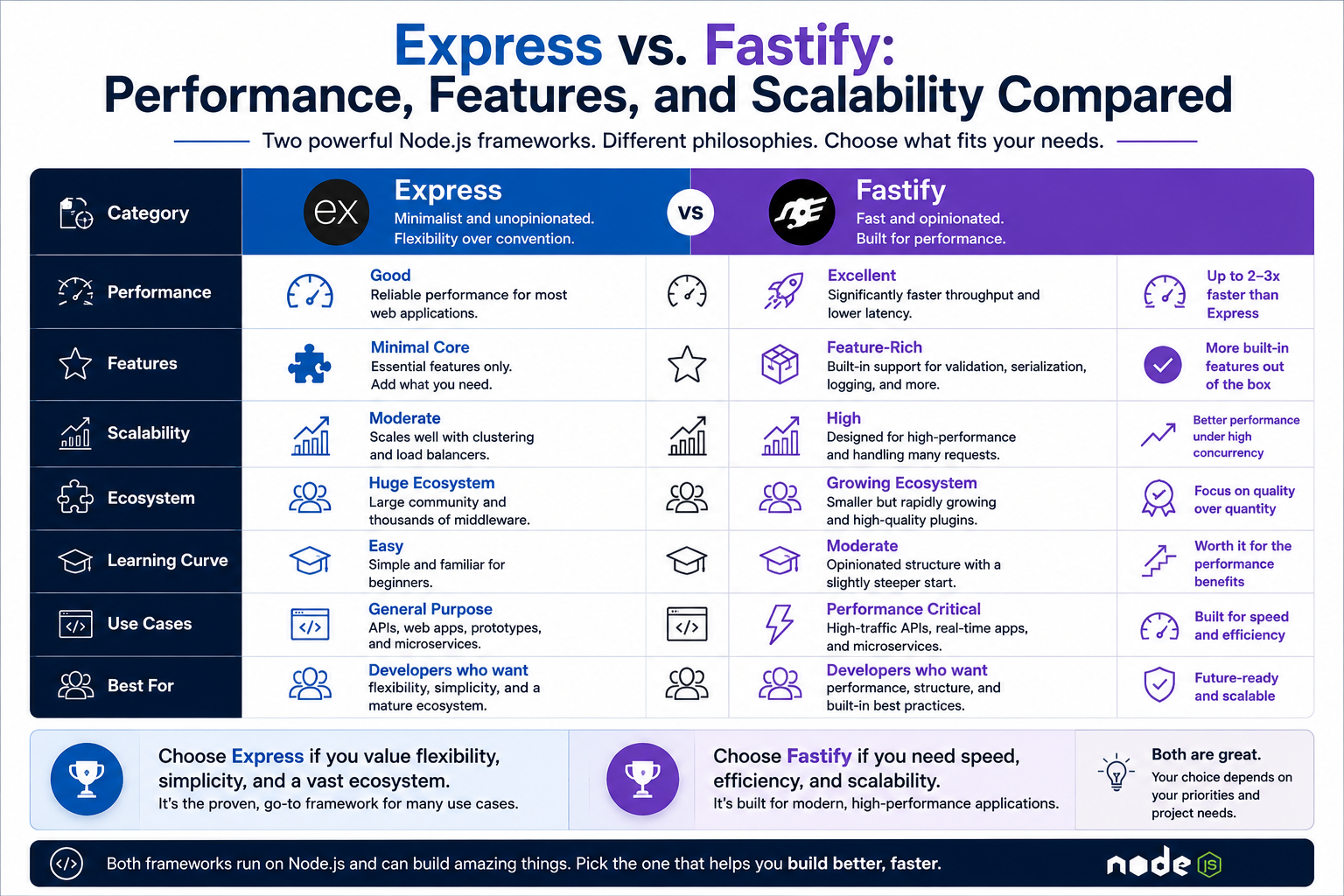
Both frameworks are designed to help developers build web applications and APIs more efficiently. However, they follow different philosophies. Express focuses on simplicity and flexibility, while Fastify emphasizes performance, scalability, and modern architecture.
Choosing the right framework is an important decision because it affects development speed, application structure, scalability, and long-term maintenance. Some developers prefer Express because it is easy to learn and has a huge ecosystem. Others prefer Fastify because of its speed and built-in optimization features.
Understanding the differences between these frameworks can help developers make smarter choices for their projects. Whether you are building a small application, a startup platform, or a large enterprise system, selecting the right framework can improve both development workflow and application performance.
This guide explores the key differences between Express and Fastify, including architecture, features, development experience, and use cases.
What Is Express?
Express is one of the oldest and most widely used frameworks in the Node.js ecosystem. It was created to simplify backend development by providing a minimal yet powerful set of tools for building web applications and APIs.
Before Express became popular, developers often had to write large amounts of boilerplate code when working with Node.js. Express solved this problem by introducing a lightweight framework that handled common backend tasks efficiently.
Express quickly became the default choice for many Node.js developers because it was simple, flexible, and easy to understand. It provided routing systems, middleware support, request handling, and integration capabilities without forcing developers into a strict architecture.
One of the biggest reasons for Express’s popularity is its minimalistic philosophy. Instead of enforcing rigid structures, Express allows developers to organize projects however they want. This flexibility makes it appealing to both beginners and experienced developers.
Express is commonly used for:
- RESTful APIs
- Backend services
- Web applications
- Authentication systems
- Server-side rendering
- Real-time applications
- Mobile application backends
The framework has been adopted by startups, enterprises, educational institutions, and independent developers worldwide.
Core Philosophy Behind Express
Express was designed around simplicity and freedom. The framework gives developers only the essential tools required for web development while allowing them to extend functionality using middleware and third-party packages.
This approach makes Express highly customizable. Developers can create small lightweight applications or large enterprise systems depending on their needs.
Unlike opinionated frameworks that force developers to follow strict patterns, Express leaves architectural decisions entirely up to the development team.
This flexibility is both a strength and a weakness. It allows maximum customization but can also lead to inconsistent project structures if teams are not careful.
Routing in Express
Routing is one of the most important features in any backend framework. It determines how applications respond to incoming client requests.
Express provides a simple and intuitive routing system that makes it easy to define endpoints for APIs and applications.
Developers can create routes for different HTTP methods such as:
- GET
- POST
- PUT
- DELETE
- PATCH
The routing system in Express is beginner-friendly and easy to understand. Developers can define routes quickly with minimal syntax.
This simplicity allows teams to build APIs rapidly and efficiently.
As applications grow, developers can organize routes into separate files and modules for better maintainability.
Middleware System in Express
Middleware is the heart of Express. Middleware functions execute during the request-response cycle and allow developers to process requests before sending responses back to clients.
Middleware can perform many tasks, including:
- Authentication
- Logging
- Error handling
- Security filtering
- Request validation
- Data parsing
- File uploads
Express middleware architecture is highly flexible. Developers can stack multiple middleware functions together to create complex workflows.
This modular approach is one of the main reasons Express became so successful. It allows developers to add functionality incrementally without changing the entire application structure.
The middleware ecosystem around Express is enormous, giving developers access to thousands of ready-made tools.
Why Developers Love Express
Express has remained popular for many years because it provides several major benefits that appeal to developers of all experience levels.
One major advantage is simplicity. Developers can create functional applications with relatively little code.
Another advantage is flexibility. Teams can organize projects however they prefer without being restricted by framework conventions.
The huge ecosystem surrounding Express is another important factor. Thousands of middleware packages are available for solving common development challenges.
Express also has excellent community support. Since millions of developers use it worldwide, finding tutorials, documentation, and troubleshooting resources is easy.
Many developers appreciate Express because it works well for both small projects and large-scale systems.
Learning Curve of Express
Express is widely considered one of the easiest backend frameworks to learn.
New developers can start building APIs after understanding only a few basic concepts:
- Routing
- Middleware
- Request handling
- Response handling
The framework avoids unnecessary complexity, making it approachable even for developers with limited backend experience.
Many educational courses and tutorials use Express because of its beginner-friendly design.
The simplicity of Express allows developers to focus on understanding backend logic rather than learning complicated framework structures.
This ease of learning is one of the reasons Express continues to attract new developers every year.
Flexibility and Customization in Express
One of Express’s defining characteristics is its flexibility.
Developers are free to:
- Choose their own folder structure
- Select preferred databases
- Integrate custom authentication systems
- Use any templating engine
- Implement their own architecture patterns
This freedom allows teams to tailor applications according to their specific requirements.
For experienced developers, this level of control can be extremely valuable.
However, excessive flexibility can sometimes create inconsistent codebases, especially in large teams without established standards.
Proper planning and architectural discipline are important when building large Express applications.
Express Ecosystem and Community
The Express ecosystem is one of the largest in the Node.js world.
Because Express has existed for many years, developers have built thousands of libraries, plugins, and middleware packages that integrate seamlessly with it.
Popular middleware solutions include tools for:
- Security
- Authentication
- Validation
- Logging
- Compression
- File handling
- Session management
This extensive ecosystem saves developers significant time because they rarely need to build features from scratch.
The Express community is also massive. Developers can find:
- Tutorials
- Open-source projects
- Online courses
- Documentation
- Community forums
- Example applications
Strong community support makes development easier and reduces troubleshooting time.
Performance Characteristics of Express
Express performs well for many types of applications, especially small and medium-sized systems.
However, performance was not the framework’s primary design goal.
Because Express relies heavily on middleware chains, additional overhead can occur during request processing.
As applications grow and middleware stacks become larger, performance may decrease.
Compared to modern high-performance frameworks like Fastify, Express handles fewer requests per second and uses more memory under heavy traffic loads.
Despite these limitations, Express remains suitable for many real-world applications because performance bottlenecks often depend more on architecture and database optimization than framework choice alone.
Scalability with Express
Express can scale successfully, but achieving high scalability often requires additional optimization and infrastructure planning.
Developers commonly use techniques such as:
- Load balancing
- Clustering
- Caching
- Database optimization
- Reverse proxies
Large companies have successfully scaled Express applications to support millions of users.
However, developers usually need more manual optimization compared to frameworks designed specifically for high throughput.
Express provides flexibility, but scalability requires careful engineering decisions.
Security in Express Applications
Express itself includes only minimal built-in security features.
Developers typically rely on middleware packages to secure applications against common vulnerabilities.
Security middleware can help protect applications from:
- Cross-site scripting attacks
- SQL injection
- Cross-site request forgery
- HTTP header vulnerabilities
- Session hijacking
Popular security tools are commonly integrated into Express applications to strengthen protection.
Developers must take responsibility for configuring security correctly because Express intentionally keeps its core lightweight.
This approach provides flexibility but also increases developer responsibility.
Error Handling in Express
Error handling is another important aspect of backend development.
Express allows developers to define custom error-handling middleware that captures exceptions and returns appropriate responses.
This approach provides flexibility and control over application behavior.
However, developers need to manually structure robust error-handling systems.
Without proper planning, error management can become inconsistent in large applications.
Modern frameworks often provide more advanced built-in error handling compared to Express.
Still, experienced developers appreciate the ability to customize every aspect of error management.
Use Cases Where Express Excels
Express works especially well for:
- Small and medium APIs
- Educational projects
- MVP development
- Startup applications
- Simple backend services
- Rapid prototyping
- Lightweight web applications
Its simplicity and flexibility allow developers to move quickly during early development stages.
Teams that value customization and ecosystem maturity often prefer Express.
It is also ideal for developers learning backend development for the first time.
Challenges Developers Face with Express
Although Express is highly popular, developers may encounter challenges as projects grow.
One common issue is middleware complexity. Large applications with many middleware layers can become difficult to maintain.
Another challenge is dependency management. Because Express relies heavily on third-party packages, applications may accumulate numerous dependencies.
This can increase:
- Security risks
- Maintenance complexity
- Version conflicts
- Technical debt
Performance optimization can also become challenging for high-traffic systems.
Developers often need additional engineering effort to achieve maximum scalability.
Despite these challenges, many teams continue using Express successfully because of its flexibility and mature ecosystem.
The Lasting Popularity of Express
Even with the rise of newer frameworks, Express remains one of the most widely used backend frameworks in the world.
Its popularity continues because it offers:
- Simplicity
- Reliability
- Flexibility
- Community support
- Extensive tooling
- Proven stability
Many organizations continue building new applications with Express because developers already understand it well and the ecosystem is extremely mature.
Express may not always be the fastest framework, but its balance of simplicity and flexibility keeps it highly relevant in modern development.
For many developers, Express remains the default starting point for Node.js backend development.
Introduction to Fastify
Fastify is a modern web framework built specifically for Node.js applications that require high performance, scalability, and efficient resource usage. While many backend frameworks focus mainly on flexibility and ease of use, Fastify was designed with speed as its primary goal.
The creators of Fastify wanted to address performance limitations commonly found in traditional Node.js frameworks. As web applications became more demanding and traffic-heavy, developers needed frameworks capable of handling large numbers of requests without excessive memory usage or latency.
Fastify was introduced as a lightweight yet highly optimized framework that could deliver better throughput while maintaining a pleasant developer experience. Over time, it gained popularity among developers building APIs, microservices, enterprise applications, and cloud-native systems.
One of the key reasons Fastify stands out is its modern architecture. Unlike older frameworks that evolved gradually over many years, Fastify was designed using modern JavaScript practices from the beginning. This allowed it to include advanced optimizations and developer-friendly features directly in its core.
Today, Fastify is considered one of the fastest web frameworks in the Node.js ecosystem and continues attracting developers who prioritize performance and scalability.
Core Philosophy Behind Fastify
Fastify focuses heavily on efficiency, structure, and developer productivity. The framework aims to provide high performance without sacrificing maintainability or flexibility.
Its core philosophy centers around several principles:
- Minimal overhead
- Optimized request handling
- Modular architecture
- Developer-friendly APIs
- Scalability
- Built-in optimization
- Modern JavaScript standards
Unlike frameworks that rely heavily on external middleware for functionality, Fastify includes many important features directly in its core. This reduces dependency complexity and improves overall application consistency.
Fastify also encourages clean architecture through encapsulation and plugin-based organization. This makes large applications easier to manage over time.
Performance-Oriented Design
Performance is the defining feature of Fastify.
The framework was engineered to process requests as efficiently as possible while minimizing resource consumption. Many internal optimizations contribute to Fastify’s impressive speed.
These optimizations include:
- Efficient routing algorithms
- Optimized JSON serialization
- Low-overhead request lifecycle
- Schema-based validation
- Asynchronous processing
- Encapsulation mechanisms
As a result, Fastify consistently performs exceptionally well in benchmark tests.
In many comparisons, Fastify handles significantly more requests per second than traditional Node.js frameworks.
This makes it highly attractive for:
- High-traffic APIs
- Real-time systems
- Streaming services
- Enterprise platforms
- Cloud-native applications
- Serverless architectures
Performance optimization is deeply integrated into Fastify’s architecture rather than added later through external tools.
Request Handling in Fastify
Fastify’s request handling system is designed for maximum efficiency.
When a client sends a request, Fastify processes it using highly optimized internal mechanisms that reduce unnecessary overhead.
The framework minimizes processing layers while maintaining flexibility for developers.
Fastify also supports asynchronous request handling naturally through async/await syntax. This results in cleaner code and better handling of concurrent operations.
Its efficient request lifecycle contributes directly to lower latency and higher throughput.
This becomes especially important when applications must handle thousands of simultaneous users.
Fastify’s architecture allows applications to remain responsive even under heavy traffic conditions.
Routing System in Fastify
Fastify provides a powerful and efficient routing system for handling application endpoints.
Developers can define routes for:
- GET requests
- POST requests
- PUT requests
- DELETE requests
- PATCH requests
- OPTIONS requests
The routing syntax is clean and modern, making it easy to organize backend services.
Fastify’s router is highly optimized internally, contributing to faster request processing.
Routes can also include validation schemas, hooks, and plugins directly within their configuration.
This structured approach helps developers create maintainable APIs while improving application performance.
As applications grow, route organization remains manageable because of Fastify’s modular architecture.
Schema-Based Validation
One of Fastify’s standout features is built-in schema-based validation.
Validation is essential in backend development because applications must verify incoming data before processing it.
Fastify allows developers to define JSON schemas for:
- Request bodies
- Query parameters
- URL parameters
- Response structures
These schemas automatically validate incoming requests.
Schema validation provides several important benefits:
- Improved security
- Better data consistency
- Faster request processing
- Automatic serialization optimization
- Easier documentation generation
Unlike frameworks that require separate validation libraries, Fastify integrates validation directly into its core.
This reduces dependency complexity and improves performance.
Developers also spend less time configuring validation tools manually.
Plugin Architecture in Fastify
Fastify uses a plugin-based architecture that encourages modular application design.
Plugins in Fastify are more advanced than traditional middleware systems because they can:
- Add routes
- Extend functionality
- Register hooks
- Decorate objects
- Encapsulate logic
- Share utilities
This architecture allows developers to organize applications into isolated modules.
Encapsulation prevents plugins from interfering with each other unintentionally.
This modular structure becomes especially valuable in large applications where maintainability is critical.
Teams can develop separate features independently while keeping the application architecture clean and scalable.
The plugin system is one of Fastify’s most powerful architectural advantages.
Encapsulation in Fastify
Encapsulation is a core architectural concept in Fastify.
In many frameworks, plugins and middleware share the same global scope, which can create conflicts and maintenance challenges.
Fastify avoids this problem through encapsulation.
Each plugin operates within its own isolated context unless explicitly shared with other parts of the application.
This improves:
- Code organization
- Security
- Maintainability
- Scalability
- Team collaboration
Encapsulation allows developers to create modular systems with clear boundaries between components.
As projects grow larger, this structure helps prevent architectural chaos.
Asynchronous Development Experience
Modern backend development relies heavily on asynchronous programming.
Fastify fully embraces async/await patterns, making asynchronous code easier to read and maintain.
Developers can write cleaner logic for:
- Database operations
- API calls
- Authentication
- File processing
- External service integration
Async/await syntax reduces callback complexity and improves application readability.
Fastify’s modern asynchronous architecture aligns well with current JavaScript development standards.
This contributes to a better overall developer experience.
Built-In Serialization Optimization
Serialization is the process of converting application data into formats such as JSON before sending responses to clients.
Serialization performance can significantly affect API speed.
Fastify includes highly optimized serialization mechanisms directly in its core.
This reduces processing overhead and improves response times.
Optimized serialization contributes heavily to Fastify’s impressive benchmark results.
Applications that process large amounts of JSON data benefit substantially from these internal optimizations.
This makes Fastify especially useful for API-heavy systems.
HTTP/2 Support in Fastify
HTTP/2 is a modern web protocol designed to improve communication efficiency between servers and clients.
Many traditional frameworks require additional configuration or external packages to support HTTP/2.
Fastify includes built-in HTTP/2 support.
This simplifies development for modern applications requiring advanced networking capabilities.
HTTP/2 provides several benefits:
- Faster page loading
- Multiplexed requests
- Reduced latency
- Improved resource efficiency
- Better handling of concurrent connections
Fastify’s native support makes it easier to adopt modern web standards.
This contributes to its reputation as a future-oriented framework.
WebSocket Integration in Fastify
Real-time applications often require WebSocket support.
Fastify supports WebSocket integration through dedicated plugins.
This allows developers to build:
- Chat applications
- Real-time dashboards
- Live notifications
- Multiplayer systems
- Streaming platforms
The plugin-based integration approach keeps the framework lightweight while maintaining flexibility.
Fastify’s efficient architecture also helps maintain strong performance during real-time communication workloads.
This makes it suitable for applications requiring persistent client-server connections.
TypeScript Support in Fastify
TypeScript has become increasingly popular in backend development because it improves code reliability and maintainability.
Fastify offers strong TypeScript support directly within its ecosystem.
Compared to some older frameworks, Fastify requires less manual configuration for TypeScript integration.
This improves developer productivity and reduces setup complexity.
TypeScript support provides several benefits:
- Better code validation
- Improved tooling
- Stronger type safety
- Easier debugging
- Improved maintainability
Many enterprise development teams prefer frameworks with excellent TypeScript compatibility.
Fastify’s strong support helps attract modern development teams building large-scale systems.
Developer Experience in Fastify
Although Fastify focuses heavily on performance, it also prioritizes developer experience.
The framework provides:
- Clean APIs
- Structured architecture
- Helpful documentation
- Modern syntax
- Strong tooling support
Developers can build scalable applications while maintaining readable and maintainable codebases.
Fastify also offers excellent debugging tools and plugin ecosystems.
However, the framework introduces concepts such as encapsulation and schema validation that may initially feel unfamiliar to beginners.
Once developers understand these concepts, many find Fastify highly productive for long-term development.
Learning Curve of Fastify
Fastify has a steeper learning curve compared to Express.
Beginners may need time to understand concepts like:
- Encapsulation
- Plugin architecture
- Schema validation
- Serialization optimization
- Lifecycle hooks
Developers familiar only with simple middleware systems may initially find Fastify more structured and technical.
However, this complexity often pays off in larger applications where organization and scalability become increasingly important.
Experienced backend developers usually adapt quickly to Fastify’s architecture.
Once mastered, Fastify can significantly improve development efficiency for complex systems.
Memory Efficiency in Fastify
Efficient memory usage is another major advantage of Fastify.
The framework is optimized to consume fewer system resources during heavy workloads.
Lower memory usage allows servers to:
- Handle more concurrent users
- Reduce infrastructure costs
- Improve scalability
- Maintain stable performance
This becomes especially important in cloud environments where resource efficiency directly impacts operational expenses.
Applications with high traffic volumes benefit greatly from Fastify’s optimized memory management.
Efficient resource usage also contributes to better server stability during peak traffic conditions.
Security Features in Fastify
Security is critical for modern backend applications.
Fastify includes several built-in mechanisms that help developers create secure applications more easily.
The framework also supports additional security plugins for enhanced protection.
Security-related features may include:
- Request validation
- Schema enforcement
- Secure headers
- Input sanitization
- Authentication integration
Because validation is built into the framework, developers reduce the risk of processing unsafe input.
Fastify’s structured architecture also helps maintain secure coding practices.
Although developers still need proper security planning, Fastify provides a strong foundation for secure backend development.
Scalability Advantages of Fastify
Scalability is one of Fastify’s greatest strengths.
The framework was designed specifically for applications expected to grow over time.
Its optimized architecture allows applications to handle:
- High traffic volumes
- Concurrent users
- Real-time communication
- Microservices workloads
- Enterprise API systems
Fastify’s low overhead helps applications remain responsive under pressure.
The plugin system and encapsulation mechanisms also support large-scale application organization.
These features make Fastify highly suitable for enterprise and cloud-native environments.
As businesses scale, Fastify applications can often adapt more efficiently than less optimized frameworks.
Use Cases Where Fastify Excels
Fastify is particularly well-suited for:
- High-performance APIs
- Enterprise backend systems
- Real-time platforms
- Microservices architectures
- Streaming applications
- Financial platforms
- Cloud-native services
- Scalable SaaS products
Applications requiring maximum throughput and low latency benefit significantly from Fastify’s architecture.
Teams focused on long-term scalability and modern development practices often choose Fastify for these reasons.
The framework’s performance advantages become increasingly noticeable as traffic and application complexity grow.
Challenges Developers May Face with Fastify
Despite its advantages, Fastify is not perfect.
Developers may encounter challenges such as:
- Smaller plugin ecosystem
- More advanced concepts
- Limited beginner tutorials
- Migration complexity
- Different architectural mindset
Teams transitioning from Express may need time to adapt to Fastify’s structured development style.
Some specialized middleware solutions available for Express may not have direct Fastify equivalents.
However, Fastify’s ecosystem continues growing rapidly.
As adoption increases, community support and plugin availability continue improving.
Why Fastify Continues Gaining Popularity
Fastify’s popularity continues rising because modern applications increasingly demand:
- Better performance
- Lower latency
- Higher scalability
- Improved resource efficiency
- Modern architecture
Developers building future-ready applications often prioritize these characteristics.
Fastify’s combination of speed, structure, and developer-friendly features makes it highly attractive for modern backend development.
Although Express remains dominant in terms of historical adoption, Fastify has positioned itself as a leading framework for high-performance Node.js applications.
Its growing ecosystem and active community suggest strong long-term potential in the evolving JavaScript ecosystem.
Comparing Express and Fastify in Real-World Development
Choosing between Express and Fastify is not simply about selecting the fastest or most popular framework. The decision depends on project goals, team experience, scalability requirements, maintenance expectations, and long-term business objectives.
Both frameworks are capable of building powerful backend applications. However, they approach development differently, and these differences become more noticeable as applications grow in complexity.
Express focuses on simplicity and flexibility. It allows developers to move quickly and customize applications freely. Fastify focuses on structured architecture, high performance, and modern optimization techniques.
Understanding how these frameworks behave in real-world scenarios can help developers select the most appropriate solution for their projects.
Performance Comparison Between Express and Fastify
Performance is one of the most frequently discussed topics when comparing these frameworks.
Fastify consistently outperforms Express in benchmark tests involving request throughput, latency, and memory efficiency. This performance advantage comes from Fastify’s optimized architecture and low-overhead request lifecycle.
Fastify is capable of handling significantly more requests per second while consuming fewer system resources. This makes it highly suitable for applications that expect heavy traffic or large numbers of concurrent users.
Express performs well for many common applications, but its middleware-heavy architecture introduces additional overhead during request processing.
In small applications, the performance difference may not be noticeable. However, as traffic grows and APIs become more complex, Fastify’s optimization advantages become increasingly important.
Performance-sensitive systems such as streaming services, real-time platforms, and enterprise APIs often benefit more from Fastify’s architecture.
Memory Usage and Resource Efficiency
Resource efficiency directly affects infrastructure costs and scalability.
Fastify uses memory more efficiently than Express because of its lightweight internal mechanisms and optimized serialization process.
Lower memory consumption allows servers to handle larger workloads without requiring additional hardware resources.
This can significantly reduce operational costs in cloud environments where infrastructure expenses scale with resource usage.
Express applications may consume more memory under heavy traffic conditions, especially when many middleware packages are involved.
Although Express can still scale effectively, achieving optimal resource efficiency often requires additional tuning and engineering effort.
For organizations operating large-scale systems, Fastify’s memory efficiency can provide substantial long-term benefits.
Request Lifecycle Differences
The way frameworks process requests affects both performance and maintainability.
Express follows a middleware-chain approach where requests pass through multiple middleware functions before reaching the final response handler.
This approach is simple and flexible, but excessive middleware layers can introduce latency and complexity.
Fastify uses a more optimized request lifecycle with encapsulated plugins, lifecycle hooks, and efficient internal processing.
Its architecture reduces unnecessary overhead while maintaining flexibility for developers.
Fastify’s structured lifecycle also helps improve application consistency and maintainability in large projects.
Understanding these lifecycle differences is important when designing scalable backend systems.
Middleware vs Plugin Architecture
One of the most significant architectural differences between Express and Fastify is how they handle extensibility.
Express relies heavily on middleware.
Middleware functions are stacked together to process requests and responses. This approach is highly flexible and easy to understand.
Developers can integrate middleware for:
- Authentication
- Logging
- Validation
- Security
- File uploads
- Compression
However, as applications grow, middleware stacks can become difficult to manage.
Fastify uses a plugin-based architecture instead of relying primarily on middleware.
Plugins in Fastify are more advanced because they can encapsulate logic, extend server functionality, register hooks, and isolate features.
This modular approach improves organization and scalability.
Fastify’s plugin system encourages cleaner application architecture and reduces the risk of conflicts between components.
Large enterprise applications often benefit greatly from this structured design.
Developer Experience Comparison
Developer experience is another critical factor when choosing a backend framework.
Express provides a highly approachable and beginner-friendly experience. Developers can quickly start building APIs with minimal setup and very little learning overhead.
Its simplicity makes it popular among:
- Beginners
- Startup teams
- Rapid prototyping environments
- Educational projects
Fastify offers a more structured and modern development experience.
Although it introduces more advanced concepts, many developers appreciate its built-in optimizations, schema validation, and plugin architecture.
Fastify often feels more organized for large-scale applications.
Developers experienced with modern backend engineering practices may find Fastify more productive over time.
The best developer experience depends heavily on team expertise and project requirements.
Learning Curve Differences
Express has a lower learning curve compared to Fastify.
New developers can understand basic Express concepts relatively quickly because the framework avoids unnecessary abstraction.
Its straightforward routing and middleware system make it easy to start building APIs immediately.
Fastify requires developers to understand additional concepts such as:
- Encapsulation
- Lifecycle hooks
- Schema validation
- Plugin registration
- Serialization optimization
Beginners may initially find Fastify more technical.
However, these concepts contribute to stronger architecture and scalability in larger applications.
Experienced developers often adapt quickly to Fastify and appreciate its modern design philosophy.
The learning investment may provide long-term benefits for teams building complex systems.
TypeScript Support Comparison
TypeScript has become increasingly important in backend development because it improves code quality and maintainability.
Express supports TypeScript, but integration often requires additional configuration and external type definitions.
Developers may need to manually manage typing for middleware and custom components.
Fastify was designed with modern JavaScript practices in mind and offers stronger built-in TypeScript support.
Its architecture aligns naturally with typed development.
This provides several advantages:
- Better autocomplete
- Improved code validation
- Easier debugging
- Enhanced maintainability
- Stronger tooling integration
Development teams building enterprise-grade applications often value Fastify’s smoother TypeScript experience.
As TypeScript adoption continues growing, this advantage becomes increasingly important.
Validation and Data Handling
Data validation is essential for building secure and reliable APIs.
Express typically relies on third-party libraries for request validation.
Developers must manually integrate validation middleware into applications.
This approach offers flexibility but can increase dependency complexity and setup time.
Fastify includes schema-based validation directly in its core.
Developers can define JSON schemas for requests and responses, allowing Fastify to automatically validate incoming data.
This built-in validation improves:
- Security
- Consistency
- Performance
- Developer productivity
Schema validation also enables optimized serialization and easier documentation generation.
Fastify’s integrated validation system is one of its strongest architectural advantages.
Security Comparison
Security is a critical concern in backend development.
Express provides minimal built-in security features and relies heavily on middleware packages for protection.
Developers commonly integrate additional tools to secure applications against vulnerabilities such as:
- Cross-site scripting
- Injection attacks
- Session hijacking
- Malicious headers
This flexibility allows customized security setups but increases developer responsibility.
Fastify includes several built-in protections and supports additional security plugins.
Its schema validation system also helps reduce risks associated with unsafe input handling.
Although both frameworks can be secured effectively, Fastify’s structured architecture provides a stronger security foundation by default.
Proper security practices remain essential regardless of framework choice.
Scalability in Enterprise Applications
Scalability becomes increasingly important as applications grow.
Express can scale successfully, but large systems often require additional optimization strategies such as:
- Clustering
- Load balancing
- Reverse proxies
- Caching systems
- Performance tuning
Many enterprise companies use Express successfully, but scalability requires careful engineering.
Fastify was specifically designed with scalability in mind.
Its low overhead, efficient request processing, and modular architecture allow applications to scale more naturally.
Fastify performs exceptionally well in:
- High-throughput environments
- Cloud-native architectures
- Microservices systems
- Distributed applications
Organizations expecting rapid growth often prefer Fastify because of these scalability advantages.
Microservices Development
Microservices architecture has become increasingly popular in modern backend engineering.
Microservices divide applications into smaller independent services that communicate through APIs.
Fastify is particularly well-suited for microservices because of its lightweight and modular architecture.
Its performance optimization and encapsulation mechanisms help teams manage distributed systems more efficiently.
Express can also support microservices architectures, but developers may need additional optimization and organizational discipline.
Fastify’s plugin system and structured lifecycle make it especially attractive for service-oriented architectures.
Many modern cloud applications benefit from Fastify’s efficiency in microservices environments.
Real-Time Application Support
Real-time applications require fast communication between servers and clients.
Examples include:
- Chat systems
- Gaming platforms
- Live dashboards
- Streaming services
- Notification systems
Express supports real-time functionality through WebSocket libraries and external integrations.
Fastify also supports real-time communication through plugins while maintaining strong performance characteristics.
Because Fastify handles concurrent connections efficiently, it often performs better in demanding real-time environments.
Applications requiring low latency and high concurrency may benefit substantially from Fastify’s architecture.
Community and Ecosystem Comparison
Express has one of the largest ecosystems in Node.js development.
Its long history has resulted in:
- Massive community support
- Extensive documentation
- Thousands of middleware packages
- Countless tutorials
- Mature integrations
Developers can usually find solutions quickly for almost any challenge.
Fastify’s ecosystem is smaller but growing rapidly.
Although it has fewer plugins than Express, many Fastify plugins are highly optimized and well-maintained.
The Fastify community is active and focused heavily on performance and modern backend engineering.
Express currently maintains an advantage in ecosystem maturity, but Fastify continues expanding steadily.
Maintenance and Long-Term Stability
Long-term maintainability is essential for enterprise applications.
Express’s flexibility allows custom architecture, but large applications can become difficult to manage without strict standards.
Middleware sprawl and inconsistent project organization may create technical debt over time.
Fastify’s structured plugin architecture encourages cleaner and more maintainable codebases.
Encapsulation helps isolate components and reduces unintended interactions between modules.
This architectural discipline can improve long-term project stability.
Fastify’s emphasis on modularity and organization often benefits large teams working on complex systems.
Future Outlook of Express
Express remains one of the most widely used backend frameworks in the world.
Its simplicity, stability, and massive ecosystem ensure continued relevance for many years.
The framework continues receiving updates and maintenance, although development tends to prioritize stability over rapid innovation.
Express will likely remain popular among:
- Beginners
- Educational platforms
- Startups
- Traditional backend systems
- Rapid development teams
Its mature ecosystem and strong community provide long-term reliability.
Even as newer frameworks emerge, Express’s influence within Node.js development remains extremely significant.
Future Outlook of Fastify
Fastify continues gaining momentum as developers increasingly prioritize performance and scalability.
Modern backend engineering trends favor:
- Efficient architectures
- Cloud-native systems
- Microservices
- TypeScript adoption
- Low-latency APIs
Fastify aligns strongly with these trends.
Its active development community continues introducing new optimizations and features.
As high-performance applications become more common, Fastify is likely to experience continued growth and adoption.
Many developers view Fastify as one of the most promising modern frameworks in the Node.js ecosystem.
When to Choose Express
Express is an excellent choice when:
- Simplicity is important
- Rapid development is required
- Teams are beginner-friendly
- Extensive middleware support is needed
- Flexibility matters more than maximum performance
- Existing projects already use Express
- Quick prototyping is a priority
Its mature ecosystem and low learning curve make it highly practical for many real-world projects.
Small and medium-sized applications often perform perfectly well with Express.
When to Choose Fastify
Fastify is an excellent choice when:
- Performance is critical
- Scalability is a major concern
- Applications expect heavy traffic
- TypeScript integration is important
- Structured architecture is preferred
- Modern optimization features are required
- Long-term scalability is a priority
Organizations building enterprise-grade APIs and cloud-native systems often benefit greatly from Fastify’s strengths.
Its modern architecture positions it well for future backend development trends.
Common Misconceptions About Express and Fastify
Some developers incorrectly assume that Fastify completely replaces Express.
In reality, both frameworks serve different needs.
Express remains highly effective for many types of applications.
Another misconception is that performance benchmarks alone determine the best framework.
Real-world application performance also depends on:
- Database optimization
- Infrastructure
- Caching strategies
- Query efficiency
- Application architecture
Framework selection is important, but it is only one part of backend engineering.
Developers should evaluate project goals carefully rather than focusing only on raw benchmark numbers.
Balancing Simplicity and Performance
The comparison between Express and Fastify ultimately reflects a balance between simplicity and optimization.
Express prioritizes developer freedom and ease of use.
Fastify prioritizes efficiency and structured scalability.
Neither philosophy is universally better.
The ideal choice depends on:
- Team experience
- Project complexity
- Traffic expectations
- Development speed requirements
- Long-term maintenance goals
Understanding these trade-offs helps developers make informed technical decisions.
Conclusion
Express and Fastify are both powerful Node.js frameworks capable of building modern backend applications, APIs, and scalable services. However, they approach backend development from very different perspectives.
Express remains one of the most beginner-friendly and flexible frameworks in the Node.js ecosystem. Its simplicity, mature ecosystem, and massive community support make it an excellent choice for rapid development, educational projects, startups, and applications where customization matters more than maximum performance.
Fastify represents a newer generation of backend frameworks focused on performance, scalability, and modern architecture. Its optimized request handling, plugin-based design, built-in validation, strong TypeScript support, and efficient resource usage make it highly suitable for enterprise systems, microservices, cloud-native platforms, and high-traffic APIs.
There is no universal winner between Express and Fastify because the best framework depends entirely on project requirements and development priorities.
Developers seeking simplicity, flexibility, and broad ecosystem support may prefer Express.
Developers prioritizing speed, scalability, modern architecture, and long-term optimization may find Fastify more suitable.
Both frameworks continue evolving and contributing significantly to the Node.js ecosystem. Understanding their strengths and limitations allows development teams to choose the right tool for building reliable, scalable, and future-ready applications.