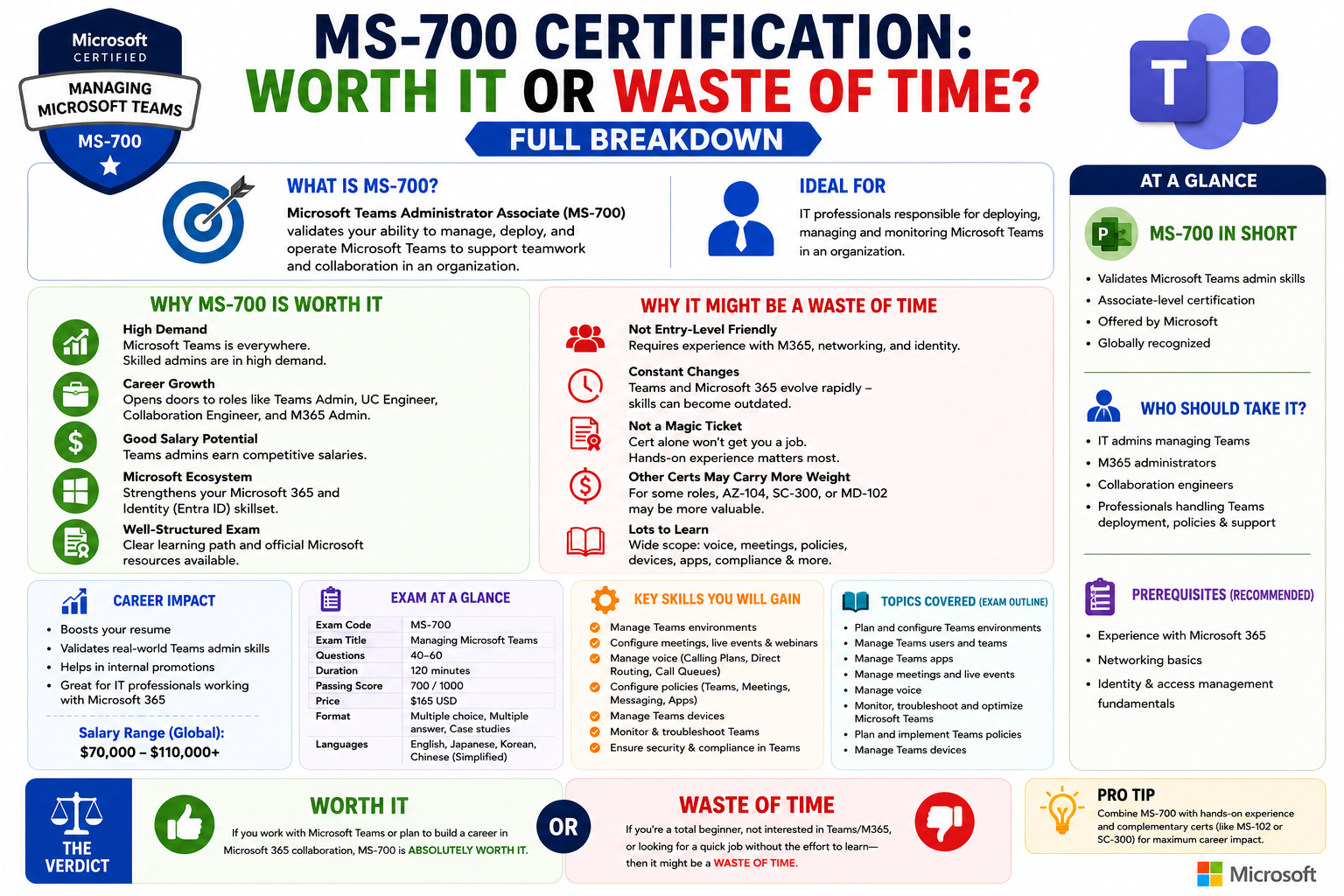
The MS-700 certification, officially known as the Microsoft Teams Administrator Associate certification, has gained significant attention among IT professionals looking to specialize in collaboration tools and modern workplace technologies. As organizations increasingly rely on remote work and digital communication platforms, the demand for skilled professionals who can manage, configure, and optimize collaboration environments continues to grow. However, a common question remains: is the MS-700 certification truly worth the effort, or is it just another credential that adds little real value?
Understanding the true worth of this certification requires a deeper look into its relevance, career impact, learning outcomes, and long-term benefits. It is not simply about passing an exam, but about whether the knowledge gained aligns with current industry demands and future opportunities.
Understanding the Purpose of MS-700 Certification
The MS-700 certification focuses on managing Microsoft Teams environments. It covers essential areas such as configuring Teams settings, managing meetings and calling features, deploying collaboration tools, and ensuring security and compliance. At its core, the certification is designed for professionals responsible for maintaining collaboration infrastructure within organizations.
In today’s digital-first environment, collaboration platforms are no longer optional. Businesses depend heavily on seamless communication between teams, departments, and even across countries. This makes the role of a Teams administrator highly relevant. The certification validates that a candidate has the technical skills to manage such environments effectively.
Why MS-700 Is Gaining Popularity
One of the primary reasons for the rising popularity of the MS-700 certification is the global shift toward hybrid and remote work models. Organizations need reliable collaboration systems, and Microsoft Teams has become a central tool in many workplaces. As a result, companies actively seek professionals who understand how to manage and optimize these systems.
Another reason is the integration of Teams with other Microsoft services. This creates a broader ecosystem where administrators are not just managing a single tool but are working within a larger cloud-based environment. This increases the importance of having certified professionals who understand how these systems connect and function together.
Career Opportunities After MS-700
Earning the MS-700 certification can open doors to various job roles. These include Teams Administrator, Collaboration Engineer, Unified Communications Specialist, and even roles within cloud administration. While it may not instantly guarantee a job, it certainly strengthens a candidate’s profile.
Employers often look for certifications as proof of expertise, especially when hiring for technical roles. Having MS-700 on a resume signals that the candidate has a structured understanding of Teams administration and can handle real-world tasks related to collaboration tools.
However, it is important to remain realistic. The certification alone is not enough. Practical experience, problem-solving ability, and understanding of real-world scenarios are equally important. Without these, the certification may not deliver the expected career benefits.
Skills You Gain from MS-700
Preparing for the MS-700 exam helps develop several valuable skills. These include managing Teams architecture, configuring policies, handling user settings, and troubleshooting communication issues. Candidates also learn about security, compliance, and governance within Teams environments.
These skills are not limited to one platform. Many concepts learned during preparation can be applied to other collaboration tools and cloud services. This makes the certification more versatile than it may initially appear.
Additionally, the certification encourages a structured approach to problem-solving. Instead of relying on guesswork, certified professionals are trained to follow best practices and use proper configurations to achieve desired outcomes.
The Cost vs Value Debate
One of the biggest concerns for many candidates is whether the certification is worth the cost. This includes not only the exam fee but also the time and effort required for preparation. For individuals already working in IT, the investment may seem manageable. However, for beginners, it can feel like a significant commitment.
The value of the certification largely depends on how it is used. If it is pursued as part of a broader career strategy, it can offer strong returns. On the other hand, if it is taken without clear goals, it may not provide much benefit.
It is also worth considering that certifications are often stepping stones rather than final destinations. The MS-700 can serve as a foundation for more advanced certifications and roles in cloud computing and enterprise administration.
Challenges of MS-700 Certification
Like any technical certification, MS-700 comes with its own set of challenges. The exam requires a solid understanding of both theoretical concepts and practical implementation. Candidates must be familiar with real-world scenarios and know how to apply their knowledge effectively.
Another challenge is keeping up with updates. Technology evolves rapidly, and Microsoft frequently updates its platforms. This means that professionals must continue learning even after earning the certification. Without ongoing learning, the knowledge gained can quickly become outdated.
Additionally, some candidates may find the exam difficult if they lack hands-on experience. Simply studying theoretical material is often not enough. Practical exposure to Teams environments is crucial for success.
Is MS-700 Suitable for Beginners
The MS-700 certification is not strictly limited to experienced professionals, but it may not be the best starting point for complete beginners. Those with basic knowledge of IT, networking, and cloud concepts will find it easier to understand the material.
Beginners can still pursue the certification, but they should be prepared to invest extra time in learning foundational concepts. Without this foundation, the topics covered in the exam may feel overwhelming.
For those new to IT, it might be more effective to start with fundamental certifications before moving on to MS-700. This approach ensures a smoother learning curve and better understanding of advanced topics.
Real-World Relevance of MS-700
One of the strongest arguments in favor of the MS-700 certification is its real-world relevance. The skills learned are directly applicable to everyday tasks in many organizations. From setting up meetings to managing user permissions, certified professionals handle tasks that impact daily operations.
This practical relevance makes the certification more valuable than those that focus solely on theory. Employers appreciate candidates who can contribute immediately without requiring extensive training.
However, the level of relevance may vary depending on the organization. Companies that rely heavily on Microsoft Teams will value this certification more than those using alternative platforms.
Salary Impact and Growth Potential
While salaries depend on multiple factors such as experience, location, and job role, certifications like MS-700 can positively influence earning potential. They demonstrate expertise and commitment to professional development, which can lead to better job opportunities and salary negotiations.
That said, it is important not to expect immediate financial rewards. Certifications contribute to long-term growth rather than instant gains. Over time, as experience increases and additional skills are acquired, the benefits become more noticeable.
When MS-700 Might Not Be Worth It
Despite its advantages, the MS-700 certification is not for everyone. If your career path does not involve collaboration tools or cloud-based communication systems, the certification may have limited value.
Similarly, if you already have extensive experience managing Teams environments, the certification might not add significant new knowledge. In such cases, pursuing more advanced certifications could be a better option.
Another scenario where it may not be worth it is when it is pursued without a clear goal. Certifications should align with career objectives. Without this alignment, the effort may not yield meaningful results.
Conclusion
The MS-700 certification is neither a guaranteed success tool nor a waste of time. Its value depends entirely on how it fits into your career path and how effectively you use the knowledge gained. For professionals working with collaboration tools or aiming to specialize in Microsoft Teams administration, it can be a valuable asset that enhances skills and improves job prospects.
However, it is not a shortcut to success. Real-world experience, continuous learning, and practical application are essential to fully benefit from the certification. When approached with the right mindset and clear goals, MS-700 can be a worthwhile investment that supports long-term career growth.