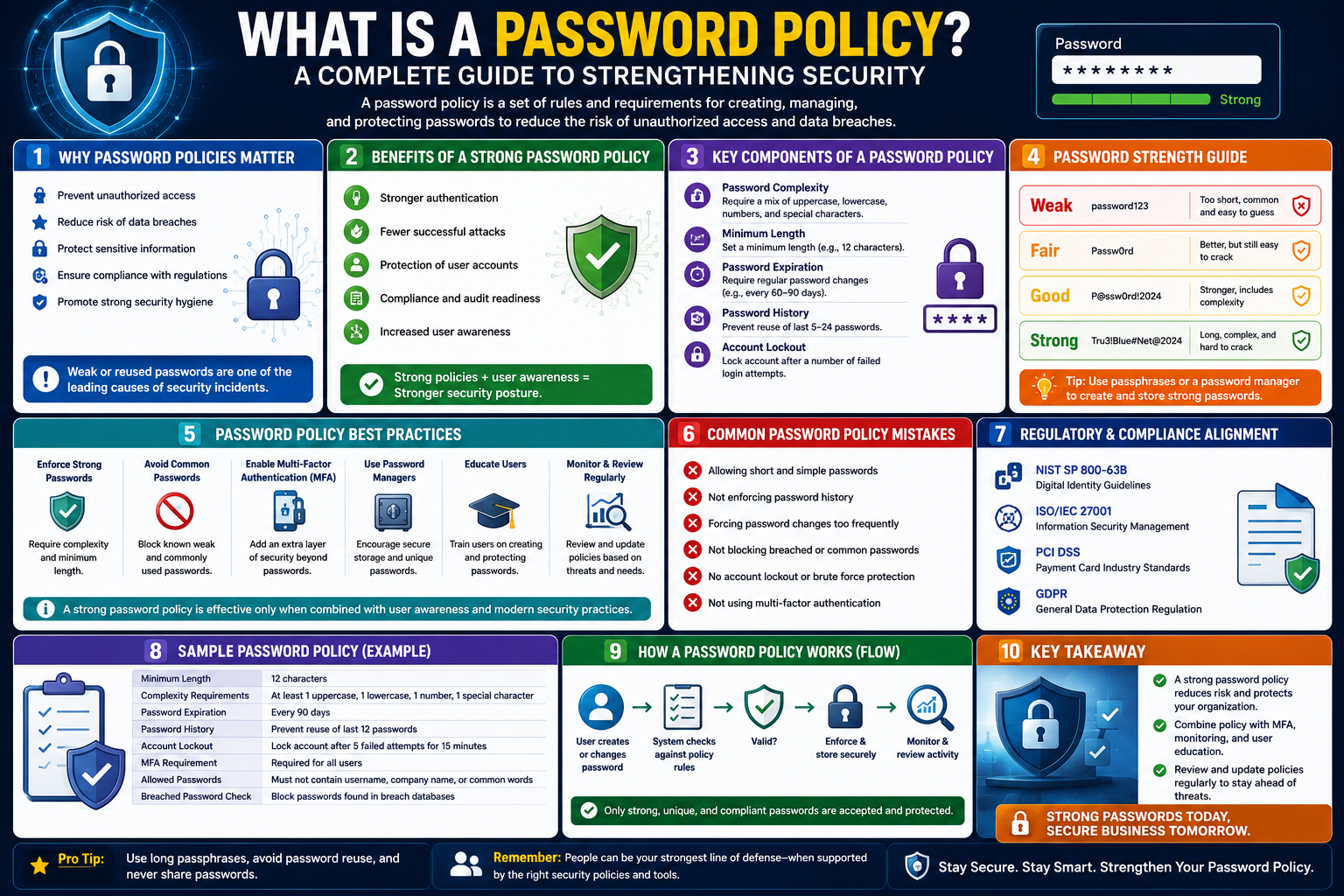
In today’s digital world, almost every online activity requires authentication, most commonly through passwords. From email accounts and social media profiles to corporate systems and financial platforms, passwords act as the first layer of protection against unauthorized access. However, weak or poorly managed passwords can easily become a gateway for cyberattacks. This is where a password policy becomes essential.
A password policy is a structured set of rules that defines how passwords should be created, managed, stored, and updated. Its purpose is to ensure that users follow secure practices when choosing passwords so that sensitive data remains protected. Instead of leaving security to chance, organizations use password policies to enforce consistency, strengthen defenses, and reduce the risk of breaches.
What is a Password Policy?
A password policy is a security framework that sets specific requirements for password creation and maintenance. These requirements typically include rules about password length, complexity, expiration, and usage.
The main goal of a password policy is to ensure that passwords are strong enough to resist attacks while still being manageable for users. Without such policies, users often choose simple or predictable passwords, making systems vulnerable to hacking attempts.
A well-designed password policy also encourages users to create unique credentials for different accounts, reducing the risk of widespread damage if one password is compromised. In essence, it serves as a protective structure that strengthens authentication systems and supports overall cybersecurity.
Importance of Password Policies
Password policies play a crucial role in maintaining digital security. They are not just technical requirements but essential safeguards against modern cyber threats.
One of the primary reasons password policies are important is their ability to reduce security risks. Weak passwords are often the easiest entry point for attackers. By enforcing strict rules, organizations can significantly reduce the chances of unauthorized access.
Another key reason is protection against common cyberattacks. Hackers use various methods such as brute-force attacks, where they attempt thousands of password combinations, or dictionary attacks, where they try commonly used words. A strong password policy makes these attacks much less effective by requiring complex and unpredictable passwords.
Password policies also help organizations maintain compliance with legal and industry standards. Many regulations require businesses to implement proper security measures to protect user data. Following a password policy ensures compliance and helps avoid penalties or reputational damage.
In addition, these policies improve overall system resilience. When combined with other security measures such as multi-factor authentication, they create multiple layers of defense that make it harder for attackers to succeed.
Key Components of a Strong Password Policy
A strong password policy is built on several important elements that work together to enhance security.
Password Complexity Requirements
Complexity is one of the most important aspects of a password policy. Users are encouraged or required to include a mix of uppercase letters, lowercase letters, numbers, and special symbols. This makes passwords harder to guess or crack using automated tools. Simple passwords like names or common words are discouraged because they are easier for attackers to predict.
Password Length Requirements
Longer passwords provide stronger protection. A good password policy usually sets a minimum length requirement, often between 8 and 12 characters or more. The longer the password, the more difficult it becomes for attackers to break it through brute-force methods. Length adds a significant layer of security even if complexity is moderate.
Password Expiration and Updates
Regular password changes are another important feature of a password policy. Users are required to update their passwords periodically. This reduces the risk of long-term exposure if a password has been compromised without the user’s knowledge. Even if an attacker gains access to an old password, it becomes useless after a reset.
Multi-Factor Authentication (MFA)
Multi-factor authentication adds an extra layer of protection beyond just a password. It requires users to verify their identity using an additional method, such as a code sent to a mobile device or a biometric scan. Even if a password is stolen, MFA can prevent unauthorized access by requiring a second form of verification.
Account Lockout Policies
Account lockout mechanisms protect systems from repeated failed login attempts. If a user enters the wrong password multiple times, the account is temporarily locked. This prevents attackers from continuously guessing passwords and helps detect suspicious activity.
Secure Password Storage and Encryption
A strong password policy ensures that passwords are not stored in plain text. Instead, they are encrypted or hashed so that even if data is exposed, the actual passwords remain unreadable. Secure storage methods are essential for protecting user credentials from internal and external threats.
How to Create an Effective Password Policy
Designing an effective password policy requires careful planning and consideration of both security and usability.
Assess Organizational Needs and Risks
Every organization has different security requirements. A financial institution may require stricter password rules compared to a small business. Understanding the level of risk, type of data handled, and user base helps in designing a suitable policy.
Customize Rules Based on User Roles
Not all users need the same level of access or security restrictions. High-level administrative accounts often require stronger passwords and more frequent updates compared to standard user accounts. Customizing policies based on roles ensures better security without unnecessary restrictions for all users.
Balance Security with Usability
A password policy should be strong but not overly complicated. If rules are too strict, users may struggle to remember their passwords or resort to unsafe practices like writing them down. A balanced approach ensures that security does not negatively impact productivity or user experience.
Educate Users on Safe Practices
User awareness is a key part of any password policy. Even the strongest rules can fail if users do not understand them. Training and awareness programs help users learn how to create strong passwords, avoid common mistakes, and recognize security threats. Educated users are more likely to follow best practices consistently.
How to Implement and Enforce a Password Policy
Once a password policy is designed, it must be properly implemented and enforced to be effective.
Clear Deployment Strategy
Introducing a new password policy should be done in a structured way. Users should be informed about the changes in advance and guided on how to comply with new requirements. A smooth rollout reduces confusion and resistance.
Integration with Security Systems
Password policies should be integrated with identity management systems so that enforcement is automated. This includes features like automatic password resets, login tracking, and account lockouts. Automation reduces human error and ensures consistency. It also helps organizations respond quickly to security incidents without waiting for manual intervention. When a user forgets a password or their account is compromised, automated systems can trigger secure recovery processes that verify identity before granting access again. This reduces downtime and improves user experience.
In addition, automated identity systems can apply security rules uniformly across all users, ensuring that no account is left unprotected due to oversight. They can also generate real-time alerts when suspicious login attempts are detected, allowing security teams to act immediately. Over time, automation helps organizations maintain a stronger security posture by continuously enforcing policies, adapting to risks, and reducing administrative workload while maintaining high reliability and control over access management.
Monitoring and Security Audits
Regular monitoring helps ensure that the password policy is working effectively. System logs can be analyzed to detect unusual login patterns or repeated failed attempts. Security audits help identify weaknesses and improve the policy over time. This continuous observation allows organizations to stay ahead of potential threats before they escalate into serious security incidents. It also helps verify whether users are following the defined password rules correctly or trying to bypass them.
Furthermore, monitoring provides valuable insights into user behavior and system performance, which can be used to refine security strategies. It supports faster incident response by enabling administrators to quickly trace suspicious activities back to their source. Over time, consistent monitoring strengthens the overall security framework by ensuring that policies remain relevant, effective, and aligned with evolving cyber risks.
Regular Updates and Improvements
Cybersecurity threats evolve continuously, and password policies must adapt accordingly. Regular reviews ensure that policies remain effective against new attack methods. Updating rules based on emerging threats helps maintain strong protection. This process also ensures that organizations are not relying on outdated security practices that may no longer provide adequate defense. As attackers develop more advanced techniques, such as automated credential stuffing and AI-driven password guessing, password policies must become more dynamic and responsive.
In addition, periodic updates allow organizations to incorporate new security technologies and best practices into their systems. It also helps align password rules with current compliance requirements and industry standards. By continuously improving the policy, organizations can reduce vulnerabilities, strengthen authentication systems, and maintain a proactive security posture against constantly changing cyber risks.
Conclusion
A password policy is a fundamental component of modern cybersecurity. It establishes clear rules for creating and managing passwords, ensuring that digital systems remain protected from unauthorized access. By enforcing complexity, length, expiration, and additional security measures such as multi-factor authentication, organizations can significantly reduce the risk of cyberattacks.
However, an effective password policy is not just about strict rules. It also requires a balance between security and usability, along with proper user education and continuous monitoring. When properly designed and enforced, a password policy becomes a powerful defense mechanism that protects sensitive data, strengthens system integrity, and supports overall digital security in an increasingly connected world.