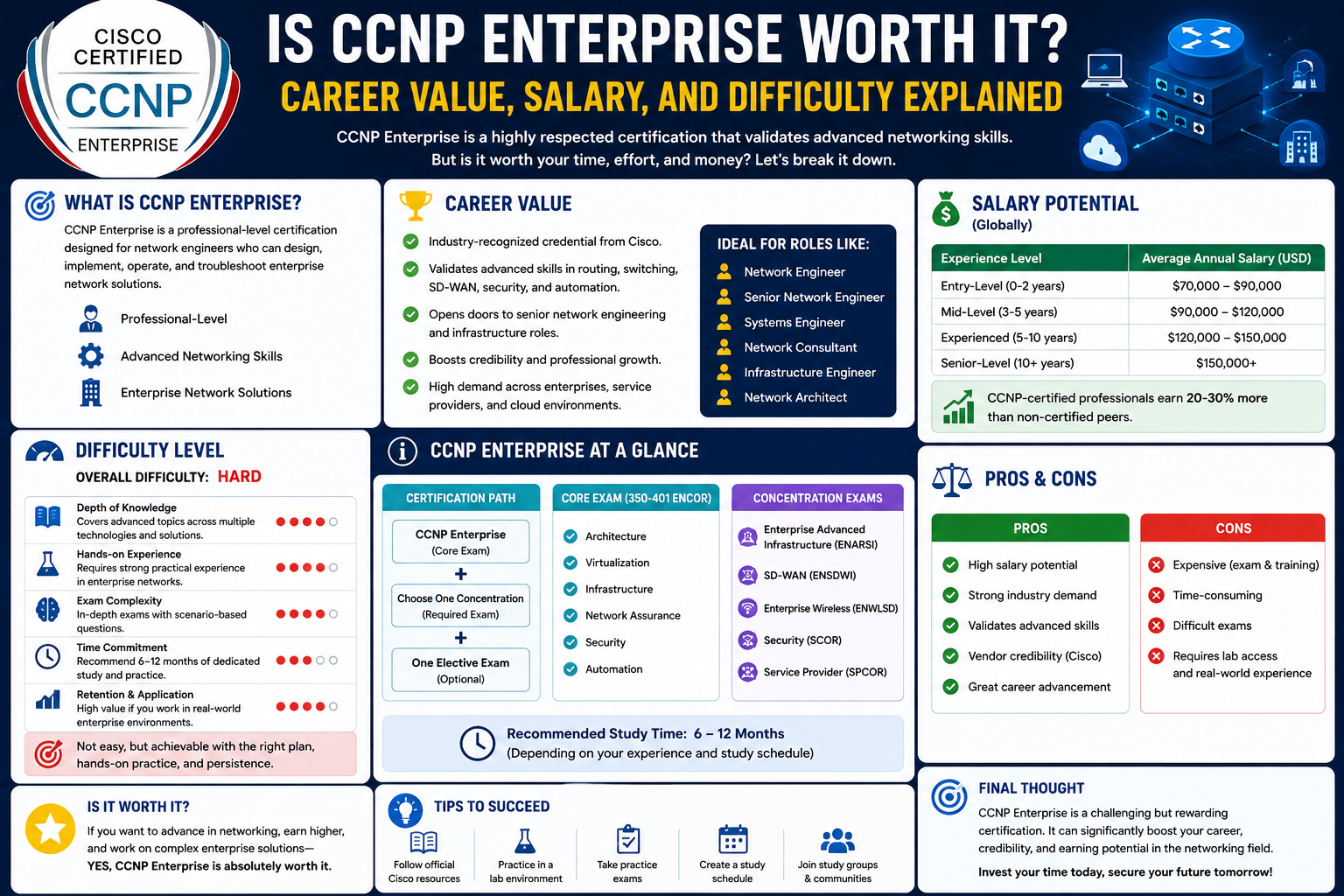
The CCNP Enterprise certification is one of the most respected qualifications in the networking industry. It is designed for IT professionals who already have foundational networking knowledge and want to advance into more specialized and higher-paying roles. Over time, Cisco has updated this certification to reflect modern networking demands such as automation, cloud connectivity, wireless systems, and advanced routing.
Today, organizations rely heavily on complex enterprise networks, and professionals who can design, implement, and troubleshoot these systems are in high demand. This makes the CCNP Enterprise an important milestone for anyone building a long-term career in networking. But the real question remains whether investing time, effort, and money into this certification is actually worth it.
Understanding the CCNP Enterprise Certification
The CCNP Enterprise certification is a professional-level credential that validates a candidate’s ability to work with enterprise networking solutions. It is structured to ensure that professionals have both broad networking knowledge and specialized skills in a chosen area.
To earn this certification, candidates must pass a core exam along with one concentration exam. The core exam focuses on fundamental enterprise networking topics, while the concentration exam allows candidates to specialize in a particular domain such as routing, wireless, automation, or network design.
This structure reflects the modern IT landscape, where professionals are no longer expected to master every single technology but instead build deep expertise in specific areas.
Core Exam Overview
The core exam is the foundation of the CCNP Enterprise certification. It evaluates knowledge across key areas of enterprise networking, including architecture, virtualization, infrastructure, security, automation, and network assurance.
A significant portion of the exam focuses on infrastructure and security, which highlights their importance in real-world enterprise environments. Candidates are expected to understand both IPv4 and IPv6 networks, routing protocols, and network security principles.
Another important component is automation, which reflects the growing trend of software-driven networking. Professionals are expected to have at least a basic understanding of how automation tools and APIs are used in modern network management.
Overall, the core exam ensures that all certified professionals share a strong baseline understanding of enterprise networking principles.
Concentration Exams and Specialization Paths
After passing the core exam, candidates must choose one specialization exam. This is where the CCNP Enterprise becomes highly flexible, allowing professionals to align their certification with their career goals.
Each specialization focuses on a different area of networking:
One option focuses on advanced routing and infrastructure, which is ideal for professionals who work heavily with network design and troubleshooting. This path dives deep into Layer 3 technologies, VPNs, and infrastructure services.
Another option focuses on SD-WAN solutions, which is important for organizations adopting modern wide-area network technologies. This specialization covers controller-based architecture, policy management, and secure connectivity.
There is also a design-focused track that emphasizes enterprise network planning. This includes campus network design, WAN architecture, and addressing strategies.
Wireless networking is another major specialization area. One path focuses on designing wireless networks, including site surveys and mobility planning, while another focuses on implementing wireless systems with features like security, monitoring, and performance optimization.
For professionals interested in automation, there is a specialization that covers programming concepts, APIs, and automation tools used in enterprise environments. This reflects the shift toward infrastructure as code and software-defined networking.
Cloud connectivity is another important specialization, focusing on hybrid and multi-cloud environments. This includes secure integration between enterprise networks and cloud platforms.
Finally, there is a specialization focused on network assurance, which emphasizes monitoring, analytics, and proactive troubleshooting using modern tools and AI-driven insights.
This wide range of options allows professionals to shape their certification around their job role and future career direction.
Skills You Gain from CCNP Enterprise
One of the biggest advantages of pursuing this certification is the practical knowledge it provides. Candidates gain hands-on understanding of complex networking concepts that are directly applicable in real-world environments.
You develop strong skills in routing and switching, including advanced protocols and network troubleshooting techniques. You also learn how enterprise networks are designed for scalability and reliability.
Security is another key area, helping professionals understand how to protect networks from threats and vulnerabilities. This includes securing infrastructure and managing access controls.
Automation skills are becoming increasingly important, and this certification introduces candidates to programming concepts and network automation tools. Even basic exposure to these concepts can significantly improve job opportunities.
Wireless networking knowledge is also valuable, especially as organizations expand their wireless infrastructure. Understanding how to design and manage wireless systems is a strong advantage in many IT roles.
Experience Requirements and Difficulty Level
Cisco recommends that candidates have several years of experience in networking before attempting this certification. While there is no strict requirement, having practical experience is highly beneficial.
The certification is considered challenging because it covers both broad and deep technical topics. The core exam alone requires a strong understanding of enterprise networking fundamentals, while the concentration exam demands specialized expertise.
Most candidates find that real-world experience combined with structured study is necessary to succeed. Without hands-on exposure, the concepts can be difficult to fully understand.
However, the difficulty also adds value to the certification. Employers recognize that certified professionals have undergone rigorous testing and possess advanced technical skills.
Career Roles That Benefit from CCNP Enterprise
This certification is valuable for a wide range of IT professionals working in networking roles.
Network administrators benefit from it because it strengthens their technical foundation and helps them move into more advanced positions.
Network engineers also gain significant value, as the certification aligns closely with their daily responsibilities. It helps them handle complex network environments more effectively.
For network architects, the certification is almost essential. It validates the ability to design large-scale enterprise networks and prepares professionals for even higher-level certifications.
Even professionals working in related IT fields benefit from understanding enterprise networking at this level, as networks are a core component of most modern IT systems.
Cost and Investment Considerations
Pursuing the CCNP Enterprise certification requires both time and financial investment. Candidates must pay for each exam attempt, and additional costs may include training courses and study materials.
While the total cost can be significant, it is important to view it as a career investment. The potential salary increase and job opportunities often outweigh the initial expenses.
Many professionals also choose to invest in training programs or practice labs to improve their chances of passing. These resources can help build confidence and provide hands-on experience with real networking scenarios.
Renewal and Continuing Education
The certification is valid for a limited period and must be renewed to remain active. Professionals can renew it by passing exams or earning continuing education credits. This renewal system is designed to ensure that certified individuals continue to stay updated with the latest technologies and industry practices. Since networking technologies evolve rapidly, skills that were relevant a few years ago may become outdated, so continuous learning is essential in maintaining professional competence.
One of the most common ways to renew the certification is by retaking the required exams or passing higher-level Cisco certifications. This allows professionals to demonstrate that their knowledge is still current and aligned with modern networking standards. Another flexible option is earning continuing education credits, which can be achieved through training courses, attending technical workshops, or completing approved learning programs. This approach is especially useful for professionals who are already working full-time and prefer structured learning instead of exam preparation.
The renewal process also encourages long-term professional development rather than one-time certification achievement. It motivates IT professionals to consistently improve their skills in areas such as automation, cloud integration, security, and network optimization. By staying engaged with new technologies, certified individuals remain competitive in the job market and better prepared for evolving job roles. Ultimately, the renewal requirement ensures that the certification continues to reflect real-world expertise rather than static knowledge.
This requirement ensures that certified individuals stay updated with evolving technologies. Since networking is constantly changing, ongoing learning is essential.
Is the CCNP Enterprise Worth It?
In most cases, yes, the CCNP Enterprise certification is worth it for networking professionals who want to advance their careers. It is widely recognized in the IT industry and respected by employers worldwide.
One of its biggest strengths is its flexibility. Professionals can choose a specialization that matches their interests and career goals. Whether someone wants to focus on routing, wireless, automation, or cloud networking, there is a clear path available.
The certification also helps professionals build both theoretical knowledge and practical skills. This combination is highly valuable in real-world IT environments where problem-solving and technical expertise are essential.
From a career perspective, holding this certification can lead to better job opportunities, higher salaries, and more advanced roles. It also serves as a stepping stone toward expert-level certifications in networking.
Even if someone does not pursue the highest-level certifications afterward, the knowledge gained during preparation is still extremely useful in daily IT work.
Conclusion
The CCNP Enterprise certification is a powerful credential for anyone serious about building a career in networking. It offers a strong balance between foundational knowledge and specialized expertise, allowing professionals to grow in their chosen direction.
While it requires effort, time, and financial investment, the long-term benefits make it worthwhile for most networking professionals. It improves technical skills, enhances career prospects, and provides industry recognition that is valued by employers globally.
For those working in enterprise networking or planning to enter advanced IT roles, this certification remains one of the most valuable steps forward in career development.