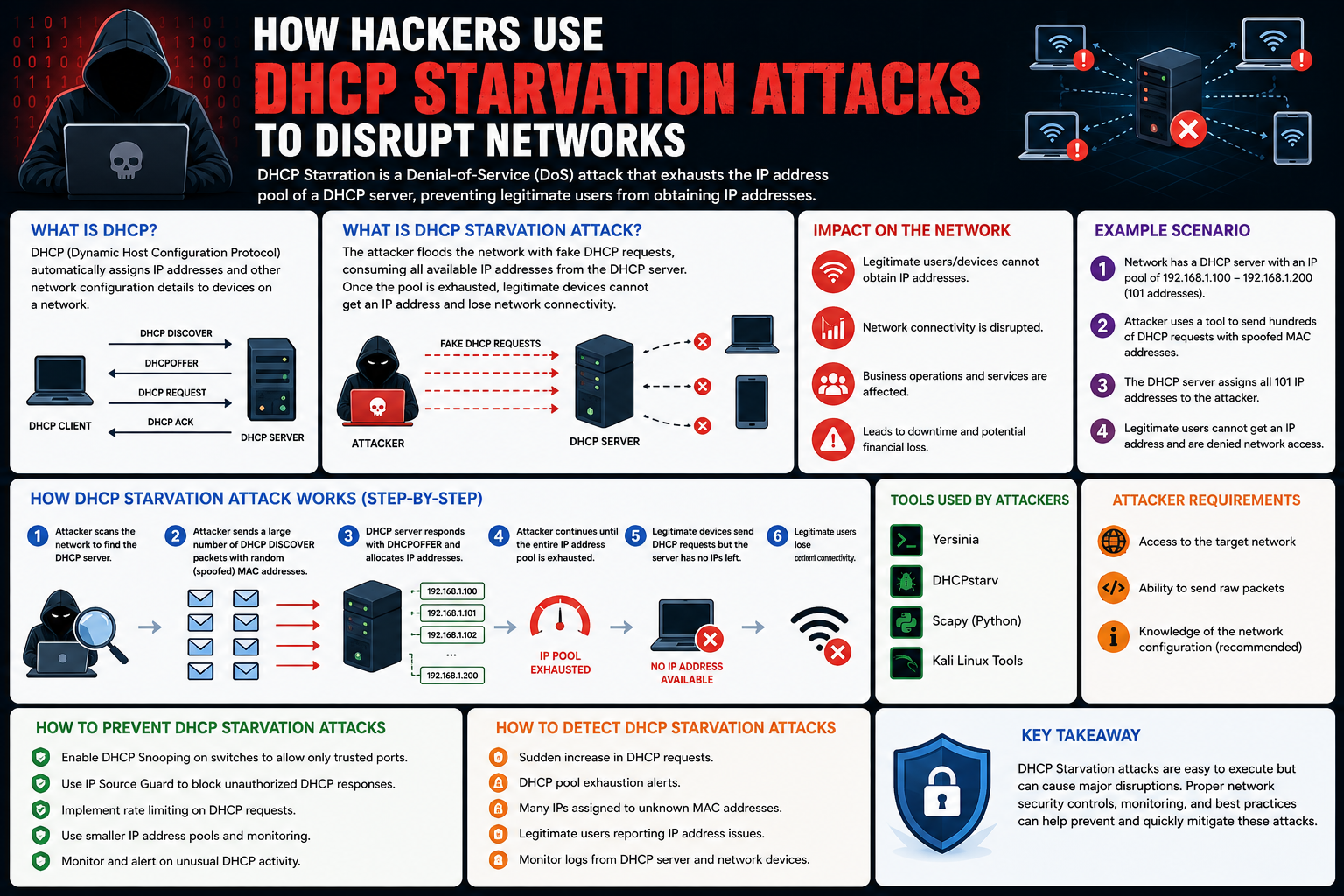
A DHCP starvation attack is a network-based cyberattack that targets Dynamic Host Configuration Protocol (DHCP) servers. The goal of the attack is to exhaust the available IP addresses that a DHCP server can assign to legitimate devices on a network. Once the DHCP address pool is depleted, new users and devices are unable to obtain valid IP addresses, resulting in a denial of service condition.
This type of attack is commonly used in network penetration testing demonstrations because it highlights weaknesses in poorly secured network environments. Attackers often combine DHCP starvation with rogue DHCP server attacks to intercept user traffic and launch more advanced attacks such as Man-in-the-Middle attacks.
Understanding how DHCP starvation attacks work is important for network administrators, cybersecurity professionals, and IT learners who want to secure enterprise networks against unauthorized access and service disruption.
Understanding DHCP
Dynamic Host Configuration Protocol is responsible for automatically assigning IP addresses to devices connected to a network. Without DHCP, administrators would need to manually configure every device with an IP address, subnet mask, gateway, and DNS information.
DHCP simplifies network management by automatically distributing network configuration details whenever a client device joins the network.
The DHCP process follows four major steps commonly known as DORA:
- Discover
- Offer
- Request
- Acknowledgement
When a computer or mobile device connects to a network, it sends a DHCP Discover packet searching for a DHCP server. The DHCP server replies with an Offer packet containing an available IP address. The client then sends a Request packet asking to use that address, and finally, the server responds with an Acknowledgement packet confirming the lease.
This process normally happens within seconds and allows devices to communicate on the network without manual configuration.
How DHCP Address Pools Work
A DHCP server maintains a pool of available IP addresses that it can distribute to clients. For example, on a small network using a /24 subnet, the DHCP server may have approximately 254 usable IP addresses available for assignment.
Not all addresses are usually available for clients because some are reserved for routers, servers, printers, or static devices. This means the actual available pool may be smaller.
Every time a DHCP server receives a valid DHCP Discover request, it temporarily reserves an address for the requesting client. If many requests arrive at once, the server quickly consumes available addresses.
Attackers exploit this behavior during a DHCP starvation attack.
What Is a DHCP Starvation Attack?
A DHCP starvation attack occurs when an attacker floods a DHCP server with a massive number of fake DHCP Discover requests. Each request uses a different spoofed MAC address to appear as a unique client device.
The DHCP server believes these requests are legitimate and begins allocating IP addresses to fake devices. Eventually, the DHCP server runs out of available addresses in its pool.
Once the pool is exhausted, legitimate users cannot obtain IP addresses and lose network connectivity.
The attack essentially overwhelms the DHCP service by consuming all available resources intended for real devices.
How a DHCP Starvation Attack Works
The attack begins with a malicious system connected to the target network. The attacker uses specialized software to generate thousands of fake DHCP Discover packets within a short period.
Each request contains a randomly generated MAC address. Since DHCP servers identify clients using MAC addresses, the server assumes every request is coming from a new device.
The DHCP server responds by reserving an IP address for each fake client. As the requests continue, the DHCP address pool becomes depleted.
Once all addresses are assigned, legitimate devices attempting to connect to the network receive no valid IP configuration. Users may see messages indicating limited connectivity or inability to access network resources.
This results in a denial of service condition because the network can no longer provide IP addresses to legitimate clients.
Why Attackers Use DHCP Starvation
Attackers use DHCP starvation attacks for several reasons. One major objective is disrupting network availability. By exhausting the DHCP pool, attackers prevent users from accessing network resources, internet services, and internal systems.
Another common reason is preparing for a rogue DHCP server attack. After disabling the legitimate DHCP server through starvation, attackers may introduce their own malicious DHCP server onto the network.
The rogue server then distributes fake network configurations to unsuspecting users. These configurations may direct traffic through attacker-controlled systems, allowing interception of sensitive information.
This creates opportunities for:
- Man-in-the-Middle attacks
- Traffic sniffing
- DNS hijacking
- Credential theft
- Session interception
The attack can become extremely dangerous in environments lacking proper network security controls.
DHCP Starvation and Man-in-the-Middle Attacks
A DHCP starvation attack often serves as the first stage of a larger attack chain.
Once the legitimate DHCP server runs out of IP addresses, devices searching for network configuration may accept responses from a rogue DHCP server controlled by the attacker.
The malicious server can assign:
- Fake default gateways
- Malicious DNS servers
- Incorrect subnet configurations
If the attacker sets their own device as the default gateway, all network traffic from connected users may pass through the attacker’s system before reaching its destination.
This enables attackers to monitor, modify, or capture sensitive data such as:
- Login credentials
- Emails
- Browser sessions
- File transfers
- Internal communications
Because of this, DHCP starvation attacks are considered highly dangerous in unsecured networks.
Tools Used in DHCP Starvation Attacks
Several penetration testing and network auditing tools can simulate DHCP starvation attacks in controlled environments.
One well-known tool historically associated with such testing is Yersinia. It is designed to test weaknesses in network protocols and can generate large volumes of DHCP Discover packets.
Attackers may also use Linux-based penetration testing distributions and custom scripts to automate the process.
These tools can rapidly generate thousands of spoofed MAC addresses and DHCP requests, overwhelming the DHCP server in seconds.
While these tools are valuable for security training and ethical hacking labs, they should only be used in authorized testing environments.
Signs of a DHCP Starvation Attack
Network administrators can identify DHCP starvation attacks through several warning signs.
One common symptom is users suddenly failing to obtain IP addresses. Devices may display automatic private IP addresses instead of valid network configurations.
Administrators may also notice:
- Unusually high DHCP traffic
- Large numbers of DHCP Discover packets
- Rapid exhaustion of DHCP leases
- Unknown MAC addresses in DHCP logs
- Network connectivity complaints from users
Monitoring DHCP server logs can reveal abnormal lease activity and suspicious patterns.
In some cases, network performance may degrade significantly because of excessive broadcast traffic generated during the attack.
Impact of DHCP Starvation Attacks
The impact of a DHCP starvation attack can range from minor disruptions to severe network outages.
Small organizations may experience temporary connectivity problems, while enterprise environments may suffer major operational interruptions.
Potential consequences include:
- Loss of network connectivity
- Business downtime
- Interrupted communications
- Reduced employee productivity
- Failed authentication services
- Inability to access cloud applications
- Increased security risks
If combined with rogue DHCP attacks, the consequences become even more serious because attackers may intercept confidential data.
Organizations relying heavily on network availability can experience financial losses and reputational damage during prolonged attacks.
How to Prevent DHCP Starvation Attacks
Preventing DHCP starvation attacks requires implementing network security controls designed to validate devices and limit suspicious behavior.
One of the most effective protections is DHCP Snooping.
DHCP Snooping
DHCP Snooping is a security feature available on many managed switches. It monitors DHCP traffic and distinguishes trusted DHCP servers from untrusted devices.
The switch blocks unauthorized DHCP responses and filters suspicious DHCP traffic.
This prevents rogue DHCP servers from distributing malicious configurations to users.
Port Security
Port security limits the number of MAC addresses allowed on a switch port. If too many MAC addresses appear on a single port, the switch can shut down the interface or restrict traffic.
This helps stop attackers from sending thousands of spoofed MAC addresses during a starvation attack.
Rate Limiting
Administrators can configure DHCP rate limiting to restrict the number of DHCP requests allowed within a certain timeframe.
If a device exceeds the threshold, the switch may temporarily block DHCP traffic from that port.
This reduces the effectiveness of flooding attacks.
Network Monitoring
Continuous monitoring helps administrators detect unusual DHCP activity before major disruptions occur.
Security tools and intrusion detection systems can identify excessive DHCP Discover packets and suspicious MAC address behavior.
Early detection significantly reduces attack impact.
VLAN Segmentation
Segmenting networks using VLANs limits the scope of DHCP attacks. Even if one network segment becomes affected, the rest of the infrastructure remains operational.
This improves overall network resilience and containment.
Authentication and Access Control
Using network access control systems ensures that only authorized devices can connect to the network.
Authentication mechanisms help reduce the risk of unauthorized attackers launching DHCP-based attacks internally.
Importance of Ethical Testing
Learning about DHCP starvation attacks is valuable for cybersecurity education and defensive training. Ethical hackers and security professionals often simulate these attacks in controlled labs to evaluate network resilience.
Testing allows organizations to identify weaknesses before malicious attackers exploit them.
However, launching DHCP starvation attacks against networks without authorization is illegal and unethical. Such actions can disrupt business operations and violate cybersecurity laws.
Security testing should always be performed with proper permission and within approved environments.
Best Practices for Securing DHCP Services
Organizations can improve DHCP security by following several best practices:
- Enable DHCP Snooping on switches
- Configure port security
- Use network segmentation
- Monitor DHCP logs regularly
- Disable unused switch ports
- Implement network access control
- Maintain updated firmware and switch software
- Train IT staff to recognize suspicious activity
Combining multiple security controls creates stronger protection against DHCP-based attacks.
Conclusion
A DHCP starvation attack is a powerful network attack that targets DHCP servers by exhausting their available IP address pools. By flooding the server with fake DHCP requests using spoofed MAC addresses, attackers can deny network access to legitimate users and potentially launch more advanced attacks such as rogue DHCP and Man-in-the-Middle attacks.
Although the attack is relatively simple to execute, it can cause serious disruption in poorly secured environments. Understanding how DHCP works and recognizing the methods attackers use are essential steps toward building secure and resilient networks.
Modern security features such as DHCP Snooping, port security, rate limiting, and network monitoring provide strong protection against DHCP starvation attacks. Organizations that implement these defenses significantly reduce their exposure to network disruption and unauthorized interception of traffic.
As networks continue to grow in complexity, proactive security practices and continuous monitoring remain critical for protecting infrastructure against evolving cyber threats.