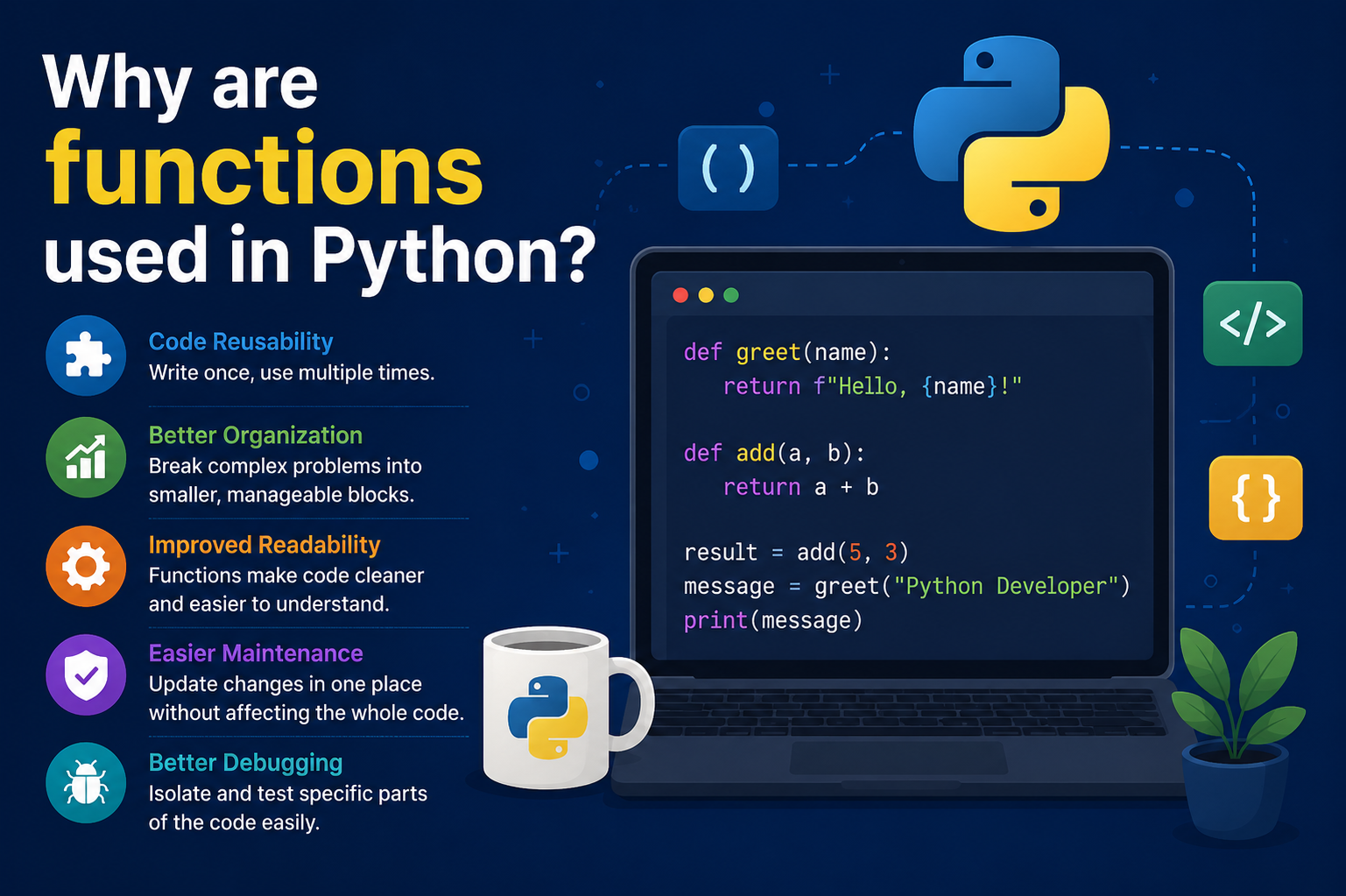
Functions are one of the most fundamental building blocks in Python programming. They play a crucial role in structuring code, improving readability, reducing repetition, and making programs easier to maintain and scale. At their core, functions are reusable blocks of code that perform a specific task. Instead of writing the same logic multiple times, programmers define a function once and use it whenever needed. This simple idea brings enormous power and flexibility to software development.
Improving Code Reusability
One of the main reasons functions are used in Python is to promote reusability. In programming, it is common to perform the same operation in multiple places within a program. Without functions, a developer would have to rewrite the same code again and again. This not only increases the length of the program but also introduces unnecessary repetition.
Functions solve this problem by allowing a block of code to be written once and reused multiple times. Once a function is defined, it can be called anywhere in the program as many times as needed. This reduces duplication and ensures that the same logic does not have to be rewritten. As a result, programs become shorter, cleaner, and more efficient.
Reusability also becomes extremely valuable in large projects where multiple developers are working together. Instead of each developer writing their own version of the same logic, a shared function can be created and used consistently across the project.
Enhancing Readability and Structure
Another important reason functions are used in Python is to improve the readability of code. When programs grow in size, they can become difficult to understand if everything is written in a single block. Functions help solve this problem by breaking the program into smaller, meaningful sections.
Each function typically performs one specific task. For example, one function may handle user input, another may process data, and another may display results. This separation makes the code easier to follow because each part of the program has a clear purpose.
When someone reads a program that uses functions properly, they do not need to understand every line of code at once. Instead, they can understand the program step by step by looking at what each function does. This improves clarity and reduces confusion, especially in complex applications.
Readable code is also easier to debug and modify. When errors occur, developers can quickly locate the function responsible for the issue instead of searching through a long, unorganized script.
Reducing Repetition and Avoiding Redundancy
Functions help eliminate redundancy in code. Redundancy occurs when the same instructions are written multiple times throughout a program. This not only wastes time but also increases the risk of errors.
For example, if a piece of logic is repeated in five different places and a change is needed, the developer must update all five instances. If even one is missed, it can lead to inconsistent behavior in the program.
By using functions, this problem is avoided entirely. The logic is written once inside a function, and any updates only need to be made in one place. This ensures consistency and reduces the chance of mistakes.
Reducing repetition also makes programs lighter and more efficient. Less code means fewer chances for bugs and easier long-term maintenance.
Improving Maintainability of Code
Maintainability refers to how easy it is to update and manage a program over time. Functions play a major role in improving maintainability in Python.
As software evolves, requirements often change. New features may need to be added, or existing features may need modification. When code is organized into functions, making these changes becomes much simpler.
Since each function handles a specific task, developers can modify one part of the program without affecting the rest. This isolation reduces the risk of breaking other parts of the system while making updates.
In large applications, maintainability is extremely important. Without functions, even small changes could require extensive modifications throughout the codebase. With functions, changes remain localized and controlled.
Supporting Modular Programming
Functions are essential for modular programming, which is a design approach where a program is divided into separate modules or components. Each module is responsible for a specific part of the program’s functionality.
In Python, functions act as the building blocks of these modules. By organizing code into functions, developers can create logical sections that work independently but also interact with each other when needed.
This modular approach makes it easier to design complex systems. Instead of thinking about the entire program at once, developers can focus on one function at a time. This reduces cognitive load and makes problem-solving more efficient.
Modular programming also makes collaboration easier. Different team members can work on different functions simultaneously without interfering with each other’s work.
Making Debugging Easier
Debugging is the process of identifying and fixing errors in a program. Functions make debugging significantly easier by isolating problems within specific sections of code.
When a program is not divided into functions, errors can be difficult to trace because everything is written in a single block. However, when functions are used, developers can test each function separately to identify where the issue lies.
This isolation allows for faster problem-solving. Instead of searching through hundreds of lines of code, developers can focus on a single function that is not behaving as expected.
Additionally, functions can be tested individually, which leads to better testing practices and more reliable software.
Encouraging Code Abstraction
Abstraction is a concept in programming where unnecessary details are hidden from the user, and only essential information is shown. Functions help achieve abstraction by encapsulating complex logic inside a simple interface.
When a function is called, the user does not need to know how it works internally. They only need to know what the function does and what inputs it requires. This simplifies interaction with the code.
For example, a function that calculates the total price of items in a shopping cart hides all the internal calculations. The user simply provides input values and receives the result without worrying about the underlying logic.
This abstraction makes programs easier to use and understand, especially for beginners or users who are not familiar with the internal workings of the system.
Improving Code Organization
Well-organized code is easier to manage and understand. Functions help structure code logically by grouping related operations together.
Instead of writing a long sequence of instructions, developers can divide the program into meaningful sections. Each section is represented by a function that performs a specific role.
This organization helps maintain a clear flow in the program. It becomes easier to see how data moves through different parts of the system and how different components interact.
Good organization is especially important in large-scale applications where poor structure can lead to confusion and inefficiency.
Enhancing Code Testing and Reliability
Functions also improve the testing process. Since each function is independent, it can be tested separately before being integrated into the larger program.
This allows developers to verify that each part of the program works correctly on its own. Once all functions are tested individually, they can be combined with greater confidence.
This approach leads to more reliable software because errors are detected early in the development process. It also reduces the risk of unexpected behavior when different parts of the program interact.
Supporting Team Collaboration
In modern software development, multiple developers often work on the same project. Functions make collaboration easier by dividing work into independent units.
Each developer can focus on specific functions without worrying about the entire codebase. This parallel development increases productivity and reduces conflicts in the code.
Clear function definitions also make it easier for team members to understand each other’s work. This improves communication and ensures that everyone is aligned with the project goals.
Conclusion
Functions are a core feature of Python that bring structure, efficiency, and clarity to programming. They are used to improve reusability, enhance readability, reduce repetition, and support maintainability. By breaking programs into smaller, manageable parts, functions make complex problems easier to solve.
They also play a key role in debugging, testing, abstraction, and collaboration. Without functions, programming would be far more chaotic and difficult to manage, especially in large-scale systems.
Ultimately, functions are not just a feature of Python—they are a fundamental concept in programming that helps transform raw instructions into organized, efficient, and scalable software systems.