As you progress beyond the fundamentals of systems administration, the focus gradually shifts from learning basic concepts to applying those concepts in complex, real-world environments. At this stage, it becomes important to understand how different systems interact at scale and how large organizations design and maintain their IT infrastructure. Systems administrators are no longer just supporting individual machines; they are responsible for entire ecosystems of servers, networks, and services that must remain reliable and secure at all times.
In modern IT environments, systems rarely operate in isolation. Instead, they are interconnected through hybrid infrastructures that combine on-premises servers, cloud platforms, and virtualized environments. A systems administrator must learn how these environments work together and how to manage resources across multiple platforms. This includes understanding how workloads are distributed, how data is stored and replicated, and how services remain available even during failures.
One of the most important advanced skills is understanding virtualization technologies. Virtualization allows multiple operating systems to run on a single physical machine, improving efficiency and resource utilization. Systems administrators must know how to create, manage, and monitor virtual machines, as well as how to allocate resources such as CPU, memory, and storage effectively. This skill is essential in both traditional data centers and modern cloud-based infrastructures.
Working with Cloud Computing Environments
Cloud computing has become a major part of systems administration. Many organizations now rely on cloud platforms to host applications, store data, and manage services. As a result, systems administrators must be familiar with cloud concepts such as scalability, elasticity, availability zones, and distributed architecture.
In cloud environments, administrators often manage virtual servers, storage systems, and networking configurations through web-based dashboards or command-line tools. Unlike traditional systems, cloud infrastructure is highly dynamic, meaning resources can be created or removed within minutes. This requires administrators to think differently about system design and resource management.
Understanding cloud security is also essential. Since data is often stored off-premises, ensuring proper access control, encryption, and compliance becomes a critical responsibility. Systems administrators must ensure that only authorized users can access sensitive systems and that data is protected during transmission and storage.
Cloud computing also introduces the concept of automation at a much larger scale. Many tasks that were previously done manually are now handled through scripts, templates, and infrastructure automation tools. This shift makes efficiency and accuracy even more important in modern systems administration.
Deepening Troubleshooting and Diagnostic Skills
At an advanced level, troubleshooting becomes more complex and requires a structured approach. Systems administrators must be able to quickly identify whether an issue is related to hardware, software, network configuration, or user error. This involves analyzing system logs, monitoring performance metrics, and using diagnostic tools to isolate problems.
Effective troubleshooting is not just about fixing issues but understanding why they occurred in the first place. This helps prevent similar problems in the future and improves system stability over time. Administrators often need to think logically and systematically, breaking down problems into smaller components to identify the root cause.
Experience plays a major role in developing these skills. Over time, systems administrators begin to recognize patterns in system behavior and can diagnose issues more quickly. However, even experienced professionals must continue learning because new technologies introduce new types of challenges.
Managing System Performance and Optimization
Another key responsibility of a systems administrator is ensuring that systems run efficiently. Performance optimization involves monitoring resource usage and making adjustments to improve speed, reliability, and scalability.
This may include balancing server loads, optimizing storage performance, or tuning operating system settings. Administrators must also ensure that systems are not overutilized or underutilized, as both situations can lead to inefficiencies.
Performance monitoring tools are often used to track system health in real time. These tools provide insights into CPU usage, memory consumption, disk activity, and network traffic. By analyzing this data, administrators can identify bottlenecks and make informed decisions about system improvements.
Optimization is an ongoing process rather than a one-time task. As user demands grow and systems evolve, administrators must continuously adjust configurations to maintain optimal performance.
Understanding Backup and Disaster Recovery Planning
One of the most critical responsibilities in systems administration is ensuring that data is protected against loss. This is achieved through backup and disaster recovery strategies. Systems administrators must design and implement backup solutions that ensure data can be restored in case of hardware failure, cyberattacks, or accidental deletion.
Backup strategies typically involve creating multiple copies of data and storing them in different locations. These backups must be tested regularly to ensure they can be restored successfully when needed. Simply creating backups is not enough; administrators must also verify their integrity and reliability.
Disaster recovery planning goes beyond backups. It involves preparing for worst-case scenarios where entire systems may become unavailable. In such cases, organizations must be able to restore operations quickly to minimize downtime. Systems administrators play a key role in designing these recovery processes and ensuring business continuity.
Exploring Automation and Infrastructure as Code
As IT environments grow more complex, automation becomes essential for efficiency and consistency. Systems administrators increasingly rely on automation tools to manage large-scale systems without manual intervention.
Automation allows repetitive tasks such as software installation, configuration updates, and system monitoring to be handled automatically. This reduces the risk of human error and saves significant time.
Infrastructure as code is an advanced concept where system configurations are defined using code instead of manual setup. This allows environments to be recreated quickly and consistently. It also makes it easier to track changes and maintain system documentation.
Learning automation requires a shift in thinking. Instead of manually performing tasks, administrators must learn how to design processes that execute automatically and reliably.
Developing Security Monitoring and Incident Response Skills
Security monitoring is a continuous responsibility in systems administration. Administrators must be able to detect unusual activity, respond to security incidents, and protect systems from potential threats.
This involves monitoring logs, analyzing access patterns, and identifying suspicious behavior. When a security incident occurs, administrators must act quickly to contain the issue, investigate the cause, and restore normal operations.
Incident response requires both technical knowledge and calm decision-making. In high-pressure situations, administrators must follow structured procedures to minimize damage and prevent further issues.
Security is not a one-time setup but an ongoing process that requires constant attention and updates. As threats evolve, systems administrators must stay informed about new vulnerabilities and security practices.
Building a Professional Systems Administration Career Path
As experience grows, systems administrators can choose to specialize in different areas. Some may focus on networking, while others may move into cloud engineering, cybersecurity, or infrastructure architecture. Each specialization requires deeper knowledge and additional skills.
Career progression often begins with entry-level IT roles and gradually moves toward more advanced responsibilities. With time, systems administrators may take on leadership roles, managing teams and overseeing large-scale infrastructure projects.
Professional growth depends not only on technical skills but also on communication, leadership, and decision-making abilities. As responsibilities increase, administrators must be able to coordinate with different teams and align technical solutions with business goals.
Common Challenges Faced by Systems Administrators
The role of a systems administrator comes with several challenges. One of the most common is dealing with unexpected system failures. These situations require quick thinking and effective problem-solving under pressure.
Another challenge is keeping up with rapidly changing technology. New tools, platforms, and security threats are constantly emerging, requiring continuous learning and adaptation.
Workload management can also be demanding, especially in large organizations where systems must operate 24/7. Administrators may be required to work outside regular hours to handle emergencies or perform maintenance.
Despite these challenges, the role is highly rewarding for individuals who enjoy problem-solving and working with technology.
Preparing for Interviews and Job Opportunities
When seeking a systems administration role, preparation is key. Employers typically look for candidates who have both theoretical knowledge and practical experience. During interviews, candidates are often asked about troubleshooting scenarios, system configurations, and networking concepts.
Hands-on experience is particularly important. Being able to demonstrate real-world problem-solving skills can significantly improve job prospects. Employers value candidates who can explain how they have handled technical issues in the past.
Clear communication is also important during interviews. Candidates should be able to explain technical concepts in a simple and structured way.
Long-Term Growth and Career Stability
Systems administration offers strong long-term career stability because IT infrastructure is essential for nearly every organization. As technology continues to evolve, the demand for skilled professionals remains high.
With experience, systems administrators can move into higher-level positions such as IT manager, systems architect, or cloud solutions specialist. These roles involve greater responsibility and strategic decision-making.
Continuous learning is the key to long-term success. Those who stay updated with new technologies and develop a broad skill set will always find opportunities for growth.
Conclusion
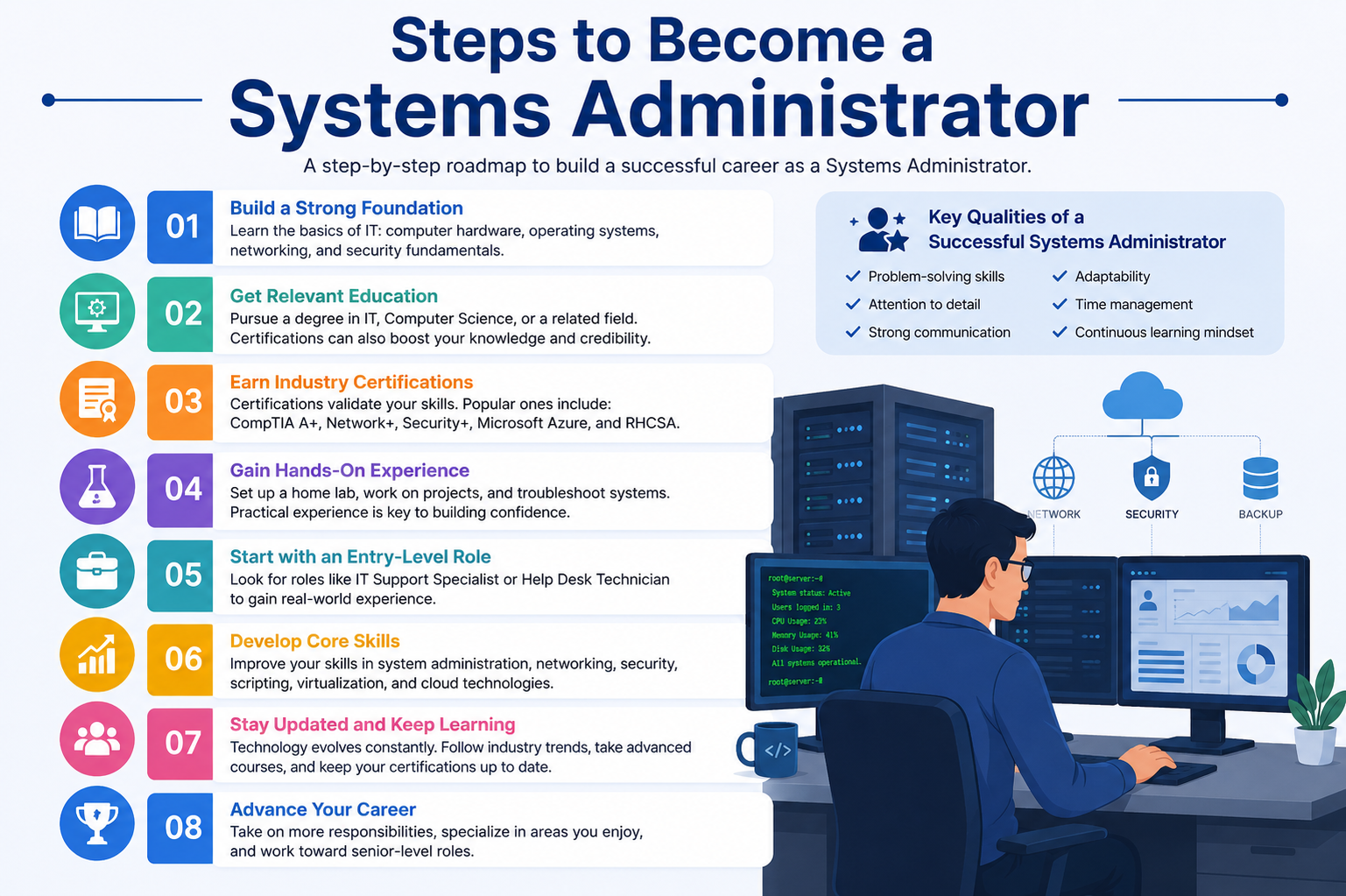
Becoming a systems administrator is a structured yet evolving journey that requires dedication, continuous learning, and hands-on experience. It begins with understanding fundamental concepts such as operating systems and networking, then gradually progresses into advanced areas like cloud computing, automation, security, and infrastructure management.
The role demands both technical expertise and strong problem-solving abilities. Systems administrators are responsible for ensuring that critical IT systems remain stable, secure, and efficient, making them an essential part of any organization.
While the path may include challenges such as rapid technological change and high-pressure situations, it also offers significant rewards, including career growth, stability, and opportunities to work with advanced technologies.
With consistent effort, practical experience, and a commitment to learning, anyone can build a successful career in systems administration and progress into highly specialized and senior roles within the IT industry.