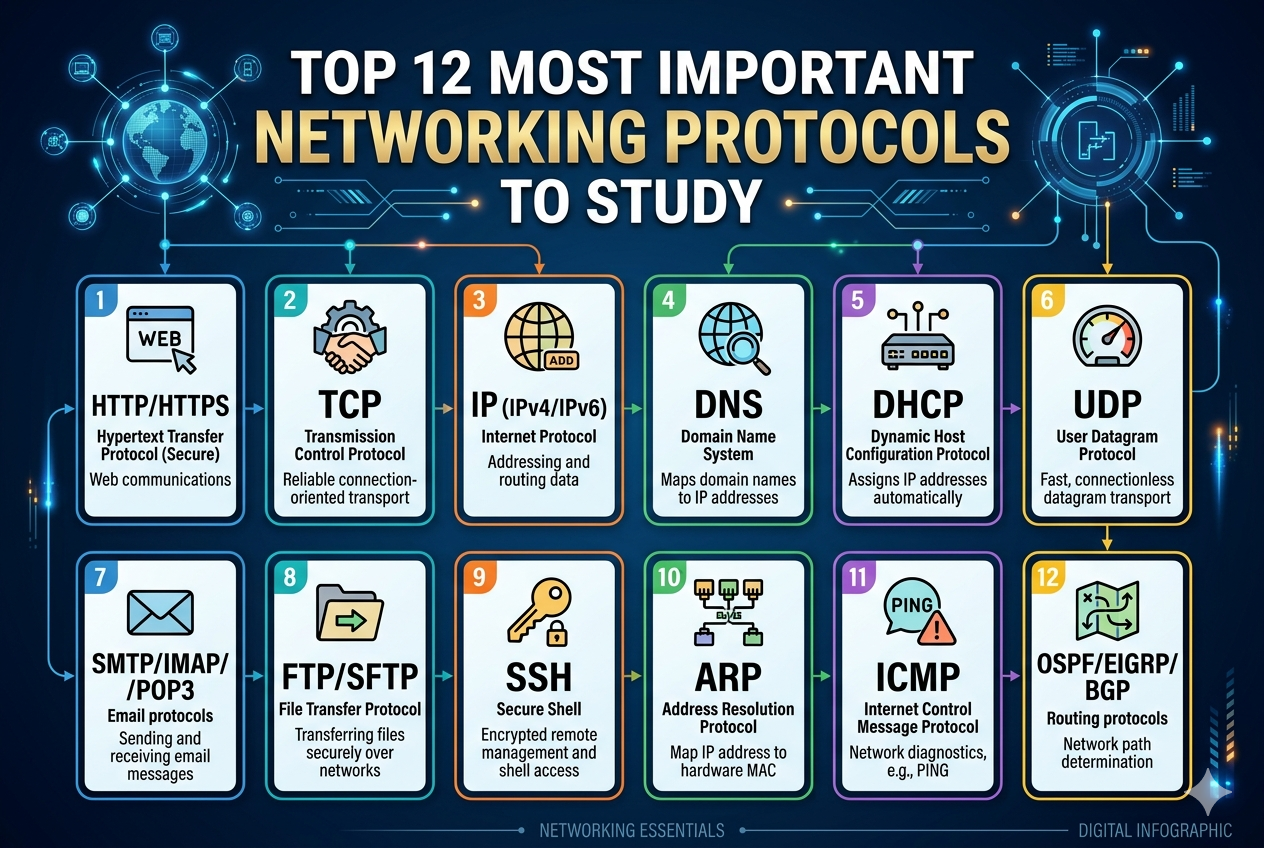
TCP is not just a basic transport protocol; it is the backbone of reliable communication in modern networking systems. It operates at the transport layer and is designed to ensure that data sent from one device reaches another without errors, duplication, or loss. One of the most important mechanisms in TCP is the three-way handshake process, which establishes a stable connection before any data is transmitted. This handshake involves SYN, SYN-ACK, and ACK messages, which confirm that both sender and receiver are ready for communication.
TCP also plays a major role in segmentation and reassembly of data. Large messages are broken into smaller packets, which are transmitted individually and then reassembled at the destination in the correct order. Sequence numbers are assigned to each packet to ensure proper ordering. If any packet is missing or corrupted during transmission, TCP automatically requests retransmission, making it highly reliable.
Flow control and congestion control are two additional strengths of TCP. Flow control ensures that a sender does not overwhelm a receiver with too much data at once, while congestion control manages network traffic to avoid overload on network paths. Because of these features, TCP is widely used in applications where accuracy is more important than speed, such as secure file transfers, email communication, and web browsing. It is also closely integrated with IP, forming the TCP/IP model that powers the internet.
IP (Internet Protocol)
Internet Protocol is responsible for addressing and routing data packets so they can travel across interconnected networks. Every device connected to a network is assigned an IP address, which acts like a digital identifier. IP ensures that data packets are sent from a source to a destination using these addresses.
Unlike TCP, IP is connectionless, meaning it does not establish a dedicated session before sending data. Each packet is treated independently, and routers decide the best path for each packet based on network conditions. This can result in packets arriving out of order, but higher-layer protocols like TCP handle reordering.
IPv4 remains widely used, but IPv6 was introduced to solve address exhaustion issues. IPv6 provides a much larger address space, allowing billions of new devices to connect to the internet. IP also supports fragmentation, where large packets are broken into smaller ones to match network size limitations. Without IP, global communication between networks would not be possible.
HTTP (Hypertext Transfer Protocol)
HTTP is the foundation of communication on the web. It defines how clients, such as browsers, request resources from servers and how servers respond. The protocol follows a stateless request-response model, meaning each interaction is independent and does not retain memory of previous requests.
HTTP methods such as GET, POST, PUT, and DELETE define the type of action being performed. GET retrieves data, POST sends data, PUT updates data, and DELETE removes data. These methods are essential in web development and API communication.
Although HTTP is efficient, it lacks encryption, making it vulnerable to interception. This limitation led to the development of HTTPS. HTTP also uses status codes like 200 for success, 404 for not found, and 500 for server errors, which help in debugging and communication between client and server.
HTTPS (Hypertext Transfer Protocol Secure)
HTTPS is the secure version of HTTP and is essential for protecting sensitive data on the internet. It uses encryption protocols such as SSL and TLS to secure communication between client and server. This encryption ensures that even if data is intercepted, it cannot be read or modified.
HTTPS also provides authentication, ensuring that users are communicating with legitimate servers and not malicious imposters. This is done through digital certificates issued by trusted authorities.
Another important feature of HTTPS is data integrity, which ensures that transmitted data is not altered during transfer. Today, HTTPS is the standard for all modern websites, especially those involving financial transactions, login systems, and personal data exchange.
DNS (Domain Name System)
DNS is a hierarchical naming system that translates human-friendly domain names into IP addresses. It eliminates the need for users to remember numerical IP addresses by allowing them to use simple names instead.
When a user enters a website address, a DNS resolver queries multiple DNS servers to find the corresponding IP address. This process involves root servers, top-level domain servers, and authoritative name servers.
DNS also improves performance through caching, where previously resolved domain names are stored temporarily for faster access. However, DNS can be vulnerable to attacks such as spoofing and cache poisoning, which makes security enhancements like DNSSEC important.
DHCP (Dynamic Host Configuration Protocol)
DHCP simplifies network management by automatically assigning IP addresses and configuration settings to devices. When a device connects to a network, it sends a request, and the DHCP server assigns an available IP address from a pool.
This automation eliminates manual configuration and reduces errors. DHCP also provides additional information such as subnet masks, gateway addresses, and DNS server details.
The lease system is another important feature of DHCP. IP addresses are assigned for a limited time and must be renewed periodically. This allows efficient reuse of addresses in large networks.
FTP (File Transfer Protocol)
FTP is used for transferring files between client and server systems. It supports uploading, downloading, and managing files on remote systems. FTP operates using two channels: a control channel for commands and a data channel for file transfer.
Although FTP is efficient, it lacks encryption, making it insecure for sensitive data. Variants like FTPS and SFTP were developed to address security concerns.
FTP is commonly used in web hosting environments where developers upload website files to servers. It also supports authentication to restrict unauthorized access.
SMTP (Simple Mail Transfer Protocol)
SMTP is the core protocol responsible for sending emails across networks. It works by transferring outgoing mail from a client to a mail server and then between servers until it reaches the recipient.
SMTP uses commands such as HELO, MAIL FROM, RCPT TO, and DATA to structure email transmission. However, it only handles sending emails and does not retrieve them.
To complete email communication, SMTP is used alongside IMAP or POP3. SMTP is also responsible for routing emails through multiple servers efficiently, ensuring reliable delivery.
IMAP (Internet Message Access Protocol)
IMAP allows users to access and manage their emails directly on the mail server. Unlike POP3, it does not download emails permanently, allowing synchronization across multiple devices.
Any changes made on one device, such as marking an email as read or deleting it, are reflected everywhere. This makes IMAP ideal for modern users who switch between devices frequently.
IMAP also supports folder management and server-side searching, improving email organization and accessibility. However, it requires a stable internet connection for full functionality.
POP3 (Post Office Protocol version 3)
POP3 is designed for downloading emails from a server to a local device. Once emails are downloaded, they are usually removed from the server, freeing up storage space.
This makes POP3 suitable for users who prefer offline access to emails. However, it lacks synchronization features, which limits its use in multi-device environments.
POP3 is simple and efficient but has largely been replaced by IMAP in modern systems. It still remains useful in environments with limited server storage or offline requirements.
SSH (Secure Shell)
SSH is a secure protocol used for remote access and management of devices over unsecured networks. It encrypts all communication between client and server, protecting against eavesdropping and attacks.
SSH is widely used by system administrators to manage servers remotely. It supports authentication using passwords or cryptographic keys, with key-based authentication being more secure.
It also allows secure file transfer and tunneling of other protocols. SSH has replaced older insecure tools due to its strong encryption and reliability.
ICMP (Internet Control Message Protocol)
ICMP is used for network diagnostics and error reporting. It helps devices communicate issues such as unreachable hosts, timeouts, and routing problems.
Tools like ping and traceroute rely on ICMP to measure network connectivity and performance. While ICMP does not carry user data, it is essential for maintaining network health.
It also helps routers and devices report errors back to the sender, improving troubleshooting efficiency.
ARP (Address Resolution Protocol)
ARP is responsible for mapping IP addresses to MAC addresses within a local network. Since communication at the data link layer requires physical addresses, ARP bridges the gap between logical and physical addressing.
When a device wants to communicate with another device, it broadcasts an ARP request. The device with the matching IP address responds with its MAC address.
This mapping process is essential for local network communication and ensures that data packets reach the correct hardware device efficiently.
Conclusion
Understanding these twelve networking protocols provides a strong foundation for mastering computer networks and modern communication systems. Each protocol plays a unique role, from ensuring reliable data transmission and secure communication to managing addressing, routing, and diagnostics.
TCP and IP form the core of internet communication, while protocols like HTTP and HTTPS enable web interactions. DNS and DHCP simplify user experience by automating naming and configuration tasks. FTP, SMTP, IMAP, and POP3 handle file and email communication, while SSH ensures secure remote access. ICMP and ARP support diagnostics and local network communication.
Together, these protocols create a layered and interconnected system that allows billions of devices to communicate seamlessly across the globe. A deep understanding of them not only helps in networking careers but also builds a strong foundation for cybersecurity, cloud computing, and system administration.