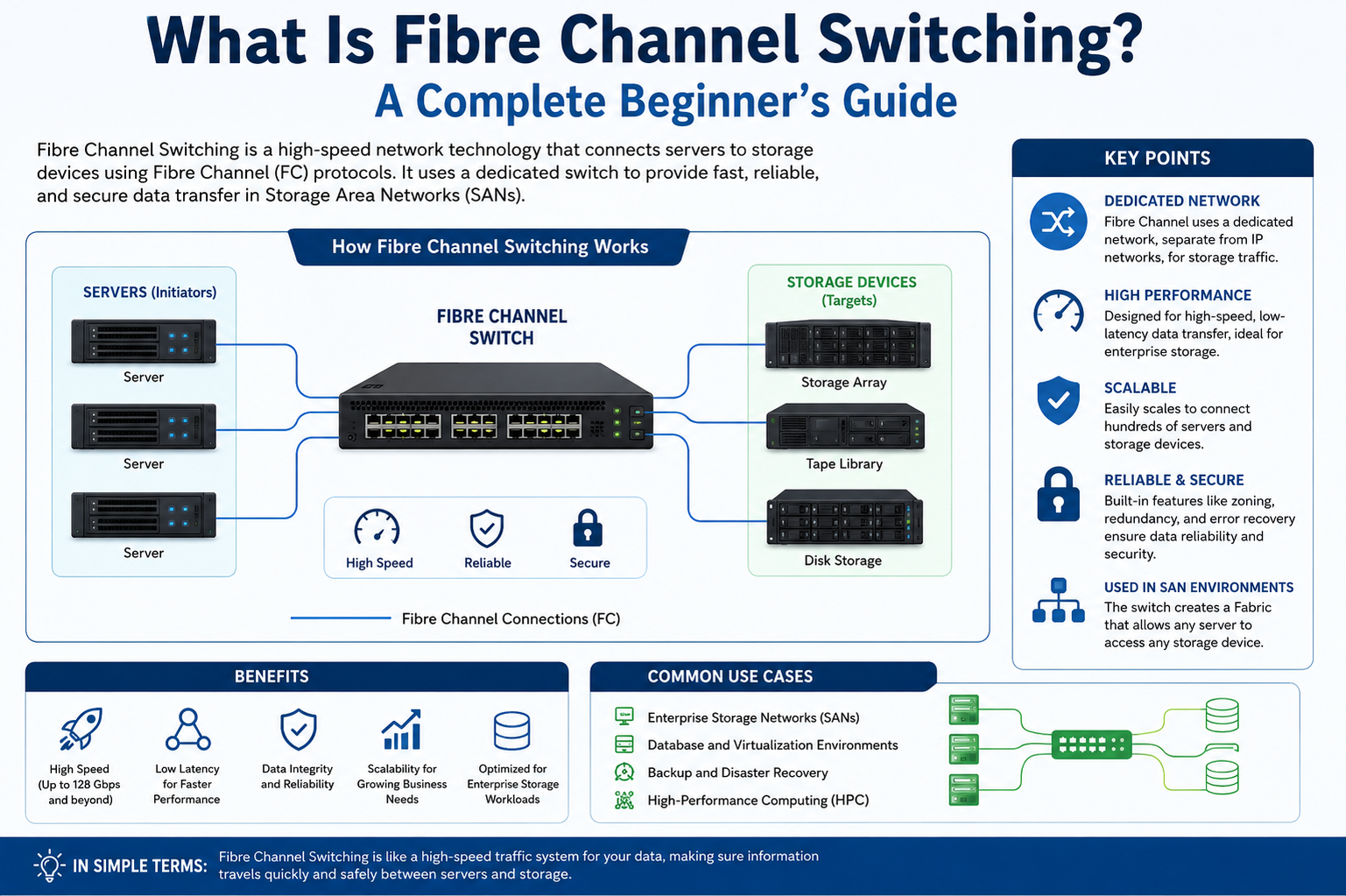
Fibre Channel switching plays a critical role in modern enterprise storage environments, especially where speed, reliability, and efficiency are non-negotiable. For beginners stepping into the world of storage networking, it is essential to build a strong foundational understanding of how Fibre Channel switching operates and why it is widely used in Storage Area Networks. This technology is not just about connecting devices; it is about ensuring seamless data movement across systems that demand high performance.
Understanding the Purpose of Fibre Channel Switching
At a basic level, Fibre Channel switching is designed to connect servers to storage systems in a way that allows data to flow quickly and without interruption. Unlike general-purpose networking systems that handle mixed traffic such as emails, web browsing, and file transfers, Fibre Channel networks are purpose-built for storage communication. This specialization enables them to achieve a level of efficiency that general networks often cannot match.
The switch acts as the central intelligence in the network. Instead of devices communicating directly with each other in a chaotic or inefficient manner, the switch organizes communication paths. It ensures that when a server requests data from a storage device, the request and response are delivered using the most optimal path available.
How Data Moves in a Fibre Channel Network
To truly understand Fibre Channel switching, it helps to visualize how data travels across the network. Data is broken down into smaller units called frames. Each frame carries not only the data itself but also important information about its destination. When a frame enters a Fibre Channel switch, the switch examines the destination address and determines where to send it.
This process happens extremely quickly, often in microseconds. The switch maintains a table of known devices and their locations, which allows it to forward frames efficiently. If the destination is not immediately known, the switch can use discovery processes to locate the appropriate device.
One of the defining characteristics of Fibre Channel switching is that it operates in a lossless environment. This means that frames are not dropped due to congestion. Instead, flow control mechanisms ensure that devices only send data when the receiving end is ready to accept it. This prevents data loss and ensures consistent performance.
Key Components of Fibre Channel Switching
A Fibre Channel switching environment is made up of several important components working together. The first is the host, which is typically a server that needs to access stored data. The second is the storage device, such as a disk array, where the data resides. The third and most crucial component is the Fibre Channel switch itself.
Each device connected to the network has a unique identifier. This identifier allows the switch to recognize and route traffic correctly. The switch uses this information to build a map of the network, often referred to as a fabric. This fabric is what enables devices to communicate seamlessly.
Another important component is the Host Bus Adapter, which is installed in servers. It acts as the interface between the server and the Fibre Channel network. Without it, the server would not be able to communicate using Fibre Channel protocols.
The Concept of a Fibre Channel Fabric
The term fabric is commonly used when discussing Fibre Channel switching. A fabric refers to a network of interconnected switches that work together as a unified system. Instead of relying on a single switch, large environments often use multiple switches connected together to create redundancy and scalability.
Within a fabric, there are multiple possible paths between any two devices. This is important because it allows the network to reroute traffic if one path becomes unavailable. For example, if a cable is disconnected or a switch fails, the fabric can automatically redirect data through an alternate route without interrupting operations.
This level of resilience is one of the reasons Fibre Channel switching is trusted in mission-critical environments. It ensures that data remains accessible even in the face of hardware failures.
Switching Techniques in Fibre Channel
Fibre Channel switches use specific techniques to forward data. One of the most common methods is called store-and-forward. In this approach, the switch receives the entire frame, checks it for errors, and then forwards it to the destination. This ensures data integrity but may introduce a slight delay.
Another method is cut-through switching, where the switch begins forwarding the frame as soon as it reads the destination address, without waiting for the entire frame. This reduces latency but may allow corrupted frames to pass through.
Each method has its advantages, and the choice often depends on the specific requirements of the environment. In many cases, modern switches support both techniques and can adapt based on network conditions.
Zoning and Access Control
Zoning is a critical feature in Fibre Channel switching that helps manage and secure the network. It allows administrators to control which devices can communicate with each other. This is particularly important in large environments where multiple servers and storage systems coexist.
By creating zones, administrators can group specific devices together. For instance, a particular server can be placed in a zone with a specific storage array, ensuring that it only accesses the data it is supposed to. This reduces the risk of unauthorized access and simplifies management.
Zoning also improves performance by limiting the number of devices that need to communicate with each other. Instead of every device interacting with every other device, communication is restricted to defined groups.
Scalability in Fibre Channel Switching
One of the strengths of Fibre Channel switching is its ability to scale. As organizations grow, their storage needs increase. Fibre Channel networks can expand to accommodate this growth by adding more switches and devices.
This scalability is achieved without major disruptions. New switches can be integrated into the existing fabric, and devices can be connected without taking the network offline. This flexibility is crucial for businesses that need to adapt quickly to changing demands.
Large enterprises often deploy multiple fabrics to handle massive workloads. These fabrics can operate independently or be interconnected, providing both redundancy and load balancing.
Performance Advantages of Fibre Channel Switching
Performance is one of the primary reasons organizations invest in Fibre Channel switching. It supports high data transfer rates and low latency, making it ideal for applications that require fast access to large amounts of data.
Unlike traditional networks, Fibre Channel is designed to handle storage traffic efficiently. It avoids common issues such as packet collisions and congestion. This results in predictable performance, which is essential for critical applications like databases and virtualization platforms.
Another advantage is the ability to maintain consistent performance under heavy workloads. Fibre Channel networks are built to handle high volumes of traffic without significant degradation, ensuring that applications continue to run smoothly.
Reliability and Fault Tolerance
Reliability is another key feature of Fibre Channel switching. The use of multiple paths within a fabric ensures that data can still be transmitted even if part of the network fails. This is known as multipathing.
Multipathing allows devices to have more than one connection to the network. If one path becomes unavailable, the system automatically switches to another path. This happens seamlessly, without interrupting operations.
In addition to multipathing, Fibre Channel switches often include features such as hot-swappable components. This means that certain parts can be replaced without shutting down the system, further enhancing uptime.
Security Considerations
Although Fibre Channel networks are typically isolated from general-purpose networks, security remains an important consideration. Zoning provides a basic level of access control, but additional measures can be implemented to enhance security.
Authentication mechanisms can be used to verify the identity of devices before allowing them to connect to the network. Encryption can also be employed to protect data during transmission. These measures help ensure that sensitive information remains secure.
Proper configuration and monitoring are essential to maintaining a secure environment. Administrators must regularly review settings and update policies to address potential vulnerabilities.
Management and Monitoring
Managing a Fibre Channel switching environment requires careful planning and ongoing monitoring. Administrators use specialized tools to configure switches, define zones, and monitor performance.
Monitoring tools provide insights into network activity, allowing administrators to identify potential issues before they become critical. For example, they can detect congestion, errors, or failing components and take corrective action.
Effective management also involves maintaining documentation and following best practices. This ensures that the network remains organized and can be easily understood by different team members.
Common Use Cases of Fibre Channel Switching
Fibre Channel switching is widely used in environments where performance and reliability are critical. Data centers rely on it to support applications that require fast and consistent access to storage.
Industries such as healthcare use Fibre Channel networks to manage large volumes of sensitive data, including medical records and imaging files. Financial institutions depend on it for transaction processing systems that must operate without interruption.
Media and entertainment companies also benefit from Fibre Channel switching, as it enables the handling of large video files and high-resolution content. In each of these cases, the ability to move data quickly and reliably is essential.
Challenges and Limitations
Despite its many advantages, Fibre Channel switching is not without challenges. One of the main drawbacks is cost. The hardware and infrastructure required can be expensive compared to other networking technologies.
Another challenge is complexity. Designing and managing a Fibre Channel network requires specialized knowledge and skills. This can make it less accessible for smaller organizations or those with limited resources.
Additionally, as newer technologies emerge, organizations may need to evaluate whether Fibre Channel remains the best solution for their needs. Hybrid approaches are becoming more common, combining Fibre Channel with other networking technologies.
Conclusion
Fibre Channel switching is a powerful and specialized technology that forms the backbone of many high-performance storage networks. It enables fast, reliable, and efficient communication between servers and storage devices, making it indispensable in environments where data access is critical.
For beginners, understanding Fibre Channel switching involves learning how data flows through the network, how switches manage communication, and how features like zoning and multipathing enhance performance and security. While the technology may seem complex at first, its core principles are straightforward once broken down into manageable concepts.
As organizations continue to generate and rely on large amounts of data, the importance of efficient storage networking will only grow. Fibre Channel switching remains a key solution in this space, offering the performance and reliability needed to support modern applications.
Building a strong foundation in Fibre Channel switching not only helps in understanding current systems but also prepares you for more advanced topics in storage networking. With continued learning and practical experience, beginners can develop the skills needed to work confidently with this essential technology.