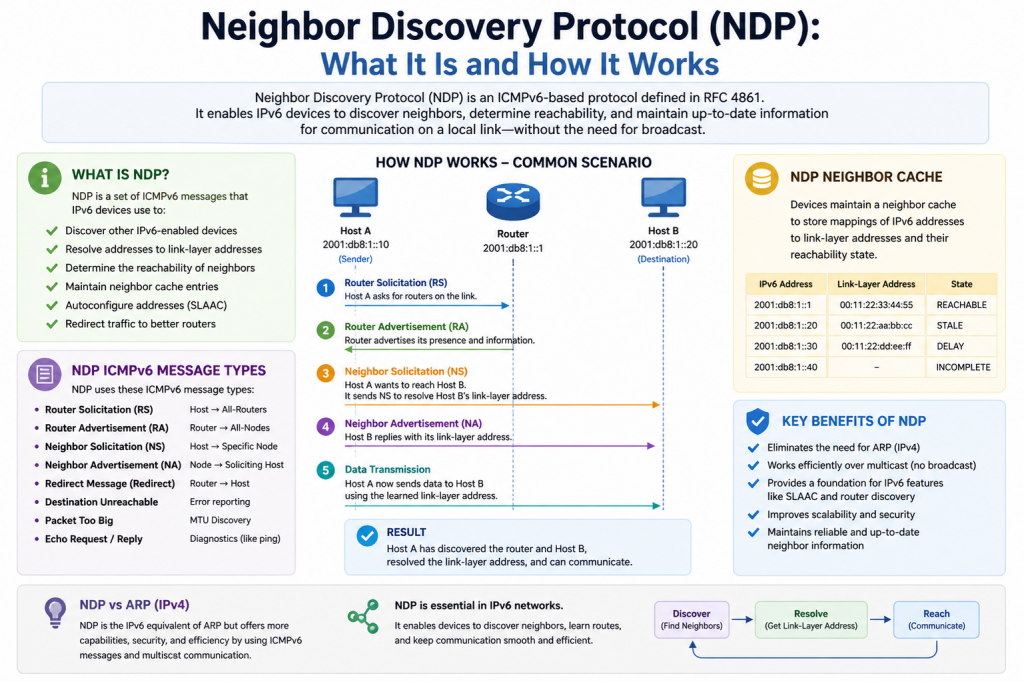
Neighbor Discovery Protocol (NDP) is a core mechanism used in IPv6 networking to enable communication between devices on the same local network. It is responsible for a wide range of essential network functions such as discovering neighboring devices, determining their physical addresses, identifying available routers, and maintaining up-to-date information about network reachability. Unlike older IPv4 mechanisms, NDP is more efficient, flexible, and integrated into the IPv6 architecture, making it a critical part of modern networking environments.
NDP operates using ICMPv6 messages and works automatically in the background without requiring manual configuration. It allows devices to communicate smoothly within a network by ensuring that each node can locate and interact with others using IPv6 addresses.
Role of NDP in IPv6 Networks
In IPv6 networks, devices must be able to identify each other and exchange data efficiently. NDP fulfills this requirement by acting as a communication facilitator between nodes. It replaces several IPv4 protocols, including ARP (Address Resolution Protocol), ICMP Router Discovery, and certain parts of DHCP functionality.
By combining these roles into a single protocol, NDP simplifies network operations. It reduces overhead, improves scalability, and enhances the overall performance of IPv6-based communication systems. This integration also allows devices to automatically configure themselves when they join a network.
Address Resolution Process
One of the most important functions of NDP is address resolution. When a device wants to send data to another device on the same local network, it must first determine the recipient’s link-layer (MAC) address. This is done using Neighbor Solicitation and Neighbor Advertisement messages.
When a device needs to find another device, it sends a Neighbor Solicitation message to a specific multicast address instead of broadcasting to all devices. The target device responds with a Neighbor Advertisement message that contains its MAC address. This process allows efficient mapping between IPv6 addresses and physical hardware addresses while minimizing unnecessary network traffic.
Router Discovery Mechanism
NDP also plays a key role in identifying routers within a network. This is done using Router Solicitation and Router Advertisement messages. When a device connects to a network, it may send a Router Solicitation message to request information about available routers. Routers respond with Router Advertisement messages that provide essential configuration details.
These details may include network prefixes, default gateway information, and other parameters required for communication. This automatic discovery process allows devices to configure themselves without manual intervention, making IPv6 networks more self-managing and scalable.
Automatic Address Configuration
Another important function of NDP is supporting Stateless Address Autoconfiguration (SLAAC). This feature allows devices to generate their own IPv6 addresses without relying on a centralized server. Using information received from Router Advertisements, a device can combine the network prefix with its own interface identifier to create a unique address.
This process significantly simplifies network setup, especially in large environments where manual configuration would be impractical. It also allows devices to join and leave networks seamlessly.
Neighbor Cache Management
NDP maintains a data structure known as the neighbor cache. This cache stores information about other devices on the network, including their IPv6 addresses, MAC addresses, and reachability status. When communication occurs, the cache is checked first to avoid unnecessary discovery processes.
Entries in the neighbor cache are dynamically updated based on network activity. If a device becomes inactive or unreachable, its entry may be removed or marked as stale. This ensures that the network always has accurate and up-to-date information about neighboring devices.
Neighbor Reachability Detection
To ensure reliable communication, NDP continuously monitors whether neighboring devices are reachable. This is done using periodic confirmation messages and feedback from ongoing communication. If a device fails to respond, it may be marked as unreachable.
This mechanism helps prevent data loss and ensures that packets are not sent to inactive or disconnected devices. It improves network reliability by maintaining accurate connectivity status at all times.
Duplicate Address Detection
Before a device begins using an IPv6 address, NDP performs a check to ensure that the address is not already in use on the network. This process is known as Duplicate Address Detection (DAD).
The device sends a Neighbor Solicitation message using the proposed address. If no response is received, the address is considered unique and can be assigned. If a response is received, it means another device is already using that address, and the new device must choose a different one.
This prevents address conflicts and ensures smooth communication between devices.
Use of Multicast in NDP
Unlike older protocols that rely heavily on broadcast communication, NDP uses multicast addresses. This improves efficiency by targeting only relevant devices instead of sending messages to all nodes on the network.
For example, when performing address resolution, a device sends a message to a solicited-node multicast address. Only the device with the matching IPv6 address responds. This reduces unnecessary network traffic and improves performance, especially in large networks.
Security Considerations in NDP
While NDP provides essential networking functions, it can also be vulnerable to certain types of attacks if not properly secured. One common issue is spoofing, where a malicious device sends fake Neighbor Advertisement messages to redirect traffic.
To address these risks, security extensions such as SEND (Secure Neighbor Discovery) can be used. These mechanisms add cryptographic protection to NDP messages, helping ensure that only legitimate devices can participate in network communication.
Proper network configuration and monitoring are also important to reduce potential vulnerabilities.
Comparison with IPv4 Mechanisms
In IPv4 networks, similar functions are handled by separate protocols such as ARP for address resolution and ICMP for router discovery. NDP combines these functions into a single integrated protocol in IPv6.
This integration results in several advantages, including reduced protocol complexity, improved efficiency, and better scalability. It also enables more advanced features such as automatic configuration and enhanced reachability detection.
Stateful Behavior of Neighbor Entries
NDP maintains different states for neighbor entries in its cache. These states reflect the current relationship between devices. For example, an entry may be marked as incomplete, reachable, stale, or delayed depending on recent communication activity.
These states help the protocol manage network resources efficiently and ensure that communication paths remain valid. They also allow quick detection of changes in network topology.
Efficiency and Performance Benefits
One of the key strengths of NDP is its efficiency. By using multicast instead of broadcast and integrating multiple functions into a single protocol, it reduces unnecessary network load. This leads to faster communication and better performance in both small and large networks.
NDP also supports dynamic environments where devices frequently join and leave the network. Its automatic discovery and configuration capabilities make it highly suitable for modern distributed systems.
Importance in Modern Networking
NDP is essential for the operation of IPv6 networks. Without it, devices would not be able to automatically discover each other, configure addresses, or identify routers. It forms the foundation of local network communication in IPv6 environments.
Its ability to automate key networking tasks reduces administrative effort and allows networks to scale more easily. As IPv6 adoption continues to grow, NDP remains a critical protocol for ensuring seamless connectivity and communication.
Neighbor Cache and Its Internal Working
The neighbor cache is one of the most important internal components used by Neighbor Discovery Protocol to manage communication between devices. It acts as a temporary storage system that keeps track of recently discovered neighbors on the network. Each entry in the cache typically includes the IPv6 address of a device, its corresponding link-layer address, and its current reachability status.
When a device wants to send data, it first checks the neighbor cache instead of initiating a new discovery process. If the required information is already available, communication becomes faster and more efficient. If the entry is missing or outdated, the device triggers a Neighbor Solicitation message to refresh the information. This caching mechanism significantly reduces unnecessary network traffic and improves overall performance.
The entries inside the neighbor cache are not permanent. They transition through different states depending on network activity. For example, an entry may remain in a reachable state if communication is ongoing, or it may shift to a stale state if it has not been used recently. This dynamic behavior ensures that only relevant and active entries are maintained.
State Transition of Neighbor Entries
Neighbor entries follow a structured lifecycle within the NDP system. Initially, when a device learns about a new neighbor, the entry is created in an incomplete state. Once the MAC address is resolved through a Neighbor Advertisement, the entry becomes reachable.
If no communication occurs for a certain period, the entry transitions into a stale state. This does not mean the neighbor is unreachable; rather, it indicates that the information has not been recently verified. When the device attempts to communicate again, it may perform reachability confirmation before using the entry.
In some cases, if repeated communication failures occur, the entry may be marked as unreachable or removed entirely from the cache. This state-based management allows NDP to adapt dynamically to changing network conditions.
Neighbor Solicitation Message Behavior
Neighbor Solicitation messages are a fundamental part of NDP communication. They are used not only for address resolution but also for reachability testing. When a device needs to verify whether a neighbor is still active, it sends a solicitation message and waits for a response.
These messages are typically sent to multicast addresses rather than broadcast, which ensures that only relevant devices process them. This improves network efficiency and reduces unnecessary load on devices that are not involved in the communication.
The structure of a Neighbor Solicitation message includes important information such as the source address, target address, and optional fields used for additional validation. This structured approach ensures accurate and secure communication between nodes.
Neighbor Advertisement Message Functionality
Neighbor Advertisement messages are the responses sent by devices when they receive a solicitation. These messages contain essential information such as the sender’s link-layer address and confirmation of reachability.
They can also be sent proactively without a solicitation request. In such cases, they are used to inform other devices about changes in network configuration, such as a change in MAC address or status updates. This proactive behavior helps maintain accurate and up-to-date network information.
Neighbor Advertisements can be either solicited or unsolicited, depending on the situation. Both types play an important role in ensuring consistent communication across the network.
Router Advertisement Timing and Behavior
Router Advertisement messages are periodically broadcast by routers to inform devices about network configuration details. These messages include information such as network prefixes, default gateway settings, and other operational parameters.
The timing of these advertisements is carefully controlled to balance network efficiency and responsiveness. If advertisements are sent too frequently, they may create unnecessary traffic. If they are too infrequent, devices may not receive timely updates about network changes.
Devices use these messages not only for initial configuration but also for ongoing updates. If a router becomes unavailable or a new router is introduced, advertisement messages ensure that devices are quickly informed of the change.
Router Solicitation and Active Discovery
While Router Advertisements are sent periodically, devices can also actively request router information using Router Solicitation messages. This is especially useful when a device first joins a network and needs immediate configuration details.
By sending a solicitation message, the device prompts nearby routers to respond without waiting for the next scheduled advertisement. This accelerates the initialization process and allows devices to become operational more quickly.
This active discovery mechanism ensures that devices do not remain in a waiting state and can immediately begin communicating on the network.
Stateless Address Autoconfiguration Process
Stateless Address Autoconfiguration (SLAAC) is closely integrated with NDP and allows devices to automatically generate their own IPv6 addresses. When a device receives a Router Advertisement, it extracts the network prefix information and combines it with a locally generated interface identifier.
This process eliminates the need for manual configuration or centralized address assignment systems. It is especially useful in large-scale networks where managing individual addresses manually would be impractical.
The generated address is then validated using Duplicate Address Detection to ensure uniqueness before it is assigned for use.
Efficiency of Multicast-Based Communication
One of the key improvements introduced by NDP is its reliance on multicast communication instead of broadcast. In traditional network protocols, broadcast messages are sent to all devices, even those that do not need the information.
NDP avoids this inefficiency by using specific multicast groups. Only devices that are relevant to the message process it, reducing unnecessary processing overhead. This improves network performance, especially in environments with a large number of connected devices.
Multicast-based communication also enhances scalability, allowing IPv6 networks to grow without significantly increasing network congestion.
Duplicate Address Detection in Depth
Duplicate Address Detection plays a critical role in preventing IP conflicts. Before a device assigns an IPv6 address to itself, it must verify that no other device is already using that address.
This is done by sending a Neighbor Solicitation message using the tentative address. If no response is received within a specified time frame, the address is considered unique and can be safely used. If a response is received, it indicates a conflict, and the device must select a different address.
This mechanism ensures that every device on the network has a unique identifier, preventing communication errors and routing issues.
Security Challenges in Neighbor Discovery Protocol
Despite its efficiency, NDP is vulnerable to certain security threats if not properly protected. One of the most common issues is spoofing, where an attacker sends fake Neighbor Advertisement messages to mislead other devices.
This can result in traffic interception or denial of service. To mitigate such risks, secure extensions such as cryptographic validation can be implemented. These mechanisms verify the authenticity of messages before they are accepted by the network.
Network administrators can also implement monitoring and filtering techniques to detect abnormal NDP activity and prevent potential attacks.
Impact of NDP on Network Performance
NDP significantly improves network performance by reducing manual configuration and automating key processes. Its use of multicast communication minimizes unnecessary traffic, while its caching system reduces repeated lookups.
The protocol also enhances reliability by continuously monitoring device reachability and updating network information in real time. This ensures that data is always routed through valid and active paths.
In large-scale environments, these optimizations contribute to smoother communication and better resource utilization.
Real-Time Adaptability of NDP
One of the most powerful features of NDP is its ability to adapt to real-time network changes. Whether a device joins, leaves, or changes its configuration, NDP quickly updates the network state.
This adaptability is essential in modern networks where devices are frequently mobile or dynamically connected. It ensures uninterrupted communication even in highly dynamic environments.
By continuously updating neighbor information and router status, NDP maintains a stable and reliable communication framework.
Operational Overview
Neighbor Discovery Protocol serves as a foundational element of IPv6 networking by handling essential tasks such as address resolution, router discovery, and reachability management. Its structured message system, caching mechanism, and automatic configuration capabilities make it highly efficient and scalable.
Through its combination of automation, efficiency, and adaptability, NDP ensures that IPv6 networks operate smoothly with minimal manual intervention, supporting modern communication requirements across diverse network environments.
Duplicate Address Detection (DAD) in Network Stability
Duplicate Address Detection is a critical safeguard within Neighbor Discovery Protocol that ensures every IPv6 address on a network remains unique. When a device attempts to assign itself an IPv6 address, it does not immediately start using it. Instead, it first performs a verification process to confirm that no other device is already using the same address.
This is achieved by sending a Neighbor Solicitation message using the tentative address as the target. Since the device has not fully activated the address yet, it listens for any responses from other nodes. If another device is already using that address, it will respond with a Neighbor Advertisement message, indicating a conflict.
If no response is received after a defined period, the address is considered safe and is assigned to the device. This process ensures that address duplication does not occur, which could otherwise lead to serious communication failures and routing confusion.
Link-Local Communication and NDP Role
NDP plays a major role in managing link-local communication, which refers to interactions between devices on the same physical or logical network segment. These communications do not require routers and are handled directly between neighboring devices.
In IPv6, link-local addresses are automatically configured, and NDP ensures that these addresses are usable and properly mapped to physical hardware addresses. It allows devices to discover each other without relying on external configuration systems.
This capability is essential for basic network operations such as file sharing, device discovery, and local service communication.
Efficient Use of ICMPv6 Messages
Neighbor Discovery Protocol operates using ICMPv6 messages, which form the foundation of its communication system. These messages are structured and standardized to support different functions such as discovery, advertisement, and verification.
Each message type serves a specific purpose. Neighbor Solicitation messages are used for requesting information, while Neighbor Advertisement messages are used for responding. Router Solicitation and Router Advertisement messages handle network configuration and router discovery.
By using ICMPv6 as a unified communication method, NDP maintains consistency and reduces complexity within IPv6 networks.
Multicast Addressing Strategy
A key feature of NDP is its intelligent use of multicast addressing instead of broadcast communication. Multicast allows messages to be delivered only to devices that are interested or relevant to the communication.
For example, when a device needs to find the MAC address of another device, it sends a Neighbor Solicitation message to a solicited-node multicast address. Only the device with the matching IPv6 address processes the message and responds.
This targeted approach reduces unnecessary network load and improves efficiency, especially in large networks where broadcast traffic could otherwise cause congestion.
Neighbor Unreachability Detection Mechanism
Neighbor Unreachability Detection is an important function that ensures continuous verification of active connections. Even if a device was previously reachable, its status may change due to network issues, shutdowns, or mobility.
To address this, NDP actively monitors communication success. If a device stops responding to data or confirmation messages, it may be marked as unreachable. This prevents future packets from being sent to inactive destinations.
The system uses feedback from ongoing traffic to determine reachability rather than relying solely on static information. This dynamic verification improves reliability and reduces packet loss.
Router Lifetime and Advertisement Control
Router Advertisements include a lifetime value that defines how long a router should be considered valid by devices on the network. This ensures that outdated router information is automatically removed over time.
If a router stops sending advertisements, its entry will eventually expire from device configuration tables. This prevents devices from relying on inactive or removed routers.
This time-based control mechanism ensures that network routing information remains accurate and up to date without manual intervention.
Prefix Information and Address Formation
Router Advertisement messages also contain prefix information, which is used by devices to generate IPv6 addresses. These prefixes define the network portion of an IPv6 address, while the remaining part is generated by the device itself.
This combination allows automatic address formation without the need for centralized assignment systems. Devices can independently create valid and unique addresses as soon as they receive prefix information.
This process is a key part of Stateless Address Autoconfiguration and greatly simplifies network deployment.
Role of NDP in Mobile IPv6 Environments
In mobile and dynamic environments, devices frequently change their network location. NDP helps manage these changes by continuously updating neighbor and router information.
When a device moves to a new network segment, it can quickly discover new routers and neighbors using NDP messages. This ensures uninterrupted connectivity even during movement.
The protocol’s ability to adapt quickly to topology changes makes it highly suitable for wireless networks, mobile devices, and distributed systems.
Proxy Neighbor Advertisement Functionality
In some cases, a device may respond to Neighbor Solicitation messages on behalf of another device. This is known as Proxy Neighbor Advertisement.
This feature is useful in scenarios where devices are behind routers or require address translation. The proxy device replies to requests as if it were the target device, allowing communication to continue smoothly.
This mechanism helps maintain connectivity in complex network architectures without requiring direct visibility of all devices.
Scalability Advantages of NDP
NDP is designed with scalability in mind. Its use of multicast communication, caching, and automated configuration allows it to function efficiently even in large networks with thousands of devices.
Unlike older protocols that rely heavily on broadcast traffic, NDP minimizes unnecessary communication overhead. This ensures that network performance remains stable as the number of connected devices increases.
Its distributed nature also eliminates the need for centralized management of basic network functions, making it suitable for modern large-scale infrastructures.
Error Handling and Recovery Mechanisms
NDP includes built-in mechanisms for handling errors and recovering from communication failures. If a message is lost or a device becomes temporarily unreachable, the protocol can retry discovery or update processes.
These recovery mechanisms ensure that temporary network issues do not lead to permanent communication breakdowns. Devices can re-establish connections automatically when conditions improve.
This resilience is an important feature in environments where network stability may vary.
Integration with IPv6 Architecture
NDP is deeply integrated into the IPv6 protocol suite and is not an optional add-on. It is a mandatory component that supports core IPv6 functionality such as addressing, routing, and neighbor communication.
This tight integration ensures consistency across all IPv6 implementations and eliminates the need for separate protocols for basic network tasks.
As a result, NDP forms one of the foundational pillars of IPv6 networking.
Performance Optimization Through Caching and Timers
NDP uses various timers and caching strategies to optimize performance. Entries in the neighbor cache are not continuously refreshed unless necessary, which reduces network traffic.
Timers control when entries should be updated, verified, or removed. This ensures that the system remains efficient while still maintaining accurate information.
By balancing freshness and efficiency, NDP achieves high performance without excessive overhead.
Advanced Operational Concepts
Neighbor Discovery Protocol continues to demonstrate its importance through advanced mechanisms such as Duplicate Address Detection, Unreachability Detection, proxy operations, and automatic address configuration. Its design allows it to handle complex networking tasks while maintaining simplicity and efficiency.
Through its structured communication model and adaptive behavior, NDP ensures that IPv6 networks remain stable, scalable, and capable of supporting modern communication demands across diverse environments.
Security Enhancements and Secure Neighbor Discovery
Security is an important aspect of Neighbor Discovery Protocol because it operates at a fundamental level of network communication. Without proper protection, attackers can exploit NDP messages to disrupt communication or redirect traffic. To address these risks, Secure Neighbor Discovery introduces cryptographic validation to ensure that messages are authentic and have not been tampered with.
This security approach uses digital signatures and certificate-based validation to verify that Neighbor Solicitation and Neighbor Advertisement messages originate from legitimate devices. When enabled, it significantly reduces the risk of spoofing and impersonation attacks.
Although Secure Neighbor Discovery improves protection, it is not always enabled by default due to its complexity and computational overhead. However, in high-security environments, it plays a critical role in maintaining network integrity.
Common Threats Targeting NDP
Several types of attacks can target Neighbor Discovery Protocol if proper safeguards are not in place. One of the most common is Neighbor Spoofing, where an attacker sends false advertisement messages to mislead other devices. This can result in traffic being redirected to unauthorized systems.
Another threat is Denial of Service attacks, where malicious nodes flood the network with excessive Neighbor Solicitation messages. This can overload devices and degrade network performance.
Rogue Router Advertisement attacks are also a concern, where fake routers advertise themselves as valid gateways, potentially disrupting routing paths. These threats highlight the importance of secure configuration and monitoring in IPv6 networks.
Mitigation Strategies for NDP Attacks
To protect against NDP-related attacks, network administrators can implement several mitigation strategies. One common approach is filtering suspicious traffic at the network level, ensuring that only valid ICMPv6 messages are processed.
Another strategy involves using security extensions that validate message authenticity. Additionally, network devices can be configured to limit the rate of Neighbor Discovery messages to prevent flooding attacks.
Monitoring tools can also detect unusual patterns in NDP traffic, helping administrators identify and respond to potential threats quickly.
NDP in Enterprise Network Environments
In enterprise environments, NDP plays a vital role in ensuring seamless communication between large numbers of devices. It supports automated configuration, which reduces the need for manual setup and simplifies network management.
Enterprises often rely on dynamic network structures where devices frequently join and leave. NDP’s ability to handle real-time updates makes it ideal for such environments. It ensures that devices can always locate routers and peers without manual intervention.
This reduces administrative workload and improves operational efficiency in large-scale networks.
Impact on Wireless and IoT Networks
Neighbor Discovery Protocol is especially important in wireless and Internet of Things environments. These networks often consist of a large number of small, frequently changing devices that require automatic configuration and discovery.
NDP enables these devices to join networks quickly, obtain addresses, and communicate with other nodes without complex setup procedures. Its lightweight and automated nature makes it suitable for resource-constrained devices.
In IoT systems, where devices must operate independently and efficiently, NDP provides a reliable foundation for communication.
Energy Efficiency Considerations
In modern networking, energy efficiency is an important factor, especially for mobile and battery-powered devices. NDP contributes to energy savings by reducing unnecessary communication through multicast usage and caching mechanisms.
Since devices do not need to constantly broadcast or listen for irrelevant traffic, they conserve processing power and battery life. Efficient neighbor tracking also reduces redundant network operations.
This makes NDP suitable for environments where energy conservation is a priority.
Interaction with Network Layers
NDP operates at the network layer but interacts closely with the data link layer to resolve hardware addresses. This cross-layer functionality allows it to bridge the gap between logical IPv6 addresses and physical network interfaces.
By integrating these functions, NDP eliminates the need for separate resolution protocols and ensures smoother communication between layers of the network stack.
This tight interaction improves efficiency and reduces protocol complexity.
Handling Network Topology Changes
Modern networks are dynamic, meaning devices frequently join, leave, or move between segments. NDP is designed to handle these changes automatically.
When a new device appears, it is quickly discovered through solicitation and advertisement messages. When a device leaves or becomes inactive, its information is removed or marked as unreachable.
This constant updating process ensures that the network topology remains accurate at all times, preventing outdated routing decisions.
Reliability Improvements Through Feedback Mechanisms
NDP uses feedback from ongoing communication to maintain reliability. Instead of relying solely on periodic updates, it observes actual data transmission success to determine device status.
If communication fails repeatedly, the protocol assumes that the neighbor may no longer be reachable and initiates verification. This adaptive approach improves accuracy and reduces reliance on outdated information.
It ensures that data is always routed through valid and active paths.
Role in Service Discovery and Local Networking
Beyond basic address resolution, NDP also supports service discovery in local networks. Devices can identify available services and resources by communicating with neighbors and routers.
This capability is important in environments where devices must interact dynamically without centralized directories. It allows systems to function efficiently in decentralized architectures.
Service discovery through NDP enhances usability and flexibility in local network environments.
Optimization of Network Traffic Flow
By reducing broadcast traffic and replacing it with targeted multicast communication, NDP significantly improves network traffic flow. This prevents unnecessary congestion and ensures that bandwidth is used efficiently.
The protocol’s caching system further reduces traffic by minimizing repeated discovery requests. Once a device’s information is known, it can be reused until it becomes outdated.
These optimizations contribute to smoother and faster network performance.
Role in Future-Ready Networking
As networks continue to evolve toward greater automation and scalability, NDP remains a key component of IPv6 infrastructure. Its ability to support self-configuring devices and dynamic environments makes it suitable for future network designs.
With the growth of cloud computing, IoT, and mobile systems, the importance of automated discovery and configuration continues to increase. NDP provides the foundational capabilities needed for these modern technologies.
Extended Operational Overview
Neighbor Discovery Protocol is a comprehensive and essential mechanism within IPv6 networking that handles communication, configuration, and maintenance tasks. Through its advanced features such as secure message handling, caching, reachability detection, and automatic configuration, it ensures efficient and reliable network operation.
Its adaptability, scalability, and integration with IPv6 architecture make it a fundamental protocol for modern digital communication systems, supporting both current and future networking requirements.
Conclusion
Neighbor Discovery Protocol is a foundational element of IPv6 networking that ensures smooth communication between devices on the same network. It replaces multiple IPv4 mechanisms with a unified system that handles address resolution, router discovery, duplicate address detection, and neighbor reachability in an automated and efficient way. By using ICMPv6 messages and multicast communication, it reduces unnecessary network traffic while improving performance and scalability.
Its ability to dynamically manage neighbor relationships, maintain accurate network information, and support automatic address configuration makes it essential for modern networks. NDP also adapts to changing network conditions in real time, ensuring that devices can always locate and communicate with each other reliably.
Overall, Neighbor Discovery Protocol strengthens the efficiency, stability, and intelligence of IPv6 networks, making it a key protocol for both current and future networking environments.