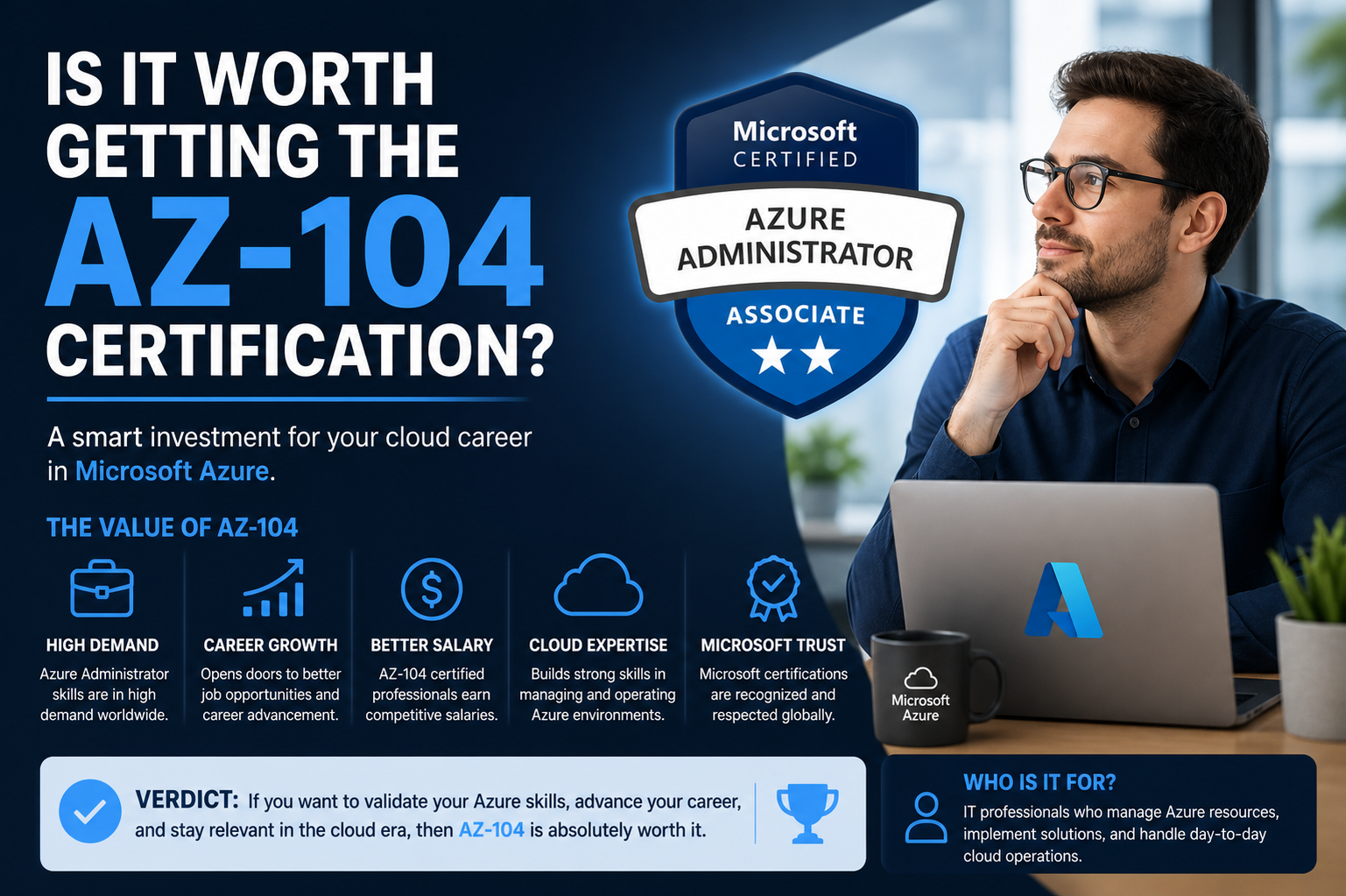
The AZ-104 certification is one of the most recognized credentials for professionals working with Microsoft Azure. It is designed for individuals who want to establish or grow their career in cloud administration, particularly in environments that rely on Azure services. In today’s IT landscape, where cloud computing has become the backbone of most modern infrastructures, this certification carries significant weight. It is not just a theoretical exam but a practical validation of real-world skills required to manage cloud resources effectively.
Understanding the Purpose of AZ-104
The AZ-104 certification focuses on Azure Administrator skills, which include managing identities, governance, storage, compute, and virtual networks. It is structured to ensure that professionals are capable of handling day-to-day operational tasks within an Azure environment. Unlike entry-level certifications that only introduce cloud concepts, this one requires deeper technical understanding and hands-on experience.
The certification is aimed at individuals who already have some familiarity with IT systems or cloud platforms. It bridges the gap between basic knowledge and professional-level expertise. By passing this exam, candidates demonstrate that they can actively manage Azure resources rather than just understand how cloud systems work in theory.
Relevance in Today’s Job Market
One of the main reasons people consider the AZ-104 certification is its relevance in the job market. Cloud computing has become essential for businesses of all sizes, and Microsoft Azure is one of the leading platforms in this space. Organizations are constantly looking for professionals who can manage their cloud infrastructure efficiently and securely.
Having the AZ-104 certification signals to employers that a candidate possesses validated skills in Azure administration. It can make a resume stand out in competitive job applications. Many companies specifically list Azure certifications as preferred or required qualifications for cloud-related roles. This makes the certification a strong asset for job seekers aiming to enter or progress in cloud computing careers.
Core Skills You Develop
The AZ-104 certification is highly practical because it focuses on essential skills used in real-world scenarios. Candidates learn how to manage Azure Active Directory, which is critical for controlling user access and permissions. This includes handling identities, roles, and security policies that ensure only authorized users can access specific resources.
Another major area is storage management. This involves configuring and managing storage accounts, implementing data solutions, and ensuring data availability and security. These tasks are common in enterprise environments where data reliability is crucial.
Networking is also a key component. Candidates must understand how to configure virtual networks, manage network security groups, and implement connectivity between resources. These skills are essential for building secure and scalable cloud infrastructures.
Compute resources, such as virtual machines and app services, are also covered. Professionals learn how to deploy, manage, and monitor these resources to ensure optimal performance and cost efficiency. Monitoring and troubleshooting are additional important skills, helping administrators maintain system health and resolve issues quickly.
Level of Difficulty
The AZ-104 certification is considered intermediate level, which means it is not easy for beginners with no IT background. However, it is also not as advanced as expert-level certifications. The difficulty lies in the wide range of topics covered rather than extreme depth in one area.
Candidates often find that hands-on practice is essential for success. Simply reading study materials is not enough because the exam tests practical knowledge. Many of the questions are scenario-based, requiring you to understand how different Azure services interact in real environments.
For those with prior experience in system administration or cloud platforms, the learning curve is manageable. For complete beginners, it may require more time and practice to build the necessary understanding.
Career Growth Opportunities
One of the strongest reasons to pursue AZ-104 is its impact on career growth. It is often considered a stepping stone into cloud-focused roles. After earning this certification, professionals can qualify for positions such as Azure Administrator, Cloud Support Engineer, or Infrastructure Engineer.
In many organizations, this certification can also lead to internal promotions or role transitions from traditional IT support to cloud operations. As companies continue migrating to cloud-based systems, professionals with Azure administration skills become increasingly valuable.
The certification can also serve as a foundation for more advanced Azure certifications. Once AZ-104 is completed, individuals often move toward specialized or expert-level certifications that focus on areas like architecture, security, or DevOps.
Salary Impact and Financial Benefits
Another important factor to consider is the potential salary improvement. While the AZ-104 certification alone does not guarantee a specific salary increase, it often contributes to higher earning potential. Certified professionals are generally preferred for higher-paying cloud roles compared to non-certified candidates.
Employers are willing to pay more for individuals who can demonstrate verified skills in managing cloud infrastructure. Since Azure is widely used across industries, professionals with AZ-104 certification often find better-paying opportunities compared to traditional IT roles.
However, salary growth also depends on experience, location, and additional skills. The certification is most effective when combined with hands-on experience and continuous learning.
How It Compares to Other Certifications
When evaluating whether AZ-104 is worth it, it is helpful to compare it with other certifications in the cloud space. Entry-level certifications provide basic cloud knowledge but do not prepare candidates for administrative roles. On the other hand, expert-level certifications require deeper architectural understanding and are usually pursued after gaining experience.
AZ-104 sits in the middle, making it a practical choice for those who want to transition from beginner-level knowledge to professional cloud administration. It is often considered a prerequisite for more advanced Azure certifications, making it an important step in a structured learning path.
Compared to certifications from other cloud providers, AZ-104 is highly respected due to Microsoft’s strong presence in enterprise environments. Many organizations already use Microsoft tools, which increases the demand for Azure-certified professionals.
Time and Effort Required
Preparing for AZ-104 requires a significant investment of time and effort. The exact duration depends on prior experience, but most candidates spend several weeks to a few months preparing. Consistent hands-on practice is essential because the exam focuses heavily on real-world scenarios.
Study materials typically include documentation, labs, and practice environments. The key challenge is not memorizing information but understanding how to apply it in practical situations. This makes the preparation process more engaging but also more demanding.
Those who dedicate regular time to practice tend to perform better. It is important to gain familiarity with the Azure portal and understand how different services interact with each other.
Real-World Application of Skills
One of the strongest advantages of the AZ-104 certification is its real-world applicability. The skills learned are not limited to passing an exam but are directly used in professional environments.
For example, managing user identities and access control is a daily task in most IT departments. Similarly, configuring virtual machines, monitoring performance, and handling storage solutions are common responsibilities for cloud administrators.
This practical relevance ensures that the knowledge gained remains useful long after the exam is completed. It also helps professionals become more confident in handling complex cloud environments.
Challenges Candidates Face
Despite its benefits, the AZ-104 certification does come with challenges. One of the main difficulties is the broad range of topics covered. Candidates must understand multiple areas of Azure rather than specializing in just one.
Another challenge is the need for hands-on experience. Without practical exposure to Azure, it can be difficult to fully understand the concepts. This makes it important to work with real or simulated environments during preparation.
Time management is also a common issue. Balancing study with work or other responsibilities can slow down progress. Consistency is key to overcoming this challenge.
Long-Term Value
The long-term value of the AZ-104 certification is one of its strongest advantages. Cloud computing is not a temporary trend but a long-term shift in how IT systems are designed and managed. As more organizations adopt cloud solutions, the demand for skilled professionals will continue to grow.
This means that the certification is not just useful for immediate job opportunities but also for long-term career stability. It helps professionals stay relevant in a rapidly evolving industry.
The knowledge gained also provides a foundation for continuous learning. Cloud platforms evolve quickly, and having a strong understanding of core concepts makes it easier to adapt to new technologies and updates.
Why It Remains a Strong Choice
Despite the availability of many certifications in the IT industry, AZ-104 remains a strong choice because of its balance between accessibility and depth. It is not overly complex, yet it is detailed enough to prepare candidates for real job responsibilities.
It is also widely recognized by employers, which adds to its credibility. In many cases, it serves as a standard requirement for Azure-related roles, making it a practical investment for career advancement.
The certification also aligns well with current industry trends, where cloud skills are increasingly prioritized over traditional infrastructure knowledge.
Building on AZ-104 Knowledge in Real Work Environments
After gaining the AZ-104 certification, the real value often begins when applying the skills in professional environments. Cloud administration is not static; it involves continuous decision-making, monitoring, and optimization. In real-world scenarios, Azure administrators are responsible for ensuring that systems remain secure, cost-effective, and highly available. This means the knowledge gained from AZ-104 is constantly tested in day-to-day operations.
In many organizations, cloud environments are complex and consist of multiple interconnected services. An Azure administrator may need to manage hybrid infrastructures, integrate on-premises systems with cloud resources, and ensure smooth communication between different services. The certification prepares you for these situations by building a foundation in core Azure components, but real-world experience deepens that understanding further.
Importance of Hands-On Practice After Certification
One of the most important aspects after earning AZ-104 is continuing hands-on practice. Cloud platforms evolve quickly, and features are frequently updated or improved. Relying only on exam knowledge is not enough to stay effective in a professional role.
Working in live environments or lab setups helps reinforce concepts such as identity management, network configuration, and resource monitoring. It also builds problem-solving skills, which are critical when dealing with unexpected issues like service outages, performance degradation, or security misconfigurations.
Many professionals find that their confidence increases significantly after working on real projects. Tasks that once seemed complex during exam preparation become routine responsibilities over time.
Role of AZ-104 in Cloud Career Progression
The AZ-104 certification often acts as a foundation for long-term career progression in cloud computing. Once professionals gain experience as Azure administrators, they can move toward more specialized roles. These may include cloud architecture, security engineering, DevOps engineering, or solutions design.
Each of these advanced roles builds upon the core knowledge gained from AZ-104. For example, understanding virtual networks and identity management is essential before moving into cloud security or architecture roles. Similarly, experience with resource management and automation is important for DevOps-related positions.
The certification therefore acts as a gateway, helping professionals transition from operational roles to more strategic and design-focused positions in cloud environments.
Industry Demand and Future Outlook
The demand for Azure professionals continues to grow as more organizations adopt cloud-first strategies. Businesses are migrating from traditional data centers to cloud platforms to improve scalability, reduce costs, and increase flexibility. This ongoing transition ensures that Azure administrators remain in high demand.
The AZ-104 certification aligns well with this trend because it focuses on the skills required to manage modern cloud infrastructures. As companies expand their cloud usage, the need for professionals who can efficiently manage and optimize these environments also increases.
In the future, cloud computing is expected to become even more integrated into everyday business operations. This means certifications like AZ-104 will continue to hold strong relevance, especially for entry to mid-level cloud roles.
Common Mistakes Candidates Make
Many candidates underestimate the practical nature of the AZ-104 exam. A common mistake is focusing too heavily on theoretical study without spending enough time in the Azure environment. This often leads to difficulty when faced with scenario-based questions.
Another mistake is rushing through preparation without fully understanding core concepts. Azure is a broad platform, and skipping foundational topics can create gaps in knowledge that become evident during the exam or in real-world tasks.
Some candidates also rely solely on practice tests without reviewing the reasoning behind answers. While practice exams are useful, understanding why a solution works is more important than memorizing correct answers.
Avoiding these mistakes requires a balanced approach that combines theory, practice, and consistent revision.
Time Management During Preparation and Work
Balancing preparation for AZ-104 with work or other responsibilities can be challenging. Effective time management becomes essential in this process. Breaking study sessions into structured intervals helps maintain consistency and prevents burnout.
Many successful candidates dedicate regular daily or weekly time slots for hands-on practice. This steady approach is often more effective than irregular, long study sessions.
After certification, time management continues to be important in professional roles. Azure administrators often handle multiple tasks simultaneously, such as monitoring systems, deploying resources, and troubleshooting issues. The discipline developed during exam preparation often translates into better workplace productivity.
Practical Scenarios in Azure Administration
In real environments, Azure administrators frequently deal with practical scenarios that require quick thinking and technical understanding. For example, they may need to scale virtual machines during peak usage periods or troubleshoot connectivity issues between services.
Another common scenario involves managing user access and permissions across different departments. Ensuring that employees have the correct level of access while maintaining security standards is a critical responsibility.
Storage management is another important area. Administrators must ensure that data is properly backed up, securely stored, and easily retrievable when needed. These tasks require both technical knowledge and attention to detail.
Security Responsibilities in Azure
Security is a major part of the AZ-104 certification and remains a core responsibility in real-world roles. Azure administrators must ensure that resources are protected against unauthorized access and potential threats.
This includes configuring identity management systems, setting up multi-factor authentication, and managing role-based access control. Administrators also monitor security alerts and respond to potential vulnerabilities.
As cyber threats continue to evolve, cloud security has become one of the most critical aspects of IT infrastructure. The skills learned through AZ-104 provide a strong foundation for understanding and implementing basic security practices in Azure environments.
Cost Management and Optimization
Another important responsibility in Azure administration is cost management. Cloud resources are often billed based on usage, which means inefficient configurations can lead to unnecessary expenses.
AZ-104 prepares candidates to monitor resource usage and implement cost-saving strategies. This includes scaling resources appropriately, shutting down unused services, and selecting cost-effective storage options.
In real-world environments, cost optimization is an ongoing process. Administrators must regularly review resource consumption and make adjustments to ensure efficient use of cloud budgets.
Automation and Efficiency
Automation plays an important role in modern cloud administration. Many repetitive tasks can be automated to improve efficiency and reduce human error.
AZ-104 introduces basic automation concepts, such as using scripts or built-in tools to manage resources. In professional environments, automation becomes even more important as organizations scale their cloud usage.
Automating tasks like resource deployment, monitoring, and backup management allows administrators to focus on more strategic responsibilities. It also improves consistency and reliability across cloud operations.
Collaboration in Cloud Teams
Azure administrators rarely work in isolation. They often collaborate with developers, security teams, and network engineers. Effective communication and teamwork are essential for maintaining smooth operations.
In many cases, administrators must coordinate deployments, resolve technical issues, and ensure that different teams are aligned on infrastructure requirements. The AZ-104 certification provides the technical foundation needed for these collaborations.
However, soft skills such as communication and problem-solving also play an important role in career success.
Continuous Learning in Cloud Computing
Cloud technology is constantly evolving, and professionals must keep learning to stay relevant. New features, services, and best practices are regularly introduced in Azure.
After completing AZ-104, many professionals continue their learning journey by exploring advanced certifications or specialized areas. This continuous development helps them stay competitive in the job market and adapt to changing technologies.
Staying updated also ensures that administrators can take advantage of new tools and improvements within the Azure ecosystem.
Long-Term Career Stability
One of the most important benefits of AZ-104 is long-term career stability. As cloud computing becomes the standard for IT infrastructure, professionals with Azure skills are likely to remain in demand.
Unlike some short-term technical trends, cloud platforms are deeply integrated into business operations across industries. This creates ongoing opportunities for skilled administrators.
The certification provides a strong entry point into this field and supports long-term career growth through continuous skill development.
Advanced Career Paths After AZ-104
Once you have built a solid foundation with the AZ-104 certification, a wide range of advanced career paths becomes available. This certification is often seen as the starting point for deeper specialization in Microsoft Azure and cloud computing in general. Many professionals use it as a stepping stone toward more advanced technical or architectural roles.
One common progression is moving into cloud architecture. In this role, professionals are responsible for designing entire cloud systems rather than just managing them. This includes planning scalable infrastructures, selecting appropriate Azure services, and ensuring that systems are both cost-efficient and secure. The knowledge gained from AZ-104 becomes essential in understanding how individual components work together within larger architectures.
Another advanced path is cloud security engineering. With increasing concerns around data protection and cyber threats, organizations are heavily investing in security-focused professionals. The AZ-104 certification introduces basic security concepts, but advanced roles require deeper expertise in identity management, threat protection, and compliance frameworks.
DevOps engineering is another strong career direction. This field combines development and operations, focusing on automation, continuous integration, and continuous delivery. Azure administrators who understand resource management and automation from AZ-104 often transition into DevOps roles with additional training and experience.
Deepening Technical Expertise
After AZ-104, professionals often realize that cloud computing is a broad field that requires continuous skill development. The certification provides a strong base, but deeper expertise comes from working on complex projects and learning advanced Azure services.
For example, understanding basic virtual machine management is one thing, but optimizing performance for large-scale distributed systems requires more advanced knowledge. Similarly, basic networking concepts evolve into complex hybrid cloud networking, involving VPNs, ExpressRoute, and multi-region architectures.
Storage solutions also become more advanced, involving data redundancy strategies, geo-replication, and high-availability configurations. These are not always fully covered in AZ-104 but build upon its core concepts.
Real-World Problem Solving in Azure Environments
In professional environments, Azure administrators are constantly solving real-world problems. These problems are often unpredictable and require a combination of technical knowledge and analytical thinking.
For example, an application hosted in Azure may suddenly experience performance issues due to increased traffic. An administrator must quickly analyze the situation, identify bottlenecks, and scale resources accordingly. This could involve increasing virtual machine capacity, optimizing load balancers, or adjusting auto-scaling rules.
In another scenario, a company may experience unauthorized access attempts. The administrator must investigate logs, identify vulnerabilities, and strengthen security configurations. These tasks require not only technical skills but also attention to detail and quick decision-making.
AZ-104 helps prepare professionals for these situations by teaching foundational troubleshooting and monitoring skills, but real expertise develops through experience.
Importance of Monitoring and Optimization
Monitoring is a critical part of Azure administration. Without proper monitoring, it is impossible to understand system performance or identify potential issues before they escalate.
Azure provides various monitoring tools that allow administrators to track resource usage, performance metrics, and system health. Professionals who have completed AZ-104 learn how to use these tools effectively to maintain stable environments.
Optimization goes hand in hand with monitoring. It involves analyzing data and making adjustments to improve efficiency. This can include resizing virtual machines, optimizing storage costs, or improving network configurations.
In real-world environments, optimization is an ongoing process rather than a one-time task. It requires continuous evaluation and improvement.
Role of Automation in Advanced Environments
As cloud environments grow in size and complexity, manual management becomes inefficient. This is where automation plays a crucial role.
After AZ-104, professionals often begin exploring automation tools and scripting to manage Azure resources more effectively. Automation can handle repetitive tasks such as deploying resources, configuring environments, or managing backups.
In advanced roles, automation becomes even more critical. Large organizations often manage hundreds or thousands of resources, making manual intervention impractical. Automation ensures consistency, reduces errors, and improves operational efficiency.
Understanding automation concepts after AZ-104 provides a strong advantage for career growth in DevOps and cloud engineering roles.
Working with Hybrid Cloud Environments
Many organizations do not operate entirely in the cloud. Instead, they use hybrid environments that combine on-premises infrastructure with cloud services. Managing such environments requires additional skills beyond basic Azure administration.
AZ-104 introduces foundational concepts that help professionals understand how cloud and on-premises systems interact. However, hybrid environments involve more complex configurations, including secure connectivity, identity synchronization, and data integration.
Professionals working in hybrid environments must ensure seamless communication between different systems while maintaining security and performance. This adds another layer of complexity to cloud administration roles.
Collaboration with Development Teams
In modern IT environments, Azure administrators often work closely with software development teams. This collaboration ensures that applications are properly deployed, maintained, and scaled.
Developers rely on administrators to provide stable infrastructure, while administrators depend on developers to build efficient applications. Effective communication between these teams is essential for smooth operations.
AZ-104 helps administrators understand the infrastructure side of this collaboration, but successful teamwork also requires interpersonal and coordination skills.
In DevOps environments, this collaboration becomes even more integrated, with both teams working together on continuous delivery pipelines and automated deployments.
Security Evolution in Advanced Roles
Security responsibilities become more complex as professionals move beyond AZ-104. While the certification covers basic identity and access management, advanced roles require deeper understanding of threat detection, incident response, and compliance standards.
Organizations today face constant cyber threats, making security one of the top priorities in cloud environments. Professionals must be able to implement advanced security measures, monitor suspicious activities, and respond to incidents quickly.
This evolution from basic security management to advanced security engineering is a natural career progression after AZ-104.
Scaling Infrastructure for Enterprise Needs
Enterprise environments often operate at a much larger scale compared to small or medium setups. Scaling infrastructure efficiently is a key responsibility for cloud professionals.
AZ-104 introduces scaling concepts such as virtual machine resizing and basic load balancing. However, enterprise-level scaling involves more advanced strategies like multi-region deployments, high availability architectures, and disaster recovery planning.
Professionals must ensure that systems remain stable even under heavy load or unexpected failures. This requires careful planning and continuous monitoring.
Cost Efficiency at Scale
As cloud usage increases, cost management becomes even more important. Small inefficiencies in large systems can lead to significant expenses.
After AZ-104, professionals often become responsible for optimizing costs at a larger scale. This includes analyzing usage patterns, identifying unused resources, and implementing cost-saving strategies across entire environments.
Cost optimization is not just a technical task but also a strategic responsibility. It requires balancing performance requirements with budget constraints.
Continuous Professional Development
Cloud computing is a rapidly evolving field, and continuous learning is essential for long-term success. AZ-104 provides a strong starting point, but professionals must keep updating their skills to stay relevant.
Many professionals pursue additional certifications or specialize in specific areas such as security, architecture, or DevOps. Others gain expertise through hands-on experience in complex projects.
The combination of certification and real-world experience is what ultimately defines long-term career success in cloud computing.
Industry Recognition and Professional Credibility
AZ-104 is widely recognized in the IT industry as a valid measure of cloud administration skills. This recognition helps professionals build credibility in the job market.
Employers often trust certification as an indicator of practical knowledge and technical ability. This can be especially valuable for individuals transitioning from traditional IT roles into cloud computing.
However, credibility is strengthened further when certification is combined with real-world experience and continuous learning.
Long-Term Career Impact
The long-term impact of AZ-104 extends beyond immediate job opportunities. It provides a foundation for a stable and growing career in cloud computing.
As cloud adoption continues to expand globally, the demand for skilled professionals is expected to remain strong. This ensures that individuals with Azure administration skills will continue to find opportunities in various industries.
Over time, professionals can move from operational roles into leadership, architecture, or specialized technical positions, depending on their interests and experience.
Transitioning from Administrator to Advanced Cloud Roles
After gaining experience with AZ-104 and working in real Azure environments, many professionals naturally begin transitioning toward more advanced responsibilities. The shift is not abrupt but gradual, as daily tasks start expanding beyond basic administration into design, optimization, and strategic planning.
At this stage, professionals are no longer only executing tasks but also making decisions that affect system architecture and performance. For example, instead of simply deploying virtual machines, they may now be responsible for designing scalable infrastructure that supports long-term business growth. This shift requires a broader understanding of Azure services and how they interact at scale.
Developing Architectural Thinking
One of the biggest changes after AZ-104 experience is the development of architectural thinking. Instead of focusing on individual components, professionals begin to see the entire system as a connected ecosystem.
This includes understanding how networking, storage, compute, and security layers work together. Decisions are no longer made in isolation; every choice has an impact on performance, cost, and security. This mindset is essential for roles such as cloud architect or senior infrastructure engineer.
Architectural thinking also involves planning for scalability and resilience. Systems must be designed to handle growth, failures, and changing business requirements without disruption.
Importance of Real Project Experience
While certifications provide structured knowledge, real project experience is what truly shapes expertise. Working on live systems exposes professionals to unpredictable challenges that cannot always be replicated in training environments.
For example, migrating a legacy system to Azure involves unexpected compatibility issues, data transfer challenges, and downtime considerations. These situations require problem-solving skills, coordination with multiple teams, and careful planning.
AZ-104 helps build the foundation, but real projects refine decision-making abilities and build confidence in handling complex environments.
Handling Large-Scale Cloud Environments
As professionals move beyond entry-level roles, they often work with large-scale cloud environments that support critical business operations. These environments may span multiple regions, include hundreds of services, and support thousands of users.
Managing such systems requires strong organizational skills and a deep understanding of Azure resource management. Small configuration errors can have significant consequences at scale, making precision and attention to detail extremely important.
Monitoring becomes more advanced, involving not just system health but also predictive analysis to prevent issues before they occur. This proactive approach is a key difference between basic administration and advanced cloud operations.
Advanced Security Responsibilities
Security responsibilities also expand significantly beyond AZ-104 level knowledge. Professionals in advanced roles must deal with complex security architectures, compliance requirements, and threat intelligence systems.
Instead of only managing user access, they may now design full security frameworks that include encryption strategies, identity federation, zero-trust models, and advanced monitoring systems.
Security incidents also become more complex, requiring structured incident response procedures. Professionals must be able to analyze logs, trace attack paths, and implement corrective actions quickly to minimize damage.
Security is no longer just a technical responsibility but a critical business function that directly impacts organizational trust and compliance.
Automation at Enterprise Scale
Automation becomes even more critical as cloud environments grow. At an enterprise level, manual processes are no longer sustainable due to the volume of resources and operations involved.
Professionals often move toward advanced automation using scripting, infrastructure-as-code tools, and CI/CD pipelines. These tools allow entire environments to be deployed, modified, and managed through code.
This approach improves consistency, reduces human error, and significantly increases efficiency. It also enables faster deployment cycles, which is essential in modern agile development environments.
AZ-104 introduces basic automation concepts, but enterprise-level automation requires deeper technical expertise and integration with development workflows.
Cost Governance in Large Organizations
Cost management becomes a strategic responsibility in larger organizations. At scale, cloud spending can grow rapidly if not carefully controlled and optimized.
Professionals must analyze usage trends, identify inefficiencies, and implement governance policies to ensure resources are used effectively. This may include setting budgets, implementing usage alerts, and enforcing policies for resource creation.
Cost optimization is not only about reducing expenses but also about maximizing value from cloud investments. This requires balancing performance, availability, and budget constraints.
In advanced roles, cost governance becomes an ongoing process integrated into overall cloud strategy.
Working with Multi-Cloud and Hybrid Strategies
Many organizations today use more than one cloud platform, or a combination of cloud and on-premises systems. This creates multi-cloud or hybrid environments that are more complex to manage.
Professionals with AZ-104 experience often begin by managing Azure environments but later expand into integrating other platforms and systems.
This requires understanding interoperability, data synchronization, and unified security policies across different environments. It also involves managing consistency in performance and user experience across platforms.
Hybrid and multi-cloud strategies add flexibility but also increase complexity, requiring advanced planning and coordination.
Leadership and Decision-Making Roles
As professionals gain experience, they often move into leadership or decision-making roles. This involves guiding technical teams, planning infrastructure strategies, and making architectural decisions that align with business goals.
Leadership in cloud environments is not only about technical expertise but also about communication and collaboration. Professionals must be able to explain complex technical concepts in simple terms to stakeholders and decision-makers.
They also participate in planning future cloud strategies, budgeting for infrastructure, and evaluating new technologies for adoption.
This transition marks a shift from technical execution to strategic influence.
Continuous Adaptation to Azure Evolution
Azure is a constantly evolving platform with frequent updates, new services, and changing best practices. Professionals must continuously adapt to these changes to remain effective.
After AZ-104, learning does not stop. Instead, it becomes a continuous process of staying updated with new features and improving existing skills.
This adaptability is essential in cloud computing because outdated knowledge can quickly become irrelevant in fast-changing environments.
Professionals who stay updated are better positioned to take advantage of new opportunities and technologies.
Problem-Solving at Scale
Problem-solving in advanced cloud roles is significantly more complex than in entry-level positions. Issues are often interconnected across multiple systems and require deep analysis.
For example, a performance issue might not be caused by a single component but by a combination of networking latency, storage bottlenecks, and application design flaws.
Identifying such problems requires a structured approach, strong analytical skills, and familiarity with monitoring tools and diagnostic techniques.
AZ-104 introduces basic troubleshooting, but advanced environments demand a much deeper level of investigation and reasoning.
Strategic Value of Cloud Expertise
As professionals progress, their role becomes more strategically important to the organization. Cloud infrastructure is no longer just an IT concern but a core part of business operations.
Decisions made by cloud professionals can impact business continuity, customer experience, and operational efficiency.
This strategic importance elevates the role of Azure professionals from technical support to business enablers who directly contribute to organizational success.
Long-Term Professional Growth
Long-term growth in cloud computing is driven by experience, continuous learning, and adaptability. AZ-104 serves as the foundation, but career progression depends on how effectively professionals build upon that foundation.
Over time, individuals may move into roles such as cloud architect, senior engineer, DevOps lead, or even cloud strategy consultant.
Each of these roles builds upon the core knowledge gained from early certifications and real-world experience.
The cloud industry rewards consistency, curiosity, and the willingness to evolve with technology.
Journey Beyond AZ-104
The AZ-104 certification is not an endpoint but the beginning of a broader professional journey in cloud computing. It provides essential knowledge and practical skills, but true expertise develops through experience, continuous learning, and exposure to complex environments.
As professionals progress, their responsibilities expand from basic administration to architecture, security, automation, and strategic decision-making. This progression reflects the natural evolution of a cloud career.
Ultimately, AZ-104 is valuable not just for what it teaches directly, but for the opportunities it unlocks and the foundation it builds for long-term success in the cloud industry.
Conclusion
The AZ-104 certification is widely considered a strong and practical starting point for anyone aiming to build a career in cloud computing with Microsoft Azure. It is not just an exam focused on theory, but a skills-based certification that reflects real-world responsibilities of a cloud administrator. From managing identities and storage to handling networking, compute resources, and security, it covers the essential building blocks required in modern Azure environments.
For beginners and IT professionals transitioning into cloud roles, AZ-104 provides a clear and structured learning path. It helps bridge the gap between foundational knowledge and hands-on operational expertise. The preparation process itself develops valuable technical confidence, especially when working directly within the Azure platform and solving real scenarios.
In terms of career value, the certification is highly relevant in today’s job market. As organizations continue to adopt cloud-first strategies, demand for Azure-skilled professionals remains consistently strong. AZ-104 not only improves job opportunities but also strengthens professional credibility, making candidates more competitive for roles such as Azure Administrator, Cloud Engineer, and related infrastructure positions.
While it requires time, effort, and consistent practice, the long-term benefits are significant. It serves as a foundation for advanced cloud certifications and specialized career paths in architecture, security, DevOps, and enterprise cloud management. More importantly, the knowledge gained continues to remain useful as cloud technologies evolve.
Overall, AZ-104 is worth it for individuals serious about entering or growing in the cloud industry. It builds essential skills, supports career progression, and provides a solid base for long-term success in a rapidly expanding field.