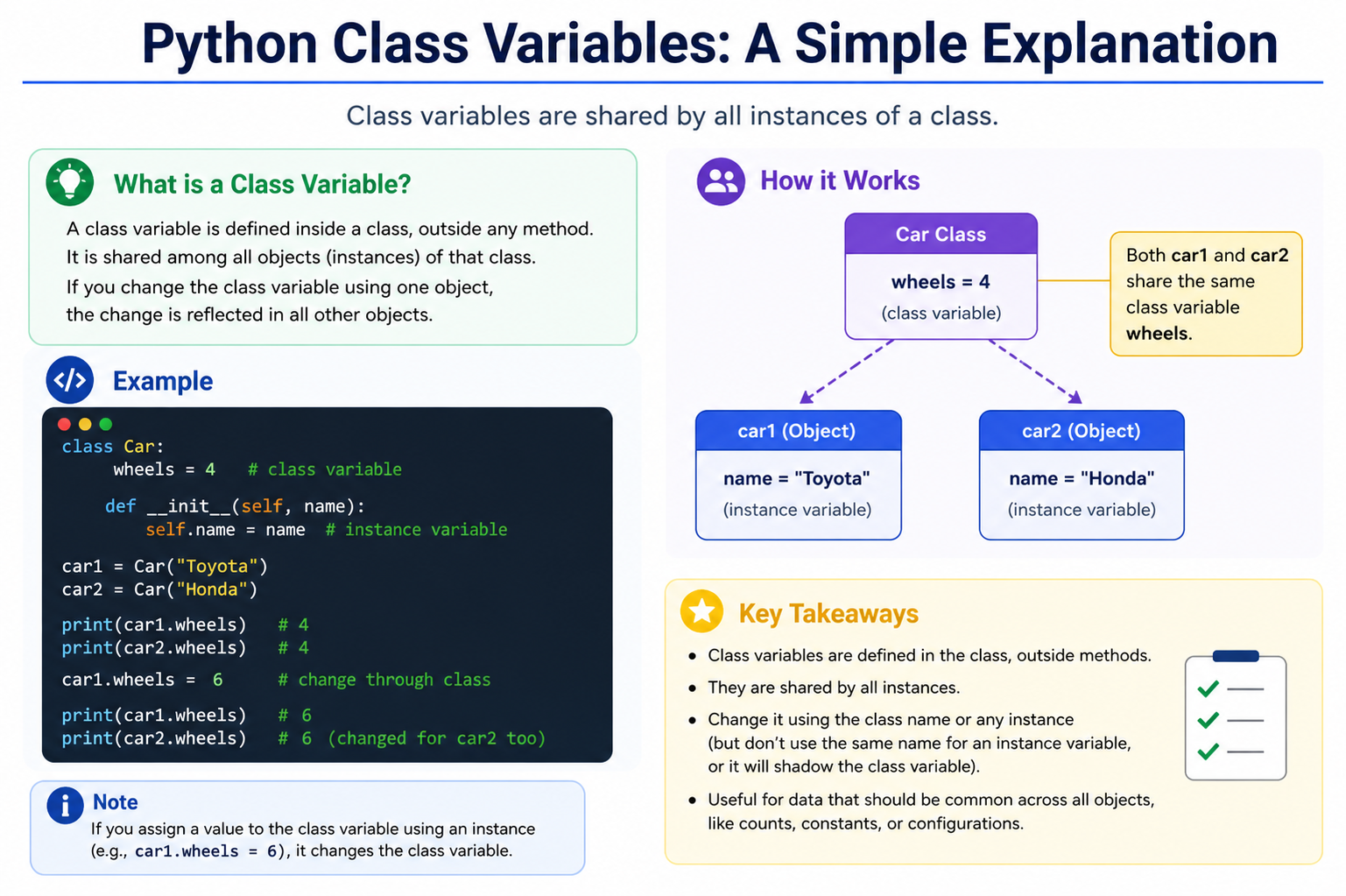
Python is built around the idea of classes and objects, which allow developers to model real-world things in a structured way. One of the most important concepts inside classes is class variables. Understanding class variables clearly helps you write better object-oriented code, avoid common mistakes, and design programs that are both efficient and easy to maintain.
Understanding the Concept of Class Variables
Class variables are variables that are shared across all instances of a class. This means that instead of each object having its own separate copy of a variable, all objects created from the same class share the same value for that variable.
When you define a variable inside a class but outside any instance methods, it becomes a class variable. It belongs to the class itself rather than to any specific object. Because of this, if one object changes the value of a class variable, that change is reflected in all other objects of the same class.
This shared nature makes class variables useful when you want to maintain data that is common to all instances, such as a counter, a configuration setting, or any value that should remain consistent across all objects.
Difference Between Class Variables and Instance Variables
To truly understand class variables, it is important to compare them with instance variables. Instance variables are defined inside methods, usually inside the constructor, and they belong to individual objects. Each object gets its own separate copy of instance variables, meaning changes in one object do not affect others.
Class variables, on the other hand, are defined directly inside the class body and are shared among all instances. This distinction is very important because mixing up the two can lead to unexpected behavior in your program.
For example, if you create a class representing a car, and you define a class variable for the number of wheels, all car objects will share that same value. But if you define a variable for color inside the constructor, each car can have its own color.
How Class Variables Work in Memory
When a class is created in Python, it acts as a blueprint. Class variables are stored in a special memory area associated with the class itself, not with individual objects. When an object tries to access a variable, Python first checks if that variable exists in the object’s own namespace. If it does not find it there, it looks in the class namespace.
This lookup process is what allows class variables to be shared. Since they exist at the class level, all objects can access them without needing their own copy.
If an object modifies a class variable directly through the class, the change affects all instances. However, if an object assigns a new value to what looks like a class variable using the object itself, Python creates a new instance variable with the same name, which can sometimes lead to confusion.
Creating Class Variables in Python
Defining class variables is simple. You just declare them inside the class but outside any method. These variables are typically initialized at the top of the class definition for clarity.
Once defined, they can be accessed using either the class name or an instance of the class. However, using the class name is considered the best practice when you want to make it clear that the variable is shared across all instances.
Class variables are especially useful when you want to keep track of data that is common to all objects, such as the total number of instances created or a constant value used in calculations.
Accessing Class Variables
There are two main ways to access class variables. The first is through the class name, and the second is through an object instance. Both methods work, but they behave slightly differently when it comes to modification.
Accessing through the class name ensures that you are referring directly to the shared variable. Accessing through an object can sometimes create confusion if you accidentally assign a new value, because it may create an instance variable instead of modifying the class variable.
Because of this behavior, developers often prefer using the class name when working with class variables, especially when making changes.
Modifying Class Variables
Changing a class variable should be done carefully. If you modify it using the class name, the change affects all instances of the class. This is because the variable is stored at the class level.
However, if you modify it using an instance of the class, Python may create a new instance variable instead, which shadows the class variable. This means the original class variable remains unchanged, but that specific object now has its own version of the variable.
This subtle difference is one of the most common sources of confusion for beginners. Understanding how Python handles variable scope inside classes is essential to avoid unexpected results.
Practical Use of Class Variables
Class variables are commonly used in real-world applications where shared data is needed. One common example is tracking how many objects of a class have been created. Each time a new object is created, the class variable can be incremented to reflect the total count.
Another example is storing constants that apply to all objects, such as default values, configuration settings, or fixed parameters used in calculations.
They are also useful in scenarios where resources need to be shared, such as connection pools or shared counters in simulations.
Why Class Variables Are Important
Class variables help reduce memory usage because they avoid duplicating the same data for every object. Instead of storing multiple copies of the same value, Python stores it once at the class level.
This makes programs more efficient, especially when dealing with a large number of objects. It also ensures consistency, since all objects refer to the same shared value.
In addition, class variables make code easier to manage when certain values need to remain consistent across all instances.
Common Mistakes with Class Variables
One of the most common mistakes is accidentally creating instance variables when trying to modify class variables. This happens when developers assign a value using an object instead of the class name.
Another mistake is assuming that class variables behave like instance variables. Since they are shared, changing them affects all objects, which may not always be the intended behavior.
It is also easy to misuse class variables for data that should actually belong to individual objects. In such cases, instance variables are more appropriate.
Best Practices for Using Class Variables
To use class variables effectively, it is important to clearly distinguish when shared data is needed. If a value should be common to all objects, a class variable is appropriate. If each object needs its own version, an instance variable should be used instead.
It is also a good practice to access class variables using the class name rather than through instances. This makes the code clearer and reduces the risk of unintended behavior.
Keeping class variables properly organized and well-documented inside the class definition also improves readability and maintainability.
Class variables are a powerful feature of Python’s object-oriented programming system. They allow developers to store and manage data that is shared across all instances of a class, making programs more efficient and organized.
By understanding how they differ from instance variables, how they behave in memory, and how to use them correctly, you can avoid common mistakes and write cleaner, more predictable code.
Mastering class variables is an important step toward becoming comfortable with Python classes and object-oriented design, as they play a key role in structuring scalable and reusable programs.
Python Class Variables: Deeper Understanding and Behavior
Building on the basic idea of class variables, it is important to explore how they behave in more complex situations. Once you start working with multiple classes, inheritance, and larger applications, class variables can behave in ways that are not immediately obvious. Understanding these deeper behaviors helps you write more predictable and stable Python programs.
Class variables are not just simple shared storage; they are part of Python’s attribute lookup system. When you access a variable from an object, Python follows a specific order: it first checks the instance, and if it does not find the variable there, it checks the class. This lookup chain is what makes class variables powerful but also slightly tricky when not fully understood.
Because of this behavior, class variables can be overridden unintentionally. If you assign a value to a variable using an instance, Python may stop using the shared class variable for that specific object and instead create a new instance-level variable with the same name. This is why understanding attribute resolution is essential when working with class variables.
Attribute Lookup and Shadowing in Python
One of the most important behaviors to understand is shadowing. Shadowing happens when an instance variable hides a class variable with the same name. Even though the class variable still exists, the instance variable takes priority for that specific object.
This means that two objects from the same class can behave differently if one of them has shadowed a class variable. This can lead to confusion if you assume both objects are still using the shared value.
Python’s flexibility allows this behavior, but it requires careful coding discipline. When consistency is needed, developers usually avoid creating instance variables with the same name as class variables.
Understanding shadowing is especially important when debugging programs, because it can make it look like a class variable has changed when in reality only one object has overridden it locally.
Class Variables in Inheritance
Inheritance adds another layer of complexity to class variables. When a class inherits from another class, it also inherits its class variables. This means the child class can access and use the same shared variables defined in the parent class.
However, if the child class modifies a class variable, it does not always affect the parent class. Instead, Python may create a separate version of that variable for the child class, depending on how it is modified.
This behavior allows flexibility but can also cause unexpected results if not carefully managed. For example, two related classes might end up with different versions of what was originally intended to be a shared variable.
It is important to understand that class variables in inheritance are not automatically deeply linked across all levels unless explicitly managed. Each class in the hierarchy can maintain its own version of a class variable.
Shared State and Its Impact on Programs
Class variables introduce the idea of shared state. Shared state means that multiple objects rely on the same data source. While this can be useful, it also introduces risks if not handled properly.
When multiple objects modify the same class variable, those changes are reflected everywhere. This can lead to unexpected side effects if different parts of a program modify the same shared value without coordination.
For example, in a program tracking active users or counting objects, class variables work very well. But in cases where each object should behave independently, using class variables incorrectly can lead to bugs that are difficult to trace.
Because of shared state, class variables require careful design decisions. Developers must decide whether data truly needs to be shared or whether it should remain isolated within each object.
When to Use Class Variables
Class variables are best used when data logically belongs to the class as a whole rather than to individual objects. This includes constants, shared settings, or counters that track how many instances exist.
They are also useful when implementing caching mechanisms or shared configuration values that should remain consistent across all instances.
Another appropriate use is when designing utility classes where all objects are expected to behave in the same way and rely on the same shared information.
However, if data varies from object to object, instance variables are the better choice. Using class variables in such cases can lead to unintended coupling between objects.
The key idea is to think about ownership of data. If the data belongs to the concept represented by the class itself, use a class variable. If it belongs to individual objects, use instance variables.
Class Variables and Memory Efficiency
One of the advantages of class variables is memory efficiency. Since class variables are stored only once at the class level, they do not consume additional memory for each object created.
This becomes especially important when creating a large number of objects. Instead of duplicating the same value thousands or millions of times, Python stores it once and shares it across all instances.
This design helps optimize performance and reduces unnecessary memory usage. In large-scale applications, this can make a significant difference in resource consumption.
However, memory efficiency should not be the only reason to use class variables. Correct design and logical structure should always come first, with efficiency as a secondary benefit.
Debugging Issues with Class Variables
Debugging class variables can sometimes be challenging because of their shared nature. One common issue is when a variable appears to change unexpectedly across objects.
This often happens when one object modifies a class variable, affecting all others. Another common issue is shadowing, where an instance variable hides the class variable, making it seem like the class variable is not updating.
To debug such issues, it is important to check whether a variable belongs to the instance or the class. Understanding where the variable is stored helps identify why it is behaving a certain way.
Careful naming conventions and consistent access patterns can reduce debugging difficulties. Using class names explicitly when modifying class variables can also help avoid confusion.
Design Considerations for Class Variables
Good software design requires careful thinking about when and how to use class variables. They should not be used simply for convenience. Instead, they should represent true shared state across all instances.
When designing a class, it is helpful to ask whether a value should logically be the same for every object. If the answer is yes, a class variable is appropriate. If not, it should be an instance variable.
It is also important to consider future changes. A variable that seems shared now might need to become object-specific later. In such cases, starting with instance variables might be safer.
Good design reduces the risk of tightly coupled objects and makes the code easier to extend and maintain.
Advanced Behavior in Large Systems
In larger systems, class variables can interact in complex ways with modules, multiple classes, and frameworks. Because Python allows dynamic modification of classes, class variables can sometimes be changed at runtime, affecting all dependent objects instantly.
This dynamic behavior can be powerful but also risky. In large applications, uncontrolled changes to class variables can lead to system-wide side effects.
For this reason, many developers treat class variables as semi-constant values unless there is a strong reason to modify them. This helps maintain stability in complex systems.
In frameworks and libraries, class variables are often used for configuration defaults that can be overridden carefully when needed.
Class variables are a fundamental part of Python’s object-oriented system. They provide a way to share data across all instances of a class, making programs more efficient and structured.
However, their shared nature also introduces complexity. Understanding how they interact with instance variables, inheritance, and Python’s attribute lookup system is essential for using them correctly.
When used properly, class variables simplify design and reduce redundancy. When used incorrectly, they can introduce subtle bugs and unexpected behavior.
Mastering class variables is not just about learning syntax, but about understanding design principles and how data flows within object-oriented programs.
Python Class Variables: Practical Patterns and Real Usage
After understanding the basics and deeper behavior of class variables, it becomes important to see how they are actually used in real programming patterns. In practical Python development, class variables often appear in situations where coordination, shared tracking, or consistent configuration is required across multiple objects.
One of the most common real-world patterns is using a class variable as a counter. Every time a new object is created, the constructor updates this shared variable to keep track of how many instances exist. This pattern is widely used in systems that need monitoring, logging, or resource tracking. Since the variable belongs to the class, it automatically reflects the total number of objects created, regardless of which instance updates it.
This approach is simple but powerful because it avoids the need for external tracking mechanisms. However, it also requires careful handling to ensure the counter is updated consistently and not accidentally reset or overridden by individual instances.
Using Class Variables for Shared Configuration
Class variables are also commonly used to store configuration values that should remain consistent across all objects. Instead of passing the same configuration to every instance, the class can define default values that apply universally.
This is especially useful in applications where many objects need to behave in a standardized way. For example, a class might define default settings for formatting, limits, or thresholds that all instances should follow unless explicitly changed.
By using class variables for configuration, developers reduce repetition and ensure consistency across the system. If a change is needed, updating the class variable automatically affects all existing and future instances.
However, this also means that changes must be made carefully. Since all objects depend on the same value, an unintended modification can affect the entire program behavior.
Class Variables in Tracking Shared Resources
Another important use of class variables is tracking shared resources. In applications where objects interact with limited resources, such as connections, sessions, or shared data pools, class variables can help maintain control.
For example, a class might track how many active connections exist at any given time. Each time an object opens or closes a connection, the class variable is updated accordingly. This helps ensure that the system remains within safe operational limits.
This pattern is especially useful in server applications, simulations, and resource management systems. It provides a centralized way to monitor global state without needing separate tracking structures.
However, when multiple objects modify the same resource counter, synchronization becomes important in more advanced systems, especially in multi-threaded environments.
Behavior of Class Variables in Object Interaction
When multiple objects interact with the same class variable, their behavior becomes interconnected. This interconnection is powerful but must be understood clearly to avoid unintended consequences.
If one object modifies a class variable, all other objects immediately see the updated value. This shared visibility can be useful in cases like global settings, but it can also create hidden dependencies between objects.
These dependencies can make debugging more difficult because changes in one part of the program may affect seemingly unrelated objects. For this reason, developers often document class variables carefully when they are used in shared interactions.
Understanding this behavior helps in designing systems where objects either cooperate through shared state or remain independent depending on the requirement.
Class Variables in Object-Oriented Design Patterns
In object-oriented design, class variables often support patterns where shared state is necessary. For example, in factory-like structures, class variables can be used to control object creation behavior or enforce limits.
They can also support singleton-like behavior where a class maintains a single shared state across all instances. While Python does not enforce strict design patterns, class variables help simulate these behaviors when needed.
Another pattern involves using class variables to define constants or default templates that guide object behavior. This ensures that all objects follow a consistent structure while still allowing instance-level customization.
These design patterns show how class variables act as a bridge between rigid structure and flexible behavior in Python.
Common Pitfalls in Real Applications
In real-world projects, misuse of class variables often leads to subtle bugs. One common issue occurs when developers assume that modifying a variable in one object will not affect others, not realizing it is a shared class variable.
Another frequent problem arises when instance variables unintentionally override class variables. This can lead to inconsistent behavior across objects, especially in large codebases where tracking variable origin becomes difficult.
Sometimes developers also overuse class variables for data that should actually be instance-specific. This creates unnecessary coupling between objects and reduces modularity.
These pitfalls highlight the importance of clearly distinguishing between shared and individual state when designing classes.
Debugging and Inspecting Class Variables
When working with class variables in complex systems, debugging becomes an essential skill. One useful approach is to inspect whether a variable belongs to the class or the instance at runtime.
Understanding where Python stores a variable helps determine why it is behaving a certain way. If a variable exists in an instance dictionary, it means it is instance-specific. If it exists only in the class, it is shared.
This distinction is crucial when tracking unexpected behavior. Many issues that appear confusing at first are often the result of shadowing or unintended instance assignment.
Careful inspection of object attributes can quickly reveal whether the program is using shared or individual data.
Class Variables in Long-Term Code Maintenance
As programs grow, class variables can either simplify or complicate maintenance depending on how they are used. When used correctly, they reduce redundancy and make shared logic easier to manage.
However, when overused or poorly structured, they can create hidden dependencies that make the code harder to modify safely. A small change in a class variable can ripple through the entire system if not properly controlled.
For long-term maintainability, it is important to document class variables clearly and ensure their purpose is well understood by anyone working on the code.
Good naming conventions also help reduce confusion. Names that clearly indicate shared behavior make it easier to distinguish class variables from instance variables.
Balancing Flexibility and Control
One of the key challenges in using class variables is balancing flexibility with control. On one hand, they provide a powerful way to share data across objects. On the other hand, they introduce the risk of unintended global changes.
Finding the right balance depends on the design of the system. In some cases, shared state is necessary and beneficial. In others, isolation between objects is more important.
Experienced developers often evaluate this trade-off carefully before deciding to use class variables. They consider how changes will propagate and whether shared behavior aligns with the system’s goals.
In practical Python programming, class variables are not just a theoretical concept but a tool for structuring shared behavior. They help manage global state within a class, reduce redundancy, and support consistent behavior across multiple objects.
However, their power comes with responsibility. Because they are shared, they can easily introduce unexpected interactions if not carefully managed.
Understanding how to use class variables effectively is a key step toward writing clean, scalable, and maintainable object-oriented Python code.
Python Class Variables: Advanced Insights and Best Practices
As you move further into Python programming, class variables start playing a more subtle but important role in how well-structured your code becomes. At this stage, it is not just about knowing what class variables are, but understanding how to use them responsibly in larger and more complex systems.
One of the most important advanced ideas is recognizing that class variables should represent stable, shared information. They work best when the value is meant to be consistent across all instances and does not frequently change based on individual object behavior. When this principle is ignored, class variables can quickly become a source of confusion and hidden bugs.
In well-designed systems, class variables are often treated as semi-static values. This means they are either constant or changed only in controlled situations. By keeping them stable, you reduce the risk of unexpected side effects spreading across multiple objects.
Controlling Access to Class Variables
In advanced Python design, controlling how class variables are accessed becomes very important. Even though Python does not enforce strict access restrictions, developers often follow conventions to signal how a variable should be used.
Class variables that are intended for internal use are often treated carefully and modified only within class methods. This helps maintain control over how shared data changes over time. Instead of allowing direct modification from outside the class, controlled methods can be used to update values safely.
This approach improves reliability because it ensures that any change to a class variable follows predefined rules. It also makes debugging easier since changes are not happening randomly across the codebase.
Class Variables and Encapsulation Principles
Encapsulation is one of the core principles of object-oriented programming, and class variables must be handled carefully within this concept. While class variables are shared, they should still be managed in a way that protects the internal logic of the class.
Good encapsulation means that even shared data should not be freely modified without understanding its impact. By limiting direct access and encouraging controlled modification, you maintain better structure in your program.
This is especially important in large applications where multiple developers may be working on the same code. Without proper encapsulation, class variables can become a weak point in system design.
Dynamic Nature of Class Variables
One of the powerful features of Python is that class variables are dynamic. They can be changed at runtime, added, or even removed. This flexibility allows developers to adjust class behavior while the program is running.
However, this dynamic nature should be used carefully. Changing class variables at runtime can affect all active objects immediately, which may lead to unpredictable results if not managed properly.
In advanced systems, runtime modification of class variables is usually reserved for configuration updates or controlled state changes. It is not typically used for frequent or uncontrolled updates.
Understanding this dynamic behavior helps you design systems that take advantage of flexibility without sacrificing stability.
Class Variables in Multi-Class Systems
When working with multiple interacting classes, class variables can create interesting relationships between different parts of a system. Sometimes, related classes may share similar class variables, but each class still maintains its own independent version.
This separation allows for structured design where each class controls its own shared state without interfering with others. However, confusion can arise when developers assume that class variables are globally shared across all classes, which is not the case.
Each class maintains its own namespace, so class variables are shared only within that class and its instances unless explicitly shared through inheritance or external references.
Understanding this separation is important when designing modular systems with multiple components.
Performance Considerations of Class Variables
From a performance perspective, class variables can contribute to more efficient programs. Since they are stored once per class, they reduce memory overhead when many objects need access to the same data.
This efficiency becomes more noticeable in large-scale systems where thousands or millions of objects are created. Instead of duplicating data, class variables ensure that only one copy exists in memory.
However, performance benefits should not be the primary reason for using class variables. The main consideration should always be logical correctness and design clarity. Performance improvements are a secondary advantage that come naturally when class variables are used appropriately.
Threading and Concurrency Concerns
In more advanced Python applications, especially those involving threading, class variables introduce additional challenges. Since they are shared across all instances, multiple threads may try to modify the same variable at the same time.
This can lead to race conditions where the final value of a class variable depends on the timing of thread execution. Without proper synchronization, this can cause inconsistent or incorrect results.
To handle such situations, developers often use locking mechanisms or design patterns that avoid direct concurrent modification of shared state. In some cases, class variables are avoided entirely in multi-threaded environments unless carefully controlled.
Understanding this limitation is crucial when designing systems that require concurrency.
Testing and Class Variables
Testing code that uses class variables requires special attention. Since class variables retain their state across instances, tests may interfere with each other if the shared state is not reset properly between test cases.
This can lead to false positives or false negatives in testing results. To avoid this, developers often reset class variables at the beginning or end of test cases to ensure isolation.
Proper test design ensures that class variables do not introduce hidden dependencies between tests. This improves reliability and makes debugging easier when issues arise.
Refactoring Code with Class Variables
As projects evolve, it is common to refactor class variables to improve structure or clarity. Sometimes a variable that was initially shared may need to become instance-specific, or vice versa.
Refactoring requires careful analysis of how the variable is used throughout the system. Changing a class variable to an instance variable affects how data is shared and may require updates across multiple parts of the code.
Good refactoring practices involve gradually transitioning variables and testing behavior at each step to ensure consistency is maintained.
This process helps improve long-term code quality and reduces technical debt.
Design Philosophy Behind Class Variables
At a deeper level, class variables reflect a design philosophy about shared identity. They represent information that belongs to the concept of the class itself rather than to individual objects.
This idea is important because it shapes how you think about program structure. Instead of focusing only on objects as isolated entities, you begin to see the relationship between objects and their shared context.
This perspective helps in designing systems that are more natural and aligned with real-world modeling. It encourages thoughtful decisions about what should be shared and what should remain unique.
Evolving Understanding of Class Variables
As your experience with Python grows, your understanding of class variables also evolves. At first, they may seem like simple shared storage, but over time you begin to see their role in architecture, performance, and system design.
They are not just variables inside a class; they are tools for managing shared behavior and global state within object-oriented systems. When used thoughtfully, they can simplify design. When used carelessly, they can complicate it.
This evolving understanding is part of becoming a more skilled Python developer.
Final Perspective on Mastering Class Variables
Mastering class variables is not about memorizing rules, but about developing intuition for when shared state is appropriate. It involves understanding how Python manages attributes, how objects interact with shared data, and how design decisions affect program behavior.
With practice, you begin to recognize patterns where class variables naturally fit and situations where they should be avoided. This balance between shared and independent state is a key part of writing clean, scalable Python code.
Class variables, when properly understood and applied, become a powerful tool in your programming toolkit, helping you build systems that are both efficient and well-structured.
Conclusion
Class variables in Python play an important role in object-oriented programming by enabling data to be shared across all instances of a class. They provide a way to maintain common information, reduce memory usage, and ensure consistency when multiple objects need access to the same value.
However, their shared nature also requires careful handling. Since class variables are accessible to every instance, any change can affect the entire class behavior. This makes it essential to clearly understand when to use class variables and when instance variables are more appropriate.
A strong understanding of how Python resolves attributes, how shadowing works, and how class variables behave in inheritance helps prevent common mistakes. These concepts ensure that your programs remain predictable and easier to debug, especially as they grow in size and complexity.
When used correctly, class variables help create clean and efficient designs where shared data is managed in a controlled and meaningful way. They are especially useful for constants, counters, configuration settings, and other values that naturally belong to the class rather than individual objects.
Ultimately, mastering class variables is about developing good design judgment. It is not just about syntax, but about understanding structure, responsibility, and data flow within your programs.