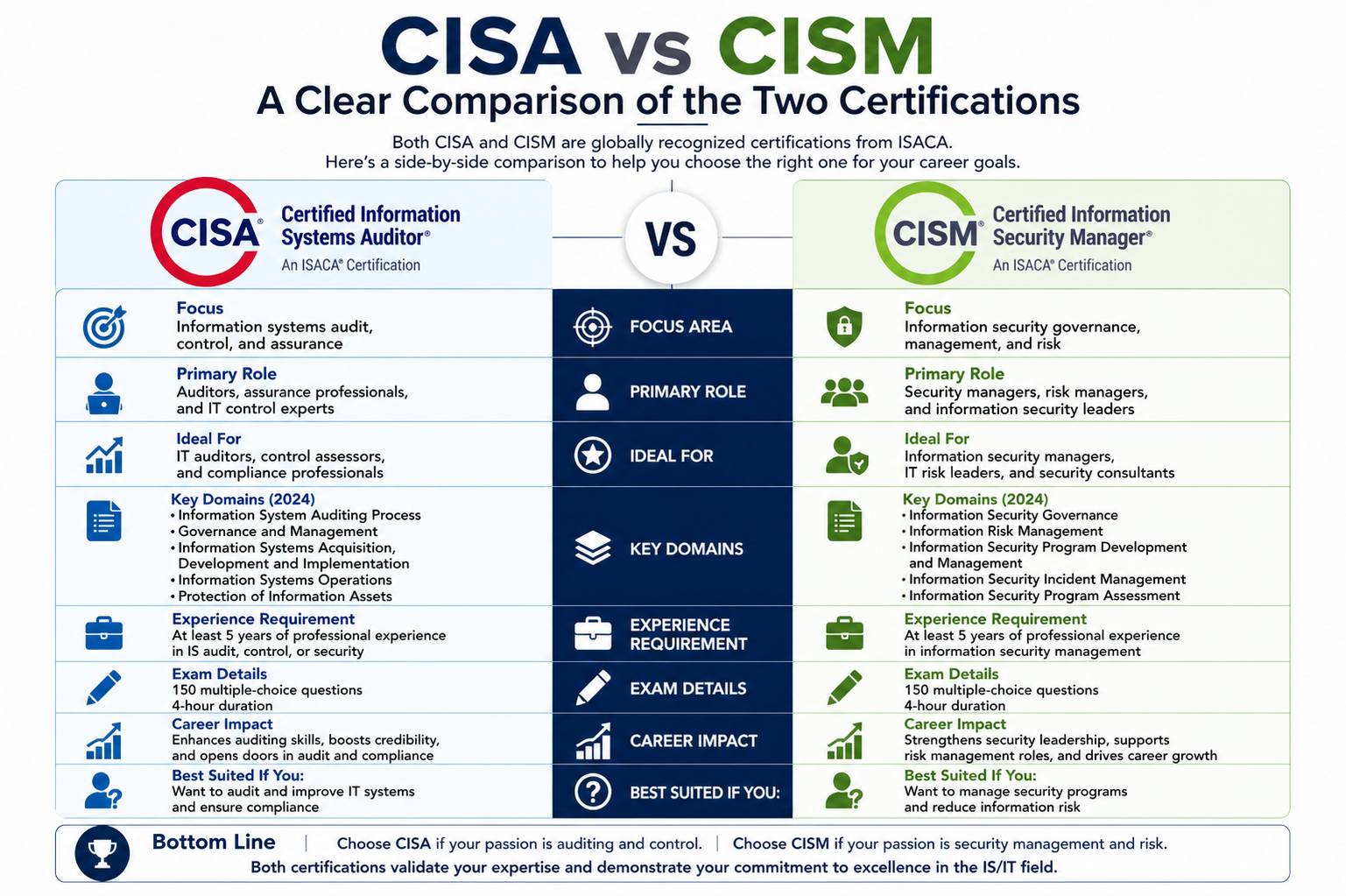
In today’s digital-driven world, organizations rely heavily on secure information systems to protect sensitive data, maintain business continuity, and ensure trust with clients and stakeholders. As cyber threats continue to evolve, the demand for skilled professionals in information security has grown significantly. Among the most recognized certifications in this field are CISA and CISM, both offered to validate expertise but designed for different professional roles and career directions. Understanding the distinction between these two certifications is essential for anyone planning to build a strong career in IT governance, auditing, or security management.
Understanding CISA in Detail
CISA is a globally recognized certification focused on the auditing, control, and assurance of information systems. It is designed for professionals who are responsible for assessing an organization’s IT environment and ensuring that systems are properly managed, protected, and aligned with industry standards. Individuals with this certification are often involved in evaluating risks, reviewing internal controls, and providing assurance that information systems are operating effectively and securely.
CISA emphasizes a deep understanding of how information systems function within an organization. It is not just about technical knowledge but also about evaluating processes, identifying weaknesses, and recommending improvements. Professionals with CISA certification play a critical role in ensuring that organizations comply with regulations and maintain strong internal control systems.
Core Domains of CISA
The CISA certification covers several key areas that define its structure and purpose. These include the process of auditing information systems, governance and management of IT, acquisition and implementation of systems, operations and business resilience, and protection of information assets. Each of these domains focuses on different aspects of auditing and control, ensuring that certified professionals are well-rounded in evaluating complex IT environments.
These domains are designed to test both conceptual understanding and practical application. A CISA professional is expected to not only understand theoretical frameworks but also apply them in real-world audit scenarios. This makes the certification highly valuable for roles that require analytical thinking and attention to detail.
Skills Developed Through CISA
Professionals who pursue CISA develop a strong set of analytical and technical auditing skills. They gain the ability to assess risk, evaluate internal controls, and identify vulnerabilities within information systems. In addition, they learn how to conduct audits in a structured and systematic manner, ensuring that organizations maintain compliance with industry standards and regulatory requirements.
Another important skill developed through CISA is reporting and communication. Since auditors must present their findings to management and stakeholders, the ability to clearly communicate risks and recommendations is essential. This combination of technical and communication skills makes CISA professionals highly valuable in governance and compliance roles.
Who Should Choose CISA
CISA is ideal for individuals who are interested in auditing, compliance, and risk assessment within IT environments. It is particularly suitable for professionals working in internal audit departments, IT governance roles, or consultancy positions that involve evaluating system controls and processes. Those who enjoy analyzing systems, identifying weaknesses, and ensuring organizational compliance will find CISA aligned with their career goals.
Understanding CISM in Detail
CISM is a certification focused on information security management rather than auditing. It is designed for professionals who are responsible for building, managing, and overseeing an organization’s overall security strategy. Unlike CISA, which emphasizes evaluation and assessment, CISM focuses on leadership, planning, and governance of security programs.
CISM professionals play a strategic role in organizations by ensuring that security policies are aligned with business objectives. They are responsible for designing frameworks that protect information assets while also supporting operational efficiency. This makes CISM more suited for managerial and leadership positions in cybersecurity.
Core Domains of CISM
The CISM certification is structured around key domains that include information security governance, risk management, security program development, and incident management. These areas focus on how organizations design and maintain a strong security posture across all levels of operation.
Information security governance ensures that security strategies align with business goals. Risk management focuses on identifying and mitigating potential threats. Security program development involves creating and implementing policies and controls, while incident management deals with responding to and recovering from security breaches. Together, these domains provide a comprehensive understanding of managing security at an organizational level.
Skills Developed Through CISM
CISM professionals develop strong leadership and strategic planning skills. They learn how to design security frameworks, manage risk at an organizational level, and coordinate responses to security incidents. In addition to technical understanding, they also gain expertise in aligning security initiatives with business objectives.
Communication and decision-making skills are also critical for CISM professionals. Since they often work in leadership roles, they must be able to communicate security risks and strategies to executives and stakeholders in a clear and effective manner. This makes CISM particularly valuable for those aspiring to move into management positions within cybersecurity.
Who Should Choose CISM
CISM is best suited for professionals who aim to take on managerial or leadership roles in information security. It is ideal for individuals responsible for overseeing security teams, managing organizational risk, and developing long-term security strategies. Those who prefer strategic thinking and leadership over technical auditing will find CISM more aligned with their career aspirations.
CISA vs CISM Key Differences Explained
Although both certifications belong to the field of information security, their core focus areas are quite different. CISA is centered on auditing and evaluating information systems, while CISM is focused on managing and governing security programs. One is more operational and assessment-driven, while the other is strategic and leadership-oriented.
CISA professionals act as evaluators who ensure systems are secure and compliant, whereas CISM professionals act as planners and decision-makers who design security strategies for organizations. This fundamental difference shapes the type of work, responsibilities, and career paths associated with each certification.
Career Paths and Opportunities
CISA certification opens doors to careers in IT auditing, compliance, risk analysis, and internal control assessment. Professionals often work in audit firms, financial institutions, government agencies, and large corporations where system evaluation is critical. Their role is to ensure that IT systems are secure, efficient, and compliant with regulations.
CISM certification leads to careers in information security management, cybersecurity leadership, and risk governance. Professionals often work as security managers, chief information security officers, and security consultants. Their responsibilities include designing security frameworks, managing teams, and ensuring organizational resilience against cyber threats.
Industry Demand and Relevance
Both certifications are highly valued in the industry, but their demand varies based on organizational needs. CISA is in demand in sectors where compliance and auditing are critical, such as finance, banking, and consulting. Organizations in these sectors require professionals who can ensure systems meet strict regulatory standards.
CISM is in high demand in industries that prioritize cybersecurity leadership and strategic risk management. As cyber threats become more sophisticated, organizations increasingly need professionals who can design and oversee comprehensive security programs. This makes CISM particularly relevant for senior-level security roles.
Which Certification is More Difficult
The difficulty level of CISA and CISM depends on an individual’s background and career experience. CISA may be more challenging for those without auditing or technical experience, as it requires a strong understanding of IT systems and control frameworks. CISM, on the other hand, may be more complex for individuals who lack managerial or strategic experience in security governance.
Both certifications require dedication, preparation, and a solid understanding of information security principles. However, they test different skill sets, making the perceived difficulty subjective based on professional background.
Salary and Growth Potential
Professionals with either certification can expect strong salary prospects and career growth opportunities. CISA holders often see growth in audit, compliance, and risk management roles, while CISM holders typically advance into leadership and executive positions within cybersecurity.
Organizations value both certifications highly, as they address different but equally important aspects of information security. This ensures that professionals with either credential remain in demand across various industries.
How CISA and CISM Fit Into Organizational Structure
Within an organization, CISA and CISM professionals typically operate at different levels of responsibility, even though both contribute to strengthening information security. CISA professionals are usually positioned in audit departments, compliance teams, or risk management units. Their primary role is to independently evaluate how well IT systems and controls are functioning. They act as objective reviewers who assess whether processes are secure, efficient, and compliant with internal policies and external regulations.
CISM professionals, in contrast, are often placed within security leadership teams or directly under senior management. Their responsibilities are more strategic and long-term in nature. Instead of reviewing existing systems, they focus on building and maintaining a strong security framework for the entire organization. They guide policies, manage teams, and ensure that security initiatives are aligned with business priorities.
This difference in placement within an organizational structure highlights the fundamental distinction between the two certifications. One is assessment-driven, while the other is leadership-driven.
CISA Role in IT Governance and Compliance
CISA plays a crucial role in IT governance, especially in environments where compliance and regulatory requirements are strict. Organizations depend on CISA-certified professionals to ensure that their systems meet industry standards and legal obligations. These professionals evaluate whether internal controls are properly designed and effectively implemented.
In many cases, CISA professionals also help organizations prepare for external audits. They identify weaknesses before regulators or third-party auditors do, allowing companies to address issues proactively. This preventive approach reduces risk and strengthens overall system integrity.
CISA holders also contribute to improving operational efficiency by identifying gaps in processes and recommending improvements. Their insights help organizations reduce errors, enhance data security, and optimize IT performance.
CISM Role in Strategic Security Leadership
CISM professionals operate at a higher strategic level, focusing on how security aligns with business goals. They are responsible for designing security programs that protect information assets while supporting organizational growth. This involves balancing security requirements with operational needs, ensuring that security measures do not hinder productivity.
They also play a key role in decision-making processes related to cybersecurity investments, risk tolerance, and incident response strategies. CISM professionals often collaborate with executive leadership to define security priorities and allocate resources effectively.
Another important aspect of their role is managing security teams. They ensure that employees follow established security policies and that the organization is prepared to respond to emerging threats. This leadership responsibility makes CISM a critical certification for those aiming to work in senior cybersecurity positions.
Differences in Career Progression
The career paths associated with CISA and CISM certifications differ significantly. CISA professionals often begin their careers in entry-level or mid-level audit roles and gradually progress to senior auditor, IT risk manager, or compliance manager positions. Over time, they may move into roles such as IT audit director or internal audit head.
CISM professionals typically follow a leadership-oriented career path. They may start as security analysts or engineers and then progress into roles such as security manager, risk manager, and eventually chief information security officer (CISO). Their career growth is more focused on management, strategy, and organizational leadership.
These distinct career trajectories reflect the fundamental difference between the certifications. One builds a path toward audit expertise, while the other builds a path toward executive security leadership.
CISA and CISM in Risk Management
Risk management is a critical area where both certifications contribute, but in different ways. CISA professionals assess risks by examining systems, identifying vulnerabilities, and evaluating control effectiveness. Their focus is on detecting potential issues and ensuring that risks are properly managed through controls and procedures.
CISM professionals, on the other hand, are responsible for developing and implementing risk management strategies. They decide how much risk an organization is willing to accept and design policies to mitigate those risks. Their role is more about planning and controlling risk at a strategic level rather than simply identifying it.
Together, both roles complement each other by ensuring that risks are both identified and properly managed within an organization.
Technical vs Managerial Focus
One of the most important differences between CISA and CISM is their focus on technical versus managerial responsibilities. CISA has a stronger technical and analytical orientation. It requires professionals to understand system architecture, audit methodologies, and control mechanisms. The focus is on examining how systems work and ensuring they meet required standards.
CISM is more managerial and strategic in nature. It emphasizes leadership, governance, and decision-making. Instead of diving deep into technical system details, CISM professionals focus on broader organizational security issues and long-term planning.
This distinction makes CISA more suitable for individuals who enjoy detailed analysis and technical evaluation, while CISM is better suited for those who prefer leadership and strategic roles.
Preparation Approach for Both Certifications
Preparing for CISA typically requires a strong understanding of IT auditing principles, control frameworks, and system evaluation techniques. Candidates must study how information systems operate and how to assess their effectiveness. Practical experience in auditing or IT control environments is highly beneficial.
CISM preparation, on the other hand, focuses more on security management concepts, risk governance, and organizational strategy. Candidates need to understand how to design security programs, manage incidents, and align security with business objectives. Experience in security management or leadership roles can significantly help in understanding the concepts.
Both certifications require disciplined study and practical knowledge, but the nature of preparation differs based on their focus areas.
Global Recognition and Industry Value
Both CISA and CISM are globally recognized certifications and are respected across industries. Organizations value these certifications because they demonstrate a professional’s ability to handle critical aspects of information security, whether it is auditing systems or managing security programs.
CISA is widely recognized in industries that emphasize compliance and regulatory adherence, such as banking, insurance, and government sectors. CISM is highly valued in industries that prioritize cybersecurity leadership and strategic risk management, including technology companies, large enterprises, and multinational corporations.
The global recognition of both certifications ensures strong career opportunities for professionals regardless of geographic location.
Long-Term Career Impact
Over the long term, both certifications can significantly enhance career growth and professional credibility. CISA helps professionals build deep expertise in auditing and compliance, which can lead to stable and specialized career paths. It establishes individuals as trusted experts in evaluating IT systems and ensuring organizational accountability.
CISM, however, positions professionals for leadership roles with higher responsibility and decision-making authority. It opens doors to executive positions where individuals shape the overall security strategy of organizations. This makes it particularly valuable for those aiming for senior management or C-level roles.
Both certifications contribute to long-term success, but they do so in different ways depending on career aspirations.
Real-World Application of CISA Skills
In real-world environments, CISA-certified professionals are deeply involved in evaluating how well an organization’s IT systems are functioning. They are often assigned to conduct audits that review security controls, data integrity processes, and operational procedures. Their work helps ensure that systems are not only secure but also efficient and aligned with business objectives.
For example, in a financial institution, a CISA professional may examine how transaction data is processed and stored. They would check whether proper controls are in place to prevent fraud, unauthorized access, or data manipulation. If any weaknesses are found, they provide recommendations to improve the system’s security posture.
CISA professionals are also heavily involved in regulatory compliance audits. Many industries require strict adherence to laws and standards, and CISA holders ensure that organizations meet these requirements. This makes them essential in preventing legal issues and maintaining trust with customers and regulators.
Real-World Application of CISM Skills
CISM-certified professionals operate at a higher level of responsibility in real-world environments. They are responsible for designing and managing an organization’s entire information security strategy. Their work is not limited to identifying problems but extends to creating long-term solutions that protect business assets.
In practice, a CISM professional may develop a cybersecurity framework for an organization, define security policies, and establish incident response procedures. They ensure that every department follows consistent security practices and that the organization is prepared to handle cyber threats effectively.
For instance, in the event of a data breach, a CISM professional would coordinate the response efforts, manage communication between teams, and guide recovery processes. Their role is critical in minimizing damage and restoring normal operations as quickly as possible.
CISA vs CISM in Incident Management
Incident management is an important area where the differences between CISA and CISM become clear. CISA professionals are typically involved in reviewing how incidents are handled and ensuring that proper controls are in place to prevent future occurrences. Their focus is on post-incident evaluation and improving control mechanisms.
CISM professionals, on the other hand, take direct responsibility during incidents. They lead the response process, make strategic decisions, and coordinate teams to contain and resolve security breaches. Their role is proactive and leadership-driven, ensuring that the organization responds effectively under pressure.
This difference highlights how CISA is more focused on evaluation and improvement, while CISM is focused on execution and leadership during critical situations.
CISA vs CISM in Organizational Risk Strategy
Risk strategy is another key area where both certifications play distinct roles. CISA professionals help organizations identify risks by analyzing systems, reviewing controls, and highlighting vulnerabilities. Their insights allow management to understand where potential threats exist within IT environments.
CISM professionals take this information further by designing strategies to manage and mitigate those risks. They decide which risks are acceptable and which require immediate action. They also establish policies that ensure risk is continuously monitored and controlled at an organizational level.
Together, CISA and CISM create a complete risk management cycle where risks are identified, analyzed, and strategically managed.
CISA vs CISM Salary and Career Growth Trends
Both certifications offer strong earning potential, but salary trends often differ based on job roles and experience levels. CISA professionals typically earn competitive salaries in audit, compliance, and risk-related positions. Their income grows steadily as they gain experience in IT auditing and governance.
CISM professionals, due to their managerial and leadership responsibilities, often command higher salaries in senior roles. Positions such as security manager, risk director, or CISO are associated with higher compensation because of the strategic decision-making involved.
Career growth for CISA professionals tends to be steady and specialized, while CISM professionals often experience faster advancement into executive-level positions.
Industry Demand and Future Scope
The demand for both CISA and CISM certifications continues to grow as organizations place greater emphasis on cybersecurity and compliance. With increasing cyber threats and stricter regulations, companies need skilled professionals who can either evaluate systems or manage security strategies effectively.
CISA will continue to be in demand in industries that require strong auditing and compliance frameworks. Financial institutions, government agencies, and consulting firms will rely heavily on these professionals to ensure system integrity.
CISM will remain highly relevant in organizations that prioritize cybersecurity leadership. As cyberattacks become more sophisticated, the need for professionals who can design and manage security programs will continue to rise.
Both certifications are expected to remain valuable in the long term, with strong relevance in evolving digital environments.
CISA vs CISM Difficulty and Experience Requirement
The difficulty level of CISA and CISM varies depending on professional background. CISA is often considered challenging for individuals who do not have prior experience in IT auditing or system controls. It requires strong analytical thinking and a detailed understanding of IT processes.
CISM can be challenging for those without experience in security management or leadership roles. It requires a strategic mindset and the ability to understand organizational risk and governance structures.
Both certifications are rigorous and require thorough preparation, but they test different skill sets, making them suitable for different career paths.
How Employers View CISA and CISM Professionals
Employers highly value both certifications, but they assign different expectations to each. CISA-certified professionals are seen as trusted auditors who ensure systems are secure, compliant, and well-controlled. They are relied upon for their objectivity and technical evaluation skills.
CISM-certified professionals are viewed as security leaders who can design and manage enterprise-wide security programs. They are trusted with decision-making responsibilities and are often involved in shaping organizational strategy.
This difference in perception makes both certifications important but distinct in the eyes of employers.
Choosing Between CISA and CISM Based on Career Goals
The decision between CISA and CISM ultimately depends on individual career aspirations. Those who prefer detailed analysis, system evaluation, and compliance work may find CISA more suitable. It offers a structured career path in auditing and risk assessment.
Those who prefer leadership roles, strategic planning, and security management may find CISM more aligned with their goals. It provides opportunities to move into senior management and executive positions within cybersecurity.
Understanding personal strengths and long-term goals is essential when choosing between these two certifications.
CISA vs CISM
CISA and CISM are both powerful credentials that serve different but equally important purposes in information security. One focuses on ensuring systems are properly controlled and audited, while the other focuses on managing and leading security programs at a strategic level.
Both certifications contribute significantly to organizational security, and both offer strong career opportunities. The key difference lies in whether a professional wants to specialize in auditing systems or take on leadership responsibilities in cybersecurity management.
CISA and CISM in Modern Cybersecurity Landscape
In the modern cybersecurity environment, organizations face increasing pressure from evolving cyber threats, data breaches, and regulatory requirements. Both CISA and CISM certifications play a crucial role in addressing these challenges, but they contribute in different ways. CISA focuses on ensuring that systems are properly controlled, monitored, and audited, while CISM focuses on building strong security leadership and governance structures that protect organizations at a strategic level.
As businesses continue to expand their digital infrastructure, the need for structured auditing and strong security management becomes even more important. CISA professionals help organizations understand where weaknesses exist in their systems, while CISM professionals ensure that those weaknesses are addressed through well-planned security strategies. Together, they strengthen the overall cybersecurity posture of any organization.
CISA in Supporting Regulatory Frameworks
One of the most important contributions of CISA-certified professionals is their role in supporting regulatory frameworks. Many industries operate under strict compliance requirements that demand accurate reporting, secure data handling, and well-documented processes. CISA professionals are responsible for ensuring that these requirements are met through detailed audits and assessments.
They examine whether internal controls align with regulations and whether data is being handled in a secure and transparent manner. In industries such as banking, healthcare, and government services, this role becomes even more critical due to the sensitivity of the information involved. CISA professionals help organizations avoid penalties, legal issues, and reputational damage by ensuring compliance is consistently maintained.
CISM in Building Organizational Security Culture
CISM-certified professionals contribute significantly to building a strong security culture within organizations. Their role is not limited to policies and frameworks but extends to shaping how employees understand and follow security practices. They ensure that security is integrated into everyday operations rather than treated as a separate function.
This involves developing awareness programs, establishing clear security guidelines, and ensuring that all departments understand their role in protecting information assets. By promoting a security-first mindset, CISM professionals help reduce human-related risks, which are often one of the weakest links in cybersecurity.
A strong security culture created by CISM professionals leads to better compliance, fewer incidents, and improved organizational resilience.
CISA vs CISM in Technology and System Understanding
CISA professionals are required to have a strong understanding of how information systems work from a technical and operational perspective. They need to know how data flows through systems, how controls are implemented, and how vulnerabilities can arise. This technical awareness allows them to perform detailed audits and identify potential risks effectively.
CISM professionals, while still requiring technical awareness, focus less on system-level details and more on how technology supports business objectives. Their understanding of technology is applied in a strategic way to design security programs rather than analyze system configurations in detail.
This difference highlights how CISA is more technically analytical, while CISM is more strategically oriented.
CISA vs CISM in Decision-Making Roles
Decision-making responsibilities differ significantly between CISA and CISM roles. CISA professionals provide recommendations based on audit findings but do not typically make final strategic decisions. Their role is to present findings, highlight risks, and suggest improvements for management to consider.
CISM professionals, however, are directly involved in decision-making processes. They determine security priorities, allocate resources, and decide how risks should be managed. Their decisions have a direct impact on organizational security strategies and long-term planning.
This makes CISM a more authority-driven certification compared to the advisory nature of CISA.
CISA vs CISM in Organizational Risk Awareness
Risk awareness is a shared focus area for both certifications, but the approach differs. CISA professionals focus on identifying and documenting risks within systems and processes. They provide detailed reports that help organizations understand where vulnerabilities exist.
CISM professionals take this information and convert it into actionable strategies. They decide how risks should be prioritized and mitigated based on business impact and organizational goals. Their role is to ensure that risk management is proactive rather than reactive.
This collaboration between identification and strategic management creates a complete risk governance structure within organizations.
CISA vs CISM in Professional Responsibility Levels
The level of responsibility associated with CISA and CISM certifications also differs significantly. CISA professionals are responsible for evaluating systems and reporting findings. Their work is highly detailed and focused on accuracy, but it typically does not involve managing teams or making executive decisions.
CISM professionals carry broader responsibility that includes managing teams, overseeing security programs, and aligning security strategies with business objectives. They are accountable for the overall security posture of the organization and often report directly to senior leadership or executive boards.
This difference in responsibility level is one of the key factors that separates the two certifications.
CISA vs CISM in Long-Term Professional Development
From a long-term career development perspective, both certifications offer strong growth opportunities but in different directions. CISA professionals often build careers rooted in technical auditing, compliance, and governance. Over time, they may become senior auditors, compliance directors, or IT governance specialists.
CISM professionals, however, tend to move toward executive and leadership positions. Their career growth often leads to roles such as security director, risk executive, or chief information security officer. These roles involve high-level decision-making and organizational leadership.
The long-term development path depends on whether an individual prefers technical expertise or executive leadership.
CISA vs CISM in Organizational Value Contribution
Both certifications add significant value to organizations but in different ways. CISA contributes by ensuring systems are secure, compliant, and efficiently controlled. It helps organizations maintain transparency, reduce risks, and improve operational effectiveness through structured audits.
CISM contributes by ensuring that organizations have strong leadership, effective security strategies, and well-managed risk frameworks. It helps organizations stay resilient against cyber threats and ensures that security is integrated into business strategy.
Together, they create a balanced approach where both technical assurance and strategic management are addressed.
CISA vs CISM in Professional Recognition
Professionals holding either certification are widely respected in the global IT and cybersecurity community. CISA is recognized as a mark of excellence in IT auditing and control evaluation, while CISM is recognized as a symbol of leadership in information security management.
Employers value both certifications because they demonstrate a high level of expertise, commitment, and professional competence. However, the recognition they bring depends on the type of role an individual is pursuing.
Final Perspective on CISA vs CISM
CISA and CISM are both essential certifications in the field of information security, but they serve different professional purposes. CISA focuses on auditing, evaluating, and ensuring the effectiveness of IT systems, while CISM focuses on managing, designing, and leading security programs at a strategic level.
Both certifications are valuable, respected, and widely recognized, but the choice between them depends on whether an individual wants to build a career in technical auditing or move into leadership and strategic security management.
Conclusion
CISA and CISM both hold strong positions in the field of information security, yet they are designed for different professional directions. CISA is centered on auditing, evaluating, and ensuring that information systems are properly controlled and compliant with established standards. It is best suited for individuals who prefer detailed analysis, system assessment, and governance-focused work where accuracy and structured evaluation are essential.
CISM, on the other hand, is focused on leadership, strategy, and the overall management of an organization’s information security program. It is ideal for professionals who aim to take on managerial or executive responsibilities, where decision-making, risk governance, and long-term security planning play a central role.
While both certifications contribute to strengthening cybersecurity in organizations, their value lies in different strengths. CISA ensures that systems are properly reviewed and controlled, while CISM ensures that security is effectively managed and aligned with business goals. Choosing between them depends entirely on career direction—whether the goal is to specialize in auditing and compliance or to move into strategic security leadership.