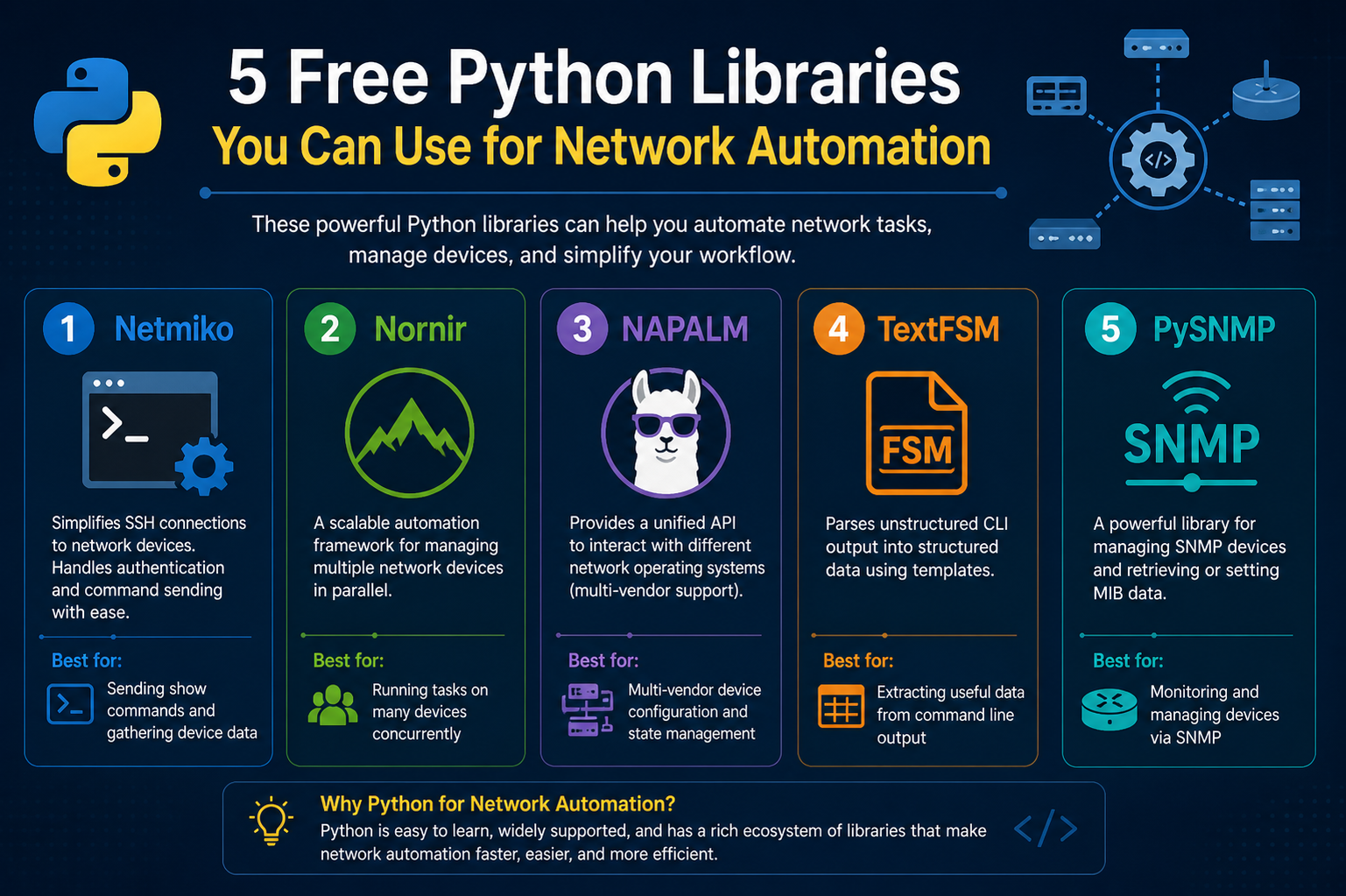
Network automation has become a core requirement in modern IT environments where speed, reliability, and scalability are essential. Instead of manually configuring each device, engineers now rely on Python-based automation tools that reduce human error and improve efficiency. These libraries provide different levels of abstraction, from low-level protocol handling to high-level multi-vendor automation frameworks, making them suitable for both beginners and advanced network engineers.
Netmiko for Simplified Device Connectivity
Netmiko is one of the most practical and widely adopted Python libraries for network automation because it significantly simplifies SSH-based communication with network devices. It is built on top of Paramiko but removes much of the complexity involved in handling device-specific command structures and connection logic.
One of the strongest advantages of Netmiko is its support for multiple vendors, including Cisco, Juniper, Arista, HP, and others. Instead of writing different scripts for each device type, engineers can use a single consistent method to connect, send commands, and retrieve outputs. This unified approach reduces development time and makes automation scripts more maintainable in large environments.
Netmiko is especially useful for tasks like configuration backups, bulk configuration changes, and command execution across multiple devices. For example, a network engineer can easily push the same security update to hundreds of switches in a matter of minutes. This eliminates repetitive manual work and ensures consistency across the infrastructure.
Another important aspect of Netmiko is its ability to handle interactive command sessions. Many network devices require confirmation prompts or step-by-step inputs, and Netmiko manages these interactions smoothly. This makes it suitable for real-world production environments where devices are not always straightforward to automate.
In addition, Netmiko integrates well with other Python libraries, allowing engineers to build more advanced automation workflows. It is often used as a foundational layer in larger automation systems where more complex logic is required.
NAPALM for Multi-Vendor Network Abstraction
NAPALM, which stands for Network Automation and Programmability Abstraction Layer with Multivendor support, is designed to solve a major challenge in networking: vendor diversity. In most organizations, networks are built using devices from different manufacturers, each with its own operating system and configuration style.
NAPALM addresses this issue by providing a unified API that works across different platforms. Instead of learning vendor-specific commands, engineers interact with a standardized interface to retrieve data, configure devices, and validate network states.
One of the most powerful features of NAPALM is its ability to gather structured data from devices. For example, it can retrieve routing tables, interface statuses, and configuration details in a consistent format regardless of the underlying vendor. This structured output makes it easier to integrate network data into monitoring systems and automation workflows.
NAPALM also supports configuration management features such as loading candidate configurations, comparing changes, and committing updates safely. This reduces the risk of misconfiguration, which is one of the most common causes of network outages.
In real-world scenarios, NAPALM is often used in automated network auditing systems. It can continuously check whether devices are configured according to organizational policies and alert engineers if any deviations are found. This makes it a key tool for maintaining compliance and operational stability.
Another advantage of NAPALM is its integration with modern orchestration tools. It fits naturally into infrastructure-as-code workflows, enabling networks to be managed with the same discipline as software systems.
Paramiko for Low-Level SSH Control
Paramiko is a foundational library in the Python ecosystem for handling SSH connections. Unlike higher-level libraries, it provides direct control over SSH sessions, file transfers, and authentication mechanisms. This makes it extremely flexible but also more complex to use.
Paramiko is often chosen when developers need full control over how connections are established and managed. It allows customization of authentication methods, session handling, and data transfer processes. Because of this flexibility, it is commonly used in custom-built automation tools where standard libraries are not sufficient.
One of the key use cases of Paramiko is secure file transfer automation. It supports SFTP, enabling automated backup of configuration files from network devices to centralized storage systems. This is especially useful in disaster recovery planning and configuration versioning.
Paramiko is also widely used as a building block for other automation tools. Many higher-level libraries, including Netmiko, rely on Paramiko under the hood to handle SSH communication. This demonstrates its importance as a core networking component in Python.
Although powerful, Paramiko requires careful handling of connection states and error management. Developers need to manually manage sessions, handle timeouts, and process command outputs. This makes it better suited for experienced users who need fine-grained control rather than quick automation solutions.
Despite its complexity, Paramiko remains essential in environments where custom SSH workflows are required. It provides the flexibility needed to build specialized automation systems tailored to unique network requirements.
PySNMP for Network Monitoring and SNMP Automation
PySNMP is a pure Python implementation of the Simple Network Management Protocol (SNMP), which is widely used for monitoring and managing network devices. SNMP plays a critical role in collecting performance data, tracking device health, and detecting network issues.
With PySNMP, developers can build scripts that query network devices for metrics such as CPU usage, memory utilization, interface traffic, and system uptime. This data is essential for maintaining network performance and identifying potential problems before they escalate.
One of the key strengths of PySNMP is its ability to work without external dependencies. Since it is written entirely in Python, it can be easily integrated into lightweight monitoring systems without requiring complex installations.
PySNMP supports both SNMP v1, v2c, and v3, allowing secure and flexible communication with network devices. SNMP v3 in particular provides encryption and authentication features, making it suitable for secure enterprise environments.
In practical applications, PySNMP is often used in custom network monitoring dashboards. It allows engineers to build tailored solutions that collect and visualize network data according to specific organizational needs. This is especially valuable when commercial monitoring tools are either too expensive or too rigid.
Another important use case is automated alerting. By continuously polling devices, PySNMP-based scripts can detect anomalies such as high bandwidth usage or device failures and trigger alerts in real time. This improves network reliability and reduces downtime.
Because of its flexibility and simplicity, PySNMP is often integrated into larger automation frameworks where monitoring is combined with configuration and orchestration tasks.
Scrapli for High-Performance Network Automation
Scrapli is a modern network automation library designed with performance and simplicity in mind. It is built to address limitations found in older tools by providing faster connections, cleaner APIs, and improved scalability.
One of the main advantages of Scrapli is its speed. It is optimized for rapid command execution and efficient session handling, making it ideal for large-scale environments where hundreds or thousands of devices must be managed simultaneously.
Scrapli supports multiple transport methods, including SSH and Telnet, and provides a consistent interface across different network devices. This allows engineers to write automation scripts without worrying about vendor-specific differences in communication.
Another important feature is its structured response handling. Scrapli can return command outputs in both raw and structured formats, making it easier to process data programmatically. This is particularly useful for integration with analytics systems and automated decision-making workflows.
Scrapli is also designed with modern Python practices in mind, making it highly readable and easy to integrate into existing codebases. Its modular architecture allows developers to extend functionality without modifying core components.
In production environments, Scrapli is often used for tasks such as large-scale configuration deployment, compliance checks, and real-time network diagnostics. Its performance advantages become especially noticeable in environments with high device density.
Additionally, Scrapli integrates well with automation frameworks and orchestration systems, making it a strong candidate for building scalable network automation pipelines.
Bringing It All Together in Network Automation Workflows
Each of these Python libraries plays a unique role in building a complete network automation ecosystem. Netmiko simplifies device connectivity, NAPALM provides vendor abstraction, Paramiko offers low-level SSH control, PySNMP enables monitoring, and Scrapli delivers high-performance execution.
In real-world environments, these tools are often combined to create powerful automation pipelines. For example, a system might use PySNMP to monitor network health, NAPALM to validate configurations, Netmiko to push updates, and Scrapli to execute large-scale changes efficiently.
This layered approach allows organizations to build flexible, scalable, and reliable network management systems. Instead of relying on manual processes, engineers can design automated workflows that respond dynamically to network conditions.
As networks continue to grow in complexity, the role of Python automation libraries will become even more important. They not only reduce operational overhead but also enable faster innovation and improved system stability across modern IT infrastructures.
Advanced Usage of Netmiko in Large-Scale Networks
Netmiko becomes especially powerful when it is used beyond simple command execution and applied in large-scale network environments where hundreds or even thousands of devices must be managed simultaneously. In such scenarios, automation is not just a convenience but a necessity to maintain consistency and reduce operational risk.
One of the most common advanced uses of Netmiko is bulk configuration deployment. Instead of logging into each device individually, engineers can design scripts that loop through device inventories and apply standardized configurations automatically. This is particularly useful in enterprise environments where security policies, VLAN setups, or routing updates must be applied uniformly.
Another advanced capability is backup automation. Netmiko can connect to devices, extract running configurations, and store them securely in centralized systems. This ensures that configuration snapshots are always available for recovery purposes in case of device failure or misconfiguration.
Netmiko also supports parallel execution when combined with Python’s multiprocessing or threading modules. This allows network engineers to dramatically reduce execution time when working with large infrastructures. Instead of processing devices one by one, tasks can be executed concurrently, improving efficiency and scalability.
Error handling is another critical aspect in advanced Netmiko usage. In real-world environments, devices may be unreachable, slow to respond, or configured inconsistently. Proper exception handling ensures that automation scripts continue running even when some devices fail, providing robustness in production systems.
Extending NAPALM for Network Intelligence
While NAPALM is already powerful for standard automation tasks, its real potential is unlocked when integrated into intelligent network systems. These systems do more than just configure devices—they analyze, validate, and optimize network behavior.
One advanced application of NAPALM is network compliance automation. Organizations often have strict rules regarding interface configurations, routing policies, and security settings. NAPALM can continuously verify whether devices match predefined standards and automatically report deviations.
Another important use case is configuration diff analysis. Before applying any changes, NAPALM can compare current device configurations with proposed updates. This helps engineers understand the exact impact of changes before deployment, reducing the risk of outages.
NAPALM is also frequently used in self-healing networks. In such systems, when a misconfiguration or failure is detected, automation scripts can trigger corrective actions automatically. This reduces downtime and improves overall network resilience.
Integration with data analytics platforms further enhances NAPALM’s capabilities. By combining structured network data with analytics tools, organizations can identify performance trends, predict failures, and optimize resource allocation.
Paramiko in Custom Automation Frameworks
Paramiko continues to play a critical role in building custom automation frameworks where flexibility is more important than simplicity. In many advanced systems, developers use Paramiko as the foundation for creating specialized SSH-based tools tailored to unique network environments.
One of the advanced applications of Paramiko is dynamic command execution systems. These systems generate commands based on real-time network conditions and execute them across devices. This allows highly adaptive automation workflows that respond to changing network states.
Paramiko is also widely used in secure configuration distribution systems. In these systems, configuration files are encrypted, transferred via SFTP, and applied to devices in a controlled manner. This ensures both security and consistency during deployment.
Another powerful use case is automated troubleshooting. Scripts built with Paramiko can connect to devices, collect diagnostic information, and run predefined test commands. This helps engineers quickly identify and resolve network issues without manual intervention.
Although Paramiko requires more development effort compared to higher-level libraries, its flexibility makes it indispensable in environments where standard tools are insufficient for complex automation requirements.
PySNMP in Real-Time Network Monitoring Systems
PySNMP becomes significantly more powerful when used in real-time monitoring architectures. Instead of periodic manual checks, it enables continuous data collection and instant visibility into network performance.
One advanced application is threshold-based alerting systems. These systems use PySNMP to continuously monitor metrics such as bandwidth usage, CPU load, and memory consumption. When values exceed predefined thresholds, alerts are automatically triggered to notify administrators.
PySNMP is also used in historical data collection systems. By storing SNMP data over time, organizations can analyze long-term trends in network performance. This helps in capacity planning and infrastructure optimization.
In more advanced environments, PySNMP is integrated with machine learning models to predict network failures. By analyzing patterns in SNMP data, these systems can forecast issues before they occur, enabling proactive maintenance.
Another important application is distributed monitoring. In large networks, multiple PySNMP agents can collect data from different regions and send it to a centralized system for aggregation and analysis. This ensures complete visibility across complex infrastructures.
Scrapli in High-Speed Automation Pipelines
Scrapli is particularly valuable in environments where speed and efficiency are critical. Its architecture is optimized for high-performance automation pipelines that need to execute commands across large numbers of devices with minimal delay.
One advanced use of Scrapli is in real-time configuration orchestration systems. These systems push configuration changes across networks in synchronized operations, ensuring consistency across all devices at the same time.
Scrapli also excels in high-frequency monitoring systems where devices are queried repeatedly in short intervals. Its fast connection handling allows it to collect data without introducing significant overhead on the network.
Another important application is automated compliance auditing at scale. Scrapli can rapidly connect to thousands of devices, retrieve configurations, and compare them against compliance standards. This enables organizations to maintain strict governance without manual effort.
Scrapli is also used in event-driven automation systems. In such systems, network events trigger automated responses, such as rerouting traffic, adjusting configurations, or restarting services. Scrapli ensures these actions are executed quickly and reliably.
Combining Libraries for End-to-End Automation Systems
The true power of Python network automation emerges when these libraries are combined into unified workflows. Each library contributes a specific capability, and together they form a complete automation ecosystem.
For example, a monitoring system may use PySNMP to collect performance data, NAPALM to validate configurations, Scrapli to apply rapid changes, and Netmiko to handle vendor-specific tasks. Paramiko may support custom operations that require deeper control.
This layered architecture allows organizations to build scalable and resilient systems that can adapt to different network environments. It also enables separation of concerns, where each tool handles a specific part of the automation process.
In modern infrastructure environments, such integrated systems are becoming standard practice. They reduce manual workload, improve reliability, and ensure that networks can scale efficiently without increasing operational complexity.
Future Direction of Network Automation with Python
As networks continue to evolve toward cloud-native and software-defined architectures, Python automation libraries will play an even more critical role. The demand for real-time responsiveness, self-healing systems, and intelligent automation will continue to grow.
Future developments are expected to focus on deeper integration with artificial intelligence, allowing networks to make autonomous decisions based on real-time data. Libraries like PySNMP and NAPALM may evolve to support predictive analytics natively.
Performance improvements will also remain a key focus, especially for tools like Scrapli that are used in large-scale environments. Faster execution and lower resource consumption will be essential for handling increasingly complex infrastructures.
Overall, Python-based network automation is moving toward fully autonomous systems where manual intervention is minimal. These tools form the foundation of that transformation, enabling smarter, faster, and more reliable network operations.
Building Scalable Network Automation Architectures
As organizations expand, network complexity grows rapidly, and automation must evolve from simple scripts into fully structured architectures. At this stage, Python libraries are no longer used in isolation but as interconnected components within larger automation ecosystems that can support scalability, resilience, and maintainability.
A scalable network automation architecture typically follows a layered design. At the bottom layer, libraries like Paramiko and Scrapli handle direct device communication. Above that, Netmiko simplifies multi-vendor interactions, while NAPALM introduces abstraction and consistency. PySNMP often operates in parallel, continuously feeding monitoring data into the system. Together, these layers create a structured workflow that can handle enterprise-level demands.
One key principle in scalable design is separation of responsibilities. Instead of writing one large script that performs all tasks, engineers break functionality into modular components. One module may handle device connectivity, another may manage configuration deployment, and another may process monitoring data. This modular approach makes systems easier to debug, extend, and maintain over time.
Another important aspect is inventory management. In large networks, devices are constantly added, removed, or modified. Automation systems must dynamically adapt to these changes. Python-based frameworks often integrate with inventory databases or configuration management systems to ensure that scripts always operate on up-to-date device lists.
Automation Orchestration and Workflow Design
Orchestration is the process of coordinating multiple automation tasks in a controlled and logical sequence. Instead of executing isolated commands, orchestration ensures that tasks are performed in the correct order with proper validation and error handling.
For example, before deploying a new configuration, an orchestrated workflow might first use NAPALM to validate current device state, then use Scrapli to push changes, and finally use PySNMP to verify performance metrics after deployment. This structured flow reduces risk and ensures system stability.
Workflow engines built using Python often include conditional logic, retries, and rollback mechanisms. If a configuration deployment fails on one device, the system can automatically roll back changes or skip the affected device while continuing the process on others. This ensures that partial failures do not disrupt the entire operation.
Advanced orchestration systems also support scheduling and event-driven execution. Tasks can be triggered at specific times or in response to network events such as interface failures or traffic spikes. This enables proactive network management rather than reactive troubleshooting.
Data Handling and Transformation in Network Automation
Data plays a central role in network automation systems. Devices generate large amounts of information, including logs, configurations, and performance metrics. Python libraries help collect, transform, and analyze this data into meaningful insights.
One common challenge is dealing with unstructured output from network devices. Tools like Netmiko and Scrapli often return raw command outputs, which must be parsed before they can be used effectively. Python’s text processing capabilities, combined with structured libraries like NAPALM, help convert this data into usable formats such as JSON or dictionaries.
Once data is structured, it can be stored in databases or passed to analytics engines. This enables long-term tracking of network behavior, helping engineers identify trends such as increasing latency, packet loss, or bandwidth saturation.
Data transformation also plays a key role in automation decision-making. For example, if monitoring data shows high CPU usage on a router, an automated system can trigger corrective actions such as load balancing or traffic rerouting without human intervention.
Security Considerations in Network Automation
Security is a critical aspect of any network automation system. Since these tools interact directly with infrastructure devices, improper implementation can expose networks to serious risks.
One of the primary security practices is secure credential management. Instead of hardcoding usernames and passwords in scripts, modern automation systems use encrypted vaults or environment variables. This ensures that sensitive information is protected even if scripts are exposed.
Another important consideration is secure communication. Libraries like Paramiko and Scrapli support encrypted SSH connections, while PySNMP supports secure SNMPv3 communication. Ensuring encryption across all communication channels helps protect against interception and unauthorized access.
Access control is also essential. Not all automation scripts should have full administrative privileges. Role-based access control ensures that only authorized processes can perform sensitive operations such as configuration changes or device reboots.
Logging and auditing further enhance security. Every automated action should be recorded, including who initiated it, what changes were made, and when they occurred. This creates a traceable history that is essential for compliance and troubleshooting.
Performance Optimization in Automation Systems
As automation systems scale, performance becomes a critical factor. Poorly optimized scripts can introduce delays, consume excessive resources, and even impact network performance.
One common optimization technique is parallel execution. Instead of processing devices sequentially, Python’s threading or asynchronous capabilities can be used to execute tasks concurrently. This significantly reduces execution time in large networks.
Another optimization strategy is reducing unnecessary device interactions. Efficient automation systems minimize the number of commands sent to devices by batching operations or retrieving only required data. This reduces load on both the automation system and the network infrastructure.
Caching is also widely used in advanced systems. Frequently accessed data such as device inventories or configuration templates can be stored locally to avoid repeated queries. This improves response time and reduces network traffic.
In high-performance environments, Scrapli is often preferred due to its lightweight architecture and fast execution model. It reduces overhead compared to older libraries, making it suitable for time-sensitive automation tasks.
Real-World Applications of Python Network Automation
Python-based network automation is used across a wide range of industries, from telecommunications to cloud computing and enterprise IT. Its flexibility allows it to adapt to different operational requirements.
In large enterprise networks, automation is commonly used for configuration management, ensuring that all devices follow standardized policies. This reduces configuration drift and improves overall network reliability.
In service provider environments, automation is essential for managing large-scale infrastructure with thousands of devices. Tasks such as provisioning new services, updating routing policies, and monitoring network health are all handled through automated systems.
Cloud environments also rely heavily on network automation. As cloud infrastructure is highly dynamic, automation tools are used to manage virtual networks, security groups, and load balancing configurations in real time.
Another important application is disaster recovery. Automated systems can quickly restore configurations, reroute traffic, and bring services back online in the event of a failure, significantly reducing downtime.
Challenges in Network Automation Implementation
Despite its advantages, network automation comes with several challenges that must be carefully managed. One of the biggest challenges is device diversity. Different vendors often implement protocols differently, which can complicate automation efforts.
Another challenge is error handling. Network environments are unpredictable, and automation systems must be designed to handle failures gracefully without causing cascading issues.
Scalability is also a major concern. As the number of devices increases, automation systems must be able to handle higher workloads without performance degradation.
Additionally, maintaining automation scripts over time can become complex if they are not properly structured. Without modular design and documentation, systems can become difficult to manage as they grow.
Future Evolution of Python in Network Automation
The future of network automation is moving toward intelligent and autonomous systems. Python will continue to play a central role in this evolution due to its simplicity and extensive ecosystem.
Artificial intelligence and machine learning will increasingly be integrated into automation systems, enabling predictive maintenance and self-optimizing networks. Instead of reacting to issues, networks will proactively adjust themselves based on predictive insights.
Event-driven automation will also become more common, where systems respond instantly to changes in network conditions. This will reduce latency and improve overall responsiveness.
In addition, abstraction layers are expected to become more advanced, further simplifying multi-vendor management. Engineers will increasingly focus on high-level policies rather than low-level configurations.
Overall, Python-based libraries will continue to form the backbone of network automation, enabling faster, smarter, and more reliable infrastructure management as networks continue to evolve.
Best Practices for Designing Python Network Automation Systems
When building production-grade network automation systems with Python, success depends less on writing scripts and more on following structured design principles. Without proper planning, even powerful libraries like Netmiko, NAPALM, Scrapli, Paramiko, and PySNMP can turn into chaotic and unmaintainable codebases.
A core best practice is modular design. Instead of combining all logic into a single script, automation should be divided into reusable components. One module should handle authentication and connections, another should manage configuration templates, and another should focus on output parsing or monitoring. This separation makes systems easier to debug and scale.
Another important principle is idempotency. Automation scripts should be designed so that running them multiple times produces the same result without unintended side effects. For example, pushing a configuration should not duplicate entries or overwrite unrelated settings. This ensures stability in production environments.
Version control is also essential. All automation code should be tracked using a versioning system so changes can be reviewed, rolled back, and audited. This becomes especially important in team environments where multiple engineers contribute to automation workflows.
Logging and observability should never be ignored. Every action performed by an automation system should be recorded in detail. This includes successful operations, failures, and skipped tasks. Good logging practices make troubleshooting significantly easier when issues arise in complex networks.
Common Mistakes in Network Automation Projects
Despite the availability of powerful tools, many network automation projects fail due to avoidable mistakes. One of the most common issues is over-automation. Trying to automate everything at once often leads to unstable systems and incomplete implementations.
Another frequent mistake is lack of testing. Automation scripts are often deployed directly into production without proper validation in staging environments. This can lead to unexpected outages or misconfigurations.
Hardcoding values such as IP addresses, credentials, or device names is another poor practice. It reduces flexibility and makes scripts difficult to maintain. Instead, dynamic inventory systems or external configuration files should always be used.
Poor error handling is also a major issue. In real networks, failures are inevitable. Scripts that do not properly handle exceptions can stop execution halfway, leaving systems in inconsistent states.
Finally, ignoring vendor differences can create serious problems. Even though abstraction libraries like NAPALM help unify interactions, underlying device behavior can still vary. Understanding these differences is essential for reliable automation design.
Integration with DevOps and CI/CD Pipelines
Modern network automation is increasingly aligned with DevOps practices. Instead of treating networks separately from software systems, organizations are integrating network changes into continuous integration and continuous deployment pipelines.
In this model, network configurations are treated like code. Changes are written, reviewed, tested, and deployed using automated pipelines. Python libraries play a key role in executing these workflows.
For example, a CI/CD pipeline may trigger a validation process using NAPALM to check existing configurations. If validation passes, Scrapli or Netmiko can be used to deploy updates. After deployment, PySNMP can verify performance metrics to ensure stability.
This approach introduces automation discipline into network operations. Every change is traceable, testable, and reversible. It significantly reduces human error and improves deployment speed.
Integration with CI/CD systems also enables rollback mechanisms. If a deployment causes issues, the system can automatically revert to a previous stable configuration. This adds a safety layer that is essential in modern infrastructure environments.
Role of APIs in Network Automation
APIs are a fundamental part of modern network automation systems. Many network devices and controllers now expose REST or gRPC APIs that allow direct programmatic access.
Python acts as a bridge between automation logic and these APIs. Libraries can send requests, process responses, and integrate results into broader workflows. This allows automation systems to interact not only with devices but also with cloud platforms, monitoring tools, and orchestration engines.
API-driven automation is especially important in software-defined networking environments. Instead of configuring devices individually, engineers define high-level policies that are pushed through centralized controllers.
Python’s flexibility makes it ideal for API integration because it can easily handle JSON data, authentication tokens, and asynchronous requests. This enables seamless communication between different systems in complex infrastructures.
Monitoring, Alerting, and Observability in Automated Networks
Monitoring is not just about collecting data; it is about understanding network behavior in real time. Python-based automation systems often combine PySNMP with other tools to build comprehensive observability frameworks.
In advanced setups, monitoring systems are event-driven. Instead of polling devices at fixed intervals, they react to changes as they occur. This reduces unnecessary load and provides faster insights into network conditions.
Alerting systems are typically built on top of monitoring data. When specific thresholds are crossed, alerts are triggered automatically. These alerts can be sent to dashboards, email systems, or incident management platforms.
Observability also includes log analysis. Automation systems collect logs from multiple devices and correlate them to identify root causes of issues. Python’s data processing capabilities make it easy to filter, analyze, and visualize this information.
In mature environments, observability is combined with automation. This means that when a problem is detected, the system can automatically take corrective action without human intervention.
Career Growth in Network Automation with Python
Network automation has become a high-demand skill in the IT industry, and Python plays a central role in this transformation. Professionals who understand both networking fundamentals and automation tools are highly valued.
Entry-level engineers often start with basic scripting using Netmiko or Paramiko. As they progress, they move toward more advanced frameworks like NAPALM and Scrapli, eventually integrating automation into large-scale systems.
Senior engineers typically focus on architecture design, orchestration systems, and integration with DevOps pipelines. They are responsible for building scalable automation frameworks rather than writing individual scripts.
There is also increasing demand for engineers who understand both networking and software development. This hybrid skill set allows them to bridge the gap between infrastructure and application teams.
As organizations continue to adopt cloud and software-defined networking technologies, the demand for automation expertise will continue to grow significantly.
Future Trends in Python Network Automation
The future of network automation is moving toward full autonomy. Networks are expected to become self-configuring, self-healing, and self-optimizing systems that require minimal human intervention.
Artificial intelligence will play a major role in this evolution. Machine learning models will analyze network behavior, predict failures, and automatically apply corrective actions. Python will remain a key language for implementing these systems due to its strong AI and data science ecosystem.
Another emerging trend is intent-based networking. Instead of configuring devices directly, engineers define desired outcomes, and the system automatically determines how to achieve them. Python automation libraries will serve as execution layers for these intent-driven systems.
Edge computing will also influence automation design. As computing moves closer to end users, automation systems will need to manage distributed infrastructure across multiple locations with high efficiency.
Finally, real-time automation will become standard. Networks will no longer wait for scheduled tasks; instead, they will respond instantly to events and changes in conditions.
Final Perspective on Python Network Automation Ecosystem
Python-based network automation is no longer just a technical enhancement; it has become a fundamental requirement for modern infrastructure management. Libraries such as Netmiko, NAPALM, Paramiko, PySNMP, and Scrapli collectively form a powerful ecosystem capable of handling everything from simple device communication to complex autonomous network systems.
The real strength of this ecosystem lies in its flexibility. Engineers can start with simple scripts and gradually evolve them into enterprise-grade automation platforms. Each tool contributes a unique capability, and when combined, they enable highly efficient, scalable, and intelligent network operations.
As networks continue to grow in size and complexity, automation will move from being optional to being essential. Python will remain at the center of this transformation, powering the next generation of intelligent, self-managing network infrastructures.
Conclusion
Python network automation has become a foundational element in modern IT and networking environments, transforming the way infrastructure is designed, managed, and maintained. What once required repetitive manual configuration across countless devices can now be handled through structured, scalable, and intelligent automation systems. Libraries such as Netmiko, NAPALM, Paramiko, PySNMP, and Scrapli collectively form a powerful toolkit that addresses nearly every aspect of network operations, from device connectivity and configuration management to monitoring, validation, and high-speed execution.
The real value of these tools lies not only in their individual capabilities but in how effectively they can be combined. When integrated properly, they enable end-to-end automation workflows that reduce human error, improve consistency, and significantly increase operational efficiency. Networks become more predictable, easier to manage, and capable of responding dynamically to changes and failures.
As infrastructure continues to evolve toward cloud-native, software-defined, and highly distributed architectures, the role of automation will only grow stronger. Organizations are increasingly shifting toward intent-based and event-driven models where systems can self-correct and self-optimize with minimal manual intervention. Python, with its simplicity and rich ecosystem, remains at the center of this transformation.
Ultimately, network automation is no longer just an advanced skill—it is becoming a core requirement for modern network engineering. Those who understand and apply these Python libraries effectively are better equipped to build resilient, scalable, and future-ready networks that meet the demands of today’s fast-changing digital world.