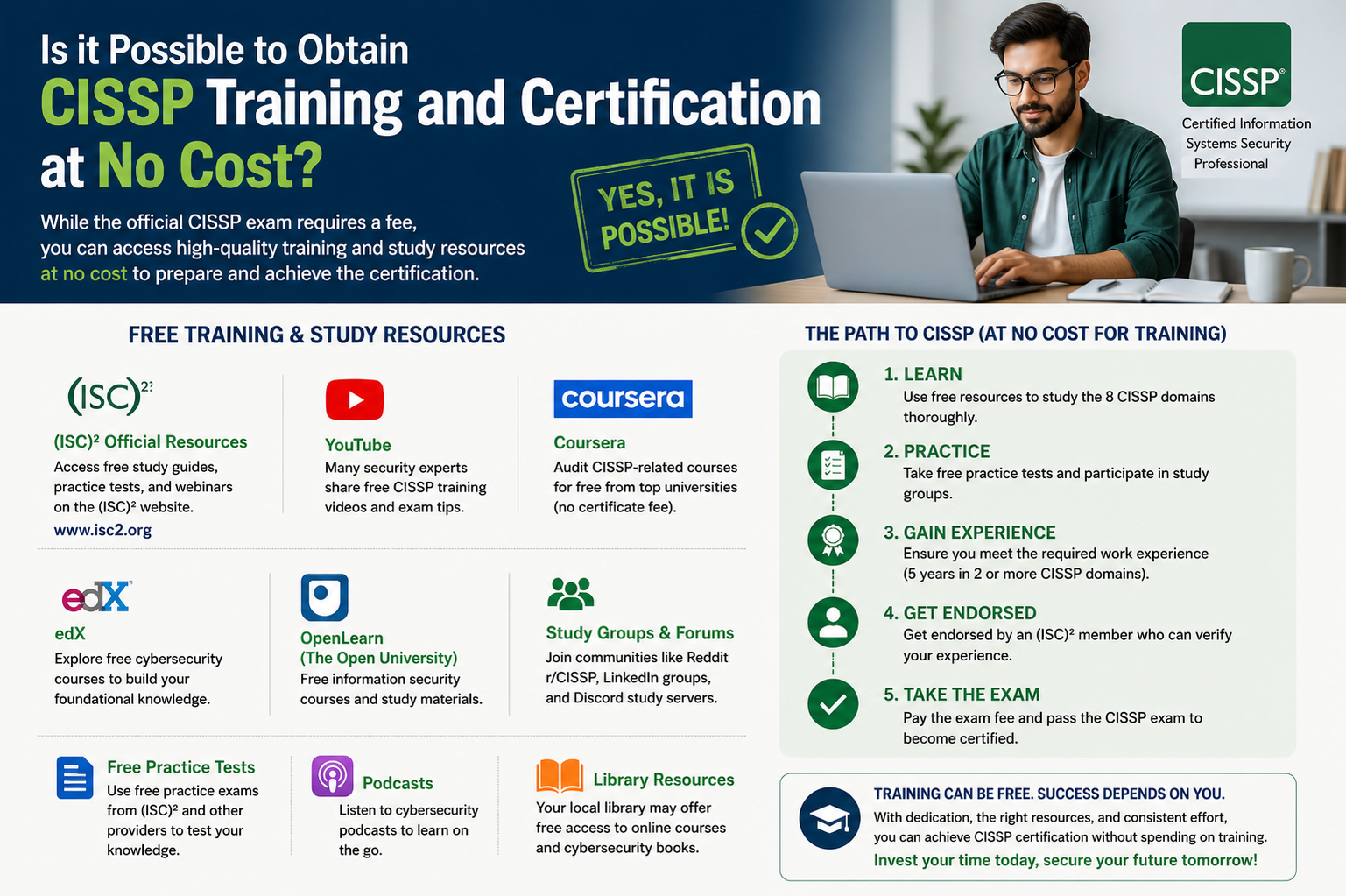
The CISSP certification is widely recognized as one of the most respected credentials in the field of cybersecurity. It is designed for professionals who want to demonstrate advanced knowledge in information security and risk management. While many people search for ways to obtain CISSP training and certification without spending money, the reality is more complex. The certification process involves strict eligibility requirements, professional experience, and an examination fee that cannot typically be avoided. However, there are meaningful ways to reduce costs and access learning resources without paying for expensive formal training programs.
Understanding the CISSP Certification Path
To fully understand why free certification is difficult to achieve, it is important to examine what the CISSP credential actually requires. The certification is governed by a professional cybersecurity organization that sets global standards for knowledge and experience. Candidates must pass a comprehensive exam that tests their understanding of multiple security domains, including risk management, network security, identity and access control, security operations, and software development security.
In addition to passing the exam, candidates must also have several years of verified work experience in cybersecurity or related fields. This requirement ensures that certified professionals are not only knowledgeable in theory but also capable of applying security principles in real-world environments. Because of these strict requirements, the certification process is structured and formal, making it difficult for it to be completely free.
The Cost Structure of CISSP Certification
One of the main reasons CISSP cannot usually be obtained for free is the cost of the examination itself. The exam fee is set at a professional level to maintain the value and credibility of the certification. This fee is mandatory for all candidates, regardless of how they prepare. In addition to the exam cost, many candidates also choose to invest in training courses, study guides, or practice exams, which can further increase expenses.
Although the financial investment can be significant, it reflects the global recognition and career value associated with the certification. Employers across the world consider CISSP holders to be highly skilled professionals, often placing them in senior cybersecurity roles. This demand contributes to the certification’s structured cost model.
Free Learning Resources and Self-Study Options
Even though the certification itself is not free, there are numerous ways to prepare without paying for formal training. Many professionals successfully pass the CISSP exam through self-study using freely available materials. These resources include online articles, cybersecurity forums, video lectures, and community discussions where experienced professionals share insights and study strategies.
Self-study requires discipline and a structured approach. Candidates often create personal study plans based on the official exam domains and allocate time to each topic. Practice questions available online can help reinforce understanding and identify weak areas. While these resources do not replace official training programs, they can significantly reduce preparation costs.
Employer Sponsorship and Financial Support
In many cases, professionals do not pay for CISSP certification out of their own pocket. Employers often recognize the value of having certified security experts within their organization and may offer financial support. This support can include covering the exam fee, providing access to paid training courses, or allowing paid study time during working hours.
Organizations benefit from having CISSP-certified employees because it strengthens their security posture and helps meet compliance requirements. As a result, companies in industries such as banking, healthcare, and technology are more likely to invest in employee certification programs. For individuals, this can be one of the most practical ways to reduce or eliminate personal costs.
Scholarships and Community Programs
There are also occasional scholarship opportunities offered by cybersecurity organizations and professional groups. These programs are designed to encourage more people to enter the field of information security, especially those from underrepresented backgrounds or developing regions. Scholarships may cover exam fees, training materials, or both.
While these opportunities are limited and competitive, they provide a pathway for individuals who are highly motivated but lack financial resources. Community initiatives and nonprofit organizations sometimes collaborate with industry leaders to support cybersecurity education, making certification more accessible to a wider audience.
The Role of Experience in Certification
Another important factor in the CISSP certification process is professional experience. Unlike many entry-level certifications, CISSP requires candidates to demonstrate several years of direct work experience in cybersecurity. This requirement ensures that individuals are not only academically prepared but also practically experienced.
For those who do not yet meet the experience requirement, there is still an option to take the exam and become an associate of the certification body. This status allows individuals to work toward the experience requirement after passing the exam. However, even in this case, the exam fee still applies, reinforcing the fact that the certification process is not entirely free.
Self-Motivation and Independent Study Discipline
One of the most important aspects of preparing for CISSP without paid training is self-discipline. Because free resources are often unstructured, candidates must take responsibility for organizing their own learning journey. This involves identifying key topics, setting study schedules, and regularly testing knowledge through practice exams.
Many successful candidates emphasize consistency over intensity. Studying a little each day and gradually building understanding across all domains is often more effective than attempting to learn everything at once. This approach allows individuals to make use of free resources efficiently while maintaining steady progress toward exam readiness.
Limitations of Free Preparation Paths
Although free study methods are possible, they do have limitations. Without structured guidance, some candidates may struggle to understand complex topics or may miss important exam areas. Paid training programs often provide expert instruction, structured learning paths, and detailed explanations that can simplify difficult concepts.
Additionally, official practice exams and study materials are often behind paywalls. These resources are designed to closely match the format and difficulty of the actual exam, giving candidates a more accurate sense of readiness. Without access to these tools, self-studying candidates may face a steeper learning curve.
Career Value Versus Certification Cost
Despite the financial investment required, CISSP certification is often viewed as a long-term career asset. Professionals who earn the certification typically gain access to higher-level positions, increased salaries, and greater job security. The certification is recognized globally, making it valuable for individuals seeking international career opportunities.
From this perspective, the cost of certification is often seen as an investment rather than an expense. Even those who initially rely on free resources for preparation may eventually choose to pay for the exam because of the potential career benefits.
Realistic Expectations for Aspiring Candidates
It is important for aspiring cybersecurity professionals to maintain realistic expectations. While free learning resources can significantly reduce preparation costs, the certification itself cannot generally be obtained without paying the required exam fee. Understanding this distinction helps candidates plan their journey more effectively.
Those who approach CISSP preparation with a clear strategy—combining free resources, structured self-study, and possible employer support—are often the most successful in balancing cost and effectiveness. The key is not necessarily to avoid all expenses, but to minimize unnecessary ones while still achieving certification goals.
Challenges of Free CISSP Preparation Paths
While free resources make it possible to begin CISSP preparation without financial investment, candidates often encounter several challenges along the way. One of the main difficulties is the lack of structured learning. Unlike paid training programs that follow a carefully designed curriculum, free study materials are scattered across different platforms and formats. This can make it harder to build a clear and organized study path, especially for those who are new to cybersecurity.
Another challenge is the varying quality of free content. Some materials are created by experienced professionals and provide valuable insights, while others may be outdated or incomplete. Since the CISSP exam covers a broad and constantly evolving range of security topics, relying solely on inconsistent resources can create knowledge gaps that may affect exam performance.
Additionally, free preparation often lacks direct mentorship. In formal training environments, instructors can answer questions, clarify complex concepts, and guide learners through difficult domains. Without this support, self-study candidates must rely on online discussions or personal research, which can slow down progress and increase confusion in certain areas.
Importance of Structured Self-Study Planning
To overcome the limitations of free preparation, structured self-study becomes essential. A well-planned approach helps candidates organize their learning process in a logical sequence. This usually begins with understanding the official CISSP domains and breaking them into manageable sections.
Candidates often start by focusing on foundational concepts such as security principles, risk management, and access control before moving into more complex areas like software security and security architecture. Setting weekly or monthly goals can help maintain consistency and ensure that all topics are covered thoroughly.
Time management also plays a crucial role. Since CISSP preparation requires a deep understanding of multiple subjects, spreading study sessions over several months is often more effective than attempting to learn everything in a short period. This gradual approach allows for better retention and reduces the risk of burnout.
Role of Practice Questions in Free Preparation
Practice questions are one of the most valuable tools available in free CISSP preparation. They help candidates understand how exam questions are structured and how theoretical knowledge is applied in practical scenarios. By regularly solving practice questions, learners can identify weak areas and focus their efforts on improving those topics.
However, it is important to use practice questions strategically rather than relying on memorization. The CISSP exam is designed to test conceptual understanding and decision-making skills rather than simple recall of facts. Therefore, candidates should focus on understanding why certain answers are correct and others are not.
Many free question sets are available online, but their quality can vary. Some may not reflect the latest exam updates, so candidates should cross-check information with reliable sources whenever possible.
Community Support and Peer Learning
One of the most effective aspects of free CISSP preparation is community support. Online cybersecurity communities, discussion groups, and forums provide a platform where learners can interact with experienced professionals and other candidates. These communities often share study tips, explanations of difficult topics, and exam strategies.
Peer learning can also help fill knowledge gaps. Discussing concepts with others allows candidates to gain different perspectives and deepen their understanding of complex subjects. In many cases, learners find that explaining topics to others is one of the best ways to reinforce their own knowledge.
However, it is important to verify information shared in informal settings, as not all advice may be accurate or up to date. Cross-referencing with official documentation or trusted sources is always recommended.
Employer-Based Learning Opportunities
For many professionals, the most realistic path to reducing CISSP costs is through employer support. Companies that value cybersecurity expertise often invest in employee development programs. These programs may include access to paid training platforms, structured learning paths, and financial coverage for certification exams.
In some cases, employers may require employees to commit to remaining with the organization for a certain period after certification. This arrangement benefits both parties: employees gain valuable certification without personal financial burden, while employers strengthen their internal security capabilities.
Employees working in industries with strict security requirements, such as finance or government sectors, are more likely to receive such support due to compliance needs and risk management priorities.
Self-Investment Versus Free Learning Balance
Although free resources are widely available, many candidates eventually choose to invest some level of personal funds into their preparation. This might include purchasing official study guides, enrolling in practice exam platforms, or attending targeted training sessions.
The decision often depends on individual learning style, time availability, and career goals. Some learners prefer fully self-guided study using free materials, while others find that a combination of free and paid resources provides a more efficient path to certification.
Balancing cost and quality is an important part of the preparation journey. Even small investments in high-quality resources can significantly improve understanding and exam readiness.
Long-Term Value of CISSP Certification
Despite the initial cost barrier, CISSP certification is widely regarded as a high-value credential in the cybersecurity industry. It demonstrates not only technical knowledge but also leadership capability in managing security programs and organizational risk.
Professionals who hold this certification often have access to senior roles such as security architect, security manager, or chief information security officer. These positions typically come with higher salaries and greater responsibility, making the certification a strong long-term career investment.
Because of this long-term value, many candidates view the exam fee as a strategic investment rather than an expense. Even those who start with free preparation resources often recognize the importance of eventually completing the formal certification process.
Realistic Approach to Cost-Free Preparation
A realistic approach to CISSP preparation acknowledges both the benefits and limitations of free learning paths. While it is possible to study extensively without spending money on training programs, completely avoiding all costs is rarely feasible due to the mandatory exam fee.
A balanced strategy typically involves starting with free resources to build foundational knowledge, followed by selective investment in key materials if needed. This approach allows candidates to minimize expenses while still ensuring adequate preparation for the exam.
Ultimately, success in CISSP certification depends more on dedication, discipline, and consistent study habits than on the amount of money spent on training materials.
Self-Learning Strategies for Advanced Preparation
As candidates progress deeper into CISSP preparation, self-learning strategies become more refined and focused. At this stage, it is no longer just about collecting information but about synthesizing knowledge across multiple domains. The CISSP exam is designed to test how well a candidate can apply security principles in real-world scenarios, so preparation must shift from memorization to analytical thinking.
One effective strategy is scenario-based learning. Instead of simply reading definitions, candidates should try to understand how security concepts interact in practical environments. For example, rather than only learning what access control is, it is more useful to understand how it is implemented in enterprise systems and how it affects risk management decisions.
Another important strategy is revision cycles. Repeated exposure to key concepts over time strengthens memory retention and improves recall under exam conditions. Candidates often revisit each domain multiple times, gradually increasing depth of understanding with each review.
Developing a Security Mindset
CISSP is not just a technical certification; it also evaluates a candidate’s ability to think like a security professional. This means adopting a mindset focused on risk, governance, and organizational impact rather than purely technical solutions.
A strong security mindset involves evaluating situations from multiple perspectives, including business needs, regulatory compliance, and operational constraints. Candidates must learn to prioritize solutions that balance security with practicality. This is especially important in CISSP questions, where multiple answers may seem correct, but only one aligns best with organizational security principles.
Developing this mindset takes time and consistent exposure to real-world case studies. Even without paid training, candidates can build this perspective by analyzing security incidents, reading industry reports, and studying how organizations respond to cyber threats.
Importance of Domain Integration
One of the most challenging aspects of CISSP preparation is integrating knowledge across different domains. The exam does not test each domain in isolation; instead, it presents scenarios that require understanding how multiple areas of security interact.
For example, a question may involve access control policies, but the correct answer could also depend on risk management principles or legal compliance considerations. This interconnected nature of the exam requires candidates to think broadly rather than focusing on isolated topics.
Free preparation materials often present domains separately, which can make integration more difficult. Therefore, candidates must make an effort to connect concepts across different areas during their study process.
Time Commitment and Study Consistency
CISSP preparation requires a significant time commitment, especially for those relying on free resources. On average, candidates spend several months preparing for the exam, depending on their prior experience and familiarity with cybersecurity concepts.
Consistency is more important than intensity. Studying for short, regular sessions is generally more effective than irregular long study periods. This approach helps reinforce learning gradually and prevents information overload.
Many candidates create structured study schedules that allocate specific days or hours for each domain. This disciplined approach ensures balanced coverage and reduces the risk of neglecting important topics.
Overcoming Information Overload
One of the common challenges in free CISSP preparation is information overload. Because there are so many resources available, candidates may feel overwhelmed by the volume of content. This can lead to confusion and inefficient study habits.
To manage this, it is important to focus on a limited set of high-quality resources rather than trying to consume everything available. Selecting a few reliable study guides or structured outlines and sticking to them can improve clarity and reduce distraction.
Organizing notes and summarizing key concepts in personal study materials can also help simplify complex topics. This active engagement with content improves understanding and retention.
Building Confidence Through Practice Exams
Practice exams play a critical role in building confidence for the CISSP test. They simulate real exam conditions and help candidates become familiar with question formats and time constraints.
As candidates progress, they should aim to simulate full-length exams under timed conditions. This helps develop stamina and improves time management skills, which are essential for completing the actual exam successfully.
Reviewing incorrect answers is equally important. Understanding why an answer is wrong provides deeper insight into the underlying concepts and helps prevent similar mistakes in the future.
Even when using free practice exams, candidates should focus on quality over quantity. It is more beneficial to thoroughly analyze a smaller set of questions than to rush through large volumes without understanding.
Role of Experience in Strengthening Preparation
Professional experience significantly enhances CISSP preparation. Candidates who have worked in cybersecurity roles often find it easier to understand abstract concepts because they have seen them applied in real environments.
For those with limited experience, it becomes even more important to focus on practical examples and case studies. This helps bridge the gap between theory and real-world application.
Even if experience is limited, exposure to simulated environments, labs, or scenario discussions can help build practical understanding. This reinforces theoretical knowledge and improves readiness for the exam.
Limitations of Fully Free Certification Paths
While free preparation methods are valuable, they do not eliminate the structural requirements of the certification process. The exam fee remains mandatory, and no fully legitimate pathway exists to bypass this requirement.
Additionally, free resources may not always reflect the most current exam updates. Cybersecurity is a constantly evolving field, and exam content is periodically revised to match industry changes. Candidates relying solely on outdated materials may face challenges during the exam.
Another limitation is the absence of formal feedback. Without instructors or structured evaluation, candidates may not always recognize gaps in their understanding until later stages of preparation.
Strategic Use of Free and Paid Resources
A balanced approach often produces the best results. Many successful candidates begin with free resources to build foundational knowledge and then selectively invest in paid materials for advanced preparation.
This strategy allows candidates to minimize costs while still benefiting from high-quality content where it matters most. For example, investing in a reliable practice exam platform or a comprehensive study guide can significantly improve exam readiness.
The key is to use free resources efficiently while recognizing when additional support is needed to strengthen weak areas.
Long-Term Professional Impact
Beyond certification, CISSP has a long-term impact on career development. It signals to employers that an individual possesses a strong understanding of security principles and can handle complex organizational challenges.
Certified professionals often move into leadership roles where they are responsible for designing and managing security programs. These positions require both technical knowledge and strategic thinking, which the CISSP certification helps validate.
Because of this long-term career value, many professionals consider the investment worthwhile even if they initially rely on free preparation methods.
Bridging Knowledge Gaps Without Paid Training
As candidates approach the final stages of CISSP preparation, one of the most important challenges is bridging remaining knowledge gaps. At this point, most learners already have exposure to all domains, but they may still struggle with weaker areas or concepts that feel less intuitive. Without paid training, this process depends heavily on self-assessment and targeted revision.
A practical approach is to repeatedly test understanding through scenario-based reflection. Instead of simply revisiting study notes, candidates should actively question how each concept applies in different situations. For example, understanding how risk management decisions change based on organizational priorities helps reinforce deeper comprehension than memorizing definitions alone.
Another useful method is teaching or explaining concepts to others. Even in informal study groups or online discussions, explaining a topic forces clarity of thought and highlights areas that need further review. This technique is especially effective for complex CISSP domains that involve layered decision-making.
Managing Exam Pressure and Mental Preparation
CISSP is not only a test of knowledge but also a test of mental endurance. The exam requires sustained concentration over a long period, and candidates must remain focused while evaluating complex questions. This makes mental preparation just as important as technical study.
One way to build exam readiness is through timed practice sessions. These sessions help simulate real exam conditions and improve decision-making speed. Over time, candidates become more comfortable working under pressure, which reduces anxiety during the actual exam.
Maintaining a consistent study rhythm also helps reduce stress. Irregular preparation can lead to uncertainty and last-minute pressure, while steady progress builds confidence gradually. Many candidates find that structured routines create a sense of control, which is important for performance on exam day.
Understanding the Value of Professional Recognition
The CISSP certification carries significant professional recognition in the cybersecurity industry. It is often viewed as a benchmark for senior-level security expertise. Employers use it as a trusted indicator that a candidate understands not only technical security principles but also governance, risk management, and leadership responsibilities.
This recognition is one of the reasons why the certification process is structured and not freely accessible. The value of CISSP comes from its credibility, and maintaining that credibility requires a standardized exam and verification process.
For professionals, this recognition often translates into career advancement opportunities. It can open doors to roles involving security architecture, compliance leadership, and organizational risk strategy. These opportunities contribute to the long-term return on investment associated with certification.
Realistic View of Cost-Free Certification
While it is understandable to search for completely free certification options, it is important to maintain a realistic perspective. CISSP cannot be fully obtained without cost due to the mandatory exam fee and certification requirements. However, preparation can be significantly reduced in cost through strategic use of available resources.
Free learning materials, peer support, employer sponsorship, and disciplined self-study can collectively reduce financial barriers. In many cases, candidates may only need to pay for the exam itself, while minimizing or completely avoiding paid training courses.
This makes the certification more accessible than it initially appears, but it still requires commitment, effort, and planning.
Building a Long-Term Cybersecurity Career Path
CISSP is not an entry-level certification; it represents an advanced stage in a cybersecurity career. For many professionals, it is part of a broader career development journey rather than a starting point.
Individuals often begin with foundational knowledge in IT or cybersecurity and gradually build experience in security operations, system administration, or network protection. Over time, they develop the expertise required to pursue CISSP certification.
Even when preparation begins with free resources, the certification aligns with long-term career goals. It is often pursued by professionals aiming for leadership roles where strategic decision-making and security governance are essential.
Balancing Effort, Time, and Resources
Successful CISSP candidates typically demonstrate a strong ability to balance effort, time, and available resources. Free preparation methods require more personal discipline, while paid training offers structure and guidance. Each approach has its advantages, but both require consistent commitment.
Candidates must decide how to allocate their time effectively across different domains, practice tests, and revision cycles. Those who manage their preparation efficiently often perform better, regardless of whether they used free or paid resources.
The key is not the cost of preparation but the quality of understanding developed throughout the process.
Alternative Learning Paths for CISSP Preparation
Beyond traditional study methods, there are alternative learning paths that can support CISSP preparation without requiring direct financial investment. Many professionals build their understanding through hands-on exposure to real systems, security operations, and organizational processes. Working in IT or cybersecurity environments naturally reinforces many of the concepts tested in the CISSP exam.
Practical experience in roles such as system administration, network support, or security monitoring helps candidates understand how security principles are applied in real organizations. This type of learning is especially valuable because CISSP focuses heavily on applying knowledge in practical, scenario-based situations rather than memorization alone.
Another alternative path is learning through incident analysis. Studying real-world cyberattacks and understanding how organizations respond to them provides insight into risk management, security controls, and operational decision-making. This type of self-directed learning strengthens conceptual clarity and builds a more practical mindset.
Building Knowledge Through Professional Exposure
Even without formal training programs, professionals can gain CISSP-relevant knowledge through everyday workplace exposure. Many organizations operate with structured security policies, incident response procedures, and compliance frameworks that align with CISSP domains.
Observing how these systems function in a real environment helps candidates understand abstract concepts more clearly. For example, witnessing how access control policies are enforced in enterprise systems can make theoretical models much easier to grasp.
Participation in internal security discussions, audits, or compliance reviews also contributes to learning. These experiences provide insight into governance structures and risk management strategies that are central to the CISSP exam.
The Importance of Continuous Learning Mindset
CISSP preparation is not a short-term effort but part of a broader commitment to continuous learning in cybersecurity. The field evolves rapidly, with new threats, technologies, and regulations emerging regularly. As a result, successful candidates often adopt a mindset of ongoing education rather than exam-focused learning alone.
This mindset helps candidates remain engaged with the material over time and improves long-term retention. It also ensures that knowledge remains relevant even after certification is achieved.
Free learning resources such as industry articles, security reports, and professional discussions can support this continuous learning approach without requiring financial investment.
Self-Evaluation and Readiness Assessment
Before attempting the CISSP exam, candidates must evaluate their readiness carefully. This involves assessing knowledge across all domains and identifying any remaining weak areas. Self-evaluation is particularly important for those relying on free resources, as they may not have formal instructors to provide structured feedback.
One effective method is simulating full exam conditions and reviewing performance critically. This helps identify whether the candidate is consistently applying correct reasoning or relying on guesswork.
Another important aspect of self-evaluation is confidence in decision-making. CISSP questions often involve selecting the best answer among multiple plausible options, so candidates must be comfortable justifying their choices logically.
Financial Reality of Certification Process
Even though preparation can be done at minimal or zero cost, the CISSP certification process itself still involves financial requirements. The exam fee remains mandatory, and candidates must meet eligibility requirements that may include verification of professional experience.
This financial structure ensures the credibility and global recognition of the certification. It also maintains a standardized process for evaluating candidates across different regions and industries.
While this may seem like a barrier, it also contributes to the value of the certification in the job market, as employers trust the rigor of the qualification process.
Strategic Career Planning with CISSP
For many professionals, CISSP is part of a broader career strategy rather than an isolated achievement. It is often pursued after gaining several years of experience in cybersecurity-related roles. This makes it a milestone in professional development rather than an entry point.
Strategic planning involves aligning CISSP preparation with long-term career goals. Professionals aiming for leadership roles in security architecture, governance, or risk management often find CISSP particularly relevant.
Even when preparation begins with free resources, the certification ultimately supports advancement into higher-level positions that require strategic thinking and decision-making authority.
Maximizing Efficiency in Free Preparation
Efficiency is key when relying on free CISSP preparation methods. Since resources are widely available, candidates must be selective and focus on materials that provide the most value.
Organizing study materials, maintaining structured notes, and regularly revising core concepts can significantly improve learning efficiency. It is also important to avoid switching between too many resources, as this can lead to confusion and fragmented understanding.
Consistency in study habits often matters more than the quantity of resources used. A focused and disciplined approach tends to produce better results than an unstructured search for information.
Final Conclusion
In conclusion, obtaining CISSP training and certification completely free of cost is not realistically possible due to the mandatory exam fee and certification requirements. However, it is entirely possible to prepare for the certification using free resources, self-study methods, community support, and employer assistance.
While paid training can make the process more structured and efficient, many candidates successfully achieve CISSP certification through disciplined independent learning. The certification’s true value lies in its rigor, global recognition, and ability to validate advanced cybersecurity expertise.
Ultimately, success depends on consistency, structured preparation, and practical understanding rather than financial investment alone. With the right approach, candidates can significantly reduce costs while still achieving one of the most respected certifications in the cybersecurity field.