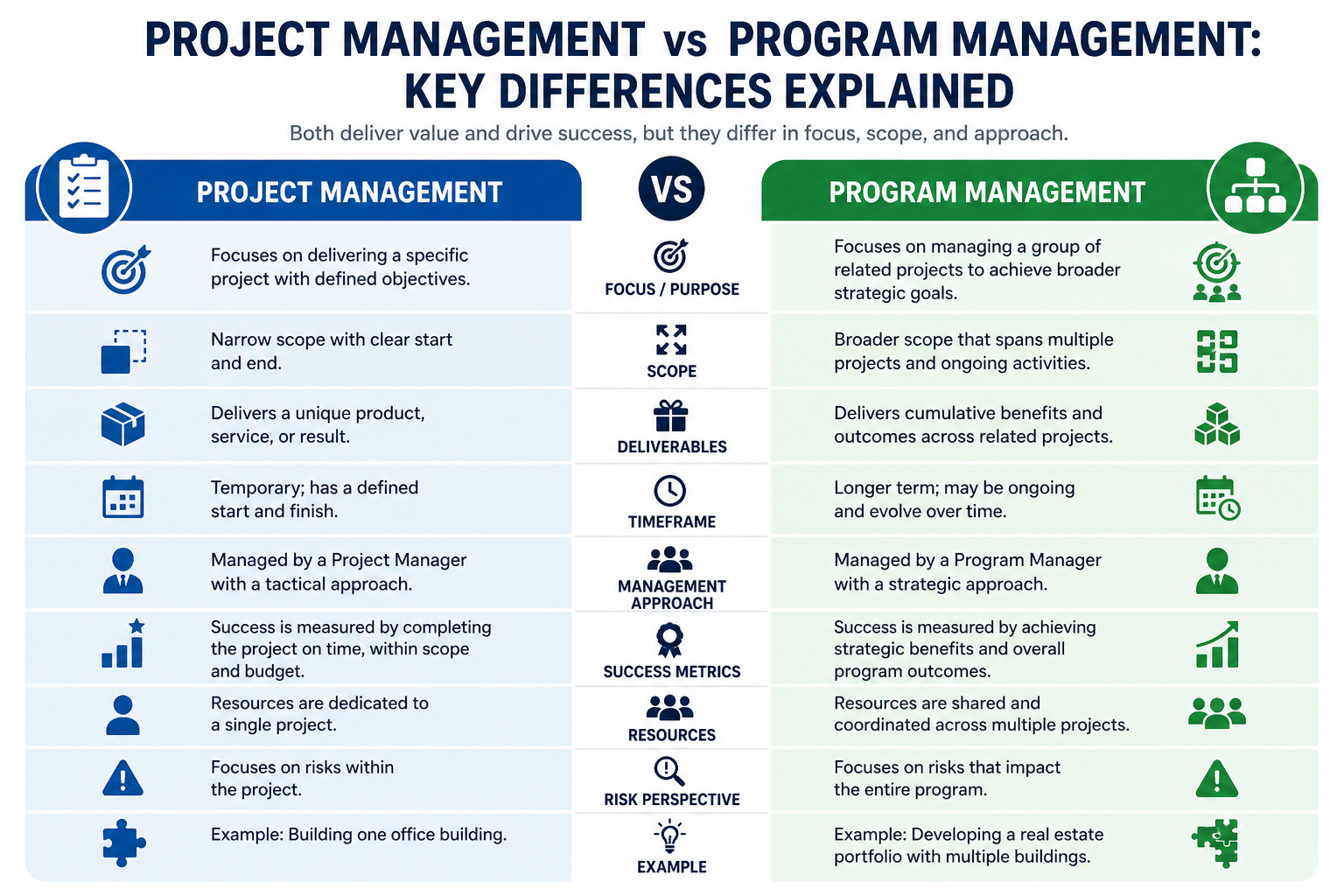
Project management and program management are often used interchangeably, but they represent two distinct levels of organizational execution. Project management is centered around delivering a specific output, while program management focuses on coordinating multiple related efforts to achieve broader strategic goals. Although both disciplines share similarities in structure, planning, and execution, their purpose, scope, and impact differ significantly. Understanding these differences is essential for organizations aiming to improve efficiency, alignment, and long-term value delivery.
Nature and Definition of Work
Project management deals with a temporary endeavor that is created to produce a unique product, service, or result. Each project is defined by a clear objective, fixed constraints, and a structured lifecycle. The work is highly focused, and success depends on completing specific deliverables within the agreed boundaries.
Program management, on the other hand, is not limited to a single output. It involves managing a group of interconnected projects that are aligned under a common strategic objective. The program exists to ensure that these projects collectively deliver value that cannot be achieved individually. Instead of focusing on individual tasks, program management emphasizes integration, coordination, and long-term benefits.
Scope and Level of Responsibility
The scope of project management is narrow and highly defined. A project manager is responsible for managing a single initiative, ensuring that all tasks are completed efficiently and effectively. Their attention is directed toward specific deliverables, timelines, and resource constraints.
Program management operates at a much broader level. A program manager oversees multiple projects that may differ in scope but are connected through shared objectives. Their responsibility includes ensuring that these projects do not operate in isolation but instead contribute to a unified strategic direction. This requires a higher level of oversight and decision-making authority.
Strategic vs Tactical Focus
Project management is primarily tactical in nature. It focuses on execution, problem-solving, and ensuring that defined tasks are completed as planned. Project managers spend much of their time managing schedules, budgets, risks, and team performance to achieve short-term goals.
Program management is strategic. It focuses on aligning multiple projects with organizational priorities and long-term vision. Program managers are less concerned with day-to-day execution and more focused on ensuring that the overall direction of all projects supports business transformation, growth, or strategic outcomes.
Time Horizon and Duration
Projects are temporary and have a clearly defined beginning and end. Once the deliverable is completed and accepted, the project is closed. This short-to-medium-term focus allows project managers to concentrate on immediate goals and deadlines.
Programs, however, are often long-term and may continue for years. They evolve as new projects are added or completed, depending on changing business needs. Unlike projects, programs do not always have a fixed end date. Instead, they are evaluated based on the ongoing value they provide to the organization.
Objectives and Success Criteria
In project management, success is measured by whether the project meets its defined scope, timeline, and budget constraints. The focus is on delivering a specific outcome that meets quality expectations and stakeholder requirements.
In program management, success is measured differently. It is not just about completing projects but about realizing benefits across the organization. This includes improved efficiency, increased revenue, better customer satisfaction, or enhanced operational capability. The success of a program is evaluated based on long-term value rather than immediate outputs.
Coordination and Integration
Project managers typically work within their own defined boundaries. While they may collaborate with other teams, their primary responsibility is to their own project.
Program managers must ensure coordination across multiple projects. This involves managing dependencies, resolving conflicts, and ensuring that resources are allocated effectively across the entire program. Integration is a key responsibility, as the success of one project may depend on the progress of another.
Decision-Making Authority
Project managers make decisions related to the execution of their specific project. These decisions are often operational and focused on solving immediate issues such as delays, resource shortages, or technical challenges.
Program managers make higher-level decisions that affect multiple projects. Their role involves prioritizing initiatives, balancing resources, and aligning project outcomes with strategic objectives. They often work closely with senior leadership to ensure alignment with organizational goals.
Risk Management Approach
In project management, risks are identified and managed at the project level. These risks are typically related to schedule delays, cost overruns, or quality issues within a single project.
Program management involves a broader view of risk. Program managers must consider risks that affect multiple projects simultaneously. These may include resource conflicts, interdependencies, or strategic misalignment. Managing program-level risks requires a more holistic and forward-looking approach.
Stakeholder Engagement
Project managers primarily engage with stakeholders who are directly involved in or impacted by the project. This includes team members, clients, and immediate sponsors.
Program managers engage with a wider and more diverse group of stakeholders. This includes senior executives, business leaders, and multiple project sponsors. Their communication is more strategic, focusing on progress, alignment, and overall value delivery rather than task-level updates.
Resource Management
Project managers manage resources within the scope of their project. They ensure that team members, tools, and budgets are used efficiently to complete specific tasks.
Program managers oversee resource allocation across multiple projects. They must ensure that resources are distributed in a way that maximizes efficiency and minimizes conflict between projects. This often involves prioritization and negotiation across different teams.
Governance Structure
Project management follows a relatively simple governance structure. It includes project sponsors, project managers, and team members who work together to achieve defined objectives.
Program management has a more complex governance structure. It includes program sponsors, program managers, project managers, and various stakeholders. Governance in program management ensures alignment with organizational strategy and provides oversight across all projects within the program.
Change Management
In project management, changes are usually controlled through formal change requests. Any modification to scope, timeline, or budget must be carefully evaluated and approved.
In program management, change is more dynamic. Since programs are aligned with evolving business strategies, change is often expected and managed at a higher level. Program managers must ensure that changes in one project do not negatively impact others.
Performance Measurement
Project performance is measured using specific indicators such as cost variance, schedule adherence, and quality standards. These metrics are clear and directly tied to project deliverables.
Program performance is measured using broader indicators such as business benefits realization, strategic alignment, and overall efficiency improvements. These metrics are more complex and often require long-term evaluation.
Tools and Techniques
Project managers often use tools that support task tracking, scheduling, budgeting, and collaboration. These tools help manage day-to-day activities and ensure project completion.
Program managers use tools that provide visibility across multiple projects. These tools focus on portfolio tracking, dependency management, and strategic reporting. The emphasis is on integration rather than individual task execution.
Leadership Style
Project management requires a leadership style that is directive and detail-oriented. Project managers must guide teams, solve problems quickly, and ensure accountability.
Program management requires a more transformational leadership style. Program managers inspire alignment across teams, influence stakeholders at senior levels, and focus on long-term vision rather than short-term tasks.
Organizational Impact
The impact of project management is usually limited to the specific deliverable being created. Once the project is completed, its direct influence may decrease.
Program management has a wider organizational impact. It shapes business transformation, drives strategic initiatives, and ensures that multiple projects collectively contribute to long-term success.
Dependency Management
Project managers handle dependencies within their own project, such as task sequencing and resource availability.
Program managers handle dependencies between multiple projects. They ensure that delays or changes in one project do not negatively affect others, maintaining overall program stability.
Interrelationship Between Projects and Programs
Projects and programs are closely connected, but their relationship is hierarchical and purpose-driven. A project exists as a standalone initiative with a clearly defined goal, while a program is essentially a collection of such projects grouped together because they contribute to a shared strategic outcome. This means that while a project can exist independently, a program cannot function without its underlying projects. Program management ensures that each project is not only completed successfully but also contributes meaningfully to the larger objective.
This relationship is important because organizations often face complexity when multiple initiatives overlap. Without program management, projects may become isolated efforts that deliver results individually but fail to generate maximum organizational value. Program management bridges this gap by ensuring cohesion and strategic alignment.
Role Clarity and Organizational Position
In most organizations, project managers operate at an operational level, working closely with teams responsible for execution. They are deeply involved in planning activities, monitoring progress, and resolving issues that arise during implementation. Their role is hands-on and detail-oriented, requiring strong organizational and problem-solving skills.
Program managers operate at a higher organizational level. They interact with senior leadership, business executives, and stakeholders responsible for strategic decision-making. Their role is less about managing tasks and more about managing outcomes, relationships, and long-term benefits. They ensure that all projects under a program remain aligned with the organization’s vision and priorities.
Skill Sets Required
Project management requires a strong focus on technical, organizational, and managerial skills. A project manager must be proficient in planning, scheduling, risk management, budgeting, and team coordination. They also need strong communication skills to manage stakeholders and ensure clarity in execution.
Program management requires a broader and more strategic skill set. In addition to understanding project management principles, program managers must have strong leadership, negotiation, strategic thinking, and governance skills. They must be capable of managing complexity, influencing senior stakeholders, and making decisions that affect multiple projects simultaneously.
Complexity Level
Projects are generally less complex in comparison to programs because they focus on a single objective. The complexity in project management is usually confined to managing tasks, timelines, and resources within a defined scope.
Programs are significantly more complex because they involve multiple interconnected projects, each with its own scope, team, and timeline. The challenge lies in ensuring that all these moving parts work together harmoniously. Dependencies between projects add another layer of complexity that requires continuous monitoring and adjustment.
Budget Management Differences
In project management, budgeting is focused on a single set of deliverables. The project manager is responsible for ensuring that costs remain within the approved budget and that financial resources are used efficiently.
Program management involves overseeing multiple budgets across different projects. The program manager must ensure that funding is allocated strategically across projects based on priority, impact, and dependency. This requires a broader financial perspective and the ability to optimize resource distribution at a macro level.
Communication Style
Project managers typically communicate in a more structured and task-oriented manner. Their communication focuses on updates, progress reports, issue resolution, and task assignments. Most of their communication is directed toward the project team and immediate stakeholders.
Program managers adopt a more strategic communication style. They provide updates on overall program health, alignment with business goals, and long-term progress. Their audience is usually senior leadership and cross-functional stakeholders, which requires clarity, influence, and the ability to present complex information in a simplified manner.
Risk Exposure and Management
Project risks are usually specific and limited to the scope of the project. These risks can include delays, technical challenges, resource shortages, or quality issues. Project managers handle these risks using predefined mitigation strategies.
Program risks are broader and more interconnected. A risk in one project can have a cascading effect on other projects within the program. Program managers must therefore adopt a systemic approach to risk management, identifying how risks interact across projects and developing strategies that minimize overall impact.
Dependency Handling
In project management, dependencies are typically internal and related to task sequencing or resource availability. These dependencies are easier to manage because they exist within a single controlled environment.
In program management, dependencies are more complex and often span across multiple projects. One project’s delay or change can directly impact another project’s timeline or deliverables. Program managers must constantly monitor these interdependencies to ensure smooth execution across the entire program.
Adaptability and Change Response
Projects are generally more rigid in structure. While changes can occur, they are controlled through formal processes and approvals. Any change in scope, timeline, or cost must be carefully evaluated to ensure it does not compromise project success.
Programs, however, are more adaptable by nature. Since they are aligned with broader business goals, they may evolve as organizational priorities shift. Program managers must be flexible and capable of adjusting plans across multiple projects to maintain alignment with strategic objectives.
Leadership Influence
Project managers lead teams through authority, structure, and clear direction. Their leadership is focused on ensuring that tasks are completed efficiently and objectives are met.
Program managers rely more on influence than authority. They work across multiple teams and departments, often without direct control over all resources. Their ability to guide, align, and motivate stakeholders is essential for achieving program success.
Deliverable vs Value Orientation
Project management is deliverable-oriented. The primary focus is on producing a specific output that meets predefined requirements. Success is determined by how well that output meets expectations.
Program management is value-oriented. The emphasis is on ensuring that all projects collectively deliver meaningful benefits to the organization. This could include improved efficiency, increased profitability, or enhanced customer experience.
Governance and Oversight Structure
Project governance is relatively straightforward, usually involving a project sponsor, project manager, and key stakeholders. Decision-making is limited to project-level concerns.
Program governance is more complex and layered. It involves program sponsors, program managers, project managers, and executive stakeholders. This structure ensures that all projects remain aligned with strategic goals and that decisions are made with a broader organizational perspective.
Tools and Reporting Systems
Project managers rely on tools that help track tasks, schedules, and budgets at a detailed level. These tools provide visibility into daily progress and help ensure timely delivery.
Program managers use more advanced systems that provide a consolidated view of all projects within the program. These systems help track overall progress, identify risks across projects, and measure strategic outcomes.
Performance Accountability
Project managers are accountable for the success of their individual projects. Their performance is measured based on delivery efficiency, adherence to scope, and stakeholder satisfaction.
Program managers are accountable for the overall success of the program. Their performance is evaluated based on the achievement of long-term benefits, alignment with business strategy, and successful coordination of multiple projects.
Impact on Business Strategy
Project management contributes to operational success by delivering specific outputs. However, its direct influence on business strategy is usually limited.
Program management has a direct and significant impact on business strategy. It ensures that multiple initiatives work together to support organizational transformation, growth, and long-term objectives.
Advanced Differences in Execution Approach
Project management follows a highly structured execution approach where work is broken down into manageable tasks, assigned to team members, and tracked against a defined timeline. Every activity is planned in detail, and deviations are closely monitored to ensure the project stays on track. The execution style is often linear or phase-based, depending on the methodology being used, and emphasizes control, predictability, and efficiency.
Program management, in contrast, follows a more adaptive execution approach. Since it involves multiple interconnected projects, execution is not strictly linear. Instead, it is dynamic and continuously adjusted based on changes across projects. Program managers focus on ensuring that all projects progress in harmony rather than enforcing rigid execution paths. This requires balancing priorities, resolving conflicts, and making high-level adjustments to maintain alignment with strategic goals.
Interdependency and System Thinking
One of the key distinctions between project and program management is the level of system thinking required. Project management typically deals with isolated systems where dependencies exist within a defined boundary. The focus is on ensuring that tasks within a project are completed in the correct sequence and that internal dependencies are managed effectively.
Program management requires system-level thinking because it deals with multiple interconnected projects. A change in one project can influence timelines, resources, or outcomes in another. Program managers must therefore understand how all components interact as part of a larger ecosystem. This ability to see the “big picture” is essential for maintaining balance and ensuring that the overall program delivers intended value.
Stakeholder Complexity and Engagement Depth
In project management, stakeholder engagement is usually limited to those directly involved in the project. These stakeholders include team members, clients, sponsors, and sometimes external vendors. Communication is frequent but focused on specific deliverables, progress updates, and issue resolution.
In program management, stakeholder complexity increases significantly. Program managers must engage with a much wider group that includes senior executives, department heads, external partners, and multiple project stakeholders. The depth of engagement is also more strategic, focusing on alignment, value delivery, and long-term outcomes rather than day-to-day progress. Managing expectations across such a diverse group requires strong interpersonal and communication skills.
Governance Decision Layers
Project governance operates within a relatively simple decision-making framework. Most decisions are made at the project level by the project manager or escalated to the project sponsor if needed. This allows for quick resolution of issues and efficient progress.
Program governance involves multiple layers of decision-making. Strategic decisions are often made at the executive level, while operational coordination happens at the program level. Program managers act as a bridge between strategic leadership and project execution teams, ensuring that decisions flow effectively across all levels of the organization. This layered structure helps maintain alignment but also adds complexity.
Flexibility in Planning
Project planning is generally rigid and detailed. At the beginning of a project, a comprehensive plan is created that outlines scope, schedule, resources, and risks. While some adjustments may occur, the overall structure remains relatively stable to ensure successful delivery.
Program planning is more flexible and evolving. Since programs span multiple projects over longer periods, planning must adapt to changing business priorities, market conditions, and organizational strategies. Program managers continuously refine plans to ensure that all projects remain aligned with overall objectives. This adaptability is essential for maintaining long-term relevance and value.
Performance Visibility
In project management, performance visibility is limited to the scope of the project. Project managers track progress through milestones, deliverables, and performance indicators that reflect the health of the project. This provides clear and focused visibility into whether the project is on track.
Program management provides a broader level of visibility. Program managers monitor performance across multiple projects simultaneously, identifying trends, risks, and opportunities that may not be visible at the project level. This aggregated view allows for better decision-making and ensures that the program remains aligned with organizational goals.
Outcome Integration
Project outcomes are usually standalone and focused on delivering a specific result. Once the project is completed, its deliverable is handed over to the client or organization, and the project is closed.
Program outcomes are integrated and cumulative. The success of a program depends on how well individual project outcomes combine to deliver broader strategic benefits. Program managers ensure that outputs from different projects complement each other and contribute to a unified organizational objective. This integration is what differentiates program success from individual project success.
Time, Cost, and Value Perspective
Project management prioritizes control over time and cost. The primary goal is to complete the project within the agreed budget and schedule while maintaining quality standards. Value is important but usually limited to the scope of the project deliverable.
Program management places greater emphasis on value rather than strict time or cost constraints. While budgets and timelines are still important, they are viewed in the context of overall benefit realization. Program managers may adjust schedules or resources across projects if it leads to greater long-term value for the organization.
Coordination Across Functions
Project managers typically coordinate within a defined functional area or cross-functional team assigned to the project. Their coordination efforts are focused on ensuring that all team members work together efficiently to achieve project goals.
Program managers coordinate across multiple functions and departments. Since programs involve several projects, coordination becomes more complex and requires alignment across different organizational units. This includes managing communication between teams that may not normally interact with each other.
Risk Tolerance and Strategic Risk Handling
Project management operates with a relatively low tolerance for risk within its defined boundaries. Risks are identified early, assessed, and mitigated to minimize impact on project delivery.
Program management, however, operates with a broader risk perspective. Some level of risk is accepted if it contributes to strategic advantage. Program managers evaluate risks not only based on immediate impact but also on long-term organizational benefits. This requires a more strategic and sometimes calculated approach to decision-making.
Leadership Scope and Influence Range
The leadership scope of a project manager is limited to the project team. Their influence is primarily operational, ensuring that tasks are completed efficiently and objectives are met.
Program managers have a much wider influence range. They lead across multiple teams, departments, and sometimes even external organizations. Their leadership is based on influence, negotiation, and strategic alignment rather than direct authority. This requires a higher level of leadership maturity and communication skill.
Organizational Value Contribution
Project management contributes value by delivering specific outputs that fulfill immediate business needs. These outputs may improve processes, create products, or support operational goals.
Program management contributes value by enabling transformation and strategic growth. By coordinating multiple projects, it ensures that organizational investments are aligned and that long-term benefits are realized in a structured and efficient manner.
Final Expanded Perspective
When viewed together, project management and program management represent two interconnected but distinct layers of organizational execution. Project management ensures that specific tasks and deliverables are completed efficiently, while program management ensures that these efforts collectively contribute to broader strategic success. One focuses on precision and execution, while the other focuses on alignment and value integration.
Organizations that understand and effectively implement both disciplines are better positioned to achieve operational excellence as well as long-term strategic growth.
Portfolio Context and Broader Alignment
Project management operates within a single initiative, focusing entirely on delivering one defined outcome. It does not typically consider how other projects in the organization are performing unless there is a direct dependency or shared resource constraint. The primary concern is execution efficiency and successful completion of that individual effort.
Program management sits within a broader organizational context and often connects directly to portfolio management. It ensures that multiple related projects are aligned with higher-level business objectives. While a project focuses on “doing things right,” program management focuses on “doing the right things together.” This alignment ensures that investments in multiple projects are not fragmented but instead contribute to a unified direction that supports organizational strategy.
Change Impact Across Multiple Layers
In project management, change is usually contained within the boundaries of the project. When a change request is introduced, it is evaluated based on its impact on scope, time, cost, and quality. If approved, it is implemented in a controlled manner without significantly affecting other initiatives.
In program management, change has a wider ripple effect. A modification in one project can influence multiple other projects within the same program. Program managers must evaluate how changes interact across different initiatives and ensure that adjustments do not disrupt overall program objectives. This requires a more layered and interconnected approach to change control.
Dependency Risk Amplification
Project-level dependencies are usually predictable and manageable because they exist within a controlled environment. These dependencies often involve task sequencing, resource availability, or vendor coordination, all of which can be addressed through structured planning.
In program management, dependencies become amplified because they exist across multiple projects. A delay or issue in one project can cascade into others, creating a chain reaction. This amplification effect requires program managers to actively monitor cross-project relationships and implement mitigation strategies that reduce systemic risk rather than isolated issues.
Strategic Prioritization of Work
Project managers prioritize tasks based on project requirements, deadlines, and resource availability. Their focus is on ensuring that the project moves forward efficiently and meets its specific goals.
Program managers prioritize entire projects within a program. This means deciding which projects should receive more resources, attention, or urgency based on strategic importance. Prioritization is not just about tasks but about balancing entire streams of work to ensure maximum organizational benefit.
Efficiency vs Effectiveness Balance
Project management is heavily focused on efficiency—doing work in the most productive and resource-effective way possible. Success is measured by how well resources are utilized to deliver the intended output within constraints.
Program management emphasizes effectiveness—ensuring that the right combination of projects is executed to achieve meaningful business outcomes. Even if individual projects are efficient, the program is only successful if the combined results create significant value for the organization.
Organizational Change Enablement
Project management contributes to change by delivering specific solutions or improvements. These may include new systems, products, or process enhancements that support organizational needs.
Program management enables broader organizational transformation. It coordinates multiple change initiatives to ensure that the organization moves in a unified direction. Instead of isolated improvements, program management drives large-scale change that affects multiple areas of the business simultaneously.
Level of Predictability
Projects are generally more predictable because they are tightly scoped and carefully planned. With defined inputs, resources, and timelines, project outcomes can be estimated with a reasonable degree of accuracy.
Programs are less predictable due to their complexity and long-term nature. External factors such as market changes, business strategy shifts, and inter-project dependencies can influence outcomes. Program managers must therefore operate with flexibility and adaptability rather than relying solely on fixed plans.
Execution Control vs Outcome Guidance
Project managers exercise strong control over execution. They closely monitor tasks, enforce deadlines, and ensure compliance with project plans. Their role is to maintain order and structure throughout the project lifecycle.
Program managers focus more on guiding outcomes rather than controlling execution details. They provide direction, resolve high-level issues, and ensure alignment but allow project managers to handle day-to-day execution. This separation of responsibilities allows for both structure and flexibility within the organization.
Time Allocation of Leadership Focus
Project managers spend most of their time on operational activities such as planning, tracking progress, managing risks, and resolving issues. Their attention is concentrated on ensuring smooth execution.
Program managers divide their time between strategic planning, stakeholder engagement, dependency management, and performance oversight. They operate at a higher altitude, focusing less on individual tasks and more on how everything fits together.
Cross-Project Learning and Optimization
Project management focuses on learning within a single initiative. Lessons learned are applied internally to improve efficiency and execution within that project.
Program management enables cross-project learning. Insights gained from one project can be applied to others within the program. This creates a feedback loop that improves overall performance and ensures continuous improvement across multiple initiatives.
Scalability of Management Approach
Project management scales in a linear manner. As more projects are added, each one is managed independently with its own structure and team.
Program management is designed for scalability across complexity. It allows organizations to manage multiple interconnected projects without losing alignment or control. This scalability is achieved through structured governance, centralized oversight, and strategic coordination.
Value Delivery Timeframe
Project value is usually realized in the short term once the deliverable is completed and implemented. The benefit is often immediate and directly measurable.
Program value is realized over a longer timeframe. It emerges gradually as multiple projects are completed and their outcomes are integrated. The true value of a program often becomes visible only when all contributing projects are aligned and functioning together.
Resource Optimization Across Systems
In project management, resource optimization is limited to the project itself. The project manager ensures that available resources are used efficiently within that scope.
In program management, optimization extends across multiple projects. Resources are allocated dynamically based on priority, urgency, and strategic importance. This system-wide optimization ensures better utilization of organizational capabilities.
Expanded View
When examined across multiple dimensions, the distinction between project management and program management becomes even clearer. Project management is focused, structured, and execution-driven, ensuring that specific deliverables are achieved efficiently. Program management is expansive, strategic, and coordination-driven, ensuring that multiple projects work together to deliver long-term value.
Together, they form a complementary system where one ensures precision in execution while the other ensures alignment in direction. Organizations that effectively balance both approaches are able to achieve not only operational success but also sustained strategic growth and transformation.
Conclusion
Project management and program management are two interconnected disciplines that serve different but complementary purposes within an organization. Project management focuses on delivering specific, well-defined outputs through structured planning, execution, and control. It ensures that individual initiatives are completed efficiently within set constraints of time, cost, and quality.
Program management, on the other hand, operates at a higher strategic level. It brings together multiple related projects and ensures they are aligned with broader organizational goals. Instead of focusing on individual deliverables, it emphasizes overall value creation, long-term benefits, and strategic alignment.
While project management is more tactical and execution-driven, program management is strategic and coordination-focused. Projects are temporary and goal-specific, whereas programs are longer-term and designed to evolve as business needs change. Project success is measured by delivery efficiency, while program success is measured by the realization of broader business outcomes.
In essence, project management ensures that work gets done correctly, while program management ensures that the right combination of work delivers meaningful organizational impact. Both roles are essential, and when effectively integrated, they enable organizations to achieve both operational excellence and strategic growth.