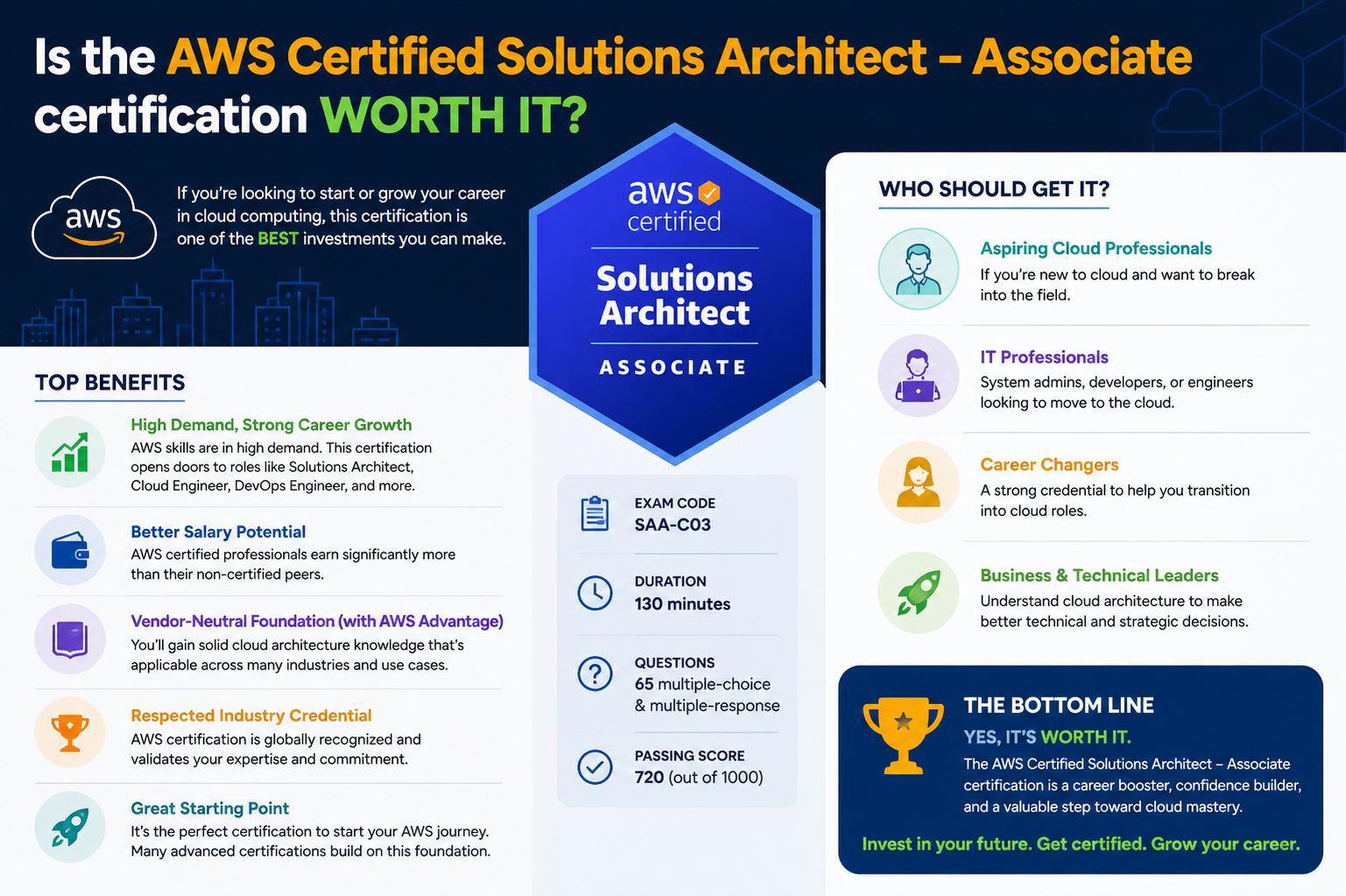
The AWS Certified Solutions Architect – Associate certification is one of the most recognized entry-to-intermediate level cloud credentials in the technology industry. It focuses on validating a candidate’s ability to design and deploy scalable, highly available, and fault-tolerant systems using Amazon Web Services. Unlike basic IT certifications that only test theoretical knowledge, this certification emphasizes real-world architectural decision-making in cloud environments.
In simple terms, it proves that a professional can understand how different AWS services work together and how to design systems that meet business requirements efficiently. This includes performance optimization, cost management, security design, and system reliability. Because AWS is used by companies of all sizes globally, this certification has become a common benchmark for cloud expertise.
For many learners and professionals, the biggest question is not what the certification is, but whether it truly adds value in career growth, salary improvement, and long-term skill development. Understanding this requires looking deeper into its relevance in the modern tech industry.
Growing Importance of Cloud Computing in the Industry
Cloud computing has become the backbone of modern digital infrastructure. Companies are no longer relying on traditional on-premises servers for their applications. Instead, they are migrating to cloud platforms to improve flexibility, reduce costs, and scale operations efficiently. AWS remains one of the leading providers in this space, which naturally increases the demand for professionals who understand its ecosystem.
Organizations need engineers who can design systems that are not only functional but also resilient under heavy load and secure from cyber threats. This is where cloud architects play a crucial role. The AWS Certified Solutions Architect – Associate certification aligns directly with these industry needs, making it highly relevant for IT professionals, software engineers, and system administrators.
As businesses continue adopting cloud-first strategies, the demand for certified cloud professionals is expected to remain strong. This long-term industry shift is one of the main reasons this certification holds significant value.
Who Should Consider This Certification
This certification is suitable for a wide range of individuals, but it is especially beneficial for those who want to build a career in cloud computing or move into more advanced technical roles.
It is a strong choice for software developers who want to understand infrastructure design in addition to coding. It is also useful for system administrators transitioning from traditional IT environments into cloud-based systems. Additionally, DevOps engineers, network engineers, and IT support professionals can benefit from the structured knowledge it provides.
Even beginners in IT can pursue this certification, although some basic understanding of networking, virtualization, and general computing concepts is recommended. While it is not an entry-level certification in terms of content depth, it is often considered the first serious step into cloud architecture careers.
Skills and Knowledge You Gain
One of the strongest advantages of this certification is the depth of practical knowledge it provides. It is not limited to memorizing AWS services but focuses on how to apply them effectively in real scenarios.
Candidates learn how to design distributed systems that can handle failures without affecting performance. They gain understanding of data storage solutions, compute services, and networking configurations within AWS. Security is also a major focus area, including identity management, encryption, and access control mechanisms.
Another important skill developed is cost optimization. AWS offers many services, but choosing the right combination while maintaining efficiency and minimizing cost is a critical skill for cloud architects. The certification trains individuals to think in terms of cost-performance balance, which is highly valued by employers.
Overall, the certification builds a strong architectural mindset, helping professionals make informed decisions when designing cloud systems.
Exam Structure and Level of Difficulty
The AWS Certified Solutions Architect – Associate exam is designed to test both conceptual understanding and practical problem-solving skills. It includes scenario-based questions where candidates must choose the best architectural solution based on given requirements.
The difficulty level is moderate but challenging for beginners without prior cloud experience. It requires not just reading but also hands-on practice with AWS services. Many candidates find that real understanding comes only after working with the platform directly rather than relying solely on study materials.
Time management during preparation is also important because the breadth of topics is wide. The exam covers multiple domains including networking, storage, compute, security, and architectural best practices.
While it is not considered extremely difficult, it does require consistent preparation and practical exposure to cloud environments.
Career Opportunities After Certification
One of the main reasons professionals pursue this certification is career advancement. It can help open doors to roles such as cloud solutions architect, AWS cloud engineer, DevOps engineer, and infrastructure specialist.
Many companies list this certification as a preferred or even required qualification for cloud-related job roles. Even when not mandatory, it significantly strengthens a candidate’s resume and improves their chances of getting shortlisted.
For entry-level professionals, it can help bridge the gap between academic knowledge and industry expectations. For experienced IT professionals, it can support a transition into higher-paying cloud architecture roles.
The certification alone does not guarantee employment, but it acts as a strong credibility factor when combined with practical experience.
Industry Recognition and Professional Credibility
In the IT industry, certifications are often used as a benchmark for evaluating skills, especially in cloud computing. The AWS Solutions Architect – Associate certification is widely recognized across global companies, from startups to large enterprises.
It signals that the individual has invested time in understanding cloud architecture principles and has validated knowledge through a structured exam process. This can increase trust during hiring processes and client-facing roles.
It also helps professionals stand out in competitive job markets where many candidates may have similar educational backgrounds. Having a recognized cloud certification adds an additional layer of credibility to technical profiles.
Initial Learning Challenges and Common Difficulties
Despite its benefits, this certification is not without challenges. Many learners struggle at the beginning due to the wide range of topics covered. AWS offers a large number of services, and understanding when and how to use each one can feel overwhelming.
Another common difficulty is the shift from theoretical learning to scenario-based thinking. The exam does not ask direct factual questions but instead tests decision-making skills. This requires a deeper understanding of architecture design principles.
Beginners may also find networking concepts and security configurations difficult if they do not have prior IT experience. However, these challenges can be overcome with consistent practice and hands-on experience.
Long-Term Value of the Certification
The long-term value of the AWS Certified Solutions Architect – Associate certification depends on how it is used. On its own, it is a strong credential, but its real power comes when combined with practical experience and continuous learning.
Cloud technology evolves rapidly, and AWS frequently updates its services. Professionals who continue learning after certification are more likely to benefit in the long run. The certification acts as a foundation that can lead to more advanced AWS certifications and specialized cloud roles.
Over time, individuals who build on this foundation can move into senior architecture positions, cloud consulting roles, or even cloud solution design leadership roles.
How This Certification Impacts Salary Growth
One of the most discussed aspects of the AWS Certified Solutions Architect – Associate certification is its potential impact on salary. While the certification itself does not directly guarantee a specific income level, it often contributes to higher earning potential by improving job eligibility and negotiation power.
In many organizations, cloud skills are considered premium expertise because they directly affect infrastructure costs, system performance, and business scalability. Professionals who understand how to design efficient cloud architectures are often compensated better than general IT roles.
Entry-level candidates may not see an immediate dramatic salary jump, but they are more likely to qualify for cloud-related roles that pay better than traditional IT support or basic development positions. For mid-level professionals, especially those transitioning from system administration or software development, the certification can help justify a higher pay bracket.
In senior roles, the certification becomes less about direct salary increase and more about credibility reinforcement. Employers often expect cloud architects to hold such certifications as proof of validated expertise, especially in AWS-heavy environments.
Real-World Relevance of AWS Skills
Unlike purely theoretical certifications, the AWS Certified Solutions Architect – Associate exam is designed around real-world cloud scenarios. This makes the knowledge highly transferable to actual job environments.
In real companies, cloud architects are responsible for designing systems that handle traffic spikes, ensure uptime during failures, and maintain secure data storage. The certification prepares individuals to think in terms of distributed systems rather than single-server setups.
For example, instead of simply deploying an application, a certified professional learns to design it with load balancing, auto-scaling, and redundancy. These are not abstract concepts but practical requirements in modern software systems.
This real-world alignment is one of the strongest reasons why the certification is respected in the industry. It is not just about passing an exam but about developing a mindset that matches how cloud systems actually operate at scale.
Comparison with Other Cloud Certifications
The AWS Certified Solutions Architect – Associate certification is often compared with similar certifications from other cloud providers. While each platform has its own ecosystem, AWS remains the most widely adopted globally, which gives its certification strong market value.
Compared to beginner-level certifications, this one goes deeper into architecture design rather than just basic cloud concepts. It is more advanced than entry-level cloud practitioner exams but still accessible compared to professional-level certifications.
In terms of difficulty, it sits in the middle range. It is more challenging than foundational certifications but less complex than expert-level architecture certifications. This balance makes it ideal for individuals who already have some technical background but are not yet advanced cloud architects.
Its broad industry acceptance also makes it more versatile. Skills learned here can often be adapted to other cloud platforms because core architectural principles like scalability, reliability, and security are universal.
Learning Curve and Preparation Journey
The preparation journey for this certification is often described as structured but demanding. It requires a combination of theoretical study and practical experimentation.
Initially, learners may find AWS services overwhelming due to the sheer number of tools available. However, over time, patterns begin to emerge, making it easier to understand how services interact with each other.
Hands-on practice is essential. Simply reading about services is not enough because the exam tests applied knowledge. Working with compute services, storage solutions, networking configurations, and security setups helps reinforce understanding.
Another important part of preparation is scenario analysis. Many exam questions present real-life problems and require selecting the most efficient architectural solution. This means learners must not only know what services do but also when to use them and why.
Consistency is more important than speed in preparation. Many successful candidates spend weeks or months gradually building their understanding instead of rushing through content.
Common Mistakes Candidates Make
Many candidates underestimate the depth of the certification and focus too much on memorization rather than understanding. This often leads to difficulty when facing scenario-based questions.
Another common mistake is skipping hands-on practice. AWS is a practical platform, and without actual usage, it becomes difficult to understand how services behave in real environments.
Some learners also rely too heavily on simplified study summaries without exploring how services integrate with each other. This creates gaps in understanding that become obvious during the exam.
Time management during preparation is another challenge. Because AWS has many services, candidates sometimes try to learn everything at once instead of focusing on core architectural concepts first.
Avoiding these mistakes significantly increases the chances of passing the exam and gaining meaningful knowledge from the process.
Long-Term Career Progression After Certification
The AWS Certified Solutions Architect – Associate certification is not an endpoint but a stepping stone. Many professionals use it as a foundation for more advanced cloud certifications and specialized roles.
After gaining this certification, individuals often move toward roles such as senior cloud architect, cloud consultant, DevOps specialist, or infrastructure engineer. These roles involve higher responsibility and more complex system design.
With experience, professionals can also move into leadership positions where they guide cloud strategy for entire organizations. In such roles, the certification serves as a credibility base that supports decision-making authority.
It can also open opportunities in consulting and freelancing, where cloud expertise is highly valued. Businesses often seek certified professionals for designing or optimizing their cloud infrastructure.
Over time, the certification becomes part of a larger professional journey rather than a standalone achievement.
Industry Trends Supporting Its Relevance
The continued growth of cloud adoption across industries strongly supports the relevance of this certification. Organizations in finance, healthcare, education, retail, and entertainment are all moving toward cloud-based infrastructure.
This widespread adoption means the demand for cloud architects is not limited to a single industry. Instead, it spans across multiple sectors, increasing job stability for certified professionals.
Another trend is the increasing focus on cost optimization and cloud efficiency. Companies are not only adopting cloud systems but also trying to optimize their usage. This requires skilled professionals who understand architectural efficiency, which is a key focus of this certification.
Security is also becoming a major concern in cloud environments. As data breaches and cyber threats increase, companies need professionals who can design secure systems from the ground up.
These trends ensure that the knowledge gained from this certification remains relevant for years to come.
Limitations and Realistic Expectations
While the certification offers many benefits, it is important to maintain realistic expectations. It is not a magic solution that guarantees a high-paying job or instant career transformation.
Employers still value practical experience, problem-solving ability, and project work. The certification is best seen as an enhancer rather than a replacement for experience.
Another limitation is that cloud technology evolves rapidly. Services and best practices may change over time, which means continuous learning is necessary even after certification.
Additionally, competition in the cloud job market is increasing. As more professionals obtain certifications, standing out requires combining certification with real-world projects or specialized expertise.
Understanding these limitations helps set a balanced and practical approach toward career planning.
Perspective on Overall Value
The AWS Certified Solutions Architect – Associate certification holds strong value for individuals aiming to build a career in cloud computing. It provides structured learning, industry recognition, and practical architectural knowledge that aligns with real-world needs.
Its worth is not just in passing the exam but in how the knowledge is applied in professional environments. When combined with hands-on experience and continuous learning, it becomes a powerful foundation for long-term career growth.
For anyone serious about entering or advancing in the cloud industry, this certification remains one of the most practical and respected starting points.
Job Market Reality and Competition Level
The cloud job market has expanded rapidly, but it has also become more competitive. The AWS Certified Solutions Architect – Associate certification helps candidates enter this space, but it is important to understand how competition actually works in real hiring scenarios.
Many candidates today hold at least one cloud certification, which means simply having the credential is no longer enough to stand out on its own. Employers now look for a combination of certification, hands-on experience, and problem-solving ability.
In entry-level roles, the certification can help get past initial screening filters used by recruiters. However, in technical interviews, candidates are still evaluated based on their ability to design systems and explain architectural decisions clearly.
For mid-level and senior roles, competition shifts even more toward experience. The certification supports credibility, but real-world project exposure becomes the deciding factor.
This means the certification is most powerful when it is part of a broader skill set rather than the only qualification.
How Employers Actually View This Certification
From an employer’s perspective, the AWS Certified Solutions Architect – Associate certification is often seen as a positive signal rather than a strict requirement. It indicates that the candidate has taken the time to understand cloud architecture fundamentals.
Many hiring managers consider it a baseline validation for cloud-related roles. It does not guarantee expertise, but it reduces uncertainty about a candidate’s foundational knowledge.
In some organizations, especially those heavily using AWS, the certification is preferred because it aligns with internal infrastructure standards. In consulting companies or cloud service providers, it may even be encouraged or required for certain roles.
However, employers are also aware that certification alone does not guarantee practical ability. This is why interviews typically focus on scenario-based questions, system design discussions, and troubleshooting approaches.
The certification opens the door, but performance in real technical discussions determines final selection.
Hands-On Experience vs Certification Knowledge
One of the most important distinctions in cloud careers is the difference between theoretical certification knowledge and real hands-on experience.
The AWS Certified Solutions Architect – Associate certification teaches concepts, patterns, and best practices. It helps individuals understand how systems should be designed in ideal scenarios.
However, real-world environments are often more complex. They include legacy systems, budget constraints, incomplete requirements, and unexpected technical limitations.
Hands-on experience teaches how to adapt cloud knowledge to these real constraints. It helps professionals understand how services behave under real workloads, how failures occur, and how systems recover in production environments.
Employers highly value candidates who can combine both certification knowledge and practical experience. The certification provides structure, while experience provides adaptability.
Role of Projects in Strengthening Certification Value
To maximize the value of this certification, working on real or simulated cloud projects is extremely important. Projects help bridge the gap between theoretical understanding and practical application.
For example, designing a simple web application using cloud services, setting up a secure storage system, or creating a scalable backend architecture can significantly deepen understanding.
These projects help learners understand how services interact in real time, how monitoring works, and how scaling decisions are made under load conditions.
When combined with certification, project experience creates a much stronger professional profile. It shows not only knowledge but also the ability to apply that knowledge effectively.
This combination is often what separates entry-level candidates from more competitive job applicants.
Common Career Paths After Certification
After earning the AWS Certified Solutions Architect – Associate certification, professionals typically move into several different career paths depending on their background and interests.
Some move toward cloud architecture roles where they design and manage infrastructure systems. Others transition into DevOps roles where they focus on automation, deployment pipelines, and system reliability.
Software developers often use this certification to move closer to infrastructure-aware development, improving how applications interact with cloud environments.
System administrators may shift into cloud engineering roles, modernizing their skill sets for cloud-based infrastructure management.
Over time, many professionals progress toward senior architecture or cloud consulting positions where they design large-scale systems for multiple clients or organizations.
Each of these paths builds on the foundation provided by the certification but requires continued learning and experience.
Future Scope of AWS and Cloud Careers
The future of cloud computing continues to show strong growth. AWS remains one of the dominant platforms in this space, which means skills related to AWS architecture are likely to remain relevant for the foreseeable future.
Organizations are increasingly shifting toward hybrid and multi-cloud environments, but AWS still plays a major role in most enterprise systems.
As technologies evolve, cloud architects are expected to take on more responsibilities beyond basic infrastructure design. This includes automation, security compliance, cost optimization, and system integration across multiple platforms.
Emerging technologies like artificial intelligence, machine learning, and data analytics are also increasingly being integrated into cloud environments. This expands the role of cloud architects even further.
Professionals with AWS certification who continue to upgrade their skills are well-positioned to take advantage of these evolving opportunities.
Time Investment vs Career Return
One of the practical considerations for many learners is whether the time invested in this certification is worth the potential return.
The preparation time varies depending on prior experience. For someone with IT or development background, it may take a few weeks to a couple of months of focused study. For beginners, it may take longer due to the need to understand foundational concepts first.
The return on investment is generally positive when the certification is used as part of a broader career strategy. It can lead to better job opportunities, improved interview chances, and stronger technical confidence.
However, the highest returns are seen when certification is combined with continuous learning and real-world application. Without practical experience, the long-term impact may be limited.
This makes it less of a one-time achievement and more of a step in an ongoing career development process.
Challenges After Certification
Even after earning the certification, professionals face new challenges in real-world environments.
One major challenge is adapting to large-scale systems that are far more complex than exam scenarios. Real systems often involve multiple interconnected services, legacy integrations, and strict business requirements.
Another challenge is keeping up with AWS updates. The platform evolves continuously, and new services or features are frequently introduced. Professionals must stay updated to remain effective in their roles.
There is also the challenge of specialization. While the certification provides broad knowledge, advanced roles often require deeper expertise in specific areas such as security, networking, or data engineering.
This means learning does not stop after certification; instead, it shifts toward specialization and practical mastery.
Overall Worth
The AWS Certified Solutions Architect – Associate certification is worth it for individuals who are serious about building a career in cloud computing. It provides structured learning, industry recognition, and a strong foundation in cloud architecture principles.
However, its true value depends on how it is used. On its own, it is a strong credential, but when combined with hands-on experience, projects, and continuous learning, it becomes a powerful career accelerator.
It is best viewed as a starting point in cloud architecture rather than a final achievement. Those who continue to build on it tend to see the most long-term benefits in terms of career growth, job opportunities, and professional development.
Real Impact on Confidence and Technical Thinking
One of the less discussed but highly important benefits of the AWS Certified Solutions Architect – Associate certification is the improvement in technical confidence. Many learners enter cloud computing feeling uncertain about how large-scale systems actually work. This certification helps bridge that gap by introducing structured ways of thinking about infrastructure design.
As candidates progress through preparation, they begin to understand how decisions in cloud architecture are not random but based on trade-offs between cost, performance, scalability, and security. This shift in thinking is significant because it changes how professionals approach problem-solving in general.
Instead of focusing only on coding or isolated system components, individuals start thinking in terms of complete system design. This includes how users interact with applications, how data flows between services, and how failures are handled without affecting the end user experience.
This broader perspective is one of the strongest long-term benefits of the certification, even beyond job roles.
Importance of Architectural Mindset in Modern IT Roles
Modern IT roles are no longer limited to a single area of expertise. Developers are expected to understand infrastructure, and infrastructure engineers are expected to understand applications. This convergence makes architectural thinking extremely valuable.
The AWS Certified Solutions Architect – Associate certification introduces this mindset by teaching how different AWS services work together to form complete solutions.
For example, instead of viewing storage, compute, and networking as separate topics, learners begin to understand how they interact in a unified system. This helps in designing solutions that are not only functional but also efficient and scalable.
This architectural mindset is increasingly important in organizations adopting microservices, serverless computing, and distributed systems.
Professionals who develop this thinking are often more effective in cross-functional teams because they can communicate clearly with developers, operations teams, and business stakeholders.
How It Helps in Technical Interviews
Technical interviews for cloud-related roles often focus heavily on system design questions. Candidates are expected to explain how they would design scalable, secure, and highly available systems for real-world scenarios.
The AWS Certified Solutions Architect – Associate certification directly supports this type of preparation.
During study, candidates learn how to approach design problems systematically. They learn to consider requirements such as traffic load, latency, fault tolerance, and data consistency.
This structured thinking becomes extremely useful during interviews, where clarity of reasoning is often more important than memorized answers.
Even when candidates are not asked AWS-specific questions, the architectural principles learned from the certification can be applied to general system design discussions.
This makes it easier to handle complex interview scenarios with confidence and logical reasoning.
Limitations in Practical Industry Expectations
While the certification provides a strong foundation, it is important to understand that industry expectations often go beyond what is covered in the exam.
Real-world cloud environments involve additional complexities such as organizational policies, compliance requirements, legacy system integration, and unpredictable user behavior.
In many cases, professionals must also deal with business constraints that influence technical decisions. These constraints are not always present in certification scenarios.
For example, while a certification may teach the ideal architecture for scalability, real companies may choose a simpler or cheaper solution based on budget limitations.
This difference highlights the importance of experience in addition to certification knowledge.
Professionals must learn to balance theoretical best practices with practical business needs.
Continuous Learning Requirement in Cloud Careers
One important reality of cloud computing careers is that learning never truly stops. AWS regularly introduces new services, updates existing features, and modifies best practices.
This means that even after earning the AWS Certified Solutions Architect – Associate certification, professionals need to continue updating their knowledge.
New architectural patterns also emerge over time, especially with the rise of serverless computing, containerization, and AI-driven cloud services.
Professionals who stay updated remain competitive in the job market, while those who stop learning may find their skills becoming outdated.
This continuous learning requirement is not a disadvantage but rather a characteristic of the cloud industry as a whole.
It ensures that professionals remain adaptable and capable of working with evolving technologies.
Psychological Advantage in Career Growth
Another subtle benefit of this certification is the psychological advantage it provides in career development. Many individuals struggle with self-doubt when entering the cloud computing field due to its complexity.
Earning the certification helps build a sense of structured progress and achievement. It confirms that the individual has successfully mastered a recognized body of knowledge.
This confidence often translates into better performance in interviews, workplace discussions, and project work.
It also encourages professionals to pursue further learning, such as advanced AWS certifications or specialized cloud domains.
In this way, the certification acts as a motivational milestone in a broader career journey.
When the Certification May Not Be Enough Alone
While the AWS Certified Solutions Architect – Associate certification is valuable, there are situations where it may not be sufficient on its own.
For example, in highly competitive job markets, many candidates may already hold similar certifications. In such cases, employers rely more heavily on practical experience and project portfolios.
Additionally, senior-level positions require deeper expertise that goes beyond associate-level knowledge. These roles often expect familiarity with advanced architecture patterns, security frameworks, and enterprise-level system design.
Without additional experience or higher-level certifications, candidates may find it challenging to move directly into senior roles.
This does not reduce the value of the certification, but it highlights the importance of using it as part of a long-term career strategy rather than a standalone qualification.
Strategic Way to Use This Certification
The most effective way to use the AWS Certified Solutions Architect – Associate certification is to treat it as a foundation for continuous growth.
After completing the certification, professionals should focus on applying their knowledge through real projects, internships, or job roles that involve cloud systems.
They should also consider exploring related areas such as DevOps, security, data engineering, or advanced cloud architecture.
Over time, this creates a layered skill set that significantly increases career opportunities.
Instead of stopping after certification, the goal should be to build on it gradually and move toward specialization.
This strategic approach ensures long-term career growth rather than short-term achievement.
Final Reflection on Overall Value
The AWS Certified Solutions Architect – Associate certification holds strong value in today’s technology landscape. It provides structured learning, industry recognition, and a solid foundation in cloud architecture principles.
However, its true worth depends on how it is used after completion. When combined with practical experience, continuous learning, and real-world projects, it becomes a powerful tool for career advancement.
It is not an endpoint but a starting point that opens multiple pathways in cloud computing, system design, and IT infrastructure careers.
For individuals willing to invest time and effort beyond the exam, this certification can serve as a meaningful step toward long-term professional growth in the cloud industry.
Is the AWS Certified Solutions Architect – Associate Certification Worth It?
The AWS Certified Solutions Architect – Associate certification is generally worth it for anyone serious about building a career in cloud computing. It provides a strong foundation in designing scalable, secure, and cost-efficient cloud systems, which are essential skills in today’s technology-driven industry. Beyond just passing an exam, it helps develop a structured architectural mindset that is directly applicable to real-world IT and software environments.
Its true value lies in how it improves career opportunities, strengthens technical understanding, and increases professional credibility. For beginners and intermediate professionals, it can act as a gateway into cloud roles, while for experienced IT professionals, it serves as a way to validate and formalize existing skills in AWS architecture.
However, it is important to keep expectations realistic. The certification alone is not enough to guarantee a high-level job or long-term success. Practical experience, hands-on projects, and continuous learning are equally important to fully benefit from it. Cloud computing is a constantly evolving field, and staying relevant requires ongoing skill development even after certification.
Overall, the AWS Certified Solutions Architect – Associate certification is a valuable investment when viewed as part of a broader learning journey. It is not the final destination, but a strong and respected stepping stone toward building a successful career in cloud architecture and modern IT infrastructure.
Conclusion:
The AWS Certified Solutions Architect – Associate certification is a valuable credential for anyone aiming to build or advance a career in cloud computing. It strengthens core understanding of AWS services, improves architectural thinking, and enhances credibility in a competitive job market. For beginners and intermediate professionals, it can open doors to better opportunities and serve as a strong foundation for more advanced cloud roles.
However, its real value depends on how it is used beyond the exam. Without practical experience and continuous learning, its impact may remain limited. When combined with hands-on projects and real-world application, it becomes a powerful stepping stone toward long-term career growth in cloud architecture and related fields.