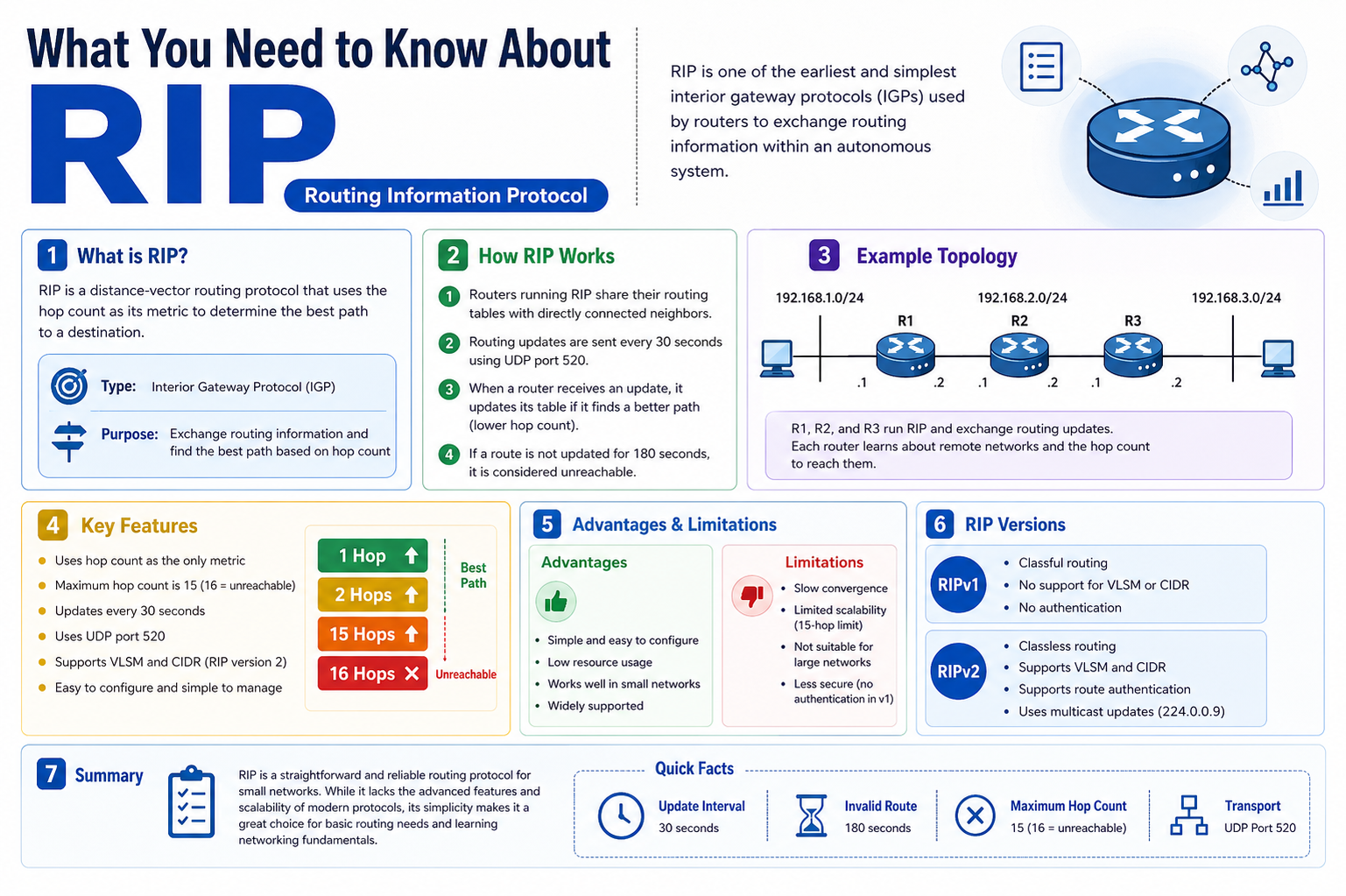
Routing Information Protocol (RIP) is a fundamental routing protocol used in computer networks to determine how data packets move from one network to another. It belongs to the class of interior gateway protocols, meaning it is used within a single autonomous system rather than across the global internet. RIP was designed with simplicity in mind, making it one of the easiest routing protocols to understand and implement. Despite being an early development in networking technology, it still plays a role in certain small-scale or educational environments where advanced routing features are not required. Its main purpose is to allow routers to share information about network destinations so that each router can build a routing table that helps it decide the best path for forwarding data.
Core Mechanism of Distance Vector Routing
RIP operates using a distance-vector routing approach. In this method, each router maintains a table that contains information about all known destinations, the distance to those destinations, and the next hop required to reach them. Routers periodically share this table with directly connected neighbors. Instead of having a complete map of the entire network, each router only knows what its neighbors tell it. Over time, this shared information spreads across the network, allowing routers to gradually learn about all available paths. The simplicity of this approach reduces computational complexity, but it also introduces certain inefficiencies compared to more advanced protocols.
Hop Count as the Primary Metric
The defining feature of RIP is its use of hop count as the sole metric for determining the best route. A hop represents each intermediate router between the source and destination. A path with fewer hops is considered more efficient and is therefore preferred. However, this simplicity also creates limitations. RIP does not consider factors such as bandwidth, latency, or congestion, which can lead to suboptimal routing decisions. To prevent routing loops and excessively long paths, RIP imposes a maximum hop limit of 15. Any destination requiring more than 15 hops is considered unreachable, which restricts the protocol to relatively small networks.
Routing Table Updates and Information Sharing
Routers running RIP exchange their entire routing tables at regular intervals. This periodic sharing ensures that all routers remain updated about changes in the network. When a router receives information from a neighbor, it compares the new data with its existing table. If a better route is found, the router updates its entry. These updates are broadcast rather than sent only when changes occur, which can lead to unnecessary network traffic. However, this method ensures consistency across the network over time and helps maintain accurate routing information even in dynamic environments.
Timers and Network Stability Mechanisms
RIP uses several timers to maintain stability and prevent routing issues. The update timer determines how often routing tables are broadcast, typically every 30 seconds. The invalid timer marks a route as unusable if no updates are received within a certain period, often 180 seconds. The hold-down timer helps prevent incorrect routing information from being accepted during network instability by temporarily ignoring certain updates. Finally, the flush timer removes invalid routes completely from the routing table after a longer period, usually around 240 seconds. These timers work together to balance responsiveness and stability in the network.
Loop Prevention Techniques in RIP
Routing loops are one of the major problems in distance-vector protocols, where packets circulate endlessly between routers. RIP implements several mechanisms to prevent such issues. One key method is the maximum hop count, which limits the distance a packet can travel. Additionally, RIP uses rules such as split horizon, which prevents a router from advertising a route back onto the interface from which it was learned. This reduces the chance of incorrect routing information circulating within the network.
Poison Reverse and Route Advertisement Control
Another technique used in RIP is poison reverse. In this method, when a router detects that a route is no longer valid, it advertises that route back to its neighbor with an infinite metric. This effectively informs other routers that the route should not be used. By marking invalid paths clearly, poison reverse helps accelerate convergence and reduces the chance of routing loops forming in unstable network conditions.
Convergence Behavior and Network Adaptation
Convergence refers to the time it takes for all routers in a network to agree on the current routing topology after a change occurs. In RIP, convergence is relatively slow compared to modern protocols. This is because updates are periodic rather than event-driven, and routers rely on multiple cycles of information exchange before the network stabilizes. As a result, RIP is less suitable for environments where fast adaptation to network changes is critical.
Differences Between RIP Versions
There are two primary versions of RIP, each improving upon the limitations of the previous one. The original version is classful, meaning it does not include subnet mask information in routing updates. This limits flexibility in modern networks where variable-length subnet masking is common. The improved version supports classless routing and includes subnet mask information, making it more suitable for complex network designs. It also introduces authentication features to enhance security and uses multicast communication instead of broadcast, reducing unnecessary network load.
Advantages of RIP in Network Design
RIP offers several benefits despite its limitations. Its simplicity makes it easy to configure and maintain, which is especially useful for small networks or learning environments. It does not require complex calculations or advanced hardware resources, making it lightweight and efficient for basic routing tasks. Additionally, its widespread support across networking devices ensures compatibility in heterogeneous network setups. These characteristics make RIP a practical choice for straightforward network topologies where advanced optimization is not required.
Limitations and Challenges of RIP
While RIP is simple and easy to use, it comes with several significant drawbacks. Its reliance on hop count alone ignores important performance factors such as bandwidth and delay, which can lead to inefficient routing decisions. The hop limit of 15 severely restricts its scalability, making it unsuitable for large networks. Additionally, periodic full-table updates consume bandwidth unnecessarily, even when no changes have occurred in the network. Slow convergence also makes RIP less responsive to network changes, which can result in temporary routing inconsistencies.
Use Cases and Practical Applications
RIP is primarily used in small networks where simplicity is more important than performance optimization. It is often found in educational labs, small office networks, or legacy systems that do not require complex routing capabilities. In modern networking environments, it is rarely used as the primary routing protocol but may still appear in specific scenarios where compatibility or simplicity is prioritized over efficiency.
Comparison with More Advanced Routing Protocols
Compared to more advanced protocols, RIP is significantly less efficient and scalable. Modern protocols use more sophisticated metrics that consider multiple factors such as bandwidth, delay, and reliability. They also support faster convergence and more intelligent route selection. While RIP relies on periodic updates, advanced protocols often use triggered updates that react immediately to network changes. This makes RIP less suitable for large or dynamic networks but still valuable as a learning tool for understanding basic routing principles.
Security Considerations in RIP
Early versions of RIP had limited security features, making them vulnerable to routing attacks such as spoofing or unauthorized route injection. Later improvements introduced authentication mechanisms to verify routing updates and prevent malicious manipulation of routing tables. Despite these enhancements, RIP is still considered less secure compared to modern routing protocols that incorporate stronger encryption and validation methods.
Behavior in Real Network Environments
In practical scenarios, RIP functions adequately in stable, small-scale networks where changes are infrequent. However, in environments with frequent topology changes or large numbers of routers, its performance declines due to slow convergence and high update overhead. Network administrators often prefer more advanced protocols for production environments, but RIP remains useful for understanding foundational concepts in routing behavior and network communication.
Advanced Operation of RIP in Network Communication
RIP operates in a continuous cycle of information sharing and route recalculation, which allows it to maintain awareness of network topology changes even in a limited way. Each router running RIP independently builds its routing table based on information received from neighbors, and this decentralized behavior defines its distance-vector nature. Unlike link-state protocols that build a complete map of the network, RIP relies entirely on neighbor-to-neighbor communication. This creates a system where routing knowledge gradually propagates outward in waves, with each router acting as both a learner and a distributor of route information.
Metric Calculation and Route Selection Process
When a router receives routing updates from a neighboring device, it increments the hop count by one before adding the route to its table. This incremental calculation ensures that every hop in the network path is accounted for accurately. If multiple routes exist to the same destination, the router selects the route with the lowest hop count. In cases where two routes have equal metrics, RIP may use load balancing by distributing traffic across both paths. However, this behavior is limited compared to more advanced protocols, which can evaluate multiple performance factors before making a decision.
Administrative Distance and Protocol Preference
In real network environments, multiple routing protocols may operate simultaneously. To determine which protocol’s route should be preferred, routers use a concept called administrative distance. RIP is assigned a relatively high administrative distance compared to more modern protocols, meaning it is less preferred when better alternatives are available. This ensures that RIP is typically used only when no more efficient routing information is present. Administrative distance does not measure path quality; instead, it represents trustworthiness or preference level assigned by the router.
Triggered Updates and Network Efficiency Improvements
Although RIP primarily relies on periodic updates, it also supports triggered updates in certain situations. A triggered update occurs immediately when a change in the network is detected, such as a link failure or restoration. This helps reduce the time required for network convergence by informing neighbors of changes without waiting for the next scheduled update cycle. While this improves responsiveness, RIP still suffers from overall slow convergence due to its inherent design limitations and reliance on hop-based decision-making.
Routing Table Structure and Information Fields
A RIP routing table contains several key pieces of information for each route, including the destination network, hop count metric, next-hop address, and route age. The route age indicates how long it has been since the entry was updated, helping the router determine whether the information is still valid. If a route becomes outdated and no updates are received within a specific time frame, it is marked as invalid and eventually removed. This aging mechanism ensures that stale routing information does not persist indefinitely in the network.
Split Horizon and Its Role in Loop Prevention
Split horizon is one of the most important loop prevention techniques used in RIP. It works by preventing a router from advertising a route back onto the interface from which it was originally learned. This simple rule significantly reduces the likelihood of routing loops forming in small networks. However, split horizon alone is not sufficient to eliminate all routing issues, especially in more complex topologies. It is typically combined with other mechanisms such as poison reverse and hold-down timers to strengthen loop prevention.
Hold-Down Timers and Stability Control
Hold-down timers are used to maintain stability during periods of network instability. When a route is marked as unreachable, the router enters a hold-down state for that route and temporarily ignores any contradictory updates suggesting that the route is available again. This prevents incorrect or outdated information from quickly re-entering the routing table and causing instability. Although this improves reliability, it can also slow down recovery time when valid routes are restored, highlighting the trade-off between stability and responsiveness in RIP.
Route Poisoning and Network Recovery Behavior
Route poisoning is another mechanism used to prevent incorrect routing information from spreading. When a router detects that a route is no longer valid, it assigns it an infinite metric value, effectively marking it as unreachable. This poisoned route is then advertised to neighbors, ensuring that all routers quickly become aware of the failure. This process helps speed up convergence by explicitly informing the network that a particular path should no longer be used.
RIP Packet Structure and Communication Format
RIP messages are transmitted using a simple packet structure that includes command fields, version information, and routing entries. Each entry contains the destination network address and the associated metric. The simplicity of this structure allows for efficient processing but limits the amount of information that can be included. RIP typically uses UDP as its transport protocol, which provides fast delivery but does not guarantee reliability. This design choice reflects RIP’s focus on simplicity rather than advanced communication control.
Scalability Constraints in Large Networks
One of the most significant limitations of RIP is its lack of scalability. The maximum hop count of 15 restricts the size of networks that can use RIP effectively. In larger environments, this limitation becomes a major drawback, as many valid routes may exceed the hop threshold and be marked as unreachable. Additionally, the periodic broadcasting of full routing tables creates unnecessary overhead in large networks, consuming bandwidth and processing resources without providing proportional benefits.
Comparison with Link-State Routing Behavior
Unlike RIP, link-state routing protocols build a complete map of the network by exchanging detailed information about all links and routers. This allows them to compute optimal paths using advanced algorithms. RIP, on the other hand, only knows what its neighbors tell it, which makes its view of the network incomplete and potentially outdated. As a result, link-state protocols converge faster, scale better, and provide more accurate routing decisions, while RIP remains limited to simpler environments.
Performance in Dynamic Network Conditions
In networks where frequent changes occur, RIP struggles to maintain stability and accuracy. Because updates are periodic and propagation of information is slow, routers may temporarily hold incorrect routing entries. This can result in packet loss or suboptimal routing until convergence is achieved. Triggered updates and hold-down mechanisms help mitigate these issues, but they do not eliminate them entirely. This makes RIP less suitable for highly dynamic or mission-critical environments.
Security Weaknesses and Authentication Improvements
Early implementations of RIP lacked strong security features, making them vulnerable to malicious routing manipulation. Attackers could inject false routing information, causing traffic to be redirected or disrupted. Later versions introduced authentication mechanisms to verify routing updates and ensure that only trusted routers can participate in the routing process. Despite these improvements, RIP is still considered less secure compared to modern routing protocols that incorporate stronger encryption and validation methods.
Real-World Limitations in Modern Networks
In modern networking environments, RIP is rarely used as a primary routing protocol due to its limitations in speed, scalability, and efficiency. However, it still exists in legacy systems and small networks where simplicity is more important than performance optimization. It is also used in educational settings to teach fundamental routing concepts, as its straightforward design makes it easier to understand how routing decisions are made.
Operational Understanding
RIP represents an early and foundational approach to routing in computer networks. Its distance-vector design, hop-based metric system, and periodic update mechanism provide a simple yet effective method for basic routing tasks. However, its limitations in scalability, convergence speed, and efficiency make it unsuitable for modern large-scale networks. Despite this, RIP remains an important protocol in the history of networking, offering valuable insight into how routing systems evolved into the complex and high-performance technologies used today.
RIP in Small Network Design and Deployment Contexts
RIP is most effectively used in small and stable network environments where simplicity is more important than high performance or rapid convergence. In such setups, the network topology usually does not change frequently, which aligns well with RIP’s periodic update mechanism. Small offices, training labs, and basic segmented networks can still benefit from RIP because it requires minimal configuration and does not demand advanced hardware resources. Its predictable behavior makes it easier for administrators to manage networks without dealing with complex routing policies or calculations.
Routing Updates and Bandwidth Consumption Behavior
One important aspect of RIP is how it consumes bandwidth through regular routing updates. Even when there are no changes in the network, RIP continues to send full routing tables at fixed intervals. This behavior ensures that all routers stay synchronized, but it can also create unnecessary network traffic. In larger environments, this constant exchange of information becomes inefficient and may reduce overall network performance. However, in small networks, this overhead is generally acceptable due to limited traffic and fewer routing entries.
Impact of Network Topology on RIP Performance
The structure of a network significantly affects how RIP performs. In linear or simple hierarchical topologies, RIP operates relatively smoothly because routing paths are straightforward and limited in number. However, in more complex mesh or highly interconnected networks, RIP struggles to maintain efficiency. The hop-count limitation can result in some destinations being unreachable even when alternative longer paths exist. Additionally, complex topologies increase the chances of routing loops and slow convergence, making RIP less suitable for such environments.
Route Aging and Stability Maintenance Mechanism
RIP uses a route aging process to maintain the accuracy of its routing table. Each route entry is assigned a timer that tracks how long it has been since the last update was received. If a router does not receive refreshed information within a defined time period, the route is marked as invalid. Eventually, if no valid updates are received, the route is removed completely. This mechanism ensures that outdated or broken paths do not remain in the system, helping maintain a level of routing integrity despite the protocol’s simplicity.
Effect of Hop Count Limitation on Network Design
The hop count limitation is one of the most critical constraints in RIP-based network design. Since the maximum allowable hop count is 15, network designers must carefully plan topology to ensure all devices remain within this limit. If a network exceeds this threshold, certain segments may become unreachable, leading to communication breakdowns. This limitation forces RIP networks to remain relatively small and prevents its use in large enterprise or global-scale infrastructures.
Behavior During Network Failures and Recovery
When a network link fails, RIP gradually detects the change through missing updates or triggered updates. However, the detection process is not immediate, which can lead to temporary routing inconsistencies. During this period, routers may still attempt to send traffic through a failed path until the route is officially marked invalid. Once failure is confirmed, route poisoning and update propagation help inform the rest of the network. Recovery is also gradual, as new valid routes must be learned through multiple update cycles before full convergence is achieved.
Load Balancing Capabilities in RIP
RIP has limited support for load balancing, allowing traffic to be distributed across multiple paths when equal-cost routes exist. This feature helps improve resource utilization in simple network setups. However, the load balancing capability is basic and does not account for real-time traffic conditions or link performance. As a result, traffic distribution may not always be optimal compared to more advanced routing protocols that use dynamic metrics for load balancing decisions.
Protocol Overhead and Processing Requirements
One of the advantages of RIP is its low processing requirement. Routers do not need to perform complex calculations or maintain detailed network topology maps. Instead, they simply update hop counts and exchange routing tables. This lightweight design makes RIP suitable for older or less powerful hardware. However, the trade-off is lower efficiency in routing decisions and slower adaptation to changes. Despite its simplicity, RIP still requires continuous processing due to its periodic update mechanism.
Role of RIP in Educational and Training Environments
RIP plays an important role in networking education because it introduces fundamental routing concepts in a simple and understandable way. Students can easily grasp how routing tables are built, how metrics are calculated, and how routers communicate with each other. The predictable nature of RIP allows learners to observe routing behavior without being overwhelmed by complex algorithms or large-scale network dynamics. This makes it a valuable teaching tool even though it is rarely used in modern production networks.
Evolutionary Importance of RIP in Networking History
RIP holds historical significance as one of the earliest standardized routing protocols. It laid the foundation for future advancements in dynamic routing by introducing key concepts such as distance-vector routing, periodic updates, and hop-based metrics. Many modern protocols were developed as improvements over RIP’s limitations. While it has been largely replaced in enterprise environments, its influence is still visible in how routing principles are taught and understood today.
Comparison of RIP Stability Versus Modern Protocols
In terms of stability, RIP is less reliable than modern routing protocols due to its slower convergence and limited loop prevention mechanisms. Modern protocols can quickly adapt to network changes and provide more accurate routing decisions. RIP, on the other hand, may experience temporary inconsistencies during topology changes. However, its stability is sufficient in small networks where changes are infrequent and traffic demands are low.
Routing Decisions Under Equal Path Scenarios
When RIP encounters multiple paths with the same hop count, it may use simple load sharing techniques rather than evaluating deeper performance metrics. This equal-cost scenario highlights one of RIP’s limitations, as it cannot determine which path is actually faster or more efficient. Advanced protocols overcome this limitation by considering bandwidth, delay, and reliability, resulting in more intelligent routing decisions.
Protocol Simplicity Versus Functional Limitations Trade-Off
RIP is often described as a trade-off between simplicity and capability. Its design prioritizes ease of use and minimal configuration over advanced functionality. While this makes it accessible and lightweight, it also limits its effectiveness in complex environments. The absence of advanced metrics, slow convergence, and strict hop limits all stem from its simplified design philosophy. This trade-off explains why RIP is still used in specific contexts but not in modern large-scale networks.
Understanding of RIP’s Role in Networking Systems
RIP represents a foundational step in the development of dynamic routing systems. It demonstrates how routers can exchange information and collectively build knowledge about network paths using simple rules. Although it has significant limitations, its structure provides essential insight into routing behavior, distance-vector principles, and network communication fundamentals. Even as more advanced protocols dominate modern networking, RIP remains an important reference point for understanding how routing technology has evolved over time.
RIP in Real-Time Network Monitoring and Behavior Analysis
In real network environments, RIP can be observed through its predictable and repetitive behavior, which makes it useful for understanding how routing information spreads across systems. Network administrators can monitor routing table changes over time and identify how updates propagate from one router to another. Because RIP operates on a fixed update cycle, its behavior is easier to trace compared to more complex protocols. This predictability allows for basic troubleshooting, especially in smaller networks where routing paths are limited and easier to analyze.
Convergence Delay and Its Practical Impact
One of the most noticeable characteristics of RIP in practical use is its slow convergence. When a change occurs in the network, such as a link failure or restoration, it takes time for all routers to update their tables and agree on the new topology. During this period, packets may follow outdated routes, leading to delays or temporary loss of connectivity. This delay is caused by periodic updates, hop-by-hop propagation, and the reliance on timers to validate route stability. While this may not significantly affect small networks, it becomes a critical limitation in environments that require fast recovery.
Behavior Under Network Instability Conditions
When network instability occurs, RIP reacts gradually rather than immediately. Routers continue to exchange routing information based on their update schedule, which means incorrect or outdated routes may persist for a short period. Mechanisms like hold-down timers and route poisoning help reduce instability, but they do not eliminate it entirely. In unstable environments, this can lead to temporary routing loops or inconsistent path selection until the network stabilizes and convergence is achieved.
Scalability Challenges in Expanding Networks
As networks grow in size, RIP becomes increasingly inefficient. The hop count limitation restricts how far routing information can travel, and the periodic broadcasting of full routing tables creates unnecessary overhead. In larger infrastructures, this results in slower performance and higher bandwidth consumption. Additionally, the lack of hierarchical routing structure means RIP cannot efficiently segment or optimize large networks, making it unsuitable for enterprise-level deployments or wide-area networks.
Interaction with Other Routing Protocols
In mixed-protocol environments, RIP may coexist with other routing protocols, but it is often the least preferred due to its higher administrative distance and lower efficiency. When multiple routing sources are available, routers typically prioritize more advanced protocols that provide faster convergence and better path selection. RIP is generally used only as a fallback or in isolated segments where no better routing option exists. This limited role reflects its declining importance in modern network design.
Maintenance and Configuration Simplicity
Despite its limitations, one of RIP’s strongest advantages is its simplicity in configuration and maintenance. Network administrators do not need to define complex routing policies or manage detailed topology maps. Basic setup involves enabling RIP on interfaces and allowing routers to automatically exchange information. This ease of use reduces the chance of configuration errors and makes RIP suitable for learning environments or small operational networks where simplicity is preferred over optimization.
Protocol Behavior in Resource-Constrained Devices
RIP performs well on older or resource-constrained devices because it requires minimal processing power and memory. Unlike advanced routing protocols that maintain large topology databases, RIP only stores basic routing table information. This lightweight nature makes it compatible with legacy hardware and simple embedded systems. However, the trade-off is reduced intelligence in routing decisions and slower adaptation to network changes.
Long-Term Relevance in Networking Education
Even though RIP is no longer widely used in modern enterprise networks, it continues to hold educational value. It provides a clear and structured way to understand how routing works at a fundamental level. Concepts such as hop count, routing tables, periodic updates, and distance-vector behavior are easier to grasp through RIP before moving on to more advanced protocols. For this reason, it remains a standard topic in networking courses and certification training programs.
Common Issues and Troubleshooting Scenarios
Typical issues encountered in RIP-based networks include routing loops, slow convergence, and unreachable destinations due to hop count limitations. Troubleshooting usually involves checking routing tables, verifying timer values, and ensuring proper configuration of loop prevention mechanisms. Because RIP is relatively simple, diagnosing problems is generally easier compared to more complex routing systems. However, resolving performance-related issues often requires redesigning the network rather than adjusting protocol settings.
Comparison of Efficiency with Modern Protocols
When compared to modern routing protocols, RIP is significantly less efficient in both performance and scalability. Advanced protocols use sophisticated algorithms that consider multiple network metrics, allowing for faster and more accurate route selection. RIP’s reliance on a single metric—hop count—limits its ability to optimize traffic flow. Additionally, modern protocols react instantly to network changes, whereas RIP depends on timed updates, resulting in slower adaptation.
Advanced Configuration Considerations of RIP in Practical Networks
When implementing RIP in real environments, configuration choices significantly influence how effectively the protocol performs. Although RIP is simple by design, small adjustments in timer values, interface settings, and routing behavior can improve stability and reduce unnecessary network traffic. Administrators often need to balance responsiveness with overhead, ensuring that updates are frequent enough to maintain accuracy but not so frequent that they overload the network. Careful planning of which interfaces participate in RIP updates also helps prevent unnecessary propagation of routing information into segments where it is not required.
Passive Interfaces and Controlled Route Propagation
In many deployments, certain interfaces are configured as passive to prevent them from sending RIP updates while still allowing route learning. This is particularly useful in networks where some segments should not actively participate in routing exchanges, such as end-user networks or sensitive internal segments. By limiting update propagation, network stability improves and unnecessary traffic is reduced. This selective participation ensures that RIP operates only where it is needed, rather than broadcasting routing information across the entire infrastructure without restriction.
Timer Optimization and Network Responsiveness Tuning
RIP relies heavily on timers, and adjusting these values can influence how quickly the network reacts to changes. Shorter update intervals may improve responsiveness but increase bandwidth usage, while longer intervals reduce overhead but slow down convergence. Similarly, invalid and flush timers determine how long a router retains outdated routes before removing them. Proper tuning of these timers requires understanding network size, stability, and performance expectations. In stable environments, longer timers are often preferred, while more dynamic networks may require shorter intervals to maintain accuracy.
Route Summarization and Its Role in RIP Efficiency
Route summarization helps reduce the size of routing tables by combining multiple network routes into a single entry. Although RIP does not support advanced hierarchical summarization like modern protocols, basic summarization techniques can still improve efficiency. By reducing the number of individual routes exchanged between routers, summarization lowers bandwidth usage and improves processing performance. This becomes especially useful in segmented networks where multiple adjacent subnets can be logically grouped together for simplified advertisement.
Behavior of RIP in Redundant Network Paths
In networks with multiple redundant paths, RIP selects routes based solely on hop count, which can sometimes lead to uneven utilization of available resources. Even when multiple physically diverse paths exist, RIP may prefer one path consistently if it has fewer hops, leaving other links underutilized. This behavior highlights a limitation in RIP’s design, as it does not consider link quality or load distribution efficiency. While equal-cost load balancing provides some relief, it does not fully optimize redundant network infrastructure.
Impact of Network Growth on Routing Table Size
As a network expands, the size of routing tables in RIP increases proportionally. Each router must store information about all reachable networks, including hop counts and next-hop addresses. This growth can strain older devices with limited memory capacity. Additionally, larger routing tables require more processing during updates, further slowing convergence. Unlike hierarchical protocols that segment routing information into areas or domains, RIP maintains a flat structure, which contributes to its scalability limitations in large environments.
Error Handling and Fault Propagation in RIP Networks
When errors occur in a RIP-based network, such as incorrect configurations or link failures, the protocol propagates these changes gradually through periodic updates. This delayed propagation can sometimes cause temporary inconsistencies where different routers have conflicting views of the network. Fault detection relies heavily on missing updates rather than immediate failure recognition, which means that recovery is not instantaneous. Although mechanisms like poison reverse help mitigate issues, complete stabilization still depends on multiple update cycles.
Influence of Network Design on RIP Stability
The stability of RIP is highly dependent on network design. Well-structured, simple topologies tend to produce stable routing behavior, while complex or poorly designed networks increase the likelihood of routing loops and slow convergence. Designing networks with RIP requires minimizing unnecessary redundancy and ensuring that hop count limits are respected. Proper segmentation and controlled routing paths help maintain predictable behavior, whereas overly complex designs can quickly expose the protocol’s weaknesses.
Limitations in Traffic Engineering Capabilities
RIP lacks advanced traffic engineering features found in modern routing protocols. It does not allow administrators to influence path selection based on bandwidth usage, delay optimization, or application-specific requirements. As a result, traffic distribution is often suboptimal, especially in networks with varying link speeds or performance characteristics. This limitation makes RIP unsuitable for environments where fine-grained control over traffic flow is necessary, such as data centers or service provider networks.
Security Considerations in Legacy RIP Deployments
Security remains a concern in RIP, especially in older implementations where authentication was not enabled. Without proper security controls, routers can be vulnerable to spoofed routing updates, potentially leading to traffic redirection or network disruption. Even with authentication enabled, RIP does not offer the same level of protection as modern secure routing protocols. For this reason, RIP is generally restricted to trusted internal networks where exposure to external threats is minimal.
Conclusion
Routing Information Protocol remains an important milestone in the evolution of network routing technology. Its simple design, based on distance-vector principles and hop-count metrics, made it one of the earliest practical solutions for dynamic routing in small networks. It introduced essential concepts such as routing tables, periodic updates, and basic loop prevention techniques, which laid the groundwork for more advanced protocols.
However, its limitations are significant. The maximum hop count restricts scalability, periodic updates create unnecessary bandwidth usage, and slow convergence affects performance in dynamic environments. The lack of advanced routing metrics also results in less efficient path selection compared to modern alternatives.
Despite these drawbacks, RIP still holds value in specific contexts such as educational environments, small-scale networks, and legacy systems. It provides a clear and accessible way to understand fundamental routing behavior without the complexity of modern protocols. Ultimately, RIP represents both the starting point of dynamic routing and a reminder of how networking technology has evolved toward faster, more intelligent, and more scalable solutions.