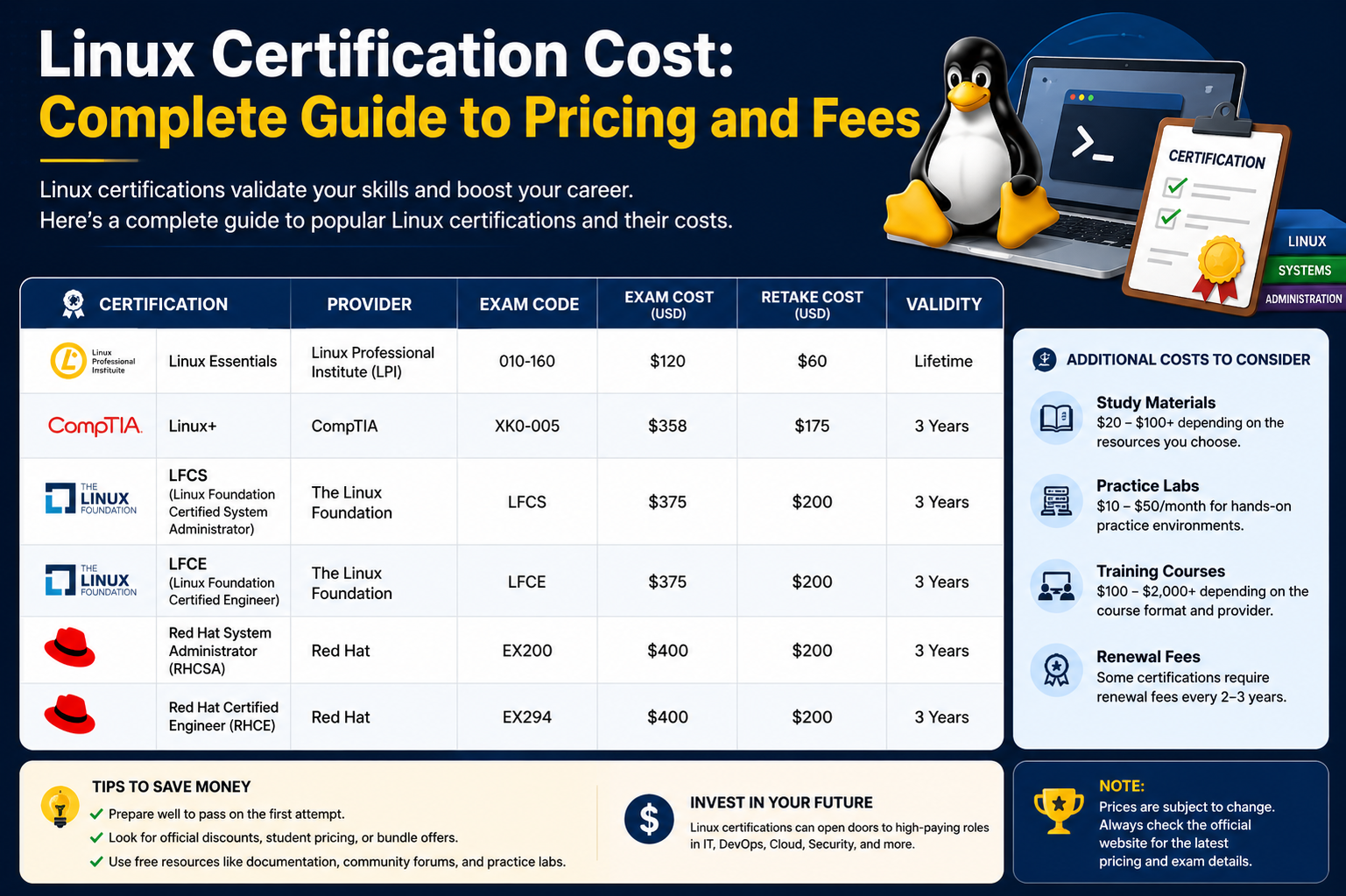
Linux certifications have become an essential part of modern IT career development because Linux is widely used in servers, cloud computing, cybersecurity, DevOps, and enterprise infrastructure. The cost of earning a Linux certification is not fixed and depends on several important factors such as the certification level, exam provider, training method, and geographic region. Some certifications are designed for beginners and are relatively affordable, while advanced certifications require a higher investment due to their complexity and professional value. Understanding the full cost structure helps learners plan their certification journey more effectively and avoid unexpected expenses.
Why Linux Certifications Are Valuable in IT Careers
Linux is the backbone of many digital systems, powering everything from web servers to cloud platforms and supercomputers. Because of this, companies prefer professionals who are certified in Linux administration and engineering. A certification proves that a candidate has verified skills in system configuration, command-line operations, security management, and troubleshooting. This demand directly influences the cost of certifications, as industry-recognized credentials often come with higher exam fees and training requirements. Employers see certified professionals as more reliable, which increases job opportunities and salary potential, making the investment worthwhile despite the cost.
Entry-Level Linux Certification Cost Structure
For beginners, entry-level Linux certifications are designed to introduce foundational skills such as basic command-line usage, file system navigation, user management, and simple system operations. These certifications usually have the lowest cost in the Linux certification ecosystem. The exam fee typically falls within a moderate price range compared to advanced certifications, making it accessible for students and early-career professionals. However, while the exam fee may be affordable, candidates often spend additional money on learning materials, practice labs, and online courses to prepare effectively. These additional resources can sometimes cost more than the exam itself, depending on the depth of preparation required.
Entry-level certifications are often considered the starting point for a career in system administration or IT support. Although the cost is lower, the value lies in building a strong foundation that supports future certifications. Many learners view this stage as an investment in long-term career growth rather than just a one-time expense.
Intermediate Linux Certification Pricing Factors
Intermediate certifications are more focused on real-world system administration skills. These include managing servers, configuring networks, handling storage systems, and working with security policies. The cost of these certifications is higher than entry-level exams because they require deeper technical knowledge and practical experience. The exam structure is also more complex, often including performance-based tasks rather than simple multiple-choice questions.
In addition to exam fees, candidates at this level usually invest in structured training programs. These programs may include instructor-led sessions, virtual labs, and simulation environments that mimic real server infrastructures. While optional, these training programs significantly increase the overall cost but also improve the chances of passing the exam on the first attempt. Retaking the exam due to failure can further increase expenses, making proper preparation a critical part of cost management.
Intermediate certifications are often seen as a turning point in a professional’s career, moving from basic knowledge to practical expertise. This increased value is reflected in the higher pricing structure.
Advanced Linux Certification Cost and Investment Level
Advanced Linux certifications are designed for experienced professionals who already have strong system administration skills. These certifications focus on complex topics such as enterprise-level server management, automation, performance tuning, virtualization, and advanced security configurations. Because of their difficulty and industry recognition, these certifications are among the most expensive in the Linux certification path.
The exam fees alone are significantly higher compared to beginner and intermediate levels. In addition, candidates often spend a considerable amount on advanced training courses, hands-on labs, and exam preparation materials. These resources are almost essential at this stage because the exam requires practical problem-solving skills under timed conditions.
Another important factor is the possibility of multiple attempts. Since advanced exams are challenging, some candidates may need to retake the exam, which increases the total cost further. Despite the high investment, these certifications often lead to senior-level job roles, higher salaries, and strong career advancement opportunities, which balances out the financial commitment over time.
Cost Differences Based on Certification Providers
The cost of Linux certifications also varies depending on the organization offering the certification. Different providers have different exam structures, difficulty levels, and pricing models. Some certifications are globally recognized and tend to have higher fees due to their reputation and industry acceptance. Others are more specialized or entry-focused and therefore cost less.
Each provider also has its own policies regarding exam retakes, validity periods, and training bundles. Some include training materials in the exam fee, while others charge separately for preparation resources. This variation makes it important for candidates to carefully compare options before choosing a certification path, as the total cost can differ significantly even for similar skill levels.
Training Methods and Their Impact on Total Cost
Training plays a major role in the overall cost of Linux certification. Self-study is the most cost-effective option, often requiring only books, online documentation, and free practice environments. However, it demands a high level of discipline and may not be suitable for everyone.
Paid training programs, on the other hand, offer structured learning paths, instructor support, and practical labs. These programs can significantly increase the total cost but also improve understanding and exam readiness. Some learners prefer hybrid approaches, combining self-study with selective paid resources to balance cost and effectiveness.
Hands-on lab environments are particularly important for Linux certifications because practical skills are heavily tested. Access to such labs may require additional subscription fees, which adds to the total investment.
Regional Variations in Certification Pricing
The cost of Linux certifications can also vary depending on the country or region where the exam is taken. Economic conditions, currency exchange rates, and local training provider pricing can influence the final amount paid by candidates. In some regions, exam fees may appear lower due to currency differences, while in others they may feel more expensive relative to average income levels.
Training availability also differs by region. In areas with fewer training centers, candidates may need to rely on online learning, which can either reduce or increase costs depending on the chosen resources. This regional variation makes it important for candidates to consider not only the exam fee but also the availability of preparation materials in their location.
Retake Fees and Certification Renewal Costs
Another important aspect of Linux certification cost is the possibility of retakes. Since many certifications require a passing score in a single attempt, failing the exam means paying the full fee again. This makes preparation extremely important, as multiple attempts can significantly increase the total cost.
Some certifications also have expiration periods, requiring professionals to renew their credentials after a certain time. Renewal may involve retaking exams or completing continuing education requirements, both of which can add to long-term costs. These recurring expenses should be considered when evaluating the overall investment in a Linux certification.
Hidden Costs Beyond Exam Fees
While exam fees are the most visible expense, there are several hidden costs associated with Linux certifications. These include study materials, practice tests, lab environments, coaching sessions, and sometimes even hardware or software setups for practice purposes. These additional costs can sometimes exceed the exam fee itself, especially for advanced certifications.
Time investment is another indirect cost. Preparing for a certification requires weeks or months of study, which may impact work schedules or other commitments. Although not a direct financial cost, it is still an important factor in the overall investment.
Return on Investment for Linux Certifications
Despite the various costs involved, Linux certifications are widely considered a strong investment in career development. Certified professionals often have access to better job opportunities, higher salaries, and more stable career paths. The demand for Linux skills continues to grow due to the expansion of cloud computing, cybersecurity, and enterprise IT systems.
When viewed from a long-term perspective, the cost of certification is often outweighed by the career benefits it provides. Many professionals recover their investment quickly after securing a better job or promotion. This makes Linux certification not just an educational expense but a strategic career decision.
Linux Certification Costs
The total cost of Linux certification is influenced by multiple factors including certification level, training method, provider, region, and preparation strategy. Entry-level certifications are relatively affordable, while advanced certifications require a significantly higher investment. Additional costs such as training, labs, and retakes also contribute to the overall expense.
However, despite the financial commitment, Linux certifications remain highly valuable in the IT industry. They provide practical skills, improve job prospects, and support long-term career growth. Understanding the complete cost structure helps learners make informed decisions and choose the right certification path based on their goals and budget.
Training Options and Their Effect on Linux Certification Cost
Training is one of the most important factors that influences the total cost of Linux certification. While some learners attempt to prepare using self-study methods, others rely on structured training programs. Each approach has a different cost implication and affects both preparation quality and exam success rate.
Self-study is the most budget-friendly option. It usually involves free resources, documentation, community forums, and practice on personal or virtual systems. Although this method reduces financial cost, it requires strong discipline, time management, and problem-solving ability. The main hidden cost in self-study is the time investment, as learners may take longer to reach exam readiness compared to structured programs.
Paid training courses, on the other hand, increase overall expenses but provide a more organized learning experience. These courses often include video lectures, guided labs, practice exams, and instructor support. The added cost is justified by improved understanding and higher chances of passing the certification exam on the first attempt. Many candidates consider this option a balance between efficiency and cost.
Instructor-led bootcamps represent the highest cost training method. These programs are intensive, short-duration courses designed to prepare candidates quickly for certification exams. They include live instruction, real-time problem-solving, and extensive lab work. While expensive, they are often chosen by working professionals who want fast certification results.
Importance of Hands-On Labs in Certification Costs
Linux certifications are highly practical, which means hands-on experience is essential. Many certification exams test real system administration skills rather than theoretical knowledge. Because of this, lab environments play a major role in preparation and indirectly increase certification cost.
Some learners set up their own virtual labs using personal computers, which reduces cost significantly. However, building and maintaining such environments requires technical knowledge and time. Others prefer cloud-based lab platforms, which offer ready-to-use systems for practice. These platforms usually charge subscription fees, adding to the overall cost of certification preparation.
Paid lab environments are especially useful for advanced certifications. They simulate enterprise-level systems, allowing candidates to practice complex tasks such as server configuration, networking, security management, and automation. Although these labs increase expenses, they significantly improve exam readiness.
Exam Retake Costs and Financial Planning
One of the often overlooked aspects of Linux certification cost is the retake fee. Certification exams are typically not easy, especially at intermediate and advanced levels. If a candidate fails the exam, they must pay the full exam fee again to retake it.
This possibility makes preparation extremely important. Many learners underestimate exam difficulty and end up spending more than expected due to multiple attempts. Therefore, proper planning, practice, and training can help reduce the risk of retakes and control total cost.
Some certification providers offer discounted retake policies or bundled exam packages. These packages allow candidates to purchase multiple attempts at a reduced price. While slightly increasing initial investment, they help reduce financial risk in case of failure.
Certification Validity and Renewal Expenses
Linux certifications do not always last forever. Many certifications have a validity period, after which professionals must renew their credentials. Renewal ensures that certified individuals stay updated with the latest technologies, system updates, and industry practices.
Renewal methods vary depending on the certification provider. Some require retaking the exam, while others allow continuing education or professional development credits. In both cases, renewal involves additional costs, either in the form of exam fees or training expenses.
Over time, these renewal costs can add up, especially for professionals who maintain multiple certifications. However, renewal is important for career growth, as outdated certifications may lose value in the job market.
Cost Variation Between Online and Offline Training
Training delivery method also plays a significant role in Linux certification cost. Online training is generally more affordable because it eliminates travel and accommodation expenses. It also offers flexibility, allowing learners to study at their own pace from anywhere.
Offline training, such as classroom-based programs, tends to be more expensive. These programs often include physical materials, instructor-led sessions, and in-person labs. While costly, they provide direct interaction with instructors and peers, which can improve understanding for some learners.
Hybrid training models combine both online and offline elements. These programs offer flexibility along with structured guidance but may still carry moderate to high costs depending on the provider.
Influence of Certification Level on Total Cost
The level of certification has a direct impact on cost. Beginner-level certifications are designed to introduce foundational Linux skills and are priced lower to encourage entry into the field. These certifications typically require less preparation time and fewer resources.
Intermediate certifications increase in cost due to more complex exam objectives and higher skill requirements. They often involve system administration tasks, server configuration, and troubleshooting scenarios. As a result, both exam fees and training expenses rise at this level.
Advanced certifications are the most expensive due to their difficulty and industry recognition. They require deep technical knowledge and extensive hands-on experience. The preparation process is longer and more resource-intensive, leading to higher overall investment.
Role of Practice Exams in Certification Budget
Practice exams are an important part of preparation for Linux certifications. They help candidates understand exam format, question patterns, and time management. While some practice tests are available for free, high-quality simulated exams are usually paid resources.
These practice exams add to the total cost but significantly improve chances of success. They help identify weak areas and reduce the likelihood of exam failure. Many learners consider them a necessary investment rather than an optional expense.
Hidden Learning Costs Often Overlooked
Beyond direct expenses like exam fees and training, there are several hidden costs associated with Linux certification. One major factor is the time spent preparing for the exam. Time invested in learning could otherwise be used for work or other professional activities.
Another hidden cost is hardware or software setup. Some learners need to upgrade their systems or install virtualization tools to create practice environments. While not always expensive, these costs can add up depending on the setup required.
Internet access and subscription-based learning platforms also contribute to indirect costs. Continuous access to learning materials is often required over several weeks or months of preparation.
Long-Term Value Compared to Certification Cost
Although Linux certification requires financial investment, its long-term value is significantly higher. Certified professionals often qualify for better-paying jobs, promotions, and specialized technical roles. The demand for Linux expertise in cloud computing, DevOps, cybersecurity, and system administration continues to grow.
In many cases, professionals recover their certification cost quickly after securing improved job opportunities. This return on investment makes Linux certification a strategic career move rather than just an educational expense.
Budget Planning for Linux Certification Path
Planning a Linux certification journey requires careful budgeting. Candidates should consider not only the exam fee but also training, practice materials, lab access, and potential retake costs. A well-planned budget reduces financial stress and improves preparation quality.
Some learners choose to spread their certification journey over time, starting with entry-level certifications and gradually progressing to advanced levels. This approach helps manage cost effectively while building strong technical skills step by step.
Overall Understanding of Linux Certification Costs
Linux certification costs are influenced by multiple interconnected factors including certification level, training method, preparation resources, and renewal requirements. While entry-level certifications are relatively affordable, advanced certifications require a significant financial commitment.
However, the value gained from certification often outweighs the cost. It provides strong technical skills, improves career opportunities, and increases earning potential. With proper planning and preparation, learners can manage expenses effectively and maximize the benefits of certification.
Career Impact and Salary Growth After Linux Certification
One of the strongest reasons professionals invest in Linux certifications is the long-term career impact. While the initial cost may seem significant, the return on investment is often realized through better job opportunities and higher salaries. Linux skills are in high demand across industries such as cloud computing, cybersecurity, DevOps, and enterprise IT infrastructure. Certified professionals are often preferred over non-certified candidates because certification validates practical, job-ready skills.
Entry-level certifications can help candidates secure roles such as junior system administrators, IT support technicians, or help desk engineers. Even at this stage, certified individuals may earn higher starting salaries compared to those without certification. As professionals progress to intermediate and advanced certifications, the salary gap becomes even more noticeable.
Advanced Linux certifications often lead to senior positions such as Linux system engineer, DevOps engineer, cloud architect, or infrastructure specialist. These roles come with significantly higher compensation packages, which can quickly offset the initial certification cost. In many cases, professionals recover their investment within months after landing a better-paying job.
Employer Recognition and Certification Value
Employers place strong value on recognized Linux certifications because they reduce hiring risk. A certified candidate has already demonstrated verified knowledge in system administration, troubleshooting, and security management. This reduces the need for extensive training after hiring, making certified professionals more attractive.
Some organizations even require Linux certifications as a mandatory qualification for specific roles. In such cases, certification is not just an advantage but a necessity. This requirement increases the importance of certification despite its cost, as it directly affects employability.
Additionally, certified professionals often receive priority in promotions and internal job changes. Employers view certification as proof of continuous learning and technical commitment, which contributes to long-term career growth.
Global Demand and Market Influence on Certification Pricing
Linux certification pricing is also influenced by global demand. As more companies adopt Linux-based systems and cloud infrastructure, the demand for certified professionals continues to grow. This demand indirectly affects certification pricing, especially for globally recognized certifications.
Certification providers often adjust exam fees based on market value, industry demand, and exam complexity. High-demand certifications tend to have higher costs because they are widely respected in the industry. However, this also increases their value in the job market, creating a balance between cost and benefit.
In regions with strong IT industries, certification demand is higher, which can make training services more expensive. Conversely, in developing regions, costs may be lower, but access to advanced training resources may be limited.
Self-Study vs Professional Training Cost Comparison
Choosing between self-study and professional training has a major impact on overall certification cost. Self-study is the most economical option, but it requires strong self-discipline and motivation. Many learners underestimate the complexity of Linux systems and end up spending more time preparing.
Professional training programs increase upfront cost but provide structured learning paths. These programs reduce confusion and help learners focus on exam-relevant topics. Instructor guidance, lab access, and practice tests improve efficiency and reduce the risk of failure.
In terms of cost-effectiveness, self-study is cheaper initially but may lead to higher indirect costs if multiple exam attempts are needed. Professional training is more expensive upfront but can reduce total cost by improving first-attempt success rates.
Importance of Real-World Experience in Cost Efficiency
Hands-on experience plays a major role in reducing certification costs. Candidates who already work in IT environments often require less training and fewer resources. Their real-world exposure helps them understand system behavior, command usage, and troubleshooting techniques more effectively.
On the other hand, beginners without practical experience may need additional lab practice and training courses, which increases total cost. Building practical skills before attempting certification can significantly reduce expenses related to retakes and extended preparation.
Internships, lab simulations, and personal projects are cost-effective ways to gain experience. These methods reduce dependency on expensive training programs while improving exam readiness.
Hidden Financial Risks in Certification Journey
Beyond visible expenses, there are financial risks associated with Linux certification that candidates should consider. One major risk is repeated exam failure, which can significantly increase total cost. Without proper preparation, candidates may end up paying multiple exam fees.
Another risk is over-investment in unnecessary training materials. Some learners purchase multiple courses or resources without a clear study plan, leading to wasted money. Selecting the right preparation resources is important for cost control.
Time-related financial impact is also a factor. Spending excessive time preparing for certification may delay career progression or job opportunities. Efficient preparation strategies help minimize this indirect cost.
Comparison of Certification Providers and Pricing Strategy
Different certification providers follow different pricing strategies based on reputation, exam difficulty, and industry recognition. Some providers focus on enterprise-level certifications that are widely recognized in global IT industries, resulting in higher exam fees.
Others offer more entry-focused certifications designed for beginners, which are relatively affordable. However, these certifications may not carry the same level of industry recognition as advanced certifications.
Candidates must evaluate not only cost but also long-term value when selecting a certification provider. A slightly higher cost may be justified if the certification leads to better job opportunities and higher salary potential.
Long-Term Investment Perspective of Linux Certification
Linux certification should be viewed as a long-term investment rather than a one-time expense. The initial cost includes exam fees, training, and preparation materials, but the long-term benefits often outweigh these expenses.
Certified professionals tend to have stronger job security, better promotion opportunities, and access to higher-level technical roles. As technology continues to evolve, Linux skills remain highly relevant, ensuring sustained career value.
Over a period of years, the return on investment from certification can be substantial. Many professionals experience multiple salary increases and career advancements directly linked to their certification achievements.
Strategic Approach to Minimizing Certification Cost
A strategic approach can significantly reduce Linux certification costs. Starting with entry-level certifications allows learners to build foundational knowledge at a lower cost before progressing to advanced levels. This step-by-step approach prevents unnecessary financial burden.
Combining self-study with selective training resources is another effective strategy. Instead of enrolling in expensive full courses, learners can focus on targeted materials that address weak areas.
Practicing in free or low-cost lab environments also helps reduce expenses. Open-source tools and virtualization software provide practical experience without additional financial investment.
Final Understanding of Linux Certification Investment
Linux certification involves multiple cost components including exam fees, training, practice resources, lab access, and potential retakes. While the total cost can vary widely depending on certification level and preparation method, the long-term value remains consistently high.
The investment not only improves technical skills but also enhances employability and earning potential. With proper planning, learners can manage costs effectively while maximizing career benefits. Linux certification continues to be one of the most valuable investments in the IT industry due to its strong impact on professional growth and global demand.
Cost Differences Across Popular Linux Certification Paths
Linux certification costs also depend heavily on the specific certification path a candidate chooses. Different paths are designed for different career goals, such as system administration, cloud engineering, or DevOps. Each path has its own structure, difficulty level, and pricing expectations.
Some certification paths focus on foundational Linux skills and are relatively affordable, making them suitable for beginners. These paths typically include basic system operations, file management, user permissions, and command-line usage. Since the scope is limited, both exam fees and preparation costs remain lower.
Other paths are designed for enterprise-level environments and are significantly more expensive. These certifications require deep understanding of system architecture, security hardening, automation tools, and large-scale infrastructure management. Because of their advanced nature, they often involve higher exam fees and more intensive preparation resources.
There are also specialized paths that focus on cloud integration and DevOps practices. These certifications often combine Linux skills with cloud platforms, containerization, and automation tools. The added complexity increases both training and exam costs, but they also provide higher career value.
Impact of Learning Speed on Total Certification Cost
The speed at which a candidate prepares for certification can also influence total cost. Faster preparation with focused study plans can reduce expenses related to training subscriptions and extended lab usage. Candidates who prepare efficiently often spend less overall.
On the other hand, slow or inconsistent preparation can increase costs. Longer study periods may require extended access to paid resources, repeated practice tests, and additional training support. In some cases, delayed preparation can also lead to exam fee inflation if pricing changes over time.
Efficient learning strategies, such as structured study schedules and goal-based practice, help reduce unnecessary spending. Candidates who maintain consistency are more likely to pass exams on the first attempt, minimizing retake costs.
Role of Technology and Online Platforms in Reducing Costs
Modern technology has significantly influenced Linux certification cost structure. Online learning platforms, virtual labs, and cloud-based practice environments have made certification preparation more accessible and affordable.
Previously, candidates needed expensive physical labs or classroom training. Now, virtual environments allow learners to practice Linux systems without additional hardware costs. This shift has reduced overall certification expenses for many learners.
Online communities and open-source resources also contribute to cost reduction. Many learners rely on free documentation, forums, and video tutorials to supplement their preparation. These resources reduce dependency on paid training programs.
However, while technology has reduced some costs, premium platforms and advanced simulation tools still carry subscription fees. The overall effect is a balance between affordability and high-quality learning options.
Psychological and Opportunity Costs of Certification
Beyond financial investment, Linux certification also involves psychological and opportunity costs. Preparation requires consistent effort, focus, and time management. The pressure of exam preparation can sometimes affect productivity in other areas of life or work.
Opportunity cost refers to what a candidate gives up while preparing for certification. Time spent studying could otherwise be used for earning income, gaining work experience, or pursuing other professional development activities. This indirect cost is important when evaluating the full impact of certification.
Despite these factors, many professionals consider the trade-off worthwhile due to long-term career benefits. Improved job roles, higher salaries, and better stability often outweigh short-term sacrifices.
Industry Trends Influencing Certification Pricing
The IT industry is constantly evolving, and these changes directly influence Linux certification costs. As organizations increasingly adopt cloud computing, automation, and container technologies, the demand for Linux professionals continues to rise.
This growing demand often leads to higher certification value and, in some cases, increased pricing by certification providers. When a certification becomes widely recognized and essential for high-paying roles, its market value increases.
At the same time, competition among training providers has introduced more affordable learning options. This creates a dynamic pricing environment where candidates can choose from a wide range of cost structures depending on their budget.
Emerging technologies such as Kubernetes, DevOps pipelines, and hybrid cloud systems also contribute to new certification paths. These newer certifications often have higher costs due to their specialized nature and industry relevance.
Financial Planning for a Complete Certification Journey
A well-planned financial strategy is essential for managing Linux certification costs effectively. Candidates should estimate total expenses before starting, including exam fees, training resources, lab access, and potential retakes.
Breaking the certification journey into stages can help manage costs more efficiently. Starting with entry-level certifications allows learners to build skills gradually while spreading expenses over time.
Budgeting for unexpected costs is also important. Retake fees, additional study materials, or extended training subscriptions can increase total expenses if not planned properly.
Some professionals choose to invest in certifications strategically based on job requirements or career goals rather than completing multiple certifications at once. This approach helps control financial burden while maximizing career impact.
Return on Investment in Real Career Scenarios
In real-world scenarios, Linux certification often delivers strong financial returns. Many professionals report salary increases after earning certifications, especially when moving into specialized roles.
For example, system administrators with certifications may transition into DevOps or cloud engineering roles, which typically offer higher compensation. This career shift significantly increases long-term earnings.
Freelancers and consultants also benefit from certification, as it increases client trust and allows them to charge higher service rates. Certification acts as proof of expertise, making it easier to secure contracts.
Over time, the cumulative financial benefits of certification often exceed the initial investment multiple times. This makes Linux certification one of the most cost-effective professional development choices in the IT industry.
Final Conclusion
Linux certification cost is influenced by a wide range of factors including certification level, training method, exam provider, preparation resources, and geographic location. Entry-level certifications are generally affordable, while advanced and specialized certifications require a significantly higher investment.
In addition to exam fees, candidates must also consider training costs, lab access, practice materials, and potential retake expenses. These hidden costs can increase the total investment, making proper planning essential.
Despite the financial requirements, Linux certification remains one of the most valuable investments in the IT field. It enhances technical skills, improves job opportunities, and significantly increases earning potential. With proper preparation and strategic planning, candidates can manage costs effectively while achieving strong career growth.
Ultimately, Linux certification should be seen not as an expense but as a long-term investment in professional success.