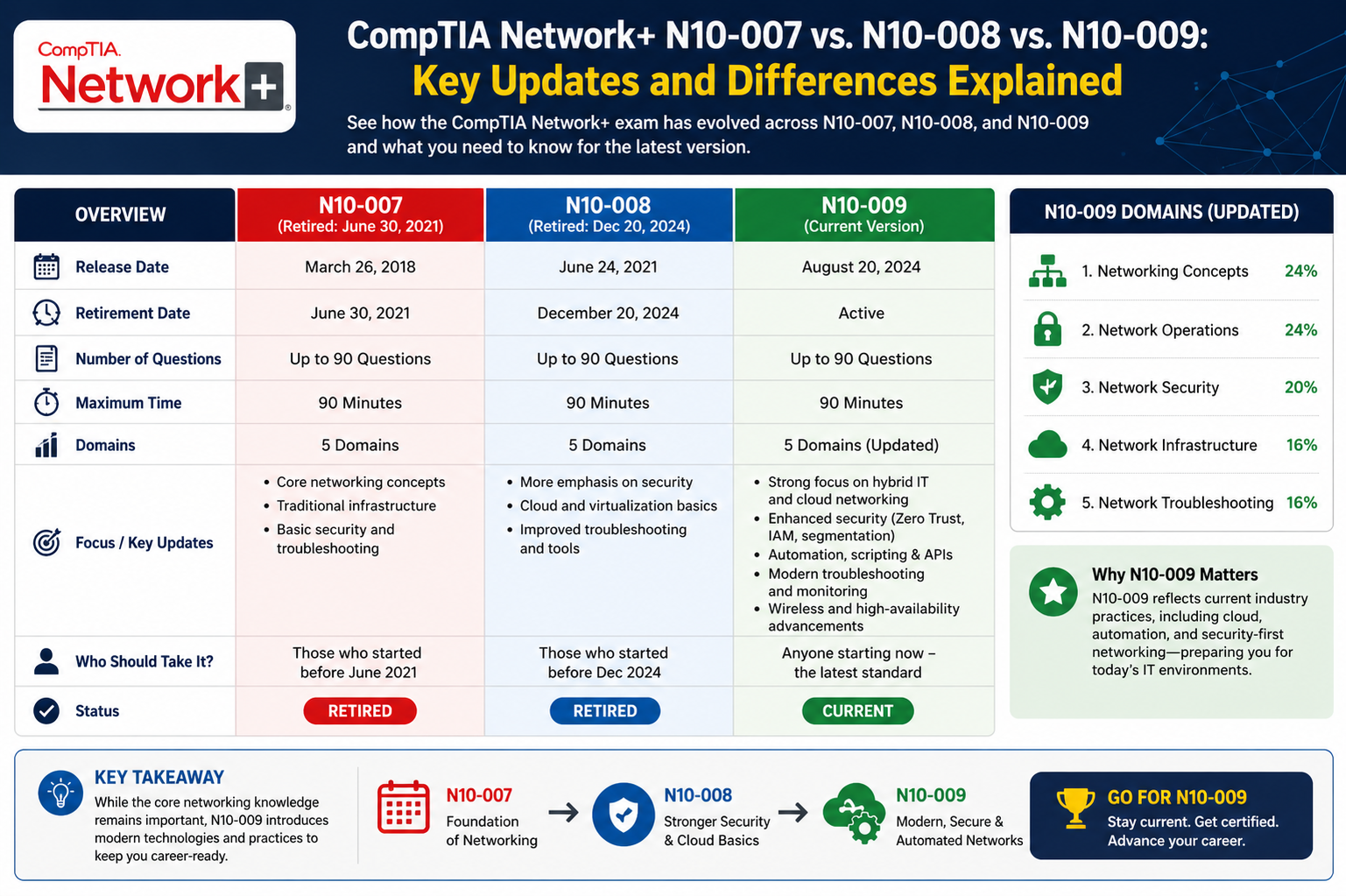
The CompTIA Network+ certification has undergone significant refinement over the years to ensure it remains aligned with the rapidly changing landscape of information technology. Networking today is no longer limited to physical routers, switches, and on-premises infrastructure. Instead, it now includes cloud platforms, hybrid systems, virtualization, automation, and advanced security frameworks. Each updated version of the exam reflects this shift, expanding the candidate’s required knowledge beyond traditional networking into more dynamic and scalable environments.
The transition from earlier to newer versions is not just about adding new topics, but also about reshaping how networking concepts are applied in real-world scenarios. Earlier versions emphasized memorization of protocols and troubleshooting steps, while newer versions require analytical thinking, scenario-based problem solving, and familiarity with modern infrastructure tools.
Network+ N10-007 Foundation and Traditional Networking Emphasis
The N10-007 version is built on a strong foundation of traditional networking principles. It focuses heavily on the core skills required for entry-level network professionals, especially in environments where physical infrastructure dominates. This includes understanding network topologies, cabling types, IP addressing schemes, routing concepts, switching fundamentals, and basic network security controls.
A significant portion of this version is dedicated to troubleshooting methodologies. Candidates are expected to understand how to diagnose and resolve common network issues such as connectivity failures, misconfigured devices, DNS problems, and IP conflicts. The emphasis is on structured troubleshooting approaches and hands-on knowledge of how networks operate at a physical and logical level.
Security in this version is relatively basic compared to later updates. It covers essential concepts such as firewalls, basic encryption methods, access control, and common threat types. However, it does not deeply explore modern security architectures or advanced threat mitigation strategies.
Overall, this version is ideal for understanding how traditional enterprise networks function, making it highly relevant for environments that still rely on legacy systems and physical infrastructure.
Network+ N10-008 Expansion into Modern and Hybrid Networking
The N10-008 version marks a clear shift toward modern networking environments. While it still retains core foundational concepts, it introduces a broader scope that includes cloud computing, virtualization, and wireless technologies as key components of network infrastructure.
One of the most notable changes in this version is the increased focus on hybrid environments. Organizations are no longer operating purely on-premises networks; instead, they are integrating cloud services with local infrastructure. This version reflects that reality by including topics such as cloud deployment models, virtual networking components, and remote connectivity solutions.
Wireless networking also becomes more prominent in this version. It includes deeper coverage of wireless standards, configuration, and troubleshooting, reflecting the widespread use of mobile devices and wireless access in modern workplaces.
Security is also strengthened in N10-008. Instead of only focusing on basic protections, it begins to introduce more advanced concepts such as secure network design principles, segmentation strategies, and improved authentication methods. This reflects the growing importance of cybersecurity in network administration.
This version acts as a bridge between traditional networking and modern cloud-driven environments, preparing candidates for real-world infrastructure that combines both legacy and contemporary technologies.
Network+ N10-009 Shift Toward Automation and Cloud-First Networking
The N10-009 version represents the most modern evolution of the certification, aligning closely with current industry demands. Networking is now deeply integrated with automation, orchestration, and cloud-native technologies, and this version reflects that transformation.
A major focus of this version is network automation. Candidates are expected to understand how scripting, automation tools, and programmable network interfaces are used to manage large-scale infrastructure efficiently. This reduces manual configuration and allows networks to adapt dynamically to changing workloads.
Cloud computing is no longer treated as an additional topic but as a core component of networking. The exam emphasizes cloud-native architectures, distributed systems, and the role of network professionals in managing hybrid and multi-cloud environments. This includes understanding how data flows between on-premises systems and cloud platforms.
Security in this version is significantly more advanced. It covers modern threat landscapes, zero-trust architecture concepts, continuous monitoring, and proactive defense strategies. The focus is on securing highly distributed and complex environments rather than just protecting static networks.
This version reflects the reality of modern IT infrastructure, where networks are highly dynamic, software-driven, and deeply integrated with cloud ecosystems.
Evolution of Networking Domains Across Versions
Across all three versions, the core networking domains remain consistent, including network architecture, operations, security, troubleshooting, and industry standards. However, the depth and complexity of each domain evolve significantly.
In the earlier version, domains are more straightforward and focused on physical and logical network structures. In the middle version, these domains expand to include cloud integration and wireless technologies. In the latest version, the domains become more abstract and software-oriented, reflecting automation, virtualization, and scalable network design principles.
This progression demonstrates how networking professionals are expected to evolve from hands-on technicians into strategic infrastructure specialists capable of managing complex, distributed systems.
Security Progression from Basic Protection to Advanced Defense Models
Security is one of the most noticeable areas of evolution across the three versions. In the earliest version, security is primarily focused on basic protective measures such as firewalls, antivirus solutions, and simple encryption techniques. The goal is to ensure foundational awareness of common threats.
In the intermediate version, security becomes more structured. It introduces concepts like segmentation, secure network design, and improved authentication systems. There is also a stronger emphasis on protecting data in transit and managing access across hybrid environments.
In the latest version, security becomes deeply integrated into network architecture. Concepts such as zero-trust models, continuous monitoring, behavioral analysis, and automated threat response are introduced. Security is no longer a separate layer but a core component of every networking decision.
Cloud Integration and Virtualization Growth
One of the most important shifts across versions is the increasing role of cloud computing. Earlier versions treat cloud services as optional or supplementary knowledge, while later versions make it a fundamental requirement.
Virtualization also becomes more significant over time. Initially, it is introduced as a basic concept, but later it evolves into a core component of network design and management. Candidates are expected to understand virtual machines, virtual networks, and how resources are allocated dynamically in cloud environments.
In modern versions, networking professionals must understand how cloud platforms impact latency, bandwidth usage, scalability, and security policies. This reflects real-world job requirements where cloud environments dominate enterprise infrastructure.
Automation and Software-Defined Networking Influence
Automation is one of the defining characteristics of the latest version. Earlier versions require manual configuration and troubleshooting skills, while the latest version emphasizes programmable networks and automation tools.
Software-defined networking concepts begin to appear more prominently, where control planes and data planes are separated to improve flexibility and scalability. This allows networks to be managed through software interfaces rather than physical configuration.
This shift requires candidates to develop a more logical and systems-based understanding of networking rather than purely hardware-focused knowledge.
Troubleshooting Complexity and Analytical Thinking Requirements
Troubleshooting remains a core component across all versions, but its complexity increases significantly over time. In earlier versions, troubleshooting is procedural and based on identifying common issues through structured steps.
In newer versions, troubleshooting becomes more analytical. Candidates are expected to interpret network behavior, analyze logs, understand system interactions, and identify issues in distributed environments. This includes hybrid cloud systems where problems may span multiple platforms simultaneously.
The focus shifts from simply fixing issues to understanding why they occur and how to prevent them in complex infrastructures.
Performance-Based Questions and Practical Skill Development
Performance-based questions are present across all versions, but their complexity increases with each update. In earlier versions, these questions focus on basic configuration and troubleshooting tasks.
In later versions, performance-based tasks simulate real-world scenarios involving cloud environments, security configurations, and automated systems. Candidates must demonstrate the ability to apply knowledge in dynamic situations rather than static memorization.
This shift reflects the industry’s need for professionals who can operate effectively in practical, high-pressure environments.
Industry Relevance and Career Alignment
Each version of the certification aligns with different stages of industry evolution. The earlier version is suitable for foundational roles such as help desk support and entry-level network technicians. The intermediate version aligns with roles involving hybrid infrastructure and basic cloud interaction. The latest version is designed for modern IT roles that involve cloud management, network automation, and cybersecurity awareness.
Employers increasingly expect candidates to be familiar with modern networking concepts, making newer versions more aligned with current job market demands.
Study Approach Differences Across Versions
The study approach also varies depending on the version. Earlier versions require strong memorization of protocols, ports, and troubleshooting steps. Intermediate versions require understanding of hybrid environments and integration of cloud services.
The latest version requires a conceptual and practical approach, focusing on understanding systems rather than memorizing facts. Candidates must be comfortable with scenario-based learning and applied knowledge.
This evolution reflects a broader shift in IT education toward problem-solving and real-world application.
Overall Transformation of Network+ Certification
The progression from earlier to later versions of the Network+ certification reflects the transformation of the networking industry itself. What began as a hardware-focused discipline has evolved into a software-driven, cloud-integrated, and security-focused field.
Each version builds upon the previous one, ensuring that professionals remain relevant in an industry that is constantly changing. The certification now serves not only as an entry-level qualification but also as a reflection of modern networking practices and expectations.
The differences between versions highlight the importance of continuous learning and adaptation in the IT field, where technologies evolve rapidly and traditional boundaries between networking, security, and cloud computing continue to blur.
Network Architecture Changes Across Versions
Network architecture is one of the most important areas where differences between the three versions become clearly visible. In the earlier version, network architecture is primarily focused on physical layouts, device roles, and standard topologies such as star, mesh, and bus configurations. The emphasis is on understanding how devices connect and communicate within a fixed infrastructure environment.
As the certification evolves, architecture becomes more dynamic and flexible. In the intermediate version, hybrid architecture is introduced, combining on-premises systems with cloud-based resources. This requires an understanding of how data flows between different environments and how connectivity is maintained across distributed systems.
In the latest version, architecture becomes highly abstract and software-driven. The focus shifts toward scalable, cloud-native, and virtualized infrastructures. Networking professionals are expected to understand how services are deployed across multiple environments, how traffic is optimized in real time, and how systems are designed for resilience and elasticity.
Role of Cloud Computing in Modern Networking
Cloud computing has become a defining factor in the evolution of networking certifications. In earlier versions, cloud concepts are minimal and often treated as optional knowledge. The primary focus remains on traditional on-premises systems where organizations maintain full control over their infrastructure.
In the intermediate version, cloud computing becomes more integrated into the curriculum. Candidates begin learning about service models, deployment strategies, and basic cloud networking concepts. This reflects the growing adoption of hybrid infrastructures in real-world businesses.
In the latest version, cloud computing is fully embedded into networking principles. It is no longer considered a separate domain but a core component of modern network design. Professionals are expected to understand how cloud environments operate, how resources are managed dynamically, and how networking functions across distributed global systems.
Wireless Networking Development and Expansion
Wireless networking has also evolved significantly across the different versions. In earlier exams, wireless networking is introduced at a basic level, focusing on configuration, encryption standards, and fundamental troubleshooting.
As the certification progresses, wireless networking becomes more complex and detailed. Intermediate versions include topics such as advanced wireless standards, channel selection, interference management, and enterprise-grade wireless deployments. This reflects the growing reliance on wireless connectivity in business environments.
In the latest version, wireless networking is treated as a critical infrastructure component. It includes topics related to high-density environments, seamless roaming, cloud-managed wireless systems, and integration with automated network management platforms.
Security Evolution in Depth Across Versions
Security continues to evolve dramatically across all versions, reflecting the increasing importance of cybersecurity in networking roles. In the earliest version, security is primarily about understanding basic threats and implementing fundamental protective measures such as firewalls and encryption.
In the intermediate version, security expands into structured defense strategies. Network segmentation, secure access controls, VPN technologies, and risk mitigation techniques become more prominent. There is also a greater focus on protecting hybrid environments where data moves between cloud and local systems.
In the most recent version, security becomes deeply integrated into every aspect of networking. Concepts such as zero-trust architecture, continuous monitoring, identity-based access control, and automated threat detection are emphasized. Security is no longer a separate layer but an ongoing process embedded in network design and operation.
Automation and Modern Network Management
Automation represents one of the most significant shifts in modern networking education. Earlier versions of the certification rely heavily on manual configuration and step-by-step troubleshooting processes.
In the intermediate version, automation begins to appear in limited forms, primarily as conceptual knowledge. Candidates are introduced to the idea of reducing manual intervention in repetitive network tasks.
In the latest version, automation becomes a core requirement. Networking professionals are expected to understand how automation tools and scripting languages are used to manage large-scale infrastructures efficiently. This includes configuration management, monitoring automation, and integration with cloud platforms.
This shift reflects the industry trend toward reducing human error and increasing efficiency in complex network environments.
Virtualization and Software-Driven Networking Growth
Virtualization has become an essential part of modern networking. In earlier versions, it is introduced as a basic concept, often limited to understanding virtual machines and simple virtual environments.
In intermediate versions, virtualization becomes more practical and widely applied. Candidates learn how virtual networks operate and how resources are allocated dynamically across systems.
In the latest version, virtualization is deeply integrated into network design. Software-defined networking principles allow administrators to manage networks through software interfaces rather than physical hardware. This enables greater flexibility, scalability, and efficiency in managing modern infrastructures.
Troubleshooting Evolution from Basic to Advanced Analysis
Troubleshooting skills evolve significantly across the different versions of the certification. In the earliest version, troubleshooting is structured and follows predictable steps focused on identifying common issues in physical networks.
In the intermediate version, troubleshooting becomes more complex as hybrid environments introduce additional variables. Professionals must consider cloud services, wireless connectivity, and virtual systems when diagnosing issues.
In the latest version, troubleshooting requires advanced analytical thinking. Network issues may span multiple environments, including cloud platforms, automated systems, and virtual networks. Professionals must analyze logs, interpret system behavior, and understand interdependent systems to identify root causes effectively.
Performance-Based Skill Requirements Increasing Over Time
Performance-based questions have always been part of the certification, but their complexity has increased significantly with each version. Earlier versions focus on simple configuration tasks and basic troubleshooting scenarios.
Intermediate versions introduce more realistic scenarios involving hybrid systems and integrated technologies. Candidates must demonstrate the ability to apply knowledge in environments that reflect real workplace conditions.
In the latest version, performance-based tasks simulate complex enterprise environments. Candidates may need to configure cloud resources, manage automated systems, and troubleshoot multi-layered network issues. This ensures that certified professionals are job-ready for modern IT roles.
Industry Alignment and Job Role Relevance
Each version of the certification aligns with different stages of industry development. Earlier versions are suitable for entry-level roles such as support technicians and junior network administrators. These roles typically involve maintaining traditional infrastructure and resolving basic connectivity issues.
Intermediate versions align with roles that involve hybrid environments and basic cloud integration. Professionals in these roles often manage both on-premises and cloud-based systems.
The latest version aligns with advanced IT roles that require expertise in cloud networking, automation, and cybersecurity. These roles are more strategic in nature and involve managing complex, distributed infrastructures.
Networking Protocols and Standards Progression
Networking protocols remain a core part of all versions, but their relevance and application evolve over time. Earlier versions focus heavily on foundational protocols such as TCP/IP, DNS, DHCP, and basic routing protocols.
In intermediate versions, the focus expands to include modern protocols and standards used in wireless and cloud environments. There is also greater emphasis on secure communication protocols.
In the latest version, protocols are discussed in the context of automated and virtualized environments. Professionals are expected to understand how protocols function within software-defined networks and cloud ecosystems.
Monitoring and Network Management Evolution
Network monitoring tools and techniques also evolve significantly across versions. In earlier versions, monitoring is basic and primarily focused on manual observation and simple diagnostic tools.
Intermediate versions introduce more advanced monitoring concepts, including centralized management systems and performance analysis tools. This reflects the growing complexity of hybrid infrastructures.
In the latest version, monitoring becomes highly automated and intelligent. Systems are expected to provide real-time insights, predictive analytics, and automated alerts. This allows network professionals to proactively manage performance and security.
Future-Oriented Networking Concepts
The latest version of the certification begins to introduce forward-looking concepts that prepare professionals for future networking environments. These include intent-based networking, artificial intelligence integration, and predictive network management.
Earlier versions do not include these concepts, as they are focused on existing technologies. The inclusion of future-oriented topics in the latest version reflects the industry’s shift toward intelligent, self-managing networks.
Overall Industry Transformation Reflected in Certification Updates
The progression from earlier to newer versions of the certification reflects the broader transformation of the IT industry. Networking has evolved from a hardware-centric discipline into a highly dynamic, software-driven field that integrates cloud computing, automation, and advanced security.
Each version of the certification serves as a snapshot of its time, capturing the technologies and practices that were most relevant during that period. The latest version represents the current state of the industry, where flexibility, scalability, and automation are essential.
This continuous evolution ensures that professionals remain aligned with real-world demands and are prepared to work in increasingly complex and interconnected environments.
Career Impact of Each Network+ Version
The career value of each Network+ version differs based on how closely it aligns with current industry requirements. Earlier versions are highly effective for individuals starting their IT careers, especially in roles that focus on foundational networking support. These roles typically involve basic troubleshooting, hardware maintenance, and support for legacy systems. The knowledge gained is practical for environments that still rely on traditional infrastructure.
Intermediate versions provide a stronger bridge into modern IT roles. Professionals with this knowledge are better prepared for organizations that have begun transitioning into hybrid environments. This includes managing both on-premises systems and cloud services, as well as handling wireless and virtual network components. This version helps professionals move beyond entry-level positions into more technical and operational roles.
The latest version significantly enhances career opportunities in advanced IT fields. It aligns with roles that require cloud networking expertise, automation knowledge, and strong security awareness. Professionals with this knowledge are often considered for positions in network engineering, cloud support, infrastructure management, and cybersecurity-focused roles. It reflects the current demand for adaptable and multi-skilled IT professionals.
Practical Skill Development Differences
Skill development varies greatly across the three versions. Earlier versions focus on building hands-on familiarity with physical devices and basic network operations. Candidates learn how to configure routers, switches, and simple network services. The learning process is more mechanical and procedure-based.
In the intermediate version, skill development becomes more contextual. Candidates begin working with hybrid systems that combine physical infrastructure with virtual environments. This requires a deeper understanding of how different technologies interact and how to manage network performance across multiple platforms.
The latest version emphasizes strategic and adaptive skills. Instead of focusing only on configuration, candidates must understand how to design, optimize, and secure complex networks. Skills such as automation, cloud integration, and real-time monitoring become essential. This reflects the shift from manual execution to intelligent network management.
Depth of Networking Knowledge Required
The depth of knowledge required increases significantly with each version. Earlier versions require a strong understanding of fundamental networking concepts, including IP addressing, subnetting, and basic protocol behavior. The focus is on building a solid technical foundation.
Intermediate versions require broader knowledge that includes both traditional networking and emerging technologies. Candidates must understand how cloud systems interact with local networks and how wireless and virtual environments are managed.
The latest version demands a comprehensive understanding of modern IT ecosystems. Professionals must not only know how networks function but also how they integrate with cloud platforms, automation systems, and security frameworks. This level of knowledge is closer to real-world enterprise requirements.
Real-World Application Differences
The real-world application of knowledge differs significantly across versions. Earlier versions are more suitable for fixed environments where networks are stable and changes are minimal. The skills learned are often applied in troubleshooting and maintaining existing systems.
Intermediate versions apply to organizations undergoing digital transformation. These environments require managing both traditional and modern systems simultaneously. Professionals must be able to adapt to changing infrastructure and support evolving technologies.
The latest version applies directly to modern enterprises where networks are constantly changing. Cloud environments, automated systems, and distributed infrastructures require continuous monitoring and adaptation. Professionals must be capable of working in dynamic environments where manual processes are no longer sufficient.
Complexity of Network Environments Across Versions
Network complexity increases dramatically from one version to the next. Earlier versions focus on simple, well-defined environments where issues are easier to isolate and resolve. Networks are typically centralized and physically managed.
Intermediate versions introduce moderate complexity due to hybrid architectures. Networks become distributed, and professionals must manage multiple systems that interact with each other across different platforms.
The latest version deals with highly complex environments that include cloud-native applications, global infrastructure, and automated systems. These environments require advanced analytical thinking and the ability to manage interdependent components across multiple layers.
Importance of Cloud-Native Thinking in Modern Networking
Cloud-native thinking becomes increasingly important in the latest version of the certification. Earlier versions do not emphasize this mindset, as cloud computing is not a central focus. Instead, networking is viewed as a static system with fixed configurations.
Intermediate versions begin to introduce cloud awareness, encouraging candidates to understand how cloud services impact network design and performance. However, the focus is still partially rooted in traditional thinking.
In the latest version, cloud-native thinking is essential. Professionals must understand scalability, elasticity, and distributed architecture principles. Networks are no longer seen as fixed systems but as flexible and evolving environments that adapt to workload demands in real time.
Shift in Problem-Solving Approach
Problem-solving approaches evolve significantly across versions. In earlier versions, problem-solving is linear and follows predefined steps. Candidates identify symptoms, isolate problems, and apply known solutions.
In intermediate versions, problem-solving becomes more analytical. Professionals must consider multiple systems and environments when diagnosing issues. This requires a deeper understanding of how different components interact.
In the latest version, problem-solving becomes predictive and proactive. Instead of reacting to issues, professionals are expected to anticipate potential problems using monitoring tools and automation systems. This reflects the shift toward intelligent network management.
Integration of Security into Everyday Networking Tasks
Security integration becomes more advanced with each version. In earlier versions, security is treated as a separate domain, focused on basic protection methods.
In intermediate versions, security becomes partially integrated into networking tasks. Professionals must consider security when designing and managing hybrid systems.
In the latest version, security is fully embedded into every aspect of networking. Every configuration, design decision, and operational task includes a security component. This reflects the modern approach where security is not optional but fundamental.
Automation as a Core Networking Requirement
Automation is one of the most significant additions in the latest version. Earlier versions do not include automation as a core requirement. Tasks are performed manually, and efficiency depends on human intervention.
Intermediate versions introduce automation conceptually, but it is not heavily emphasized. It serves more as an emerging trend rather than a core skill.
In the latest version, automation becomes essential. Professionals must understand how to use automation tools to manage large-scale networks efficiently. This reduces manual workload and improves consistency across systems.
Networking Tools and Technology Progression
The tools and technologies used in networking also evolve across versions. Earlier versions focus on basic diagnostic tools and hardware configuration utilities. These tools are simple and primarily used for troubleshooting.
Intermediate versions introduce more advanced tools for monitoring and managing hybrid environments. These tools allow better visibility into network performance and cloud integration.
The latest version includes modern tools that support automation, real-time analytics, and cloud management. These tools provide deeper insights and allow for proactive network management.
Learning Curve Differences Across Versions
The learning curve becomes progressively steeper with each version. Earlier versions are more straightforward and suitable for beginners with limited IT experience. The concepts are easier to grasp and apply.
Intermediate versions require more effort as candidates must understand multiple interconnected technologies. The learning process becomes more analytical and less memorization-based.
The latest version has the steepest learning curve due to its complexity and modern focus. Candidates must understand abstract concepts, automated systems, and distributed architectures, making it more challenging but also more relevant to current industry needs.
Long-Term Value of Each Certification Version
The long-term value of each version depends on industry adoption at the time. Earlier versions remain useful for understanding foundational networking principles but may become less relevant in modern environments.
Intermediate versions offer moderate long-term value, especially in organizations that are still transitioning to hybrid systems. They provide a balanced understanding of both traditional and modern networking.
The latest version offers the highest long-term value because it aligns with current and future industry trends. It prepares professionals for evolving technologies and ensures continued relevance in the IT field.
Final Perspective on Network+ Evolution
The progression of the Network+ certification reflects the transformation of the entire networking industry. What once focused on physical infrastructure and manual configuration has evolved into a highly dynamic, software-driven ecosystem.
Each version represents a different stage in this evolution, from traditional networking foundations to modern cloud-integrated and automated environments. The certification continues to adapt to industry needs, ensuring that professionals remain equipped with relevant and practical skills.
This continuous evolution highlights the importance of adaptability in IT careers, where technologies change rapidly and professionals must continuously update their knowledge to stay effective in real-world environments.
Future of Networking Certifications and Industry Direction
The future of networking certifications is closely tied to how quickly technology continues to evolve. Traditional networking roles are gradually shifting toward more integrated and intelligent systems where automation, cloud computing, and security are deeply connected. As a result, future certification updates are likely to focus even more on software-driven infrastructure, artificial intelligence-assisted network management, and real-time adaptive systems. This means networking professionals will need to think beyond manual configuration and focus more on designing, optimizing, and securing complex digital ecosystems.
Growing Importance of Artificial Intelligence in Networking
Artificial intelligence is becoming a major influence in modern networking environments. While earlier certification versions did not include AI-related concepts, newer industry trends show that AI is increasingly used for monitoring network performance, predicting failures, and optimizing traffic flow. Intelligent systems can now analyze large volumes of network data in real time, allowing faster detection of issues and more efficient resolution.
In future-focused networking roles, professionals will likely need to understand how AI tools integrate with network infrastructure. This includes learning how automated systems make decisions, how predictive analytics improve performance, and how machine learning contributes to security and optimization.
Expansion of Cloud-Native and Distributed Systems
Cloud-native architecture continues to redefine how networks are designed and managed. Instead of relying on centralized systems, modern networks are distributed across multiple cloud platforms and geographic locations. This allows for greater scalability, flexibility, and resilience.
Future networking knowledge will require a deep understanding of how distributed systems operate. Professionals will need to manage workloads that shift dynamically between environments, ensure consistent performance across regions, and maintain security across interconnected systems. This evolution reflects a move toward fully decentralized and highly adaptive network structures.
Increasing Role of Cybersecurity in Networking Careers
Cybersecurity has become one of the most critical aspects of networking, and its importance continues to grow. Earlier networking knowledge focused on basic protection methods, but modern environments require a more advanced and continuous security approach.
Future networking professionals will be expected to work within zero-trust frameworks, implement continuous monitoring systems, and respond to threats in real time. Security is no longer a separate responsibility but a core function of every network decision. This integration ensures that systems remain protected in highly complex and constantly evolving environments.
Shift Toward Fully Automated Network Operations
Automation is rapidly transforming how networks are managed. Instead of manually configuring devices or troubleshooting issues step by step, modern systems are increasingly self-managing. Automation tools can now deploy configurations, monitor performance, and even resolve common issues without human intervention.
In future networking environments, professionals will likely focus more on designing automation workflows rather than performing manual tasks. This shift allows for greater efficiency and reduces the risk of human error, especially in large-scale enterprise networks.
Evolution of Networking Skills and Job Roles
As networking technologies evolve, job roles are also changing. Traditional roles focused on hardware maintenance and basic troubleshooting are gradually being replaced by positions that require cloud expertise, automation knowledge, and security awareness.
Future networking professionals will need a combination of technical and analytical skills. They must understand system design, data flow optimization, and security architecture, while also being able to work with automation tools and cloud platforms. This combination of skills reflects the increasing complexity of modern IT environments.
Conclusion
The CompTIA Network+ certification has clearly evolved from a traditional networking qualification into a modern, industry-aligned credential that reflects today’s complex IT environments. Earlier versions focused on foundational networking concepts, physical infrastructure, and basic troubleshooting skills, making them ideal for understanding how classic networks operate. As the certification progressed, it began incorporating hybrid networking, cloud computing, and wireless technologies, bridging the gap between legacy systems and modern digital infrastructures.
In its latest form, the certification emphasizes automation, cloud-native architectures, advanced security practices, and software-driven networking. This shift highlights how networking has moved beyond manual configuration into intelligent, scalable, and highly dynamic systems. Professionals are now expected to understand not only how networks function but also how they integrate with cloud platforms, automated tools, and security frameworks in real time.
Overall, the evolution of Network+ demonstrates the continuous transformation of the IT industry itself. It reinforces the need for professionals to stay adaptable, continuously upgrade their skills, and develop a deeper understanding of modern networking technologies to remain relevant in an ever-changing digital landscape.