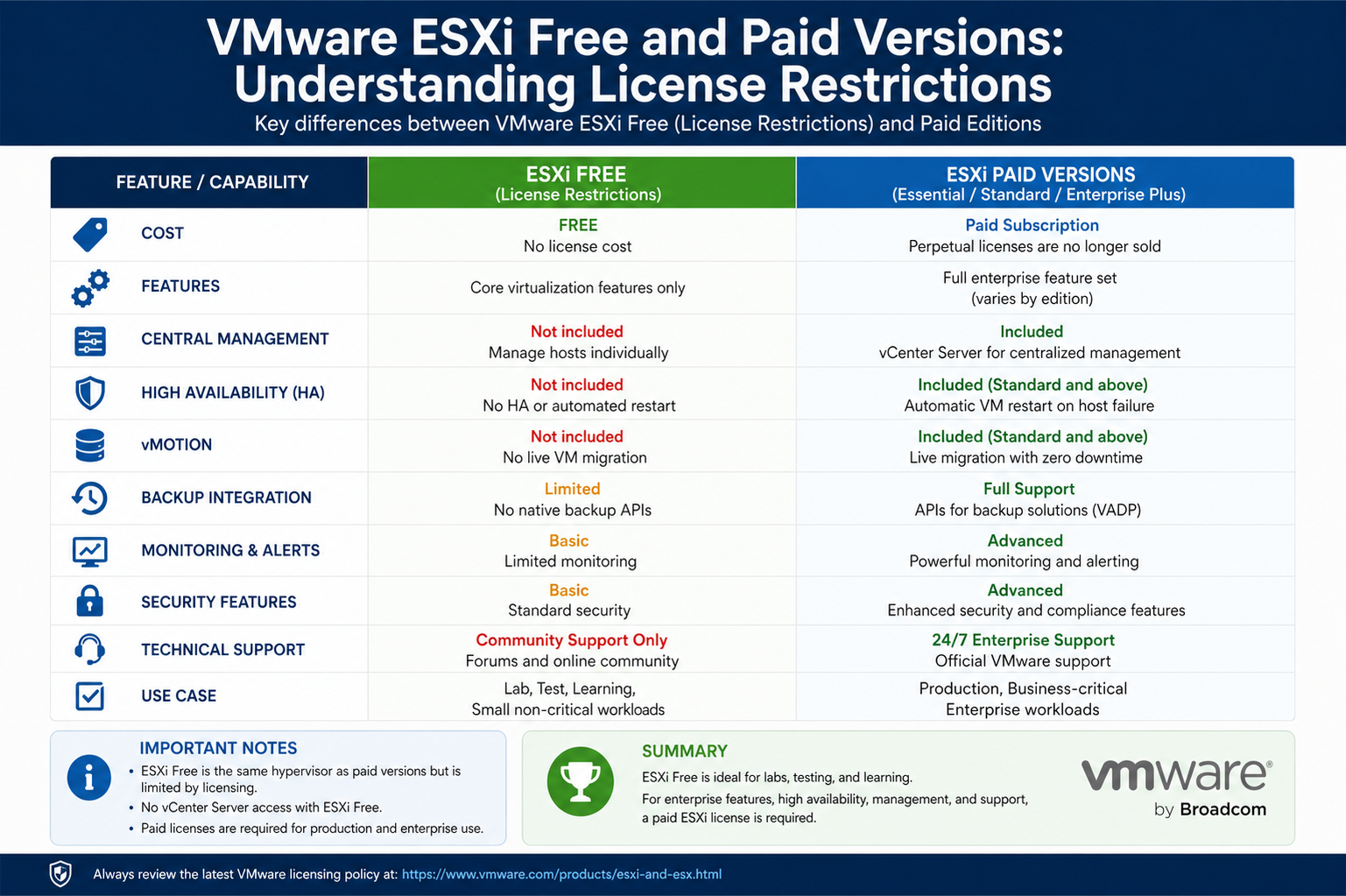
VMware ESXi is a type of hypervisor that runs directly on physical hardware and enables the creation and management of multiple virtual machines on a single server. It plays a central role in modern data centers by improving hardware utilization, reducing operational costs, and enabling flexible IT infrastructure management. The distinction between free and paid versions becomes important when organizations begin to scale beyond basic virtualization needs. While the core hypervisor engine remains the same, the differences emerge in management capabilities, feature access, scalability, and support structures.
Core Architecture of VMware ESXi
At its foundation, VMware ESXi is designed as a lightweight operating layer that installs directly onto a physical server without requiring a traditional operating system. This architecture reduces overhead and improves performance by allowing direct interaction with hardware resources such as CPU, memory, storage, and network interfaces. Virtual machines operate on top of this hypervisor layer, each receiving allocated resources while remaining isolated from one another. This isolation ensures stability and security, as issues in one virtual machine do not directly impact others.
The architecture is optimized for efficiency, but its true power is unlocked when paired with advanced management tools and enterprise features, which are typically available only in paid versions. Without these tools, the environment remains functional but limited in terms of centralized control and automation.
Functional Scope of the Free Version
The free version of VMware ESXi provides access to core virtualization functionality, allowing users to create, run, and manage virtual machines on a single host. It is commonly used in small environments, testing labs, and educational setups where simplicity is preferred over scalability. Users can interact with the system through a basic interface, but advanced centralized management features are restricted.
One of the key limitations of the free edition is the lack of integration with centralized management systems. This means each host must be managed individually, which becomes inefficient as the number of servers increases. Additionally, access to advanced APIs is restricted, preventing automation and integration with external tools or orchestration platforms. This significantly limits its use in production-grade environments where automation and scalability are essential.
Capabilities Introduced in Paid Editions
Paid editions of VMware ESXi expand significantly on the base functionality by introducing advanced features designed for enterprise environments. These include centralized management, enhanced resource allocation, automation capabilities, and high availability options. Organizations using paid versions can manage multiple hosts from a single control point, greatly simplifying administration and improving operational efficiency.
Advanced resource scheduling and optimization features ensure that workloads are distributed efficiently across available hardware. This improves performance consistency and reduces the risk of resource contention. Paid versions also include support for advanced storage and networking configurations, enabling more complex and resilient infrastructure designs.
Centralized Management and Operational Control
One of the most significant differences between free and paid versions is the ability to use centralized management systems. In paid environments, administrators can control multiple ESXi hosts from a single interface, enabling them to deploy virtual machines, monitor performance, and manage resources across the entire infrastructure.
This centralized approach reduces administrative overhead and provides better visibility into system performance and health. It also enables consistent configuration across multiple hosts, reducing the risk of human error and configuration drift. In contrast, the free version requires manual management of each individual host, which becomes impractical in larger environments.
Networking Features and Differences
Networking plays a crucial role in virtualization environments, and VMware ESXi provides a flexible virtual networking architecture. In the free version, basic networking features are available, allowing virtual machines to communicate with each other and external networks. However, advanced networking configurations such as distributed switching and centralized network management are not available.
Paid editions introduce advanced networking capabilities that allow administrators to create complex virtual network topologies. These include features such as distributed virtual switches, network traffic monitoring, and advanced traffic management policies. These capabilities are essential for enterprise environments where network performance, security segmentation, and scalability are critical.
Storage Management and Optimization
Storage is another area where differences between free and paid versions become evident. The free edition supports basic storage configurations, allowing virtual machines to use local or shared storage. However, advanced storage management features are limited.
Paid versions introduce enhanced storage capabilities such as centralized storage management, automated load balancing across storage devices, and advanced data protection features. These capabilities improve performance and reliability while reducing the complexity of managing large storage infrastructures. They also enable more efficient use of storage resources by dynamically allocating space based on workload demands.
Security Enhancements in Paid Versions
Security is a critical aspect of any virtualization environment. While the free version includes basic security features such as isolation between virtual machines, it lacks advanced security controls. Paid editions introduce enhanced security mechanisms that allow administrators to implement fine-grained access control, encryption, and compliance management.
These features help organizations protect sensitive workloads and meet regulatory requirements. Advanced logging and auditing capabilities also provide better visibility into system activity, enabling faster detection and response to potential security incidents.
Performance Optimization and Scalability
The free version of VMware ESXi is limited in terms of scalability, as it is designed primarily for single-host environments. While it can handle multiple virtual machines on a single server, it does not support advanced load balancing or resource distribution across multiple hosts.
Paid editions, on the other hand, are designed for scalability. They enable dynamic resource allocation across clusters of hosts, ensuring optimal performance even under heavy workloads. This is particularly important in enterprise environments where workloads can fluctuate significantly and require flexible resource management.
Automation and API Access
Automation is a key feature of modern IT environments, and VMware ESXi supports this through its APIs. However, access to these APIs is restricted in the free version. This limits the ability to automate tasks such as virtual machine provisioning, monitoring, and lifecycle management.
Paid versions provide full API access, enabling integration with automation tools and orchestration platforms. This allows organizations to streamline operations, reduce manual effort, and improve consistency across their infrastructure. Automation also plays a critical role in scaling environments efficiently without increasing administrative overhead.
High Availability and Disaster Recovery Features
Enterprise environments require high availability and disaster recovery capabilities to ensure business continuity. The free version of VMware ESXi does not include these features, meaning virtual machines are dependent on a single host and are vulnerable to hardware failures.
Paid editions introduce high availability mechanisms that automatically restart virtual machines on alternative hosts in the event of a failure. They also include advanced disaster recovery options that allow organizations to replicate workloads across multiple locations, ensuring data protection and rapid recovery in case of system failure.
Licensing Models and Cost Considerations
The licensing structure of VMware ESXi plays a major role in determining which version is suitable for an organization. The free version requires no license cost but comes with significant functional limitations. Paid versions are available under different licensing tiers, each offering progressively more advanced features.
Organizations must evaluate their operational needs, scalability requirements, and budget constraints when choosing between free and paid editions. While the free version may appear cost-effective initially, its limitations often make it unsuitable for growing or production environments.
Use Case Scenarios for Free and Paid Editions
The free version is typically used in environments where simplicity and cost savings are the primary concerns. This includes home labs, training environments, and small-scale testing setups. It allows users to gain hands-on experience with virtualization without financial investment.
Paid versions are used in enterprise environments where reliability, scalability, and advanced management capabilities are required. These environments often involve multiple hosts, complex workloads, and strict performance requirements. The additional features provided by paid editions are essential for maintaining operational efficiency and system stability at scale.
Transitioning from Free to Paid Versions
As organizations grow, they often transition from the free version of VMware ESXi to a paid edition. This transition typically involves migrating virtual machines into a managed environment and enabling centralized control features. While the underlying virtual machines remain compatible, the shift introduces new capabilities that significantly improve management efficiency.
This transition also allows organizations to adopt best practices in virtualization, including automation, load balancing, and high availability. It represents a natural progression as infrastructure demands increase.
Operational Considerations and Long-Term Strategy
Choosing between free and paid versions of VMware ESXi should not be based solely on immediate needs but also on long-term operational strategy. While the free version provides a good starting point, its limitations can become restrictive as workloads grow. Paid versions offer a scalable foundation that supports evolving business requirements.
Organizations must consider factors such as system growth, workload complexity, security requirements, and administrative efficiency when making this decision. Investing in a more capable virtualization platform early can prevent operational bottlenecks later.
Advanced Virtualization Management Capabilities in Paid VMware ESXi Editions
As virtualization environments grow in complexity, the need for advanced management capabilities becomes increasingly important. Paid editions of VMware ESXi introduce a wide range of tools designed to simplify infrastructure administration, improve visibility, and enable more efficient control over virtualized workloads. These capabilities are especially important in enterprise environments where downtime, inefficiency, or misconfiguration can have significant operational and financial consequences.
Cluster-Level Resource Management
One of the most important enhancements in paid editions is cluster-level resource management. Instead of managing each host individually, administrators can group multiple ESXi hosts into a cluster and manage them as a single logical unit. This approach allows workloads to be distributed intelligently across available resources, ensuring optimal performance and minimizing bottlenecks.
Cluster-based management also enables more efficient use of hardware resources. If one host becomes overloaded while another remains underutilized, workloads can be automatically balanced to maintain system stability. This dynamic allocation is not available in the free version, which operates strictly on a per-host basis.
Live Migration and Workload Mobility
Paid versions introduce the ability to move running virtual machines between hosts without downtime. This capability is essential for maintenance, load balancing, and infrastructure upgrades. It ensures that services remain available even while underlying hardware is being updated or replaced.
In contrast, the free version does not support live migration, meaning virtual machines must be powered off before being moved. This limitation makes it unsuitable for environments that require continuous uptime or flexible workload distribution.
Workload mobility also enhances disaster preparedness. In the event of hardware issues or performance degradation, virtual machines can be quickly shifted to healthier hosts without interrupting operations.
Automated Load Balancing and Resource Scheduling
Automation plays a central role in modern virtualization, and paid editions of VMware ESXi include intelligent load balancing systems that continuously monitor resource usage. These systems analyze CPU, memory, and storage consumption across the environment and automatically redistribute workloads to maintain efficiency.
This eliminates the need for constant manual intervention and reduces the risk of performance degradation due to uneven resource usage. The free version lacks these automation capabilities, requiring administrators to manually monitor and adjust workloads.
Resource scheduling in paid editions also allows for prioritization of critical workloads. High-priority virtual machines can be guaranteed access to required resources, ensuring consistent performance even during peak demand periods.
Enhanced Storage Infrastructure Management
Storage management in paid VMware ESXi editions is significantly more advanced compared to the free version. Administrators gain access to centralized storage control, enabling them to manage multiple storage devices and datastores efficiently.
Advanced storage features include automated storage balancing, improved redundancy mechanisms, and optimized data placement strategies. These tools help improve both performance and reliability by ensuring that storage resources are used effectively.
Additionally, paid versions support advanced storage technologies that enable faster data access and improved fault tolerance. These capabilities are critical in environments where data availability and speed are essential.
Network Virtualization and Traffic Control
Networking in enterprise virtualization environments requires more than basic connectivity. Paid editions of VMware ESXi introduce advanced network virtualization features that allow administrators to design and manage complex network architectures.
These features include distributed networking configurations, traffic segmentation, and centralized network policy enforcement. Such capabilities enable organizations to isolate workloads, enhance security, and optimize network performance across multiple hosts.
Traffic control features allow administrators to prioritize or limit network usage for specific virtual machines. This ensures that critical applications maintain consistent connectivity even during periods of heavy network demand.
The free version, by comparison, provides only basic networking functionality without advanced control or centralized configuration options.
High Availability and Fault Tolerance Mechanisms
One of the most critical advantages of paid VMware ESXi editions is support for high availability. In enterprise environments, hardware failures are inevitable, and systems must be designed to recover quickly without disrupting services.
High availability features ensure that if a host fails, virtual machines are automatically restarted on another available host within the cluster. This minimizes downtime and maintains business continuity.
Some advanced configurations also include fault tolerance mechanisms that provide continuous availability by running synchronized copies of virtual machines on multiple hosts simultaneously. If one instance fails, the other immediately takes over without interruption.
These capabilities are not available in the free version, which lacks any automated recovery mechanisms.
Advanced Security and Access Control
Security in virtualization environments extends beyond basic isolation. Paid VMware ESXi editions provide advanced security frameworks that allow organizations to enforce strict access control policies, encrypt data, and monitor system activity.
Role-based access control enables administrators to define specific permissions for users and groups, ensuring that only authorized personnel can access critical infrastructure components. This reduces the risk of unauthorized changes or security breaches.
Encryption capabilities protect data both at rest and in transit, safeguarding sensitive information from potential threats. Additionally, detailed audit logs provide visibility into system activity, helping organizations detect and respond to suspicious behavior.
The free version offers only basic security isolation without these advanced protective features.
Scalability in Enterprise Environments
Scalability is one of the primary reasons organizations choose paid VMware ESXi editions. As infrastructure requirements grow, systems must be able to expand without disruption.
Paid versions support large-scale deployments involving multiple hosts, clusters, and data centers. This allows organizations to add new resources seamlessly and scale workloads horizontally.
The free version is inherently limited to single-host environments, making it unsuitable for large or growing infrastructures. Its lack of centralized management further restricts its scalability potential.
Integration with Automation and Orchestration Tools
Modern IT environments rely heavily on automation to manage complex systems efficiently. Paid VMware ESXi editions provide full API access, enabling integration with automation and orchestration platforms.
This allows organizations to automate tasks such as virtual machine deployment, configuration management, monitoring, and scaling. Automation reduces manual workload, improves consistency, and speeds up operational processes.
In contrast, the free version restricts API access, limiting its ability to integrate with external systems. This makes automation and large-scale orchestration impractical.
Performance Monitoring and Analytics
Visibility into system performance is essential for maintaining a stable virtualization environment. Paid editions include advanced monitoring and analytics tools that provide real-time insights into resource usage, system health, and workload behavior.
Administrators can identify performance bottlenecks, predict resource shortages, and optimize system configurations based on detailed analytics. These insights help improve efficiency and prevent potential issues before they impact operations.
The free version provides only basic monitoring capabilities, offering limited visibility into system performance.
Backup and Disaster Recovery Integration
Data protection is a critical aspect of enterprise virtualization. Paid VMware ESXi editions support integration with advanced backup and disaster recovery solutions, enabling organizations to protect virtual machines and restore them quickly in case of failure.
These integrations allow for automated backups, replication across multiple locations, and rapid recovery of workloads. This ensures business continuity even in the event of major system failures or disasters.
The free version lacks these integration capabilities, requiring manual backup processes that are less efficient and more prone to error.
Licensing Flexibility and Enterprise Support
Paid VMware ESXi editions come with flexible licensing models that allow organizations to choose the level of functionality they require. These licenses are typically structured based on features, number of hosts, or level of support.
In addition to licensing flexibility, paid versions also include official technical support. This ensures that organizations can receive assistance in resolving issues quickly, minimizing downtime and operational risk.
The free version does not include any official support, meaning users must rely on community resources for troubleshooting and assistance.
Operational Efficiency and Cost Justification
While paid VMware ESXi editions require financial investment, they provide significant returns in terms of operational efficiency, reduced downtime, and improved resource utilization. The ability to automate tasks, balance workloads, and manage infrastructure centrally leads to lower administrative overhead and better system performance.
In large environments, these efficiencies often outweigh the cost of licensing, making paid versions a cost-effective choice in the long term.
The free version, while cost-free, often incurs hidden operational costs due to manual management and limited scalability.
Strategic Role in Modern IT Infrastructure
Paid VMware ESXi editions play a strategic role in modern IT infrastructure by enabling organizations to build flexible, scalable, and resilient virtual environments. They support digital transformation initiatives by providing the foundation for cloud integration, automation, and hybrid infrastructure models.
As businesses increasingly rely on virtualized systems, the importance of advanced hypervisor capabilities continues to grow.
Enterprise Integration and Hybrid Infrastructure Support
Modern IT environments are no longer confined to isolated on-premises systems. Organizations increasingly operate in hybrid infrastructures that combine local data centers with cloud environments. Paid VMware ESXi editions are designed to support this evolution by offering integration capabilities that allow seamless interaction between virtualized on-premises workloads and external platforms.
This integration enables organizations to extend their infrastructure without completely replacing existing systems. Virtual machines can be moved, replicated, or synchronized across different environments depending on workload demands and business requirements. The free version does not support such integration, limiting it to standalone usage without external connectivity enhancements.
Virtual Machine Lifecycle Management
In enterprise environments, managing the full lifecycle of virtual machines is a critical requirement. This includes provisioning, configuration, monitoring, updates, scaling, and decommissioning. Paid VMware ESXi editions provide structured lifecycle management tools that automate and streamline these processes.
Administrators can define standardized templates for virtual machines, ensuring consistent configuration across deployments. This reduces errors and improves operational efficiency. Automated update mechanisms also ensure that virtual machines remain secure and up to date without requiring manual intervention.
The free version lacks lifecycle automation capabilities, requiring manual handling of each stage. This becomes inefficient and error-prone as the number of virtual machines increases.
Resource Optimization in Multi-Tenant Environments
In environments where multiple departments or clients share the same infrastructure, resource optimization becomes essential. Paid VMware ESXi editions provide mechanisms to allocate resources fairly and efficiently across different workloads.
These systems allow administrators to define resource limits, reservations, and priorities for virtual machines. This ensures that critical applications always receive the necessary resources while preventing any single workload from consuming excessive capacity.
Such multi-tenant resource control is not available in the free version, which operates without advanced resource governance features. As a result, performance can become unpredictable in shared environments.
Advanced Fault Detection and System Resilience
System resilience is a key requirement in enterprise virtualization. Paid editions of VMware ESXi include advanced fault detection systems that continuously monitor hardware and software health. These systems can identify potential issues before they result in system failure.
When anomalies are detected, corrective actions can be automatically triggered, such as migrating workloads away from affected hosts or reallocating resources to maintain stability. This proactive approach significantly reduces downtime and improves system reliability.
The free version lacks predictive fault detection and automated remediation features, relying instead on manual monitoring and intervention.
Centralized Policy Enforcement
Consistency in configuration and security policies is essential for maintaining control in large-scale environments. Paid VMware ESXi editions enable centralized policy enforcement, allowing administrators to define rules that apply across multiple hosts and virtual machines.
These policies can cover areas such as security settings, network configurations, storage behavior, and resource allocation. Once defined, they are automatically enforced across the entire infrastructure, ensuring uniformity and compliance.
In contrast, the free version requires manual configuration on each host, increasing the risk of inconsistencies and misconfigurations.
Improved Resource Scheduling for High-Demand Workloads
High-demand applications require precise resource scheduling to ensure consistent performance. Paid VMware ESXi editions include advanced scheduling algorithms that allocate CPU, memory, and storage resources based on workload priority and demand patterns.
This ensures that critical applications maintain performance even during peak usage periods. Lower-priority workloads are adjusted dynamically to prevent resource contention.
The free version uses basic scheduling mechanisms without advanced prioritization or dynamic adjustment capabilities, which can lead to performance variability under load.
Support for Large-Scale Virtualization Deployments
As organizations grow, their virtualization environments often expand to include hundreds or even thousands of virtual machines. Paid VMware ESXi editions are specifically designed to handle such large-scale deployments efficiently.
They provide centralized tools for managing extensive infrastructures, enabling administrators to maintain visibility and control across all resources. Performance remains stable even as the environment scales, thanks to optimized resource distribution and management systems.
The free version is not designed for large-scale use and becomes difficult to manage as the number of virtual machines increases due to the absence of centralized oversight tools.
Advanced Logging and Compliance Reporting
In regulated industries, compliance and audit requirements play a major role in IT operations. Paid VMware ESXi editions include advanced logging systems that record detailed information about system activity, configuration changes, and user actions.
These logs can be used to generate compliance reports that demonstrate adherence to industry standards and regulatory requirements. This is particularly important in sectors such as finance, healthcare, and government.
The free version provides only basic logging capabilities, which are insufficient for formal compliance reporting or detailed auditing.
Automation-Driven Infrastructure Scaling
Automation is a key driver of modern infrastructure scalability. Paid VMware ESXi editions enable infrastructure to scale automatically based on demand. When workloads increase, additional resources can be provisioned without manual intervention.
This elasticity ensures that performance remains consistent even during sudden spikes in demand. Once demand decreases, resources can be scaled back to optimize efficiency.
The free version does not support automated scaling, requiring manual intervention to adjust resource allocation.
Virtual Machine Isolation and Security Hardening
While both free and paid versions provide virtualization-based isolation, paid editions include additional security hardening features that strengthen system protection. These include stricter access controls, enhanced isolation policies, and advanced monitoring of virtual machine behavior.
Such features help prevent unauthorized access and reduce the risk of lateral movement within the virtualized environment. Security policies can also be enforced uniformly across all virtual machines.
The free version offers basic isolation but lacks advanced security hardening and enforcement mechanisms.
Energy Efficiency and Infrastructure Optimization
In large data centers, energy consumption becomes a significant operational cost. Paid VMware ESXi editions include optimization features that help reduce energy usage by intelligently managing workload distribution.
When demand is low, systems can consolidate workloads onto fewer hosts, allowing unused hardware to enter low-power states. This reduces energy consumption and operational costs while maintaining service availability.
The free version does not include energy optimization features, limiting its efficiency in larger environments.
Disaster Recovery Planning and Continuity Strategies
Disaster recovery is a fundamental requirement for enterprise systems. Paid VMware ESXi editions provide comprehensive disaster recovery planning tools that enable organizations to replicate workloads across multiple locations.
These tools allow for automated failover and recovery procedures, ensuring that services remain available even in the event of major disruptions. Recovery times are minimized through preconfigured replication and failover strategies.
The free version does not support structured disaster recovery planning, making it unsuitable for mission-critical environments.
Advanced Networking Security Controls
Beyond basic connectivity, paid editions provide advanced networking security controls that allow administrators to define strict traffic rules and segmentation policies. This ensures that sensitive workloads remain isolated from less secure environments.
Network traffic can be monitored, filtered, and controlled at a granular level, reducing the risk of unauthorized access or data leakage. These controls are essential in environments where security is a top priority.
The free version lacks advanced network security controls and segmentation capabilities.
Operational Monitoring at Scale
Monitoring large virtualization environments requires detailed visibility into system performance and behavior. Paid VMware ESXi editions provide centralized monitoring dashboards that aggregate data from multiple hosts.
This enables administrators to identify trends, detect anomalies, and respond quickly to performance issues. Predictive analytics can also be used to forecast future resource needs.
The free version provides limited monitoring capabilities restricted to individual hosts.
Long-Term Infrastructure Stability and Planning
Paid VMware ESXi editions support long-term infrastructure planning by providing tools that help organizations forecast growth, allocate resources efficiently, and maintain system stability over time.
These planning capabilities ensure that infrastructure evolves in alignment with business needs without unexpected disruptions or capacity shortages.
The free version lacks forecasting and long-term planning tools, making it more suitable for short-term or experimental use.
Performance Optimization in High-Density Virtual Environments
As virtualization density increases, performance optimization becomes a central requirement for maintaining system stability. Paid VMware ESXi editions include advanced mechanisms that continuously analyze workload behavior and adjust resource allocation to ensure smooth performance across all virtual machines. These mechanisms help prevent bottlenecks that can occur when multiple high-demand applications compete for limited CPU, memory, or storage resources.
The system intelligently distributes workloads based on real-time demand rather than static allocation. This dynamic behavior ensures that resources are not wasted and that critical applications maintain consistent responsiveness. In comparison, the free version operates with basic scheduling logic, which does not adapt as effectively to fluctuating workloads, making it less suitable for environments with variable demand patterns.
Advanced Memory Management Techniques
Memory optimization plays a crucial role in virtualization efficiency. Paid versions of VMware ESXi implement advanced memory management techniques that allow the hypervisor to maximize usable memory across virtual machines. These include intelligent memory sharing, compression techniques, and efficient reclamation processes that help reduce unnecessary consumption.
These mechanisms allow multiple virtual machines to operate efficiently even when physical memory resources are limited. As a result, overall system density increases without sacrificing performance. The free version includes only basic memory handling capabilities, which limits its ability to support high-density workloads or memory-intensive applications effectively.
CPU Scheduling and Core Utilization Efficiency
Paid VMware ESXi editions introduce enhanced CPU scheduling algorithms designed to optimize processor usage across multiple virtual machines. These algorithms ensure that CPU cycles are distributed fairly and efficiently based on workload priority and system demand.
This level of optimization allows multiple virtual machines to share physical CPU cores without significant performance degradation. It also reduces idle CPU time, improving overall system efficiency. In contrast, the free version relies on simpler scheduling logic that may not fully optimize CPU utilization in complex or heavily loaded environments.
Storage Performance Acceleration Features
Storage performance is another critical factor in virtualization environments. Paid editions of VMware ESXi include features that enhance storage responsiveness and throughput. These include caching mechanisms, optimized I/O handling, and intelligent data placement strategies that reduce latency and improve access speeds.
Such enhancements are particularly important for applications that rely heavily on disk performance, such as databases and transactional systems. The free version lacks these advanced storage acceleration capabilities, which can result in slower performance under heavy I/O workloads.
Workload Prioritization and Quality of Service Controls
In enterprise environments, not all workloads have equal importance. Paid VMware ESXi editions allow administrators to define workload priorities through quality of service controls. These controls ensure that critical applications receive preferential access to system resources during periods of high demand.
This prioritization helps maintain service reliability and prevents performance degradation in essential systems. Lower-priority workloads are automatically adjusted to accommodate higher-priority demands. The free version does not support such prioritization, meaning all virtual machines compete equally for resources without structured control.
Enhanced Virtual Machine Snapshot Management
Snapshots are an important feature in virtualization, allowing administrators to capture the state of a virtual machine at a specific point in time. Paid versions of VMware ESXi provide more efficient snapshot management capabilities, enabling faster creation, restoration, and consolidation of snapshots.
These improvements reduce performance overhead and storage consumption associated with snapshot usage. This is particularly beneficial in environments where frequent testing, updates, or rollback operations are required. The free version supports basic snapshot functionality but lacks the performance optimizations found in paid editions.
Distributed Resource Coordination Across Hosts
Paid VMware ESXi editions enable coordination of resources across multiple hosts in a cluster. This distributed approach ensures that workloads are balanced not just within a single server, but across an entire infrastructure.
Such coordination improves overall system efficiency and reduces the risk of overloading individual hosts. It also enables seamless scaling, as new hosts can be added to the cluster and immediately participate in resource distribution. The free version does not support distributed coordination, limiting its operation to isolated environments.
Intelligent Workload Placement Strategies
Workload placement is a critical factor in virtualization performance. Paid editions use intelligent algorithms to determine the optimal location for each virtual machine within the infrastructure. These decisions are based on factors such as resource availability, workload type, and current system load.
This ensures that virtual machines are always placed in environments that best support their performance requirements. It also prevents resource imbalance across hosts. The free version lacks automated placement intelligence, requiring manual decisions for workload distribution.
Reduced Downtime Through Predictive Maintenance
Predictive maintenance capabilities in paid VMware ESXi editions allow systems to anticipate potential hardware or software issues before they occur. By analyzing performance trends and system behavior, the platform can identify early warning signs of failure.
When risks are detected, workloads can be proactively migrated to healthy hosts, minimizing downtime and preventing service interruptions. This predictive approach significantly improves system reliability. The free version does not include predictive maintenance capabilities and relies solely on reactive troubleshooting.
Enhanced Virtual Network Performance Optimization
Network performance is optimized in paid VMware ESXi editions through advanced traffic management and segmentation techniques. These features ensure that network bandwidth is allocated efficiently and that latency-sensitive applications receive priority handling.
Network traffic can be shaped and controlled dynamically to prevent congestion and maintain consistent performance. This is particularly important in environments with heavy inter-virtual-machine communication. The free version provides only basic networking without advanced optimization or traffic control features.
Scalable Infrastructure Expansion Without Service Disruption
One of the key advantages of paid VMware ESXi editions is the ability to expand infrastructure without disrupting ongoing services. New hosts, storage devices, and virtual machines can be added seamlessly to existing environments.
This scalability ensures that organizations can grow their infrastructure in response to business needs without requiring downtime or complex migration procedures. The free version lacks this level of flexibility, making expansion more manual and disruptive.
Improved System Reliability Through Redundancy Mechanisms
Paid editions include redundancy mechanisms that improve overall system reliability. These mechanisms ensure that critical components have backups or failover options available in case of failure.
This redundancy extends across compute, storage, and networking layers, creating a highly resilient infrastructure. As a result, system availability is significantly increased. The free version does not provide structured redundancy mechanisms, making it more vulnerable to single points of failure.
Operational Automation for Routine Administrative Tasks
Routine administrative tasks such as provisioning, monitoring, and configuration management can be fully automated in paid VMware ESXi editions. This automation reduces administrative workload and ensures consistency across the infrastructure.
Automated workflows can be customized based on organizational policies, allowing IT teams to focus on strategic tasks rather than repetitive operations. The free version does not support automation workflows, requiring manual execution of most tasks.
Improved Data Integrity and Consistency Mechanisms
Data integrity is essential in virtualization environments, especially when multiple virtual machines interact with shared resources. Paid editions implement mechanisms that ensure data consistency across storage and compute layers.
These mechanisms help prevent data corruption and ensure that virtual machines operate reliably even under heavy workloads or system stress. The free version provides basic data handling without advanced consistency protections.
Enhanced Troubleshooting and Diagnostic Tools
Paid VMware ESXi editions include advanced diagnostic tools that help administrators quickly identify and resolve system issues. These tools provide deep insights into system behavior, performance metrics, and configuration states.
This level of visibility significantly reduces troubleshooting time and improves operational efficiency. The free version offers limited diagnostic capabilities, making issue resolution more time-consuming.
Strategic Value of Paid Virtualization Environments
Beyond technical capabilities, paid VMware ESXi editions provide strategic value by enabling organizations to build future-ready IT infrastructures. These environments support digital transformation initiatives, hybrid cloud adoption, and large-scale automation strategies.
By providing a stable and scalable foundation, paid editions allow businesses to adapt quickly to changing technological and operational demands. The free version, while useful for basic use cases, does not provide the strategic depth required for long-term enterprise growth.
Conclusion
VMware ESXi exists in two fundamentally different usage categories when comparing its free and paid editions. While both are built on the same core hypervisor technology and are capable of running virtual machines efficiently, their purpose and operational depth differ significantly.
The free version is primarily intended for basic virtualization use cases such as learning, experimentation, and small-scale testing environments. It provides the essential capability to create and run virtual machines on a single physical host, making it useful for users who want to understand virtualization without financial investment. However, its limitations in management, scalability, automation, and integration restrict its practicality in complex or production-grade environments.
In contrast, paid editions are designed for enterprise environments where reliability, scalability, security, and performance are critical. They introduce advanced capabilities such as centralized management, automated workload balancing, high availability, resource optimization, and deep infrastructure integration. These features allow organizations to manage large-scale virtual environments efficiently while maintaining consistent performance and operational control.
The key distinction lies not in the virtualization engine itself, but in the ecosystem of tools and features built around it. Paid versions transform ESXi from a standalone hypervisor into a fully managed virtualization platform capable of supporting enterprise-level infrastructure demands. This includes automation, disaster recovery readiness, policy enforcement, and advanced monitoring capabilities that are essential for modern IT operations.