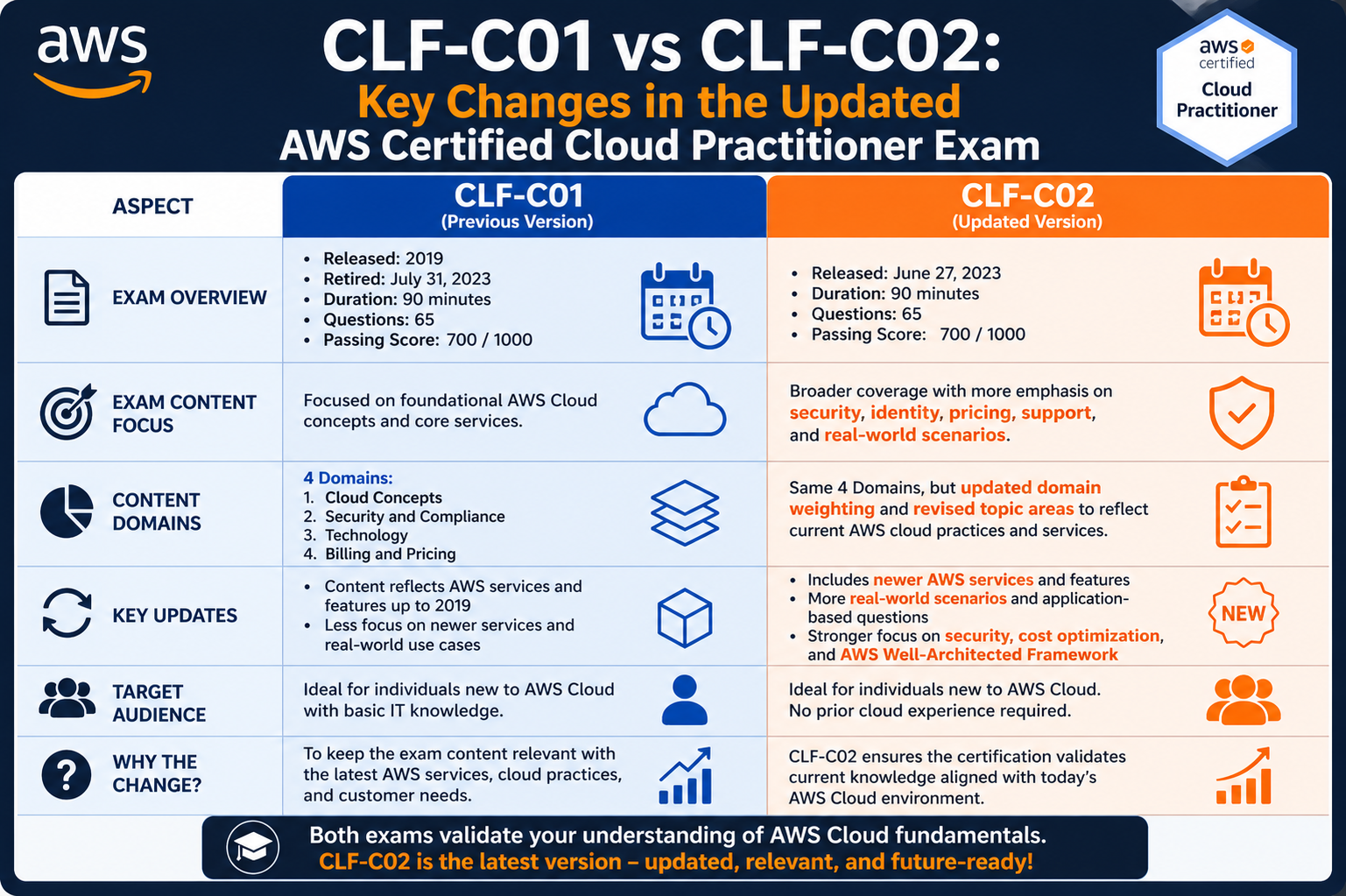
The AWS Certified Cloud Practitioner certification has undergone a meaningful transformation with its updated version. The goal of this change is to better reflect how cloud computing is used in modern organizations and to ensure that candidates are evaluated on practical understanding rather than only theoretical knowledge. While the foundational purpose of the certification remains the same, the updated exam places a stronger emphasis on real-world cloud adoption, service usage, and decision-making in AWS environments.
Earlier versions of the exam were primarily focused on introducing cloud concepts and AWS fundamentals in a broad sense. Candidates were expected to recognize basic terminology, understand general cloud benefits, and identify core AWS services at a surface level. In contrast, the updated version expands beyond simple recognition and requires a deeper understanding of how AWS services interact within business and technical scenarios. This shift reflects the growing importance of cloud literacy across industries where cloud computing is no longer optional but essential.
The updated certification is designed for individuals who are not necessarily cloud engineers but still need to understand how AWS supports modern digital infrastructure. This includes roles in business analysis, sales, marketing, finance, and IT support. As cloud adoption continues to grow globally, AWS has refined this certification to ensure it remains relevant for both technical and non-technical professionals.
Shift Toward Real-World Application
One of the most significant changes in the updated exam is the increased focus on practical application. Instead of asking purely definitional questions, the exam now presents scenarios where candidates must evaluate situations and choose appropriate AWS services or solutions. This reflects how cloud knowledge is applied in real business environments.
For example, rather than simply identifying what a specific AWS service does, candidates may be asked how that service can be used to solve a business problem such as reducing operational costs, improving scalability, or enhancing security. This approach encourages critical thinking and ensures that certified individuals can apply their knowledge effectively in workplace situations.
This shift also aligns with the broader trend in cloud certifications, where memorization is becoming less important than problem-solving ability. AWS expects certified professionals to understand not just what a service is, but when and why it should be used.
Expanded Focus on Core AWS Services
The updated exam places greater emphasis on widely used AWS services that form the backbone of cloud deployments. These include compute, storage, database, and networking services, along with tools for monitoring and management. While earlier versions introduced these services at a high level, the newer version explores them in more context-driven ways.
Candidates are expected to understand how different services work together to build scalable and resilient cloud solutions. For example, understanding how compute services interact with storage solutions or how databases integrate with application services is now more relevant than ever.
In addition, there is increased attention on newer or more commonly adopted AWS offerings. This ensures that candidates are familiar with the services they are most likely to encounter in real-world environments, rather than outdated or rarely used features.
Greater Emphasis on Cloud Economics
A notable enhancement in the updated exam is the stronger focus on cost management and cloud economics. Organizations adopting cloud technologies are highly concerned with optimizing costs, and AWS has reflected this priority in the certification.
Candidates are expected to understand pricing models, cost optimization strategies, and tools that help manage AWS spending. This includes awareness of how different pricing structures work and how organizations can choose the most cost-effective options based on workload requirements.
The updated exam also highlights the importance of financial accountability in cloud environments. Professionals are expected to recognize how cloud usage impacts business expenses and how AWS provides tools to monitor and control these costs effectively.
This focus makes the certification more relevant for business-oriented professionals who need to understand not only the technical side of cloud computing but also its financial implications.
Improved Coverage of Security Fundamentals
Security remains a central pillar of AWS, and the updated exam reinforces this significantly. Candidates are expected to understand basic cloud security principles and how AWS implements security across its infrastructure.
The shared responsibility model plays a crucial role in this section. Candidates must clearly understand what AWS is responsible for and what the customer is responsible for when operating in the cloud. This concept is essential for ensuring secure cloud deployments.
The updated version also introduces more scenario-based security questions, requiring candidates to identify appropriate security measures for different situations. This includes access control, data protection, and identity management concepts.
The emphasis on security reflects the growing importance of protecting cloud environments as organizations move more sensitive workloads to the cloud.
Better Alignment with Modern Cloud Practices
The updated certification aligns more closely with how organizations currently use cloud services. Cloud computing today is not limited to simple infrastructure hosting; it plays a critical role in digital transformation, innovation, and business agility.
The exam now includes concepts related to hybrid cloud environments, where organizations use both on-premises and cloud infrastructure. Candidates are expected to understand how AWS supports migration strategies and integration with existing systems.
There is also greater emphasis on scalability and elasticity, which are key advantages of cloud computing. Understanding how AWS enables businesses to scale resources dynamically based on demand is an important part of the updated exam.
This alignment ensures that candidates are prepared for modern cloud environments rather than outdated or overly simplified models of cloud usage.
Changes in Question Style and Complexity
While the certification remains entry-level, the complexity of questions has increased slightly due to the shift toward scenario-based evaluation. Instead of straightforward recall questions, candidates are more likely to encounter situations that require analysis and judgment.
This does not necessarily make the exam harder in a technical sense, but it does require better comprehension and reasoning skills. Candidates must be able to interpret a scenario, identify key requirements, and select the most appropriate AWS solution.
This change helps ensure that certified individuals are not just familiar with terminology but are capable of applying knowledge in practical contexts. It also improves the overall value of the certification in professional environments.
Broader Understanding of Cloud Adoption
The updated exam places more importance on understanding why organizations adopt cloud computing in the first place. This includes benefits such as flexibility, scalability, cost efficiency, and global reach.
Candidates are expected to understand the business drivers behind cloud adoption, not just the technical components. This helps bridge the gap between technical and non-technical roles, making the certification more useful across different job functions.
The exam also highlights the role of cloud computing in innovation, showing how AWS enables organizations to experiment, deploy faster, and improve operational efficiency.
Improved Coverage of Global Infrastructure
AWS operates a global network of data centers, and the updated exam places more emphasis on understanding this infrastructure. Candidates are expected to know how regions and availability zones work and why they are important for performance, reliability, and compliance.
This knowledge helps professionals understand how AWS ensures high availability and fault tolerance across different geographic locations. It also supports better decision-making when designing or evaluating cloud solutions.
The updated version reinforces the importance of selecting appropriate regions based on business needs such as latency, data residency, and regulatory requirements.
Relevance for Career Development
The updated certification continues to serve as an entry point into cloud computing careers, but it now offers greater value due to its improved relevance. Employers increasingly look for candidates who understand not just basic cloud concepts but also how cloud services are used in practice.
This makes the certification particularly useful for individuals seeking roles in cloud support, technical sales, project coordination, and business analysis. It also serves as a strong foundation for more advanced AWS certifications.
By focusing more on real-world applications, the updated exam helps candidates build skills that are directly transferable to workplace scenarios.
Deeper Emphasis on Cloud Architecture Awareness
The updated exam introduces a stronger focus on understanding basic cloud architecture principles, even at an entry-level stage. While candidates are not expected to design complex systems, they are required to understand how AWS components fit together to form scalable, reliable, and secure environments.
This includes a clearer understanding of how compute, storage, networking, and database services interact within a cloud solution. The intention is to help candidates think in terms of systems rather than isolated services. Instead of treating AWS services as separate tools, the updated exam encourages a more connected perspective of how cloud environments are built and maintained.
This architectural awareness also helps learners prepare for more advanced AWS certifications, where system design becomes a core requirement. By introducing these ideas early, AWS ensures a smoother learning progression for candidates advancing through certification levels.
Stronger Focus on Identity and Access Management Concepts
Identity and access management has become a more prominent topic in the updated exam. Candidates are expected to understand how AWS controls access to resources and how permissions are structured within an AWS environment.
The updated version emphasizes the importance of secure authentication and authorization practices. This includes understanding user roles, groups, policies, and permission boundaries at a conceptual level. While detailed configuration is not required, candidates must be able to recognize how access control contributes to overall cloud security.
This increased focus reflects the growing importance of identity security in modern cloud environments, where misconfigured access can lead to significant risks. By strengthening this area, the certification ensures candidates are aware of one of the most critical aspects of cloud security.
Enhanced Coverage of Monitoring and Operational Tools
The updated exam places greater importance on understanding how AWS environments are monitored and managed. Candidates are expected to be familiar with tools that provide visibility into system performance, usage patterns, and operational health.
Rather than focusing on technical configuration, the exam highlights the purpose and use cases of monitoring services. This includes understanding how organizations track resource utilization, detect anomalies, and maintain system reliability.
This change reflects the operational reality of cloud computing, where continuous monitoring is essential for maintaining performance and preventing issues. It also reinforces the idea that cloud environments are dynamic and require ongoing management rather than static setup.
Improved Understanding of Migration Concepts
Cloud migration is another area that receives increased attention in the updated exam. Candidates are expected to understand the basic concepts involved in moving applications, data, and workloads from on-premises environments to the cloud.
The exam focuses on high-level migration strategies rather than technical execution. This includes understanding why organizations migrate to the cloud, what benefits they expect, and what challenges they may face during the process.
By introducing these concepts, AWS ensures that candidates are aware of one of the most common use cases for cloud adoption. It also helps learners understand the broader business context behind cloud transformation initiatives.
More Practical Interpretation of Availability and Reliability
The updated certification places greater emphasis on understanding availability and reliability in cloud systems. Instead of treating these as abstract concepts, candidates are expected to understand how AWS designs infrastructure to achieve high availability.
This includes awareness of redundancy, fault tolerance, and disaster recovery principles at a conceptual level. Candidates should be able to recognize how AWS services are distributed across multiple locations to ensure continuous operation even in the event of failures.
This shift helps candidates understand why cloud systems are more resilient compared to traditional on-premises environments. It also reinforces the importance of designing systems that can withstand unexpected disruptions.
Refined Understanding of Support and Service Models
Another area that has been refined in the updated exam is AWS support and service models. Candidates are expected to understand the different types of support plans and what level of assistance each one provides.
The exam also highlights how organizations interact with AWS support in real-world scenarios. This includes understanding when to escalate issues and what type of support is appropriate for different business needs.
This change reflects the practical reality of cloud operations, where support services play a critical role in maintaining system stability and resolving issues efficiently.
Increased Relevance of Compliance and Governance Concepts
Compliance and governance have become more relevant in the updated certification. Candidates are expected to have a basic understanding of how AWS helps organizations meet regulatory requirements and maintain governance standards.
This includes awareness of how cloud environments support auditing, compliance reporting, and policy enforcement. While detailed regulatory knowledge is not required, candidates should understand the importance of compliance in cloud adoption.
This focus reflects the increasing number of industries that must adhere to strict regulatory frameworks while operating in cloud environments.
More Balanced Approach to Service Categorization
The updated exam presents AWS services in a more balanced and contextual manner. Instead of memorizing long lists of services, candidates are encouraged to understand service categories and their practical use cases.
This includes grouping services into compute, storage, networking, databases, security, and management categories. The goal is to help candidates develop a mental model of how AWS services are organized and when they should be used.
This approach improves long-term retention of knowledge and helps candidates apply concepts more effectively in real-world scenarios.
Greater Focus on Business Value of Cloud Computing
The updated certification places stronger emphasis on the business value delivered by cloud computing. Candidates are expected to understand how AWS supports cost savings, operational efficiency, scalability, and innovation.
Rather than focusing solely on technical features, the exam encourages candidates to think about how cloud computing impacts business outcomes. This includes understanding how organizations use AWS to reduce infrastructure overhead, improve speed of deployment, and enhance customer experiences.
This shift makes the certification more relevant for non-technical professionals who need to understand the strategic value of cloud adoption.
Simplified Yet More Contextual Learning Approach
Although the updated exam introduces more scenario-based questions, the overall learning approach is more structured and contextual. Candidates are encouraged to understand concepts through real-world examples rather than isolated definitions.
This makes the learning process more intuitive and practical. Instead of memorizing individual facts, candidates build an understanding of how AWS services function together within complete solutions.
This approach also helps reduce confusion and improves the ability to recall and apply knowledge under exam conditions.
Better Preparation for Advanced AWS Certifications
The updated Cloud Practitioner certification is designed to serve as a stronger foundation for advanced AWS certifications. By introducing more practical and scenario-based learning, it prepares candidates for higher-level exams that require deeper technical expertise.
Candidates who complete the updated certification will find it easier to transition into associate-level certifications such as Solutions Architect, Developer, or SysOps Administrator tracks.
This improved alignment ensures a smoother learning path for individuals pursuing long-term careers in cloud computing.
Improved Clarity in AWS Shared Responsibility Model
The updated exam places a clearer and more structured emphasis on the AWS shared responsibility model. Candidates are expected to understand this concept in a more practical way, especially how responsibilities are divided between AWS and the customer in different cloud scenarios.
Instead of simply memorizing definitions, the exam now focuses on how responsibility shifts depending on the type of service being used. For example, candidates should recognize that AWS handles more of the underlying infrastructure in managed services, while customers retain responsibility for data, configuration, and access management.
This clearer framing helps reduce confusion and ensures that candidates can correctly interpret security and operational responsibilities in real-world cloud environments. It also reinforces the importance of understanding boundaries in cloud security and compliance.
More Realistic Business Scenario Questions
The updated version introduces a stronger reliance on business-oriented scenarios that reflect actual organizational challenges. These questions are designed to test not just technical awareness but also decision-making in practical situations.
Candidates may be presented with situations involving cost concerns, scalability issues, or security requirements and asked to choose the most suitable AWS approach. This shift encourages a more analytical mindset and better reflects how cloud decisions are made in professional environments.
This change also helps bridge the gap between technical understanding and business reasoning, making the certification more valuable for roles that involve communication between technical teams and stakeholders.
Refined Understanding of Cloud Value Propositions
The updated exam places greater importance on understanding why organizations choose cloud computing in the first place. Candidates are expected to recognize the core value propositions such as agility, elasticity, global reach, and cost efficiency.
Instead of treating these as abstract benefits, the exam connects them to real business outcomes. For example, scalability is no longer just a definition but is linked to handling traffic spikes during product launches or seasonal demand changes.
This deeper understanding helps candidates explain cloud benefits in a way that resonates with business decision-makers, making the certification more relevant in cross-functional roles.
Increased Focus on Well-Architected Principles
The updated certification introduces a stronger conceptual awareness of AWS Well-Architected principles. While detailed architectural design is not required, candidates are expected to understand the importance of building systems that are secure, reliable, efficient, and cost-effective.
This includes awareness of best practices such as designing for failure, optimizing performance, and maintaining operational excellence. The exam emphasizes these ideas in scenario-based questions rather than standalone definitions.
This addition helps candidates develop a mindset aligned with industry best practices, which is essential for anyone working in or around cloud environments.
Better Coverage of Data Management Concepts
Data-related concepts have been expanded in the updated exam, particularly around storage options and data handling approaches. Candidates are expected to understand how AWS provides different types of storage solutions depending on performance, durability, and access requirements.
The focus is not on deep technical configuration but on recognizing which type of storage is appropriate for different use cases. This includes structured awareness of object storage, file storage, and database storage at a conceptual level.
This improvement ensures candidates are better prepared to understand how data is managed in cloud environments, which is a critical aspect of most AWS workloads.
Stronger Emphasis on Cloud Adoption Journey
The updated exam places more attention on the overall cloud adoption journey of organizations. Candidates are expected to understand the stages businesses go through when transitioning to the cloud, from initial awareness to full-scale implementation.
This includes recognizing the motivations behind cloud adoption, such as reducing infrastructure costs, increasing agility, and improving innovation capabilities. It also involves understanding common challenges organizations face during migration and adoption.
This broader perspective helps candidates connect technical knowledge with strategic business transformation goals.
More Structured Understanding of AWS Global Reach
AWS operates across a large global infrastructure, and the updated exam provides a more structured understanding of how this infrastructure is organized. Candidates are expected to understand concepts like regions, availability zones, and edge locations in a more applied context.
Rather than memorizing definitions, candidates should be able to interpret how global infrastructure supports performance, resilience, and compliance requirements.
This helps learners appreciate why AWS services perform reliably across different parts of the world and how organizations choose deployment locations based on business needs.
Enhanced Awareness of Automation and Efficiency
The updated certification introduces a stronger conceptual focus on automation within cloud environments. Candidates are expected to understand how automation improves efficiency, reduces manual effort, and minimizes operational errors.
While technical scripting or implementation is not required, candidates should be aware of how automation contributes to scalable and reliable cloud operations.
This reflects modern cloud practices where automation plays a key role in infrastructure management, deployment processes, and system monitoring.
More Emphasis on Service Integration Concepts
The updated exam highlights how AWS services are designed to work together as integrated solutions rather than isolated tools. Candidates are expected to understand how different services combine to deliver complete cloud solutions.
For example, a web application may involve compute services, storage systems, databases, and monitoring tools working together seamlessly. The exam encourages candidates to think in terms of end-to-end solutions rather than individual components.
This integrated perspective is essential for understanding how real-world cloud architectures are built and maintained.
Improved Understanding of Cloud Flexibility and Elasticity
Elasticity and flexibility are core advantages of cloud computing, and the updated exam reinforces these concepts in a more applied manner. Candidates are expected to understand how AWS enables systems to scale up or down based on demand automatically or efficiently.
Instead of focusing on definitions, the exam presents scenarios where candidates must recognize the importance of dynamic resource allocation. This helps reinforce how cloud computing differs from traditional fixed infrastructure models.
This understanding is especially important for recognizing how businesses maintain performance while controlling costs.
Better Alignment with Entry-Level Career Roles
The updated certification is more closely aligned with actual entry-level job roles in cloud environments. It is designed not just as a learning milestone but as a practical qualification for roles such as cloud support associate, junior cloud analyst, and non-technical cloud-adjacent positions.
This alignment ensures that candidates who earn the certification are better prepared to contribute meaningfully in workplace environments where AWS is used.
It also improves the credibility of the certification as a foundational step in cloud career development.
Refined Focus on Cost Optimization Strategies
The updated exam places a deeper emphasis on understanding how organizations optimize costs in AWS environments. Instead of simply recognizing pricing concepts, candidates are expected to understand how cost efficiency is achieved through proper service selection, resource management, and architectural decisions.
This includes awareness of how cloud usage can be continuously adjusted to avoid unnecessary spending. The exam highlights the importance of aligning cloud resources with actual demand rather than over-provisioning infrastructure. Candidates are also expected to recognize how businesses evaluate cost versus performance trade-offs when selecting AWS services.
This stronger focus reflects real-world priorities, where cost control is one of the most important factors in cloud adoption and long-term usage.
Improved Understanding of Deployment Models
The updated certification introduces a clearer understanding of different cloud deployment models, including public, private, and hybrid cloud environments. Candidates are expected to understand how these models differ and when each one is typically used.
Rather than focusing on definitions alone, the exam encourages understanding of how organizations choose deployment models based on security, compliance, scalability, and operational requirements.
This helps candidates develop a more practical view of cloud adoption strategies and how AWS fits into broader IT infrastructure decisions.
Stronger Emphasis on Fault Tolerance and Resilience
The updated exam places increased importance on the concepts of fault tolerance and system resilience. Candidates are expected to understand how cloud systems are designed to continue functioning even when components fail.
This includes recognizing how redundancy, distributed infrastructure, and automated recovery mechanisms contribute to system stability. The focus is not on technical configuration but on conceptual understanding of how AWS maintains service continuity.
This improvement ensures that candidates are aware of how modern cloud systems achieve high reliability in real-world conditions.
Expanded Awareness of Service Categories and Use Cases
The updated version encourages a more structured understanding of AWS service categories and their typical use cases. Candidates are expected to recognize which types of services are best suited for specific business needs.
Instead of memorizing isolated service names, the exam emphasizes understanding patterns such as when to use compute services, when storage solutions are appropriate, and how databases support different application types.
This approach helps candidates build a mental framework for organizing AWS services in a logical and practical way.
Improved Clarity in Cloud Security Responsibilities
Security continues to be a major focus in the updated exam, with clearer distinctions between AWS responsibilities and customer responsibilities. Candidates are expected to understand how security operates at different layers of the cloud environment.
This includes recognizing how AWS secures the infrastructure while customers are responsible for securing their data, applications, and user access. The exam reinforces this concept through scenario-based questions that require applied understanding.
This clarity helps reduce common misconceptions and ensures candidates understand their role in maintaining secure cloud environments.
More Emphasis on Cloud Innovation and Agility
The updated certification highlights how cloud computing enables innovation and business agility. Candidates are expected to understand how AWS allows organizations to experiment quickly, deploy applications faster, and adapt to changing market demands.
Instead of treating innovation as a general benefit, the exam connects it to practical outcomes such as faster product development cycles and improved responsiveness to customer needs.
This makes the certification more relevant to modern business environments where speed and adaptability are critical competitive advantages.
Better Understanding of Pricing Models and Billing Concepts
The updated exam strengthens coverage of AWS pricing structures and billing mechanisms. Candidates are expected to understand how usage is measured and how different pricing models impact overall costs.
This includes awareness of on-demand usage, reserved capacity, and other pricing approaches at a conceptual level. The goal is not financial expertise but the ability to understand how cloud consumption translates into billing outcomes.
This knowledge is essential for anyone working in environments where cloud cost management is a key responsibility.
Enhanced Focus on Cloud Monitoring and Visibility
Monitoring and visibility have become more important in the updated exam. Candidates are expected to understand how organizations track system performance and resource usage in AWS environments.
This includes awareness of how monitoring tools help identify performance issues, optimize usage, and maintain system health. The exam emphasizes the importance of visibility in ensuring operational efficiency and reliability.
This reflects real-world cloud practices where continuous monitoring is essential for maintaining stable systems.
Improved Conceptual Understanding of Scalability
Scalability is given more structured attention in the updated certification. Candidates are expected to understand how cloud systems can handle increasing or decreasing workloads without performance degradation.
Rather than focusing on technical implementation, the exam emphasizes the concept of dynamic resource adjustment based on demand. This helps candidates understand one of the most important advantages of cloud computing.
This knowledge is especially relevant for understanding how modern applications handle variable traffic patterns efficiently.
More Practical Interpretation of Cloud Benefits
The updated exam encourages candidates to think about cloud benefits in practical terms rather than theoretical ones. Benefits such as cost savings, scalability, reliability, and global reach are now connected to real-world business scenarios.
This helps candidates understand how organizations actually experience value from cloud adoption rather than just learning abstract advantages.
This practical interpretation makes the certification more meaningful and applicable in professional contexts.
Stronger Focus on Service Reliability Concepts
Reliability is a key theme in the updated exam, with emphasis on how AWS ensures consistent service availability. Candidates are expected to understand how distributed systems and redundant infrastructure contribute to reliability.
This includes recognizing how AWS minimizes downtime and maintains performance even during failures or maintenance activities.
This understanding is critical for appreciating how cloud systems differ from traditional infrastructure models.
Better Alignment with Industry Expectations
The updated certification is more closely aligned with what employers expect from entry-level cloud professionals. It ensures that candidates not only understand AWS terminology but can also interpret and apply cloud concepts in real-world situations.
This makes the certification more valuable for job readiness and improves its relevance across different industries.
It also ensures that candidates are better prepared for collaboration with technical teams in workplace environments.
Structural Improvements
The updated AWS Certified Cloud Practitioner exam represents a significant refinement in how foundational cloud knowledge is assessed. It shifts the focus from memorization to understanding, from theory to application, and from isolated concepts to integrated systems.
By strengthening areas such as cost optimization, security awareness, service integration, and real-world scenarios, the certification becomes more practical and industry-relevant.
Overall, the updated version provides a stronger foundation for anyone entering the cloud computing field and ensures better preparation for both career development and advanced AWS certifications.
Improved Emphasis on Cloud Communication Concepts
The updated exam places more importance on understanding how cloud concepts are communicated within organizations. Candidates are expected to recognize how technical ideas are translated into business language so that non-technical stakeholders can make informed decisions.
This includes understanding how cloud benefits, risks, and costs are explained in a business context. The goal is to ensure that candidates can bridge the gap between technical teams and decision-makers by interpreting AWS concepts in a clear and practical way.
This improvement reflects real workplace scenarios where cloud professionals often need to explain complex ideas in simple terms.
Better Understanding of Service Availability Models
The updated certification introduces a more structured understanding of how AWS ensures service availability. Candidates are expected to understand how cloud systems maintain uptime through distributed architecture and redundancy.
Instead of focusing on technical implementation, the exam emphasizes conceptual awareness of how services remain accessible even during disruptions. This includes recognizing how AWS designs systems to reduce downtime and maintain continuity of operations.
This knowledge is essential for understanding why cloud platforms are considered more reliable than traditional infrastructure.
Enhanced Focus on Cloud Decision-Making Factors
The updated exam encourages candidates to think about the factors that influence cloud decision-making. This includes cost, performance, scalability, security, and compliance requirements.
Candidates are expected to evaluate how these factors interact when organizations choose AWS services or design cloud solutions. The emphasis is on understanding trade-offs rather than memorizing isolated features.
This helps candidates develop a more realistic perspective on how cloud decisions are made in professional environments.
Conclusion
The transition from the earlier AWS Certified Cloud Practitioner exam to its updated version represents a clear shift toward practical, scenario-based learning and real-world cloud understanding. Instead of focusing mainly on basic definitions and surface-level knowledge, the updated exam emphasizes how AWS services are actually used in business environments.
The newer version strengthens key areas such as cloud security, cost management, service integration, and operational awareness. It also improves clarity around core concepts like the shared responsibility model, global infrastructure, and scalability, ensuring candidates develop a more complete and usable understanding of cloud computing.
Overall, the updated certification is more aligned with modern industry expectations. It prepares learners not just to pass an exam, but to understand how cloud technology supports real organizational goals such as efficiency, innovation, reliability, and cost optimization. This makes it a more valuable starting point for anyone beginning their journey in cloud computing and a stronger foundation for advancing into higher-level AWS certifications.