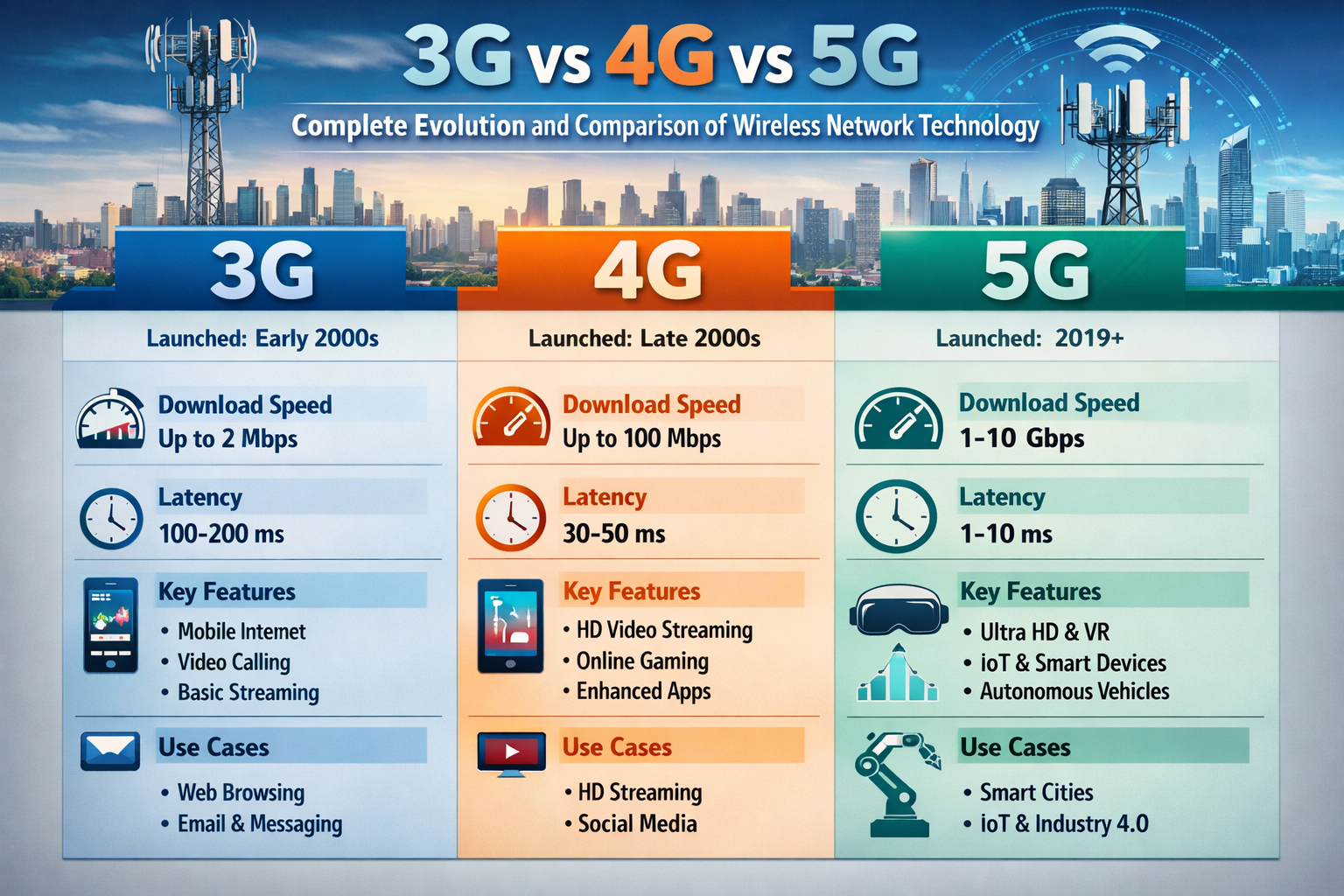
The evolution of mobile communication technology has completely transformed the way people connect, communicate, and access information. From simple voice calls in early mobile systems to today’s ultra-fast, intelligent, and highly connected digital ecosystem, each generation of wireless technology has played a crucial role in shaping modern society. The journey from 3G to 4G and now 5G reflects continuous innovation aimed at increasing speed, reducing delay, improving reliability, and expanding the number of connected devices. These improvements have not only enhanced personal communication but have also revolutionized industries such as education, healthcare, transportation, entertainment, and business operations.
Mobile networks are built on the idea of transmitting data through radio waves using cellular towers. Each generation represents a major upgrade in how efficiently this data is transmitted and how much information can be handled at once. As digital demand increased with smartphones, streaming platforms, and cloud computing, the need for faster and more reliable networks became essential. This demand led to the development of 3G, 4G, and eventually 5G technologies, each solving the limitations of the previous generation while introducing new possibilities.
Understanding 3G Technology in Detail
3G, or third-generation mobile technology, was the first major step toward mobile internet accessibility. Before its introduction, mobile phones were mainly used for voice calls and basic text messaging. 3G changed this by allowing users to access the internet on their mobile devices at relatively faster speeds compared to earlier systems. It introduced the concept of smartphones being used for browsing websites, sending emails, and using early mobile applications.
One of the most important improvements in 3G was better data transmission capability. It allowed video calling, which was a significant innovation at that time. Although the quality was not very high by today’s standards, it was still a breakthrough in mobile communication. 3G also improved voice clarity and network stability, making calls more reliable and reducing dropped connections.
However, 3G had several limitations. Internet speeds were still relatively slow, especially when compared to modern expectations. Downloading large files or streaming high-definition videos was difficult. Latency, which refers to the delay in data transfer, was also noticeable, making real-time online gaming or high-quality video streaming less efficient. Despite these limitations, 3G played a foundational role in introducing mobile internet to the world and setting the stage for future advancements.
Transition from 3G to 4G and Its Importance
The transition from 3G to 4G was driven by the growing demand for faster internet and more powerful mobile applications. As smartphones became more advanced, users started expecting seamless video streaming, faster downloads, and smooth online experiences. 3G networks were unable to fully support these requirements, leading to the development of 4G technology.
4G, or fourth-generation mobile technology, brought a massive improvement in speed and performance. It was designed to support high-definition multimedia content, real-time communication, and advanced applications. One of the most important changes introduced by 4G was the shift to an all-IP network, which means that both voice and data were transmitted through the internet protocol. This made communication more efficient and faster.
4G networks significantly reduced latency compared to 3G, allowing for smoother online gaming, video conferencing, and live streaming. Users could now watch HD videos without buffering and download large files in a matter of seconds. This generation also supported the rapid growth of social media platforms, mobile apps, and cloud-based services, which became essential parts of daily life.
Impact of 4G on Digital Lifestyle and Industries
The introduction of 4G completely changed the digital lifestyle of users across the world. Smartphones became powerful tools for entertainment, communication, and productivity. Video streaming services gained massive popularity as users could easily watch high-quality content on the go. Social media platforms also expanded rapidly due to improved connectivity and faster upload and download speeds.
In the business world, 4G enabled remote work, cloud computing, and real-time collaboration. Companies could now conduct video meetings, share large files instantly, and operate more efficiently. The education sector also benefited significantly, as online learning platforms and virtual classrooms became more practical and accessible.
In healthcare, 4G supported telemedicine services, allowing doctors to consult patients remotely. Emergency services improved communication systems, and transportation systems started using GPS-based applications more effectively. Overall, 4G acted as a foundation for the modern digital economy by enabling faster, more reliable, and more versatile mobile connectivity.
Introduction to 5G Technology and Its Vision
5G, or fifth-generation mobile technology, represents the most advanced stage of wireless communication currently available. It is designed not only to improve speed but also to completely transform how devices communicate with each other. Unlike previous generations that focused mainly on human communication, 5G is built to support machine-to-machine communication on a massive scale.
One of the key goals of 5G is ultra-low latency, which means almost instant data transmission. This is essential for technologies that require real-time response, such as autonomous vehicles, remote surgery, and industrial automation. Another major feature of 5G is its ability to connect a huge number of devices simultaneously without reducing performance. This makes it ideal for smart cities, Internet of Things (IoT) devices, and advanced digital ecosystems.
5G also provides extremely high-speed internet, far surpassing 4G capabilities. This allows users to download large files in seconds, stream ultra-high-definition videos without interruption, and enjoy immersive technologies like virtual reality and augmented reality with minimal delay.
Technological Differences Between 3G, 4G, and 5G
The differences between these generations are not just about speed but also about architecture, efficiency, and purpose. 3G was focused on bringing mobile internet to users for the first time. 4G improved that experience by making internet usage fast, smooth, and reliable for multimedia content. 5G goes beyond human use and focuses on connecting everything in a smart digital ecosystem.
Latency is one of the most important differences. 3G had relatively high latency, which caused delays in communication. 4G reduced this significantly, enabling real-time applications. 5G takes latency to an extremely low level, making communication nearly instant.
Speed is another major difference. 3G offered basic internet browsing speeds, 4G introduced high-speed mobile broadband, and 5G delivers ultra-fast gigabit-level speeds. Network capacity also increased significantly with each generation, with 5G being capable of supporting millions of devices per square kilometer.
Role of 5G in Future Technologies
5G is expected to play a critical role in shaping future technologies. It will support autonomous vehicles that require instant communication to ensure safety and efficiency. Smart cities will rely on 5G for managing traffic systems, energy usage, and public services through interconnected devices.
In healthcare, 5G will enable remote surgeries using robotic systems controlled in real time by doctors located far away. In education, it will enhance virtual reality classrooms and immersive learning experiences. Industries will benefit from automation, smart factories, and advanced robotics powered by stable and fast connectivity.
The Internet of Things will expand rapidly with 5G, connecting everyday objects such as home appliances, vehicles, wearable devices, and industrial machines. This will create a fully connected environment where data flows seamlessly between devices, improving efficiency and convenience.
Technical Architecture Differences Between 3G, 4G, and 5G
The technical structure of each mobile generation is one of the most important factors that defines its performance and capabilities. 3G networks were built using a combination of circuit-switched and packet-switched systems. This meant that voice calls and data services were handled differently, which often limited efficiency and speed. The architecture was an improvement over earlier generations but still not fully optimized for high-speed internet usage.
4G introduced a major architectural shift by moving to an all-IP (Internet Protocol) based system. This meant that both voice and data were transmitted through the same network infrastructure using internet protocols. This change significantly improved efficiency, reduced complexity, and enabled faster communication. It also allowed services like VoLTE (Voice over LTE), which improved call quality and reduced connection time.
5G takes architecture even further by introducing a highly flexible, software-driven network design. It uses technologies such as network slicing, which allows multiple virtual networks to run on a single physical infrastructure. Each slice can be optimized for a specific use case, such as gaming, healthcare, or industrial automation. This makes 5G far more adaptable and efficient compared to previous generations. It also relies heavily on cloud computing and edge computing, which bring data processing closer to users, reducing delay and improving performance.
Speed and Performance Comparison Across Generations
Speed is one of the most noticeable differences between 3G, 4G, and 5G. 3G networks offered modest speeds suitable for basic internet browsing and messaging. While it was a major improvement at its time, it struggled with modern digital demands such as HD streaming and large file downloads.
4G introduced a significant jump in speed, enabling users to stream high-definition videos, play online games, and download large files quickly. It provided a smooth and stable experience for most mobile internet activities and became the global standard for mobile connectivity for many years.
5G, however, represents a revolutionary leap in speed. It is capable of delivering extremely high data transfer rates, often measured in gigabits per second. This allows users to download full movies in seconds and stream ultra-high-definition content without buffering. The increased speed also supports advanced technologies like virtual reality, augmented reality, and real-time cloud computing.
Latency Improvements and Real-Time Communication
Latency, which refers to the delay between sending and receiving data, has decreased significantly across mobile generations. In 3G networks, latency was relatively high, which often caused noticeable delays in video calls and online activities. This made real-time communication less efficient and sometimes frustrating.
4G reduced latency dramatically, making online experiences much smoother. Video calls became clearer, online gaming became more responsive, and streaming services became more reliable. This improvement played a major role in the growth of real-time applications and social media platforms.
5G reduces latency to an extremely low level, almost approaching real-time communication. This is essential for applications where even a slight delay can cause problems, such as autonomous driving, remote surgery, and industrial automation. Ultra-low latency is one of the defining features of 5G and is critical for future technologies that require instant response times.
Device Connectivity and Network Capacity
Another important difference between these generations is the number of devices they can support simultaneously. 3G networks were limited in capacity, which often led to slower speeds in crowded areas such as cities or large events. As more users connected to the network, performance tended to decrease.
4G improved network capacity significantly, allowing more users to connect at the same time without major performance drops. This was essential for the growth of smartphones and mobile internet usage, especially in densely populated areas.
5G is designed to handle an extremely large number of connected devices simultaneously. This is especially important for the Internet of Things, where billions of devices such as sensors, smart appliances, and connected vehicles need to communicate continuously. 5G ensures stable performance even in highly dense environments like smart cities, stadiums, and industrial zones.
Impact on Entertainment and Media Consumption
The evolution of mobile networks has completely changed how people consume entertainment and media. With 3G, users could access basic streaming services, but the experience was limited due to slower speeds and buffering issues.
4G transformed entertainment by enabling seamless video streaming, online gaming, and social media usage. Platforms for video content became extremely popular as users could watch high-quality videos anytime and anywhere. This generation made mobile entertainment a central part of daily life.
5G is expected to take entertainment to a completely new level. It supports ultra-high-definition video, cloud gaming, and immersive experiences such as virtual reality concerts and augmented reality environments. Users can experience interactive content in real time without delays, creating a more engaging and realistic digital experience.
Impact on Business and Industry Transformation
The shift from 3G to 4G and 5G has had a major impact on global industries. 3G enabled basic mobile communication and early mobile internet usage, which helped businesses stay connected on the go.
4G revolutionized business operations by enabling cloud computing, remote work, and real-time communication. Companies could collaborate more efficiently, share data instantly, and operate globally without physical limitations. This generation played a key role in the rise of digital businesses and online services.
5G is expected to transform industries even further by enabling automation, artificial intelligence integration, and smart manufacturing. Factories will become more efficient through connected machines, logistics systems will become more intelligent, and businesses will rely heavily on real-time data analysis. This will lead to increased productivity, reduced costs, and improved decision-making.
Healthcare and Education Advancements with 5G
In healthcare, 3G allowed basic mobile communication between patients and doctors, while 4G introduced telemedicine and remote consultations. However, 5G takes healthcare to a much more advanced level.
With 5G, remote surgeries using robotic systems become possible due to ultra-low latency and high reliability. Doctors can perform complex procedures from distant locations with precision and real-time feedback. Wearable health devices can continuously monitor patients and send real-time data to healthcare providers for immediate action.
In education, 3G supported basic online learning, and 4G enabled video-based classes and virtual learning platforms. 5G will enhance education through immersive technologies like virtual reality classrooms, interactive simulations, and real-time global collaboration. Students will be able to experience practical learning environments without physical limitations.
Challenges and Limitations of Each Generation
Despite their advancements, each generation also has limitations. 3G struggled with slow speeds and high latency, making it unsuitable for modern applications. It also had limited capacity, which affected performance in crowded areas.
4G, while significantly better, still faces challenges such as network congestion in densely populated regions and limited support for massive IoT deployments. It also consumes more battery power compared to earlier technologies.
5G, although highly advanced, comes with its own challenges. It requires significant infrastructure development, including a large number of small cell towers. It also has limited coverage in rural areas during early deployment stages. Additionally, the cost of implementation and device compatibility can be barriers to widespread adoption.
Future Beyond 5G and Emerging Possibilities
The evolution of mobile networks does not stop at 5G. Research is already underway for future generations that will further enhance connectivity and intelligence. These future networks are expected to focus on even faster speeds, higher reliability, and deeper integration with artificial intelligence.
Future technologies may enable fully autonomous communication systems where devices make decisions without human intervention. The integration of communication networks with AI, quantum computing, and advanced robotics will create a highly intelligent digital ecosystem.
These advancements will continue to expand the possibilities of human interaction with technology, making communication more seamless, efficient, and intelligent than ever before.
Real-World User Experience Across 3G, 4G, and 5G
The difference between 3G, 4G, and 5G becomes most visible when looking at real-world usage rather than just technical specifications. In everyday life, 3G felt like a basic entry point into mobile internet. Users could load simple web pages, send emails, and use early social media platforms, but the experience often required patience. Videos took time to buffer, apps loaded slowly, and network performance varied heavily depending on location and traffic.
With 4G, the user experience changed dramatically. Mobile phones became true multimedia devices capable of handling high-speed browsing, instant video streaming, and smooth app performance. Social media platforms became highly interactive with real-time uploads, live streaming, and instant sharing. Users no longer had to wait for content to load in most cases, and mobile internet became reliable enough to replace fixed broadband for many people.
5G introduces a new level of experience where the focus shifts from simple connectivity to intelligent responsiveness. Applications respond almost instantly, high-definition content streams without delay, and cloud-based services feel like they are running directly on the device. The experience is not only faster but also more stable and immersive, especially for advanced technologies like augmented reality navigation, real-time multiplayer gaming, and remote-controlled systems.
Evolution of Mobile Applications and Digital Ecosystem
The evolution of mobile networks directly influenced the development of mobile applications and digital ecosystems. During the 3G era, applications were simple and lightweight. They were mainly focused on communication, basic browsing, and limited multimedia sharing. The internet was still growing on mobile devices, so app functionality was restricted by network limitations.
With the arrival of 4G, developers were able to create more advanced applications. Streaming platforms, ride-hailing apps, mobile banking, food delivery services, and social media networks expanded rapidly. These apps relied heavily on stable, high-speed internet to function efficiently. The app economy flourished during this time, creating millions of digital jobs and services that became part of daily life.
5G takes this ecosystem even further by enabling highly advanced and data-heavy applications. These include real-time language translation, augmented reality shopping, remote robotic control, smart surveillance systems, and fully immersive gaming environments. Applications are no longer limited by device processing power alone because 5G allows cloud computing to handle complex tasks in real time. This shifts mobile devices into gateways for powerful external computing systems.
Network Reliability and Stability Improvements
Reliability is another key factor that has improved significantly across generations. 3G networks often faced issues with signal drops, inconsistent speeds, and reduced performance in crowded areas. Users frequently experienced fluctuations in connectivity, especially when moving between locations.
4G improved reliability by introducing stronger infrastructure and better data handling techniques. It provided more stable connections and reduced interruptions during calls or data usage. However, in very crowded environments or during peak usage times, some congestion could still occur.
5G is designed to be far more reliable, even in extremely dense environments. It uses advanced technologies like beamforming, which directs signals more precisely toward users, improving stability and reducing interference. This makes it highly effective in environments such as stadiums, airports, and smart cities where thousands of devices are connected simultaneously.
Energy Efficiency and Device Performance Impact
Another important aspect of network evolution is energy efficiency. 3G networks were not highly optimized for battery usage, which often resulted in faster battery drain during internet usage. However, because data usage was relatively low, the overall impact on devices was manageable.
4G improved efficiency but also increased battery consumption due to higher data speeds and more frequent connectivity demands. Smartphones became more powerful, but they also required better battery management to handle constant high-speed internet usage.
5G presents a mixed scenario in terms of energy efficiency. On one hand, it is designed to be more efficient in data transmission and network management. On the other hand, because it supports extremely high speeds and continuous connectivity for multiple devices, it can increase power demands depending on usage. However, advancements in hardware and network optimization are helping balance performance with energy consumption.
Security Enhancements Across Generations
Security has also evolved significantly from 3G to 5G. 3G introduced basic encryption methods to protect voice and data communication, but it was still vulnerable to certain types of interception and attacks.
4G strengthened security by introducing more advanced encryption protocols and better authentication systems. It became much more difficult for unauthorized users to intercept or manipulate data. This made mobile banking, online shopping, and digital communication much safer.
5G takes security to an even higher level by integrating advanced encryption, network segmentation, and continuous authentication mechanisms. It is designed to protect not only human communication but also machine-to-machine interactions. However, because 5G connects a massive number of devices, it also introduces new security challenges that require constant monitoring and advanced protection systems.
Global Impact and Digital Transformation
The global impact of mobile network evolution cannot be overstated. 3G played a foundational role in introducing mobile internet to developing regions, helping bridge the digital gap for the first time. It allowed more people to access basic online services and communication tools.
4G accelerated global digital transformation by enabling widespread internet usage, digital businesses, and mobile-first economies. It supported the rise of global platforms that changed how people work, shop, learn, and communicate. Entire industries shifted toward digital models powered by fast mobile internet.
5G is currently driving the next phase of global transformation. It is expected to reshape industries by enabling smart infrastructure, autonomous systems, and highly connected environments. Countries investing in 5G are positioning themselves for future technological leadership, as it forms the backbone of next-generation digital economies.
Societal Changes Driven by Mobile Network Evolution
The progression from 3G to 4G and 5G has not only changed technology but also society itself. Communication has become instant and global, allowing people to stay connected regardless of distance. Social interactions have shifted toward digital platforms, where information is shared in real time.
Work culture has also changed significantly. Remote work, online collaboration, and digital freelancing became possible due to reliable mobile internet. Education has become more accessible through online learning platforms, and entertainment has shifted toward on-demand digital content.
5G is expected to deepen these changes by enabling fully immersive digital environments. People may soon interact in virtual spaces for work, education, and social activities in ways that feel more natural and realistic than ever before.
Challenges in Global 5G Deployment
Despite its advantages, 5G deployment faces several challenges. Building infrastructure requires significant investment, as 5G networks rely on a large number of small cell towers instead of fewer large ones. This makes deployment complex, especially in rural and less developed areas.
Device compatibility is another challenge, as older devices cannot support 5G technology. This requires users to upgrade their hardware, which can slow down adoption rates. Additionally, regulatory and spectrum allocation issues can affect how quickly 5G networks expand globally.
There are also concerns about ensuring equal access to 5G technology so that digital inequality does not increase between urban and rural regions. Addressing these challenges is essential for maximizing the benefits of this technology.
Long-Term Future of Wireless Communication
Looking beyond 5G, the future of wireless communication is expected to focus on even deeper integration between physical and digital worlds. Networks will become more intelligent, adaptive, and self-managing through artificial intelligence.
Future systems may enable seamless communication between humans, machines, and environments in real time. This could lead to fully automated cities, intelligent transportation systems, and highly personalized digital experiences.
The evolution of wireless technology will continue to focus on reducing delay, increasing speed, and expanding connectivity. However, the ultimate goal is not just faster communication but creating a fully connected intelligent ecosystem where technology works seamlessly in the background of daily life.
The Entire Evolution
The journey from 3G to 4G and 5G represents a continuous path of innovation that has reshaped the modern world. 3G introduced mobile internet and basic digital communication. 4G transformed mobile devices into powerful tools for entertainment, business, and everyday life. 5G is now building the foundation for a fully connected intelligent world where communication is instant, immersive, and highly automated.
Each generation has solved the limitations of the previous one while introducing new possibilities that were once unimaginable. Together, they form the backbone of today’s digital society and the future of global connectivity.
Deep Dive into Network Infrastructure Differences
The physical and logical infrastructure behind 3G, 4G, and 5G networks has evolved significantly over time, shaping how data is transmitted and managed across the globe. 3G networks relied heavily on large macro cell towers that covered wide areas but had limited capacity and efficiency. These towers were designed primarily for voice communication with added data capabilities, which meant they were not optimized for high-speed internet usage.
4G networks improved infrastructure design by introducing more efficient base stations and better backhaul systems. These improvements allowed faster data transmission and more stable connections. Fiber-optic integration also became more common, significantly enhancing network speed and reliability. However, 4G still depended largely on centralized network architecture, which sometimes created bottlenecks during heavy usage.
5G introduces a completely new infrastructure model that is far more decentralized and advanced. It relies on a dense network of small cells in addition to traditional towers. These small cells are placed closer to users, which improves speed, reduces latency, and increases capacity. 5G also uses edge computing, which processes data closer to the source instead of sending it to distant servers. This reduces delays and improves real-time performance, making it ideal for modern intelligent systems.
Role of Spectrum and Frequency Bands in Performance
Spectrum usage plays a crucial role in determining the speed and coverage of mobile networks. 3G primarily operated on lower frequency bands, which provided wider coverage but limited data capacity. This made it suitable for basic communication but not for heavy internet usage.
4G expanded into higher frequency bands, allowing faster data transmission while still maintaining decent coverage. This balance between speed and reach made 4G highly successful globally. It enabled high-speed internet across urban and semi-urban regions with relatively stable performance.
5G utilizes a combination of low-band, mid-band, and high-band (millimeter wave) frequencies. Low-band ensures wide coverage, mid-band provides a balance between speed and range, and high-band delivers extremely fast speeds over short distances. This multi-layered approach allows 5G to adapt to different environments, making it more flexible and powerful than previous generations.
Evolution of Mobile Gaming and Interactive Applications
Mobile gaming has evolved dramatically alongside network technology. During the 3G era, mobile games were simple, offline, and limited in graphics and functionality. Online gaming was possible but often suffered from lag and poor connectivity.
With 4G, mobile gaming became a global phenomenon. Real-time multiplayer games, high-quality graphics, and competitive online platforms became widely accessible. Players could enjoy smooth gameplay, live interactions, and global competition without major interruptions. This period marked the rise of mobile esports and cloud-based gaming services.
5G takes gaming to an entirely new level by enabling ultra-low latency and cloud gaming experiences. Games can now be streamed directly from powerful servers without requiring high-end hardware on the device. This allows even complex and graphically intensive games to run smoothly on mobile devices. Additionally, augmented reality and virtual reality gaming become more immersive and responsive, creating fully interactive digital environments.
Transformation in Communication Systems
Communication has undergone a massive transformation from 3G to 5G. In the 3G era, communication was mainly limited to voice calls, SMS, and basic video calling. The experience was functional but not highly interactive.
4G introduced a more dynamic communication environment. High-quality video calls, instant messaging apps, and social media platforms became dominant. Communication became visual, interactive, and real-time, allowing people to stay connected in more meaningful ways.
5G enhances communication further by enabling real-time holographic communication, advanced video conferencing, and AI-assisted translation services. These advancements reduce barriers between languages, distances, and devices, making communication more natural and seamless across the world.
Impact on Smart Devices and Internet of Things (IoT)
The Internet of Things has grown significantly with each generation of mobile networks. During the 3G era, IoT was in its early stages and limited to basic applications like simple tracking systems.
4G accelerated IoT adoption by providing stable and fast connectivity for smart devices. Smart home systems, wearable technology, and connected vehicles became increasingly common. These devices relied on consistent internet access to function effectively.
5G is the backbone of large-scale IoT expansion. It allows millions of devices to connect and communicate simultaneously without performance degradation. Smart cities, industrial automation, agriculture monitoring systems, and intelligent transportation networks are all powered by 5G connectivity. This creates a fully integrated digital ecosystem where devices interact autonomously and efficiently.
Economic Impact of Mobile Network Evolution
The progression of mobile networks has had a significant impact on the global economy. 3G helped introduce mobile internet, creating early opportunities for digital services and communication-based industries.
4G revolutionized the digital economy by enabling mobile commerce, online services, app-based businesses, and global connectivity. It led to the rise of tech giants, digital startups, and gig economy platforms. Millions of jobs were created as industries shifted toward mobile-first strategies.
5G is expected to contribute trillions of dollars to the global economy in the coming years. It will drive innovation in sectors such as manufacturing, healthcare, transportation, and entertainment. By enabling automation, artificial intelligence integration, and real-time data processing, 5G will increase productivity and open new business opportunities across industries.
Environmental and Sustainability Considerations
As mobile networks evolve, environmental impact has become an important consideration. 3G networks consumed relatively less energy but offered limited efficiency in data transmission.
4G networks increased energy consumption due to higher data usage and continuous connectivity demands. However, improvements in network optimization helped reduce overall inefficiencies.
5G aims to be more energy-efficient per unit of data transmitted, even though it supports significantly higher data volumes. However, the dense infrastructure required for 5G deployment can increase energy demands if not managed properly. As a result, sustainability and green technology solutions are being integrated into network design to minimize environmental impact.
Security Challenges in an Advanced Connected World
As networks become more advanced, security challenges also become more complex. 3G networks had basic security features, which were sufficient at the time but vulnerable to certain types of attacks.
4G introduced stronger encryption and authentication systems, making mobile communication more secure. However, the increase in digital transactions and online services also created new cybersecurity risks.
5G introduces advanced security frameworks, but its massive connectivity and complexity also expand the potential attack surface. With billions of connected devices, ensuring security across all endpoints becomes a major challenge. Continuous monitoring, AI-driven threat detection, and advanced encryption methods are essential to maintaining secure communication.
User Experience Evolution Across Generations
User experience has improved dramatically with each generation of mobile networks. 3G provided basic access to mobile internet but was often slow and inconsistent.
4G delivered a smooth, fast, and reliable experience that made mobile devices central to everyday life. Streaming, browsing, communication, and online services became seamless and widely accessible.
5G elevates user experience to a new level where interactions are instant, immersive, and highly responsive. Users can engage with advanced digital environments, real-time services, and intelligent systems without noticeable delays, creating a more natural and integrated experience.
Technological Progression
The continuous evolution from 3G to 4G and 5G reflects humanity’s ongoing pursuit of faster, more reliable, and more intelligent communication systems. Each generation has not only improved technical performance but also reshaped how society functions.
3G introduced mobility in internet access, 4G made digital life practical and widespread, and 5G is building the foundation for a fully connected intelligent world. This transformation is ongoing, and future advancements will continue to push the boundaries of communication, automation, and digital interaction.
The journey of wireless technology demonstrates that innovation is not just about speed but about creating meaningful improvements in how people live, work, and connect across the globe.
Conclusion
The evolution from 3G to 4G and 5G represents a continuous journey of innovation that has fundamentally reshaped global communication and digital life. Each generation of mobile technology has addressed the limitations of the previous one while introducing new capabilities that have expanded how people connect and interact with the world.
3G marked the beginning of mobile internet access, allowing users to move beyond voice calls and text messages into basic online browsing and early digital communication. It laid the foundation for a connected mobile experience, even though it was limited in speed, capacity, and performance.
4G transformed this foundation into a powerful digital ecosystem. It enabled high-speed internet, smooth video streaming, real-time communication, and the rapid growth of mobile applications. This generation turned smartphones into essential tools for daily life, work, education, and entertainment, making digital connectivity widely accessible and practical.
5G takes this evolution further by introducing ultra-fast speeds, extremely low latency, and massive device connectivity. It is not only designed for human communication but also for intelligent machine-to-machine interaction. This makes it the backbone of future technologies such as smart cities, autonomous vehicles, advanced robotics, virtual reality, and large-scale Internet of Things systems.
Overall, the progression from 3G to 4G and 5G highlights how wireless communication has evolved from simple connectivity to a highly advanced, intelligent, and integrated digital network. It has transformed industries, improved lifestyles, and opened the door to future innovations that will continue to reshape the world in ways that were once unimaginable.