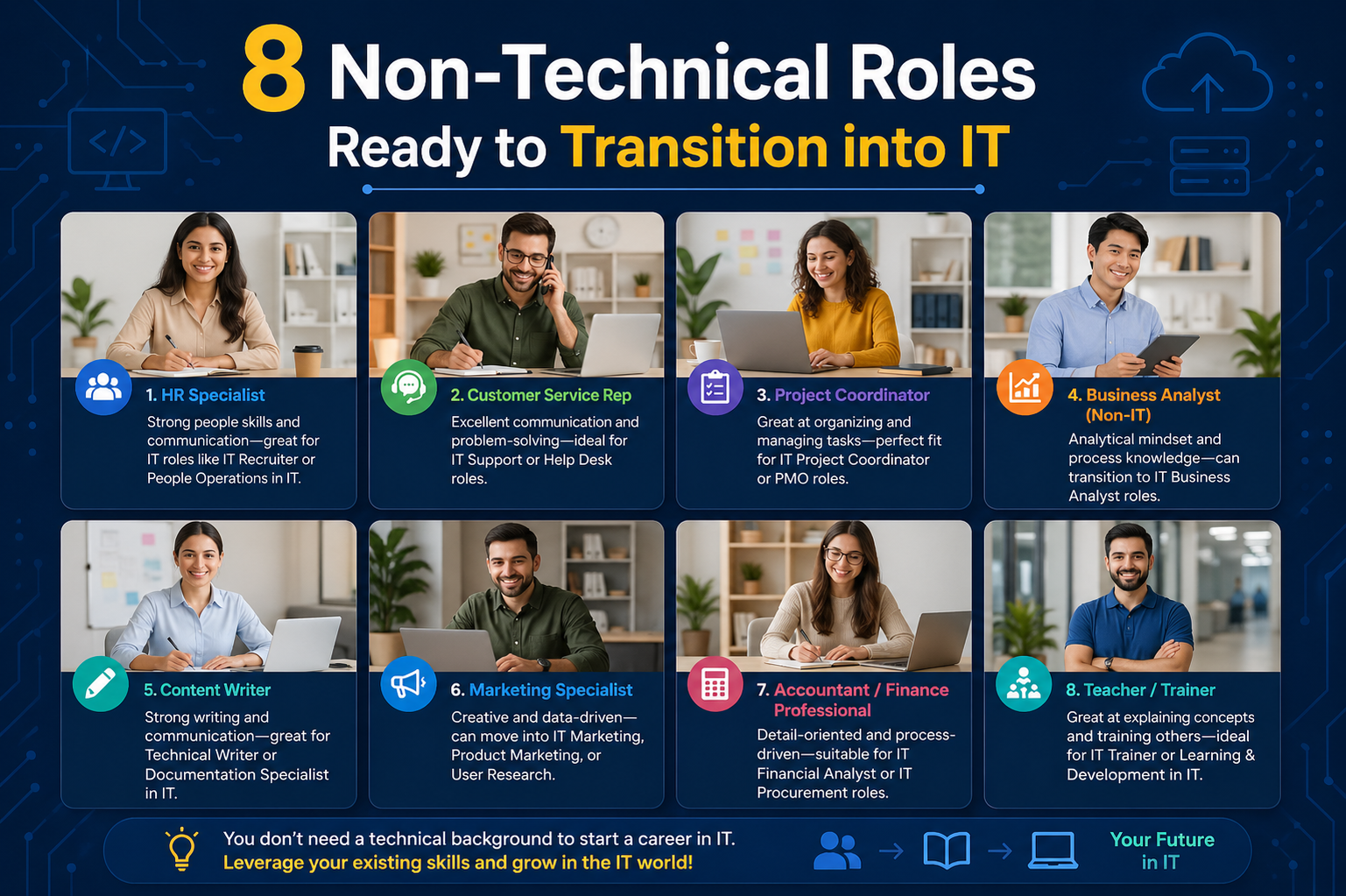
Technology has become one of the fastest-growing career sectors across the world, offering strong job security, excellent salaries, and long-term career growth. Over the past fifteen years, the digital economy has expanded much faster than many other industries, creating countless opportunities for professionals from different backgrounds. Fields like cybersecurity continue to face major talent shortages, with millions of positions remaining unfilled globally. At the same time, technology careers often provide flexible work environments, including remote opportunities, making them even more attractive for professionals seeking stability and better work-life balance.
With competitive salaries and increasing demand, many people are now considering a move into information technology. The good news is that transitioning into IT does not always require starting from zero or having a highly technical background. Many non-technical roles already develop valuable skills that align closely with the needs of the tech industry. Leadership, communication, problem-solving, strategic thinking, and customer relationship management are all highly transferable abilities that can help professionals successfully move into IT careers.
Understanding how to enter IT from a non-technical role starts with recognizing the strengths you already have. Some positions naturally provide more exposure to technology, making the transition smoother and faster. Professionals working in management, design, writing, training, or sales often find themselves closer to IT than they realize. By building on existing experience and intentionally learning technical concepts, they can successfully move into rewarding technology-focused roles.
Product Manager
Product managers are often at the center of product development, guiding products from the idea stage all the way to market success and beyond. Their role involves leading teams made up of both technical and non-technical professionals, including developers, engineers, customer support teams, marketing specialists, and sales staff. They are responsible for ensuring that a product meets business goals while also satisfying customer needs.
Most of a product manager’s daily responsibilities are rooted in business operations. They focus on budgeting, profit and loss analysis, forecasting, customer research, and strategic planning. However, they must also understand enough technical language to communicate effectively with developers and engineers. This regular exposure to software development processes, product lifecycles, and technical decision-making gives product managers a strong foundation for transitioning into IT.
Because they already work closely with technical teams, product managers often develop the confidence and vocabulary needed to step into more technology-focused positions. Their understanding of how products are built and maintained makes them excellent candidates for roles in IT management, systems planning, or even software operations.
Visual Designer
Visual designers work across many industries, making the role broad and highly adaptable. They may create digital graphics, website layouts, marketing materials, mobile app interfaces, branding assets, or even physical design concepts depending on their field. Their work focuses on creating visually appealing and user-friendly experiences that support business goals.
Although visual designers rely heavily on digital tools and software, their work is not always considered part of the technology field. However, their familiarity with design platforms and user behavior gives them a strong advantage when moving into tech. One of the most natural transitions for visual designers is into user experience design, where they focus on how users interact with websites, software, and mobile applications.
User experience design plays a major role in technology companies because usability directly affects customer satisfaction and product success. Designers who understand how to create intuitive digital experiences can move easily into tech teams, working closely with developers and product managers. From there, opportunities in software development environments and broader IT roles become much more accessible.
Operations Manager
Operations managers are responsible for keeping businesses running smoothly. They handle strategy, workflow management, team coordination, budgeting, and day-to-day problem-solving. Their role requires them to understand how different departments function together and how to improve efficiency across the organization.
In industries with little technology exposure, such as retail or hospitality, operations managers may not deal directly with advanced IT systems. However, the skills they develop are highly valuable in technology-driven environments. By moving into operations roles within tech companies or departments that rely heavily on digital systems, they gain direct exposure to IT processes and technical teams.
Operations managers in technology organizations often work with software systems, cybersecurity teams, technical support departments, and infrastructure planning. This constant interaction creates opportunities to learn about technology while still using familiar leadership and management skills. As they become more comfortable with technical workflows, transitioning fully into IT leadership or systems operations becomes a practical next step.
Account Manager
Account managers serve as the connection between a company and its clients, making sure customer relationships remain strong and business continues to grow. They focus on communication, problem-solving, customer satisfaction, and ensuring that client needs are met effectively. Strong interpersonal skills and the ability to manage complex relationships are essential in this role.
While account management is usually considered non-technical, professionals in this field often gain valuable exposure to technology—especially if they work for companies that provide software, digital services, or technical products. Understanding the details of the products they manage helps account managers perform better and creates a pathway into IT.
Even in companies that do not sell technical products, account managers can still benefit from learning about internal systems, customer platforms, and digital workflows. Becoming familiar with business technology tools strengthens both current performance and future career opportunities. This knowledge can support a move into IT support, systems coordination, customer success in tech companies, or technical account management roles.
Project Manager
Project managers and product managers are often confused, but their responsibilities differ significantly. A project manager focuses on specific initiatives that have clear start and end dates. Their role is to ensure that projects are completed on time, within budget, and according to defined goals. They coordinate teams, manage resources, solve obstacles, and track progress throughout the project lifecycle.
Because projects can vary widely, project managers often work on many different types of initiatives throughout their careers. This creates frequent opportunities to become involved in technology-related projects such as software implementation, infrastructure upgrades, cybersecurity planning, or digital transformation efforts.
By intentionally seeking out projects connected to technology, project managers can build relevant IT experience without changing roles immediately. Managing technical teams and learning the language of software development or IT systems helps create a strong bridge into technology careers. Their existing leadership and planning abilities make them especially valuable in IT operations, technology consulting, and systems implementation roles.
Technical Writer
Technical writers create user manuals, product documentation, guides, and instructional content for complex products and services. Their job is to take detailed technical information and translate it into clear, understandable language for users. This requires strong writing ability, attention to detail, and the capacity to understand specialized subjects quickly.
Interestingly, many technical writers do not begin with formal IT training. In fact, some companies prefer writers without deep technical backgrounds because they can explain concepts more clearly to everyday users. This creates a strong opportunity for professionals who want to use writing as a pathway into technology.
By working closely with engineers, developers, and technical teams, writers gain firsthand exposure to how products function. Taking on more complex assignments allows them to deepen their technical understanding while building valuable knowledge. Over time, this can lead to transitions into business analysis, product documentation management, software support, or other IT-related roles where communication and technical understanding are equally important.
IT Trainer
Many technology companies rely on trainers to teach employees, customers, or users how to work with software systems and digital platforms. These professionals focus on helping people understand workflows, user interfaces, and practical usage rather than the deeper technical architecture behind the systems.
Because training emphasizes communication and teaching ability, many IT trainers come from education or instructional backgrounds rather than technical fields. However, their close relationship with products and direct interaction with users gives them unique access to the technology world.
When users encounter problems, trainers often see firsthand how systems fail or where confusion happens. Instead of simply passing issues to technical support, trainers who investigate these problems can build strong technical knowledge. This hands-on exposure helps them understand how systems work behind the scenes and opens the door to roles in support, system administration, or broader IT operations.
Their strength in simplifying complex ideas also remains valuable even after transitioning, making them strong contributors in technical support and user-focused technology teams.
Sales Professional
Sales professionals succeed because of their ability to understand customer needs, build trust, and communicate value effectively. While technical knowledge may not always be required, understanding the products being sold can significantly improve performance—especially in industries connected to technology.
Selling software, digital services, cybersecurity solutions, or IT products creates a natural pathway into the tech industry. The more a salesperson learns about the technical details of what they are offering, the stronger both their sales performance and career flexibility become.
Sales skills are highly transferable, and professionals who move into technology sales often gain direct access to technical teams, product specialists, and customer support departments. This exposure helps them understand systems, processes, and customer challenges from a technical perspective.
By actively learning how products work rather than focusing only on closing deals, sales professionals can position themselves for roles in technical consulting, solutions engineering, customer success, or IT account management. The move from sales into IT can be surprisingly smooth for those willing to invest in technical learning.
Building an IT Career from Any Background
The most important lesson in transitioning to IT is that career growth often begins where you already are. Many professionals assume they need a computer science degree or years of technical experience to enter the field, but that is not always true. The technology industry values practical skills, adaptability, and the ability to solve real business problems.
Whether someone works in writing, management, design, teaching, or customer relations, there are opportunities to move closer to technology by becoming more involved in systems, software, and digital processes within their current role. Curiosity and consistent learning often matter more than job titles.
The key is to identify how your current responsibilities connect to technology and then intentionally strengthen that connection. Learn the tools your company uses, ask questions, take on technical projects, and seek collaboration with IT teams whenever possible. Small steps create strong momentum over time.
A successful transition into IT is rarely about starting over completely. More often, it is about recognizing the value of your existing experience and using it as a foundation for something bigger. With the right mindset and willingness to grow, professionals from almost any non-technical role can build a successful and rewarding future in information technology.
Building Transferable Skills for IT Success
Moving into information technology is not only about changing job titles—it is also about recognizing the value of the skills you already use every day. Many professionals underestimate how important communication, leadership, organization, and critical thinking are in the technology world. While technical knowledge is necessary, companies also rely heavily on people who can manage teams, solve business problems, and translate complex ideas into practical solutions.
Transferable skills make career transitions much smoother because they reduce the need to start from the beginning. For example, someone with strong customer service experience already understands how to identify user problems and provide solutions, which is highly valuable in technical support roles. Similarly, professionals who have experience managing deadlines, coordinating teams, or handling budgets can move naturally into IT operations and project-based roles.
The most successful career transitions happen when professionals combine their existing strengths with new technical learning. Instead of trying to become an expert in everything at once, focusing on practical skills related to your current role creates faster and more sustainable progress.
Learning Basic Technical Foundations
Even if your role is non-technical, building a basic understanding of IT concepts is extremely important. You do not need to become a software engineer overnight, but learning the fundamentals of how systems work can make a major difference. Understanding topics like networking, cybersecurity, cloud computing, software development processes, and data management helps professionals communicate more effectively with technical teams.
Learning these foundations can begin with simple steps such as online courses, certifications, internal company training, or self-study. Entry-level certifications in areas like IT support, cybersecurity awareness, or project management can strengthen your credibility and show employers that you are serious about the transition.
The goal is not perfection—it is familiarity. Once you understand the language of IT, conversations become easier, confidence grows, and opportunities become more visible. Employers often value someone who can learn quickly and apply knowledge practically more than someone with only theoretical expertise.
Networking with IT Professionals
Career growth in technology often depends on relationships just as much as skills. Building connections with IT professionals can provide valuable insights, mentorship, and direct opportunities that are difficult to find through job applications alone. Many people successfully transition into tech because they learned from someone already working in the field.
Start by connecting with colleagues in your own organization. Ask questions about their work, volunteer for cross-functional projects, and show genuine interest in understanding technical processes. This internal exposure is often the easiest and most powerful way to begin.
Professional communities, industry events, webinars, and online groups can also help expand your network. Listening to how others entered the field can provide clarity and inspiration. Often, the best career advice comes from professionals who made the same transition themselves and understand the challenges involved.
Networking is not only about finding jobs—it is about learning how the industry works and discovering where your existing experience fits best.
Using Certifications to Strengthen Your Position
Certifications can be a strong bridge between non-technical experience and IT career opportunities. They provide proof of learning and help employers see potential beyond traditional technical backgrounds. For someone changing industries, certifications often serve as evidence of commitment and readiness.
Depending on your career goals, certifications in project management, cybersecurity fundamentals, cloud platforms, data analysis, or technical support can be highly valuable. These credentials help structure your learning and make your resume more competitive, especially when applying for entry-level or transition-focused roles.
However, certifications should support real understanding rather than replace it. Employers are increasingly looking for practical problem-solving ability, not just completed courses. Combining certification study with hands-on practice, small projects, or workplace application creates much stronger results.
Choosing the right certification matters more than collecting many of them. Focus on the one that aligns most closely with your target role and use it as a stepping stone for future growth.
Gaining Experience Without Changing Jobs Immediately
One of the smartest ways to move into IT is by building experience before officially changing roles. Many professionals think they must leave their current job immediately, but often the best opportunities exist inside their existing workplace. Internal transitions are usually faster because your employer already knows your work ethic, reliability, and business understanding.
Look for chances to participate in software rollouts, digital transformation projects, reporting systems, customer platforms, or technical training programs. Volunteer to support system improvements or help document technical workflows. Even small responsibilities related to IT can become valuable experience when presented correctly.
For example, helping implement a new CRM system may demonstrate systems knowledge and project coordination. Supporting software training can show technical communication ability. Managing data reports may reveal analytical skills relevant to technology roles.
These experiences strengthen your professional story and make interviews much easier because you can show real examples instead of only theoretical interest.
Overcoming Fear of Starting Late
Many professionals delay moving into IT because they feel they are too late to change careers. This fear is common, especially for people who have spent years building experience in another field. However, technology values problem-solving and adaptability more than age or traditional career paths.
In fact, professionals entering IT later often have advantages that younger candidates do not. They bring maturity, business understanding, leadership experience, and stronger communication skills. These qualities are often difficult to teach and highly valuable in real workplace environments.
A person moving from operations, customer service, education, or management into technology brings practical business awareness that pure technical candidates may lack. This combination can make them exceptionally effective in leadership, support, and cross-functional roles.
The idea of “starting over” is often misleading. You are not erasing your previous career—you are building on it. Every role you have held contributes something useful to your future in IT.
Choosing the Right IT Path
Information technology is a broad field, and not every role requires the same skills or interests. Some people thrive in cybersecurity because they enjoy solving risks and protecting systems. Others prefer project management because they enjoy planning and coordination. Some are drawn to UX design because of creativity and user-focused thinking.
Choosing the right path depends on understanding both your strengths and your interests. Someone with strong writing skills may fit well in documentation or business analysis. A former teacher may succeed in training, onboarding, or support. A salesperson may excel in technical consulting or client-facing software solutions.
Instead of chasing the highest salary or the most popular job title, focus on where your current abilities naturally connect. Long-term success usually comes from alignment, not trend-following. When your strengths match your work, learning becomes faster and performance becomes stronger.
Exploring different paths before making a final decision helps avoid frustration and creates a more sustainable career move.
The Importance of Continuous Learning
Technology changes quickly, and one of the most important habits for long-term success is continuous learning. Entering IT is only the beginning. New systems, tools, and security challenges emerge constantly, which means professionals must stay curious and adaptable throughout their careers.
This does not mean constant pressure to study endlessly. It means developing a mindset of improvement—asking questions, exploring new tools, and staying open to change. Professionals who remain flexible are often the ones who grow the fastest.
Learning can happen through formal education, workplace experience, mentorship, or simple observation. Sometimes the most valuable lessons come from solving unexpected problems in real situations. Staying engaged with the industry keeps your skills relevant and your confidence strong.
The willingness to learn often matters more than current expertise. Employers know technology evolves, and they look for people who can evolve with it.
Creating a Strong Personal Career Strategy
A successful move into IT requires intention. Random effort often creates frustration, while a clear strategy creates progress. Start by identifying your target role, understanding the required skills, and comparing them to your current experience. This helps you focus your learning instead of wasting time on unnecessary areas.
Update your resume to reflect transferable skills using language relevant to technology roles. Highlight problem-solving, systems exposure, cross-functional collaboration, and any technical projects you have supported. Your experience may already be more relevant than you think—it simply needs stronger positioning.
Set realistic goals with timelines. For example, complete one certification in three months, join one internal technology project, or connect with two IT professionals each month. Small consistent actions create stronger results than waiting for the perfect opportunity.
Career transitions succeed through momentum, not perfection. Progress matters more than speed.
Turning Opportunity into a New Future
Technology is not reserved only for programmers or engineers. It is a field built by teams of people with different strengths, backgrounds, and perspectives. Every business problem solved through technology still requires leadership, communication, planning, creativity, and human understanding.
This is why so many non-technical professionals successfully move into IT. They bring the business perspective that makes technology useful and practical. Their ability to connect people, processes, and systems often becomes their greatest advantage.
The journey may require patience, learning, and confidence, but it is absolutely possible. Whether you come from management, design, writing, teaching, sales, or customer service, your experience has value in the technology world.
The key is to stop viewing yourself as outside the industry and start recognizing how close you already are. Sometimes the path into IT is not a dramatic leap—it is simply the next step forward in the work you are already doing.
reating Long-Term Growth After Entering IT
Successfully transitioning into information technology is only the beginning of the journey. Once you enter the field, the next challenge is building long-term career growth and creating a path that leads to stability, leadership, and professional satisfaction. Many people focus only on getting their first IT role, but true success comes from understanding how to grow after that first opportunity.
The technology industry rewards people who stay adaptable and continue improving their skills. Unlike some professions where responsibilities remain mostly the same for years, IT changes rapidly. New tools, new threats, and new business needs constantly reshape the workplace. Professionals who stay curious and flexible are often the ones who move ahead the fastest.
Growth in IT is not always about becoming more technical. In many cases, leadership, strategic thinking, and business understanding become even more important as careers advance. This is where professionals from non-technical backgrounds often gain a major advantage because they already understand how organizations operate beyond the technical side.
Building Confidence in Technical Environments
One of the biggest challenges for people entering IT from non-technical roles is confidence. Many professionals feel surrounded by people with stronger technical backgrounds and begin to doubt whether they truly belong in the field. This feeling is common, but it should not be confused with a lack of ability.
Confidence grows through experience, not perfection. No one enters IT knowing everything, and even experienced professionals continue learning throughout their careers. The goal is not to compete with experts immediately but to consistently improve your understanding and contribution.
Asking questions, seeking feedback, and being willing to learn openly often creates stronger professional relationships than pretending to know everything. Employers value reliability, communication, and problem-solving just as much as technical skill. Confidence comes from recognizing that your value is not limited to coding or system administration—it includes how you think, lead, and solve business challenges.
The more you participate in projects and decision-making, the stronger your confidence becomes. Over time, the unfamiliar becomes normal, and what once felt intimidating becomes part of your professional strength.
Finding Mentors and Career Guidance
Mentorship can significantly accelerate success in IT. A good mentor helps you avoid common mistakes, understand industry expectations, and make smarter career decisions. They provide perspective that often cannot be learned from courses or certifications alone.
Mentors do not always need to be formal supervisors. Sometimes the best guidance comes from experienced colleagues, project leaders, or professionals in your network who are willing to share honest advice. Their insight can help you understand which skills matter most, which opportunities to pursue, and how to position yourself for advancement.
For professionals transitioning from non-technical roles, mentors can also provide reassurance during periods of uncertainty. They remind you that career growth is a process and that progress takes time. Their support can make difficult transitions feel more manageable.
Strong mentorship relationships are built through genuine curiosity and professional respect. Asking thoughtful questions and showing commitment to learning often opens the door to meaningful guidance.
Improving Communication as a Competitive Advantage
In technology, communication is often underestimated. Many people assume technical skill alone determines success, but the ability to explain problems clearly, work across teams, and translate technical information into business language is often what separates average professionals from exceptional ones.
Companies need people who can connect technical teams with leadership, customers, and operational departments. Miscommunication creates delays, confusion, and costly mistakes. Professionals who can simplify complexity become extremely valuable because they improve both productivity and decision-making.
This is another area where non-technical professionals often excel. Their experience in management, customer service, writing, training, or account handling gives them strong communication habits that many purely technical professionals may still be developing.
Being able to explain a system issue to executives, guide customers through technical challenges, or align project teams around clear goals creates real business impact. In many cases, communication becomes the reason someone is promoted into leadership roles within IT.
Understanding Business Value in Technology
Technology exists to solve business problems. This principle is critical for long-term success because professionals who understand business value become far more effective than those who focus only on technical tasks.
For example, implementing software is not valuable simply because it is modern—it must improve efficiency, reduce costs, increase security, or support growth. Cybersecurity is not only about preventing attacks—it protects revenue, trust, and operations. Data analysis matters because it improves decisions, not just because reports look impressive.
Professionals who come from non-technical backgrounds often understand this naturally because they have worked directly with operations, sales, finance, or customer service. They know how decisions affect the broader business, which helps them approach technology with practical purpose.
This perspective becomes especially powerful in management roles. Leaders who understand both technology and business strategy are often the ones trusted with major decisions and long-term planning.
Developing Leadership Opportunities
Leadership in IT is not limited to management titles. It begins with ownership, reliability, and the ability to guide solutions even without formal authority. People who consistently solve problems, support teams, and improve processes naturally become leaders over time.
For professionals transitioning from non-technical roles, leadership is often one of the strongest assets they bring. Experience managing people, resolving conflicts, handling pressure, and making decisions translates directly into IT environments.
Leadership can start with small actions—taking responsibility for a process improvement, helping onboard new team members, or leading part of a project. These moments build trust and visibility. As credibility grows, opportunities for formal advancement become much stronger.
Technology companies increasingly look for leaders who can manage both systems and people. Technical knowledge matters, but emotional intelligence, strategic thinking, and decision-making often determine who moves into senior roles.
Strong leadership is not about having all the answers. It is about creating clarity, supporting progress, and helping teams succeed under pressure.
Avoiding Common Transition Mistakes
Many career transitions fail not because people lack ability, but because they approach the process with unrealistic expectations. One common mistake is expecting immediate results. Moving into IT takes time, and frustration often comes from comparing your beginning to someone else’s years of experience.
Another mistake is focusing too much on titles instead of skills. Chasing job names without understanding responsibilities can lead to poor decisions. It is better to build the right experience first and let titles follow naturally.
Some professionals also rely too heavily on certifications without gaining practical exposure. While credentials are helpful, real workplace application matters far more during interviews and promotions. Employers want proof that you can solve problems, not just pass exams.
Finally, many people underestimate the importance of patience. Career transitions are rarely linear. Some opportunities may feel like small steps sideways rather than big moves forward, but those smaller roles often create the strongest long-term foundation.
Understanding these challenges early helps create more realistic expectations and stronger results.
Creating Personal Brand and Professional Visibility
In modern careers, professional visibility matters. Doing good work is essential, but people also need to understand the value you bring. Building a strong professional reputation helps create trust, opens opportunities, and strengthens career mobility.
This does not mean self-promotion without substance. It means clearly communicating your strengths, contributions, and growth. Sharing successful projects, participating in internal discussions, supporting team improvements, and maintaining strong professional relationships all contribute to your personal brand.
For career changers, visibility is especially important because people may still associate them with previous roles. Demonstrating your new skills and commitment helps others begin to see you differently. Consistency builds credibility.
Your reputation becomes your professional currency. People remember those who solve problems, stay reliable under pressure, and contribute positively to team success.
In IT, trust often leads to opportunity long before formal applications begin.
Balancing Technical Skills with Human Skills
The strongest professionals in technology are rarely the ones who know the most code—they are often the ones who balance technical ability with human understanding. Systems are built for people, businesses are run by people, and leadership depends on people.
Human skills such as empathy, listening, negotiation, adaptability, and collaboration remain essential in every stage of an IT career. Technical excellence without communication often creates friction, while strong relationships combined with technical understanding create long-term influence.
Professionals from non-technical backgrounds often enter IT with these human skills already well developed. Instead of viewing this as secondary, they should recognize it as a major competitive advantage. Many organizations actively seek this balance because technology must work within real business environments, not in isolation.
Success comes from being both capable and trusted. Skills may get you hired, but relationships often determine how far you grow.
Building a Career with Purpose
The best technology careers are not built only around salary or job titles. They are built around purpose—understanding how your work creates value and contributes to something meaningful. Whether you are improving security, helping customers, supporting teams, or building better systems, purpose creates motivation that lasts longer than short-term rewards.
Professionals who move into IT from other industries often appreciate this deeply because they understand what it means to seek better alignment in their careers. They are not simply chasing trends; they are looking for stability, growth, and work that feels valuable.
Purpose also helps during difficult moments. Every career includes setbacks, challenging projects, and periods of uncertainty. When your work connects to a bigger reason, persistence becomes easier.
Technology offers enormous opportunity, but long-term success comes from building a career that fits both your strengths and your values.
The Future Belongs to Adaptable Professionals
The future of work will continue to be shaped by technology, and professionals who can adapt across industries will remain in high demand. The lines between technical and non-technical roles are becoming smaller as every business becomes more digital.
This means the question is no longer whether non-technical professionals can succeed in IT—it is how quickly they choose to begin. The experience gained in management, communication, operations, design, writing, and customer service is not separate from technology. It is part of what makes technology successful.
The most valuable professionals are often those who can bridge both worlds. They understand systems, but they also understand people. They can solve technical problems while keeping business goals in focus.
For anyone considering the move, the opportunity is real. IT is not reserved for a select few—it is a field open to those willing to learn, contribute, and grow. The path may begin with one small decision, but it can lead to an entirely new future filled with possibility, purpose, and lasting professional success.
Conclusion
Transitioning into information technology from a non-technical role is no longer an unusual career move—it has become a practical and achievable path for professionals across many industries. As technology continues to shape every part of business and daily life, companies increasingly need people who can combine technical understanding with strong communication, leadership, problem-solving, and strategic thinking. This creates valuable opportunities for individuals whose backgrounds may not be traditionally technical but whose skills are highly relevant.
Roles such as product managers, project managers, operations managers, visual designers, account managers, technical writers, trainers, and sales professionals already develop many of the core abilities needed to succeed in IT. These professionals often work closely with systems, software, customers, and cross-functional teams, making the transition smoother than many people expect. Instead of starting from the beginning, they can build on their existing experience and gradually strengthen their technical knowledge.
Success in this transition depends on recognizing transferable skills, learning technical foundations, gaining practical exposure, and staying committed to continuous growth. Certifications, mentorship, networking, and workplace projects all help create stronger career opportunities. Most importantly, professionals must understand that moving into IT is not about abandoning their previous experience—it is about using that experience as a foundation for something bigger.
Long-term success in IT also requires confidence, adaptability, and the ability to connect technology with business value. The professionals who grow the fastest are often those who can work across both technical and human environments. Leadership, communication, and purpose remain just as important as technical expertise, especially as careers advance.
Ultimately, information technology is not limited to programmers or engineers. It is a field built by diverse professionals who bring different strengths and perspectives. Anyone willing to learn, stay curious, and take intentional steps forward can build a successful future in IT. The journey may begin in a non-technical role, but with the right mindset and strategy, it can lead to a rewarding and lasting career in one of the world’s most important industries.