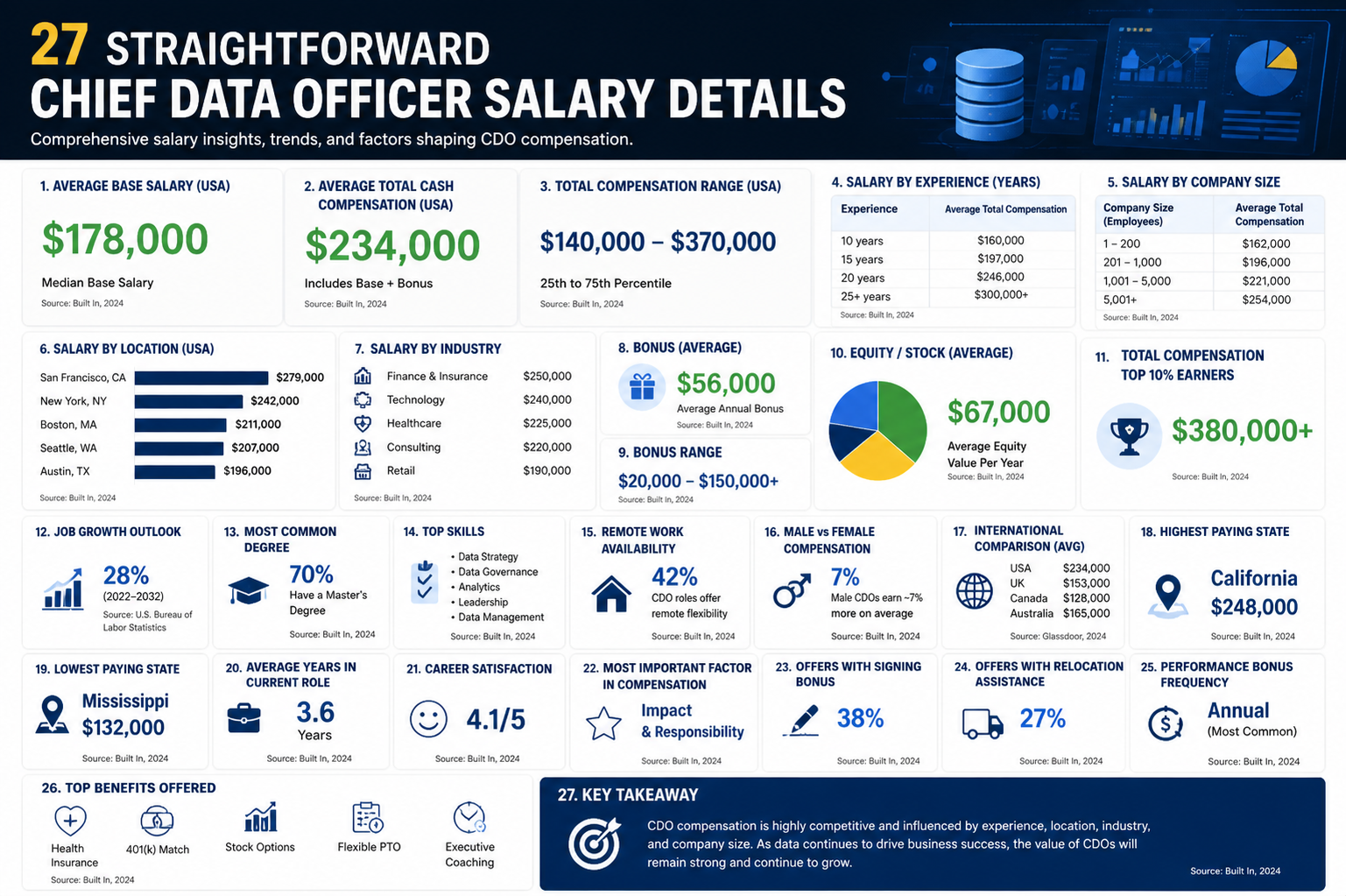
Chief Data Officer compensation is not a single fixed number but a structured package that reflects senior leadership responsibility, technical expertise, and strategic decision-making authority. In most organizations, total earnings are built from multiple components rather than a single salary figure. The base salary forms the foundation, while bonuses, equity, and long-term incentives significantly increase total annual compensation.
At its core, the base salary is determined by organizational size, industry maturity, and the complexity of the data ecosystem being managed. However, the real financial value of a CDO role often lies in variable pay and performance-based rewards. These are tied to measurable outcomes such as data-driven revenue growth, operational efficiency improvements, and successful implementation of enterprise data strategies.
In large enterprises, compensation structures are highly formalized. A significant portion of earnings is linked to long-term performance incentives, ensuring alignment between executive decisions and organizational success. This makes the role financially rewarding but also performance-intensive, as expectations are closely tied to business outcomes.
Core Responsibilities That Influence Salary Levels
The salary of a Chief Data Officer is closely connected to the scope of responsibilities assigned to the role. A CDO is responsible for overseeing an organization’s entire data lifecycle, including collection, governance, storage, security, and utilization. The broader and more complex these responsibilities become, the higher the compensation tends to be.
In many organizations, the CDO also plays a key role in shaping digital transformation strategies. This includes integrating artificial intelligence, machine learning, and advanced analytics into business operations. As companies become more data-dependent, the strategic importance of this role increases, directly impacting salary growth.
Another major responsibility involves data governance and compliance. With increasing global regulations around data privacy and security, organizations rely heavily on CDOs to ensure legal and ethical handling of data. This responsibility carries significant accountability, which is reflected in higher compensation packages.
Experience and Career Progression Impact on Earnings
Experience plays a major role in determining Chief Data Officer salaries. Early-stage CDOs or professionals transitioning into the role from senior data leadership positions may earn comparatively lower compensation than highly experienced executives.
As professionals progress, their ability to manage large-scale data ecosystems improves, along with their strategic influence within the organization. Mid-career CDOs typically oversee cross-functional teams and are responsible for aligning data strategy with business objectives. This expanded influence leads to a noticeable increase in compensation.
At the senior level, CDOs often become part of executive leadership teams, participating in board-level decisions and shaping overall corporate strategy. At this stage, compensation reaches its peak due to the combination of leadership responsibility, technical oversight, and business impact.
Industry-Based Salary Differences
Industry plays one of the most significant roles in determining CDO salaries. Different sectors assign varying levels of importance to data leadership, which directly influences compensation structures.
In the financial sector, Chief Data Officers are among the highest paid due to the critical importance of data in risk management, fraud detection, and regulatory compliance. Financial institutions rely heavily on accurate and secure data systems, making the CDO role essential to operations.
In the healthcare industry, salaries are also competitive due to the sensitive nature of patient data and strict compliance requirements. CDOs in this sector are responsible for managing complex data systems while ensuring privacy and regulatory adherence.
Technology companies offer highly competitive compensation packages, often including stock options and equity-based incentives. Since data is central to product innovation and user experience, CDOs in this sector play a highly strategic role.
Manufacturing, retail, and logistics industries are increasingly investing in data leadership roles, but compensation levels may vary depending on digital maturity and data adoption strategies.
Company Size and Organizational Complexity
The size of an organization significantly affects Chief Data Officer salaries. Large multinational corporations typically offer higher compensation due to the scale and complexity of their data environments. These organizations operate across multiple regions, manage vast datasets, and require advanced data governance frameworks.
In such environments, CDOs are responsible for coordinating global data strategies, ensuring consistency across departments, and managing large teams of data professionals. This level of responsibility naturally leads to higher compensation.
In contrast, smaller companies or startups may offer lower base salaries but compensate with equity stakes or growth-based incentives. While immediate earnings may be lower, long-term financial benefits can be substantial if the company grows successfully.
Geographic and Regional Salary Variations
Geographic location is another important factor influencing Chief Data Officer salaries. In developed economies, particularly in major business hubs, compensation tends to be significantly higher due to demand for experienced data leaders.
In regions with advanced digital infrastructure and strong enterprise ecosystems, organizations compete aggressively for top-tier talent. This competition drives salary levels upward, especially in industries heavily dependent on data analytics.
In emerging markets, salaries may be comparatively lower, but they are steadily increasing as digital transformation accelerates. As more organizations adopt data-driven strategies, the demand for skilled CDOs continues to grow globally.
Cost of living also plays a role in salary structuring. Companies in high-cost regions typically offer higher compensation packages to attract and retain talent.
Education, Skills, and Certifications Influence
Educational background and technical expertise significantly impact Chief Data Officer earnings. Professionals with advanced degrees in data science, computer science, business analytics, or information systems often command higher salaries.
However, formal education alone is not the only determining factor. Practical experience in managing enterprise data systems and leading large teams is equally important. Employers value a combination of technical knowledge and leadership capability.
Certifications in cloud computing, data governance, artificial intelligence, and cybersecurity can also enhance earning potential. These certifications demonstrate specialized expertise, which is highly valued in modern data-driven organizations.
Strong communication and strategic thinking skills further increase compensation potential, as CDOs must bridge the gap between technical teams and executive leadership.
Bonuses, Incentives, and Long-Term Compensation
A significant portion of Chief Data Officer compensation comes from performance-based bonuses and long-term incentives. These are designed to align executive performance with organizational success.
Annual bonuses are typically tied to key performance indicators such as data strategy execution, cost optimization, and business growth impact. In some organizations, bonuses can represent a substantial percentage of total compensation.
Long-term incentives, including stock options and equity grants, are especially common in technology companies and startups. These incentives encourage CDOs to focus on long-term value creation rather than short-term results.
Over time, these additional components can significantly increase total earnings, sometimes surpassing the base salary by a large margin.
Demand Trends and Market Growth for Chief Data Officers
The demand for Chief Data Officers has grown rapidly in recent years as organizations increasingly rely on data-driven decision-making. Businesses across all industries are investing in data leadership roles to improve competitiveness and operational efficiency.
This rising demand has led to a steady increase in salary levels, particularly for experienced professionals with proven leadership capabilities. As organizations continue to adopt advanced analytics, artificial intelligence, and automation technologies, the role of the CDO is expected to become even more critical.
The growing importance of data privacy and regulatory compliance has also contributed to increased demand. Organizations require strong leadership to navigate complex legal requirements and ensure responsible data usage.
Future Outlook for Chief Data Officer Salaries
The future outlook for Chief Data Officer compensation remains strong. As data continues to play a central role in business strategy, the value of experienced data leaders is expected to rise further.
Organizations are increasingly viewing data as a core asset, similar to financial or operational resources. This shift is elevating the importance of the CDO role within executive leadership structures.
With continued advancements in artificial intelligence, machine learning, and big data technologies, the complexity of data environments will increase. This will require even more skilled leadership, further driving salary growth.
In the long term, Chief Data Officer roles are expected to evolve into even more strategic positions, potentially integrating closely with Chief Technology Officers or Chief Digital Officers in some organizations. This evolution is likely to enhance both responsibility and compensation levels significantly.
Advanced Compensation Structures in Large Enterprises
In large multinational organizations, Chief Data Officer compensation is designed to reflect both strategic importance and organizational scale. These roles are not limited to managing internal data systems but extend to shaping global data ecosystems. As a result, compensation packages are structured with multiple layers to reward both immediate performance and long-term impact.
Base salary in such organizations is typically complemented by annual performance bonuses that are tied to enterprise-wide objectives. These objectives often include revenue growth driven by data insights, operational efficiency improvements, and successful execution of digital transformation initiatives. Because the CDO is directly involved in these outcomes, their compensation is closely aligned with business performance.
Long-term incentives are a defining feature of executive compensation at this level. Stock options, restricted stock units, and performance shares are commonly included. These instruments are designed to retain top talent while ensuring that leadership decisions contribute to sustainable company growth over several years.
Strategic Influence and Its Impact on Earnings
The Chief Data Officer role has evolved from a technical leadership position into a strategic executive function. This shift has significantly influenced compensation trends. In modern organizations, CDOs are expected to contribute to board-level decisions, particularly those related to digital transformation, innovation strategy, and risk management.
As strategic influence increases, so does financial compensation. Executives who actively shape business models through data-driven insights are rewarded at higher levels. Their ability to translate complex data into actionable business strategies makes them essential to organizational success.
In many cases, the CDO collaborates closely with other C-suite executives such as the Chief Executive Officer, Chief Technology Officer, and Chief Financial Officer. This level of integration into leadership decision-making further elevates the importance of the role and justifies higher compensation packages.
Impact of Data Maturity on Salary Levels
An organization’s level of data maturity plays a crucial role in determining Chief Data Officer compensation. Companies with highly advanced data ecosystems require more experienced leaders capable of managing complex architectures and sophisticated analytics systems.
In mature data organizations, the CDO is responsible for optimizing existing systems, integrating advanced technologies, and ensuring continuous innovation. These responsibilities demand deep technical knowledge and strong leadership skills, which are reflected in higher salaries.
On the other hand, organizations in earlier stages of data maturity often focus on foundational data infrastructure development. In such environments, the CDO’s role is more implementation-focused, which may result in comparatively lower compensation but offers significant growth potential over time.
Role of Artificial Intelligence and Emerging Technologies
The increasing adoption of artificial intelligence and machine learning has significantly impacted the responsibilities of Chief Data Officers. These technologies require advanced data governance frameworks, ethical oversight, and robust data pipelines, all of which fall under the CDO’s domain.
As organizations invest heavily in AI-driven decision-making systems, the demand for skilled data leaders has increased. This demand directly influences salary levels, as companies compete to attract professionals capable of managing complex AI ecosystems.
CDOs who possess expertise in AI strategy, predictive analytics, and automation technologies are often compensated at a premium. Their ability to integrate emerging technologies into business operations adds measurable value to organizations.
Risk Management and Compliance Responsibilities
One of the most critical aspects of the Chief Data Officer role is managing data-related risks. This includes ensuring compliance with international data protection laws, preventing data breaches, and maintaining data integrity across systems.
As regulatory frameworks become more complex globally, organizations rely heavily on CDOs to navigate compliance challenges. This responsibility carries significant accountability, especially in industries such as finance, healthcare, and telecommunications.
Because of the high level of risk associated with data governance failures, organizations are willing to offer higher compensation to experienced CDOs who can ensure regulatory compliance and minimize potential liabilities.
Leadership Team Integration and Organizational Impact
The Chief Data Officer is typically part of the executive leadership team, contributing to high-level strategic planning and decision-making. This integration into leadership structures significantly enhances the value of the role.
CDOs often lead cross-functional teams that include data engineers, analysts, scientists, and governance specialists. Managing such diverse teams requires strong leadership capabilities, which are reflected in compensation structures.
Their influence extends beyond data management, impacting product development, customer experience, and overall business strategy. This broad organizational impact justifies the executive-level compensation associated with the role.
Equity Growth and Wealth Accumulation Potential
One of the most significant financial advantages of the Chief Data Officer role is the potential for wealth accumulation through equity-based compensation. In many organizations, particularly in the technology sector, equity grants form a substantial portion of total earnings.
As companies grow and their market value increases, the value of these equity holdings can rise significantly. This creates long-term financial benefits that often exceed base salary over time.
For CDOs in high-growth companies, equity compensation can become a major wealth-building component, especially when tied to successful IPOs or acquisitions.
Market Competition and Talent Demand Dynamics
The demand for experienced Chief Data Officers continues to outpace supply in many regions. This imbalance has created a competitive job market where organizations must offer attractive compensation packages to secure top talent.
Companies are increasingly willing to offer higher salaries, flexible compensation structures, and additional benefits to attract skilled data leaders. This competitive environment has contributed to consistent salary growth across industries.
As digital transformation accelerates globally, the need for experienced CDOs is expected to remain strong, further driving competition and compensation levels upward.
Impact of Organizational Digital Strategy
An organization’s digital strategy directly influences the responsibilities and compensation of the Chief Data Officer. Companies that prioritize data-driven decision-making assign greater strategic importance to the CDO role.
In digitally advanced organizations, the CDO is responsible for aligning data strategy with business transformation goals. This includes enabling automation, improving customer personalization, and enhancing operational efficiency.
Because of this strategic alignment, compensation packages in digitally mature organizations tend to be significantly higher compared to traditional businesses with limited digital integration.
Globalization and Cross-Border Data Management
As businesses expand globally, managing cross-border data becomes increasingly complex. Chief Data Officers in multinational organizations are responsible for ensuring consistent data governance across multiple jurisdictions.
This includes navigating varying data protection laws, cultural differences in data usage, and regional compliance requirements. The complexity of global data management significantly increases the value of the CDO role.
Executives capable of managing international data ecosystems are often compensated at higher levels due to the expanded scope of responsibility.
Performance Metrics and Evaluation Systems
Chief Data Officer compensation is often tied to clearly defined performance metrics. These metrics may include data quality improvements, system efficiency gains, cost reductions, and successful implementation of data initiatives.
Organizations use these metrics to evaluate executive performance and determine bonus payouts and long-term incentives. The ability to meet or exceed these targets has a direct impact on total compensation.
In some organizations, performance evaluation also includes qualitative factors such as leadership effectiveness, innovation contribution, and cross-departmental collaboration.
Evolving Nature of the Chief Data Officer Role
The Chief Data Officer role continues to evolve as data becomes more central to business operations. Initially focused on data governance and reporting, the role has expanded into strategic leadership, technology integration, and business transformation.
This evolution has led to increased expectations and, consequently, higher compensation levels. As organizations continue to rely on data for competitive advantage, the importance of the CDO role is expected to grow further.
The expanding scope of responsibilities ensures that Chief Data Officers remain among the most highly compensated executives in modern organizations.
Executive Leadership Expectations and Salary Alignment
The Chief Data Officer role sits at the intersection of technology, business strategy, and executive leadership. As organizations become more data-driven, expectations for this position continue to expand. This evolution directly influences compensation, as companies align pay structures with the strategic value delivered by the role.
CDOs are no longer viewed solely as data custodians. Instead, they are expected to act as strategic advisors who shape business direction through data insights. This includes influencing revenue strategy, improving customer experience, and identifying new market opportunities. The broader the impact, the higher the compensation tends to be.
In executive leadership settings, compensation is often benchmarked against peer roles such as Chief Technology Officers and Chief Information Officers. However, in data-centric organizations, the CDO is increasingly positioned at a similar or even higher compensation level due to the critical importance of data strategy.
Data Governance Complexity and Financial Value
One of the most significant factors affecting Chief Data Officer compensation is the complexity of data governance within an organization. Large enterprises typically operate across multiple systems, platforms, and regulatory environments, making data governance a highly complex task.
CDOs are responsible for ensuring that data is accurate, secure, accessible, and compliant with regulations. This requires the implementation of robust governance frameworks, monitoring systems, and quality control processes. The more complex the data environment, the greater the responsibility placed on the CDO.
Because poor data governance can lead to financial loss, legal penalties, and reputational damage, organizations place high value on experienced professionals who can manage these risks effectively. This responsibility is directly reflected in higher compensation packages.
Digital Transformation Leadership Role
Chief Data Officers play a central role in digital transformation initiatives across industries. As organizations shift toward automation, artificial intelligence, and advanced analytics, the CDO becomes a key driver of this transformation.
They are responsible for ensuring that data infrastructure supports digital innovation. This includes modernizing legacy systems, implementing cloud-based architectures, and enabling real-time analytics capabilities.
The success of digital transformation initiatives often depends on the effectiveness of the CDO. As a result, organizations that prioritize transformation tend to offer higher compensation to attract experienced data leaders capable of delivering measurable results.
Integration of Cloud Technologies and Salary Impact
The widespread adoption of cloud computing has significantly changed the responsibilities of Chief Data Officers. Cloud-based data systems require new governance models, security protocols, and integration strategies.
CDOs must ensure that data stored across multiple cloud platforms remains consistent, secure, and accessible. This adds another layer of complexity to the role, increasing both responsibility and compensation potential.
Professionals with expertise in cloud architecture, hybrid systems, and multi-cloud environments are often rewarded with higher salaries due to their specialized skill set.
Artificial Intelligence Governance Responsibilities
As artificial intelligence becomes more embedded in business processes, Chief Data Officers are increasingly responsible for AI governance. This includes ensuring ethical use of data, eliminating bias in algorithms, and maintaining transparency in automated decision-making systems.
AI governance is a rapidly evolving field that requires both technical understanding and ethical awareness. Organizations place high value on CDOs who can balance innovation with responsible data use.
Because of the complexity and importance of this responsibility, AI governance expertise is becoming a major factor in determining executive compensation levels.
Cross-Functional Collaboration and Organizational Value
Chief Data Officers work closely with multiple departments, including marketing, finance, operations, and product development. This cross-functional collaboration ensures that data is effectively integrated into all areas of the business.
The ability to communicate complex data insights in a clear and actionable manner is a key leadership requirement. CDOs who excel in cross-functional collaboration often contribute significantly to business performance.
Their influence across departments increases their perceived value within the organization, which is reflected in higher compensation structures.
Talent Management and Team Leadership Responsibilities
Another important aspect of the Chief Data Officer role is managing large teams of data professionals. These teams often include data engineers, data scientists, analysts, and governance specialists.
CDOs are responsible for building high-performing teams, setting strategic direction, and ensuring alignment with business objectives. Effective talent management is critical to organizational success in data-driven environments.
Because of the leadership demands associated with managing specialized technical teams, compensation is structured to reflect both managerial and technical responsibilities.
Strategic Decision-Making and Business Impact
Chief Data Officers play a critical role in strategic decision-making processes. Their insights influence business strategy, investment decisions, and operational planning.
By leveraging data analytics, CDOs help organizations identify trends, optimize performance, and reduce operational inefficiencies. This strategic contribution directly impacts revenue and profitability.
As a result, organizations are willing to offer higher compensation to executives who consistently deliver measurable business value through data-driven decision-making.
Innovation and Competitive Advantage Contribution
Data is a key driver of innovation in modern organizations. Chief Data Officers play a central role in identifying opportunities for innovation through data analysis and advanced analytics.
This includes developing predictive models, enhancing customer personalization, and improving product development processes. The ability to generate competitive advantage through data is highly valued.
CDOs who contribute directly to innovation and market differentiation often receive higher compensation due to their impact on long-term business growth.
Regulatory Environment and Compliance Pressure
Global regulatory environments continue to evolve, placing increasing pressure on organizations to manage data responsibly. Chief Data Officers are responsible for ensuring compliance with laws such as data protection regulations and industry-specific standards.
Failure to comply with these regulations can result in severe financial penalties and reputational damage. This makes the CDO role critical in risk mitigation strategies.
Because of the high level of accountability involved, organizations compensate CDOs at premium levels to reflect the importance of compliance leadership.
Economic Conditions and Salary Fluctuations
Economic conditions also influence Chief Data Officer salaries. During periods of strong economic growth, organizations tend to invest more heavily in digital transformation and data leadership roles.
In contrast, during economic downturns, salary growth may stabilize, although demand for skilled data leaders generally remains strong due to the essential nature of data-driven operations.
Despite economic fluctuations, the long-term trend for CDO compensation remains upward due to increasing reliance on data across industries.
Global Talent Shortage and Salary Inflation
There is a global shortage of highly experienced Chief Data Officers, which has contributed to salary inflation in many regions. Organizations often compete aggressively to attract top talent, especially those with proven leadership experience in large-scale data environments.
This shortage has led to increased compensation packages, including higher base salaries, expanded bonus structures, and more attractive equity offerings.
As demand continues to outpace supply, salary levels are expected to remain strong or continue increasing over time.
Long-Term Career Value and Financial Growth Potential
The Chief Data Officer role offers significant long-term financial growth potential. As professionals advance in their careers, their compensation increases not only through salary growth but also through equity accumulation and performance-based incentives.
Over time, experienced CDOs can build substantial financial portfolios, especially when working in high-growth industries or publicly traded companies.
The combination of leadership responsibility, strategic influence, and equity participation makes the role one of the most financially rewarding positions in modern executive leadership.
Organizational Data Strategy Ownership and Executive Pay Structure
Chief Data Officers are increasingly recognized as full owners of enterprise data strategy, not just operational managers of data systems. This ownership includes defining how data is collected, structured, governed, and transformed into business value. Because this responsibility directly influences company direction, compensation is structured at an executive level rather than a technical leadership level.
In many organizations, the CDO is responsible for setting multi-year data roadmaps that align with business expansion plans. These roadmaps often include investments in infrastructure, analytics capabilities, and artificial intelligence adoption. The strategic nature of this planning elevates the role’s importance and directly contributes to higher compensation packages.
The more deeply integrated data strategy becomes with business strategy, the more the CDO’s compensation reflects enterprise-level impact rather than departmental responsibility.
Enterprise Data Architecture Responsibility and Salary Growth
Modern organizations operate on complex data architectures that span cloud platforms, hybrid systems, and legacy infrastructure. Chief Data Officers are responsible for overseeing this entire ecosystem and ensuring it functions as a unified system.
This includes ensuring data consistency across platforms, optimizing data pipelines, and enabling real-time analytics. Managing such complexity requires both technical depth and strategic oversight, which significantly increases the value of the role.
As organizations scale their digital infrastructure, the CDO’s responsibility grows, and compensation tends to rise accordingly to match the increasing architectural complexity.
Data Monetization and Revenue Impact Contribution
One of the most important evolving responsibilities of Chief Data Officers is data monetization. Organizations are increasingly recognizing data as a revenue-generating asset rather than just an operational resource.
CDOs play a central role in identifying opportunities to monetize data through analytics products, customer insights, and predictive services. This transformation from cost center to revenue driver significantly increases the strategic importance of the role.
When a CDO directly contributes to revenue generation, their compensation structure often reflects this impact through performance bonuses and long-term incentives tied to financial outcomes.
Customer Experience Optimization Through Data Leadership
Chief Data Officers also contribute to improving customer experience by leveraging data insights. This includes analyzing customer behavior, personalizing interactions, and improving service delivery.
By enabling organizations to better understand customer needs, CDOs help increase retention, satisfaction, and lifetime value. These outcomes are directly tied to business performance, making the role financially significant.
In customer-centric industries, the ability of a CDO to enhance experience through data-driven strategies can significantly influence compensation levels.
Data Security Leadership and Risk-Based Compensation
Data security is one of the most critical responsibilities under the Chief Data Officer’s domain. With increasing cyber threats and data breaches, organizations place high importance on secure data management.
CDOs are responsible for implementing security frameworks, monitoring vulnerabilities, and ensuring compliance with cybersecurity standards. This role often overlaps with risk management functions, increasing its strategic importance.
Because data breaches can result in severe financial and reputational damage, organizations compensate CDOs at higher levels to reflect the importance of risk mitigation.
Board-Level Communication and Influence Value
Chief Data Officers are often required to communicate complex data insights to board members and executive committees. This requires the ability to translate technical concepts into business language.
Effective communication at this level enhances decision-making across the organization. CDOs who can clearly present data-driven insights are often more influential in shaping corporate strategy.
This board-level influence adds significant value to the role and contributes to higher executive compensation packages.
Digital Ecosystem Expansion and Role Complexity
As organizations expand their digital ecosystems, the complexity of data management increases significantly. This includes integration with third-party platforms, APIs, and external data sources.
Chief Data Officers are responsible for ensuring that these systems operate seamlessly together while maintaining data integrity and governance standards. The growing complexity of digital ecosystems has a direct impact on the scope of the role.
Increased complexity leads to higher responsibility, which is reflected in higher compensation levels across industries.
Performance Measurement Frameworks and Bonus Structures
Most Chief Data Officer compensation packages include structured performance measurement systems. These frameworks evaluate success based on predefined metrics such as data accuracy, system efficiency, and business impact.
Performance bonuses are typically awarded based on achieving or exceeding these metrics. In some cases, bonuses can form a significant portion of total annual compensation.
This performance-based structure ensures that compensation is closely aligned with organizational outcomes and strategic success.
Organizational Transformation Leadership Role
Chief Data Officers are often central figures in organizational transformation initiatives. These transformations may include digital modernization, process automation, or enterprise-wide analytics adoption.
Leading such transformations requires strong leadership, technical expertise, and strategic vision. The success of these initiatives often depends heavily on the effectiveness of the CDO.
Because transformation projects are high-value and high-impact, organizations compensate CDOs accordingly for their leadership contributions.
Artificial Intelligence Strategy Integration Responsibility
The integration of artificial intelligence into business operations has added new responsibilities for Chief Data Officers. They are now responsible for ensuring that AI systems are built on reliable, ethical, and high-quality data.
This includes overseeing model governance, data training processes, and algorithm transparency. AI strategy integration requires advanced technical understanding and strong ethical judgment.
CDOs with expertise in AI strategy are often compensated at higher levels due to the strategic importance of these technologies.
Global Data Standardization and Coordination Duties
In multinational organizations, Chief Data Officers are responsible for ensuring global data standardization. This includes aligning data definitions, governance policies, and reporting standards across different regions.
Without standardization, organizations risk data inconsistency and inefficiency. Managing global data coordination requires strong organizational and technical capabilities.
This global scope of responsibility increases the complexity of the role and contributes to higher compensation levels.
Innovation Enablement and Strategic Growth Contribution
Chief Data Officers play a key role in enabling innovation across organizations. By providing access to high-quality data and advanced analytics, they support product development and business model innovation.
Their contributions help organizations identify new growth opportunities and improve decision-making speed. This innovation enablement function adds significant value to the organization.
As innovation becomes a core business driver, the compensation of CDOs continues to reflect their importance in enabling growth.
Leadership Accountability and Executive Risk Exposure
At the executive level, Chief Data Officers carry significant accountability for data-related outcomes. This includes both operational performance and compliance adherence.
Failures in data governance or security can have serious consequences, including financial penalties and reputational damage. This high level of accountability increases the risk exposure associated with the role.
Compensation is structured to reflect this responsibility, rewarding executives who can effectively manage both strategic and operational risks.
Long-Term Career Progression and Wealth Accumulation
Chief Data Officers often experience strong long-term career progression, moving into broader executive roles such as Chief Operating Officer or Chief Executive Officer in some cases.
This upward mobility is supported by their deep understanding of organizational data and business strategy. Over time, this can lead to significant wealth accumulation through salary growth, bonuses, and equity participation.
The combination of leadership influence, strategic responsibility, and financial incentives makes the CDO role one of the most financially rewarding executive positions in modern business environments.
Conclusion
The Chief Data Officer role has evolved into one of the most strategically important executive positions in modern organizations. It sits at the center of data, technology, and business strategy, making it essential for driving digital transformation, innovation, and long-term growth. As businesses increasingly depend on data for decision-making, the value of this role continues to rise across industries.
Compensation for Chief Data Officers reflects this growing importance. Salaries are influenced by multiple factors including industry type, organizational size, geographic location, experience level, and the complexity of data ecosystems. In addition to base pay, performance bonuses, equity, and long-term incentives significantly contribute to total earnings, often making the overall compensation package highly competitive at the executive level.
The role also carries significant responsibility, from managing data governance and security to enabling artificial intelligence and supporting enterprise-wide strategy. This level of accountability increases both the demand for skilled professionals and the compensation offered to attract and retain them.
Looking ahead, the importance of Chief Data Officers is expected to grow even further as organizations deepen their reliance on data-driven operations. With expanding responsibilities and increasing technological complexity, the role is likely to remain one of the most rewarding and influential positions in the executive leadership landscape.