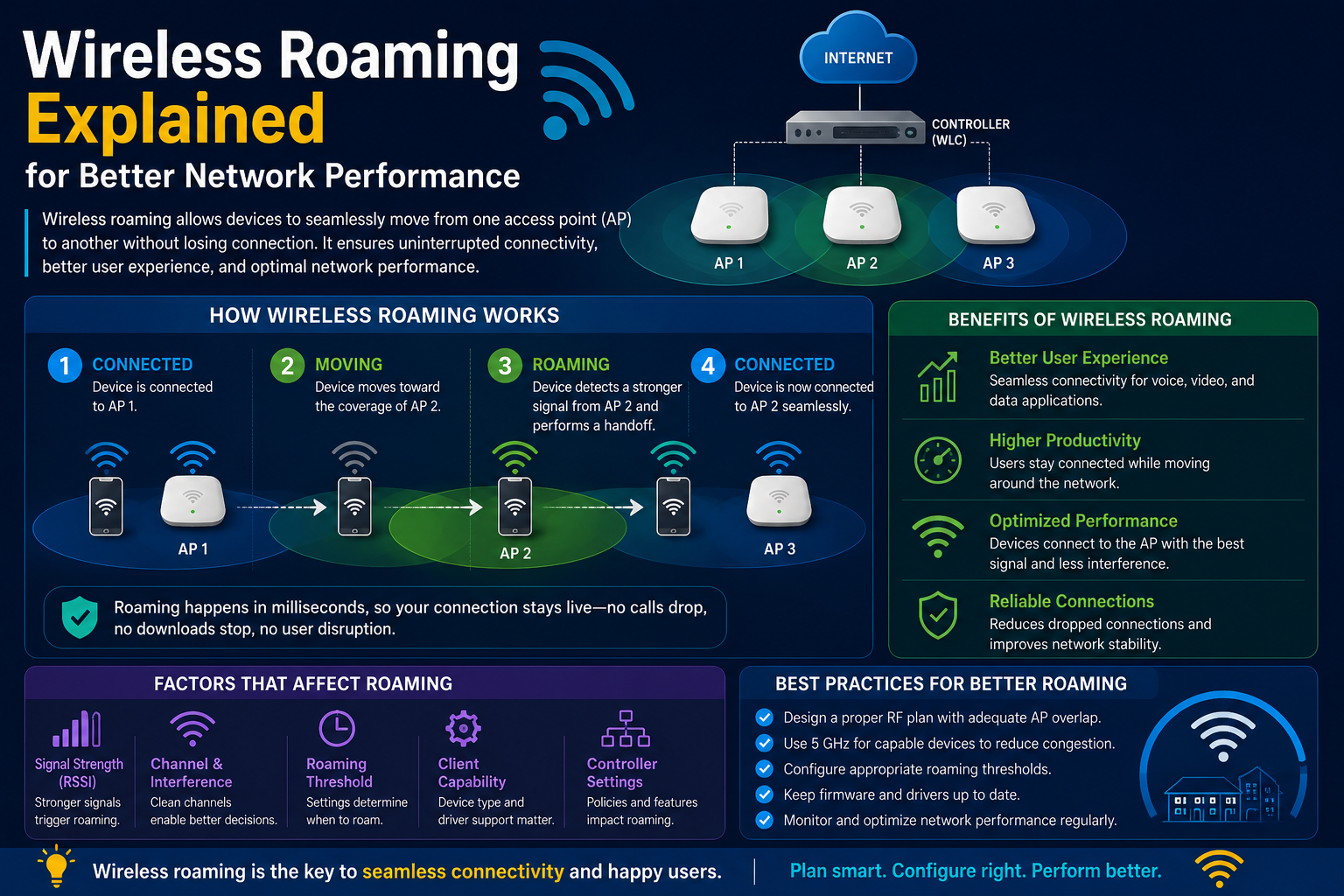
Wireless connectivity has become one of the most important technologies in modern communication. Whether at home, in an office building, at a university campus, or in a public venue, wireless devices depend on strong and stable Wi-Fi connections to function properly. Users expect to move from room to room while staying connected without interruption. This smooth movement between wireless access points is made possible through a process called wireless roaming.
Wireless roaming is the process that allows a device to move from one access point to another while remaining connected to the same wireless network. It ensures continuous communication as users move through areas covered by multiple access points. Although it usually happens automatically and invisibly, roaming involves complex communication between wireless devices and network infrastructure.
For beginners in networking, roaming can seem confusing because it involves multiple technical components working together. Devices must constantly monitor their signal quality, evaluate nearby access points, and decide when switching connections will improve performance. Understanding these steps is essential for anyone learning wireless networking concepts or preparing for certification exams.
Roaming is particularly important in environments where users move frequently while remaining connected. In a large office, employees may walk between conference rooms while participating in video calls. In hospitals, staff members move across departments while using mobile medical systems. In warehouses, workers use handheld scanners while traveling throughout the building. In each of these situations, roaming ensures uninterrupted connectivity.
The quality of wireless roaming directly impacts user experience. When roaming works properly, transitions between access points happen so quickly that users never notice. When roaming fails, users may experience dropped calls, buffering video, interrupted downloads, or complete loss of connectivity.
Understanding how roaming works begins with understanding wireless coverage areas.
Each wireless access point creates a radio coverage zone. This zone is often referred to as a cell. Devices within that coverage area can communicate with the access point and access network resources. Large wireless deployments use multiple overlapping cells to provide continuous coverage.
These overlapping cells allow roaming to occur. As a device moves away from one access point, the signal from that access point becomes weaker. At the same time, signals from nearby access points may become stronger. The device compares these signals and determines whether switching access points will improve communication quality.
Wireless roaming only occurs when access points belong to the same wireless infrastructure. Multiple access points must share network coordination and configuration so devices can transition without requiring manual reconnection.
This is different from switching between completely separate wireless networks. If a phone disconnects from one saved network and manually joins another, that is not considered roaming. True roaming happens within a unified wireless environment where movement between access points appears seamless.
The wireless device itself usually controls the roaming process.
This is one of the most important concepts to understand. Many people assume the network infrastructure decides when a device should move to another access point. In reality, the client device typically makes this decision.
The wireless driver inside the client constantly evaluates connection quality and determines whether another access point would provide better service. The access point generally responds to requests rather than commanding movement.
This client-driven behavior explains why different devices behave differently on the same network.
A laptop and smartphone sitting next to each other may connect to different access points even though they see the same wireless signals. This happens because each device uses its own roaming algorithms.
Some devices hold onto weak connections for too long. These are commonly called sticky clients.
Sticky clients resist switching even when better options are available. This can reduce performance because communication continues through a weak signal.
Users often notice slow speeds or unstable connectivity when devices remain attached to distant access points.
Other devices roam too aggressively.
These devices switch access points frequently, sometimes even when improvements are minimal. This behavior creates unnecessary transitions that can interrupt applications and waste wireless resources.
Finding the right roaming balance is challenging because every manufacturer designs roaming logic differently.
Wireless drivers use internal decision rules that are often proprietary. Some vendors publish technical details, while others reveal very little.
This lack of standardization makes roaming behavior difficult to predict.
Even devices from the same manufacturer may behave differently depending on operating system versions, driver updates, and hardware generations.
Because roaming decisions happen on the client side, network engineers cannot always force ideal behavior.
However, network design can strongly influence roaming quality.
Proper access point placement is critical.
Access points must provide overlapping coverage without creating excessive interference. If overlap is too weak, devices may lose connectivity before finding alternatives. If overlap is too strong, devices may struggle to determine the best candidate.
Signal planning requires careful consideration of building materials, room layouts, radio power levels, and channel assignments.
Poor placement often leads to roaming problems.
For example, if two access points overlap heavily on the same channel, interference increases and roaming decisions become unstable.
If access points are too far apart, devices may experience dead zones before discovering stronger signals.
Professional wireless design aims to create balanced overlap that supports predictable roaming.
Signal strength is one of the most common roaming triggers.
Wireless devices continuously measure signal quality using indicators such as received signal strength.
As signal weakens, the device begins searching for better candidates.
However, signal strength alone does not determine roaming behavior.
Devices also evaluate packet reliability, retransmission rates, channel utilization, supported data rates, and historical performance.
A slightly weaker access point may still deliver better performance if it experiences less congestion.
Modern wireless drivers use sophisticated algorithms to evaluate these factors.
The exact decision process varies widely between vendors.
Some prioritize stability and avoid roaming unless absolutely necessary.
Others prioritize performance and switch earlier.
This difference explains why users sometimes see unexpected roaming behavior.
A device may remain attached to a weaker signal because its driver values stability over signal improvement.
Alternatively, it may switch rapidly because its algorithm aggressively seeks stronger connections.
Wireless scanning is another essential roaming component.
Devices must discover nearby access points before roaming.
This happens through scanning.
Scanning occurs in two primary ways.
Passive scanning involves listening for beacon frames.
Access points periodically transmit beacons announcing their presence and capabilities.
Devices listen for these broadcasts and build a list of available candidates.
This method consumes fewer resources and avoids interrupting communication.
Active scanning involves sending probe requests.
Nearby access points respond with probe responses containing network information.
This allows devices to gather information faster but may briefly interrupt data transmission.
Most devices combine both scanning methods depending on urgency and network conditions.
When signal quality begins degrading, scanning becomes more aggressive.
The device compares discovered access points against its roaming criteria.
If a better candidate is found, the roaming process begins.
The device disconnects logically from its current access point.
It then sends a reassociation request to the new access point.
This request differs from an initial association because it indicates movement within the same wireless network rather than joining for the first time.
The new access point validates the request and accepts the device if conditions are met.
Once reassociation completes, data traffic resumes through the new connection.
If optimized roaming features are enabled, this process happens extremely quickly.
Users may never notice the transition.
Without optimization, roaming delays may cause brief interruptions.
These interruptions are especially noticeable during real-time applications.
Voice calls, video conferencing, and interactive gaming are sensitive to even small delays.
Fast roaming technologies reduce transition time by streamlining authentication and key exchange processes.
These improvements are essential in enterprise environments where uninterrupted mobility is critical.
Authentication plays a major role in roaming speed.
When devices first connect to secure wireless networks, authentication establishes encryption keys.
Repeating full authentication during every roam would introduce delays.
To avoid this, modern networks often support key caching and fast transition mechanisms.
These methods allow devices to reuse security information during reassociation.
This significantly improves roaming speed.
Without fast transition support, authentication delays can interrupt applications.
Environmental factors also affect roaming behavior.
Wireless signals interact with physical surroundings.
Walls, furniture, glass, metal surfaces, and people all influence signal propagation.
Signal quality may fluctuate even when devices remain stationary.
Temporary interference from microwave ovens, Bluetooth devices, or neighboring networks can also affect communication.
Roaming algorithms must distinguish meaningful degradation from temporary fluctuations.
If devices reacted instantly to every signal change, roaming would become unstable.
To prevent this, devices use hysteresis.
Hysteresis requires the new candidate to be noticeably better before roaming occurs.
This prevents unnecessary switching.
Devices also use timers.
Conditions must persist for a minimum duration before action is taken.
These protections improve stability.
Another important feature is roam-back prevention.
After roaming to a new access point, devices usually avoid returning immediately unless strong evidence supports the move.
This prevents bouncing between access points when signal conditions fluctuate.
Without this protection, performance would become highly unstable.
Packet retransmissions also influence roaming decisions.
Wireless communication depends on acknowledgments confirming successful delivery.
If acknowledgments are missing, frames must be resent.
High retransmission rates indicate interference or poor signal conditions.
When retransmissions increase, devices may lower transmission complexity to improve reliability.
If problems continue, roaming becomes more likely.
This adaptive behavior helps maintain connectivity under changing conditions.
Wireless roaming is far more complex than most users realize.
It involves constant monitoring, scanning, decision-making, authentication handling, reassociation, and environmental adaptation.
Despite this complexity, successful roaming usually remains invisible.
Users simply move through spaces while staying connected.
For networking professionals, understanding these mechanics provides valuable insight into troubleshooting and wireless optimization.
It explains why devices behave differently, why signal strength alone does not guarantee performance, and why careful network design matters.
Mastering roaming fundamentals builds a strong foundation for deeper wireless expertise and helps professionals create reliable mobile connectivity experiences.
How Devices Decide When to Roam
One of the most interesting aspects of wireless roaming is the decision-making process that determines exactly when a client device chooses to leave one access point and connect to another. Many people assume this decision is simple and based entirely on signal strength. In reality, the process is far more advanced and depends on a combination of signal measurements, device-specific algorithms, environmental awareness, and network performance analysis.
Every wireless device constantly evaluates its current connection while also monitoring surrounding access points. It is always gathering information about available wireless options, comparing performance indicators, and determining whether staying connected to the current access point remains the best choice.
The timing of this decision is critical. If a device roams too early, it may switch unnecessarily and create instability. If it roams too late, performance can degrade significantly before the transition occurs.
Manufacturers spend enormous effort refining roaming algorithms because this balance directly affects user experience. A poorly tuned roaming system creates dropped calls, buffering video streams, interrupted application sessions, and general frustration.
Different manufacturers approach roaming differently.
There is no universal roaming algorithm shared across all wireless devices. Each vendor develops its own driver logic based on internal testing, performance goals, and product design philosophy.
Some prioritize maintaining stable associations for as long as possible. These devices prefer avoiding unnecessary transitions, even if signal quality weakens.
Others prioritize connection quality and aggressively seek stronger access points whenever improvement becomes available.
This variation explains why two devices connected to the same wireless network may behave very differently while moving through the same space.
A laptop may roam smoothly between access points while a nearby phone stubbornly clings to a weaker connection. Another tablet may jump rapidly between access points, causing intermittent disruptions.
These differences are usually not caused by the network itself but by the roaming behavior built into each client device.
Wireless engineers often encounter this challenge during troubleshooting.
Users may report roaming problems affecting only certain devices while others function perfectly under identical conditions.
Understanding that roaming decisions happen at the client level helps explain these inconsistencies.
Signal Strength as a Roaming Trigger
Signal strength remains one of the most important roaming triggers.
Wireless devices constantly measure received signal strength from their current access point. This measurement reflects how clearly the client hears the AP’s transmissions.
As users move farther away, signal strength decreases.
Physical obstacles such as walls, furniture, metal structures, and people can also weaken signals.
When signal strength falls below a device-defined threshold, the roaming process becomes more likely.
The exact threshold varies by manufacturer and device type.
Some devices begin evaluating alternatives as soon as signal quality begins declining.
Others tolerate weaker signals for longer periods.
This threshold often depends on intended device use.
Voice-focused devices may roam sooner to preserve real-time communication quality.
Battery-sensitive devices may delay roaming to conserve power.
Consumer devices often balance both concerns.
Signal strength comparisons also involve relative improvement.
A device usually does not roam simply because another access point is slightly stronger.
Most roaming algorithms require a meaningful improvement before switching.
This margin prevents constant movement between access points when signals are nearly equal.
For example, if the current AP provides acceptable performance and a neighboring AP is only marginally stronger, staying connected often makes more sense than roaming.
The transition itself carries cost.
Even fast roaming introduces slight overhead.
Avoiding unnecessary transitions improves stability.
This improvement margin is often called hysteresis.
Hysteresis ensures devices only roam when the benefit clearly outweighs the transition cost.
Without hysteresis, devices would constantly bounce between access points in overlapping coverage zones.
This would create instability and degrade performance.
Environmental Conditions and Signal Fluctuation
Wireless signals are highly sensitive to environmental changes.
Signal strength does not remain perfectly stable.
It fluctuates constantly due to movement, reflection, interference, and changing physical surroundings.
A person walking between a device and access point may briefly weaken the signal.
Opening or closing a door may alter signal reflection patterns.
Nearby electronic devices can introduce interference.
Even slight repositioning of the client device can change antenna orientation enough to affect reception.
Roaming algorithms must account for these temporary fluctuations.
If devices reacted instantly to every small signal drop, roaming would become chaotic.
To prevent this, devices apply smoothing and timing analysis.
Signal degradation usually must persist for a minimum duration before triggering action.
This persistence requirement filters out short-lived disturbances.
The device waits to confirm that conditions truly indicate movement or sustained degradation rather than temporary noise.
This timing logic improves roaming accuracy.
It reduces unnecessary transitions while still allowing timely movement when needed.
Packet Errors and Retransmission Analysis
Signal strength alone does not fully reflect connection quality.
A strong signal can still perform poorly if interference or congestion affects transmission reliability.
For this reason, devices also monitor packet performance.
Wireless communication depends on acknowledgments.
When a frame is successfully received, the receiving device sends confirmation.
If confirmation does not arrive, the sender assumes failure and retransmits.
Retransmissions are normal in wireless communication.
Occasional retries are expected.
However, excessive retransmissions indicate poor conditions.
High retransmission counts suggest interference, weak signal integrity, channel congestion, or physical obstruction.
Devices track these retry rates carefully.
If retransmissions increase significantly, the client recognizes declining connection quality.
Before roaming immediately, many devices first reduce transmission complexity.
Wireless standards support multiple modulation and coding schemes.
Higher complexity provides faster speeds but requires cleaner signal conditions.
When reliability declines, devices shift to simpler schemes.
This improves delivery success at lower throughput.
If reliability continues deteriorating even after lowering transmission complexity, roaming becomes more likely.
This adaptive process helps preserve connectivity before initiating full reassociation.
Channel Congestion Awareness
Modern devices also evaluate channel congestion.
An access point may offer strong signal strength while serving too many active clients.
Heavy congestion reduces available airtime and increases contention delays.
A less crowded access point with slightly weaker signal may provide better real-world performance.
Some advanced client drivers consider channel utilization when selecting roaming candidates.
They prefer access points with available capacity rather than choosing based solely on signal power.
This capability improves performance in dense wireless environments such as offices, campuses, stadiums, and conference centers.
Not all devices evaluate congestion equally.
Enterprise-grade clients often perform more advanced analysis than basic consumer devices.
This difference contributes to varying roaming behavior across hardware categories.
Historical Performance Memory
Some devices maintain historical roaming information.
They remember past experiences with specific access points.
If an AP previously delivered poor performance despite strong signal strength, the device may deprioritize it in future decisions.
Similarly, access points with consistent reliability may receive preference.
This historical awareness improves decision-making over time.
It allows devices to learn network behavior rather than relying solely on immediate measurements.
Such intelligence is especially useful in environments where signal strength alone fails to predict performance accurately.
This memory-based optimization contributes to smarter roaming behavior.
It reduces repeated poor choices and improves long-term stability.
Fast Roaming Requirements
Real-time applications require extremely fast transitions.
Voice calls and video sessions are particularly sensitive to interruption.
Even brief roaming delays can produce noticeable audio gaps or frozen video.
To support seamless mobility, fast roaming technologies reduce transition overhead.
These mechanisms streamline authentication and security negotiation.
Instead of repeating full credential exchanges during every roam, devices reuse cached security information.
This dramatically shortens handoff time.
Fast transition support is essential in enterprise wireless deployments.
Without it, roaming may introduce delays long enough to disrupt sensitive applications.
Client devices must support these features to benefit from them.
If either the device or network lacks support, roaming may fall back to slower methods.
This compatibility requirement explains why some devices perform better than others on the same infrastructure.
Sticky Client Behavior
Sticky clients remain one of the most common roaming challenges.
A sticky client holds onto its current access point even when a better option exists.
This usually happens because the device’s roaming threshold is too conservative.
The device tolerates poor signal quality longer than ideal.
Users experience reduced speed, lag, and unstable connectivity.
Sticky behavior is particularly noticeable when moving away from an access point.
The device remains attached despite significantly stronger nearby alternatives.
Eventually performance degrades enough to force roaming.
By then, users may already notice problems.
Sticky clients are frustrating because network administrators have limited direct control.
Since the client controls roaming decisions, infrastructure adjustments often provide only indirect influence.
Engineers may lower transmit power to encourage earlier roaming or optimize coverage overlap.
These adjustments help guide client behavior.
However, final decisions remain client-driven.
Aggressive Roaming and Hopping Clients
The opposite problem involves overly aggressive roaming.
These devices roam too often.
They constantly chase small signal improvements even when performance remains acceptable.
Frequent transitions interrupt communication and waste resources.
This behavior is often called hopping.
Hopping clients create instability.
Applications experience brief pauses during repeated reassociation.
Battery consumption may increase due to constant scanning and transitions.
Aggressive roaming usually reflects poorly tuned driver thresholds or overly sensitive signal evaluation.
Network design can worsen this issue if access point overlap is excessive.
Clients see multiple strong candidates and switch unnecessarily.
Proper wireless planning reduces these opportunities.
Balanced overlap encourages stable roaming decisions.
Vendor Transparency and Hidden Algorithms
Wireless roaming remains partly mysterious because vendors rarely publish full algorithm details.
Roaming logic represents valuable intellectual property.
Manufacturers treat these systems as competitive advantages.
As a result, engineers often infer behavior through testing rather than documentation.
Packet captures reveal roaming timing and frame exchanges.
Signal analysis shows trigger conditions.
Repeated observation helps identify vendor patterns.
Still, some internal decision logic remains hidden.
This limited transparency makes troubleshooting challenging.
Engineers must rely on practical experience and environmental optimization rather than complete algorithm visibility.
Despite this complexity, understanding the general principles behind roaming decisions provides valuable insight.
Devices evaluate signal strength, retransmissions, congestion, timing persistence, historical performance, and roaming thresholds.
These factors combine to determine when movement between access points occurs.
This decision-making process forms the heart of wireless roaming performance.
When properly tuned, it creates seamless mobility users never notice.
When poorly tuned, it becomes a source of frustration and connectivity disruption.
Mastering these concepts helps networking professionals design better wireless environments and diagnose roaming problems more effectively.
Access Point Influence on Wireless Roaming
Wireless roaming is often described as a client-controlled process, but that does not mean access points are powerless. While client devices make the final decision to move from one access point to another, the wireless infrastructure plays a major supporting role in influencing that decision and shaping how smoothly the transition occurs.
Access points constantly communicate with wireless clients by sending management frames, beacon information, and performance metrics. These exchanges provide the information devices use when evaluating whether they should remain connected or begin searching for alternatives.
Network administrators can carefully design and configure wireless infrastructure to guide roaming behavior.
This guidance begins with radio frequency planning.
The physical placement of access points directly affects roaming performance. If access points are positioned too far apart, dead zones may appear between coverage areas. Devices may lose signal before discovering a suitable roaming target.
If access points are placed too close together, excessive overlap creates confusion.
A client device may see multiple strong signals at once and switch unnecessarily between them.
The ideal deployment creates controlled overlap that allows clients to discover stronger candidates gradually while maintaining stable connections during movement.
Transmit power settings also influence roaming.
If transmit power is too high, devices remain connected to distant access points longer than necessary. This often creates sticky client behavior.
The client continues hearing the original access point strongly enough to delay roaming even though a nearby AP would perform better.
Reducing transmit power encourages earlier roaming by shrinking effective coverage zones.
This allows nearby access points to become clearly stronger sooner.
Balancing transmit power across all access points is critical.
Uneven power creates unpredictable roaming behavior and inconsistent coverage quality.
Professional wireless deployments carefully tune these settings to encourage smooth mobility.
Controller-Assisted Roaming
In enterprise environments, wireless controllers can influence roaming more directly.
Controllers coordinate access points across the network and maintain awareness of client activity, signal quality, channel conditions, and AP load.
This centralized intelligence allows infrastructure to guide client behavior.
One common technique is load balancing.
If one access point becomes overloaded while nearby APs have available capacity, the controller may discourage new associations to the crowded AP.
Clients then connect elsewhere.
This improves performance distribution across the network.
Another technique is band steering.
Dual-band devices often prefer lower-frequency connections because they travel farther.
However, higher-frequency bands usually offer better performance due to reduced congestion and wider channel options.
Controllers may gently encourage capable clients to use these faster bands.
This improves network efficiency and roaming performance.
Infrastructure may also influence roaming through client steering.
If the controller detects that another AP can provide better service, it may delay responses from the current AP or reject reassociation attempts.
This nudges the client toward a stronger alternative.
The client still technically chooses the move, but infrastructure strongly shapes that decision.
These mechanisms improve wireless performance while preserving client autonomy.
Forced Disconnection Events
Sometimes infrastructure becomes more aggressive.
If an access point determines that continuing service is no longer beneficial, it may force the client to disconnect.
This usually happens when signal quality falls too low or another AP clearly offers superior service.
The AP sends a deauthentication frame terminating the connection.
The client must then begin scanning and reassociation.
From the user’s perspective, this often appears as roaming.
Technically, however, the infrastructure initiated the break.
Forced disconnections are carefully managed because abrupt transitions can interrupt applications.
Used properly, they improve roaming responsiveness.
Used poorly, they create instability and frustration.
Enterprise-grade wireless systems apply these mechanisms cautiously based on detailed performance analysis.
This ensures intervention improves rather than harms connectivity.
Authentication and Security During Roaming
Security plays a major role in roaming performance.
Every wireless connection relies on authentication and encryption.
When a device first joins a secure wireless network, it exchanges credentials and establishes encryption keys.
Repeating this full process during every roam would introduce noticeable delays.
To solve this problem, wireless systems use optimized authentication techniques.
Key caching allows devices to reuse previously established security credentials when returning to known access points.
Fast transition protocols allow security context transfer between access points.
This eliminates redundant negotiation steps.
These optimizations significantly reduce roaming latency.
Without them, authentication delays may interrupt communication for hundreds of milliseconds or longer.
This is especially disruptive for voice and video applications.
Fast authentication mechanisms are essential in mobility-focused environments such as hospitals, warehouses, and campuses.
Proper configuration ensures secure roaming remains nearly invisible to users.
Troubleshooting Wireless Roaming Problems
Roaming issues can be difficult to diagnose because they involve both client behavior and infrastructure conditions.
Successful troubleshooting requires understanding the interaction between these components.
One common symptom is delayed roaming.
The device remains attached to a weak AP despite stronger nearby alternatives.
This often indicates sticky client behavior.
Engineers investigate signal overlap, transmit power balance, and client roaming thresholds.
Adjustments may encourage earlier transitions.
Another issue is excessive roaming.
Devices switch repeatedly between access points.
This usually reflects aggressive client thresholds or excessive signal overlap.
Reducing overlap and optimizing AP placement often improves stability.
Dropped connections during movement suggest authentication delays or poor fast roaming support.
Engineers verify protocol compatibility and security optimization settings.
Intermittent roaming failures may indicate interference.
Spectrum analysis identifies competing signals from neighboring networks, Bluetooth devices, microwave ovens, or other radio-frequency sources.
Eliminating interference improves reliability.
Packet captures provide deep visibility into roaming behavior.
Engineers analyze management frames to observe scanning, disassociation, reassociation, authentication timing, and retry patterns.
This reveals exactly how and why transitions occur.
Packet analysis often exposes vendor-specific roaming behaviors invisible through standard monitoring tools.
Though complex, this method provides valuable diagnostic insight.
Real-World Roaming Challenges
Wireless roaming performs differently depending on the environment in which it is deployed. In home networks, roaming is usually straightforward because there are typically only a few access points and limited user movement. Devices can transition between coverage areas with relatively little complexity, making roaming easier to manage and troubleshoot.
Enterprise environments introduce much greater challenges. Large office buildings often contain many overlapping wireless cells, and high numbers of connected users increase channel contention and competition for airtime. In these settings, real-time applications such as voice calls, video conferencing, and collaboration tools require extremely fast and reliable transitions between access points to avoid interruptions.
Outdoor wireless environments create their own difficulties. Signal propagation can change constantly due to weather conditions, physical obstacles, and user movement patterns. These changing factors make it more difficult to predict roaming behavior and maintain stable performance.
Warehouses present especially challenging radio frequency conditions because metal shelving, storage racks, and reflective surfaces can distort wireless signals and create multipath interference. This can affect roaming decisions and reduce connection stability.
Hospitals demand highly reliable roaming because many medical systems and mobile healthcare devices depend on uninterrupted wireless connectivity. Even brief disruptions can affect critical operations, making seamless roaming essential.
Educational campuses also present significant roaming challenges. Thousands of students, faculty members, and devices move throughout buildings and open spaces simultaneously, requiring wireless networks to handle high-density mobility efficiently.
Each environment requires unique roaming optimization strategies. There is no single configuration that works perfectly in every scenario. Successful wireless design depends on careful planning, thorough testing, continuous monitoring, and regular adjustments to match environmental conditions.
Understanding the fundamentals of roaming allows network engineers to adapt their designs effectively and create wireless environments that deliver stable, reliable mobility regardless of deployment complexity.
The Future of Wireless Roaming
Wireless roaming continues evolving.
Modern wireless standards introduce smarter coordination between infrastructure and clients.
Machine learning increasingly improves roaming prediction.
Devices can analyze historical behavior and environmental patterns to make better roaming decisions.
Artificial intelligence allows wireless systems to anticipate movement and prepare target access points in advance.
This reduces transition latency.
Future networks will likely become more context-aware.
Devices may consider application type, user movement speed, battery state, and network demand when deciding when to roam.
This deeper intelligence will create more seamless mobility experiences.
Emerging technologies such as augmented reality, autonomous systems, and industrial automation require ultra-reliable low-latency roaming.
Meeting these demands drives continuous innovation in wireless standards and infrastructure design.
As wireless environments grow more complex, roaming optimization becomes increasingly important.
Networking professionals who understand these systems will remain highly valuable.
Why Roaming Knowledge Matters
Wireless roaming often goes unnoticed when functioning correctly. Users can move freely throughout a space while maintaining uninterrupted connectivity, making the process seem effortless. Because these transitions happen seamlessly, many people fail to recognize the sophisticated technology and decision-making processes involved behind the scenes.
A solid understanding of roaming significantly improves wireless troubleshooting skills. It helps explain why devices on the same network may behave differently under identical conditions and clarifies why signal strength alone is not always a reliable indicator of wireless performance. Roaming knowledge also highlights how infrastructure design, including access point placement and coverage overlap, directly impacts mobility quality and overall user experience.
These insights allow networking professionals to design stronger and more efficient wireless environments. Wireless certification programs frequently emphasize roaming concepts because they represent practical, real-world networking knowledge that professionals encounter regularly. Engineers responsible for maintaining wireless performance must understand roaming behavior deeply to diagnose issues effectively and optimize network reliability.
Even home users benefit from understanding roaming fundamentals when improving personal Wi-Fi networks. Knowing how roaming works makes it easier to place access points strategically, identify weak coverage areas, and better understand device connection behavior.
Ultimately, this knowledge transforms wireless connectivity from something that feels mysterious and automatic into a clear, understandable engineering process. Recognizing how devices transition between access points provides valuable insight into the technology that makes modern wireless mobility possible.
Conclusion
Wireless roaming is one of the most important processes in modern networking.
It allows devices to move freely between access points while maintaining continuous connectivity.
Though it appears simple from the user’s perspective, roaming depends on constant signal analysis, intelligent decision-making, authentication coordination, infrastructure planning, and adaptive optimization.
Client devices usually control roaming decisions, evaluating signal quality, retransmissions, congestion, and performance trends before choosing whether to transition.
Access points and controllers influence this process through careful design, power management, steering techniques, and authentication optimization.
Environmental conditions add further complexity, requiring algorithms to distinguish real degradation from temporary fluctuations.
When all these components work together, roaming becomes seamless.
Users move through spaces without interruption, unaware of the sophisticated coordination occurring behind the scenes.
When roaming fails, performance issues quickly appear.
Understanding these mechanics provides valuable insight for troubleshooting and wireless design.
As wireless technology continues advancing, roaming will become even smarter and more efficient.
For networking professionals, mastering roaming fundamentals provides a strong foundation for deeper expertise and future innovation.
Wireless mobility depends on this invisible process, making roaming one of the most essential concepts in modern Wi-Fi networking.