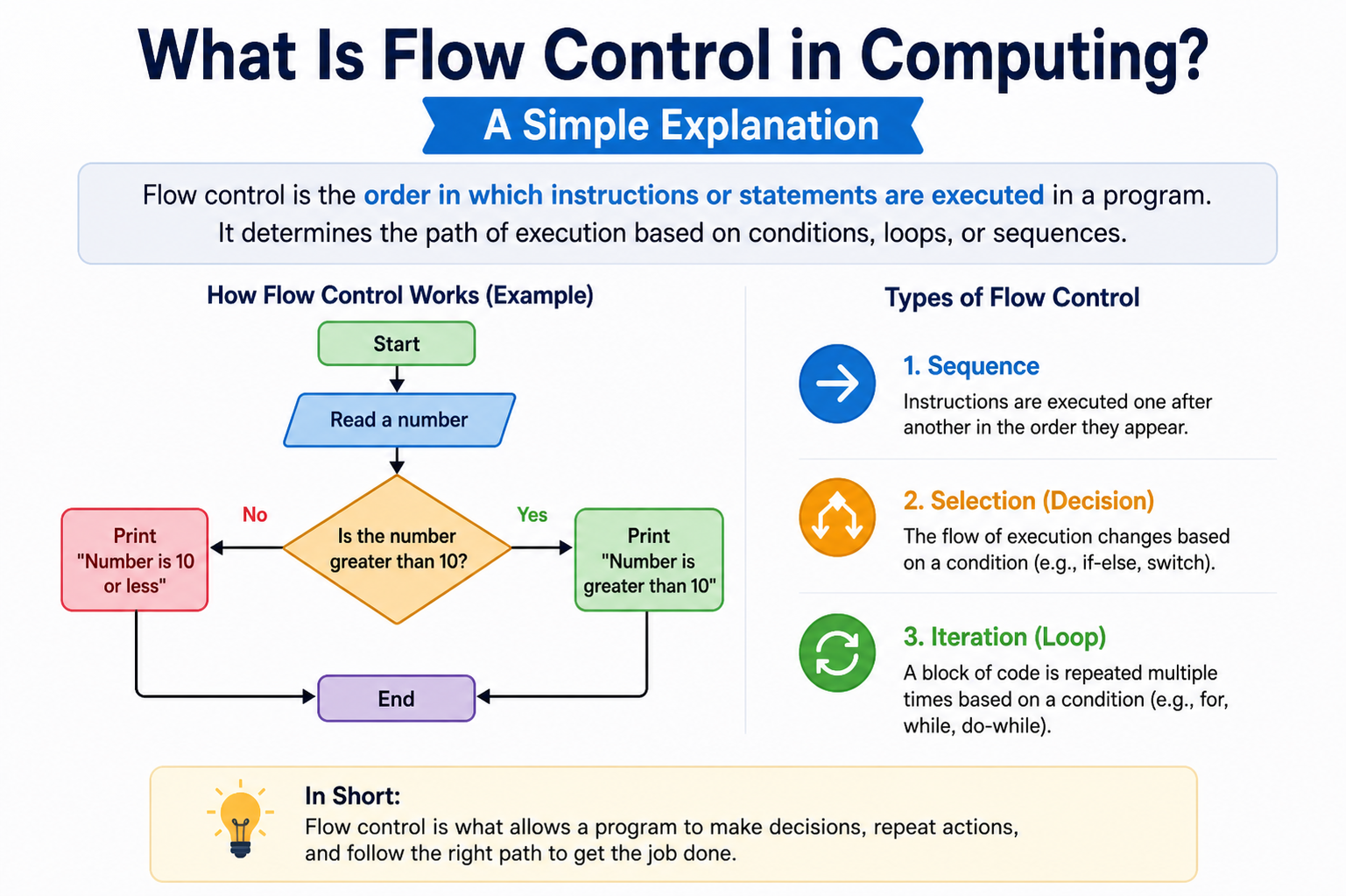
Flow control in computing is not just a basic concept limited to simple decision-making; it is a core mechanism that governs how software behaves at every level. It defines the exact path a program follows while executing instructions, ensuring that logic is applied correctly based on input, conditions, and system states. In modern computing systems, flow control acts as the backbone of structured programming and plays a crucial role in how efficient, scalable, and reliable applications are built.
Role of Flow Control in Program Execution
Every program written in a programming language follows a specific execution path. Flow control determines this path by directing the sequence in which statements are executed. Without flow control, programs would run in a rigid linear fashion, making it impossible to handle real-world problems where decisions and repetition are required. By introducing logic into execution, flow control allows software to adapt dynamically to different situations.
In simple terms, flow control answers the question of “what happens next” in a program. It ensures that instructions are not just executed blindly but are guided by logic and conditions defined by the developer.
Sequence as the Foundation of Flow Control
Sequence is the most basic form of flow control. It refers to executing instructions one after another in the order they are written. Most programs begin with sequential execution before any conditions or loops are introduced. Even in complex systems, sequence still plays an important role because every decision and loop ultimately breaks down into ordered steps.
Sequence ensures predictability in program behavior. It allows developers to structure logic in a clear and understandable way, making debugging and maintenance easier.
Decision Making Through Conditional Flow
Conditional flow is one of the most powerful aspects of flow control. It allows programs to make decisions based on specific conditions. When a condition is evaluated, the program chooses between different execution paths.
This type of flow control is essential in real-world applications. For example, a login system checks whether a password is correct before granting access. Similarly, an online store checks product availability before confirming an order. These decisions are handled through conditional logic.
Conditional flow introduces intelligence into programs by allowing them to respond differently based on input or system state.
Iteration and Repetition in Flow Control
Iteration is another key component of flow control that allows repetition of a set of instructions. Instead of writing the same code multiple times, loops are used to execute a block of code repeatedly until a condition is met.
This is extremely useful in tasks such as processing large datasets, running calculations, or handling user input. Iteration improves efficiency by reducing redundancy and making code shorter and more manageable.
Loops continue execution as long as a condition remains true and stop once it becomes false. This dynamic behavior allows programs to handle repetitive tasks without manual intervention.
Flow Control in Modern Programming Languages
Almost all programming languages include built-in structures for flow control. Languages like Python, Java, C++, and JavaScript use similar concepts such as if statements, switch cases, for loops, and while loops.
Although syntax may differ, the underlying logic remains the same across languages. This consistency allows developers to switch between languages easily once they understand flow control principles.
Flow control structures are designed to translate human logic into machine-executable instructions, making it easier to build complex software systems.
Importance of Flowcharts in Visualizing Flow Control
Flowcharts are often used to represent flow control visually. They help in understanding how a program moves from one step to another. Each shape in a flowchart represents a specific action, decision, or process.
By visualizing flow control, developers can plan logic before writing actual code. This reduces errors and improves clarity in program design. Flowcharts are especially useful in large systems where multiple conditions and loops interact with each other.
They act as a blueprint for programming logic and help in breaking down complex problems into simpler steps.
Flow Control in Decision-Based Systems
Decision-based systems rely heavily on flow control to function properly. These systems analyze input data and choose actions based on predefined rules.
For example, recommendation systems on streaming platforms analyze user behavior and suggest content accordingly. Similarly, banking systems use flow control to detect fraud by evaluating transaction patterns.
In such systems, multiple conditions are evaluated simultaneously, and flow control ensures that the correct outcome is selected based on priority and logic.
Error Handling Through Flow Control
Flow control is also used to manage errors in programs. When something goes wrong, such as invalid input or system failure, control structures help the program respond appropriately instead of crashing.
Error handling mechanisms allow programs to continue running safely or display meaningful messages to users. This improves reliability and user experience.
Without proper flow control, even small errors could cause entire systems to fail unexpectedly.
Flow Control in Real-Time Applications
Real-time applications such as gaming, navigation systems, and live data processing rely heavily on flow control. These systems must respond instantly to changing inputs and conditions.
For example, in a game, flow control determines character movement, collision detection, and game events. In navigation apps, it continuously updates routes based on traffic conditions.
The ability to process and respond in real time makes flow control essential for interactive systems.
Nested Flow Control Structures
In advanced programming, flow control structures can be nested inside one another. This means a condition can exist inside another condition, or loops can exist within loops.
Nested structures allow developers to handle complex logic that cannot be managed with simple conditions or loops. However, excessive nesting can make code difficult to read and maintain, so it must be used carefully.
Proper organization of nested flow control is important for writing clean and efficient code.
Flow Control and Algorithm Design
Algorithms are step-by-step procedures used to solve problems, and flow control is at the heart of every algorithm. Each step in an algorithm depends on logical flow decisions.
Whether sorting data, searching for values, or performing calculations, flow control ensures that each step is executed in the correct order. It helps define how input is processed and how output is generated.
Without flow control, algorithms would not function effectively because there would be no structure guiding execution.
Efficiency and Optimization in Flow Control
Efficient flow control improves the performance of software. Poorly designed control structures can slow down programs and consume unnecessary resources.
Optimizing flow control involves reducing unnecessary conditions, minimizing loops, and ensuring logical clarity. Well-structured flow leads to faster execution and better memory management.
Developers often analyze flow control paths to identify bottlenecks and improve system performance.
Common Mistakes in Flow Control
One common mistake in flow control is incorrect condition handling. This can lead to unexpected behavior or infinite loops. Another issue is overly complex nested conditions, which make code difficult to understand.
Logical errors in flow control are often harder to detect than syntax errors because the program still runs but produces incorrect results.
Careful planning and testing are essential to avoid these problems and ensure smooth execution.
Flow Control in Automation Systems
Automation systems rely heavily on flow control to perform tasks without human intervention. These systems follow predefined rules and conditions to execute actions automatically.
For example, industrial machines use flow control to manage production lines, while smart home systems use it to control lighting and temperature based on user behavior.
Flow control enables automation to be intelligent and adaptive rather than static.
Flow Control Concepts
Flow control is a fundamental concept in computing that defines how programs make decisions, repeat actions, and execute instructions in a structured manner. It transforms simple instructions into intelligent systems capable of handling complex tasks.
From basic sequence execution to advanced decision-making systems, flow control remains essential in all areas of programming and software development. It not only improves efficiency but also enables adaptability, scalability, and real-world functionality in modern computing systems.
Flow Control in Operating Systems
Operating systems rely heavily on flow control to manage processes, memory, and hardware interactions. Every action performed by a computer, from opening an application to saving a file, is guided by controlled execution paths. The operating system decides which process should run, when it should run, and for how long, ensuring smooth multitasking and resource allocation.
Flow control in operating systems helps manage multiple programs simultaneously without conflicts. It uses scheduling algorithms to prioritize tasks and maintain system stability. Without proper flow control, systems would become unresponsive or crash due to resource overload.
Process Scheduling and Flow Control
Process scheduling is one of the most important applications of flow control in operating systems. It determines the order in which processes are executed by the CPU. Since multiple processes often compete for limited resources, flow control ensures fairness and efficiency.
Different scheduling techniques use flow control logic to decide execution order. Some processes may be prioritized based on urgency, while others may be queued for later execution. This controlled decision-making ensures optimal system performance and prevents bottlenecks.
Flow Control in Memory Management
Memory management also depends on flow control to allocate and deallocate memory efficiently. When a program runs, it requires memory space, and the operating system uses flow control to decide how much memory to assign and when to release it.
Without proper control, memory leaks or fragmentation can occur, leading to performance issues. Flow control ensures that memory usage is optimized and that different programs do not interfere with each other’s allocated space.
Flow Control in Networking Systems
In networking, flow control regulates the transmission of data between devices. It ensures that the sender does not overwhelm the receiver with too much data at once. This is essential for maintaining stable communication between systems.
Flow control in networks helps manage data packets, preventing congestion and data loss. It adjusts the speed of transmission based on network conditions, ensuring reliable and efficient communication.
Flow Control in Data Communication
Data communication systems use flow control to synchronize data transfer between devices. When data is sent from one system to another, flow control ensures that both systems operate at compatible speeds.
If the sender transmits data too quickly, the receiver may not be able to process it, leading to errors or data loss. Flow control prevents this by regulating the pace of communication and maintaining balance between sender and receiver.
Flow Control in User Interfaces
User interfaces rely on flow control to manage user interactions. Every click, input, or action triggers a response controlled by underlying logic. Flow control determines how the system responds to user behavior.
For example, when a user submits a form, flow control checks the input, validates it, and then decides whether to accept or reject it. This ensures that applications behave predictably and provide meaningful feedback.
Event-Driven Flow Control
Modern applications often use event-driven flow control, where execution is triggered by events such as clicks, key presses, or system signals. Instead of following a fixed sequence, the program waits for events to occur and then responds accordingly.
This approach is widely used in graphical applications, web development, and interactive systems. It allows programs to remain idle until needed, improving efficiency and responsiveness.
Flow Control in Web Development
Web applications depend heavily on flow control to manage user sessions, server requests, and data processing. When a user interacts with a website, flow control determines how the server responds and what content is displayed.
It handles login sessions, page navigation, form submissions, and dynamic content updates. Without flow control, web applications would not be able to provide personalized or interactive experiences.
Flow Control in Artificial Intelligence Systems
Artificial intelligence systems use advanced flow control to make decisions based on data patterns. Instead of following fixed rules, AI systems evaluate conditions dynamically and adjust their behavior accordingly.
Machine learning models, for example, use flow control to process training data, identify patterns, and generate predictions. This allows AI systems to improve over time and adapt to new inputs.
Flow Control in Machine Learning Workflows
In machine learning, flow control is used to manage data preprocessing, model training, and evaluation steps. Each stage depends on the output of the previous one, creating a controlled pipeline.
If data is not clean or properly formatted, flow control ensures that it is processed correctly before moving to the next stage. This structured approach improves model accuracy and performance.
Flow Control in Robotics
Robotic systems use flow control to manage movements, sensors, and decision-making processes. Robots rely on programmed instructions that are executed based on environmental inputs.
For example, a robot may stop moving when it detects an obstacle or change direction based on sensor data. Flow control ensures that these actions happen in a logical and safe sequence.
Importance of Logical Flow in Robotics
In robotics, logical flow is essential for safety and precision. Flow control ensures that robots do not perform conflicting actions at the same time. It coordinates multiple systems such as motion, vision, and control units.
Without proper flow control, robotic systems would behave unpredictably, leading to errors or damage.
Flow Control in Embedded Systems
Embedded systems, such as those used in appliances, vehicles, and industrial machines, rely on flow control for real-time operation. These systems perform specific tasks and must respond instantly to inputs.
Flow control ensures that embedded systems operate efficiently with limited resources. It manages hardware interactions and ensures timely execution of critical functions.
Flow Control in Security Systems
Security systems use flow control to monitor and respond to threats. For example, access control systems check credentials before granting entry. Surveillance systems analyze input data and trigger alerts when suspicious activity is detected.
Flow control ensures that security decisions are made accurately and quickly, improving overall protection.
Flow Control in Database Systems
Databases use flow control to manage queries, transactions, and data integrity. When multiple users access a database simultaneously, flow control ensures that operations are executed in a safe and organized manner.
It prevents conflicts such as data corruption or duplication by controlling transaction order and consistency.
Transaction Management and Flow Control
In database systems, transaction management depends on flow control to maintain reliability. Each transaction must be completed fully or not at all. Flow control ensures that partial updates do not affect system integrity.
This is essential in banking, e-commerce, and other systems where accuracy is critical.
Flow Control in Cloud Computing
Cloud computing environments use flow control to manage distributed resources across multiple servers. It ensures that workloads are balanced and resources are used efficiently.
Flow control helps allocate computing power, storage, and network bandwidth dynamically based on demand. This improves scalability and performance in cloud systems.
Load Balancing Through Flow Control
Load balancing is a key application of flow control in cloud systems. It distributes tasks evenly across servers to prevent overload. This ensures that no single server becomes a bottleneck.
By controlling flow of requests, systems maintain high availability and reliability even under heavy traffic.
Challenges in Flow Control Implementation
Implementing flow control can be challenging in complex systems. Developers must carefully design logic to handle all possible conditions and edge cases.
Poorly designed flow control can lead to unexpected behavior, system crashes, or performance issues. Testing and validation are essential to ensure correct implementation.
Debugging Flow Control Issues
Debugging flow control problems requires analyzing program logic step by step. Developers often use tools to trace execution paths and identify where logic fails.
Common issues include infinite loops, incorrect conditions, and missing control paths. Proper debugging helps improve system stability and reliability.
Best Practices for Effective Flow Control
Effective flow control requires clear logic, minimal complexity, and proper structure. Developers should avoid unnecessary nesting and ensure that conditions are well-defined.
Writing modular code also improves flow control by breaking complex logic into smaller, manageable parts. This enhances readability and maintainability.
Advanced Flow Control Concepts
Flow control is a foundational concept that extends across all areas of computing. From operating systems and networking to artificial intelligence and cloud computing, it plays a critical role in ensuring proper execution and decision-making.
Its importance lies in its ability to bring structure, logic, and intelligence into software systems. As computing systems become more advanced, flow control continues to evolve, enabling faster, smarter, and more efficient technologies.
Flow Control in Software Architecture
Flow control plays a major role in software architecture by defining how different components of a system interact with each other. In large-scale applications, multiple modules work together, and flow control ensures that data moves in a structured and predictable manner between them.
Modern software architecture often includes layered designs, where each layer depends on the output of another. Flow control manages this dependency chain so that requests are processed in the correct order. This prevents system failures and ensures smooth communication between different parts of the application.
In distributed systems, flow control becomes even more important because components may exist on different servers or environments. Proper coordination ensures that services remain synchronized and function as a single system.
Flow Control in Microservices Architecture
Microservices architecture breaks applications into smaller, independent services that communicate with each other. Flow control in this environment ensures that each service performs its task and passes results correctly to other services.
Since microservices often operate independently, flow control manages communication between APIs, data streams, and service requests. It ensures that failures in one service do not break the entire system.
This controlled communication improves scalability and makes it easier to update or replace individual services without affecting the whole application.
Flow Control in API Communication
APIs rely heavily on flow control to manage requests and responses between clients and servers. When a request is sent, flow control determines how it is processed, validated, and responded to.
It ensures that data is exchanged in a structured format and that errors are handled properly. APIs often include rate limiting, which is also a form of flow control used to prevent excessive requests from overwhelming the server.
This structured communication helps maintain performance and reliability in web services and applications.
Flow Control in Concurrency
Concurrency refers to multiple processes running at the same time. Flow control is essential in managing concurrency because it ensures that processes do not interfere with each other.
In multi-threaded systems, flow control decides how threads access shared resources. Without proper control, issues like race conditions and deadlocks can occur.
By coordinating execution, flow control allows systems to perform multiple tasks simultaneously while maintaining consistency and stability.
Synchronization and Flow Control
Synchronization is closely related to flow control in concurrent systems. It ensures that different processes or threads reach certain points in execution at the right time.
Flow control mechanisms such as locks, semaphores, and monitors are used to synchronize tasks. This prevents data corruption and ensures that shared resources are accessed safely.
Synchronization is especially important in systems where accuracy and timing are critical, such as financial applications or real-time processing systems.
Flow Control in Compilers
Compilers use flow control to translate high-level programming languages into machine code. During compilation, the compiler analyzes the structure of the code and determines the execution flow.
It checks conditions, loops, and function calls to ensure that the program logic is valid. Flow control analysis also helps optimize code by removing unnecessary steps and improving execution efficiency.
Without flow control, compilers would not be able to correctly interpret program logic or generate efficient machine instructions.
Control Flow Graphs in Compilation
Control flow graphs are used by compilers to represent all possible paths of execution in a program. Each node represents a block of code, and edges represent possible transitions between blocks.
These graphs help in analyzing program behavior, optimizing performance, and detecting errors. They provide a visual representation of how flow control operates at a low level.
Control flow graphs are essential in advanced compiler design and optimization techniques.
Flow Control in Functional Programming
Functional programming approaches flow control differently compared to traditional programming paradigms. Instead of using loops and conditions in a procedural manner, functional programming relies on functions and expressions.
Flow control is achieved through function composition, recursion, and higher-order functions. This leads to more predictable and side-effect-free code.
Because of its structured nature, functional flow control is often easier to test and debug.
Recursion as a Flow Control Mechanism
Recursion is a technique where a function calls itself to solve smaller instances of a problem. It is a powerful form of flow control used in both functional and procedural programming.
Recursion continues until a base condition is met, at which point the execution stops. This controlled repetition allows complex problems to be broken down into simpler parts.
Examples of recursion include tree traversal, mathematical computations, and search algorithms.
Flow Control in Data Structures
Data structures rely on flow control to manage how data is stored, accessed, and modified. Different structures such as arrays, stacks, queues, and trees use flow control in unique ways.
For example, stacks follow a last-in-first-out structure, while queues follow first-in-first-out behavior. Flow control ensures that these rules are followed correctly during operations.
Efficient flow control in data structures improves performance and reduces computational complexity.
Tree Traversal and Flow Control
Tree traversal algorithms such as in-order, pre-order, and post-order rely on flow control to navigate hierarchical data structures.
Each traversal method uses specific rules to determine the order in which nodes are visited. Flow control ensures that every node is processed exactly once and in the correct sequence.
These techniques are widely used in file systems, databases, and artificial intelligence applications.
Flow Control in Sorting Algorithms
Sorting algorithms such as bubble sort, merge sort, and quicksort depend heavily on flow control. They use loops and conditional checks to arrange data in a specific order.
Flow control determines how elements are compared, swapped, and repositioned during the sorting process. Efficient control structures reduce time complexity and improve performance.
Sorting is a fundamental operation in computing, and flow control is at the core of its execution.
Flow Control in Search Algorithms
Search algorithms like linear search and binary search use flow control to locate specific data within a dataset. Conditional checks guide the search process until the target element is found.
Binary search, for example, uses a divide-and-conquer approach where flow control eliminates half of the search space in each step. This significantly improves efficiency compared to sequential searching.
Flow control ensures that search operations are optimized and accurate.
Flow Control in Game Development
Game development is one of the most dynamic areas where flow control is used extensively. It manages game logic, player interactions, physics, and rendering.
Every action in a game, such as movement, scoring, or collision detection, is controlled through logical flow structures. This ensures that the game responds in real time to user inputs.
Flow control also manages game states such as start, pause, and end, providing a smooth gaming experience.
Artificial Intelligence Decision Trees
Decision trees in artificial intelligence are built using flow control principles. Each node in the tree represents a decision based on input conditions.
The flow moves from one node to another until a final decision is reached. This structured approach allows AI systems to make logical and explainable decisions.
Decision trees are widely used in classification, prediction, and pattern recognition tasks.
Flow Control in Natural Language Processing
Natural language processing systems use flow control to analyze and interpret human language. Sentences are broken down into components, and decisions are made based on grammar and context.
Flow control helps in tasks such as sentiment analysis, translation, and speech recognition. It ensures that language data is processed in a structured and meaningful way.
This allows machines to understand and respond to human communication effectively.
Flow Control in Cybersecurity Systems
Cybersecurity systems use flow control to monitor and respond to potential threats. They analyze network traffic, user behavior, and system activity to detect anomalies.
When suspicious activity is detected, flow control triggers security protocols such as blocking access or alerting administrators.
This ensures that systems remain protected against attacks and unauthorized access.
Adaptive Flow Control Systems
Adaptive flow control systems adjust their behavior based on changing conditions. Instead of following fixed rules, they modify execution paths dynamically.
These systems are used in intelligent applications such as autonomous vehicles, smart grids, and adaptive networks. They improve efficiency by responding to real-time data.
Adaptive flow control represents an advanced stage of computing intelligence.
Future of Flow Control in Computing
The future of flow control is closely tied to advancements in artificial intelligence, quantum computing, and automation. As systems become more complex, flow control will evolve to handle greater levels of unpredictability and data volume.
Intelligent flow control systems will be able to make decisions autonomously, optimize performance in real time, and adapt to changing environments without human intervention.
This evolution will play a key role in shaping the next generation of computing technologies.
Overview of Flow Control Concepts
Flow control remains one of the most fundamental and powerful concepts in computing. It governs how programs execute, how decisions are made, and how systems respond to input.
From simple sequences to complex adaptive systems, flow control provides structure, logic, and intelligence to software. It connects all areas of computing, making it essential for both basic programming and advanced system design.
Its importance continues to grow as technology advances, ensuring that computing systems remain efficient, reliable, and capable of handling increasingly complex tasks.
Flow Control in Parallel Computing
Parallel computing involves executing multiple tasks simultaneously to improve performance and efficiency. Flow control plays a crucial role in coordinating these tasks so that they do not conflict with each other while sharing resources.
In parallel systems, different processes run at the same time on multiple processors or cores. Flow control ensures that these processes are properly synchronized and that dependencies between tasks are maintained. Without proper control, parallel execution can lead to inconsistent results or system instability.
It also manages task distribution so that workloads are evenly balanced across processing units, improving overall system speed and efficiency.
Flow Control in Distributed Systems
Distributed systems consist of multiple independent computers working together as a single system. Flow control is essential in these environments to manage communication, data consistency, and task coordination.
Since data is often shared across networks, flow control ensures that information is transmitted in the correct order and without duplication or loss. It also handles synchronization between different nodes to maintain system integrity.
This structured control allows distributed systems to function reliably even when components are located in different geographical regions.
Flow Control in Big Data Processing
Big data systems handle extremely large volumes of information, and flow control is essential for managing how this data is processed. It determines the order in which data is collected, filtered, analyzed, and stored.
Flow control ensures that data pipelines operate smoothly without bottlenecks. It manages batch processing and stream processing systems, allowing continuous data flow without interruption.
Efficient flow control in big data systems improves processing speed and helps organizations extract meaningful insights from large datasets.
Flow Control in Data Pipelines
Data pipelines are structured workflows that move data from one system to another. Flow control manages each stage of this pipeline, ensuring that data flows correctly from source to destination.
It coordinates extraction, transformation, and loading processes so that data is clean, accurate, and properly formatted. If an error occurs in one stage, flow control determines how the pipeline should respond, whether by retrying, skipping, or logging the issue.
This ensures reliability and consistency in data processing workflows.
Flow Control in Real-Time Analytics
Real-time analytics systems depend on flow control to process data instantly as it arrives. These systems analyze streaming data and provide immediate insights.
Flow control ensures that incoming data is processed in the correct sequence and that delays are minimized. It prioritizes critical data streams and manages system resources efficiently.
This is especially important in industries like finance, healthcare, and online services where real-time decisions are required.
Flow Control in Internet of Things (IoT)
Internet of Things systems consist of interconnected devices that communicate and exchange data. Flow control is essential in managing communication between these devices.
It ensures that data from sensors and devices is transmitted efficiently and processed correctly. Flow control also manages device synchronization, preventing data collisions and communication delays.
In smart environments such as homes, cities, and industries, flow control enables seamless interaction between connected devices.
Flow Control in Smart Systems
Smart systems use flow control to make automated decisions based on environmental data. These systems include smart homes, smart cities, and intelligent transportation systems.
Flow control allows these systems to analyze inputs such as temperature, traffic, or energy usage and respond accordingly. It ensures that actions are executed in a logical sequence based on real-time conditions.
This improves efficiency, reduces human intervention, and enhances overall system intelligence.
Flow Control in Virtualization
Virtualization technology allows multiple virtual machines to run on a single physical machine. Flow control manages how resources such as CPU, memory, and storage are allocated among these virtual machines.
It ensures that each virtual environment operates independently without interfering with others. Flow control also manages workload distribution to maintain system stability and performance.
This is essential in cloud computing and enterprise systems where resource optimization is critical.
Flow Control in Resource Allocation
Resource allocation is a key function of flow control in computing systems. It determines how system resources are distributed among competing processes.
Flow control ensures that resources such as memory, processing power, and bandwidth are used efficiently. It prevents resource starvation and ensures fairness across different tasks.
This helps maintain system stability and improves overall performance.
Flow Control in Scheduling Algorithms (Advanced View)
Scheduling algorithms use advanced flow control techniques to manage complex task execution scenarios. These algorithms consider priorities, deadlines, and resource availability when deciding execution order.
Flow control ensures that high-priority tasks are completed on time while maintaining balance with lower-priority tasks. It also adapts dynamically to system changes, making scheduling more efficient and responsive.
This is particularly important in real-time operating systems and high-performance computing environments.
Flow Control in System Performance Optimization
System performance optimization relies on flow control to identify and eliminate inefficiencies in execution paths. By analyzing how instructions flow through a program, developers can optimize logic and reduce unnecessary processing.
Flow control helps detect redundant operations, infinite loops, and slow execution paths. Improving these areas leads to faster and more efficient software systems.
Optimization through flow control is a continuous process in software development.
Flow Control in Compiler Optimization Techniques
Compilers use flow control analysis to optimize code before execution. Techniques such as loop unrolling, dead code elimination, and instruction reordering depend on understanding execution flow.
Flow control allows compilers to restructure programs for better performance without changing their output. This results in faster execution and reduced resource consumption.
Advanced optimization techniques rely heavily on accurate flow analysis.
Flow Control in Debugging and Testing
Debugging and testing processes use flow control to trace program execution and identify errors. By following execution paths, developers can locate where logic fails or behaves unexpectedly.
Flow control helps simulate different scenarios to ensure that all possible conditions are tested. This improves software reliability and reduces the chances of runtime errors.
Testing frameworks often rely on flow control structures to automate test cases.
Flow Control in Software Lifecycle Management
Flow control is also important in managing the software development lifecycle. It helps structure stages such as planning, development, testing, deployment, and maintenance.
Each stage depends on the completion of the previous one, and flow control ensures smooth transitions between phases. This structured approach improves project management and software quality.
It also helps teams coordinate tasks and maintain development timelines.
Flow Control in Human-Computer Interaction
Human-computer interaction systems use flow control to manage how users interact with machines. Every action performed by a user triggers a response controlled by underlying logic.
Flow control ensures that inputs are processed correctly and that feedback is provided in a meaningful way. This improves usability and user experience.
It is essential in designing intuitive interfaces and interactive systems.
Flow Control in Automation and Robotics Integration
In advanced automation systems, robotics and software work together using flow control mechanisms. This integration allows machines to perform complex tasks with minimal human intervention.
Flow control coordinates sensor data, mechanical movement, and decision-making processes. It ensures that robotic actions are executed safely and efficiently.
This integration is widely used in manufacturing, healthcare, and logistics industries.
Flow Control in Autonomous Systems
Autonomous systems such as self-driving cars rely heavily on flow control to make real-time decisions. These systems process large amounts of sensor data and continuously adjust their behavior.
Flow control ensures that decisions such as braking, steering, and acceleration are executed in the correct order. It also manages safety protocols to prevent accidents.
This makes autonomy possible in modern intelligent systems.
Flow Control in Financial Computing Systems
Financial systems use flow control to manage transactions, risk analysis, and trading operations. Every transaction follows a controlled execution path to ensure accuracy and security.
Flow control helps detect fraud, validate transactions, and maintain financial records. It ensures that operations are executed in compliance with regulatory standards.
This is critical in banking, stock markets, and digital payment systems.
Flow Control in High-Performance Computing
High-performance computing systems rely on optimized flow control to handle complex scientific calculations. These systems process massive datasets and perform simulations that require precise coordination.
Flow control ensures that tasks are distributed efficiently across computing clusters. It minimizes execution time and maximizes computational power.
This is widely used in scientific research, weather modeling, and engineering simulations.
Evolving Nature of Flow Control
Flow control continues to evolve as computing systems become more advanced. Traditional models based on simple conditions and loops are being enhanced with intelligent and adaptive mechanisms.
Modern systems use predictive flow control that anticipates system behavior and adjusts execution paths accordingly. This leads to more efficient and responsive computing environments.
The evolution of flow control reflects the increasing complexity of modern technology.
Conclusion
Flow control is one of the most fundamental concepts in computing that defines how a program executes instructions in a structured and logical way. It ensures that software does not simply run line by line without intelligence, but instead follows decision-making paths, repetitions, and structured sequences based on conditions and requirements.
Across all areas of computing, flow control plays a central role in making systems functional, efficient, and responsive. Whether it is operating systems managing processes, networks controlling data transfer, or applications responding to user input, flow control is always working in the background to maintain order and stability.
As computing systems become more advanced, the importance of flow control continues to grow. Modern technologies such as artificial intelligence, cloud computing, distributed systems, and automation rely heavily on complex flow control mechanisms to function effectively. These systems require precise coordination, real-time decision-making, and adaptive behavior, all of which are made possible through well-designed control flow structures.
In simple terms, flow control is what transforms basic code into intelligent systems. It allows computers to make decisions, repeat tasks efficiently, handle errors, and adapt to changing conditions. Without it, programming would lack flexibility and real-world usefulness.
Understanding flow control is essential for anyone learning computer science or software development because it forms the foundation of how programs think and behave. It is not just a technical concept, but the core logic that drives every modern computing system.