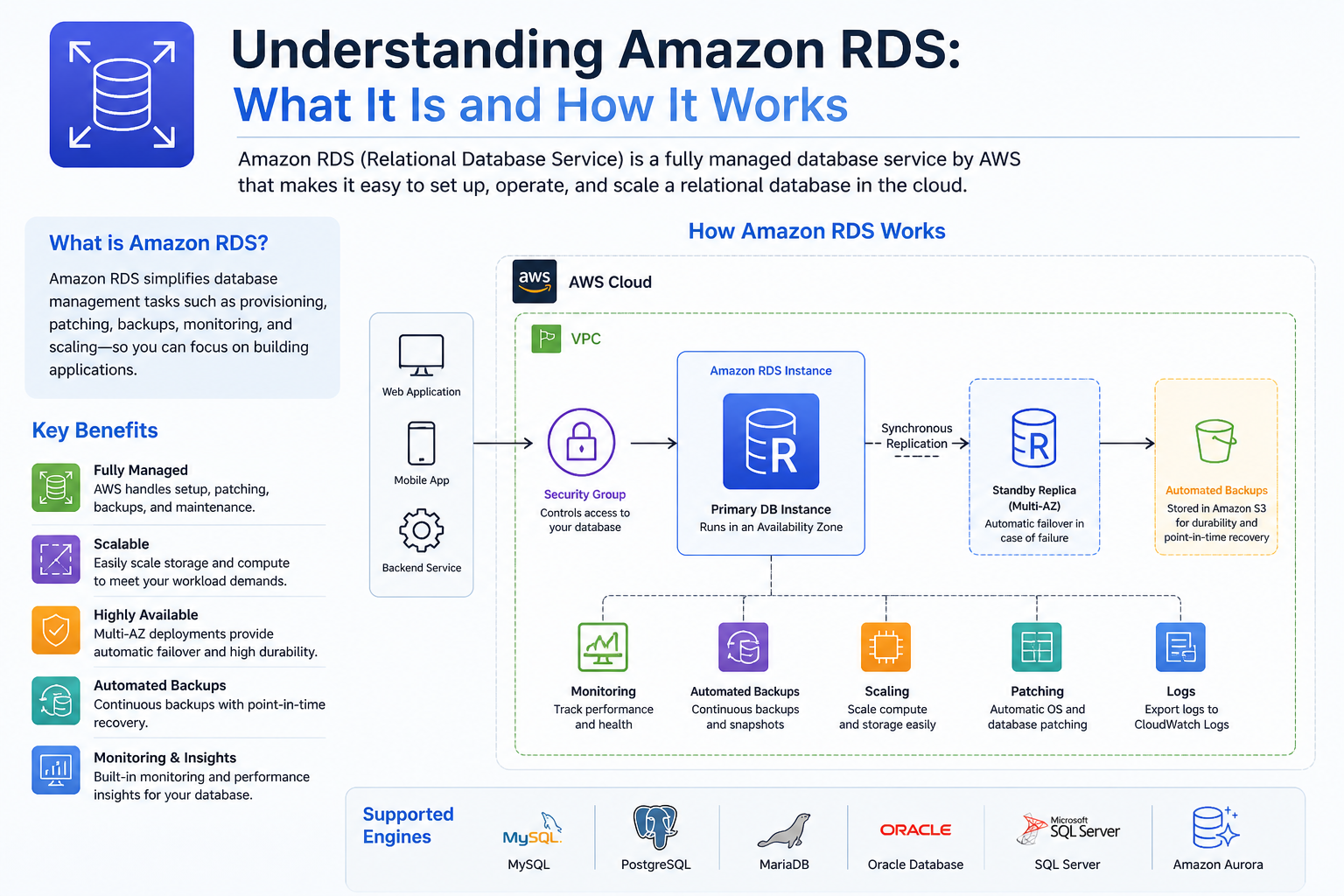
Amazon RDS (Relational Database Service) is a cloud-based service that simplifies relational database management by handling routine administrative tasks automatically. It is designed to reduce the complexity involved in deploying and maintaining traditional databases, allowing users to focus more on application development and business logic rather than infrastructure management. By abstracting away much of the operational burden, it provides a more efficient and scalable way to run databases in cloud environments.
At its core, Amazon RDS provides a managed environment where relational databases can be created, configured, and maintained with minimal manual intervention. It supports several widely used database engines, giving users flexibility in choosing the technology that best aligns with their application requirements. These engines are fully integrated into the service, meaning users do not need to worry about installation, patching, or low-level configuration.
Core Concept of Managed Database Service
The fundamental idea behind Amazon RDS is the concept of managed infrastructure. In a traditional setup, database administrators are responsible for installing software, configuring servers, applying security patches, monitoring performance, and handling backups. This process can be time-consuming and prone to human error.
With Amazon RDS, these responsibilities are shifted to the service itself. The system automatically provisions the necessary infrastructure and ensures that the database runs efficiently. It continuously monitors the health of the database instance and takes corrective actions when needed. This automation significantly reduces operational overhead and increases system reliability.
Database Engines Supported in Amazon RDS
Amazon RDS supports multiple relational database engines, allowing users to select based on their technical and business needs. Each engine is fully managed within the service environment, meaning operational tasks are handled consistently regardless of the engine chosen.
The supported engines include widely used relational database technologies that are commonly used in enterprise applications, web systems, and data-driven platforms. Each engine has its own strengths in terms of performance, compatibility, and feature sets, but they all benefit from the same managed infrastructure capabilities provided by the service.
This flexibility is particularly useful for organizations migrating existing applications to the cloud, as they can continue using familiar database technologies without major changes to their application architecture.
How Amazon RDS Works in Practice
When a user creates a database instance in Amazon RDS, the service automatically provisions the underlying compute and storage resources. This instance behaves like a fully functional database server, but without requiring manual setup of the operating system or database software.
Once the instance is launched, users can connect to it using standard database tools and applications. From that point onward, the service handles most of the operational responsibilities in the background. This includes monitoring performance, applying updates, and ensuring availability.
The system also provides configuration options that allow users to control aspects such as storage capacity, instance size, and backup policies. These settings can be adjusted as requirements evolve, enabling dynamic scaling without significant downtime.
Storage and Data Management
Storage in Amazon RDS is designed to be both flexible and reliable. It automatically scales based on the needs of the database, reducing the need for manual capacity planning. The storage system is also engineered for durability, ensuring that data is protected against hardware failures.
Data is continuously replicated within the underlying infrastructure to maintain consistency and availability. This replication helps ensure that even if one component fails, the database remains accessible through redundant systems. This architecture significantly reduces the risk of data loss and downtime.
In addition, storage performance is optimized for database workloads, allowing efficient handling of both read and write operations. This makes it suitable for applications that require consistent and predictable performance.
Backup and Recovery Mechanisms
One of the most important features of Amazon RDS is its automated backup system. Backups are created regularly without requiring manual intervention, ensuring that data can be restored in case of accidental deletion, corruption, or system failure.
These backups are stored securely and can be retained for a configurable period. Users also have the option to create manual snapshots at specific points in time, which can be useful for long-term archival or testing purposes.
Recovery processes are designed to be straightforward. In the event of a failure, the system can restore the database to a previous state using available backups. This reduces downtime and minimizes data loss, which is critical for business continuity.
High Availability and Failover Support
Amazon RDS is built with high availability in mind. It provides mechanisms that allow database instances to remain operational even in the event of infrastructure failures. This is achieved through a feature that maintains a standby replica of the database in a separate location.
If the primary instance becomes unavailable, the system automatically switches to the standby replica. This process, known as failover, helps ensure that applications experience minimal disruption. The transition is handled automatically, without requiring manual intervention.
This architecture is particularly valuable for applications that require continuous uptime, such as financial systems, e-commerce platforms, and enterprise software.
Scalability of Database Resources
Scalability is a key advantage of Amazon RDS. Users can increase or decrease computing power and storage capacity based on workload demands. This flexibility allows systems to handle both low-traffic and high-traffic scenarios efficiently.
Vertical scaling, which involves changing the size of the database instance, can be performed with minimal downtime. This makes it easy to adapt to growing application requirements without redesigning the entire system.
In addition, read-heavy workloads can be optimized by distributing traffic across multiple read replicas. These replicas help reduce the load on the primary database instance, improving overall performance and responsiveness.
Security and Data Protection
Security is a fundamental aspect of Amazon RDS. The service includes multiple layers of protection to safeguard data from unauthorized access and potential threats. This includes encryption mechanisms for data at rest and in transit.
Access to database instances is controlled through identity and permission management systems. Users can define who has access to specific resources and what actions they are allowed to perform. This ensures that sensitive data remains protected.
The system also supports network isolation, allowing databases to be deployed within private environments. This adds an additional layer of security by limiting external access.
Performance Monitoring and Optimization
Amazon RDS includes built-in monitoring tools that help track database performance in real time. These tools provide insights into resource utilization, query performance, and system health.
By analyzing this data, users can identify performance bottlenecks and optimize database configurations accordingly. This helps ensure that applications run efficiently even under heavy workloads.
Automated monitoring also allows the system to detect unusual behavior and respond proactively. This contributes to maintaining consistent performance and reliability.
Maintenance and Automated Updates
One of the major advantages of Amazon RDS is automated maintenance. The service handles software patching, minor version upgrades, and system updates without requiring manual intervention.
Maintenance tasks are typically scheduled during defined time windows to minimize disruption. In many cases, updates are applied in a way that reduces or eliminates downtime.
This automation ensures that database systems remain secure and up to date without requiring constant administrative effort.
Use Cases of Amazon RDS
Amazon RDS is widely used across different industries and application types. It is commonly used for web applications that require reliable data storage and retrieval. It is also used in enterprise systems that handle large volumes of transactional data.
E-commerce platforms benefit from its high availability and scalability features, while analytics applications use it to manage structured data efficiently. Development and testing environments also use Amazon RDS to quickly deploy and manage databases without complex setup processes.
Its versatility makes it suitable for both small-scale applications and large enterprise systems.
Advantages of Using Amazon RDS
One of the main advantages of Amazon RDS is reduced operational complexity. By automating routine database tasks, it allows teams to focus on application development rather than infrastructure management.
It also provides high availability, scalability, and security features that are difficult to implement manually in traditional environments. The ability to quickly deploy and modify database instances makes it highly flexible.
Additionally, its support for multiple database engines ensures compatibility with a wide range of applications.
Challenges and Considerations
While Amazon RDS offers many benefits, it also has certain limitations. Users have less control over the underlying infrastructure compared to fully self-managed databases. This can be a constraint for applications requiring deep system customization.
Cost can also increase depending on usage, especially for high-performance configurations or large-scale deployments. Proper planning is required to optimize resource usage and control expenses.
Despite these considerations, the benefits often outweigh the limitations for most use cases.
Amazon RDS Architecture Overview
Amazon RDS is built on a layered architecture that separates database management responsibilities from underlying infrastructure management. This design allows users to interact with a fully functional database system while the service handles provisioning, hardware maintenance, and operational tasks in the background. The architecture is designed to ensure reliability, scalability, and fault tolerance without requiring manual intervention from users.
At the foundation, RDS runs on virtualized compute instances that are managed by the cloud environment. These instances host the database engine and are connected to a storage layer that is optimized specifically for database workloads. The separation between compute and storage allows each component to scale independently, improving flexibility and performance efficiency.
Above the infrastructure layer, the database engine operates as it would in a traditional environment, but with additional management services integrated into it. These services continuously monitor performance, apply updates, and manage backups. This layered approach ensures that the database remains highly available and resilient under different workload conditions.
Multi-AZ Deployment and High Availability Design
One of the most important features of Amazon RDS is Multi-AZ deployment, which is designed to provide high availability and fault tolerance. In this configuration, a primary database instance is replicated synchronously to a standby instance located in a different availability zone.
This standby instance remains inactive for read and write operations but is continuously updated with changes from the primary database. In the event of a failure, the system automatically switches to the standby instance, ensuring minimal downtime and uninterrupted service.
This automatic failover mechanism is critical for applications that require continuous availability. It eliminates the need for manual intervention during infrastructure failures and significantly reduces recovery time. The architecture ensures that data remains consistent and protected even in the event of unexpected outages.
Read Replicas and Performance Scaling
Amazon RDS provides read replicas as a mechanism to improve performance for read-heavy workloads. A read replica is a copy of the primary database that asynchronously replicates data from the source instance. These replicas can be used to distribute read traffic, reducing the load on the primary database.
This approach is particularly useful for applications that handle large numbers of read requests, such as reporting systems, analytics dashboards, and content-heavy platforms. By offloading read operations to replicas, the primary database can focus on write operations and critical transactions.
Read replicas can also be promoted to standalone databases if needed, providing additional flexibility for scaling or disaster recovery scenarios. This feature enhances both performance and operational resilience.
Storage Architecture and Data Durability
The storage system in Amazon RDS is designed to provide high durability and performance. It uses a distributed architecture that automatically replicates data across multiple physical devices within a region. This ensures that data is protected against hardware failures and corruption.
Storage is also decoupled from compute resources, allowing it to scale independently. As data volume grows, storage capacity can automatically increase without requiring downtime or manual intervention. This elasticity is essential for applications with unpredictable or rapidly growing data needs.
The system is engineered to provide low-latency access to data, ensuring that database operations remain fast and efficient even under heavy workloads. This combination of durability and performance makes it suitable for mission-critical applications.
Backup Strategies and Point-in-Time Recovery
Amazon RDS offers a comprehensive backup system that supports both automated and manual backups. Automated backups are performed continuously and allow users to restore their database to any point within a defined retention period.
This point-in-time recovery capability is particularly valuable in scenarios where data corruption or accidental changes occur. Instead of restoring from a single snapshot, users can revert the database to a specific moment before the issue happened.
Manual snapshots provide additional flexibility by allowing users to capture the state of the database at any time. These snapshots can be stored for long periods and used for archival, testing, or migration purposes. Together, these backup strategies provide strong data protection and recovery options.
Security Architecture and Data Protection Mechanisms
Security in Amazon RDS is implemented through multiple layers that protect data at rest, in transit, and during access. Data encryption is supported both for stored data and for network communication between applications and database instances.
Access control is managed through identity-based policies that define who can interact with database resources. These policies ensure that only authorized users and applications can perform specific actions, reducing the risk of unauthorized access.
Network security is enhanced by allowing databases to be deployed within isolated virtual networks. This limits exposure to external threats and provides a controlled environment for sensitive data. These combined security measures make RDS suitable for handling confidential and regulated data.
Database Migration and Integration Capabilities
Amazon RDS supports database migration from on-premises environments and other cloud platforms. This is achieved through specialized tools that help transfer data with minimal downtime and disruption.
Migration processes typically involve replicating data from the source system to the RDS environment while keeping both systems in sync until the final cutover. This ensures a smooth transition without significant service interruption.
Integration with other cloud services further enhances its usability. RDS can be connected to analytics tools, application services, and storage systems, enabling seamless data flow across different components of an application ecosystem.
Performance Optimization Techniques
Performance optimization in Amazon RDS involves a combination of configuration tuning, monitoring, and architectural design. Users can adjust instance sizes, storage types, and parameter settings to match workload requirements.
The service also provides performance insights that help identify slow queries, resource bottlenecks, and inefficient operations. By analyzing this data, users can optimize database structure and query design to improve efficiency.
Caching mechanisms and read replicas further enhance performance by reducing direct load on the primary database. These techniques ensure that applications remain responsive even under high traffic conditions.
Pricing Model and Cost Considerations
The pricing structure of Amazon RDS is based on resource usage, including compute capacity, storage consumption, and data transfer. Users are charged based on the configuration of their database instances and the duration of usage.
Different pricing options are available depending on workload requirements, including on-demand and reserved capacity models. On-demand usage provides flexibility, while reserved options offer cost savings for long-term deployments.
Additional costs may apply for features such as backups, read replicas, and cross-region replication. Proper planning and resource optimization are important for controlling overall expenses while maintaining performance and reliability.
Monitoring, Logging, and Observability
Amazon RDS provides extensive monitoring capabilities that allow users to track database performance and system health in real time. Metrics such as CPU usage, memory consumption, and disk I/O are continuously collected and displayed through monitoring tools.
Logging features provide detailed information about database operations, including query execution and error reporting. This information is valuable for debugging issues and optimizing performance.
Observability tools help administrators gain insights into system behavior and identify potential issues before they impact application performance. This proactive monitoring approach improves overall system stability.
Automation and Operational Efficiency
Automation is a key strength of Amazon RDS. Routine tasks such as patching, backups, and system maintenance are handled automatically by the service. This reduces the need for manual intervention and minimizes the risk of human error.
Automated scaling capabilities allow the system to adjust resources based on demand. This ensures that performance remains consistent even during sudden traffic spikes or workload changes.
Operational efficiency is further enhanced by simplified management interfaces that allow users to perform complex tasks with minimal effort. This makes database administration more accessible and less time-consuming.
Common Use Cases in Real-World Applications
Amazon RDS is widely used across industries for a variety of applications. In web development, it serves as the backend database for dynamic websites and applications that require reliable data storage.
In enterprise environments, it supports business applications that handle transactional data, customer records, and operational workflows. Its reliability and scalability make it suitable for mission-critical systems.
Data-driven applications such as reporting tools and analytics platforms also benefit from its ability to manage large volumes of structured data efficiently. Its flexibility allows it to adapt to different workload types and business requirements.
Limitations and Design Considerations
Despite its advantages, Amazon RDS has certain limitations. Users have restricted access to underlying operating systems and infrastructure, which limits customization options for advanced configurations.
Some workloads that require extremely high levels of control or specialized database tuning may not be ideal for RDS. In such cases, self-managed database solutions might be more appropriate.
Cost can also become a factor in large-scale deployments if resources are not optimized effectively. Careful planning is required to balance performance needs with budget constraints.
Best Practices for Using Amazon RDS
To maximize the benefits of Amazon RDS, it is important to follow best practices in design and management. This includes selecting appropriate instance sizes based on workload requirements and regularly monitoring performance metrics.
Using Multi-AZ deployments for critical applications ensures high availability and fault tolerance. Implementing read replicas can significantly improve performance for read-heavy workloads.
Regularly reviewing security configurations and access policies helps maintain a secure environment. Additionally, optimizing queries and database schemas contributes to better performance and resource utilization.
Future Trends and Evolution of Managed Databases
Managed database services like Amazon RDS continue to evolve as cloud technologies advance. Future developments are likely to focus on greater automation, improved performance optimization, and deeper integration with artificial intelligence and analytics tools.
There is also a growing trend toward serverless database architectures, which further reduce operational complexity by eliminating the need for instance management altogether. These innovations are expected to complement existing managed services and expand their capabilities.
As organizations continue to adopt cloud-native architectures, services like Amazon RDS will play an increasingly important role in simplifying database management and enabling scalable application development.
Advanced Features of Amazon RDS
Amazon RDS offers several advanced features that extend its capabilities beyond basic database hosting. These features are designed to improve automation, resilience, performance, and integration with modern cloud-native applications. They allow organizations to build highly scalable and reliable systems without needing deep expertise in infrastructure management.
One of the key advanced capabilities is automated patching. The service continuously ensures that database engines are updated with the latest security fixes and performance improvements. This reduces the risk of vulnerabilities and keeps systems aligned with current standards. Users can schedule maintenance windows, allowing updates to be applied at convenient times with minimal disruption.
Another important feature is enhanced monitoring. Amazon RDS provides detailed performance metrics that go beyond basic system statistics. These insights include query-level performance tracking, resource utilization trends, and database load analysis. This level of visibility helps administrators fine-tune configurations and detect inefficiencies early.
Parameter Groups and Database Customization
Amazon RDS allows customization of database behavior through parameter groups. These are configuration templates that control how the database engine operates. Users can adjust settings such as memory allocation, query caching, logging behavior, and connection limits.
Parameter groups provide a flexible way to optimize performance based on workload requirements. For example, a high-transaction system may require different tuning compared to a reporting or analytics system. Changes to parameter groups can be applied without directly modifying the database engine, making configuration management more structured and controlled.
This separation of configuration from infrastructure simplifies administration and reduces the risk of misconfiguration. It also allows consistent settings to be applied across multiple database instances.
Event Notifications and Automation Triggers
Amazon RDS includes event notification capabilities that allow users to receive alerts about important database activities. These events may include instance creation, backup completion, failover occurrences, or maintenance updates.
By integrating these notifications with automation tools, organizations can create responsive systems that react to database changes in real time. For example, an alert about a failover event can trigger automated scaling actions or logging processes.
This event-driven approach enhances operational awareness and helps teams respond quickly to changes in database status. It also supports more advanced automation workflows in modern cloud architectures.
Cross-Region Replication and Disaster Recovery
For organizations that require global availability and disaster recovery capabilities, Amazon RDS supports cross-region replication. This feature allows database copies to be created in different geographic regions, ensuring data availability even in the event of a regional outage.
Cross-region replicas are particularly useful for disaster recovery planning. In case of a major failure in one region, traffic can be redirected to a replica in another region, minimizing downtime and data loss.
This capability also supports global applications by reducing latency for users in different parts of the world. By placing replicas closer to end users, response times can be improved significantly.
Data Consistency and Transaction Management
Amazon RDS ensures strong data consistency through transactional processing mechanisms. This means that database operations are executed in a way that maintains accuracy and reliability, even in complex multi-step transactions.
If an operation fails at any stage, the system can roll back changes to maintain data integrity. This ensures that partial updates do not corrupt the database or lead to inconsistent states.
Transaction management is especially important for applications that handle financial data, inventory systems, or any environment where accuracy is critical. The reliability of transactional processing is one of the core strengths of relational database systems managed through RDS.
Elasticity and Dynamic Resource Allocation
One of the defining characteristics of Amazon RDS is its ability to dynamically adjust resources based on demand. This elasticity allows database instances to scale vertically by increasing compute power or storage capacity as needed.
Dynamic allocation helps ensure that performance remains stable during periods of high demand. When workload decreases, resources can be scaled down to optimize cost efficiency.
This flexible approach eliminates the need for manual capacity planning and allows systems to respond automatically to changing usage patterns. It is particularly useful for applications with unpredictable traffic.
Integration with Cloud Ecosystem Services
Amazon RDS is designed to integrate seamlessly with other cloud services, enabling the creation of complex and interconnected application architectures. It can work alongside analytics platforms, storage systems, monitoring tools, and application hosting services.
This integration allows data stored in RDS to be used across different parts of an application ecosystem. For example, data can be exported to analytics services for reporting or processed in real-time by application services.
Such interoperability enhances the value of RDS by making it a central component in broader cloud-based solutions.
Query Optimization and Indexing Strategies
Efficient query execution is essential for maintaining database performance. Amazon RDS supports standard indexing techniques that help speed up data retrieval operations. Proper indexing reduces the amount of data scanned during queries, improving response times.
Query optimization tools provide insights into execution plans, allowing developers to identify inefficient queries and restructure them for better performance. This process is critical for applications with large datasets or complex query patterns.
By combining indexing strategies with performance monitoring, users can achieve significant improvements in database efficiency.
Connection Management and Load Handling
Managing database connections efficiently is important for maintaining stability under high traffic conditions. Amazon RDS includes mechanisms to handle multiple concurrent connections without degrading performance.
Connection pooling techniques can be used to reuse existing connections rather than creating new ones for every request. This reduces overhead and improves response times.
The system is designed to handle spikes in traffic by distributing load effectively across available resources. This ensures consistent performance even during peak usage periods.
Storage Optimization and Cost Efficiency
Storage efficiency plays a key role in managing overall system costs. Amazon RDS provides different storage types optimized for performance and cost balance. Users can select storage configurations based on workload requirements.
Automatic storage scaling ensures that capacity increases when needed without manual intervention. This prevents storage limitations from affecting application performance.
Cost optimization strategies include selecting appropriate instance types, managing backup retention policies, and using reserved capacity options for predictable workloads.
Security Compliance and Regulatory Support
Amazon RDS supports compliance with various industry standards and regulatory frameworks. This makes it suitable for use in sectors such as finance, healthcare, and government services.
Compliance features include encryption, auditing, and access control mechanisms that help organizations meet regulatory requirements. Logs and monitoring data can be used to demonstrate adherence to security policies.
These capabilities reduce the complexity of maintaining compliance in highly regulated environments.
Fault Tolerance and Self-Healing Mechanisms
Fault tolerance is built into the core design of Amazon RDS. The system continuously monitors database health and automatically responds to failures.
If an issue is detected, the system can initiate recovery processes such as failover, restart, or resource reallocation. These self-healing mechanisms reduce downtime and ensure continuous operation.
This automation significantly improves system reliability and reduces the need for manual intervention during critical events.
Development and Testing Environments
Amazon RDS is widely used in development and testing environments due to its ease of setup and flexibility. Developers can quickly create database instances for application testing without worrying about infrastructure configuration.
These environments can be easily replicated or reset, making them ideal for iterative development processes. Snapshots allow developers to capture database states and restore them as needed during testing cycles.
This flexibility accelerates development workflows and improves productivity.
Data Lifecycle Management
Managing data over its lifecycle is an important aspect of database administration. Amazon RDS provides tools for managing data retention, archiving, and deletion policies.
Older data can be archived to reduce storage costs while maintaining accessibility when needed. Automated retention policies ensure that data is managed consistently over time.
This structured approach to data lifecycle management helps organizations maintain efficient and compliant data storage practices.
Operational Resilience in Cloud Environments
Operational resilience refers to the ability of a system to continue functioning despite failures or disruptions. Amazon RDS is designed with multiple layers of redundancy and automation to ensure resilience.
Features such as Multi-AZ deployment, automated backups, and self-healing mechanisms work together to maintain system stability. This reduces the impact of infrastructure failures on applications.
Resilience is a key requirement for modern cloud applications, and RDS provides a strong foundation for achieving it.
Operational Management in Amazon RDS
Managing database operations in Amazon RDS is significantly simplified compared to traditional database environments. The service automates many of the routine administrative tasks that would normally require dedicated database administrators. This includes monitoring system health, applying updates, handling backups, and managing failover processes.
Operational management is designed to reduce human intervention while maintaining high levels of reliability. The system continuously tracks performance metrics and automatically responds to potential issues before they escalate into major failures. This proactive approach ensures that database systems remain stable and available under varying workloads.
In addition to automation, users are provided with intuitive management interfaces that allow them to configure, monitor, and control database instances. These tools make it easier to manage complex database environments without requiring deep infrastructure expertise.
Lifecycle of an Amazon RDS Database Instance
The lifecycle of a database instance in Amazon RDS begins with creation and provisioning. During this phase, the system allocates the necessary compute and storage resources and configures the selected database engine. This process is fully automated and typically completes within minutes.
Once the instance is active, it enters a running state where it handles application requests and performs database operations. During this phase, it is continuously monitored for performance, availability, and security compliance.
Over time, the instance may undergo modifications such as scaling, configuration updates, or patching. These changes are managed in a controlled manner to minimize downtime and maintain system stability. Eventually, the instance may be stopped or deleted when it is no longer needed, with data optionally retained through snapshots or backups.
Monitoring Tools and Performance Insights
Amazon RDS provides comprehensive monitoring tools that help users understand database behavior and performance trends. These tools collect detailed metrics such as CPU utilization, memory usage, disk I/O, and query performance.
Performance insights allow users to analyze database load and identify which queries or processes are consuming the most resources. This level of visibility helps in diagnosing performance issues and optimizing database efficiency.
Monitoring data is presented in a structured format that allows for easy interpretation and decision-making. By using these insights, administrators can make informed adjustments to improve system performance and stability.
Automation of Routine Maintenance Tasks
One of the key strengths of Amazon RDS is its ability to automate routine maintenance tasks. These tasks include software patching, minor version upgrades, and system optimization processes.
Maintenance operations are typically scheduled during predefined windows to minimize disruption to applications. In many cases, updates are applied seamlessly with little or no downtime.
This automation reduces the operational burden on database administrators and ensures that systems remain up to date with the latest improvements and security patches.
Cost Optimization Strategies in Amazon RDS
Cost management is an important aspect of using Amazon RDS effectively. Since pricing is based on resource usage, optimizing database configurations can significantly reduce operational expenses.
One common strategy is selecting the appropriate instance size based on workload requirements. Over-provisioning resources can lead to unnecessary costs, while under-provisioning can impact performance.
Another strategy involves using reserved instances for long-term workloads. This provides cost savings compared to on-demand pricing. Additionally, optimizing storage usage and managing backup retention policies can further reduce expenses.
By carefully planning resource allocation, organizations can achieve a balance between performance and cost efficiency.
Scalability in Real-World Scenarios
Amazon RDS is designed to handle a wide range of workloads, from small applications to large enterprise systems. Its scalability features allow it to adapt to changing demands without requiring significant architectural changes.
In real-world scenarios, applications may experience sudden spikes in traffic due to seasonal demand, marketing campaigns, or user growth. RDS handles these situations by allowing vertical scaling of compute resources and horizontal scaling through read replicas.
This flexibility ensures that applications remain responsive and stable even under unpredictable conditions. It also allows businesses to grow without worrying about database limitations.
Reliability and Fault Recovery Mechanisms
Reliability is a core design principle of Amazon RDS. The system is built with multiple layers of redundancy to ensure continuous operation even in the event of hardware or software failures.
Automatic failover mechanisms ensure that if a primary database instance becomes unavailable, a standby instance can take over without manual intervention. This reduces downtime and ensures continuity of service.
Backup and recovery systems further enhance reliability by allowing data to be restored quickly in case of corruption or accidental deletion. These mechanisms work together to provide a highly resilient database environment.
Integration with Modern Application Architectures
Amazon RDS integrates well with modern application architectures, including microservices, serverless computing, and containerized environments. This makes it a versatile choice for contemporary software development.
Applications can interact with RDS using standard database protocols, making integration straightforward. This compatibility allows developers to use familiar tools and frameworks without major modifications.
The service also works seamlessly with other cloud-native components, enabling the creation of scalable and distributed systems that are easy to manage and maintain.
Data Consistency and Integrity Assurance
Maintaining data consistency is critical for any relational database system. Amazon RDS ensures that all transactions are processed reliably and that data remains accurate even in complex scenarios.
Transaction management systems ensure that operations are completed fully or not at all, preventing partial updates that could lead to inconsistencies. This is especially important for applications that handle financial transactions or sensitive data.
Integrity constraints and validation mechanisms further ensure that data stored in the database adheres to defined rules and structures.
Use in Enterprise and Business Applications
Amazon RDS is widely used in enterprise environments where reliability, scalability, and security are essential. It supports applications such as customer relationship management systems, enterprise resource planning platforms, and financial systems.
Its ability to handle structured data efficiently makes it ideal for business-critical applications that require consistent performance and high availability.
Organizations benefit from reduced infrastructure complexity, allowing them to focus on core business operations rather than database management.
Ecosystem Advantages of Amazon RDS
One of the key advantages of Amazon RDS is its integration within a broader cloud ecosystem. It works seamlessly with other cloud services, enabling data sharing, analytics, and application development workflows.
This interconnected environment allows organizations to build end-to-end solutions that are scalable and efficient. Data stored in RDS can be easily used by analytics engines, machine learning models, and application services.
This ecosystem approach enhances productivity and simplifies system architecture design.
Future of Managed Relational Databases
The future of managed relational databases is moving toward greater automation, intelligence, and serverless architectures. Amazon RDS is expected to evolve further with enhanced automation capabilities and deeper integration with artificial intelligence tools.
Emerging trends include predictive scaling, self-tuning databases, and automated performance optimization. These advancements will further reduce the need for manual intervention and improve system efficiency.
As cloud adoption continues to grow, managed database services will play an increasingly central role in application development and deployment strategies.
Final Conclusion
Amazon RDS represents a major advancement in database management by providing a fully managed, scalable, and secure relational database service. It eliminates much of the complexity associated with traditional database administration by automating tasks such as provisioning, backups, patching, monitoring, and failover.
Through its flexible architecture, support for multiple database engines, and integration with cloud ecosystems, it enables organizations to build robust and high-performing applications with minimal operational overhead. Features such as high availability, read replicas, automated scaling, and strong security controls make it suitable for a wide range of use cases, from small applications to large enterprise systems.
While it does have certain limitations in terms of customization and cost control, its benefits in reliability, efficiency, and ease of use make it one of the most widely adopted managed database services in modern cloud computing. Overall, Amazon RDS plays a crucial role in simplifying database operations and enabling organizations to focus on innovation and growth rather than infrastructure management.