Modern organizations depend on stable, secure, and scalable networking infrastructure more than ever before. Every application, cloud service, remote employee, security policy, and collaboration platform relies on a network stack that functions properly behind the scenes. While end users rarely think about the architecture powering their daily workflows, IT teams understand that the quality of the network stack directly affects productivity, security, and operational continuity.
As businesses expand their digital operations, infrastructure decisions become increasingly strategic. Organizations must determine not only which technologies they want to deploy, but also whether they should standardize on one vendor ecosystem or combine solutions from several providers. This debate has become one of the most important long-term infrastructure discussions in enterprise IT.
The concept of a network stack extends far beyond switches and routers. A modern stack includes every layer of networking and connectivity infrastructure required to support business operations. This often includes switches, wireless access points, firewalls, routing infrastructure, software-defined networking tools, centralized management systems, monitoring platforms, automation frameworks, authentication systems, segmentation technologies, and cloud connectivity solutions.
Together, these components create the digital backbone of the organization. When properly designed, the stack allows employees to collaborate efficiently, applications to communicate securely, and administrators to manage operations effectively. When poorly designed, the same infrastructure becomes a constant source of outages, security incidents, performance bottlenecks, and operational frustration.
The challenge for IT leaders is that there is no universal blueprint for building the ideal network stack. Every organization has different priorities, budgets, staffing models, growth expectations, and compliance requirements. Some businesses prioritize operational simplicity above all else, while others focus on flexibility, cost optimization, or best-in-class performance.
This is where the debate between single-vendor and mixed-vendor environments begins.
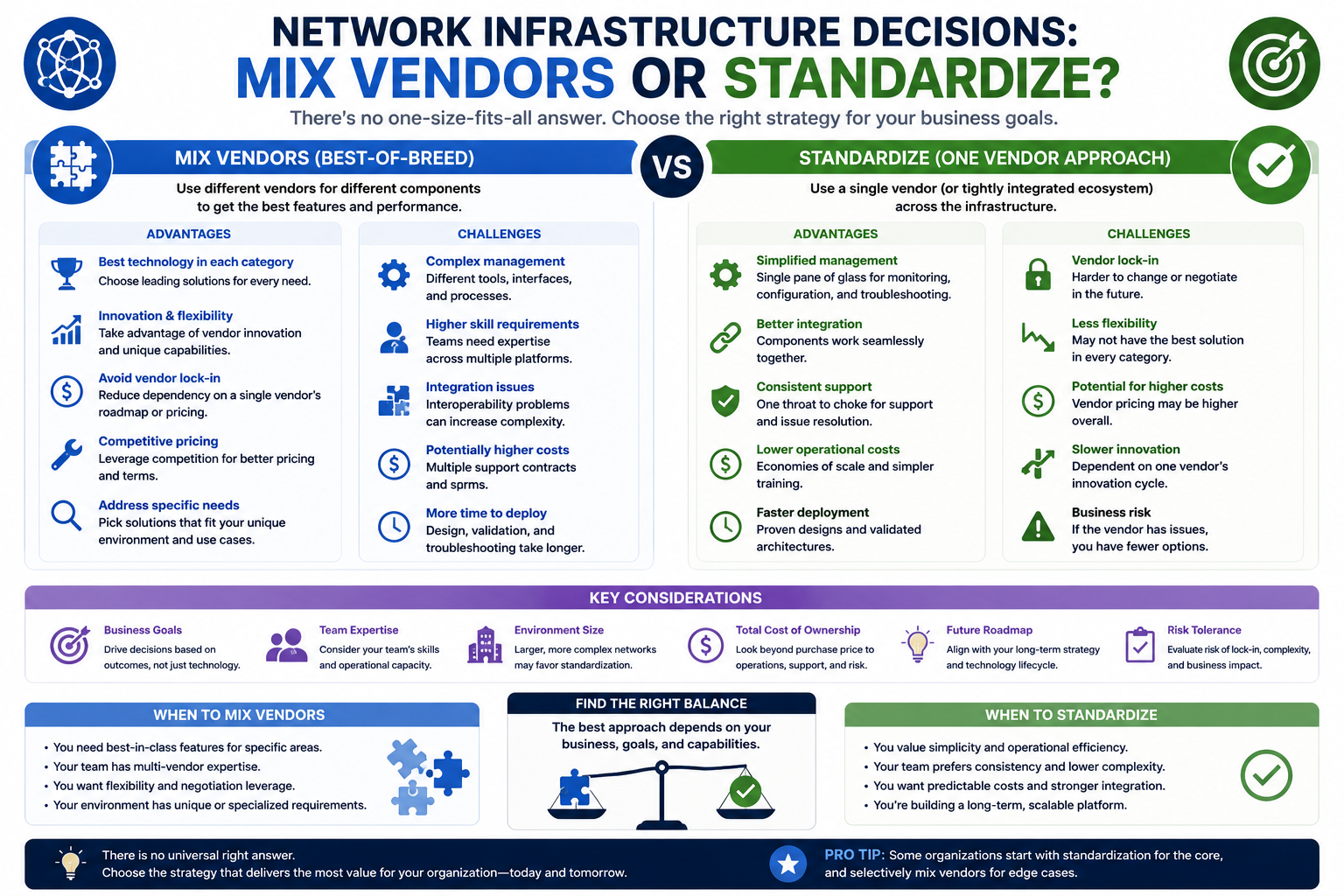
A single-vendor approach involves selecting one primary vendor for most or all infrastructure layers. In these environments, switching, wireless networking, security systems, management platforms, and automation tools are all designed to operate within the same ecosystem.
A mixed-vendor strategy takes the opposite approach. Organizations deliberately select products from different vendors to create a customized environment built around specific strengths. One vendor may provide security infrastructure, while another handles wireless networking or switching.
Both approaches can succeed. Both can also fail if implemented without proper planning and operational maturity.
Understanding when to standardize and when to diversify requires careful analysis of business priorities, technical capabilities, operational workflows, and long-term goals.
Why the Network Stack Matters More Than Ever
The importance of networking infrastructure has changed dramatically over the past decade. Traditional office environments once relied on relatively simple client-server communication models. Employees worked primarily from corporate offices, applications ran inside local data centers, and security perimeters were easier to define.
Modern business environments are far more dynamic.
Organizations now support hybrid workforces, cloud-native applications, remote offices, mobile devices, IoT systems, AI-driven workloads, and increasingly sophisticated cybersecurity threats. Data flows constantly between users, cloud providers, branch offices, SaaS applications, and distributed environments.
As networks become more complex, the underlying stack becomes increasingly important.
Performance issues that once affected only local office traffic can now impact global collaboration, cloud productivity platforms, and customer-facing services. Security weaknesses inside the network stack can expose organizations to ransomware attacks, unauthorized access, and data breaches.
At the same time, operational efficiency has become a major concern for IT departments. Teams are expected to manage growing infrastructures without dramatically increasing headcount. Automation, centralized visibility, and simplified troubleshooting are now essential operational goals.
This changing landscape has pushed organizations to rethink how they design and maintain their networking environments.
Instead of treating networking as isolated hardware deployments, businesses increasingly view the network stack as an integrated operational platform that supports long-term digital transformation.
Infrastructure decisions now influence nearly every aspect of business operations, including scalability, cybersecurity, cloud adoption, automation maturity, remote access capabilities, and disaster recovery planning.
The vendor strategy chosen today may shape operational flexibility for years to come.
The Core Philosophy Behind Single-Vendor Networking
Organizations that commit to a single-vendor environment usually prioritize consistency, operational simplicity, and centralized management.
In these environments, infrastructure components are intentionally selected to work together within a unified ecosystem. The goal is not necessarily to achieve the absolute best individual product in every category, but rather to create a cohesive operational framework that minimizes complexity.
This philosophy appeals strongly to organizations seeking predictability.
When switching, wireless networking, security tools, and management platforms all come from the same vendor, administrators typically gain access to unified dashboards, integrated analytics, coordinated policy management, and standardized deployment workflows.
The operational advantages can be significant.
Instead of maintaining multiple management interfaces, IT teams can often monitor and configure the environment through centralized platforms. Firmware compatibility is usually easier to maintain because vendors test updates within their own ecosystems. Automation workflows become more consistent because APIs and orchestration tools follow common design standards.
Support processes also become more streamlined.
When problems occur inside a mixed-vendor environment, troubleshooting often turns into a multi-party investigation involving several support teams. Each vendor may suspect another component is responsible for the issue.
In a single-vendor environment, support escalation paths are generally simpler. The vendor owns responsibility for a larger portion of the environment, reducing finger-pointing and shortening resolution times.
Organizations with smaller IT departments frequently value this simplicity because operational overhead matters just as much as technical performance.
A highly capable infrastructure still becomes problematic if the internal team struggles to manage it effectively.
Operational Consistency and Administrative Efficiency
Operational efficiency is one of the strongest arguments in favor of standardization.
Every networking vendor develops its own approach to management interfaces, command-line syntax, automation frameworks, telemetry systems, and policy structures. Supporting multiple ecosystems requires administrators to learn and maintain expertise across several operational models simultaneously.
That complexity adds up quickly.
Engineers managing mixed environments often switch constantly between different dashboards, alert systems, logging tools, and configuration standards. Even simple troubleshooting tasks may require correlation across several management platforms.
In contrast, unified ecosystems create consistency.
Configuration templates follow similar structures. Monitoring systems present information through familiar workflows. Automation scripts operate within standardized APIs. Security policies align more naturally across the environment.
This consistency improves day-to-day operations in several important ways.
New deployments become faster because administrators can replicate proven configurations across the environment. Branch office rollouts become more predictable because templates and provisioning workflows are already standardized.
Training also becomes easier.
New engineers entering the organization can focus deeply on one ecosystem rather than dividing attention across multiple platforms. This often accelerates onboarding and reduces operational mistakes caused by unfamiliar interfaces or inconsistent workflows.
Organizations with limited staffing resources may find this especially valuable.
A smaller team managing a highly standardized environment can sometimes outperform a larger team struggling with excessive complexity and fragmented operational visibility.
Administrative efficiency also affects incident response.
During outages or security incidents, speed matters. Teams working within a familiar ecosystem can often isolate issues more quickly because workflows, logs, alerts, and telemetry formats remain consistent across the environment.
Operational maturity depends heavily on repeatability, and standardization helps create repeatable operational processes.
The Value of Deep Integration
One of the defining characteristics of modern networking ecosystems is integration.
Vendors increasingly position their products as interconnected platforms rather than isolated hardware components. Switching infrastructure communicates with wireless controllers. Firewalls share telemetry with identity systems. Monitoring tools correlate events across the environment automatically.
These integrations create operational advantages that are difficult to replicate manually.
For example, an integrated environment may automatically detect a compromised endpoint, quarantine the device through network segmentation policies, update firewall rules dynamically, and notify administrators through centralized dashboards.
Achieving similar functionality across multiple vendors often requires additional engineering effort, custom integrations, or third-party orchestration tools.
Integrated ecosystems also improve visibility.
Administrators can track user sessions, application performance, device health, and security events across multiple infrastructure layers without manually stitching together information from separate systems.
This level of visibility is particularly important in distributed environments where users, applications, and devices constantly move between locations and cloud platforms.
Zero-trust security models further increase the importance of integration.
Modern security architectures rely heavily on identity-aware policies, continuous validation, segmentation enforcement, and automated threat response. These capabilities function more effectively when infrastructure components share telemetry and policy intelligence seamlessly.
Organizations adopting cloud-managed networking platforms often prioritize these integrations because centralized visibility and automation reduce operational burden significantly.
Integrated ecosystems also simplify compliance management.
Consistent policy enforcement across the environment makes it easier to demonstrate regulatory compliance and maintain audit readiness. Security baselines can be standardized across branch offices, campuses, and remote locations.
As infrastructures grow more complex, many organizations conclude that operational integration provides greater long-term value than isolated best-in-class performance.
The Financial Appeal of Standardization
Cost considerations play a major role in infrastructure planning.
At first glance, premium single-vendor ecosystems may appear expensive. However, organizations often evaluate total operational cost rather than focusing exclusively on hardware pricing.
Operational simplicity reduces administrative overhead. Centralized management platforms reduce the time required for troubleshooting and maintenance. Standardized training lowers onboarding complexity.
These efficiencies create measurable financial value over time.
Vendors also frequently reward standardization through enterprise agreements, bundled licensing, and preferred pricing structures. Organizations committing to broader adoption may receive discounts that reduce long-term procurement costs.
Support contracts become easier to manage as well.
Rather than juggling multiple renewal cycles, licensing frameworks, and vendor relationships, businesses can consolidate procurement under a unified operational model.
Lifecycle planning also becomes more predictable.
Vendors usually align firmware compatibility, support timelines, and hardware refresh recommendations across their ecosystems. This helps organizations coordinate upgrades more efficiently and reduce unexpected compatibility issues.
Budget forecasting improves because infrastructure roadmaps follow a more centralized structure.
Large enterprises sometimes prioritize this predictability over maximum flexibility because operational stability matters more than constant customization.
However, financial advantages can become disadvantages if organizations become excessively dependent on one vendor.
Subscription-based licensing models continue evolving rapidly across the networking industry. Vendors increasingly shift toward recurring revenue models that may increase operational costs over time.
Organizations deeply invested in proprietary ecosystems may struggle to pivot when pricing structures change unexpectedly.
As a result, financial evaluations must consider both short-term operational efficiency and long-term strategic flexibility.
The Role of Vendor Trust and Long-Term Stability
Choosing a networking ecosystem is not simply a technical decision. It is also a long-term partnership decision.
Organizations standardizing on one vendor place significant trust in that vendor’s roadmap, support quality, innovation strategy, and financial stability.
This trust becomes extremely important because infrastructure lifecycles often extend across many years.
Businesses want confidence that vendors will continue supporting key products, investing in relevant technologies, and maintaining compatibility across evolving platforms.
Operational continuity depends heavily on this long-term alignment.
When organizations trust a vendor’s direction, standardization becomes easier to justify. Teams gain confidence investing in certifications, automation frameworks, and operational processes built around the ecosystem.
This investment can create strong operational maturity over time.
Engineers develop deeper expertise. Automation becomes more sophisticated. Troubleshooting processes improve. Documentation standards become more refined.
These benefits compound over several years.
Organizations with mature operational processes often prioritize long-term stability over constantly evaluating alternative vendors.
For many businesses, the ability to maintain reliable operations consistently outweighs the theoretical advantages of assembling a highly customized infrastructure from multiple providers.Why Organizations Are Moving Toward Mixed-Vendor Strategies
While many businesses continue to rely on single-vendor ecosystems, an increasing number of organizations are adopting mixed-vendor network strategies. Instead of purchasing every infrastructure component from one manufacturer, these organizations intentionally combine products from different vendors to create an environment tailored to their specific operational and technical needs.
This approach has gained momentum because networking technology has evolved rapidly in recent years. Vendors have become highly specialized in certain areas of infrastructure, meaning one company may dominate wireless networking while another leads in firewall security or cloud-based management.
As a result, organizations are no longer automatically assuming that one vendor should control every layer of the environment.
The philosophy behind mixed-vendor networking is relatively straightforward. Rather than accepting compromises across an entire ecosystem, businesses select the strongest technologies for each infrastructure category. The goal is to maximize performance, flexibility, scalability, and cost efficiency by leveraging the unique strengths of different vendors.
For many IT leaders, this strategy reflects a broader shift in enterprise technology planning. Organizations increasingly prefer modular architectures that allow them to evolve individual infrastructure layers independently rather than being locked into rigid long-term ecosystems.
The rise of cloud computing, software-defined networking, and API-driven automation has also made integration between vendors more achievable than it once was. Modern infrastructure platforms often support open standards and interoperability features that reduce some of the barriers historically associated with multi-vendor environments.
At the same time, organizations have become more cautious about long-term vendor dependency.
Many businesses have experienced situations where licensing costs increased unexpectedly, support models changed dramatically, or product roadmaps shifted in ways that no longer aligned with operational goals. Mixed-vendor strategies provide a level of strategic flexibility that some organizations now consider essential.
However, while the advantages of mixed-vendor networking can be substantial, the operational realities are far more complicated than simply choosing the “best” products in each category.
Success requires careful planning, strong documentation, disciplined operational processes, and highly capable engineering teams.
The Best-of-Breed Infrastructure Philosophy
One of the biggest motivations behind mixed-vendor networking is the pursuit of best-of-breed performance.
No vendor dominates every infrastructure category equally. One company may provide exceptional firewall security while another delivers superior wireless performance or switching reliability.
Organizations adopting mixed-vendor architectures recognize this reality and build environments designed around specialization rather than ecosystem uniformity.
For example, a business may choose one vendor for enterprise-grade switching and wireless infrastructure while selecting another vendor specifically for advanced threat protection and firewall services.
This strategy allows organizations to optimize each layer of the stack independently.
Rather than compromising on security because the preferred networking vendor lacks advanced firewall capabilities, businesses can select a specialized security platform that better aligns with their requirements.
Similarly, organizations dissatisfied with wireless performance inside one ecosystem may choose alternative wireless technologies without redesigning the entire environment.
This flexibility can create measurable improvements in performance, reliability, and operational efficiency.
The best-of-breed approach also allows organizations to adapt more rapidly to technological innovation.
Infrastructure markets evolve constantly. Vendors introduce new automation tools, security capabilities, AI-driven analytics, and cloud management platforms every year. Mixed-vendor environments allow businesses to adopt emerging technologies selectively instead of waiting for one ecosystem to catch up across all infrastructure categories.
This adaptability is especially valuable in fast-moving industries where digital transformation initiatives evolve quickly.
Organizations pursuing aggressive cloud adoption, AI integration, advanced security segmentation, or hybrid workforce expansion often prioritize architectural flexibility because they expect infrastructure requirements to change continuously over time.
Avoiding the Risks of Vendor Lock-In
Vendor lock-in has become one of the most discussed concerns in modern enterprise IT.
When organizations commit heavily to a single ecosystem, replacing any part of the infrastructure can become extremely difficult. Management tools, licensing models, automation frameworks, security policies, and operational workflows become tightly coupled to the vendor’s architecture.
Over time, this dependency can limit strategic flexibility.
Organizations may discover that changing vendors requires large-scale redesigns, retraining initiatives, migration projects, and operational disruptions. Even when businesses become dissatisfied with pricing or product direction, the cost of leaving the ecosystem may feel overwhelming.
Mixed-vendor strategies help reduce this dependency.
Because the environment is already designed around interoperability, organizations can replace individual components more gradually. Switching platforms, firewalls, wireless infrastructure, or monitoring tools can evolve independently rather than forcing complete infrastructure overhauls.
This flexibility provides leverage during procurement negotiations as well.
Vendors recognize when organizations are fully dependent on their ecosystems. In some cases, this dependency weakens the customer’s ability to negotiate pricing, licensing terms, or support agreements effectively.
Businesses operating mixed-vendor environments retain more bargaining power because they maintain the option to shift future investments toward competing platforms.
Strategic flexibility becomes particularly important during periods of rapid industry change.
The networking industry continues transitioning toward subscription licensing, cloud-managed platforms, AI-driven analytics, and consumption-based pricing models. Organizations want the ability to adapt to these changes without becoming trapped inside inflexible infrastructure strategies.
For many IT leaders, avoiding lock-in is not simply about pricing. It is about preserving long-term operational control.
Businesses want the freedom to adopt new technologies, respond to market shifts, and evolve infrastructure architectures without excessive dependency on any single vendor’s roadmap.
Cost Optimization Through Infrastructure Diversity
Cost optimization is another major reason organizations choose mixed-vendor strategies.
Contrary to popular assumptions, the most expensive component is not always the most necessary in every part of the environment. Different infrastructure layers often have different operational priorities.
An organization may require premium security controls at headquarters and data center locations while using more cost-effective switching infrastructure in smaller branch offices.
Similarly, businesses may invest heavily in wireless performance for high-density campus environments while using simpler routing solutions in less demanding locations.
Mixed-vendor architectures allow organizations to allocate resources strategically.
Instead of paying premium pricing across the entire stack, businesses can focus investment where performance, scalability, or security matters most.
This approach becomes especially attractive during periods of budget pressure.
Organizations facing limited capital expenditure budgets may prefer selective investment strategies that maximize operational value without standardizing on premium pricing everywhere.
Cloud adoption also influences these decisions.
As more applications move into cloud environments, some organizations reevaluate traditional networking spending priorities. Businesses may shift investment toward cloud security, WAN optimization, or identity management while reducing emphasis on certain on-premises infrastructure layers.
Mixed-vendor environments provide the flexibility to align infrastructure spending with evolving business priorities.
However, organizations must evaluate operational costs carefully.
While hardware acquisition costs may decrease, administrative complexity often increases. Supporting multiple ecosystems requires broader expertise, additional training, more documentation, and potentially longer troubleshooting cycles.
True cost analysis must include both procurement expenses and long-term operational overhead.
A cheaper hardware platform may ultimately become more expensive if operational complexity increases dramatically.
How Specialized Vendors Shape Modern Infrastructure Decisions
The networking industry increasingly rewards specialization.
Some vendors focus heavily on security innovation. Others prioritize wireless networking, automation frameworks, cloud management, or software-defined architectures.
Organizations building mixed-vendor environments often select platforms based on these specialized strengths.
Security-focused vendors may provide superior threat intelligence integration, advanced malware detection, deep packet inspection, and segmentation capabilities.
Networking-focused vendors may deliver stronger wireless performance, simplified campus management, or more scalable switching architectures.
Cloud-centric platforms may emphasize centralized visibility, automation, and simplified remote deployment models.
This specialization creates compelling opportunities for organizations willing to manage additional complexity.
Rather than settling for average performance across every category, businesses can optimize individual infrastructure layers according to operational priorities.
The growth of APIs and automation standards has made this approach more practical than in the past.
Modern platforms increasingly support integration through standardized interfaces, automation frameworks, and orchestration tools. While interoperability challenges still exist, integration capabilities have improved significantly compared to earlier generations of enterprise networking.
Organizations with mature engineering teams often leverage these capabilities to build highly customized operational environments tailored to specific business requirements.
However, this customization requires operational discipline.
Successful mixed-vendor architectures depend heavily on testing, documentation, standardization practices, and cross-platform visibility strategies.
Without strong governance, complexity can quickly become unmanageable.
The Operational Complexity of Multi-Vendor Networking
Despite its advantages, mixed-vendor networking introduces operational challenges that organizations cannot ignore.
Every vendor ecosystem has its own management philosophy, configuration standards, terminology, monitoring tools, and automation models.
Supporting multiple platforms means administrators must understand several operational frameworks simultaneously.
This complexity affects nearly every aspect of infrastructure management.
Engineers may need to move constantly between different management consoles while troubleshooting incidents. Alert formats may vary between platforms. Logging structures may require manual correlation. Automation workflows may depend on entirely different scripting models.
Even basic operational tasks become more complicated.
Firmware updates must be coordinated carefully across multiple vendors. Compatibility testing becomes more important because software changes in one layer may affect behavior elsewhere in the environment.
Documentation requirements increase significantly as well.
Teams must track interoperability dependencies, configuration standards, authentication integrations, segmentation policies, and operational workflows across multiple ecosystems.
Without disciplined documentation practices, troubleshooting becomes increasingly difficult over time.
Operational complexity also affects staffing models.
Organizations supporting mixed-vendor environments need engineers with broader skill sets. Specialists must understand not only individual platforms, but also how those platforms interact under real-world conditions.
This creates additional training demands and increases onboarding complexity for new team members.
Smaller organizations sometimes underestimate these operational realities.
A mixed-vendor environment may appear attractive during procurement discussions, but long-term success depends heavily on operational maturity and staffing capabilities.
Infrastructure flexibility always comes with management overhead.
Compatibility Challenges in Real-World Deployments
One of the most common concerns in mixed-vendor environments involves interoperability.
Although networking standards exist to promote compatibility, vendors do not always implement standards identically. Minor differences in behavior can create unexpected operational issues.
These challenges may involve VLAN configurations, authentication workflows, Power over Ethernet behavior, wireless roaming, routing protocols, or security policy enforcement.
In some cases, issues appear only under specific conditions or during periods of high traffic load.
This unpredictability complicates troubleshooting.
An environment may function perfectly during initial deployment testing yet experience subtle operational problems months later after firmware updates or configuration changes.
Wireless infrastructure presents particularly common interoperability challenges.
Access points, authentication systems, network access control platforms, and switching infrastructure must coordinate seamlessly to provide consistent user experiences.
Even small differences in implementation can affect roaming behavior, endpoint visibility, or policy enforcement.
Security integrations create additional complexity.
Firewalls, identity services, segmentation tools, endpoint platforms, and monitoring systems often rely heavily on telemetry exchange and policy synchronization. Cross-vendor compatibility may require custom integrations or additional middleware platforms.
Organizations deploying software-defined networking or zero-trust architectures must pay especially close attention to interoperability testing.
The more automation and policy coordination involved, the greater the importance of reliable integration.
As a result, successful mixed-vendor environments require extensive testing before production deployment.
Proof-of-concept environments become essential for validating interoperability under realistic operational conditions.
The Human Side of Multi-Vendor Infrastructure
Technology discussions often focus heavily on hardware specifications and software features, but people remain one of the most important variables in infrastructure success.
Mixed-vendor networking places substantial demands on engineering teams.
Administrators must understand multiple command-line interfaces, management platforms, monitoring systems, automation frameworks, and troubleshooting methodologies.
This broader knowledge requirement affects hiring, training, and operational resilience.
Organizations relying heavily on a few highly specialized engineers may unintentionally create operational risk. If only one or two individuals fully understand critical integrations between platforms, outages become more difficult to resolve when those individuals are unavailable.
Cross-training becomes extremely important in mixed-vendor environments.
Teams must share knowledge consistently and maintain detailed operational documentation. Standard operating procedures should include cross-platform troubleshooting workflows and escalation processes.
Training investments also increase.
Engineers may pursue certifications across several ecosystems rather than specializing deeply within one vendor. While this creates broader expertise, it also requires additional time and financial commitment.
Operational maturity depends heavily on team culture as well.
Successful mixed-vendor organizations typically emphasize collaboration, documentation discipline, testing procedures, and continuous learning. Engineers must think beyond isolated technologies and understand how infrastructure layers interact collectively.
Without this operational discipline, infrastructure complexity can eventually overwhelm the organization’s ability to manage the environment effectively.
That is why mixed-vendor networking works best in organizations that treat infrastructure management as an ongoing strategic capability rather than simply a hardware deployment project.
Why There Is No Universal Networking Strategy
One of the biggest mistakes organizations make when designing network infrastructure is assuming there is a universally correct approach. In reality, networking decisions are heavily influenced by business priorities, operational maturity, staffing capabilities, growth expectations, and long-term technology goals.
A strategy that works perfectly for one organization may create major problems for another.
Some businesses thrive with highly standardized single-vendor ecosystems because operational simplicity and centralized management align with their internal structure. Other organizations gain tremendous value from mixed-vendor flexibility because they prioritize customization, specialized performance, and infrastructure agility.
The networking industry often encourages polarized thinking. Vendors naturally promote the benefits of staying inside their ecosystems, while infrastructure consultants may advocate for best-of-breed architectures that combine multiple technologies. The truth usually exists somewhere in the middle.
Successful infrastructure planning is not about following trends or copying competitors. It is about understanding operational realities and making decisions that support the organization’s actual workflows.
IT leaders must evaluate how the network supports users, applications, security policies, cloud services, remote workforces, automation initiatives, and future scalability plans.
Infrastructure decisions should always begin with business outcomes rather than vendor marketing.
Organizations that ignore this principle often end up with environments that look impressive technically but fail operationally because they do not align with internal capabilities or long-term goals.
The smartest infrastructure strategies are usually the ones that balance performance, manageability, security, scalability, and operational sustainability in realistic ways.
Aligning Infrastructure with Business Priorities
Every networking decision ultimately reflects organizational priorities.
Some businesses prioritize aggressive growth and rapid deployment. Others focus heavily on security and compliance. Some organizations value operational simplicity above all else, while others emphasize flexibility and customization.
These priorities shape infrastructure strategy directly.
Organizations focused on operational efficiency may prefer centralized management, standardized deployments, and integrated automation. In these environments, unified ecosystems often provide substantial advantages because consistency reduces operational overhead.
Businesses operating with lean IT teams frequently benefit from simplified management structures. Standardized environments reduce the administrative burden associated with troubleshooting, patch management, training, and lifecycle planning.
In contrast, organizations with highly specialized engineering teams may prioritize flexibility and technical optimization.
These businesses may intentionally adopt mixed-vendor architectures because they want the freedom to select specific technologies for specific use cases. Their teams often possess the operational maturity required to manage additional complexity effectively.
Security priorities also influence vendor strategy significantly.
Some organizations operate in highly regulated industries where compliance, segmentation, and threat visibility are critical operational concerns. These businesses may prioritize advanced security platforms even if doing so introduces additional integration complexity.
Cloud transformation initiatives further shape infrastructure planning.
Organizations aggressively adopting cloud-native architectures may place greater emphasis on automation frameworks, API integration, software-defined networking, and centralized orchestration capabilities.
Meanwhile, businesses with large on-premises environments may continue prioritizing traditional operational stability and hardware lifecycle consistency.
There is no perfect formula because infrastructure priorities differ across industries, business models, and operational cultures.
The most successful organizations evaluate networking strategy through the lens of business enablement rather than isolated technical preferences.
Evaluating Operational Maturity Before Expanding Complexity
One of the most important but overlooked aspects of infrastructure planning is operational maturity.
Technology decisions should always reflect the organization’s ability to operate the environment successfully over time.
Many businesses focus heavily on procurement decisions while underestimating the operational complexity introduced by advanced architectures.
A mixed-vendor environment may appear highly attractive during the design phase because it offers flexibility and specialized performance. However, long-term success depends on whether the organization can realistically support the operational demands associated with that flexibility.
Operational maturity includes several factors.
Engineering expertise is one of the most obvious. Teams supporting multi-vendor environments need broad technical knowledge across several platforms. They must understand interoperability, automation frameworks, security integration models, and cross-platform troubleshooting techniques.
Documentation practices are equally important.
Complex environments require disciplined operational documentation. Configuration standards, interoperability dependencies, authentication workflows, escalation procedures, and automation processes must all be documented carefully.
Without strong documentation, operational consistency deteriorates quickly as environments evolve.
Change management processes also become increasingly important as infrastructure complexity grows.
Organizations must validate firmware compatibility, test integrations, evaluate security impacts, and coordinate updates across multiple infrastructure layers carefully.
Weak change management practices can create cascading operational problems in mixed-vendor environments.
Monitoring and visibility capabilities matter as well.
Teams need centralized methods for correlating alerts, logs, telemetry, and performance metrics across the environment. Fragmented visibility significantly increases troubleshooting complexity.
Organizations that lack mature operational processes often struggle with highly customized architectures even when the underlying technologies are technically excellent.
In many cases, simplicity creates more long-term value than theoretical optimization.
Infrastructure strategy should always reflect not only what the organization wants to build, but also what it can realistically maintain over time.
The Importance of Testing and Proof-of-Concept Deployments
Modern infrastructure environments are too complex for assumption-based planning.
Organizations should never redesign critical networking environments based entirely on marketing materials, feature comparisons, or theoretical architecture diagrams.
Real-world testing is essential.
Proof-of-concept deployments allow organizations to validate interoperability, performance, visibility, automation, security integration, and operational workflows before committing to large-scale production rollouts.
These pilots often reveal issues that are impossible to identify during procurement discussions.
For example, platforms that appear highly compatible on paper may exhibit unexpected behavior under realistic traffic conditions. Automation features may require additional customization. Monitoring systems may expose visibility gaps. Security integrations may create operational friction.
Testing helps organizations identify these problems early.
Effective proof-of-concept environments should simulate real operational conditions as closely as possible.
Testing should include realistic authentication workflows, production-style traffic patterns, firmware update scenarios, failover conditions, segmentation policies, remote access behavior, and monitoring integrations.
Organizations should also evaluate day-to-day operational workflows during pilots.
Technical performance alone does not determine long-term success.
Administrators should assess how easily engineers can deploy configurations, troubleshoot issues, monitor infrastructure health, automate repetitive tasks, and manage lifecycle operations.
Operational usability often matters just as much as technical capability.
Testing additionally helps organizations evaluate vendor support quality.
During proof-of-concept phases, businesses gain insight into responsiveness, documentation quality, troubleshooting processes, and escalation effectiveness.
These operational relationships become extremely important during future outages and infrastructure incidents.
Organizations that skip realistic testing frequently encounter avoidable deployment problems later.
Investing time in validation upfront reduces long-term operational risk substantially.
Why Training Determines Infrastructure Success
Technology alone does not create reliable infrastructure. Skilled engineers do.
Regardless of whether an organization chooses a single-vendor or mixed-vendor strategy, training remains one of the most important investments an IT department can make.
Modern networking environments evolve constantly.
Cloud integration, automation frameworks, AI-driven analytics, software-defined architectures, zero-trust security models, and advanced segmentation technologies continue reshaping operational expectations.
Teams that fail to maintain current expertise eventually struggle to operate infrastructure effectively.
Training needs vary depending on the architecture strategy chosen.
Single-vendor environments often allow teams to develop deep specialization within one ecosystem. Engineers become highly efficient because operational workflows remain consistent across the environment.
This specialization can improve deployment speed, troubleshooting accuracy, and automation maturity.
Mixed-vendor environments require broader expertise.
Administrators must understand multiple management platforms, APIs, policy frameworks, monitoring systems, and security models simultaneously.
This broader knowledge base increases operational flexibility but also requires ongoing investment in cross-training.
Organizations should plan training strategically rather than treating it as an afterthought.
Certification programs help establish foundational expertise, but operational learning should also include hands-on labs, internal documentation development, simulation exercises, and collaborative troubleshooting scenarios.
Knowledge sharing is especially important in multi-vendor environments.
Organizations should avoid creating operational silos where only one engineer understands specific integrations or workflows. Cross-training reduces dependency risks and improves long-term operational resilience.
Training additionally influences employee retention.
Engineers working in rapidly evolving infrastructure environments often value opportunities for professional development. Organizations investing in technical growth frequently improve both operational capability and staff satisfaction simultaneously.
Ultimately, infrastructure reliability depends heavily on the people managing the environment every day.
Well-trained teams can often overcome technical limitations that poorly prepared teams cannot handle effectively.
Balancing Security, Performance, and Simplicity
One of the most difficult aspects of infrastructure planning involves balancing competing priorities.
Organizations rarely have unlimited budgets, unlimited staffing, or unlimited operational capacity. Every networking decision involves tradeoffs.
Security, performance, flexibility, scalability, cost efficiency, and operational simplicity all compete for attention.
The challenge is determining which priorities matter most for the business.
Some organizations intentionally sacrifice maximum customization in favor of operational simplicity. Others accept greater complexity because security or performance requirements justify additional engineering effort.
Neither approach is inherently wrong.
Problems arise when organizations pursue highly advanced architectures without considering operational sustainability.
For example, a business may implement sophisticated segmentation policies, highly customized automation workflows, and multi-vendor security integrations that exceed the internal team’s ability to manage them effectively.
Initially, the environment may function well.
Over time, however, insufficient documentation, limited expertise, inconsistent testing, and growing operational complexity can create significant reliability issues.
Simplicity should never be underestimated.
Operationally sustainable infrastructure often delivers more long-term value than excessively complicated architectures designed around theoretical optimization.
This does not mean organizations should avoid innovation.
Instead, businesses should adopt technologies gradually and align complexity with operational maturity.
The best infrastructure strategies are usually evolutionary rather than revolutionary.
Organizations that scale thoughtfully, validate integrations carefully, invest in training consistently, and maintain operational discipline tend to achieve stronger long-term results than those chasing constant architectural reinvention.
How Networking Trends Are Reshaping the Debate
The networking industry continues evolving rapidly, and these changes are reshaping the single-vendor versus mixed-vendor conversation.
Cloud-managed networking platforms have significantly changed operational expectations. Organizations increasingly expect centralized visibility, remote deployment capabilities, AI-assisted analytics, and simplified lifecycle management.
These trends often favor integrated ecosystems because centralized platforms function most effectively when infrastructure components share telemetry and policy coordination frameworks.
At the same time, API-driven automation and software-defined architectures have improved interoperability between vendors.
Open standards and orchestration tools make it easier to integrate technologies from multiple providers compared to earlier generations of networking infrastructure.
Security trends also influence infrastructure strategy.
Zero-trust architectures, identity-aware segmentation, endpoint visibility, and AI-driven threat detection require increasingly sophisticated coordination between infrastructure layers.
Some organizations achieve these goals more easily through tightly integrated ecosystems. Others prefer specialized security platforms that provide advanced capabilities beyond what generalized ecosystems offer.
Hybrid work continues shaping networking priorities as well.
Organizations must support remote users, distributed applications, cloud connectivity, and secure access across highly dynamic environments.
This operational shift increases the importance of automation, centralized visibility, policy consistency, and scalable remote management.
Artificial intelligence may further transform infrastructure operations in the coming years.
AI-assisted troubleshooting, predictive analytics, automated remediation, and intelligent traffic optimization are already appearing across networking platforms.
As these capabilities mature, vendor strategy may become even more closely tied to operational automation and centralized analytics capabilities.
The debate between single-vendor and mixed-vendor networking will continue evolving alongside these industry trends.
There will likely never be a permanent winner because organizational priorities will always differ.
Building a Long-Term Infrastructure Strategy
Infrastructure planning should always focus on long-term operational sustainability rather than short-term technical excitement.
Organizations need networking strategies that can evolve alongside business growth, security requirements, cloud adoption, and workforce transformation.
This requires realistic planning.
Businesses should evaluate current operational maturity honestly. They should assess staffing capabilities, documentation standards, automation readiness, security requirements, compliance obligations, and budget constraints before making architectural decisions.
Long-term flexibility matters, but operational simplicity matters too.
The ideal strategy is not necessarily the most advanced or the most customizable. It is the one the organization can operate confidently and consistently over many years.
Strong infrastructure planning also requires continuous reassessment.
Technology landscapes evolve constantly. Vendors change licensing models, introduce new capabilities, and adjust strategic priorities. Organizations should review infrastructure alignment regularly rather than assuming current architectures will remain optimal indefinitely.
Operational feedback is extremely valuable during this process.
Engineers working directly with the environment often identify friction points, visibility gaps, management challenges, and scalability limitations long before they appear in executive planning discussions.
Organizations that listen carefully to operational teams typically make better long-term infrastructure decisions.
Most importantly, businesses should avoid treating vendor strategy as a purely technical debate.
Networking infrastructure exists to support business operations. The best architecture is the one that enables reliability, security, scalability, operational efficiency, and future adaptability in ways that align with organizational goals.
Conclusion
The debate between single-vendor and mixed-vendor network stacks has no universal answer because every organization operates under different conditions, priorities, and constraints.
Single-vendor environments offer simplicity, centralized management, tighter integration, and operational consistency. They often work best for organizations prioritizing streamlined operations, predictable lifecycle management, and reduced administrative complexity.
Mixed-vendor architectures provide flexibility, specialized performance, cost optimization opportunities, and reduced dependency on any single provider. They appeal strongly to organizations with mature engineering teams and evolving technical requirements.
Both strategies can succeed when implemented thoughtfully.
The real challenge is not choosing the most popular approach. It is choosing the approach that aligns with the organization’s operational maturity, business objectives, security priorities, staffing capabilities, and long-term vision.
Successful infrastructure planning requires more than comparing hardware specifications or feature lists. Organizations must evaluate interoperability, operational workflows, training requirements, support models, automation readiness, scalability expectations, and long-term sustainability.
Testing assumptions through proof-of-concept deployments is essential. Investing in training is critical. Maintaining strong documentation and operational discipline matters just as much as selecting the right technologies.
As networking environments continue evolving through cloud adoption, AI integration, automation, and advanced security models, the importance of strategic infrastructure planning will only increase.
The organizations that succeed long term will not necessarily be the ones with the most complex or expensive infrastructures. They will be the ones that build networking environments aligned with real operational needs and supported by teams capable of managing them confidently and effectively.