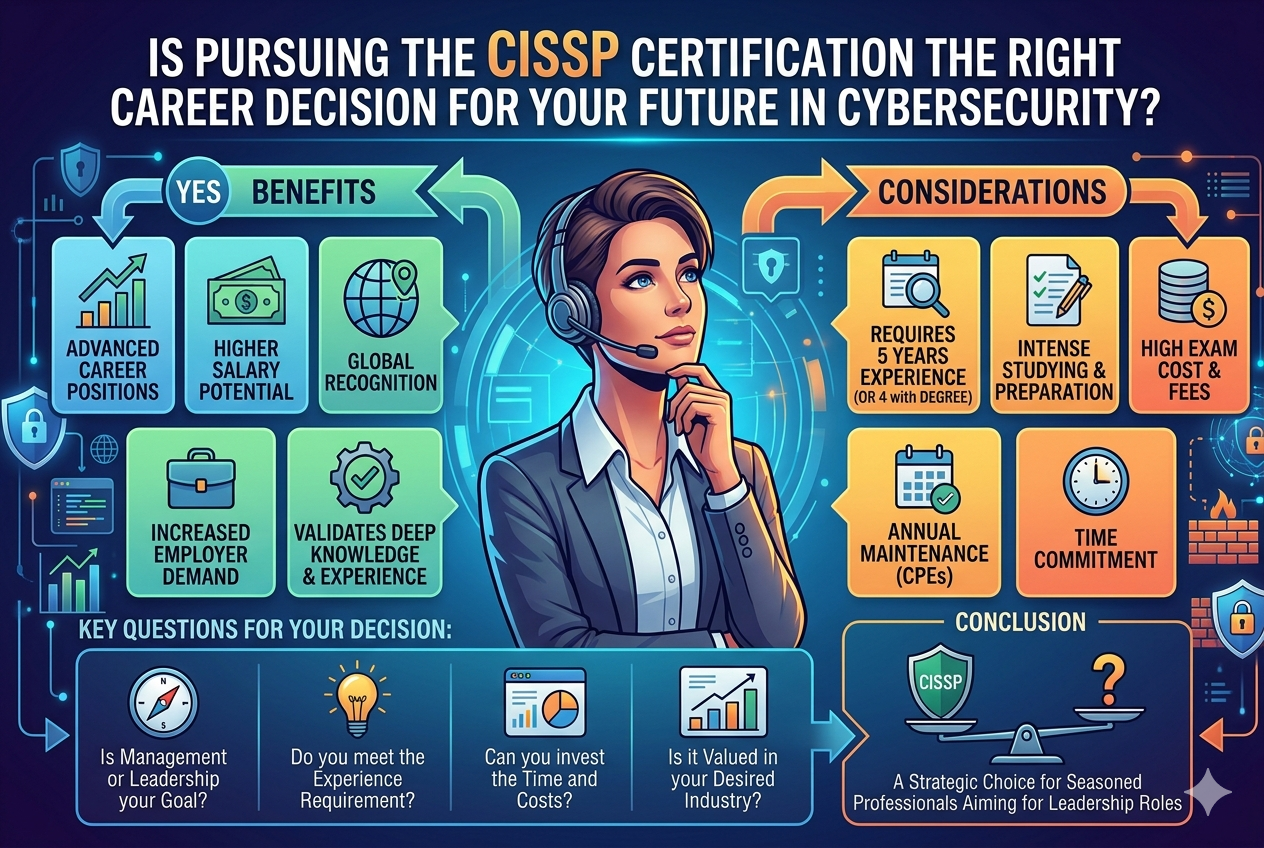
The CISSP certification is not simply another technical credential in cybersecurity. It represents a shift in thinking from hands-on technical execution toward security leadership, governance, and risk management. Many professionals misunderstand it as an advanced hacking or technical defense certification, but its real focus is much broader. It evaluates how well you understand security as a business function and how effectively you can align security strategies with organizational goals.
This makes CISSP particularly relevant in environments where cybersecurity is not just about preventing attacks but also about managing risk, ensuring compliance, and building resilient systems that can support business continuity. Professionals who succeed with CISSP often find themselves transitioning into roles where decision-making, policy creation, and strategic planning become more important than day-to-day technical troubleshooting.
Why CISSP Holds Strong Value in the Cybersecurity Industry
One of the main reasons CISSP remains highly respected is its emphasis on comprehensive knowledge across multiple security domains. Instead of specializing in one narrow area, it expects professionals to understand how different components of cybersecurity interact with each other. This includes areas like access control, cryptography, network security, security operations, and software development security.
Employers value this broad understanding because cybersecurity challenges rarely exist in isolation. A vulnerability in one system can affect multiple layers of an organization. CISSP-certified professionals are expected to see these connections and make decisions that reduce overall risk rather than focusing only on isolated technical issues.
Another important reason for its value is trust. Organizations handling sensitive data, financial systems, or critical infrastructure often prefer candidates with CISSP because it signals maturity, discipline, and a strong understanding of security frameworks. It is often used as a benchmark for senior-level hiring decisions.
Who Should Consider Pursuing CISSP
CISSP is best suited for professionals who already have several years of experience in cybersecurity or IT-related fields. It is not designed for beginners who are still learning basic networking or system administration concepts. Instead, it is intended for individuals who have already worked in roles such as security analyst, system administrator, network engineer, or IT auditor.
Professionals who are aiming for leadership positions such as security manager, security architect, or chief information security officer often find CISSP to be a natural next step. It helps bridge the gap between technical execution and strategic decision-making.
However, even experienced professionals should carefully evaluate whether they are ready for the mindset shift required. CISSP demands thinking beyond tools and technologies and focusing more on governance, risk, and compliance frameworks.
Core Knowledge Areas Covered in CISSP
The CISSP exam is structured around a broad set of security domains that reflect real-world organizational security needs. These domains are designed to ensure that certified professionals have a well-rounded understanding of cybersecurity.
One major area focuses on security and risk management, which includes understanding regulatory requirements, risk assessment methodologies, and ethical practices. Another important area is asset security, which deals with protecting data and ensuring proper classification and handling of information.
Identity and access management is another critical domain, focusing on ensuring that only authorized individuals have access to systems and data. This is closely connected with security architecture and engineering, which involves designing secure systems from the ground up.
Communication and network security addresses how data is protected during transmission, while security operations focuses on monitoring, incident response, and disaster recovery. Finally, software development security ensures that applications are built with security principles in mind from the beginning.
The Level of Difficulty and Required Preparation
The CISSP exam is known for its complexity and depth. It is not an exam that can be passed through memorization alone. Instead, it requires an understanding of concepts and the ability to apply them in practical scenarios.
Many candidates underestimate the level of preparation needed. It often takes months of consistent study, especially for those who are balancing full-time jobs. The exam questions are designed to test judgment and decision-making rather than simple factual recall.
A key challenge is that multiple answers may seem correct, but only one aligns best with industry best practices or security principles. This requires a shift in thinking from “what works technically” to “what is the most appropriate security decision in a business context.”
Career Opportunities After CISSP
Earning the CISSP certification can significantly expand career opportunities. Many organizations consider it a requirement for senior cybersecurity roles. It is commonly associated with positions that involve responsibility for designing security programs, managing teams, and developing organizational security policies.
Professionals with CISSP often move into roles such as security consultant, security architect, compliance officer, or IT risk manager. In more advanced stages of their careers, they may transition into executive positions where they oversee entire security departments.
The certification also has global recognition, which means it can support international career mobility. Many multinational companies and government agencies value CISSP as a standard measure of expertise.
Financial Benefits and Salary Growth
One of the motivating factors for pursuing CISSP is the potential for salary growth. While compensation varies depending on location, experience, and job role, CISSP-certified professionals generally earn higher salaries compared to non-certified peers in similar positions.
However, it is important to understand that the certification alone does not guarantee high income. It enhances credibility and improves job prospects, but real financial growth comes from combining certification with experience, leadership ability, and technical competence.
Employers are willing to pay more for individuals who can reduce risk, manage security programs effectively, and make informed decisions that protect organizational assets.
Challenges and Limitations of CISSP
Despite its advantages, CISSP is not without challenges. One of the main limitations is that it may not provide deep technical expertise in any single area. Professionals who want to specialize in ethical hacking, penetration testing, or cloud security may need additional certifications or training.
Another challenge is the experience requirement. Candidates must have several years of professional experience in relevant domains before they can become fully certified. Without this experience, even if the exam is passed, full certification may not be granted immediately.
Additionally, the broad nature of the exam can be overwhelming. It requires balancing multiple topics at once, which can be difficult for individuals who prefer focusing on one technical area.
Comparing CISSP with Other Cybersecurity Certifications
When evaluating CISSP as a career choice, it is helpful to compare it with other certifications in the cybersecurity field. Some certifications focus on entry-level knowledge, while others focus on highly specialized technical skills.
CISSP stands out because it is positioned at a senior level and emphasizes management and strategic thinking. Unlike certifications that focus on hands-on technical tasks, CISSP is designed to evaluate how well you understand security as a whole system.
This makes it less suitable for beginners but highly valuable for professionals who want to move into leadership roles. In contrast, certifications focused on technical skills may be better for those who are still building foundational experience.
Industry Demand and Long-Term Relevance
Cybersecurity continues to grow in importance as organizations become more dependent on digital systems. With increasing cyber threats, data breaches, and regulatory requirements, the demand for skilled security professionals remains strong.
CISSP maintains its relevance because it is not tied to a specific technology. Instead, it focuses on principles and frameworks that remain applicable even as tools and technologies evolve.
This long-term relevance is one of its strongest advantages. Professionals who invest in CISSP are not just learning current tools but developing a mindset that can adapt to future changes in the cybersecurity landscape.
Common Mistakes When Pursuing CISSP
Many candidates make the mistake of approaching CISSP as a purely technical exam. This leads to confusion when they encounter scenario-based questions that require judgment rather than technical calculations.
Another common mistake is underestimating the importance of practical experience. Without real-world exposure to security challenges, it can be difficult to fully understand the reasoning behind certain concepts.
Some candidates also rush into the exam without adequate preparation, assuming that their existing IT knowledge will be enough. While experience helps, structured study and familiarity with exam style questions are essential for success.
Evaluating Whether CISSP Aligns with Your Career Goals
Deciding whether to pursue CISSP ultimately depends on your long-term career direction. If your goal is to remain deeply technical and focus on areas like penetration testing or system development, CISSP may not be the most direct path.
However, if you aim to move into leadership roles, design security strategies, or manage cybersecurity programs at an organizational level, CISSP becomes highly relevant.
It is important to evaluate not only where you are in your career today but also where you want to be in the next five to ten years. CISSP is more of a long-term investment in career growth rather than an immediate technical upgrade.
Final Perspective on the Value of CISSP
The CISSP certification represents a significant milestone in a cybersecurity career. It is not an entry point but rather a progression toward advanced understanding and leadership capability. It requires commitment, experience, and a willingness to think beyond technical execution.
For professionals who are ready to take on broader responsibilities and move into strategic roles, it can be a powerful credential that enhances credibility and opens new opportunities. For others, especially those early in their careers, it may be more beneficial to first build foundational and intermediate skills before pursuing CISSP.
Ultimately, its value depends on alignment with your personal career path, your experience level, and your long-term professional ambitions in the cybersecurity field.
Building the Right Foundation Before Attempting CISSP
Before pursuing CISSP, it is important to recognize that success with this certification is heavily dependent on the strength of your foundational knowledge in IT and cybersecurity. Many professionals who struggle with the exam often do so not because the content is impossible, but because they lack real-world exposure to how security principles are applied in practice.
A strong foundation typically includes understanding networking concepts, operating systems, basic security controls, and common attack methods. Without these fundamentals, CISSP concepts can feel abstract and overly theoretical. For example, topics like access control models or security architecture are much easier to understand when you have already seen how systems behave in real environments.
This is why experienced professionals tend to perform better. They are able to connect CISSP concepts with situations they have already encountered in their jobs. For newcomers, it is often necessary to spend additional time gaining practical exposure before attempting the certification.
The Mindset Shift Required for CISSP Success
One of the most challenging aspects of CISSP is not the content itself but the way questions are framed. The exam is designed to test how you think rather than what you remember. This requires a significant mindset shift from technical problem-solving to risk-based decision-making.
In many cases, multiple answer choices may appear technically correct. However, the best answer is usually the one that aligns most closely with security policies, risk management principles, and organizational priorities. This means that candidates must learn to think like security managers rather than engineers.
This shift can be difficult for professionals who are used to hands-on technical roles. Instead of focusing on how to fix a problem, CISSP requires you to evaluate what should be done first, what reduces risk most effectively, and what supports business objectives.
Time Commitment and Study Strategy
Preparing for CISSP requires a disciplined and structured approach. Because of the breadth of topics, studying randomly or inconsistently often leads to gaps in understanding. Most successful candidates create a study plan that spans several months and covers each domain systematically.
A balanced approach usually includes reading official materials, practicing scenario-based questions, and reviewing explanations for both correct and incorrect answers. Simply memorizing concepts is not enough, as the exam focuses heavily on application.
Consistency is more important than intensity. Short, regular study sessions tend to be more effective than occasional long study marathons. This allows the information to be absorbed gradually and connected across different domains.
Common Difficulties Faced by Candidates
Many candidates find CISSP challenging because of the way it blends technical and managerial concepts. The difficulty often lies in understanding when to apply technical knowledge and when to prioritize business or policy considerations.
Another common challenge is dealing with the scope of the syllabus. With eight major domains to cover, it can feel overwhelming at first. Some candidates spend too much time on one area while neglecting others, leading to imbalanced preparation.
Time management during the exam is also a critical factor. Because questions are scenario-based and require careful reading, it is easy to spend too much time analyzing each question. Developing the ability to quickly identify key information becomes essential.
How CISSP Shapes Your Professional Identity
Earning CISSP often changes how professionals are perceived within their organizations. It signals that an individual has moved beyond technical execution and is capable of understanding security from a broader, organizational perspective.
This shift in perception can lead to increased responsibility. CISSP holders are often included in strategic discussions, security planning meetings, and risk assessment decisions. Their input is valued not just for technical accuracy but for alignment with business objectives.
Over time, this can reshape a professional’s identity from a technical specialist to a security leader. It also encourages a more holistic view of cybersecurity, where technology, people, and processes are all considered equally important.
The Role of Experience in Passing CISSP
Experience plays a critical role in both understanding and passing CISSP. The exam is designed with the assumption that candidates have worked in real security environments and have encountered practical challenges.
For example, understanding incident response procedures is much easier if you have actually participated in or observed a security incident. Similarly, concepts like risk assessment become clearer when you have had to evaluate threats and make decisions in real situations.
Without this experience, CISSP concepts may feel theoretical and disconnected. This is why many successful candidates recommend gaining several years of hands-on experience before attempting the certification.
Long-Term Career Growth After CISSP
CISSP is often not the end goal but rather a stepping stone toward higher-level positions in cybersecurity. After achieving the certification, many professionals continue to grow into roles that involve greater responsibility and influence.
These roles may include designing enterprise security architectures, managing security teams, or overseeing compliance programs. In some cases, professionals move into executive-level positions where they are responsible for shaping the entire security strategy of an organization.
Over time, CISSP can help build a career path that is less focused on technical implementation and more focused on leadership, governance, and strategic decision-making.
Industry Recognition and Global Acceptance
One of the strongest advantages of CISSP is its global recognition. It is widely accepted across industries and regions, making it a valuable credential for professionals who want international career opportunities.
Large organizations, including multinational corporations and government institutions, often recognize CISSP as a standard requirement for senior security roles. This makes it easier for certified professionals to transition between companies or even countries.
This level of recognition also adds credibility when working in consulting or advisory roles, where clients expect a high level of trust and expertise.
Limitations in Technical Depth
While CISSP is highly respected, it is important to understand its limitations. It does not focus deeply on hands-on technical skills such as penetration testing, malware analysis, or advanced system configuration.
Professionals who want to specialize in highly technical areas may need additional certifications or training to complement CISSP. It is best viewed as a broad, strategic certification rather than a deep technical one.
This does not reduce its value, but it does mean that it serves a different purpose compared to more technical certifications. It is about managing and designing security systems rather than directly building or breaking them.
Balancing CISSP with Other Certifications
Many cybersecurity professionals choose to combine CISSP with other certifications to create a more complete skill set. While CISSP provides strategic and managerial knowledge, other certifications can strengthen technical expertise.
This combination allows professionals to operate effectively at both technical and leadership levels. It also increases flexibility in career choices, enabling movement between hands-on roles and management positions.
The key is to choose certifications that align with your long-term career direction rather than collecting credentials without purpose.
Realistic Expectations from CISSP
It is important to have realistic expectations when pursuing CISSP. While it can significantly improve career prospects, it is not a shortcut to success. Employers still value experience, problem-solving ability, and leadership skills alongside certification.
CISSP should be seen as a reinforcement of your existing knowledge and experience rather than a replacement for it. It enhances credibility but does not automatically guarantee promotions or high-level roles.
Professionals who combine CISSP with strong practical experience tend to benefit the most from it.
When CISSP May Not Be the Right Choice
Despite its advantages, CISSP is not suitable for everyone. Individuals who are early in their careers may find it too advanced and less practical for their immediate needs.
Similarly, professionals who are highly specialized in technical fields such as ethical hacking or cloud engineering may find other certifications more directly relevant to their goals.
In such cases, it may be more effective to focus on building technical depth first and consider CISSP later as a long-term goal.
Career Alignment
Deciding whether CISSP is the right career move depends heavily on your personal direction in cybersecurity. It is most beneficial for those who want to transition into leadership, governance, or strategic roles.
It requires commitment, experience, and a willingness to think beyond technical implementation. However, for those who are ready for this shift, it can be a powerful tool for career advancement and long-term growth.
Ultimately, CISSP is not just about passing an exam. It represents a shift in how you view cybersecurity, moving from a technical discipline to a strategic function that supports and protects entire organizations.
Transitioning from Technical Roles to Security Leadership
One of the most important shifts that CISSP represents is the transition from technical execution to security leadership. Many professionals begin their cybersecurity careers in roles where they are focused on solving immediate technical problems, such as configuring firewalls, monitoring systems, or responding to alerts. While these skills are essential, they represent only one part of the broader cybersecurity landscape.
CISSP encourages professionals to move beyond day-to-day operations and think about how security decisions impact the entire organization. This includes understanding how policies are created, how risks are evaluated, and how security investments are prioritized. Instead of asking how to fix a vulnerability, the focus shifts toward deciding whether the risk is acceptable, how it should be mitigated, and what business impact it may have.
This transition is not automatic. It requires experience, perspective, and a willingness to adopt a more strategic mindset. For many professionals, CISSP acts as a catalyst for this change by introducing frameworks and concepts that are commonly used in leadership roles.
Understanding Risk-Based Thinking in CISSP
A core concept within CISSP is risk-based thinking. Rather than viewing security as a series of technical tasks, it frames it as a process of identifying, evaluating, and managing risk. Every decision in cybersecurity is ultimately tied to how much risk an organization is willing to accept.
For example, instead of focusing solely on preventing all possible attacks, organizations must decide which risks are most critical and allocate resources accordingly. This requires balancing security with cost, usability, and business goals.
CISSP trains professionals to evaluate these trade-offs. It emphasizes that perfect security is not realistic, and the goal is to achieve an acceptable level of risk. This perspective is essential for anyone moving into a managerial or advisory role in cybersecurity.
The Importance of Security Governance
Another key area emphasized in CISSP is security governance. Governance refers to the set of policies, procedures, and frameworks that guide how security is implemented within an organization. It ensures that security is not applied randomly but follows a structured and consistent approach.
Security governance also defines roles and responsibilities. It clarifies who is responsible for making security decisions, who implements controls, and who monitors compliance. Without strong governance, even the most advanced technical defenses can fail due to mismanagement or lack of coordination.
CISSP helps professionals understand how governance frameworks are designed and maintained. This includes aligning security policies with organizational objectives and ensuring compliance with legal and regulatory requirements.
Incident Response and Organizational Readiness
Incident response is another critical area covered in CISSP, but the focus is not just on technical recovery. Instead, it emphasizes organizational readiness and structured response planning.
In real-world scenarios, security incidents are rarely simple. They often involve multiple systems, stakeholders, and communication challenges. CISSP teaches professionals how to prepare for these situations in advance through planning, documentation, and training.
A strong incident response plan ensures that when a security breach occurs, the organization can respond quickly and effectively. This reduces damage, limits downtime, and improves recovery outcomes.
Understanding this process is essential for anyone in a leadership role because it directly impacts business continuity and organizational resilience.
Business Continuity and Disaster Recovery Planning
CISSP also highlights the importance of business continuity and disaster recovery. These concepts go beyond cybersecurity and focus on ensuring that an organization can continue operating even during major disruptions.
Business continuity planning involves identifying critical business functions and ensuring they can continue during unexpected events such as cyberattacks, natural disasters, or system failures. Disaster recovery focuses on restoring systems and data after an incident has occurred.
Professionals pursuing CISSP must understand how these plans are created, tested, and maintained. It is not enough to simply design technical backups; organizations must also ensure that people, processes, and communication channels are prepared to handle disruptions.
This area reinforces the idea that cybersecurity is closely tied to overall business resilience.
Security Architecture and System Design Thinking
Another important aspect of CISSP is security architecture. This involves designing systems that are secure by default rather than adding security measures after systems are built.
Security architecture requires understanding how different components of a system interact and how vulnerabilities can emerge from those interactions. It also involves selecting appropriate security controls based on risk levels and system requirements.
CISSP encourages professionals to think in terms of layered defenses, where multiple security controls work together to protect systems. This approach reduces the likelihood that a single failure will lead to a major security breach.
Professionals who move into architecture roles often find CISSP valuable because it provides a structured way of thinking about system security at a high level.
The Role of Compliance and Legal Requirements
Compliance is another major area covered in CISSP. Organizations must follow various laws, regulations, and industry standards depending on their location and industry. These requirements often define how data should be handled, stored, and protected.
CISSP helps professionals understand the importance of aligning security practices with these regulations. Failure to comply can result in legal penalties, financial losses, and reputational damage.
Compliance is not just about avoiding penalties; it also helps build trust with customers and stakeholders. When organizations demonstrate that they follow recognized security standards, they strengthen their credibility and reputation.
For professionals, understanding compliance is essential when working in regulated industries such as finance, healthcare, and government sectors.
Human Factors in Cybersecurity
CISSP also emphasizes the importance of human behavior in cybersecurity. Many security incidents occur not because of technical failures but due to human error, lack of awareness, or social engineering attacks.
Understanding how people interact with systems is essential for designing effective security controls. This includes implementing training programs, awareness campaigns, and policies that guide user behavior.
Security is not just a technical issue; it is also a cultural one. Organizations must build a security-aware culture where employees understand their role in protecting information.
CISSP-trained professionals are expected to consider these human factors when designing security strategies.
Strategic Decision-Making in Cybersecurity
At its core, CISSP prepares professionals for strategic decision-making. This means evaluating multiple factors such as cost, risk, usability, and business impact before making security decisions.
For example, choosing between different security solutions is not just about technical performance. It also involves considering budget constraints, implementation complexity, and long-term maintenance.
Strategic decision-making requires balancing competing priorities. A solution that offers the highest level of security may not always be practical or cost-effective. CISSP helps professionals develop the judgment needed to make these trade-offs effectively.
This skill becomes increasingly important as professionals move into senior roles where their decisions affect entire organizations.
Leadership Responsibilities in Cybersecurity Roles
As professionals progress in their careers after CISSP, they often take on leadership responsibilities. These responsibilities include managing teams, setting security goals, and communicating with executives.
Leadership in cybersecurity is not just about technical knowledge. It also involves communication skills, decision-making ability, and the capacity to translate technical risks into business language.
Executives and non-technical stakeholders rely on security leaders to explain risks in a way that is easy to understand. CISSP helps bridge this gap by teaching professionals how to think and communicate at a higher level.
Effective cybersecurity leaders must also prioritize tasks, manage resources, and ensure that security initiatives align with business objectives.
Long-Term Professional Development After CISSP
CISSP is not the end of professional development but rather a foundation for continuous growth. Cybersecurity is a rapidly evolving field, and professionals must continue learning even after achieving certification.
Many CISSP holders pursue additional certifications, specialized training, or advanced degrees to deepen their expertise in specific areas. Others focus on gaining leadership experience and expanding their influence within organizations.
Continuous learning is essential because new threats, technologies, and regulatory requirements emerge regularly. Staying updated ensures that professionals remain effective in their roles.
CISSP encourages this mindset of lifelong learning by requiring ongoing education to maintain certification status.
Evaluating the Long-Term Value of CISSP
The long-term value of CISSP lies in its ability to open doors to leadership and strategic roles. It is not just about passing an exam but about developing a way of thinking that aligns with senior cybersecurity responsibilities.
Professionals who invest in CISSP often find that it enhances their credibility, expands their career options, and prepares them for higher levels of responsibility. However, its value is maximized when combined with real-world experience and continuous learning.
For those aiming to build a long-term career in cybersecurity leadership, CISSP remains one of the most influential certifications available.
Perspective on Career Direction
Ultimately, pursuing CISSP is a decision that should be aligned with your long-term vision in cybersecurity. It is most beneficial for those who want to move beyond technical execution and into roles that involve strategy, governance, and leadership.
It requires commitment, experience, and a willingness to think at a broader organizational level. For professionals ready to make this shift, CISSP can serve as a powerful tool for career advancement and long-term professional growth.
Real-World Application of CISSP Knowledge in Organizations
One of the most important aspects of CISSP is how its knowledge is applied in real organizational environments. Unlike certifications that focus heavily on tools or specific technologies, CISSP prepares professionals to operate in complex environments where multiple systems, teams, and priorities must work together.
In real-world scenarios, security decisions are rarely isolated. For example, implementing a new security control may require coordination between IT teams, compliance officers, business managers, and sometimes external regulators. CISSP helps professionals understand how to navigate these interactions effectively.
It also prepares individuals to evaluate situations where security needs conflict with business goals. In many organizations, there is a constant balance between maintaining strong security and ensuring smooth business operations. CISSP-certified professionals are trained to find practical solutions that reduce risk without disrupting productivity unnecessarily.
How CISSP Influences Organizational Security Culture
Beyond technical knowledge and decision-making, CISSP also plays a role in shaping security culture within organizations. Security culture refers to how employees think about and approach security in their daily work.
When CISSP-certified professionals take on leadership roles, they often influence how security policies are communicated and enforced. They help create environments where security is not seen as a burden but as a shared responsibility.
This cultural shift is important because many security breaches occur due to human behavior rather than technical failures. A strong security culture reduces risky behavior and improves overall awareness across the organization.
CISSP helps professionals understand how to build this culture through training programs, awareness campaigns, and consistent enforcement of policies.
The Importance of Communication Skills in CISSP Roles
One often overlooked aspect of CISSP-related roles is communication. As professionals move into senior positions, their ability to explain complex security issues in simple terms becomes extremely important.
Executives and business leaders may not have technical backgrounds, but they are responsible for making high-level decisions about security investments and risk management. CISSP professionals must be able to translate technical risks into business impact.
For example, instead of describing a vulnerability in technical detail, they may need to explain how it could affect revenue, customer trust, or regulatory compliance. This type of communication ensures that security is properly understood and prioritized at the organizational level.
Strong communication skills also help in writing policies, presenting reports, and collaborating with different departments.
Evolving Cybersecurity Landscape and CISSP Relevance
The cybersecurity landscape is constantly evolving, with new threats, technologies, and challenges emerging regularly. Despite these changes, CISSP remains relevant because it focuses on foundational principles rather than specific tools.
For example, while specific attack methods may change over time, the core concepts of risk management, access control, and incident response remain consistent. CISSP teaches these principles in a way that can adapt to new environments.
This adaptability is one of the reasons why CISSP has maintained its value over time. Professionals who understand these principles can apply them across different technologies and industries.
As organizations adopt cloud computing, artificial intelligence, and remote work models, the need for strong security governance becomes even more important. CISSP provides a framework for addressing these modern challenges.
Career Progression Path After CISSP
After achieving CISSP, many professionals experience a shift in their career trajectory. Instead of focusing solely on technical tasks, they begin to take on more responsibility in planning, strategy, and leadership.
Common career progression paths include roles such as security manager, security architect, IT risk manager, and compliance lead. These positions involve overseeing teams, managing security programs, and aligning security strategies with business objectives.
With further experience, some professionals move into executive roles such as chief information security officer. In these positions, they are responsible for the overall security posture of an organization.
CISSP acts as a foundation that supports this progression by providing a broad understanding of cybersecurity as a business function.
Challenges in Maintaining CISSP Certification
While earning CISSP is a major achievement, maintaining it requires ongoing effort. Certified professionals must complete continuing professional education activities to keep their certification active.
This requirement ensures that professionals stay updated with changes in the cybersecurity field. It also encourages continuous learning and professional development.
However, it can be challenging for busy professionals to balance work responsibilities with ongoing education requirements. Proper planning and time management are essential to maintain certification status.
Despite these challenges, the requirement for continuous learning helps ensure that CISSP holders remain relevant in a rapidly changing industry.
Misconceptions About CISSP
There are several misconceptions about CISSP that can lead to unrealistic expectations. One common misconception is that CISSP is a purely technical certification. In reality, it focuses more on management, governance, and strategy.
Another misconception is that CISSP guarantees a high-paying job immediately after certification. While it can improve job prospects, career growth still depends on experience, skills, and performance.
Some also believe that CISSP alone is sufficient for all cybersecurity roles. However, in practice, it is often combined with other certifications and practical experience to build a complete skill set.
Understanding these misconceptions is important for setting realistic goals and making informed career decisions.
Strategic Value of CISSP in Organizations
From an organizational perspective, CISSP-certified professionals add strategic value by improving decision-making and strengthening security governance. They help organizations develop structured approaches to managing risk and protecting assets.
Their ability to align security initiatives with business objectives ensures that security is not treated as an isolated function but as an integral part of organizational strategy.
This strategic alignment is particularly important in industries where security and compliance are critical, such as finance, healthcare, and government sectors.
Organizations benefit not only from the technical knowledge of CISSP professionals but also from their ability to think holistically about security challenges.
Long-Term Impact on Professional Identity
Over time, CISSP can significantly influence a professional’s identity in the cybersecurity field. It often marks the transition from being a technical contributor to becoming a trusted advisor or leader.
This shift changes how professionals are perceived by colleagues, managers, and industry peers. They are often seen as individuals who can be relied upon to make informed decisions about security strategy and risk management.
This change in identity can also increase confidence and open new opportunities for collaboration and leadership.
However, it also comes with increased responsibility, as decisions made at this level can have significant organizational impact.
Conclusion
Deciding whether CISSP is the right career move depends entirely on your current experience level and long-term goals in cybersecurity. It is not designed for beginners but for professionals who are ready to step into leadership, governance, and strategic roles.
If your goal is to move beyond technical tasks and take responsibility for designing security strategies, managing teams, and influencing organizational decisions, CISSP can be an excellent investment. It provides a structured way of thinking about cybersecurity that aligns with senior-level responsibilities.
However, if you are still building foundational technical skills or prefer highly specialized technical roles, it may be more beneficial to gain additional experience or pursue other certifications first before attempting CISSP.
Ultimately, CISSP is not just a certification but a transformation in how you approach cybersecurity. It shifts your focus from fixing problems to understanding systems, managing risk, and guiding organizations toward stronger security postures.
When aligned with the right experience and career direction, CISSP can serve as a powerful milestone that supports long-term growth, leadership opportunities, and professional credibility in the ever-evolving field of cybersecurity.