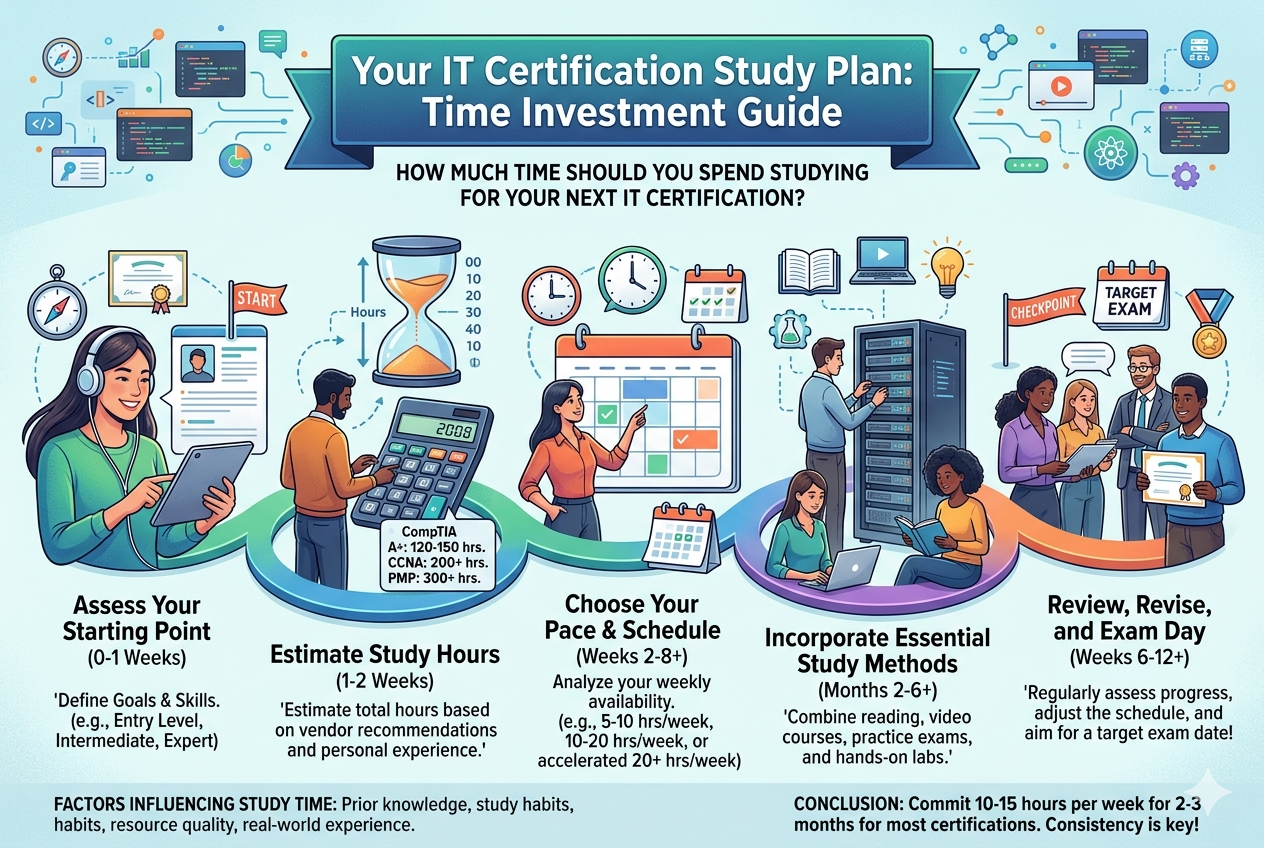
The time required to prepare for an IT certification is not the same for everyone, and it should never be treated as a fixed number. It depends heavily on your background knowledge, your familiarity with the subject, and how comfortable you are with technical concepts. Someone who already works in IT may only need a short period of structured revision, while a beginner may require a much longer and more gradual preparation phase. The key is not just how many hours you study, but how effectively those hours are used to build understanding and confidence.
Factors That Influence Your Study Duration
Several important factors determine how long you should study before taking your certification exam. One of the biggest factors is prior experience. If you already work with the technologies covered in the exam, you will naturally progress faster because you have real-world exposure. Another factor is the difficulty level of the certification itself, since entry-level exams require less preparation compared to advanced or specialist-level certifications.
Your learning speed also plays a major role. Some individuals grasp technical concepts quickly, while others need more time to fully absorb the same material. In addition, your study environment, consistency, and access to practice resources can significantly impact your preparation timeline. Distractions, lack of planning, or irregular study habits often extend the time needed to become fully prepared.
Beginners Starting from Zero Knowledge
If you are completely new to IT or a specific certification domain, you should expect a longer preparation period. This is because you will not only be learning exam topics but also foundational concepts that experienced learners already know. In this case, rushing is not helpful, as it can lead to confusion and poor retention.
A structured approach works best for beginners. Starting with basic concepts and gradually moving to more complex topics helps build a strong foundation. Spending consistent time each day, even if it is just a small amount, is more effective than long irregular study sessions. Over time, this steady approach creates a deeper understanding and reduces the pressure closer to the exam date.
Intermediate Learners with Some Experience
If you already have some background knowledge or hands-on experience in IT, your study time can be more focused and efficient. Instead of learning everything from scratch, you can concentrate on filling knowledge gaps and aligning your understanding with the exam objectives.
For intermediate learners, the study process often involves refining skills, practicing scenario-based questions, and reviewing topics that are less frequently used in daily work. This stage is less about discovering new concepts and more about strengthening and organizing what you already know. With proper discipline, this group can prepare more quickly than beginners while still achieving strong results.
Experienced Professionals Preparing for Certification
Experienced professionals usually require the least amount of preparation time, but that does not mean they can ignore studying altogether. Even with years of experience, certification exams often include theoretical details, specific terminology, or structured frameworks that may not be used regularly in real-world work.
For professionals, the focus should be on exam alignment rather than basic learning. This means understanding the exam structure, practicing scenario questions, and reviewing official topics carefully. Since experience already provides a strong foundation, the preparation period is often shorter and more targeted.
Creating a Balanced Study Schedule
A balanced study schedule is one of the most important factors in successful certification preparation. Instead of trying to study randomly or only when free time is available, it is better to create a consistent routine. This helps your brain adapt to regular learning and improves long-term retention.
Most learners benefit from studying in smaller, focused sessions rather than long, exhausting hours. Short daily sessions allow better concentration and reduce mental fatigue. It is also important to mix different types of learning activities, such as reading, watching tutorials, and practicing questions, to keep the process engaging and effective.
Daily and Weekly Study Commitment
The ideal daily study time depends on your schedule, but consistency is more important than intensity. Studying a small amount every day is more effective than cramming large amounts of information in a single day. When preparing over several weeks or months, regular exposure to the material helps reinforce memory and understanding.
Weekly planning is also useful because it allows you to track progress and adjust your focus. Some weeks may require more attention on difficult topics, while others can be used for revision and practice tests. This flexible approach ensures steady improvement without burnout.
Importance of Hands-On Practice
For IT certifications, practical experience is just as important as theoretical knowledge. Many exams are designed to test real-world problem-solving skills rather than simple memorization. Because of this, hands-on practice should be a major part of your study plan.
Working with labs, simulations, or real systems helps you understand how concepts apply in practical situations. This not only improves exam performance but also strengthens your professional skills. Without practice, it becomes difficult to retain information or answer scenario-based questions effectively.
Common Mistakes in Time Management
One of the most common mistakes learners make is underestimating the amount of preparation required. Many people assume that reading material once or watching videos is enough, but this often leads to poor results. Another mistake is delaying preparation until the last moment, which creates unnecessary stress and reduces learning quality.
Overstudying without breaks is also a problem. While dedication is important, excessive study sessions without rest can lead to burnout and reduced focus. A balanced approach with regular breaks is more effective for long-term learning.
Adjusting Study Time Based on Progress
Your study plan should never remain completely rigid. As you progress, you may find that some topics are easier or harder than expected. Adjusting your study time based on this feedback is important for efficiency. If you are struggling with certain areas, it makes sense to spend more time on them rather than rushing forward.
Regular self-assessment through quizzes or practice exams can help you measure your progress. These evaluations show whether your current study time is sufficient or needs adjustment. This adaptive method ensures that you are always moving in the right direction.
Final Preparation and Revision Strategy
As the exam date approaches, your focus should gradually shift from learning new topics to revising existing knowledge. This stage is crucial for strengthening memory and improving confidence. Revision helps reinforce key concepts and ensures that you are familiar with the exam structure.
Practice tests become especially important during this phase. They help you manage time, identify weak areas, and simulate real exam conditions. Repeating this process improves accuracy and reduces exam-day anxiety.
Building Confidence Through Consistency
Confidence is built through consistent preparation rather than last-minute effort. When you follow a structured study plan over time, you naturally develop a better understanding of the subject. This reduces stress and makes the exam feel more manageable.
Even small daily improvements add up over time. The goal is not to study perfectly every day but to stay consistent and committed. Over weeks and months, this consistency becomes the strongest factor in achieving success.
Long-Term Approach to Certification Success
IT certification preparation should be viewed as a gradual learning journey rather than a short-term task. Rushing through material may help you pass temporarily, but it does not build lasting knowledge. A well-planned study schedule ensures that you not only pass the exam but also gain practical skills that can be applied in real work environments.
By balancing theory, practice, and revision, and by adjusting your study time based on your progress, you create a strong foundation for success. The most important factor is not the exact number of hours you spend, but the quality, consistency, and focus of those hours over time.
Optimizing Study Methods for IT Certification Success
Once you understand how much time you need to study, the next step is improving how you study. Many learners spend hours preparing but still struggle in exams because their study methods are not efficient. Effective preparation is not about doing more work, but about using smarter strategies that improve understanding and retention. The way you approach learning has a direct impact on how quickly you progress and how well you perform in the final exam.
A strong study method focuses on active learning instead of passive reading. Simply going through notes or watching videos is not enough for technical subjects. You need to engage with the material by taking notes in your own words, solving problems, and testing yourself regularly. This active involvement helps your brain process information more deeply, making it easier to recall during the exam.
The Role of Consistency in Long-Term Retention
Consistency is one of the most powerful factors in successful certification preparation. When you study regularly, even for short periods, your brain builds stronger memory connections. This is far more effective than studying intensively for a few days and then stopping for long gaps.
Irregular study patterns often lead to forgetting previously learned topics, which forces you to restart your learning repeatedly. On the other hand, consistent study keeps information fresh and builds momentum over time. This steady progress reduces stress and increases confidence as the exam approaches.
Maintaining consistency also helps reduce the feeling of overwhelm. When learning is spread out over weeks or months, each session feels manageable. This makes it easier to stay motivated and avoid burnout.
Breaking Down Complex Topics into Manageable Sections
IT certifications often cover large and complex topics that can feel overwhelming at first. One effective strategy is breaking these topics into smaller, more manageable sections. Instead of trying to understand everything at once, focus on one concept at a time.
This approach allows you to build knowledge step by step. Each small topic becomes easier to understand and remember, and over time, these pieces come together to form a complete understanding. Breaking down content also helps identify weak areas more clearly, so you know exactly where to focus your attention.
By simplifying complex subjects, you reduce mental pressure and make learning more structured. This method also improves confidence because each completed section gives a sense of progress and achievement.
Using Practice Exams as a Learning Tool
Practice exams are not just a way to test your knowledge; they are one of the most powerful learning tools in certification preparation. They help you understand the format of the real exam and expose you to the types of questions you will face.
When you take practice tests regularly, you start identifying patterns in questions and improve your ability to think under time pressure. This is especially important for IT certifications, where time management plays a critical role in success.
After completing a practice exam, reviewing your mistakes is equally important. Understanding why you got a question wrong helps prevent repeating the same errors in the actual exam. Over time, this process significantly improves accuracy and performance.
Balancing Speed and Accuracy in Preparation
One common challenge during certification preparation is balancing speed and accuracy. Some learners focus too much on speed and rush through topics without fully understanding them. Others focus too much on accuracy and move very slowly, which delays progress.
A balanced approach is necessary for success. You should aim to understand concepts clearly while also maintaining a steady pace of progress. During practice tests, it is important to simulate real exam conditions so you can develop both speed and accuracy together.
As your preparation improves, your ability to answer questions quickly and correctly will naturally increase. This balance is what ultimately leads to strong exam performance.
Managing Study Fatigue and Mental Pressure
Long study periods can sometimes lead to mental fatigue, especially when preparing for technical certifications. When the brain becomes tired, it becomes harder to focus and retain information. This is why taking breaks is an essential part of effective learning.
Short breaks between study sessions help refresh your mind and improve concentration. It is also important to avoid overloading yourself with too much information in a single session. Studying in balanced intervals keeps your energy levels stable and improves long-term productivity.
Mental pressure can also affect performance. Many learners feel stressed as the exam date approaches, but proper preparation and planning can reduce this anxiety. Confidence comes from consistent practice and familiarity with the exam format.
Adjusting Study Techniques Based on Learning Style
Every learner has a different learning style, and understanding your own style can significantly improve your study efficiency. Some people learn better through visual materials such as diagrams and videos, while others prefer reading or hands-on practice.
Identifying your preferred learning style allows you to choose study methods that work best for you. For example, visual learners may benefit from charts and flow diagrams, while practical learners may prefer lab exercises and simulations.
Adapting your study approach based on your strengths makes learning faster and more effective. It also keeps the process more engaging, which helps maintain motivation over time.
Importance of Revision Cycles
Revision is a critical part of any certification preparation plan. Without regular revision, it is easy to forget previously studied material. Revisiting topics multiple times strengthens memory and improves understanding.
Revision should not be treated as a single activity done at the end of preparation. Instead, it should be part of your ongoing study routine. Revisiting older topics while learning new ones helps reinforce knowledge continuously.
Each revision cycle should become faster and more focused. Initially, you may need to spend more time reviewing topics, but over time, revision becomes quicker as your understanding improves.
Avoiding Information Overload During Preparation
One of the biggest mistakes learners make is trying to study too many resources at once. This often leads to confusion and information overload. Instead of improving understanding, it can make concepts harder to grasp.
It is better to stick to a limited number of high-quality resources and study them thoroughly. This helps maintain clarity and reduces unnecessary complexity. Once you fully understand the core material, you can expand your knowledge if needed.
Simplifying your study sources allows you to focus better and reduces mental clutter. This leads to more effective learning and better retention.
Tracking Progress and Measuring Improvement
Tracking your progress is an important part of certification preparation. Without tracking, it becomes difficult to know whether your study plan is effective. Regular self-assessment helps you understand how much you have improved over time.
Practice tests, quizzes, and topic reviews are useful ways to measure progress. They show which areas you have mastered and which areas still need improvement. This information helps you adjust your study plan more effectively.
Seeing progress also increases motivation. When you notice improvement, it encourages you to continue studying with more confidence and focus.
Building Exam-Day Readiness
As the exam day approaches, your preparation should shift toward readiness and confidence. This includes reviewing key concepts, practicing time management, and simulating real exam conditions.
It is important to become familiar with the structure of the exam so there are no surprises on the actual day. Knowing what to expect reduces anxiety and helps you stay calm during the test.
At this stage, the goal is not to learn new information but to strengthen what you already know. This ensures that your knowledge is stable and ready for application under exam conditions.
Developing a Long-Term Learning Mindset
IT certifications should not only be viewed as a short-term goal but also as part of long-term professional development. The skills you build during preparation often remain useful throughout your career.
A long-term learning mindset encourages continuous improvement and adaptability. Technology evolves quickly, and maintaining a habit of regular learning helps you stay updated in your field.
By viewing certification preparation as part of ongoing growth, you develop stronger skills and greater confidence in your professional abilities.
Final Phase of IT Certification Preparation and Mastery
As you move closer to your exam date, your study approach should shift from heavy learning to focused refinement. This final phase is where everything you have studied starts to come together. Instead of trying to cover new topics, the goal is to strengthen your understanding, fix weak areas, and improve your ability to apply knowledge under exam conditions. Many learners underestimate this phase, but it often determines whether you pass comfortably or struggle under pressure.
At this stage, your brain benefits more from repetition and reinforcement than from new information. Revisiting concepts multiple times helps convert short-term memory into long-term retention. This is why candidates who consistently revise tend to perform better, even if they studied fewer total hours.
Strengthening Weak Areas Through Focused Review
Every learner has certain topics that feel more difficult than others. These weak areas should become your priority during the final preparation stage. Instead of avoiding them, you should actively revisit and practice them until they become more comfortable.
Focused review means identifying exactly what you do not understand and breaking it down further. Sometimes the problem is not the topic itself but a small underlying concept that was missed earlier. By isolating and correcting these gaps, you gradually remove confusion and improve overall clarity.
This process requires patience, but it is one of the most effective ways to increase exam readiness. Strong preparation is not about knowing everything equally well, but about reducing weak points to a minimum.
The Importance of Mock Exams Under Real Conditions
One of the most effective ways to prepare in the final stage is by simulating real exam conditions. This means taking full-length practice exams without interruptions, distractions, or pauses. The purpose is to train your mind to perform under pressure.
When you practice under timed conditions, you develop a better sense of pacing. You learn how much time to spend on each question and when to move on. This is critical because many candidates fail not due to lack of knowledge, but due to poor time management.
After each mock exam, reviewing your performance is essential. Instead of just checking your score, analyze why you made mistakes. This reflection helps you improve accuracy and avoid repeating errors.
Building Confidence Through Repetition
Confidence in IT certification exams does not come suddenly. It is built gradually through repeated exposure to similar questions and concepts. The more you practice, the more familiar the exam patterns become.
Repetition reduces uncertainty. When you have seen similar questions multiple times, your brain responds more quickly during the actual exam. This improves both speed and accuracy.
Confidence also reduces anxiety. When you feel prepared, you are less likely to panic during difficult questions. This mental stability is often what separates successful candidates from those who struggle despite studying.
Managing Time Effectively During the Exam
Time management is one of the most critical skills for certification success. Even well-prepared candidates can struggle if they do not manage their time properly during the exam.
A good strategy is to quickly answer easy questions first and mark difficult ones for review later. This ensures that you secure all the points you can before spending time on complex problems.
Practicing this strategy during mock exams helps you apply it naturally in the real test. Over time, you develop a sense of how long you can spend on each question without losing overall progress.
Good time management also reduces stress because you are not constantly worried about running out of time.
Avoiding Last-Minute Overloading
Many learners make the mistake of trying to study too much in the final days before the exam. This often leads to confusion, stress, and mental exhaustion. The brain performs better when it is calm and well-rested rather than overloaded with new information.
Instead of learning new topics at the last moment, it is better to focus on revision and light review. This keeps your knowledge fresh without overwhelming your mind.
Last-minute cramming may feel productive, but it usually does not improve long-term retention. A calm and focused approach is far more effective for final success.
Maintaining Mental and Physical Balance
Exam preparation is not only about studying but also about maintaining your mental and physical well-being. A tired or stressed mind cannot perform at its best, even with strong knowledge.
Getting enough rest, staying hydrated, and taking breaks are all important parts of preparation. When your body is well-rested, your brain processes information more efficiently.
Stress management is also important. Simple techniques like short walks, deep breathing, or stepping away from study material for a few minutes can help refresh your mind.
A balanced lifestyle during preparation improves focus, memory, and overall performance.
Developing Exam Strategy and Question Approach
Every certification exam has a certain style of questioning. Understanding how to approach different types of questions is an important skill.
Some questions test theoretical knowledge, while others focus on practical scenarios. Learning how to identify what each question is asking helps you respond more accurately.
A good strategy is to read each question carefully, eliminate incorrect options first, and then select the best answer from the remaining choices. This improves accuracy, especially in multiple-choice exams.
Practicing this method during study sessions helps you apply it naturally during the real exam.
Handling Difficult Questions Without Panic
During the exam, it is normal to encounter questions that seem difficult or unfamiliar. The key is not to panic. Instead of spending too much time on one question, it is better to move on and return to it later if time allows.
Sometimes, answering other questions first can help refresh your memory and make difficult questions easier to understand when you return to them.
Staying calm under pressure is a skill that improves with practice. Mock exams are the best way to develop this ability.
Building Long-Term Knowledge Beyond the Exam
Although the main goal is to pass the certification, the knowledge you gain should not end there. IT certifications are designed to build real-world skills that can be used in professional environments.
When you study with understanding rather than memorization, you retain knowledge for a longer time. This helps you in your career even after the exam is completed.
Treating certification preparation as skill development rather than just exam preparation creates more lasting value.
Avoiding Dependence on Memorization Alone
Memorization can help in some areas, but it is not enough for IT certifications. Many questions require understanding of concepts rather than exact answers.
When you understand why something works, you can apply that knowledge in different scenarios. This is especially important for scenario-based questions.
Focusing on understanding instead of memorization makes learning easier and more meaningful. It also reduces the risk of forgetting information quickly after the exam.
Improving Decision-Making Skills During the Exam
Good decision-making is essential during certification exams. You often need to choose the best answer from several correct-looking options.
This requires careful analysis and logical thinking. Instead of rushing, take a moment to understand what each option means and how it relates to the question.
With enough practice, you develop the ability to quickly eliminate incorrect answers and select the most appropriate one.
Staying Consistent Until the Final Day
Consistency remains important even in the final days before the exam. However, the focus should shift from heavy learning to light revision and confidence building.
Maintaining a steady routine helps keep your mind prepared without causing fatigue. Sudden changes in study habits can disrupt your focus.
A calm and consistent approach ensures that you enter the exam feeling prepared and stable.
Final Mindset for Exam Success
The final mindset you should carry into your certification exam is one of confidence, clarity, and calmness. At this point, your preparation has already been completed, and your focus should be on execution.
Trusting your preparation is important. Doubting yourself at the last moment can reduce performance even if you are well prepared.
Approach the exam as an opportunity to demonstrate what you have learned rather than as a test of fear or pressure. This mindset helps you perform at your best and apply your knowledge effectively.
Applying Your Certification Skills After the Exam
Once the exam is completed, the value of your preparation does not end. In fact, this is where real-world application begins. IT certifications are designed not only to test knowledge but also to prepare you for practical environments where those skills are needed daily. The concepts you studied, practiced, and revised should now be actively applied in real or simulated work scenarios.
Many learners make the mistake of forgetting what they studied after passing the exam. However, the true benefit comes when you continue practicing those skills. Whether it is networking, cloud computing, cybersecurity, or system administration, regular use of knowledge strengthens long-term understanding and keeps your skills relevant.
Applying what you learned also helps you discover gaps that were not visible during exam preparation. Real-world environments are often more complex than exam scenarios, and this exposure improves your problem-solving ability over time.
Turning Certification Knowledge Into Career Growth
A certification alone does not guarantee career success, but it can open important opportunities when combined with practical skills. Employers value individuals who can demonstrate both theoretical understanding and hands-on capability.
After earning a certification, it is important to update your resume, strengthen your professional profile, and look for opportunities where your new skills can be applied. This might include internships, job roles, freelance work, or internal promotions within your current organization.
More importantly, certifications should act as stepping stones rather than final destinations. Each certification you earn can lead to more advanced learning paths and higher-level expertise.
Continuing Learning Beyond One Certification
Technology evolves rapidly, and IT professionals must continuously update their knowledge. Completing one certification is only the beginning of a longer learning journey.
After passing an exam, it is useful to explore related certifications or advanced levels in the same domain. This helps build deeper expertise and keeps your skills aligned with industry trends.
Continuous learning also improves adaptability. As new tools, platforms, and technologies emerge, professionals who keep learning remain more valuable and competitive in the job market.
Developing a habit of lifelong learning ensures that your knowledge does not become outdated and that you remain confident in your field.
Reflecting on Your Study Experience
After completing your certification journey, it is helpful to reflect on your study process. Understanding what worked well and what could be improved helps you prepare more effectively for future certifications.
You may realize that certain study methods were more effective than others. For example, practice tests might have helped more than reading alone, or hands-on labs may have improved understanding significantly.
This reflection helps you build a personalized learning strategy for future exams. Over time, you become more efficient and confident in your preparation approach.
Avoiding Common Post-Exam Mistakes
One common mistake after passing a certification is becoming inactive or stopping learning altogether. This can lead to skill decline over time. Another mistake is overestimating knowledge and ignoring the need for continued practice.
It is important to stay engaged with your subject area even after the exam. Regular practice, reading updates, and exploring new challenges help maintain your expertise.
Another mistake is relying solely on certification titles without practical application. While certifications are valuable, real skills come from consistent usage and experience.
Building a Long-Term Professional Mindset
A successful IT professional does not focus only on passing exams but on continuous improvement. The most successful individuals treat certifications as part of a larger career development path.
This mindset encourages curiosity, problem-solving, and adaptability. Instead of learning only what is required for exams, you start exploring how systems work in real environments.
Over time, this approach leads to stronger expertise, better job opportunities, and increased professional confidence.
Maintaining Motivation for Future Certifications
After completing one certification, it is natural to feel a sense of accomplishment. However, maintaining motivation for future learning is important if you want to grow in the IT field.
Setting new goals helps keep your learning journey active. These goals could include advanced certifications, specialization in a new area, or mastering a new technology.
Breaking long-term goals into smaller milestones makes them easier to achieve and keeps motivation high. Each completed certification builds momentum for the next challenge.
Understanding the Value of Continuous Improvement
In IT, standing still is not an option. Technology changes quickly, and professionals must evolve with it. Continuous improvement ensures that your skills remain relevant and valuable.
Even small learning efforts over time can make a big difference. Reading documentation, practicing labs, or exploring new tools helps you stay updated.
This mindset of continuous improvement is what separates average learners from highly skilled professionals in the long run.
The Real Value of IT Certification Preparation
The journey of preparing for an IT certification is more valuable than the certification itself. Throughout the process, you develop discipline, problem-solving skills, and technical understanding that extend far beyond the exam.
The time you spend studying should not be measured only in hours, but in the quality of learning and consistency of effort. Whether you are a beginner or an experienced professional, success depends on structured preparation, regular practice, and continuous revision.
A well-planned study approach helps you not only pass the exam but also build real-world skills that support your career growth. Each stage of preparation—from initial learning to final revision—plays an important role in shaping your understanding.
Ultimately, IT certification is not just about achieving a title. It is about developing knowledge, confidence, and professional capability that continue to benefit you long after the exam is over.
Conclusion:
The time you should spend studying for an IT certification is not a fixed number but a balance between your current knowledge, consistency, and study quality. What matters most is not how many hours you put in, but how effectively you use those hours to understand concepts, practice skills, and reinforce learning over time. Beginners usually need a longer preparation period with steady daily effort, while experienced learners can focus more on revision, practice tests, and filling specific knowledge gaps.
A structured and consistent study plan always produces better results than last-minute cramming or irregular learning. Breaking topics into smaller parts, practicing regularly, and revising frequently helps build strong understanding and long-term retention. As the exam approaches, shifting focus toward mock tests, time management, and weak area improvement becomes essential for success.
Ultimately, IT certification preparation is not just about passing an exam. It is about building real skills, gaining confidence, and developing a disciplined learning approach that benefits your career in the long run.