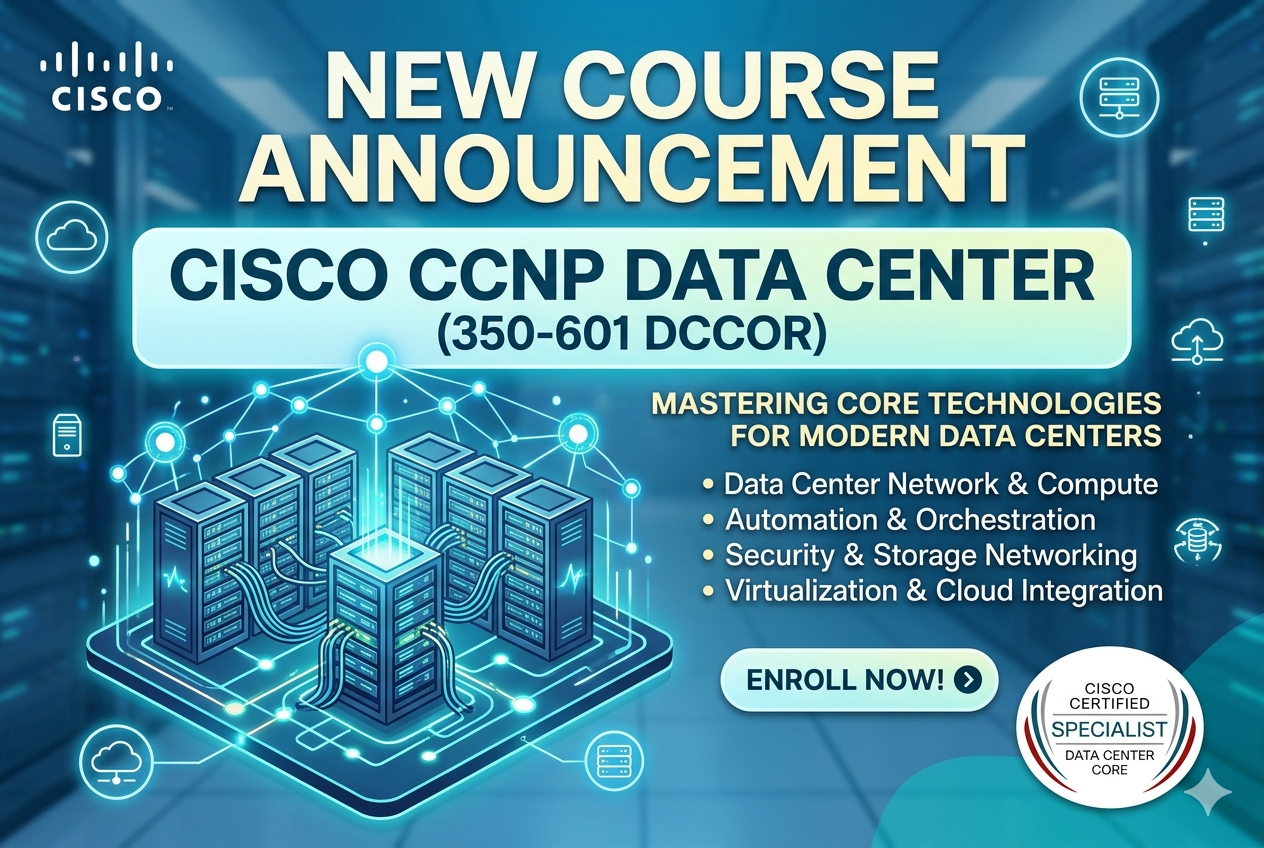
This advanced-level training program is designed to build deep technical expertise in modern data center environments. It focuses on developing the skills required to design, implement, operate, and troubleshoot complex data center infrastructures. The course is structured to align with enterprise-level requirements, ensuring learners gain both conceptual clarity and practical competence in handling real-world scenarios.
Understanding Modern Data Center Architecture
Modern data centers are no longer limited to traditional server and storage setups. They now integrate highly virtualized environments, automated operations, and software-defined networking principles. This course begins by building a strong understanding of how contemporary data centers are structured, including compute layers, storage systems, network fabrics, and orchestration platforms.
Learners are introduced to the evolution of data center technologies and how businesses have shifted toward scalable, cloud-ready infrastructures. Emphasis is placed on understanding redundancy, high availability, load balancing, and disaster recovery mechanisms that ensure uninterrupted service delivery in enterprise environments.
Core Networking Concepts in Data Center Environments
A significant portion of the program focuses on networking technologies that form the backbone of data centers. Participants explore switching and routing principles tailored for high-performance environments. This includes advanced Layer 2 and Layer 3 designs, overlay and underlay networks, and efficient traffic engineering techniques.
The training also highlights how modern data centers use virtual networking to separate physical infrastructure from logical design. Concepts such as segmentation, isolation, and multi-tenant architecture are explained in depth to help learners understand how large-scale environments maintain security and efficiency simultaneously.
Data Center Compute Infrastructure
Compute resources form the foundation of any data center. This section focuses on server architectures, virtualization technologies, and resource optimization strategies. Learners gain insights into how compute nodes are deployed, managed, and scaled based on workload requirements.
Virtualization plays a key role in maximizing hardware utilization. The course explains hypervisor technologies, virtual machine management, and container-based environments that support modern application deployment. Special attention is given to resource allocation techniques that ensure performance consistency across workloads.
Storage Systems and Data Management
Efficient storage design is critical in any enterprise environment. This program provides a detailed understanding of storage architectures, including block, file, and object storage systems. Learners explore how data is distributed, replicated, and protected across storage networks.
The course also discusses storage protocols, data redundancy strategies, and performance optimization techniques. Emphasis is placed on ensuring data availability, integrity, and scalability, which are essential for mission-critical applications running in data centers.
Network Virtualization and Overlay Technologies
One of the key areas covered is network virtualization, which enables flexible and scalable infrastructure design. Learners study how overlay networks operate on top of physical underlay networks to create isolated and programmable environments.
Technologies such as tunneling mechanisms, virtual routing, and encapsulation methods are explored in detail. These concepts help in understanding how modern data centers support multi-tenant environments while maintaining security and performance efficiency.
Automation and Programmability in Data Centers
Automation has become a cornerstone of modern data center operations. This section introduces learners to automation frameworks, scripting concepts, and programmable infrastructure management.
The focus is on reducing manual intervention and improving operational efficiency through automated workflows. Learners understand how configuration management, orchestration tools, and APIs are used to control large-scale environments with minimal human error.
The course also introduces infrastructure-as-code principles, enabling professionals to treat data center configurations as programmable and repeatable assets.
Data Center Security Principles
Security is a critical aspect of any data center environment. This program covers multiple layers of security, including physical security, network security, and application-level protection.
Learners study segmentation techniques, access control mechanisms, and encryption methods used to safeguard sensitive data. The course also explores threat detection, mitigation strategies, and best practices for maintaining a secure infrastructure.
Understanding how security integrates with networking and compute layers is a key outcome of this section, ensuring learners can design secure and resilient systems.
High Availability and Disaster Recovery Concepts
Enterprise environments require continuous uptime, making high availability a core requirement. This section explains redundancy models, failover mechanisms, and load distribution techniques that ensure system reliability.
Disaster recovery planning is also covered, focusing on backup strategies, replication methods, and recovery time objectives. Learners understand how to design systems that can recover quickly from failures while minimizing data loss and downtime.
Advanced Automation Frameworks in Enterprise Environments
Modern data center operations rely heavily on structured automation frameworks that go beyond simple scripting. This section explores how enterprise-grade automation platforms coordinate large-scale infrastructure changes across compute, network, and storage systems.
Learners understand how workflow orchestration tools manage complex sequences of tasks, ensuring that changes are applied consistently and safely. These frameworks help eliminate repetitive manual work, reduce configuration drift, and improve overall operational reliability. The emphasis is on building repeatable processes that can scale across thousands of devices without compromising stability.
API-Driven Infrastructure Management
APIs form the backbone of modern infrastructure programmability. This section focuses on how RESTful APIs and other interface models enable communication between management systems and data center devices.
Learners explore how API calls are used to retrieve system data, push configurations, and automate operational tasks. This approach allows administrators to interact with infrastructure in a more dynamic and efficient manner. API-driven management also supports integration with third-party tools, enabling a highly flexible ecosystem.
Advanced Network Security Analytics and Threat Intelligence
Security in modern data centers is no longer static. This section explains how security analytics systems continuously evaluate network behavior to detect potential threats.
Learners understand how threat intelligence feeds, behavioral analysis, and anomaly detection work together to identify malicious activity. Instead of relying only on predefined rules, systems now adapt dynamically to evolving threats. This proactive security approach strengthens defense mechanisms and reduces response time during incidents.
Infrastructure Observability and Deep Visibility Models
Observability goes beyond traditional monitoring by providing deep insights into system behavior. This section focuses on how logs, metrics, and traces are combined to create a complete picture of infrastructure health.
Learners study how distributed tracing helps identify performance issues across complex service chains. This level of visibility is essential in modern environments where applications span multiple layers and services.
Advanced Data Center Interconnect (DCI) Technologies
Data center interconnect solutions enable communication between geographically separated facilities. This section explores how high-speed links, tunneling technologies, and routing strategies are used to connect multiple data centers.
Learners understand how DCI ensures data consistency, workload mobility, and disaster recovery capabilities. These interconnections allow enterprises to operate as a single logical infrastructure despite physical separation.
Scalable Identity and Access Management Systems
Identity management becomes more complex as infrastructure scales. This section explains how centralized identity systems manage authentication and authorization across large environments.
Learners explore federation models, single sign-on mechanisms, and multi-factor authentication strategies. These systems ensure that only verified users and services can access critical resources, enhancing overall security posture.
Advanced Resource Scheduling and Workload Optimization
Efficient resource scheduling ensures that workloads are distributed optimally across infrastructure. This section focuses on how intelligent schedulers allocate compute, storage, and network resources based on demand.
Learners understand how prioritization rules, capacity limits, and workload characteristics influence scheduling decisions. This improves performance consistency and prevents resource contention.
Next-Generation Storage Architectures
Storage technologies continue to evolve toward faster and more flexible models. This section explores distributed storage systems, software-defined storage, and high-performance flash-based architectures.
Learners study how data is distributed across multiple nodes to improve redundancy and access speed. These architectures are designed to handle massive data volumes while maintaining low latency and high availability.
Data Center Operations and Troubleshooting
Operational efficiency is essential for maintaining complex environments. This part of the course focuses on monitoring, diagnostics, and troubleshooting methodologies used in data centers.
Learners are trained to identify performance bottlenecks, resolve connectivity issues, and analyze system logs effectively. The goal is to build strong analytical skills that help in maintaining stable and optimized infrastructure.
Real-world scenarios are used to demonstrate how professionals handle unexpected failures and maintain service continuity under pressure.
Advanced Routing and Switching in Data Centers
Routing and switching technologies in data centers differ significantly from traditional enterprise networks. This section explores advanced protocols and architectures designed for high-speed and low-latency environments.
Learners gain knowledge of optimized routing techniques, scalable switching fabrics, and efficient traffic distribution methods. The focus is on ensuring minimal latency and maximum throughput across interconnected systems.
Infrastructure Scalability and Performance Optimization
Scalability is a major requirement in modern IT environments. This section explains how data centers are designed to grow seamlessly without disrupting existing services.
Learners study scaling strategies, performance tuning techniques, and resource balancing methods. The emphasis is on building infrastructures that can handle increasing workloads while maintaining efficiency and stability.
Integration of Cloud and Hybrid Environments
Modern data centers often operate in hybrid environments that combine on-premises infrastructure with cloud services. This section introduces concepts related to hybrid connectivity, workload migration, and resource synchronization.
Learners understand how cloud integration enhances flexibility, scalability, and cost efficiency. The course explains how data centers interact with external cloud platforms while maintaining control over critical workloads.
Monitoring and Analytics in Data Centers
Monitoring plays a crucial role in maintaining operational health. This section focuses on tools and methodologies used to track performance metrics, detect anomalies, and analyze system behavior.
Learners are introduced to real-time monitoring techniques and predictive analytics that help in proactive issue resolution. The goal is to ensure continuous optimization and stability of data center environments.
Real-World Implementation Scenarios
Practical application is a core component of this training. Learners are exposed to real-world scenarios that simulate enterprise environments. These scenarios include network failures, traffic congestion, security breaches, and system upgrades.
By working through these situations, learners develop problem-solving skills and gain confidence in managing complex infrastructures.
Career Opportunities and Professional Growth
Completing this level of training opens doors to advanced career opportunities in the IT and networking industry. Professionals can pursue roles in data center engineering, network architecture, infrastructure design, and cloud integration.
The skills gained through this program are highly valued in enterprise environments where reliability, scalability, and security are critical requirements.
Final Learning Outcomes
By the end of this training program, learners develop a comprehensive understanding of data center technologies, including networking, compute, storage, automation, and security. They gain the ability to design and manage scalable infrastructures, troubleshoot complex systems, and implement efficient operational strategies.
The course prepares professionals to handle modern data center challenges with confidence and technical expertise, making them valuable assets in any enterprise IT environment.
Deep Dive into Data Center Network Fabrics
In modern enterprise environments, data center networks are built using highly scalable and resilient fabric architectures. This section focuses on understanding how spine-leaf designs replace traditional hierarchical models to deliver predictable latency and high bandwidth. The spine-leaf topology ensures every leaf switch connects to every spine switch, reducing bottlenecks and improving east-west traffic flow, which is critical for modern application workloads.
Learners explore how fabric-based designs improve redundancy and fault tolerance while simplifying network expansion. The emphasis is placed on ensuring that as demand grows, additional leaf or spine devices can be integrated without redesigning the entire network. This scalability is a key requirement in cloud-ready infrastructures.
VXLAN and EVPN Technologies in Modern Data Centers
Virtual Extensible LAN (VXLAN) and Ethernet VPN (EVPN) are essential technologies in large-scale data center environments. VXLAN enables network virtualization by extending Layer 2 networks over Layer 3 infrastructure, allowing greater flexibility and segmentation.
EVPN acts as a control plane mechanism that improves MAC address learning and distribution, reducing flooding and enhancing efficiency. Together, VXLAN and EVPN enable multi-tenant environments where isolated network segments can coexist securely on shared infrastructure.
Learners gain a clear understanding of how these technologies support workload mobility, allowing virtual machines and containers to move across different physical hosts without network reconfiguration.
Advanced Switching Features and Hardware Acceleration
This section focuses on high-performance switching capabilities used in enterprise data centers. Modern switches are equipped with hardware acceleration features that enhance packet processing speed and reduce latency.
Topics include cut-through switching, buffer management, and ASIC-based forwarding. Learners also study how switch architectures are optimized to handle high-density traffic and support large-scale deployments without performance degradation.
The importance of selecting the right hardware platform for specific workloads is also discussed, ensuring optimal balance between cost, performance, and scalability.
Multilayer Data Center Design Principles
A multilayer approach is essential for organizing complex data center networks. This section breaks down the roles of access, aggregation, and core layers in traditional designs and explains how these roles are transformed in modern fabric-based systems.
Learners understand how traffic flows between different layers and how redundancy is maintained across multiple paths. The focus is on eliminating single points of failure and ensuring continuous connectivity across the infrastructure.
Quality of Service (QoS) in Data Centers
Quality of Service is critical in environments where multiple applications compete for bandwidth. This section explains how traffic prioritization techniques are implemented to ensure mission-critical applications receive the necessary resources.
Learners explore classification, marking, queuing, and congestion management techniques used in data centers. These mechanisms help maintain performance consistency, especially during peak traffic conditions.
Load Balancing and Traffic Distribution Strategies
Efficient traffic distribution is essential for maximizing resource utilization. This section focuses on load balancing techniques used in data centers to distribute workloads evenly across servers and network paths.
Learners study both hardware-based and software-based load balancing approaches. The importance of session persistence, failover handling, and health monitoring is also emphasized to ensure uninterrupted service delivery.
Storage Networking and Converged Infrastructure
Modern data centers often use converged or hyper-converged infrastructure models where compute, storage, and networking are tightly integrated. This section explains how storage networks operate using protocols such as Fibre Channel, iSCSI, and NVMe over Fabrics.
Learners understand how storage traffic is optimized for performance and reliability. The integration of storage and networking reduces complexity while improving scalability and management efficiency.
Identity Management and Access Control in Data Centers
Security in data centers extends beyond firewalls and encryption. This section focuses on identity management systems that control access to infrastructure resources.
Learners explore authentication, authorization, and accounting mechanisms used to enforce security policies. Role-based access control ensures that users and systems only access the resources they are permitted to use, reducing the risk of unauthorized activity.
Network Automation with APIs and Controllers
Automation is increasingly driven by programmable interfaces and centralized controllers. This section introduces learners to API-based management and software-defined networking controllers used in modern data centers.
By leveraging APIs, administrators can automate configuration tasks, monitor network health, and deploy services dynamically. This reduces manual effort and increases operational efficiency across large-scale environments.
Telemetry and Real-Time Network Visibility
Telemetry provides real-time insights into network performance and health. This section explains how streaming telemetry is used to collect data from network devices continuously.
Learners understand how this data is analyzed to detect anomalies, predict failures, and optimize performance. Real-time visibility is essential for maintaining high availability in mission-critical environments.
Data Center Migration and Upgrade Strategies
Upgrading or migrating data center infrastructure requires careful planning to avoid disruptions. This section covers methodologies used to transition from legacy systems to modern architectures.
Learners study phased migration approaches, compatibility considerations, and rollback strategies. The goal is to ensure smooth transitions while maintaining service continuity.
Virtual Machine Networking and Overlay Integration
Virtual machine environments require specialized networking configurations to ensure connectivity and performance. This section explains how virtual switches and distributed virtual switches operate within hypervisor environments.
Learners explore how overlay networks integrate with virtualization platforms to support dynamic workloads and flexible resource allocation.
High-Speed Interconnects and Performance Engineering
Data centers rely on high-speed interconnects to support demanding applications. This section focuses on technologies such as 10G, 40G, 100G, and beyond, which enable high-throughput communication between devices.
Learners understand how link aggregation, congestion control, and latency optimization contribute to overall system performance.
Disaster Recovery Architecture and Business Continuity
Ensuring business continuity during failures is a critical design requirement. This section expands on disaster recovery strategies, focusing on geographically distributed data centers and replication techniques.
Learners study active-active and active-passive architectures, as well as recovery planning methods that minimize downtime and data loss during unexpected failures.
Advanced Troubleshooting Methodologies
This section enhances diagnostic skills required for complex environments. Learners are trained to use systematic approaches to identify and resolve issues across networking, compute, and storage layers.
Techniques include root cause analysis, packet inspection, and performance monitoring. The emphasis is on structured problem-solving rather than reactive fixes.
Infrastructure Lifecycle Management
Data center infrastructure goes through multiple phases, including planning, deployment, operation, and decommissioning. This section explains how lifecycle management ensures efficiency and cost optimization.
Learners understand how proper planning and maintenance extend the lifespan of infrastructure while reducing operational risks.
Energy Efficiency and Sustainability in Data Centers
Modern data centers are designed with energy efficiency in mind. This section discusses cooling systems, power distribution strategies, and green computing initiatives.
Learners explore how optimizing energy consumption not only reduces costs but also supports environmental sustainability goals.
Advanced Security Threats and Mitigation Techniques
Data centers face evolving security threats that require advanced protection mechanisms. This section covers distributed denial-of-service attacks, insider threats, and advanced persistent threats.
Learners understand how layered security approaches, intrusion detection systems, and behavioral analytics help mitigate risks effectively.
Cloud-Native Application Support in Data Centers
The rise of cloud-native applications has transformed infrastructure requirements. This section explains how data centers support microservices, containers, and distributed applications.
Learners study orchestration platforms and container networking concepts that enable scalable application deployment.
Performance Monitoring and Capacity Planning
Effective capacity planning ensures that infrastructure can handle future growth. This section focuses on analyzing usage trends, forecasting demand, and optimizing resource allocation.
Learners gain skills in interpreting performance data and making informed decisions about infrastructure scaling.
Operational Best Practices for Enterprise Data Centers
This final section emphasizes best practices that ensure smooth operations. Topics include change management, documentation, standardization, and incident response procedures.
Learners understand how structured operational practices improve reliability, reduce downtime, and enhance overall efficiency in enterprise environments.
Software-Defined Data Center (SDDC) Concepts
Modern enterprise infrastructures are increasingly shifting toward software-defined data center models, where control is decoupled from physical hardware. This section explains how compute, storage, and networking resources are abstracted and managed through centralized software layers.
Learners explore how software-defined approaches enable faster provisioning, greater flexibility, and improved scalability. Instead of manually configuring each device, administrators can define policies that automatically control resource behavior across the entire infrastructure. This transformation significantly reduces operational complexity while increasing agility.
Centralized Control and Policy-Based Management
A key principle of advanced data center design is centralized management. This section focuses on how policy-based control systems govern the behavior of network devices, compute resources, and storage systems.
Learners understand how policies define rules for traffic flow, security enforcement, and resource allocation. These policies ensure consistency across large environments and reduce the risk of configuration errors. Centralized control also allows rapid deployment of services, making infrastructure more responsive to business needs.
Advanced Fabric Extensibility and Scalability Models
Data center fabrics must support continuous growth without impacting performance. This section explores how extensible architectures allow seamless expansion of network capacity.
Learners study modular design approaches that enable new nodes, switches, and services to be added dynamically. Scalability models are explained in detail, showing how infrastructure can grow horizontally without requiring major redesigns or downtime.
Network Segmentation and Micro-Segmentation Strategies
Security and isolation are critical in multi-tenant environments. This section explains how segmentation techniques are used to divide networks into smaller, controlled zones.
Micro-segmentation takes this concept further by applying security policies at the workload level. This ensures that even devices within the same network segment are isolated from each other unless explicitly permitted. Learners understand how this approach reduces attack surfaces and enhances security posture.
Advanced Routing Protocol Behavior in Data Centers
Routing in data center environments is optimized for speed, stability, and scalability. This section explores how routing protocols behave differently in fabric-based architectures compared to traditional networks.
Learners study convergence mechanisms, route propagation techniques, and load balancing strategies used to maintain efficient traffic flow. Emphasis is placed on ensuring rapid recovery from failures and maintaining consistent connectivity across large-scale deployments.
Infrastructure Monitoring Using Intelligent Analytics
Monitoring systems in modern data centers are not limited to simple alerts. This section focuses on intelligent analytics platforms that process large volumes of operational data in real time.
Learners understand how machine learning and predictive algorithms are used to identify performance trends and detect anomalies before they impact services. This proactive approach helps organizations maintain high availability and reduce downtime.
Advanced Virtualization Architectures
Virtualization continues to play a central role in data center design. This section explores advanced virtualization architectures that support high-density workloads and dynamic resource allocation.
Learners study how hypervisors manage compute resources efficiently and how virtual machines interact with physical infrastructure. The role of virtualization in enabling cloud computing and workload mobility is also emphasized.
Containerization and Microservices Integration
Modern applications are increasingly built using microservices and container-based architectures. This section explains how data centers support container orchestration platforms that manage distributed applications.
Learners understand how containers differ from traditional virtual machines and how they improve deployment speed, scalability, and portability. Integration between container platforms and underlying infrastructure is also covered in detail.
High Availability Design Patterns for Critical Systems
Ensuring continuous availability is essential in enterprise environments. This section focuses on design patterns that eliminate single points of failure and improve system resilience.
Learners explore redundancy techniques, clustering models, and failover mechanisms used to maintain uninterrupted service. The importance of geographic redundancy and distributed systems is also highlighted.
Advanced Storage Optimization Techniques
Storage efficiency is a key concern in large-scale data centers. This section explores techniques used to optimize storage performance, including caching mechanisms, deduplication, and compression.
Learners understand how intelligent storage systems dynamically allocate resources based on workload demands. This ensures efficient utilization of storage capacity while maintaining high performance levels.
Cloud Interconnectivity and Hybrid Integration Models
Hybrid infrastructures require seamless communication between on-premises data centers and cloud platforms. This section explains how secure interconnects are established to enable workload portability.
Learners study routing, tunneling, and secure gateway configurations used to integrate private infrastructure with public cloud environments. The focus is on maintaining performance, security, and reliability across hybrid systems.
Advanced Security Architecture in Data Centers
Security architecture in modern data centers is multi-layered and highly dynamic. This section covers perimeter security, internal segmentation, and application-level protection strategies.
Learners understand how firewalls, intrusion prevention systems, and encryption technologies work together to protect sensitive data. The importance of continuous monitoring and adaptive security policies is also emphasized.
Disaster Recovery Testing and Validation
Disaster recovery is not only about planning but also about continuous validation. This section explains how organizations test recovery strategies to ensure they function correctly during real failures.
Learners study simulation techniques, failover testing, and recovery validation processes that confirm system readiness. Regular testing helps identify weaknesses before they impact production environments.
Traffic Engineering and Path Optimization
Efficient traffic management is essential in high-performance networks. This section focuses on techniques used to optimize data flow across multiple paths.
Learners explore load distribution algorithms, dynamic routing adjustments, and congestion avoidance mechanisms. The goal is to ensure maximum utilization of available bandwidth while minimizing delays.
Advanced Logging and Event Correlation Systems
Large-scale environments generate massive amounts of operational data. This section explains how logging systems collect, store, and analyze events across infrastructure components.
Learners understand how event correlation helps identify root causes of issues by linking related logs from different systems. This improves troubleshooting efficiency and reduces resolution time.
Infrastructure as Code Implementation Practices
Infrastructure as code transforms manual configuration into automated, repeatable processes. This section focuses on how infrastructure definitions are stored as code and deployed consistently across environments.
Learners study version control integration, template-based deployment, and automation pipelines that streamline infrastructure management. This approach improves accuracy and reduces human error.
Advanced QoS and Traffic Prioritization Models
Quality of Service mechanisms ensure that critical applications receive priority over less important traffic. This section expands on advanced queuing strategies and bandwidth allocation models.
Learners understand how different traffic classes are handled within congested networks and how policies are applied to maintain service quality.
Real-Time Network Optimization Techniques
Modern data centers require continuous optimization to maintain performance. This section explores adaptive systems that automatically adjust configurations based on real-time conditions.
Learners study feedback-driven optimization techniques that help maintain efficiency under varying workloads and traffic patterns.
Capacity Forecasting and Resource Planning
Planning for future growth is essential in enterprise environments. This section focuses on forecasting methods used to predict resource usage trends.
Learners understand how historical data is analyzed to estimate future demand and ensure infrastructure scalability. Proper planning helps avoid resource shortages and performance degradation.
Operational Resilience and Fault Tolerance Strategies
Resilience is the ability of a system to continue functioning despite failures. This section explains how fault tolerance is built into data center architectures.
Learners explore redundancy strategies, self-healing systems, and automated recovery mechanisms that maintain operational stability under adverse conditions.
Emerging Trends in Data Center Technologies
The final section highlights emerging innovations shaping the future of data centers. This includes artificial intelligence-driven automation, edge computing, and intent-based networking.
Learners gain insight into how these technologies are transforming infrastructure design and enabling more intelligent, autonomous systems.
Advanced Edge Computing in Modern Data Centers
Edge computing is becoming an essential extension of traditional data center environments. This section explains how computation and data processing are moved closer to the source of data generation to reduce latency and improve response times.
Learners understand how edge nodes interact with central data centers to process time-sensitive workloads. This distributed approach is especially useful for applications such as IoT, real-time analytics, and autonomous systems where immediate processing is critical. The integration between edge and core infrastructure ensures seamless data flow and operational consistency.
Intent-Based Networking in Data Center Automation
Intent-based networking represents a major evolution in infrastructure management. This section focuses on how administrators define desired outcomes instead of manually configuring individual devices.
The system automatically translates business intent into network policies and configurations. Learners explore how validation, automation, and continuous assurance mechanisms ensure that the network always aligns with defined objectives. This reduces human error and increases operational efficiency across complex environments.
Artificial Intelligence and Machine Learning in Data Center Operations
Artificial intelligence and machine learning are increasingly integrated into data center management systems. This section explains how intelligent algorithms analyze network behavior, detect anomalies, and predict potential failures.
Learners understand how AI-driven insights improve decision-making, optimize resource allocation, and enhance security monitoring. These technologies allow infrastructure to become more adaptive, self-learning, and efficient over time.
Advanced Network Convergence Techniques
Network convergence refers to the unification of multiple communication services over a single infrastructure. This section explores how data, voice, and storage traffic are integrated within modern data centers.
Learners study convergence models that simplify infrastructure design while improving efficiency. The focus is on reducing complexity, lowering operational costs, and ensuring consistent performance across different types of traffic.
Latency Optimization and Performance Engineering
Low latency is a critical requirement for modern applications. This section focuses on techniques used to minimize delays in data transmission across data center networks.
Learners explore hardware optimization, traffic prioritization, and routing efficiency strategies. Performance engineering ensures that systems operate at maximum efficiency even under heavy workloads, which is essential for financial systems, cloud applications, and real-time services.
Advanced Fault Detection and Self-Healing Systems
Modern data centers are designed to automatically detect and recover from failures. This section explains how self-healing systems identify issues and initiate corrective actions without human intervention.
Learners understand how monitoring systems, automation scripts, and redundancy mechanisms work together to maintain continuous service availability. This reduces downtime and improves system reliability significantly.
Distributed Systems and Global Data Center Architectures
Large enterprises often operate multiple data centers across different geographic locations. This section explains how distributed systems coordinate workloads across global infrastructure.
Learners explore replication techniques, synchronization methods, and global load balancing strategies that ensure consistent performance across regions. This architecture improves disaster resilience and supports global service delivery.
Advanced Encryption and Data Protection Strategies
Data protection is a fundamental requirement in any enterprise environment. This section focuses on encryption methods used to secure data at rest, in transit, and during processing.
Learners understand how encryption protocols, key management systems, and secure communication channels protect sensitive information from unauthorized access. Strong data protection strategies are essential for compliance and trust.
Zero Trust Security Model in Data Centers
The zero trust model assumes that no user or device is automatically trusted, even within the network perimeter. This section explains how continuous verification and strict access controls are implemented.
Learners study identity verification, micro-segmentation, and least privilege access principles. This approach significantly enhances security by minimizing potential attack vectors.
Advanced Infrastructure Troubleshooting Scenarios
This section focuses on complex troubleshooting scenarios that require deep technical analysis. Learners are exposed to multi-layer issues involving networking, compute, and storage systems simultaneously.
They develop structured approaches to isolate problems, analyze dependencies, and resolve issues efficiently. This prepares professionals for real-world operational challenges in enterprise environments.
Lifecycle Automation and Continuous Deployment Models
Modern data centers rely on continuous deployment pipelines to maintain infrastructure agility. This section explains how automation is used throughout the infrastructure lifecycle.
Learners understand how configuration updates, software upgrades, and policy changes are deployed automatically with minimal disruption. This ensures consistency and reduces manual intervention.
Capacity Optimization Using Predictive Analytics
Predictive analytics helps organizations optimize resource usage before bottlenecks occur. This section focuses on forecasting models that analyze historical and real-time data.
Learners study how predictive systems recommend scaling actions and resource adjustments to maintain optimal performance. This proactive approach improves efficiency and reduces operational risks.
Advanced Multi-Tenant Architecture Design
Multi-tenant environments allow multiple organizations or departments to share the same infrastructure securely. This section explains how isolation and resource allocation are managed in such environments.
Learners explore segmentation techniques, policy enforcement, and resource scheduling methods that ensure fairness and security across tenants.
High-Speed Data Processing and Stream Computing
Modern applications require real-time data processing capabilities. This section focuses on stream computing architectures that process data as it is generated.
Learners understand how data streams are ingested, analyzed, and acted upon instantly. This is essential for applications such as fraud detection, monitoring systems, and live analytics platforms.
Operational Efficiency and Cost Optimization Strategies
Efficient data center operations require careful cost management. This section explains how resource utilization, energy consumption, and infrastructure design impact operational expenses.
Learners explore strategies for optimizing performance while reducing costs, including virtualization efficiency, automation, and workload consolidation.
Future of Data Center Evolution
The final technical section highlights the ongoing transformation of data center technologies. Emerging trends such as autonomous infrastructure, quantum computing readiness, and fully software-driven ecosystems are shaping the future.
Learners gain insight into how data centers will continue evolving toward higher automation, intelligence, and scalability, reducing human dependency while increasing operational precision.
Conclusion
The Cisco CCNP Data Center (350-601 DCCOR) advanced learning path provides a comprehensive and in-depth understanding of modern data center technologies. It covers every critical domain including networking, compute, storage, automation, security, virtualization, and emerging technologies.
This structured learning journey equips professionals with the ability to design, implement, and manage highly scalable and resilient data center environments. It builds strong technical expertise along with practical problem-solving skills required for enterprise-level operations.
By completing this advanced training path, learners develop the confidence to handle complex infrastructure challenges, optimize performance, and contribute effectively to modern IT environments. The knowledge gained prepares professionals for high-level roles in data center engineering, network architecture, and infrastructure management, supporting long-term career growth in the rapidly evolving technology landscape.