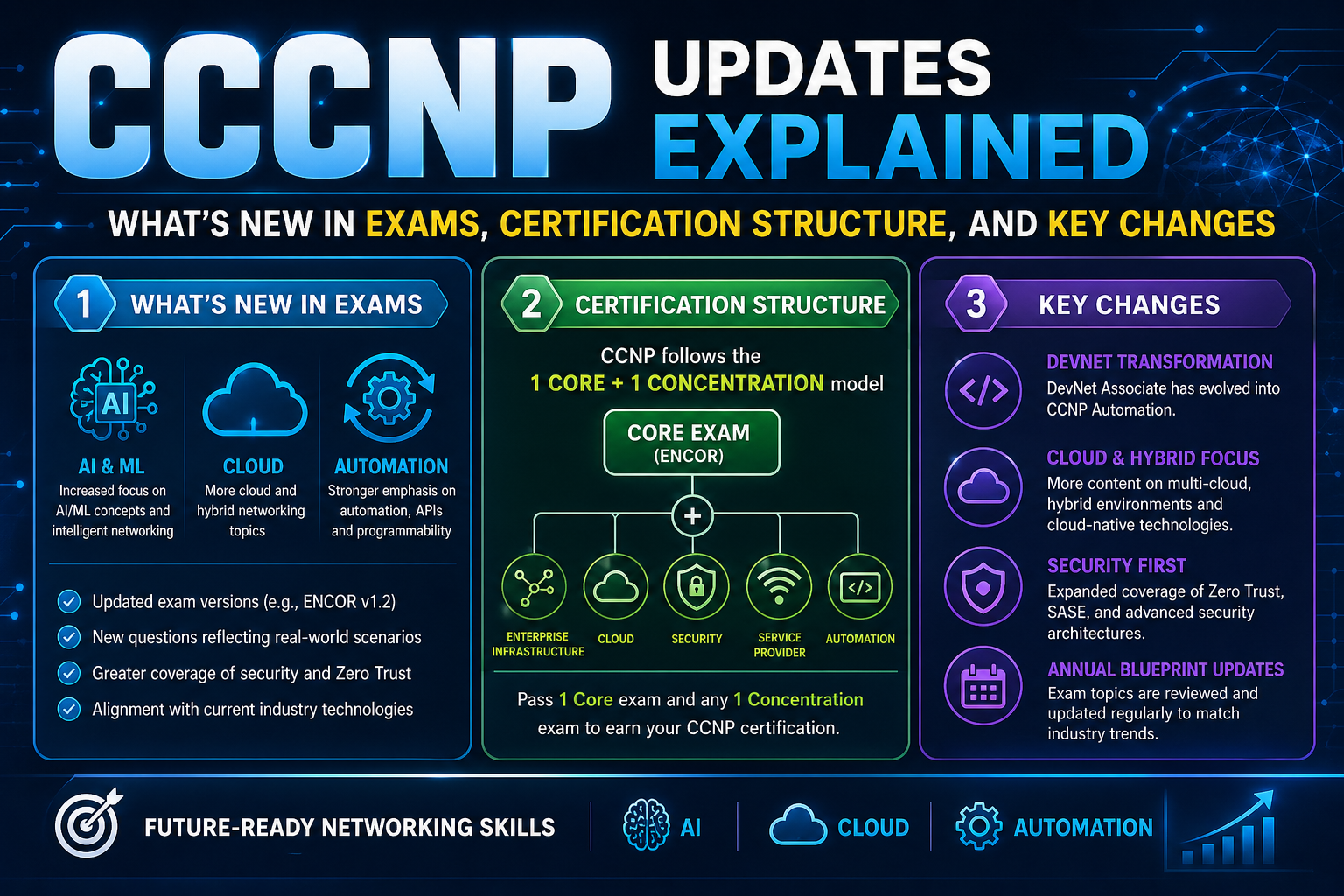
The CCNP certification has been redesigned to reflect the rapid transformation of networking environments in modern enterprises. It is no longer limited to traditional routing and switching knowledge but now represents a broader skill set that includes automation, cloud integration, security awareness, and software-driven network management. The updated structure aims to ensure that professionals are equipped to handle both legacy infrastructure and next-generation networking systems that rely heavily on programmability and centralized control.
This evolution is driven by the shift in how organizations design and manage their networks. Instead of manually configuring devices one by one, modern networks are increasingly controlled through software-defined approaches. As a result, certification content has been adjusted to prepare candidates for real operational challenges rather than purely theoretical scenarios. The focus is now on applied knowledge that directly translates into workplace efficiency and adaptability.
The certification also serves as a bridge between traditional networking roles and emerging IT roles that require hybrid knowledge of networking, automation, and cloud systems. This makes it highly relevant for professionals aiming to remain competitive in a rapidly changing technology landscape.
Revised Certification Structure and Core Exam Concept
One of the most important updates in CCNP is the introduction of a structured path consisting of a core exam and a concentration exam. The core exam focuses on essential networking knowledge within a chosen domain, such as enterprise infrastructure or security. This ensures that all certified professionals have a strong foundational understanding of key networking principles.
The concentration exam allows candidates to specialize in a specific technical area. This could include advanced routing, wireless networking, security implementations, automation, or data center technologies. This dual-exam structure provides flexibility, enabling learners to align their certification journey with their career goals and industry demands.
The restructuring also reduces redundancy in exam content and eliminates unnecessary overlap. Instead of multiple generalized exams, candidates now follow a more streamlined approach that emphasizes depth over breadth. This helps ensure that certified individuals are not only knowledgeable but also capable of handling specialized responsibilities in real-world environments.
Integration of Automation and Network Programmability
A major shift in the updated CCNP framework is the integration of automation and programmability concepts. Traditional networking focused heavily on manual configuration and device-level management. However, modern enterprise networks rely on automation tools and programmable interfaces to improve efficiency and reduce human error.
Candidates are now expected to understand how network devices can be controlled using APIs, scripts, and automation platforms. This includes familiarity with configuration management tools and data formats commonly used in network automation. The goal is to prepare professionals for environments where repetitive tasks are automated, allowing engineers to focus on higher-level design and optimization.
This shift also reflects the increasing role of DevOps practices in networking. Networking professionals are now expected to collaborate more closely with software teams, using shared tools and workflows. As a result, CCNP certification has become more aligned with modern IT operations, where networking is no longer isolated but integrated into broader system automation strategies.
Emphasis on Software-Defined Networking Concepts
Software-defined networking has become a core component of modern network architecture, and the updated CCNP certification reflects this reality. SDN separates the control plane from the data plane, allowing centralized management of network behavior through software controllers.
Candidates are expected to understand how SDN architectures function, including how policies are defined and enforced across distributed network devices. This includes knowledge of centralized controllers, policy-driven networking, and dynamic resource allocation.
The inclusion of SDN concepts ensures that certified professionals can work effectively in environments where networks are no longer manually configured but dynamically controlled. This is particularly important in large-scale enterprise and cloud environments where agility and scalability are critical requirements.
By incorporating SDN into the certification, the CCNP framework ensures that professionals remain relevant in a landscape where traditional networking methods are rapidly being replaced by software-driven solutions.
Updated Focus on Security Integration
Security is no longer treated as a separate discipline in networking but is now integrated into almost every aspect of network design and operation. The updated CCNP certification reflects this shift by embedding security principles throughout its exam content.
Candidates are expected to understand how to secure network infrastructure, implement access control policies, and identify potential vulnerabilities in both physical and virtual environments. This includes awareness of secure routing practices, encryption methods, and threat mitigation strategies.
The integration of security concepts ensures that networking professionals are prepared to handle modern cyber threats that target network infrastructure directly. It also emphasizes the importance of designing networks with security as a foundational element rather than an afterthought.
This approach aligns with industry expectations, where network engineers are often required to collaborate closely with cybersecurity teams to maintain secure and resilient systems.
Real-World Scenario-Based Exam Design
The updated CCNP exams place a strong emphasis on scenario-based questions that reflect real-world networking challenges. Instead of simple memorization or theoretical recall, candidates are tested on their ability to analyze complex situations and apply appropriate solutions.
These scenarios often involve troubleshooting network issues, optimizing performance, or designing scalable architectures under specific constraints. This approach ensures that certified professionals are not only knowledgeable but also capable of practical problem-solving in live environments.
The shift toward scenario-based assessment improves the overall value of the certification by ensuring that it accurately reflects job requirements. Employers can have greater confidence that certified individuals possess the hands-on skills needed to manage enterprise networks effectively.
This also encourages deeper learning, as candidates must understand how different networking concepts interact in real systems rather than studying them in isolation.
Specialization Through Concentration Exams
The concentration exam component of CCNP allows professionals to specialize in areas that match their career interests or organizational needs. This flexibility is one of the most significant improvements in the certification structure.
Specializations may include enterprise advanced routing, wireless technologies, security implementations, automation strategies, or data center networking. Each concentration exam focuses on advanced topics within its domain, enabling candidates to develop deep expertise.
This specialization model is particularly valuable in modern IT environments, where roles are becoming increasingly focused and skill-specific. Instead of generalist knowledge alone, employers often seek professionals with targeted expertise in critical areas of networking.
By offering multiple specialization paths, the CCNP certification allows professionals to tailor their learning journey and build a career trajectory aligned with industry demand.
Impact on Career Growth and Industry Relevance
The updated CCNP certification significantly enhances career opportunities for networking professionals. It is widely recognized as a benchmark for intermediate to advanced-level networking expertise and is often required for roles such as network engineer, systems engineer, and infrastructure specialist.
With the inclusion of modern technologies like automation and SDN, the certification also opens pathways into emerging roles that blend networking with software engineering. This includes positions focused on network automation, cloud infrastructure, and DevOps integration.
Employers value CCNP-certified professionals because the certification demonstrates both theoretical knowledge and practical capability. It signals that an individual is capable of managing complex network environments and adapting to evolving technological requirements.
As networking continues to evolve, CCNP certification remains a strong indicator of technical competence and career readiness.
Hands-On Practice and Lab Importance
Practical experience plays a crucial role in preparing for CCNP certification. The updated exam structure requires candidates to develop strong hands-on skills through lab practice and simulation environments.
Working with virtualized network environments helps candidates understand how theoretical concepts apply in real-world scenarios. This includes configuring routers and switches, implementing security policies, and testing network automation scripts.
Lab practice also helps reinforce troubleshooting skills, which are essential for scenario-based exam questions. By simulating real network conditions, candidates gain confidence in diagnosing and resolving issues efficiently.
The emphasis on hands-on learning ensures that certification holders are not only knowledgeable but also operationally competent in managing enterprise networks.
Alignment with Modern IT Infrastructure Trends
The CCNP certification has been updated to align closely with current trends in IT infrastructure, including cloud computing, hybrid networks, and distributed systems. Modern organizations often operate across multiple environments, requiring seamless connectivity between on-premises and cloud-based systems.
The updated certification content reflects this reality by including topics related to network integration across different platforms. This ensures that professionals understand how to design and manage networks that span diverse environments.
It also prepares candidates for the growing complexity of modern infrastructure, where traditional boundaries between networking, computing, and storage are increasingly blurred.
By addressing these trends, CCNP certification remains relevant in a rapidly evolving technological landscape.
Continuous Learning and Recertification Approach
The updated CCNP framework encourages continuous learning rather than one-time certification achievement. Networking technologies evolve quickly, and professionals are expected to stay updated with new developments.
Recertification policies support this approach by requiring individuals to maintain and update their skills over time. This ensures that certified professionals remain current with industry changes and emerging technologies.
Continuous learning also promotes long-term career growth, as professionals are encouraged to expand their expertise beyond initial certification requirements. This creates a culture of ongoing development and adaptability.
As a result, CCNP certification is not just a milestone but part of an ongoing professional journey in networking.
Overall Significance of CCNP Updates
The recent updates to the CCNP certification represent a major shift toward modern, practical, and technology-driven networking education. By integrating automation, security, SDN, and scenario-based learning, the certification has become more aligned with real-world industry demands.
The flexible structure allows professionals to specialize while maintaining a strong foundational knowledge base. This balance between depth and adaptability makes the certification highly valuable in today’s IT job market.
Ultimately, the updated CCNP framework ensures that networking professionals are prepared not only for current technologies but also for future advancements in the field.
Advanced Changes in CCNP Exam Content Domains
The updated CCNP certification introduces more depth across its core technical domains, reflecting the increasing complexity of enterprise networking environments. Each domain is no longer treated as an isolated topic but is instead integrated into broader, real-world networking scenarios. This means routing, switching, security, automation, and infrastructure design are all interconnected within exam expectations.
Candidates are expected to demonstrate not only conceptual understanding but also the ability to apply multiple domains simultaneously. For example, a troubleshooting scenario may require knowledge of routing protocols, security policies, and automation tools all at once. This integrated approach mirrors real enterprise environments where network issues rarely occur within a single isolated layer.
The updated structure ensures that professionals are prepared for multi-domain problem solving, which is now a critical requirement in modern IT roles. This shift significantly increases the depth of knowledge required but also enhances the practical value of the certification.
Greater Emphasis on Network Infrastructure Design
Network design has become a central focus of the updated CCNP certification. Instead of simply configuring devices, candidates are now expected to design scalable, resilient, and efficient network architectures that meet organizational needs.
This includes understanding redundancy mechanisms, load balancing strategies, hierarchical design models, and high availability configurations. Candidates must also consider performance optimization, scalability requirements, and fault tolerance when designing networks.
The emphasis on design reflects real-world expectations where network engineers are often involved in planning and architecting infrastructure rather than only maintaining it. This shift elevates the role of certified professionals from operational technicians to strategic infrastructure designers.
It also ensures that CCNP-certified individuals can contribute to long-term network planning decisions, which are critical in large enterprise environments.
Integration of Cloud Networking Concepts
Modern enterprise networks are increasingly dependent on cloud services, and the updated CCNP certification reflects this transformation. Cloud networking concepts are now integrated into exam expectations, requiring candidates to understand hybrid and multi-cloud environments.
Professionals must be familiar with how traditional on-premises networks connect and interact with cloud-based infrastructure. This includes understanding virtual networks, cloud routing mechanisms, and secure connectivity between distributed environments.
The certification also emphasizes the importance of scalability and flexibility in cloud-integrated networks. Candidates are expected to understand how workloads move between environments and how network performance is maintained across different platforms.
This integration ensures that CCNP-certified professionals remain relevant in organizations that rely heavily on cloud technologies for their operations.
Enhanced Focus on Troubleshooting Methodologies
Troubleshooting remains a core skill in CCNP certification, but the updated version places greater emphasis on structured and systematic problem-solving approaches. Candidates are expected to follow logical troubleshooting methodologies rather than relying on memorized solutions.
This includes identifying symptoms, isolating potential causes, testing hypotheses, and implementing corrective actions. The ability to diagnose complex network issues efficiently is a critical skill in real-world environments where downtime can have significant business impact.
The updated exam scenarios often present layered problems that require analysis across multiple network components. This ensures that candidates develop strong analytical thinking skills and the ability to remain calm under pressure.
Structured troubleshooting not only improves exam performance but also prepares professionals for real operational challenges in enterprise networks.
Expansion of Automation Tool Knowledge Requirements
Automation tools play a much larger role in the updated CCNP certification. Candidates are expected to understand how network automation frameworks operate and how they are applied in enterprise environments.
This includes familiarity with configuration automation, network orchestration, and policy-driven management systems. The focus is not on mastering a specific tool but on understanding the principles behind automation and how they improve network efficiency.
Automation reduces manual configuration errors and increases operational speed, making it an essential part of modern networking. Candidates must understand how automation interacts with traditional network infrastructure and how it can be used to streamline repetitive tasks.
This knowledge ensures that CCNP-certified professionals are prepared for environments where automation is standard practice rather than an advanced option.
Increased Importance of Network Security Integration
Security has become deeply embedded into every aspect of the CCNP certification. Instead of being treated as a separate topic, it is now integrated into routing, switching, design, and automation domains.
Candidates are expected to understand how security policies are enforced across networks and how different layers of infrastructure contribute to overall protection. This includes knowledge of segmentation, access control, encryption, and threat detection principles.
The updated certification also emphasizes proactive security design, where networks are built with security considerations from the ground up. This approach reduces vulnerabilities and improves overall resilience against cyber threats.
By embedding security into all areas of the exam, the certification ensures that professionals are prepared for modern security challenges that target network infrastructure directly.
Shift Toward Real Operational Scenarios
One of the most important changes in the CCNP certification is the shift toward operational realism. Exam questions are now designed to simulate real workplace situations rather than abstract theoretical problems.
Candidates may be required to interpret network diagrams, analyze logs, or identify misconfigurations based on complex scenarios. These tasks reflect the responsibilities of real network engineers working in enterprise environments.
This approach ensures that certified professionals are not only academically prepared but also operationally capable. It bridges the gap between theoretical learning and practical job performance.
The focus on realism also improves the credibility of the certification in the industry, as it demonstrates actual skill application rather than memorized knowledge.
Changes in Study Approach and Preparation Methods
The updated CCNP certification requires a more structured and hands-on study approach. Traditional memorization-based learning is no longer sufficient to succeed in the exams.
Candidates are encouraged to use lab environments, simulation tools, and real-world practice scenarios to develop their skills. This includes configuring networks, testing automation scripts, and troubleshooting simulated failures.
Study methods now emphasize active learning rather than passive reading. Engaging with practical exercises helps reinforce theoretical concepts and improves long-term retention.
This change in preparation style ensures that candidates develop genuine technical competence rather than surface-level knowledge.
Role of Simulation and Virtual Lab Environments
Virtual labs have become essential in preparing for the updated CCNP certification. These environments allow candidates to practice complex configurations without requiring physical hardware.
Through simulation, learners can experiment with routing protocols, security configurations, and automation workflows in a controlled setting. This hands-on experience is critical for understanding how different network components interact in real environments.
Virtual labs also allow for repeated practice, which is essential for mastering troubleshooting and configuration skills. Mistakes can be made safely and corrected without impacting real systems.
This approach significantly enhances learning efficiency and prepares candidates for real-world operational challenges.
Comparison with Previous Certification Structure
The updated CCNP certification differs significantly from earlier versions in both structure and content depth. Earlier versions focused more on device configuration and protocol knowledge, while the current version emphasizes integration, automation, and design.
Previously, exams were more compartmentalized, with separate focus areas that did not always reflect real-world overlap. The new structure integrates multiple domains into unified scenarios, creating a more realistic assessment environment.
The inclusion of automation, cloud networking, and security integration represents a major shift toward modern IT infrastructure needs. This makes the certification more relevant but also more challenging.
Overall, the updated structure better aligns with current industry expectations and technological advancements.
Impact on Job Roles and Industry Demand
The updated CCNP certification has a significant impact on job roles within the networking industry. Professionals with this certification are now expected to handle more complex responsibilities, including network design, automation implementation, and security integration.
Employers increasingly seek candidates who can manage hybrid environments that combine traditional infrastructure with cloud-based systems. The certification helps validate these skills and improves job market competitiveness.
It also opens opportunities in advanced roles such as network architect, infrastructure engineer, and automation specialist. These roles require a combination of technical expertise and strategic thinking.
As networking continues to evolve, CCNP-certified professionals are positioned to take on more senior and specialized positions within organizations.
Future Direction of CCNP Certification
The future direction of CCNP certification is likely to continue focusing on automation, cloud integration, and security convergence. As networks become more intelligent and software-driven, certification content will continue to evolve.
Emerging technologies such as artificial intelligence in networking, intent-based networking, and advanced orchestration systems may become part of future updates. This will further increase the importance of adaptability and continuous learning.
The certification is expected to remain aligned with industry transformation, ensuring that professionals stay relevant in rapidly changing environments.
This forward-looking approach makes CCNP a long-term investment in networking careers.
Final Understanding of CCNP Transformation
The transformation of CCNP certification represents a major shift in how networking expertise is defined and evaluated. It moves beyond traditional configuration skills and embraces a broader, more modern skill set that includes automation, cloud integration, security, and design thinking.
This evolution ensures that certified professionals are not only technically competent but also capable of adapting to future technological changes. The certification now reflects the reality of modern enterprise networking, where systems are dynamic, interconnected, and heavily automated.
By aligning with industry trends and operational demands, the updated CCNP certification remains one of the most relevant and valuable credentials for networking professionals today.
Advanced Troubleshooting in Modern CCNP Environments
The updated CCNP certification places strong importance on advanced troubleshooting skills that reflect real enterprise network environments. Troubleshooting is no longer limited to identifying basic configuration errors but now involves analyzing complex, multi-layered infrastructure issues. Candidates are expected to evaluate interactions between routing protocols, switching behavior, security policies, and automation systems to identify root causes effectively.
Modern troubleshooting scenarios often simulate real outages or performance degradation situations where multiple factors contribute to the problem. This requires a structured and analytical approach rather than trial-and-error methods. Professionals must be able to interpret logs, analyze traffic patterns, and understand protocol behavior under different conditions.
The focus on advanced troubleshooting ensures that certified individuals are capable of maintaining high network availability in critical business environments. It also strengthens decision-making skills under pressure, which is essential in large-scale infrastructure operations.
Deepening Knowledge of Routing and Switching Technologies
Routing and switching remain foundational elements of CCNP certification, but their treatment has become significantly more advanced. Candidates are now expected to understand not only how protocols function but also how they interact in complex enterprise topologies.
Routing concepts include deeper analysis of dynamic routing behavior, route optimization, and convergence mechanisms. Switching topics emphasize VLAN design, spanning tree optimization, and efficient traffic distribution across network segments. These concepts are no longer tested in isolation but are embedded within larger network design and troubleshooting scenarios.
The updated approach ensures that professionals can design and manage networks that are both efficient and resilient. It also prepares them for environments where multiple routing protocols may coexist and require careful coordination.
By strengthening these core areas, the certification maintains a strong technical foundation while integrating modern networking requirements.
Role of Network Automation in Operational Efficiency
Network automation has become a critical component of modern enterprise infrastructure, and the CCNP certification reflects this shift. Automation is now viewed as a key factor in improving operational efficiency, reducing human error, and increasing deployment speed.
Candidates are expected to understand how repetitive network tasks can be automated using scripts, templates, and orchestration systems. This includes configuration deployment, policy enforcement, and network monitoring automation.
The emphasis is not on mastering a specific programming language but on understanding how automation integrates into network operations. Professionals must be able to interpret automation workflows and understand how they impact network behavior.
This shift ensures that CCNP-certified individuals are prepared for environments where manual configuration is gradually being replaced by automated systems.
Importance of Intent-Based Networking Concepts
Intent-based networking is an emerging concept that plays an increasingly important role in modern network design. The updated CCNP certification introduces foundational knowledge of this approach, where network behavior is driven by high-level business intent rather than manual configuration.
In this model, administrators define desired outcomes, and the network automatically adjusts configurations to achieve those outcomes. This requires a deep understanding of policy-driven networking and automated enforcement mechanisms.
Candidates are expected to understand how intent translates into network policies and how these policies are implemented across distributed systems. This concept represents a shift from reactive management to proactive and intelligent network control.
By including intent-based networking, the certification ensures alignment with future-oriented infrastructure models.
Strengthening of Security-First Network Design Philosophy
Security is now deeply embedded into every stage of network design within the CCNP certification framework. Rather than being treated as an additional layer, security is considered a fundamental design principle.
Candidates are expected to design networks that minimize vulnerabilities through segmentation, controlled access, and secure communication protocols. This includes understanding how to isolate critical systems, implement secure routing paths, and protect data in transit.
The certification also emphasizes threat awareness, ensuring professionals understand common attack vectors targeting network infrastructure. This knowledge is essential for designing resilient systems capable of withstanding modern cyber threats.
The security-first approach ensures that networking professionals contribute to overall organizational cybersecurity posture.
Evolution of Enterprise Network Architectures
Enterprise network architecture has evolved significantly, and the CCNP certification reflects this transformation. Traditional flat network designs have been replaced with hierarchical, scalable, and cloud-integrated architectures.
Candidates are expected to understand how modern networks support distributed users, remote access, and hybrid cloud environments. This includes knowledge of segmentation strategies, redundancy planning, and high availability design principles.
The updated certification emphasizes flexibility in architecture, allowing networks to adapt dynamically to changing business requirements. This is particularly important in organizations that operate across multiple geographic locations and cloud platforms.
Understanding modern architecture ensures that professionals can design networks that support both current and future business needs.
Greater Focus on Performance Optimization Techniques
Network performance optimization has become an essential part of CCNP certification. Candidates are expected to understand how to analyze and improve network efficiency across different layers.
This includes optimizing routing paths, reducing latency, balancing traffic loads, and ensuring efficient bandwidth utilization. Performance tuning is no longer a separate topic but is integrated into design and troubleshooting scenarios.
Professionals must also understand how application behavior impacts network performance and how to prioritize critical traffic. This requires a holistic view of both network infrastructure and application requirements.
The focus on performance optimization ensures that certified individuals can deliver high-quality network services in demanding environments.
Integration of Wireless Networking Concepts
Wireless networking has become a major component of enterprise infrastructure, and its importance is reflected in the updated CCNP certification. Candidates are expected to understand how wireless systems integrate with wired networks to provide seamless connectivity.
This includes knowledge of wireless design principles, access point deployment strategies, and interference management. Security considerations for wireless environments are also emphasized, particularly in enterprise deployments.
The integration of wireless concepts ensures that professionals can manage hybrid environments where users rely on both wired and wireless access.
As mobility continues to grow in importance, wireless expertise becomes a critical skill for networking professionals.
Understanding Network Scalability and Growth Planning
Scalability is a key focus area in modern network design, and CCNP certification places strong emphasis on planning for future growth. Candidates are expected to design networks that can expand without major restructuring.
This includes understanding modular design principles, hierarchical architecture, and scalable routing strategies. Professionals must also consider how increased traffic and device counts impact overall network performance.
Scalability planning ensures that networks remain efficient and stable as organizations grow. It also reduces long-term operational costs by minimizing the need for frequent redesigns.
This forward-thinking approach is essential for enterprise-level infrastructure management.
Increased Complexity of Exam Scenarios
The complexity of CCNP exam scenarios has increased significantly in the updated version. Candidates are presented with multi-layered problems that require deep analysis and cross-domain knowledge.
These scenarios often involve multiple simultaneous issues, such as routing failures combined with security misconfigurations or automation errors affecting network behavior. This reflects real-world situations where problems rarely occur in isolation.
The increased complexity ensures that only candidates with strong analytical and practical skills succeed. It also improves the credibility of the certification as a true measure of professional competence.
This approach encourages deeper understanding rather than surface-level memorization.
Role of Continuous Skill Development in Networking Careers
The networking industry evolves rapidly, and continuous skill development is essential for long-term career success. The CCNP certification encourages professionals to keep updating their knowledge as new technologies emerge.
This includes staying current with automation tools, cloud networking advancements, and security best practices. Continuous learning ensures that professionals remain relevant in a competitive job market.
It also promotes adaptability, which is essential in environments where technologies and business requirements change frequently.
The certification acts as a foundation for ongoing professional growth rather than a final achievement.
Career Impact and Professional Growth
The updated CCNP certification significantly enhances long-term career opportunities for networking professionals by aligning directly with current industry demands. With its strong focus on automation, security integration, and advanced infrastructure design, it prepares candidates for higher-level technical roles that go beyond basic network administration. Professionals who complete this certification are better positioned for roles such as network engineer, infrastructure specialist, systems engineer, and network architect, where analytical thinking and hands-on expertise are essential.
It also strengthens professional credibility in the job market, as employers increasingly value candidates who can manage complex hybrid environments that combine on-premises systems, cloud platforms, and automated network operations. The certification demonstrates not only technical knowledge but also the ability to adapt to modern networking challenges. As a result, it acts as a strong foundation for career advancement and opens pathways toward leadership and specialized technical positions.
Future Readiness and Industry Relevance
One of the most important strengths of the updated CCNP certification is its focus on future-ready skills that align with ongoing technological evolution. As networking continues to shift toward automation, artificial intelligence integration, and cloud-native architectures, the certification ensures that professionals remain relevant in rapidly changing environments. It builds adaptability by encouraging continuous learning and exposure to emerging technologies.
This future-oriented approach makes CCNP a long-term investment in a networking career rather than just a certification milestone. It prepares professionals to evolve alongside industry advancements and remain effective in environments where traditional networking boundaries are constantly being redefined. By focusing on real-world application and modern infrastructure trends, the certification maintains its position as a highly respected and globally recognized standard in the networking field.
Alignment with Industry Transformation Trends
The updated CCNP certification is closely aligned with major industry transformation trends, including digital transformation, cloud adoption, and network automation. These trends are reshaping how organizations design and manage their IT infrastructure.
Networking professionals are now expected to support digital services that rely on fast, secure, and scalable connectivity. This requires a combination of technical expertise and strategic thinking.
The certification ensures that professionals are prepared to contribute to digital transformation initiatives within their organizations.
This alignment makes CCNP highly relevant in modern IT ecosystems.
Final Perspective on CCNP Modernization
The modernization of CCNP certification represents a comprehensive shift toward real-world relevance, technical depth, and future readiness. It moves beyond traditional networking concepts and embraces a broader skill set that includes automation, security, cloud integration, and advanced design principles.
This transformation ensures that certified professionals are equipped to handle the complexities of modern enterprise networks. It also positions them for long-term career growth in an evolving technology landscape.
By combining practical skills with advanced theoretical knowledge, the CCNP certification remains a strong benchmark for networking excellence in the modern IT industry.
Conclusion
The updated CCNP certification represents a major transformation in how networking expertise is defined, tested, and applied in real-world environments. It has evolved far beyond traditional routing and switching knowledge to include modern technologies such as automation, cloud integration, software-defined networking, and advanced security practices. This shift ensures that certified professionals are prepared for the complexity of today’s enterprise networks, where systems are highly dynamic, interconnected, and increasingly software-driven.
The new structure, built around a core exam and specialized concentration exams, provides both flexibility and depth. It allows candidates to strengthen foundational networking knowledge while also developing expertise in a focused area that aligns with their career goals. This makes the certification more adaptable to different professional paths and industry requirements.
Another key strength of the updated CCNP framework is its strong emphasis on practical, scenario-based learning. Instead of relying on memorization, candidates are required to apply their knowledge to realistic network challenges. This approach improves problem-solving skills and ensures that certified individuals can handle actual operational issues in enterprise environments.
The integration of automation, cloud technologies, and security into every aspect of the certification reflects the direction in which the networking industry is moving. Networks are no longer static systems but intelligent, automated ecosystems that require continuous monitoring, optimization, and protection. CCNP now prepares professionals to work effectively within this modern landscape.
Overall, the updated CCNP certification is not just an academic credential but a comprehensive validation of real-world networking capability. It equips professionals with the skills needed to design, manage, and troubleshoot complex infrastructures while staying aligned with future technological advancements.