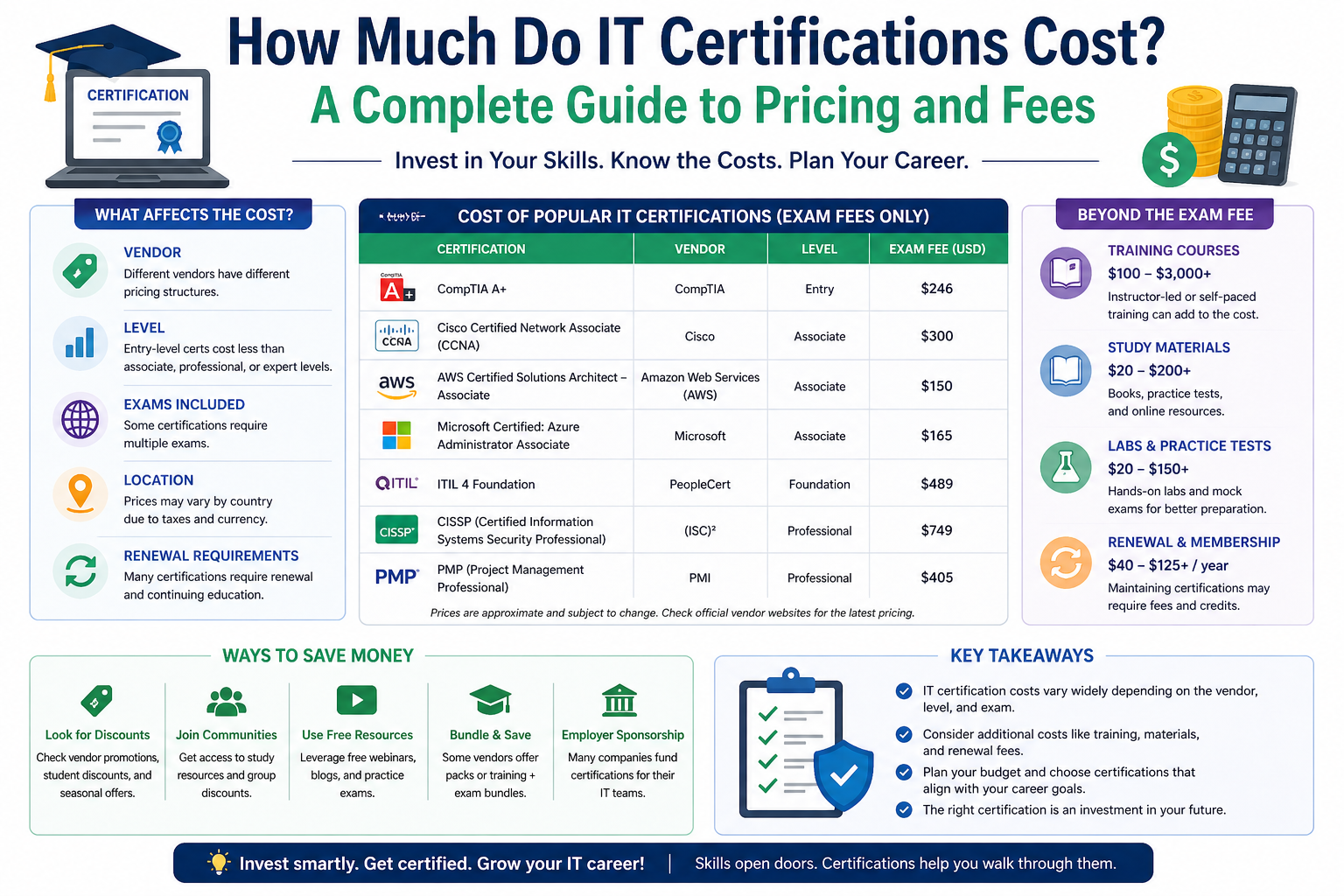
The cost of IT certifications is often misunderstood because many people focus only on the exam fee. In reality, the total investment includes several layers such as preparation, study resources, training programs, and sometimes repeated attempts. Each certification path is different, and the final cost depends on the learner’s background, experience level, and chosen study method. Some individuals may pass with minimal expense, while others invest heavily in structured training and premium materials to ensure success on the first attempt.
Entry-Level Certification Pricing
Entry-level IT certifications are generally designed for beginners who are new to the technology field. These certifications are usually the most affordable option, making them a popular starting point for students and career changers. The exam fees are typically lower because the content covers foundational knowledge rather than advanced technical expertise.
However, even at the entry level, additional costs can add up. Many learners choose to purchase practice exams, beginner-friendly courses, or study guides to improve their understanding. While these resources are optional, they often play a key role in helping candidates build confidence before sitting for the actual exam.
Associate-Level Certification Costs
Associate-level certifications are the next step after foundational credentials. These certifications require a deeper understanding of technical concepts and practical skills. As a result, the exam fees are usually higher than entry-level certifications.
At this stage, many candidates begin to invest in more structured learning approaches. Online courses, instructor-led classes, and virtual labs become more common because the material is more complex. These training programs can significantly increase the overall cost, especially if they include hands-on practice environments or mentorship sessions.
In addition to training, candidates often spend more time preparing for associate-level exams. This indirect cost, in terms of time and effort, is an important factor that is often overlooked but still contributes to the overall investment.
Professional-Level Certification Expenses
Professional-level IT certifications are designed for individuals with substantial experience in the field. These certifications are more challenging and are often recognized as industry standards for advanced roles. Because of this, the exam fees are noticeably higher compared to beginner and associate levels.
The preparation costs at this level are also significantly higher. Many professionals rely on specialized training programs, advanced practice exams, and real-world simulations to prepare effectively. Some organizations offer intensive bootcamps that can last several days or weeks, and these can be expensive but highly effective.
Another important factor is that professionals may need to take time off work or reduce their workload to focus on exam preparation. This opportunity cost adds another layer to the overall expense of certification.
Expert and Advanced Certification Pricing
Expert-level certifications represent the highest tier in IT credentialing. These certifications are intended for senior professionals, architects, and specialists who already have years of experience. The exam fees for these certifications are typically the highest due to their complexity and industry value.
Preparation for expert-level certifications often requires extensive study and practical experience. Candidates may need to invest in multiple advanced courses, simulation environments, and peer study groups. In some cases, individuals also hire mentors or join specialized training programs to improve their chances of success.
Because of the difficulty level, it is not uncommon for candidates to attempt these exams more than once, which can further increase total costs. Each retake usually requires paying the full exam fee again, making careful preparation essential.
Training Programs and Learning Resources
One of the most significant contributors to certification costs is training. While some individuals choose self-study methods, many prefer structured programs to ensure better understanding and higher pass rates.
Training programs vary widely in price. Self-paced online courses are generally more affordable, while live instructor-led training sessions are more expensive. Bootcamps and intensive workshops tend to be the highest-cost option, but they also offer the most immersive learning experience.
Study materials such as books, practice exams, and video tutorials also contribute to overall expenses. Some candidates prefer premium resources that offer updated content and realistic exam simulations, while others rely on free or low-cost materials available online.
Lab Access and Practical Experience Costs
For many IT certifications, especially those related to networking, cloud computing, or cybersecurity, hands-on experience is essential. Virtual labs and simulation environments allow candidates to practice real-world scenarios without needing physical hardware.
Access to these labs is often subscription-based, meaning candidates must pay monthly or yearly fees. While this adds to the overall cost, it is often necessary for understanding complex systems and improving practical skills.
Some certification providers also offer official lab environments as part of their training packages. These bundled options can be convenient but may come at a higher price compared to third-party solutions.
Exam Retake Fees and Their Impact
Not passing a certification exam on the first attempt can significantly increase total costs. Retake fees are usually similar to the original exam price, meaning each additional attempt adds a substantial financial burden.
This is why many candidates invest more in preparation upfront to avoid multiple attempts. Practice exams, mock tests, and review sessions are commonly used strategies to reduce the risk of failure and minimize additional expenses.
Some certification programs also have waiting periods between attempts, which can delay career progress and indirectly increase costs in terms of time and opportunity.
Certification Renewal and Maintenance Costs
Many IT certifications are not permanent and require periodic renewal. This ensures that professionals stay updated with evolving technologies and industry standards. Renewal methods vary depending on the certification provider.
Some certifications require retaking the exam after a certain period, while others allow renewal through continuing education credits or professional development activities. These renewal processes may involve additional fees, course costs, or membership requirements.
Over time, renewal expenses can accumulate, especially for professionals who hold multiple certifications. This makes long-term planning important when choosing which certifications to pursue.
Hidden Costs of IT Certification
Beyond the obvious expenses, there are several hidden costs associated with certification. One of the most common is the time investment required for study and preparation. Time spent studying could otherwise be used for work or other income-generating activities.
Another hidden cost is the potential need for updated hardware or software. Some certifications require specific system environments or tools that may not already be available to the candidate. Setting up these environments can add to the overall expense.
There is also the cost of stress and effort, which, while not financial, plays a real role in the certification journey. Preparing for difficult exams requires sustained focus and discipline, which can be demanding over long periods.
Cost Differences Across Certification Providers
Different IT certification providers have different pricing structures. Some organizations charge higher fees due to global recognition and industry demand, while others offer more affordable options aimed at beginners or niche markets.
Well-known certifications in cloud computing, networking, cybersecurity, and project management often fall on the higher end of the pricing scale. Meanwhile, newer or less globally recognized certifications may offer more budget-friendly alternatives.
The value of a certification is often linked to its recognition in the job market. As a result, higher-cost certifications are sometimes preferred because they can lead to better career opportunities and higher salaries.
Balancing Cost and Career Value
When evaluating IT certification costs, it is important to consider long-term career benefits rather than just upfront expenses. A more expensive certification may provide stronger job prospects, higher earning potential, and better professional recognition.
On the other hand, lower-cost certifications can still be valuable for gaining foundational knowledge and building confidence in a new field. Many professionals begin with affordable certifications and gradually progress to more advanced ones over time.
Choosing the right balance between cost and value depends on individual career goals, current skill level, and available budget. Strategic planning can help ensure that certification investments deliver meaningful returns in the future.
IT Certification Investment
The overall cost of IT certifications is influenced by multiple factors including exam fees, training, study resources, lab access, retakes, and renewal requirements. While the financial investment can vary significantly, the potential career benefits often make it worthwhile.
Understanding all components of certification pricing helps individuals make informed decisions and avoid unexpected expenses. With proper planning and preparation, it is possible to manage costs effectively while achieving valuable industry-recognized credentials.
Advanced Strategies for Managing IT Certification Costs
As IT certifications become more advanced, managing costs effectively becomes just as important as preparing for the exam itself. Many professionals find that without a clear strategy, expenses can quickly increase beyond expectations. A structured approach helps reduce unnecessary spending while still ensuring high-quality preparation. Planning ahead, choosing the right learning resources, and understanding available options can significantly reduce financial pressure.
Choosing the Right Certification Path Wisely
One of the most important decisions that affects overall cost is selecting the right certification path. Not every certification is necessary for every career goal, and choosing too many at once can lead to wasted time and money. It is often more effective to focus on certifications that directly align with job roles or long-term career objectives.
Before committing, it helps to research job market demand, salary expectations, and skill relevance. Some certifications carry strong industry recognition and can lead to higher-paying roles, while others may have limited impact depending on the region or industry. Making informed choices ensures that each investment contributes meaningfully to professional growth.
Self-Study vs Paid Training Approach
The method used for exam preparation plays a major role in determining total cost. Self-study is usually the most affordable option because it relies on free or low-cost materials such as documentation, online tutorials, and community resources. However, it requires strong discipline, time management, and the ability to learn independently.
Paid training programs, on the other hand, offer structured learning paths, expert guidance, and organized content delivery. While these programs can be expensive, they often reduce the time needed to prepare and improve the chances of passing on the first attempt. Many candidates choose a hybrid approach, combining self-study with selective paid resources to balance cost and effectiveness.
Leveraging Free and Community Resources
A significant way to reduce certification expenses is by using free learning resources. Many online communities, forums, and educational platforms provide high-quality content at no cost. These resources often include study guides, discussion groups, video explanations, and practice questions shared by experienced professionals.
Community learning can also be valuable for motivation and problem-solving. Engaging with others preparing for the same certification helps clarify difficult topics and provides real-world insights. However, it is important to ensure that the information is accurate and up to date, as unofficial materials can sometimes be outdated or incomplete.
Timing Your Certification for Cost Efficiency
The timing of certification attempts can also influence overall expenses. Some organizations occasionally adjust exam prices or offer promotional discounts during specific periods. Planning exams around such opportunities can reduce costs.
Additionally, allowing enough preparation time before scheduling the exam reduces the likelihood of retakes. Rushing into an exam without adequate preparation often leads to failure, which increases total spending due to retake fees. A well-planned timeline helps avoid unnecessary financial loss.
Employer Sponsorship and Financial Support
In many cases, employers are willing to support IT certification costs, especially when the certification benefits the organization. This support may come in the form of full reimbursement, partial funding, or paid training programs.
Taking advantage of employer sponsorship can significantly reduce personal expenses. Some companies even encourage employees to pursue certifications by offering salary increases or bonuses upon completion. It is always beneficial to check company policies regarding professional development support before paying out of pocket.
Subscription-Based Learning Platforms
Subscription-based learning platforms have become a popular alternative to traditional training programs. These platforms offer access to a wide range of courses for a monthly or annual fee. For individuals pursuing multiple certifications, this can be more cost-effective than purchasing separate courses for each exam.
However, it is important to actively use the subscription. If not fully utilized, ongoing payments can add up over time without providing equal value. Choosing platforms with updated content and structured learning paths ensures better return on investment.
Bundled Certification Packages
Some certification providers and training organizations offer bundled packages that include exam vouchers, training materials, and practice labs. These bundles can sometimes reduce the total cost compared to purchasing each component separately.
While bundled options may seem expensive upfront, they often provide better value for serious candidates. They also simplify the preparation process by offering a complete learning solution in one package. Evaluating bundle contents carefully ensures that all included resources are actually useful.
Long-Term Value vs Initial Cost
When considering IT certification expenses, it is important to think beyond the initial cost. A certification should be viewed as a long-term investment in career development. Higher-paying job opportunities, promotions, and career mobility often outweigh the upfront financial commitment.
Some certifications may appear expensive at first but can quickly pay for themselves through increased salary or better job prospects. On the other hand, cheaper certifications that do not lead to meaningful career advancement may not provide the same return on investment.
Avoiding Unnecessary Certification Overload
One common mistake is pursuing too many certifications without a clear strategy. While it may seem beneficial to collect multiple credentials, this can lead to high costs without significant career impact.
Focusing on quality rather than quantity is more effective. Employers often value relevant experience and a few strong certifications more than a long list of unrelated credentials. Careful planning helps ensure that each certification adds real value to a career path.
Geographical Differences in Certification Pricing
Certification costs can also vary depending on geographical location. Some regions may have adjusted pricing based on economic conditions, while others may have additional taxes or fees. Exchange rates can also impact the final cost for international candidates.
In some cases, candidates may explore remote or online exam options that reduce travel and logistical expenses. However, it is important to ensure that such options are officially recognized by the certification provider.
Impact of Retake Strategy on Total Cost
Retakes are one of the most significant hidden cost factors in IT certification. Each failed attempt adds not only financial cost but also delays career progression. Developing a strong retake strategy is essential for minimizing expenses.
This includes analyzing previous mistakes, focusing on weak areas, and using targeted study resources before attempting the exam again. Many candidates find that improving preparation methods reduces the need for multiple attempts over time.
Importance of Updated Study Materials
Using outdated study materials can lead to unnecessary costs due to exam failure. IT certifications frequently update their exam objectives to reflect changes in technology. Relying on old content may result in missing key topics during the exam.
Investing in up-to-date materials ensures better alignment with current exam requirements. While newer resources may cost more, they often save money in the long run by increasing the likelihood of passing on the first attempt.
Psychological and Indirect Costs
Beyond financial expenses, certification preparation involves psychological and indirect costs. Stress, time pressure, and work-life balance challenges can affect performance and learning efficiency. These factors may indirectly increase costs if they lead to repeated attempts or extended study periods.
Proper planning, realistic scheduling, and consistent study habits help reduce these indirect costs. Maintaining a balanced approach ensures better results without unnecessary pressure.
Building a Cost-Effective Certification Plan
A well-structured certification plan helps control expenses while maximizing results. This includes selecting certifications strategically, combining free and paid resources, setting realistic timelines, and preparing thoroughly before each exam attempt.
By treating certification as a step-by-step process rather than a rushed goal, candidates can manage costs more effectively. Each stage of preparation contributes to long-term career success without unnecessary financial strain.
Perspective on IT Certification Investment
IT certifications represent both a financial and professional investment. While costs can vary widely depending on the path chosen, careful planning makes it possible to achieve certification goals without excessive spending.
Understanding exam fees, training options, hidden costs, and long-term benefits allows individuals to make informed decisions. With the right strategy, IT certifications can become a powerful tool for career growth while remaining financially manageable.
Return on Investment of IT Certifications
The value of IT certifications is not measured only by how much they cost, but also by what they return in terms of career growth, salary increase, and job opportunities. Many professionals initially focus on exam fees and training expenses, but over time, the real benefit becomes clearer through improved employability and access to higher-level roles. A well-chosen certification can quickly recover its cost by opening doors to better-paying positions or promotions.
In many technology roles, certifications act as proof of specialized knowledge. Employers often use them as a screening tool when hiring or promoting candidates. This means that even a relatively expensive certification can be financially worthwhile if it significantly improves job prospects or leads to a higher salary bracket.
However, return on investment varies depending on industry demand, experience level, and geographic location. Some certifications provide immediate value in high-demand fields like cloud computing, cybersecurity, and data engineering, while others may offer slower or more gradual returns over time.
Salary Impact and Career Advancement
One of the strongest motivators for pursuing IT certifications is the potential increase in salary. Many professionals experience noticeable pay growth after obtaining certifications that align with their job roles. This is especially true for intermediate and advanced certifications that demonstrate specialized expertise.
Employers often reward certified professionals with higher salaries because certifications reduce training time and increase confidence in technical abilities. In some cases, certifications are required for specific roles, making them essential rather than optional. This requirement further increases their financial value.
Career advancement is another important factor. Certifications can help professionals transition from entry-level roles to more senior positions. They also support career shifts into new areas of IT, such as moving from general support roles into cloud architecture or cybersecurity specialization.
Vendor Ecosystem and Pricing Differences
The cost of IT certifications also depends heavily on the vendor or organization offering them. Different technology providers set their own pricing structures based on market demand, brand recognition, and the complexity of their certification paths.
Some vendors are known for offering globally recognized certifications that are widely accepted across industries, often at a higher price point. Others provide more affordable certifications that focus on specific tools or niche technologies. While lower-cost certifications may still be valuable, their recognition in the job market can vary.
Understanding the vendor ecosystem is important because it helps candidates choose certifications that align with both budget and career goals. Investing in widely recognized certifications may cost more initially, but they often provide stronger long-term benefits.
Corporate Training and Sponsored Certifications
Many organizations invest in employee development by funding IT certifications. Corporate training programs are designed to improve workforce skills while also ensuring that employees are aligned with current technologies and industry standards.
When certifications are sponsored by employers, the financial burden on individuals is significantly reduced. Some companies cover exam fees entirely, while others reimburse costs after successful completion. In certain cases, employees may also receive paid training time during working hours.
This type of support makes certifications more accessible and encourages continuous learning. However, employees may sometimes be required to remain with the company for a certain period after receiving sponsorship, as part of a return-on-investment agreement.
Certification Bundles and Subscription Models
The rise of subscription-based learning platforms has changed how people approach certification preparation. Instead of paying for individual courses, learners can now access large libraries of training content through monthly or yearly subscriptions.
For individuals pursuing multiple certifications, this model can be cost-effective. It allows access to a wide range of materials without repeated purchases. However, for single certification goals, subscriptions may become more expensive if not fully utilized.
Bundled certification packages offered by training providers often include exam vouchers, practice labs, and structured courses. These bundles simplify the learning process and can sometimes reduce total costs compared to purchasing each component separately.
Geographic Influence on Certification Costs
Location plays a significant role in determining certification expenses. Exam fees may be adjusted based on regional economic conditions, currency differences, or local demand for IT professionals. As a result, the same certification may cost different amounts in different countries.
Exchange rate fluctuations also impact total cost for international candidates. When exam fees are set in foreign currencies, changes in exchange rates can make certifications more expensive or more affordable depending on timing.
Some candidates explore online exam options to avoid additional travel costs. Remote testing has become more common, allowing individuals to take exams from home while still maintaining official certification standards.
Common Mistakes That Increase Certification Costs
One of the most common mistakes candidates make is underestimating the difficulty of certification exams. This often leads to inadequate preparation and multiple retakes, which significantly increases total expenses.
Another frequent mistake is purchasing too many training resources without a clear study plan. While having multiple resources can be helpful, it can also lead to confusion and inefficient learning if not managed properly.
Rushing into exams without sufficient preparation time is another costly error. Proper planning and realistic timelines are essential for avoiding unnecessary retakes and wasted expenses.
Hidden Value in Practical Experience
While certification exams focus on theoretical and practical knowledge, real-world experience plays an equally important role in reducing long-term costs. Candidates who already have hands-on experience often require less preparation, which reduces training expenses.
Practical experience also improves exam performance, increasing the likelihood of passing on the first attempt. This directly reduces retake costs and overall financial investment.
In many cases, employers value experience combined with certification more than certification alone. This makes practical exposure an important part of the overall certification strategy.
Discount Programs and Cost-Saving Opportunities
Many certification providers and training platforms offer discount programs at different times of the year. These may include seasonal promotions, student discounts, or special pricing for bulk exam purchases.
Some organizations also provide exam vouchers at reduced prices through partnerships or membership programs. Taking advantage of these opportunities can significantly reduce overall certification costs.
However, it is important to ensure that discounted offers come from official or trusted sources to avoid invalid or fraudulent exam vouchers.
Risk of Unofficial or Fake Certification Providers
One overlooked aspect of certification cost is the risk of fraudulent providers. Some platforms offer extremely cheap certifications that are not recognized by employers or official certification bodies.
While these may appear cost-effective initially, they provide no real career value and can lead to wasted money and time. Choosing verified and recognized certification providers is essential for ensuring that the investment leads to real professional benefits.
Verifying the authenticity of certification programs before enrolling helps avoid financial loss and ensures that the credential holds value in the job market.
Long-Term Cost Accumulation Across Multiple Certifications
Many IT professionals pursue multiple certifications throughout their careers. While each individual certification may seem affordable, the combined cost over time can become significant.
This includes repeated exam fees, ongoing renewal costs, and continuous training investments. Planning a long-term certification roadmap helps manage these expenses more effectively.
By prioritizing certifications based on career stages, professionals can avoid unnecessary spending and focus on the most impactful credentials at each phase of their career.
Strategic Certification Planning for Cost Efficiency
A structured approach to certification planning helps reduce financial pressure and improves outcomes. This includes setting clear career goals, identifying required certifications, and spacing out exams to allow sufficient preparation time.
Instead of pursuing certifications randomly, a strategic roadmap ensures that each certification builds on the previous one. This reduces redundancy and maximizes both learning efficiency and financial return.
Careful planning also helps in budgeting for future expenses, including renewals and advanced-level certifications.
Final Reflection on IT Certification Costs
IT certification costs should be viewed as part of a broader professional investment rather than a single expense. While the financial commitment can vary widely depending on the path chosen, the long-term benefits often outweigh the initial costs when certifications are selected wisely.
Understanding exam fees, training options, hidden expenses, and career impact allows individuals to make informed decisions. With proper planning, IT certifications can be both financially manageable and highly rewarding, supporting long-term career growth and professional success.
Building a Sustainable Certification Strategy
A sustainable certification strategy focuses on long-term career growth rather than short-term achievements. Instead of collecting certifications randomly, professionals benefit more from following a structured path that aligns with evolving industry needs. This approach reduces unnecessary spending and ensures that each certification adds meaningful value to a career profile.
A well-planned strategy often begins with foundational certifications and gradually progresses toward advanced or specialized credentials. This step-by-step progression helps distribute costs over time, making the financial burden more manageable while also improving skill development in a logical order.
It is also important to regularly reassess career goals. As technology evolves, new certifications emerge while others lose relevance. Updating a certification plan ensures that time and money are invested in skills that remain in demand in the job market.
The Role of Experience in Reducing Certification Expenses
Experience plays a major role in minimizing certification costs. Professionals who already work in IT environments often have hands-on exposure to the technologies covered in exams. This reduces the amount of study time required and lowers the likelihood of failing the exam.
Practical experience also helps in understanding real-world scenarios, which are often included in advanced certification exams. This reduces dependence on expensive training programs and allows more effective use of self-study materials.
Over time, experience becomes one of the most cost-effective tools for certification success. It not only improves exam performance but also enhances long-term career value beyond the certification itself.
Balancing Multiple Certifications Without Overspending
As professionals advance in their careers, they often consider multiple certifications across different technologies. While diversification can be beneficial, it is important to avoid unnecessary overlap that increases costs without adding value.
A balanced approach involves selecting certifications that complement each other. For example, combining networking, cloud, and security certifications can create a strong and cohesive skill set. However, pursuing unrelated certifications without a clear purpose may lead to wasted investment.
Setting priorities ensures that each certification contributes to a larger career objective. This helps control costs while still building a strong professional profile.
Industry Trends Affecting Certification Pricing
The IT industry is constantly evolving, and certification pricing often reflects these changes. Emerging technologies such as cloud computing, artificial intelligence, and cybersecurity have increased demand for specialized certifications.
As demand grows, certification providers may adjust pricing to reflect market value. In some cases, new certifications may be introduced at lower introductory prices, while established certifications may become more expensive due to their popularity and recognition.
Staying aware of industry trends helps candidates choose the right time to pursue certifications. Early adoption of new certifications can sometimes be more cost-effective before demand drives prices higher.
Hidden Benefits That Offset Certification Costs
While certification costs can appear high initially, there are several hidden benefits that offset the investment. One of the most significant benefits is improved job security. Certified professionals are often more valuable to organizations, reducing the risk of job loss during restructuring.
Another benefit is increased flexibility in career choices. Certifications allow professionals to transition into new roles or industries more easily, reducing the need for additional education or degrees.
Certifications also improve confidence and credibility. This can lead to better job performance, higher chances of promotion, and increased professional recognition, all of which contribute to long-term financial gain.
Planning for Certification Renewals
Renewal requirements are an ongoing cost that must be considered when planning certifications. Many IT certifications require periodic renewal to ensure professionals remain up to date with current technologies.
Renewal methods vary, and some may involve retaking exams, completing continuing education activities, or paying renewal fees. These recurring costs can accumulate over time if not planned properly.
Keeping track of expiration dates and renewal requirements helps avoid last-minute expenses. Planning ahead ensures that certifications remain active without unnecessary financial stress.
Avoiding Over-Reliance on Paid Resources
While paid training programs can be helpful, over-reliance on them can significantly increase certification costs. Many successful candidates use a combination of free and paid resources to optimize learning efficiency.
Free resources such as documentation, community forums, and video tutorials often provide sufficient knowledge for many certifications. Paid resources should be used strategically to fill knowledge gaps rather than replace all study methods.
This balanced approach helps reduce unnecessary spending while still maintaining high-quality preparation.
Psychological Preparation and Cost Efficiency
Mental preparation is often overlooked when discussing certification costs, but it plays an important role in reducing expenses. Poor preparation due to stress or lack of confidence can lead to exam failure and additional retake costs.
Developing a consistent study routine, setting realistic goals, and maintaining a balanced lifestyle can improve focus and performance. This reduces the likelihood of repeated attempts and lowers overall certification expenses.
Confidence built through preparation also improves decision-making during exams, increasing the chances of passing on the first attempt.
Technology Advancements Reducing Certification Costs
Advancements in technology have made certification preparation more accessible and affordable. Online learning platforms, virtual labs, and AI-based study tools have reduced the need for expensive physical training programs.
Remote exam options also eliminate travel and accommodation costs, making certifications more accessible to individuals in different regions. These innovations have significantly reduced the overall cost barrier for IT professionals.
As technology continues to evolve, certification processes are expected to become even more flexible and cost-efficient.
Final Cost Optimization Tips
Managing IT certification costs effectively requires a combination of planning, resource selection, and strategic decision-making. Focusing on relevant certifications, using a mix of free and paid materials, and avoiding unnecessary retakes are key ways to reduce expenses.
Taking advantage of employer support, discounts, and subscription platforms can further improve cost efficiency. At the same time, maintaining realistic expectations and adequate preparation time helps avoid costly mistakes.
A thoughtful approach ensures that certification investments remain manageable while still delivering strong career benefits.
Conclusion
IT certification costs vary widely depending on the level, provider, preparation method, and long-term maintenance requirements. While entry-level certifications may be relatively affordable, advanced and expert-level credentials can require significant financial investment.
However, the true value of IT certifications extends far beyond the initial expense. When chosen strategically, they offer strong returns through higher salaries, better job opportunities, and improved career growth. The key to success lies in careful planning, selecting the right certifications, and managing preparation efficiently.
Ultimately, IT certifications should be viewed as a long-term professional investment rather than a one-time cost. With the right strategy, individuals can minimize expenses while maximizing career potential, making certifications a powerful tool for sustainable success in the technology industry.