Modern communication depends heavily on computer networks. Every time people send messages, browse websites, attend online classes, stream videos, or transfer files, they are using a network. A network is simply a group of connected devices that share information and resources. These devices can include computers, mobile phones, printers, servers, routers, and many other systems.
Networks can be very small, such as the one inside a single home, or extremely large, such as the internet that connects billions of devices around the world. Because networks vary greatly in size and purpose, they are divided into different categories to make them easier to understand and manage.
The three most common types are LAN, WAN, and MAN. These terms describe networks based mainly on the geographical area they cover.
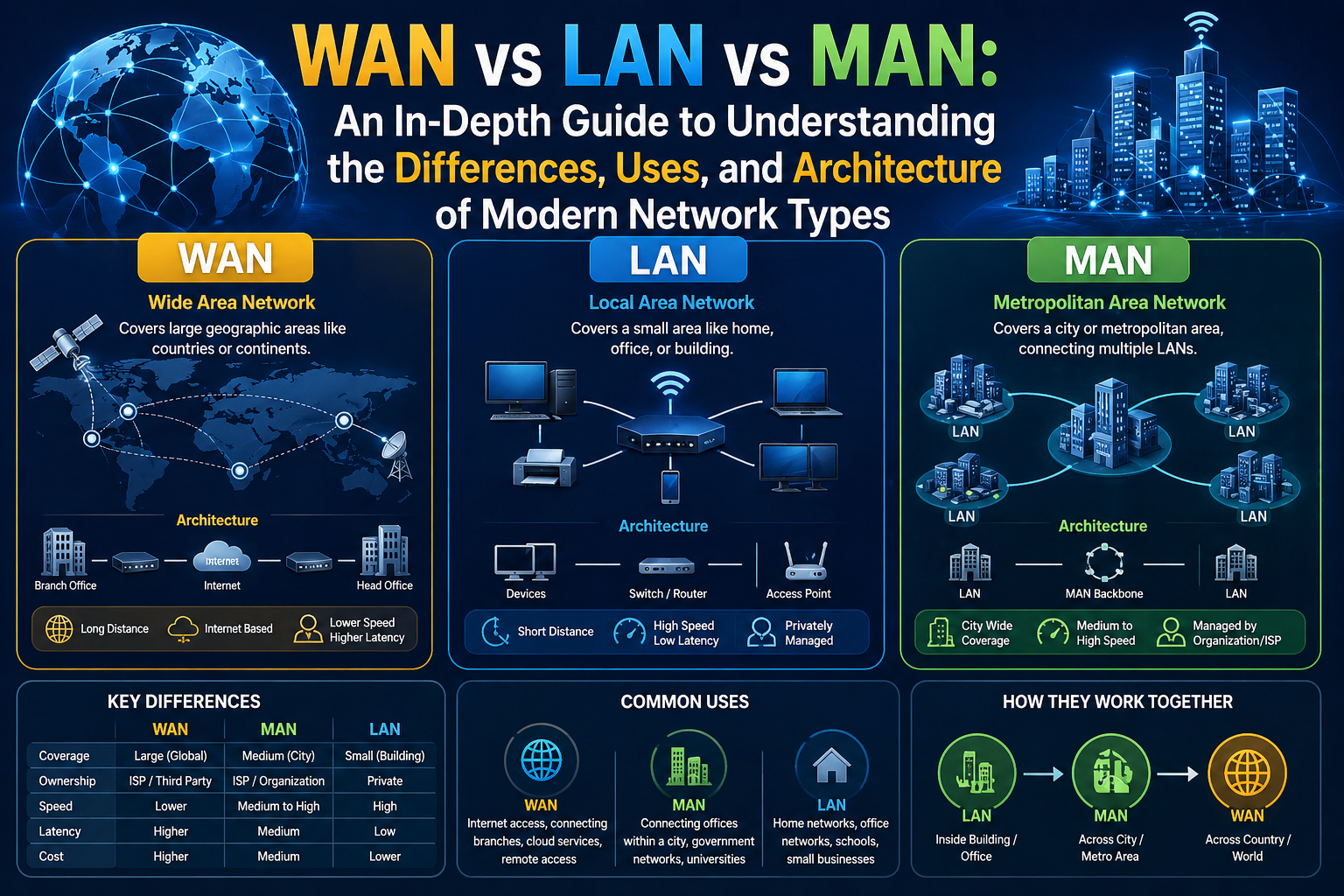
A LAN, or Local Area Network, is used in a small area like a house, office, school building, or campus. A WAN, or Wide Area Network, covers a much larger area such as a city, country, or even the entire world. A MAN, or Metropolitan Area Network, falls between the two and usually covers a large town or metropolitan area.
These network types are important because they help organizations choose the right design for communication, performance, security, and cost. A small office does not need the same network structure as a global company with branches in multiple countries. Understanding the difference between these networks helps network administrators build systems that are efficient, reliable, and scalable.
The internet itself is often called a network of networks. It is made by connecting many smaller LANs through larger WAN connections. Businesses, schools, hospitals, and governments all depend on these network structures to keep operations running smoothly.
Learning the basics of WAN, LAN, and MAN is one of the first steps in understanding networking. These concepts form the foundation for more advanced topics such as routing, switching, IP addressing, security, cloud infrastructure, and enterprise network design.
What is a Wide Area Network
A Wide Area Network, or WAN, is a network that covers a large geographical area. It can connect devices and smaller networks across cities, states, countries, and even continents. WANs are designed for long-distance communication and allow users in different physical locations to share data and resources.
The internet is the most well-known example of a WAN. It connects millions of local networks across the world, allowing users to communicate regardless of distance. A company with offices in different countries may also use a WAN to connect all of its branches into one larger network.
Unlike smaller networks, WANs do not usually rely only on privately owned infrastructure. They often depend on services provided by internet service providers, telecommunications companies, and major network carriers. These providers supply the physical connections and routing systems needed to move data over long distances.
For example, if a company has one office in Karachi and another in Lahore, both offices may have their own local networks. A WAN connection links those offices so employees can access shared files, applications, and communication systems as if they were in the same building.
WANs are essential for businesses that operate across multiple locations. They also support cloud services, remote work, online banking, international communication, and global data exchange.
Without WANs, modern business operations and global internet access would not be possible.
Key Characteristics of WAN
One of the main features of a WAN is its ability to transmit data over very long distances. Unlike local networks, which are limited to a building or campus, WANs are built for regional and international communication.
WANs usually use infrastructure provided by external service providers. This may include fiber optic cables, leased communication lines, satellite links, and undersea cables connecting countries and continents.
Routers play a major role in WAN communication. These devices move data packets between networks and determine the best path for traffic to travel. When data leaves a local network and moves across the internet, routers guide it toward its destination.
Public IP addresses are commonly associated with WANs. Devices that connect directly to the internet, such as routers and modems, use public IP addresses so they can communicate with systems outside the local network.
Another characteristic of WANs is that they may have slightly higher latency compared to LANs. Since data must travel over longer distances and pass through multiple network devices, response times can be slower. However, modern fiber connections have greatly improved WAN speed and performance.
Security is also a major concern in WAN environments. Because data often travels across public networks, it must be protected from interception and unauthorized access. Businesses commonly use encryption, firewalls, and VPNs to secure communication across WAN links.
WANs are powerful because they allow separate locations to function as one connected system, even when those locations are thousands of kilometers apart.
WAN Technologies
Two of the most important technologies behind WANs are fiber optics and routers.
Fiber optic cables are used to carry large amounts of data across long distances at very high speeds. These cables use thin strands of glass to transmit light signals instead of electrical signals. This makes them faster, more reliable, and less affected by interference compared to traditional copper cables.
Fiber is commonly used for internet backbones, city-to-city links, and international communication systems. It supports high bandwidth and can handle the massive amount of traffic required by modern businesses and internet users.
There are different types of fiber for different purposes. Some are better for short distances, while others are designed for long-haul communication between cities and countries.
Routers are equally important in WAN communication. Their job is to direct traffic between networks. They examine the destination of each data packet and decide the best route for it to take.
At home, a router connects personal devices to the internet. In large service provider environments, enterprise routers manage huge volumes of traffic between cities, data centers, and global internet exchange points.
Routers help improve speed, efficiency, and reliability by choosing the shortest or fastest available path. They also support security features such as filtering traffic and controlling access between networks.
Together, fiber and routers create the foundation that allows WANs to function on a global scale.
The Development of WAN Communication
The idea behind WAN communication is not new. It began long before computers existed.
One of the earliest long-distance communication systems was the telegraph in the 1800s. It allowed messages to be sent over wires using electrical signals. Although simple compared to modern systems, it introduced the basic concept of transmitting information across large distances.
Later, telephone networks expanded this idea by allowing voice communication between different places. Telephone systems used switching methods to create a connection between two users. At first, operators connected calls manually, but later machines handled the process automatically.
As technology improved, digital systems replaced older analog systems. Data communication became faster and more reliable, leading to the rise of computer networking.
Copper telephone lines were used for early internet access methods such as dial-up and leased lines. These systems worked, but they had limited speed and bandwidth.
The introduction of fiber optic technology changed everything. Fiber allowed much larger amounts of data to travel much farther with greater reliability. This made modern WANs possible and supported the growth of the internet, cloud computing, and global business operations.
Today, WANs connect not only offices and homes but also satellites, mobile networks, banking systems, transportation systems, and international communication platforms.
Even though the technology has changed, the purpose remains the same: connecting distant places so people and systems can communicate efficiently.
What is a Local Area Network
A Local Area Network, or LAN, is a network that connects devices within a small and limited area. This area may be a home, office, school, laboratory, hospital, or university campus.
LANs are designed for local communication. They allow nearby devices to share files, printers, internet access, and applications. Because all devices are close to each other, LANs are usually faster and easier to manage than larger network types.
For example, in an office, employees may use a LAN to access shared printers, internal servers, and internet connectivity. In a home, phones, laptops, smart TVs, and gaming consoles may all be connected through a home LAN.
A LAN can work with or without internet access. Even if the internet is disconnected, devices on the same LAN can still communicate with each other. This makes LANs useful for internal operations that do not depend on external connectivity.
Most LANs are owned and managed by the person or organization using them. Unlike WANs, they do not usually depend on large telecommunications providers for internal communication.
LANs are the most common network type because they are found almost everywhere. Every building with connected devices usually has some form of LAN.
Core Features of LAN
One of the main characteristics of a LAN is its small coverage area. It is limited to a local environment such as a room, floor, building, or campus.
LANs typically use privately owned networking equipment. This includes switches, routers, access points, and Ethernet cables installed by the organization or homeowner.
Switches are the main devices used inside a LAN. They connect computers and other devices so data can move efficiently between them. Unlike routers, switches focus only on local traffic within the same network.
LANs usually use private IP addresses. These addresses are assigned by the router using DHCP, which automatically gives each device an address when it joins the network.
Speed is another major advantage of LANs. Most modern LAN switches support at least 1 gigabit per second, while advanced systems may offer 2.5, 5, or even 10 gigabit connections.
Because devices are physically close, LANs often have lower latency and faster response times than WANs.
Security is still important in a LAN, but it is often easier to control because physical access to the building limits who can connect. Administrators can manage permissions, monitor traffic, and restrict access to sensitive systems.
LANs provide the stable and high-speed local connectivity needed for everyday work, learning, and communication.
How LANs Operate in Real Environments
Local Area Networks are the most common type of network used in everyday life. They exist in almost every environment where multiple digital devices need to communicate with each other. Even though they are considered “local,” their importance is extremely high because they support the basic foundation of all digital communication within a small area.
In a typical home, a LAN connects devices such as smartphones, laptops, smart televisions, gaming consoles, printers, and smart home devices. These devices communicate through a central networking device, usually a router or a switch. The router acts as the gateway that connects the local network to the internet, while the switch ensures efficient communication between devices inside the network.
In office environments, LANs are more structured and complex. Employees may be connected to shared servers, internal applications, file storage systems, and communication tools. Printers and scanners are often shared across departments using the LAN. This reduces cost and improves efficiency because resources do not need to be duplicated for every user.
Educational institutions also rely heavily on LANs. Schools, colleges, and universities use LANs to connect computer labs, libraries, administrative offices, and sometimes entire campuses. Students and staff can access shared systems, online learning platforms, and internal databases through the network.
LANs are designed to provide fast, reliable communication within a limited area. Since all devices are close to each other, data does not need to travel long distances. This reduces delays and improves performance significantly.
Another important aspect of LAN operation is simplicity. Unlike large networks, LANs do not require complex routing across long distances. Most communication stays within the local system, which makes management easier and troubleshooting more straightforward.
Devices Used in LANs
Several key devices are used to build and maintain a Local Area Network. Each device plays a specific role in ensuring smooth communication between connected systems.
The most important device in a LAN is the switch. A switch connects multiple devices within the same network and allows them to communicate efficiently. It receives data from one device and forwards it directly to the correct destination within the network. This makes communication faster and more organized compared to older networking methods.
Another essential device is the router. While switches handle internal communication, routers connect the LAN to external networks such as the internet. The router manages traffic entering and leaving the LAN and assigns IP addresses to devices through a process called DHCP.
Access points are also commonly used in modern LANs. These devices allow wireless connectivity, enabling devices like smartphones and laptops to connect without cables. Wireless LANs have become extremely popular because of their convenience and flexibility.
Cables, especially Ethernet cables, are still widely used in LANs. They provide stable and high-speed connections between devices. In many office environments, wired connections are preferred for critical systems because they offer better performance and reliability compared to wireless connections.
Network interface cards are installed in devices like computers and servers to allow them to connect to the LAN. These cards translate data into signals that can be transmitted over the network.
Together, these devices form the structure of a LAN and ensure that communication happens smoothly and efficiently.
IP Addressing and Communication in LAN
Every device in a LAN needs a unique identifier so that data can be sent to the correct destination. This identifier is called an IP address. In LAN environments, private IP addresses are used.
Private IP addresses are not visible on the public internet. They are used only inside the local network. This provides an additional layer of organization and security.
When a device connects to a LAN, it is usually assigned an IP address automatically by the router. This process is handled by a system called DHCP. It ensures that each device gets a unique address without manual configuration.
Once devices have IP addresses, they can communicate with each other. For example, a computer can send a file to a printer, or a laptop can access a shared folder on another computer.
Communication inside a LAN is very fast because data does not need to travel outside the local network. Instead, it moves directly between devices using switches and local routing.
The use of private IP addressing also helps reduce conflicts and makes network management easier. Administrators can organize devices into groups and control access based on IP ranges.
Advantages of LAN
LANs offer several important advantages that make them essential in both personal and professional environments.
One of the biggest advantages is speed. Because devices are located close to each other, data can be transferred very quickly. This is especially useful for tasks that require large file transfers or real-time communication.
Another advantage is cost efficiency. LANs do not require expensive infrastructure compared to wide area networks. Most LAN components are affordable and easy to install.
LANs also provide better control. Since the network is local, administrators can manage devices, monitor traffic, and apply security policies more easily.
Resource sharing is another key benefit. Devices on a LAN can share printers, storage, internet connections, and applications. This reduces duplication and improves productivity.
LANs are also scalable. Additional devices can be added without major changes to the network structure. This makes them suitable for growing businesses and institutions.
Limitations of LAN
Despite their advantages, LANs also have limitations.
The most obvious limitation is coverage area. A LAN can only function within a small geographical space. If communication is needed between different cities or countries, a LAN alone is not sufficient.
Another limitation is dependency on physical infrastructure. Cables, switches, and routers must be properly installed and maintained. Faults in any part of the system can affect the entire network.
LANs can also face congestion if too many devices are connected without proper planning. This can slow down performance and affect communication quality.
Security is generally easier to manage in LANs, but internal threats can still exist. Unauthorized access from inside the network can pose risks if proper controls are not in place.
What is a Metropolitan Area Network
A Metropolitan Area Network, or MAN, is a type of network that connects multiple LANs within a specific geographical region such as a city or large town. It is larger than a LAN but smaller than a WAN.
MANs are designed to provide high-speed connectivity between different locations that are relatively close to each other. For example, different branches of a university located across a city may be connected using a MAN.
A MAN allows multiple LANs to communicate with each other as if they were part of the same network. This is useful for organizations that have multiple buildings or departments spread across a city.
MANs are typically managed by internet service providers or large organizations that have the infrastructure to support city-wide networking.
Features of MAN
One of the main features of a MAN is its coverage area. It spans across a city or metropolitan region, connecting multiple LANs within that area.
MANs are designed for high-speed communication. They often use fiber optic cables to ensure fast and reliable data transfer.
They provide better performance than traditional long-distance WAN connections when dealing with local city-based communication.
MANs usually operate on private or semi-private infrastructure managed by service providers. This allows organizations to connect multiple locations without relying entirely on public internet systems.
Another feature of MANs is their ability to reduce communication delays between nearby LANs. This makes them useful for organizations that require fast internal communication across multiple buildings.
Use Cases of MAN
MANs are commonly used in environments where multiple LANs need to be connected within the same city.
Large educational institutions often use MANs to connect different campuses or buildings. This allows students and staff to access shared resources from any location.
Government organizations also use MANs to connect offices and departments spread across a city.
Large corporations with multiple offices in a metropolitan area may use MANs to ensure fast communication between branches.
In some cities, MAN infrastructure is used to support public services, traffic systems, and municipal operations.
Limitations of MAN
Although MANs are useful, they also have limitations.
One limitation is cost. Building and maintaining a MAN requires significant investment in infrastructure such as fiber cables and networking equipment.
MANs are also limited to a specific geographical region. They cannot be used for long-distance communication beyond a city or metropolitan area.
Another limitation is dependency on service providers. Organizations may need to rely on external companies to maintain and operate the network.
Relationship Between LAN and MAN
A MAN essentially connects multiple LANs together. Each LAN operates independently within its local environment, but the MAN allows them to communicate with each other.
For example, two office buildings in different parts of a city may each have their own LAN. The MAN connects these LANs so that employees can share data and communicate easily.
This relationship helps improve efficiency and collaboration between different branches of the same organization.
MANs act as an intermediate layer between small local networks and large global networks.
Evolution of LAN and MAN Technologies
LAN and MAN technologies have evolved significantly over time.
Early LANs used slow connections and limited bandwidth. Over time, Ethernet technology improved speeds from megabits to gigabits per second.
Wireless technology also transformed LANs by allowing devices to connect without physical cables.
MANs evolved as a solution to the limitations of older communication systems. In the past, connecting multiple LANs across a city required expensive and slow WAN connections.
With the introduction of fiber optic technology, MANs became faster and more efficient. However, as WAN technology improved, some MAN systems became less necessary.
Despite this, LANs continue to grow in importance, especially with the rise of cloud computing, smart devices, and wireless communication.
Importance of Understanding LAN and MAN
Understanding LAN and MAN is important for anyone working with networks or technology.
LAN knowledge helps in managing local systems, troubleshooting connectivity issues, and improving performance within small environments.
MAN knowledge helps in understanding how multiple locations within a city can be connected efficiently.
Together, these concepts form the foundation for more advanced networking topics such as WAN design, cloud infrastructure, cybersecurity, and enterprise network architecture.
Without a clear understanding of LAN and MAN, it becomes difficult to design or manage larger networks effectively.
In the next part, the focus will move toward WAN in greater depth, along with comparisons and real-world applications of all three network types.
What is a Wide Area Network in Real Use
A Wide Area Network is the largest type of network among LAN, MAN, and WAN. It connects devices and smaller networks over very long distances such as cities, countries, and even continents. In everyday life, the most common example of a WAN is the internet itself. Whenever a person browses a website, sends an email, joins a video call, or uses cloud storage, they are relying on WAN technology working in the background.
WANs are designed to connect multiple local networks together so they can communicate even if they are far apart. For example, a company with offices in different countries uses a WAN so employees in one location can access files and systems located in another. This makes global communication possible without needing physical proximity.
Unlike smaller networks, WANs are not limited to one building or campus. They rely on large-scale infrastructure that spans across regions and countries. This infrastructure is usually built and maintained by internet service providers and telecommunications companies. These providers manage the cables, routers, and systems that carry data across long distances.
WANs allow data to travel through different types of connections such as fiber optic cables, satellite links, and undersea cables. These physical systems form the backbone of global communication. Without WANs, the modern internet and international communication systems would not exist.
Structure and Operation of WAN
A WAN operates by connecting multiple LANs through intermediate networks and routing systems. Data does not travel in a straight line from sender to receiver. Instead, it passes through many different routers and network nodes before reaching its destination.
Each router plays an important role in directing traffic. It reads the destination information in data packets and decides the best possible path for them to travel. This process continues until the data reaches its final destination. Because of this system, WANs are able to handle massive amounts of traffic across large distances.
The structure of a WAN is highly distributed. There is no single central point that controls everything. Instead, it is made up of many interconnected networks that work together. This makes WANs very flexible and scalable.
Public IP addresses are used in WAN communication to identify devices and networks globally. These addresses ensure that data can be sent and received correctly across different regions. Without a standardized addressing system, global communication would not be possible.
WANs also rely heavily on routing protocols. These protocols help determine how data moves across networks. They allow routers to communicate with each other and share information about network paths and performance.
Performance of WAN
WAN performance depends on several factors, including distance, infrastructure quality, and network traffic load. Since data must travel long distances, WANs usually have higher latency compared to LANs. Latency refers to the delay that occurs when data is sent from one point to another.
Even though WANs are slower than local networks in terms of response time, modern technology has significantly improved their speed. Fiber optic cables allow data to travel at extremely high speeds across continents and oceans. This has reduced delays and improved overall performance.
Bandwidth is another important factor in WAN performance. WANs must support large amounts of data being transmitted by millions of users at the same time. This requires strong infrastructure and efficient traffic management systems.
Network congestion can sometimes affect WAN performance. When too many users are accessing the same network paths, data may experience delays. To manage this, service providers use load balancing and traffic optimization techniques.
Despite these challenges, WANs are powerful enough to support global communication systems, cloud services, and real-time applications such as video conferencing and online gaming.
WAN Security Considerations
Security is extremely important in WAN environments because data often travels across public and shared infrastructure. Unlike local networks, WAN traffic may pass through multiple external systems before reaching its destination.
To protect data, encryption is widely used. Encryption converts information into a secure format that cannot be read without the correct decryption key. This ensures that even if data is intercepted, it cannot be understood.
Virtual private networks are also commonly used in WAN communication. They create secure connections between users and networks, allowing data to travel safely over public infrastructure.
Firewalls are another important security tool. They monitor and control incoming and outgoing network traffic based on security rules. This helps prevent unauthorized access and malicious activity.
Organizations that use WANs must implement strong security practices because they often handle sensitive information such as financial data, personal records, and business communications.
How LAN, MAN, and WAN Work Together
LAN, MAN, and WAN are not separate systems working independently. Instead, they work together as different layers of a complete communication structure.
A LAN handles communication within a small area such as a home or office. When communication needs to go beyond this local area, it is passed to a larger network.
A MAN connects multiple LANs within a city or metropolitan region. This allows different locations of the same organization to communicate quickly and efficiently.
A WAN connects these larger networks across countries and continents. It ensures that even distant locations can communicate and share data.
For example, an employee working in one office building uses a LAN to connect to local systems. If they need to access data from another branch in the same city, the MAN helps connect those LANs. If the data is stored in another country, the WAN handles the communication.
This layered structure ensures that each type of network handles the scale it is best suited for, making communication efficient and organized.
Evolution of Network Technologies
Network technologies have evolved significantly over time to support increasing communication needs. Early communication systems were simple and relied on electrical signals sent over wires. These systems were slow and limited but introduced the concept of long-distance communication.
Telephone networks improved communication by allowing voice transmission between distant locations. These systems used switching mechanisms to connect users across different regions.
The development of computer networks introduced digital communication. Data began to be transmitted in small packets, making communication faster, more reliable, and more efficient.
LAN technology evolved from basic wired connections to high-speed Ethernet and wireless systems. This allowed faster communication within local environments such as offices and homes.
WAN technology evolved from copper-based communication systems to fiber optic networks capable of carrying massive amounts of data across long distances.
MAN systems were introduced to solve regional communication challenges but became less essential as WAN technology improved and became more widespread.
Today, modern networks use a combination of fiber optics, wireless communication, cloud computing, and advanced routing technologies to deliver fast and reliable connectivity.
Importance of Understanding Network Types
Understanding LAN, MAN, and WAN is important for anyone working with technology or digital systems. These network types form the foundation of how modern communication works.
LAN knowledge helps in managing local environments such as homes, offices, and schools. It is essential for troubleshooting connectivity issues and managing internal systems.
MAN knowledge helps understand how multiple locations within a city can be connected efficiently. This is useful for organizations with distributed offices or campuses.
WAN knowledge is critical for understanding global communication systems such as the internet and cloud services.
Together, these concepts provide a complete understanding of how data moves from one device to another, whether locally or across the world.
Additional Insight: Real-World Importance of WAN, LAN, and MAN Integration
In modern digital environments, WAN, LAN, and MAN are rarely used in isolation. Instead, they are combined to create layered network architectures that support complex organizational needs. Large businesses, for example, often operate multiple LANs in different departments or buildings. These LANs are connected through MAN infrastructure when located within the same city, ensuring fast internal communication. When the organization expands globally, WAN connections link these city-based systems together, creating a unified global network.
This layered approach allows organizations to balance performance, cost, and scalability. LANs provide high-speed local communication for daily operations. MANs ensure efficient communication between nearby locations without relying on long-distance infrastructure. WANs make it possible to connect everything across countries and continents, enabling global collaboration and remote work.
Another important aspect is the rise of cloud computing, which depends heavily on WAN infrastructure. Users access applications, storage, and services hosted in remote data centers through WAN connections. At the same time, LANs ensure smooth access within local offices, and MANs help connect multiple branches within metropolitan areas to these cloud services efficiently.
This integration of LAN, MAN, and WAN creates a seamless communication experience for users. Even though data travels through different network types behind the scenes, users experience it as a single connected system.
Conclusion
LAN, MAN, and WAN are the three fundamental types of networks that support modern communication. Each one plays a different role based on its size and purpose.
A LAN is used for local communication within a small area and provides fast, efficient connectivity for nearby devices. A MAN connects multiple LANs within a city or metropolitan area and supports regional communication. A WAN connects networks across countries and continents, forming the backbone of the internet and global communication systems.
Although they differ in scale and structure, all three network types work together to create a complete communication system. LANs handle local communication, MANs handle regional communication, and WANs handle global communication.
Modern technology continues to improve all three network types, making communication faster, more secure, and more reliable. Understanding how they work together is essential for anyone interested in networking, technology, or digital communication because they form the invisible foundation behind every online interaction in today’s world.