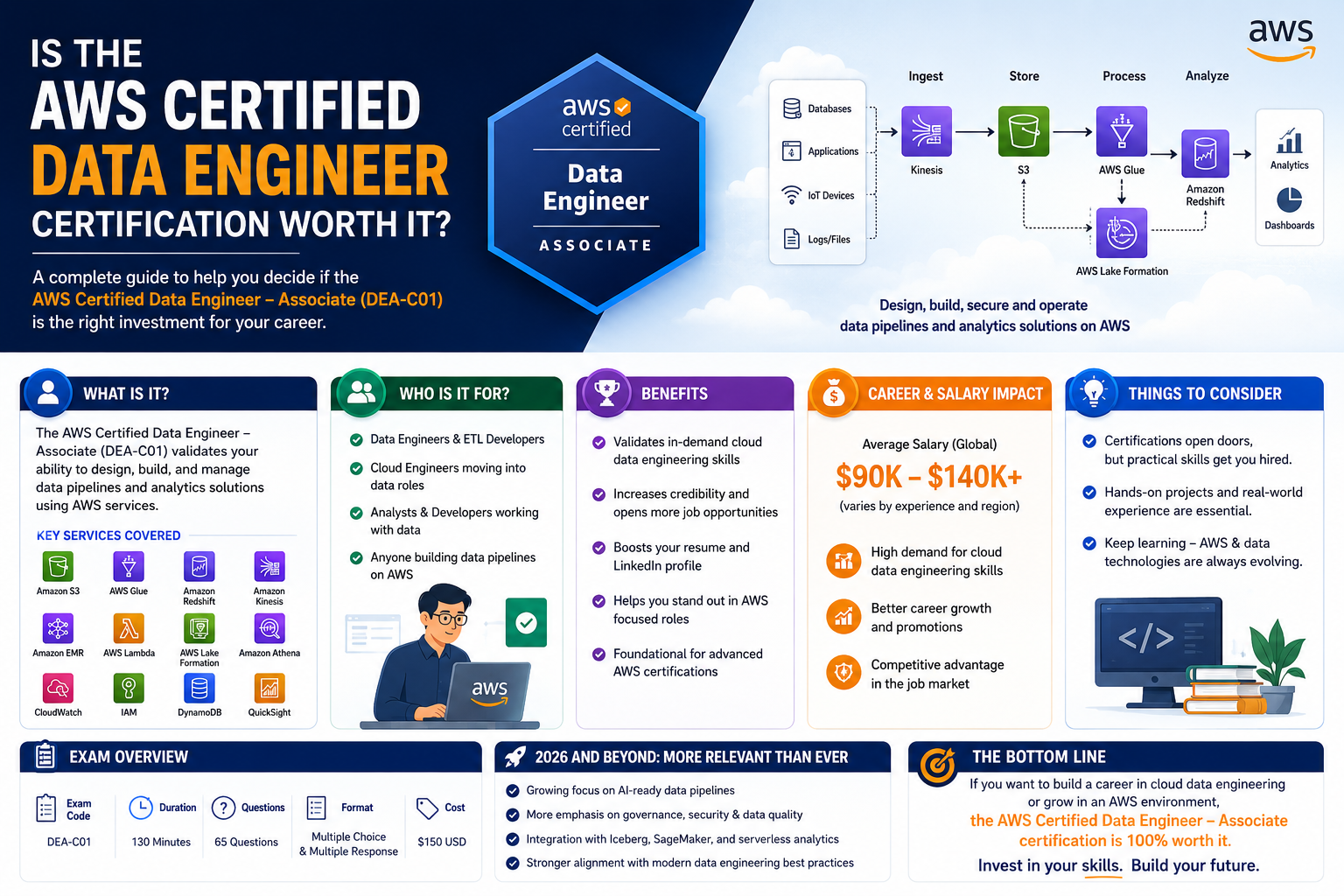
The cloud computing industry continues to expand at an incredible pace, and organizations around the world are investing heavily in technologies that help them collect, process, and analyze data more efficiently. Businesses now rely on data to make strategic decisions, improve customer experiences, automate operations, and remain competitive in crowded markets. Because of this growing dependence on data, professionals who understand how to manage cloud-based data systems are becoming increasingly valuable.
Among the many cloud certifications available today, the AWS Certified Data Engineer – Associate certification has attracted strong attention from IT professionals interested in data engineering, analytics, and cloud infrastructure. Many individuals considering the certification often ask whether it is truly worth the time, money, and effort required to earn it. The answer depends largely on professional goals, existing experience, and long-term career plans.
For some professionals, the certification represents an opportunity to specialize in one of the fastest-growing areas of cloud computing. Others pursue it to strengthen existing knowledge, improve career opportunities, or validate practical skills they already use daily. Regardless of motivation, understanding the purpose and structure of the certification is important before deciding whether to pursue it.
The Growing Importance of Data Engineering
Over the last decade, organizations have generated more data than ever before. Every online purchase, social media interaction, customer support ticket, website visit, and mobile application action creates information that businesses can analyze. Companies use this information to understand customer behavior, optimize operations, forecast trends, and identify new opportunities.
However, raw data alone is not useful unless it can be properly organized and processed. This is where data engineering becomes essential. Data engineers build systems that collect information from multiple sources, clean and transform it, and move it into environments where analysts and business leaders can use it effectively.
Modern businesses often rely on enormous volumes of information coming from databases, streaming platforms, cloud applications, sensors, and external services. Managing this data efficiently requires specialized technical skills. Organizations need professionals who understand how to create scalable systems capable of handling large workloads while remaining secure and reliable.
Cloud platforms such as Amazon Web Services have transformed how businesses manage data infrastructure. Instead of maintaining expensive physical servers and data centers, organizations can now use cloud services that provide flexibility, scalability, and cost efficiency. AWS has become one of the dominant cloud providers globally, making AWS expertise highly desirable in the job market.
As businesses continue shifting operations to the cloud, professionals with data engineering skills are becoming increasingly important. This growing demand explains why certifications related to cloud data management have gained popularity.
What the AWS Certified Data Engineer – Associate Certification Is
The AWS Certified Data Engineer – Associate certification is an industry-recognized credential focused on validating cloud data engineering skills using AWS technologies. The certification is designed for individuals who work with data pipelines, storage systems, data transformation workflows, and cloud-based analytics environments.
AWS created this certification to help organizations identify professionals who understand how to manage data systems within AWS environments. The exam focuses on practical knowledge related to data ingestion, storage management, operational maintenance, security practices, and governance principles.
Unlike beginner-level certifications that introduce basic cloud concepts, this certification targets professionals with intermediate-level experience. Candidates are expected to understand AWS services and possess hands-on familiarity with cloud operations.
The certification belongs to the associate-level category within the AWS certification structure. AWS certifications are organized into multiple levels, including foundational, associate, professional, and specialty credentials. Associate certifications generally represent a balance between practical operational knowledge and technical specialization.
The AWS ecosystem includes several associate-level certifications focused on different areas of expertise. These certifications cover architecture, development, systems administration, machine learning, and data engineering. Each certification serves professionals pursuing different cloud career paths.
The Data Engineer certification specifically focuses on the technologies and practices involved in managing data within AWS environments. It emphasizes real-world workflows and practical decision-making rather than purely theoretical understanding.
Why AWS Certifications Matter in the IT Industry
Cloud certifications have become increasingly valuable because organizations want evidence that technical professionals possess validated skills. While experience remains extremely important, certifications provide standardized proof of knowledge across different technologies and platforms.
AWS certifications carry strong recognition because AWS remains one of the most widely used cloud providers in the world. Many organizations build critical systems entirely within AWS environments, creating consistent demand for professionals who understand AWS services.
Employers often use certifications as part of hiring and promotion decisions. A certification demonstrates that a candidate has invested time and effort into developing specialized knowledge. It also indicates familiarity with industry-standard tools and practices.
For professionals already working in cloud environments, certifications may strengthen credibility within teams or organizations. Certified employees may gain greater responsibility, leadership opportunities, or involvement in more complex projects.
Certifications can also help professionals transition into new technical roles. Someone working in general systems administration, for example, may use AWS certifications to move toward cloud engineering or data-focused positions.
In competitive job markets, certifications sometimes help candidates stand out during recruitment processes. Hiring managers frequently receive applications from individuals with similar experience levels, and certifications can provide additional differentiation.
However, certifications alone do not guarantee success. Employers still value practical experience, problem-solving ability, communication skills, and adaptability. The most effective approach combines certification preparation with hands-on practice.
Understanding the Structure of the Certification Exam
The AWS Certified Data Engineer – Associate exam is designed to evaluate practical understanding of AWS data engineering concepts and services. The exam includes multiple-choice and multiple-response questions that test both technical knowledge and decision-making abilities.
Candidates encounter scenarios requiring them to identify appropriate solutions based on operational requirements, performance considerations, scalability needs, and security concerns. The questions often resemble real-world situations that cloud professionals might face in enterprise environments.
The exam includes a fixed number of questions that must be completed within a specific time limit. Time management becomes important because some questions involve lengthy technical scenarios requiring careful analysis.
AWS allows candidates to take the exam either at authorized testing centers or through online proctoring systems. This flexibility helps professionals schedule certification attempts around work and personal responsibilities.
The certification is available in several languages, reflecting AWS’s global reach and international user base. Accessibility improvements have helped expand participation among cloud professionals worldwide.
Although the exam focuses on AWS services, success requires more than memorizing product names or technical definitions. Candidates must understand how services interact and how architectural decisions affect operational outcomes.
The Core Areas Covered in the Exam
The certification exam focuses on several major technical areas that reflect real-world data engineering responsibilities. These domains collectively represent the knowledge AWS expects certified professionals to possess.
One major area involves data ingestion and transformation. Data engineers frequently work with systems that collect information from various sources and move it through processing pipelines. Understanding how to ingest data efficiently and transform it into usable formats is a critical skill.
Extract, transform, and load workflows are central to many cloud data operations. Professionals pursuing the certification must understand how AWS services support these workflows in scalable and reliable ways.
Another major focus area involves managing data storage systems. AWS offers multiple storage solutions designed for different workloads and performance requirements. Candidates must understand how to select appropriate services based on scalability, access patterns, reliability needs, and cost considerations.
Storage management also includes lifecycle planning, backup strategies, replication methods, and optimization techniques. Data engineers must ensure that information remains accessible, durable, and secure over time.
Operational support represents another important area within the certification. Cloud-based data systems require ongoing monitoring and maintenance. Engineers need to understand logging, automation, troubleshooting, and performance optimization practices.
Failures in data systems can disrupt analytics platforms, reporting systems, and business operations. Because of this, operational reliability is extremely important in modern cloud environments.
Security and governance form another major component of the certification. Organizations handle sensitive information such as financial records, healthcare data, and customer details. Professionals working with cloud data systems must understand how to secure information appropriately.
AWS expects certified professionals to understand encryption, access management, compliance considerations, and governance frameworks. Security is not treated as an optional feature but rather as a fundamental responsibility.
Why Businesses Need Cloud Data Professionals
Organizations today operate in environments where data-driven decision-making has become essential. Companies rely on analytics to identify customer trends, forecast demand, improve efficiency, and optimize products and services.
As businesses generate larger volumes of information, managing data infrastructure becomes increasingly complex. Traditional on-premises systems often struggle to provide the scalability and flexibility required for modern workloads.
Cloud computing addresses many of these challenges by allowing organizations to scale resources dynamically. AWS provides services capable of handling massive amounts of information without requiring businesses to maintain expensive hardware infrastructure.
However, simply adopting cloud services does not guarantee success. Organizations need professionals who understand how to design and maintain efficient data systems. Poorly designed pipelines, insecure configurations, or inefficient storage architectures can lead to operational problems and unnecessary costs.
Data engineers help organizations avoid these issues by building scalable and reliable systems. They ensure that information flows efficiently across platforms and remains available for analysis and reporting.
The increasing adoption of artificial intelligence and machine learning has also increased demand for data professionals. Machine learning systems depend heavily on high-quality data pipelines and storage architectures. Without strong data engineering foundations, advanced analytics initiatives often fail.
This growing demand explains why cloud data certifications have become increasingly relevant in the modern technology industry.
The Value of Hands-On AWS Experience
One of the most important aspects of preparing for the AWS Certified Data Engineer – Associate certification is gaining practical experience. Reading documentation and watching training videos can help build theoretical understanding, but real-world practice is essential.
AWS services often interact in complex ways. Understanding how different services connect and behave under various conditions becomes much easier through hands-on experimentation.
Practical experience helps professionals understand deployment processes, troubleshooting methods, and operational challenges. It also builds confidence when working with unfamiliar architectures or technical scenarios.
Many successful certification candidates spend time creating test environments within AWS accounts. Building sample pipelines, configuring storage systems, and experimenting with analytics tools can significantly improve understanding.
Hands-on practice also helps candidates remember technical concepts more effectively than memorization alone. Applying knowledge in realistic environments strengthens problem-solving skills and prepares professionals for real operational responsibilities.
Employers generally value practical cloud experience highly. Certifications supported by hands-on expertise are far more meaningful than certifications obtained through memorization-focused study methods.
Who Should Consider Pursuing This Certification
The AWS Certified Data Engineer – Associate certification is particularly valuable for professionals already involved in cloud or data-related work. Data engineers naturally represent one of the primary audiences because the certification aligns closely with their daily responsibilities.
Data engineers working with ETL workflows, analytics systems, or cloud storage platforms can use the certification to strengthen technical credibility and validate expertise.
Cloud engineers who regularly support analytics environments may also benefit significantly. Some professionals begin with broader cloud administration responsibilities and gradually move into data-focused operations. The certification can help formalize that transition.
Data architects may also find value in the certification because they design large-scale systems responsible for handling information across organizations. Understanding AWS data services helps architects create scalable and reliable environments.
Business intelligence professionals sometimes pursue the certification as well. Although they may focus more heavily on analytics and reporting, understanding data engineering principles improves collaboration with technical teams.
Software developers working with cloud-native applications may also benefit. Modern applications frequently rely on cloud-based storage systems, streaming platforms, and analytics pipelines. Understanding AWS data services can improve application design and operational efficiency.
Even professionals transitioning into cloud careers may view the certification as a long-term goal. While beginners may require foundational learning first, the certification provides a clear path toward specialized expertise.
The Role of Continuous Learning in Cloud Careers
Cloud computing evolves rapidly. AWS regularly introduces new services, updates existing technologies, and changes recommended best practices. Because of this constant evolution, cloud professionals must commit to continuous learning.
Certifications encourage structured learning and help professionals stay current with industry developments. Preparing for the AWS Certified Data Engineer – Associate certification exposes candidates to modern cloud architectures, operational strategies, and security principles.
Continuous learning also improves career resilience. Technology changes quickly, and professionals who fail to update their skills may struggle to remain competitive. Certifications provide a practical framework for maintaining technical relevance.
Many professionals discover that preparing for certifications improves their confidence in real-world projects. Structured study often fills knowledge gaps that might otherwise remain unnoticed during day-to-day work.
Learning cloud data engineering concepts can also improve broader technical understanding. Skills related to scalability, automation, security, and analytics apply across many technology roles and industries.
For professionals passionate about technology, certifications can also provide motivation and direction. Structured learning goals help individuals maintain momentum while exploring increasingly advanced technical topics.
How Certification Can Support Career Advancement
Career growth remains one of the most common reasons professionals pursue cloud certifications. Organizations increasingly rely on cloud technologies, creating strong demand for employees who understand AWS systems.
The AWS Certified Data Engineer – Associate certification can support advancement in several ways. It may improve visibility during hiring processes, strengthen promotion opportunities, or help professionals transition into more specialized technical roles.
Recruiters frequently search for AWS-certified candidates when filling cloud-related positions. Certifications provide a quick way to identify applicants with validated platform knowledge.
Within organizations, certified professionals may gain access to more advanced projects involving analytics, data modernization, or cloud transformation initiatives. Managers often prefer assigning critical responsibilities to employees with demonstrated expertise.
Certification can also improve professional confidence. Preparing for challenging technical exams encourages deeper understanding of cloud systems and operational practices. This confidence may translate into stronger performance during meetings, interviews, or technical discussions.
For independent consultants or freelancers, certifications may enhance credibility with potential clients. Businesses often prefer working with professionals who possess recognized credentials tied to widely adopted technologies.
Although certifications alone do not guarantee higher salaries or promotions, they frequently contribute positively when combined with practical experience and strong performance.
Preparing for the AWS Certified Data Engineer – Associate Exam
Preparing for the AWS Certified Data Engineer – Associate certification requires more than simply reading technical documents or memorizing service names. The exam is designed to evaluate practical understanding of cloud-based data engineering concepts, meaning candidates need both theoretical knowledge and hands-on experience. Professionals who approach preparation strategically often gain far more than just exam readiness. They develop skills that apply directly to real-world cloud environments.
One of the biggest challenges candidates face is the sheer number of AWS services available. AWS offers hundreds of cloud products, and even though the certification only focuses on services relevant to data engineering, there is still a large amount of material to understand. Candidates must learn not only what each service does but also when and why it should be used.
Successful preparation usually begins with understanding the exam objectives clearly. AWS provides official exam guides outlining the skills and knowledge areas included in the certification. Reviewing these guides carefully helps candidates focus their efforts on the topics most likely to appear on the exam.
Many candidates create structured study plans that divide preparation into manageable sections. Rather than attempting to study everything at once, they concentrate on one topic area at a time. This gradual approach often improves retention and reduces frustration.
Consistency matters more than intensity for most learners. Studying for short periods regularly is usually more effective than attempting long sessions only occasionally. Professionals balancing work and family responsibilities often succeed by dedicating steady daily or weekly study time.
Hands-on practice remains one of the most valuable preparation methods. AWS offers free-tier services that allow candidates to experiment with cloud environments without major financial investment. Building small projects can significantly improve understanding of how services interact.
Learning Data Ingestion and Transformation Concepts
One of the largest areas covered by the certification involves data ingestion and transformation. Data engineers spend much of their time designing systems that move information between platforms while ensuring accuracy and reliability.
Data ingestion refers to collecting information from different sources and bringing it into cloud environments. Sources may include databases, applications, streaming systems, sensors, APIs, or external services. Engineers must understand how to move this information efficiently while minimizing delays and failures.
Transformation involves modifying raw information into formats suitable for analytics, reporting, or storage. This may include cleaning inconsistent data, converting formats, filtering unnecessary information, or combining datasets.
AWS provides numerous services that support these workflows. Understanding how these tools function together is essential for certification success. Candidates must learn how different ingestion methods affect scalability, latency, and operational complexity.
Streaming data systems represent an especially important area in modern data engineering. Businesses increasingly rely on real-time information processing for monitoring, analytics, and customer experiences. Engineers must understand how cloud platforms handle continuous data flows.
Batch processing remains important as well. Many organizations still process large amounts of information on scheduled intervals rather than in real time. Candidates preparing for the certification need to understand both approaches and know when each method is appropriate.
Error handling also plays a major role in transformation workflows. Real-world data systems frequently encounter missing values, corrupted information, or failed transfers. Engineers must design systems capable of identifying and recovering from these problems.
Understanding transformation pipelines helps candidates not only pass the exam but also build practical operational skills useful in enterprise environments.
Understanding AWS Storage Solutions
Data storage is one of the foundational elements of cloud computing. The AWS Certified Data Engineer – Associate exam places strong emphasis on understanding different storage technologies and selecting appropriate solutions for various workloads.
AWS offers multiple storage services designed for different purposes. Some are optimized for structured relational data, while others support unstructured objects, high-speed analytics, or massive scalability.
Candidates must understand the strengths and limitations of different storage approaches. Choosing the wrong storage architecture can affect performance, increase costs, or create operational inefficiencies.
Object storage systems are commonly used for large-scale cloud data environments because they provide durability, scalability, and flexibility. Data lakes often rely heavily on object storage for storing raw and processed information.
Relational databases remain essential for transactional workloads requiring structured data relationships and consistency. Engineers must understand how relational systems operate within cloud environments and how they differ from alternative storage models.
NoSQL databases support workloads requiring flexible schemas or extremely high scalability. These systems are commonly used in applications handling large volumes of rapidly changing information.
Data warehouses represent another important storage category. Businesses frequently use data warehouses for analytics and reporting because they support fast query performance across large datasets.
Candidates preparing for the certification must understand not only storage types but also lifecycle management practices. Organizations often move data between storage classes depending on access frequency, compliance requirements, and cost considerations.
Backup and disaster recovery concepts are equally important. Data engineers must ensure that information remains protected against accidental deletion, corruption, or infrastructure failures.
Understanding replication, redundancy, and availability principles helps candidates develop a broader understanding of enterprise cloud architectures.
The Importance of Monitoring and Operations
Cloud systems require continuous monitoring and maintenance to operate effectively. The certification exam evaluates whether candidates understand how to support operational reliability in cloud-based data environments.
Monitoring allows organizations to identify issues before they become major problems. Engineers use metrics, logs, and alerts to track system health and performance. AWS provides tools that help monitor infrastructure, applications, and data pipelines.
Candidates must understand how to interpret operational data and respond appropriately when problems occur. Delays in identifying failures can disrupt analytics systems, reporting platforms, and business operations.
Automation plays an important role in cloud operations. Modern cloud environments often involve dynamic scaling, scheduled workflows, and automated recovery processes. Engineers need to understand how automation improves efficiency and reduces operational risk.
Operational troubleshooting is another major responsibility. Data pipelines may fail because of configuration issues, network interruptions, permission problems, or unexpected data formats. Engineers must identify root causes quickly and restore functionality.
Scalability considerations are also central to cloud operations. Data workloads can grow rapidly, especially in organizations handling large customer bases or real-time analytics systems. Engineers must design systems capable of expanding without major disruptions.
Performance optimization involves balancing speed, reliability, and cost efficiency. Cloud systems should deliver acceptable performance while minimizing unnecessary expenses.
Logging practices are especially valuable in complex environments. Logs provide visibility into system behavior and help engineers investigate operational issues. Understanding how to manage and analyze logs is an important part of cloud operations.
Candidates who develop strong operational skills during certification preparation often become more effective in real-world engineering roles as well.
Security Responsibilities in Data Engineering
Security has become one of the most critical areas in modern cloud computing. Organizations handle enormous amounts of sensitive information, including financial records, healthcare data, customer identities, and proprietary business information.
The AWS Certified Data Engineer – Associate exam emphasizes security because data engineers play a major role in protecting cloud environments. Security is not limited to specialized cybersecurity teams. Engineers designing data systems must also understand how to secure information appropriately.
Identity and access management is one of the most important concepts candidates must learn. Organizations need strict control over who can access data resources and what actions users are permitted to perform.
Engineers must understand permission structures, authentication methods, and least-privilege principles. Excessive permissions create security risks that can lead to unauthorized access or accidental exposure.
Encryption is another essential topic. Sensitive information should be protected both during transmission and while stored. Candidates need to understand how encryption mechanisms work within AWS environments.
Compliance considerations also affect cloud data operations. Many industries operate under strict regulations governing how information is stored and processed. Engineers must understand governance practices that support compliance requirements.
Data classification and retention policies influence storage decisions as well. Some information must be archived for long periods, while other data should be deleted according to legal or operational guidelines.
Monitoring for suspicious activity represents another important security practice. Engineers need visibility into unusual access patterns or operational anomalies that may indicate potential threats.
Security-focused preparation benefits candidates beyond certification success. Organizations increasingly prioritize professionals who understand secure cloud architecture principles.
Challenges Candidates Often Face During Preparation
Although the AWS Certified Data Engineer – Associate certification offers valuable career benefits, preparation can be challenging. Many candidates underestimate the breadth of knowledge required.
One common difficulty involves balancing technical depth with broad service coverage. Candidates must understand many AWS tools without becoming overwhelmed by excessive detail.
Another challenge is transitioning from theoretical understanding to practical application. Reading documentation may explain what services do, but real-world usage often involves complexities not obvious from study materials alone.
Time management is also difficult for many professionals. Candidates often prepare while working full-time jobs or managing family responsibilities. Maintaining consistent study habits requires discipline and planning.
Technical terminology can create additional obstacles for beginners. Cloud computing involves many specialized concepts, acronyms, and architectural patterns that may initially seem confusing.
Hands-on learning environments sometimes present financial concerns as well. While AWS free-tier services help reduce costs, extended experimentation or large-scale testing can still generate expenses if not managed carefully.
Imposter syndrome is another challenge many candidates experience. Cloud technologies evolve rapidly, and professionals sometimes feel they do not know enough to succeed. However, this feeling is common even among experienced engineers.
Effective preparation usually involves combining multiple learning approaches. Candidates often benefit from using official documentation, training videos, practice exams, hands-on labs, and community discussions together.
Persistence is extremely important. Many successful candidates require several months of preparation before feeling fully confident.
How Training Courses Help Certification Candidates
Structured training programs often play a significant role in certification preparation. While self-study works well for some individuals, others benefit from guided instruction and organized learning paths.
Training courses help simplify complex topics by presenting information progressively. Instead of navigating large volumes of documentation independently, candidates receive curated explanations focused on exam objectives.
Many courses include demonstrations and hands-on exercises that reinforce theoretical concepts. Practical examples often improve understanding more effectively than reading alone.
Practice exams are especially useful because they help candidates become familiar with question formats and time management. Simulated exams also identify weak areas requiring additional study.
Some training platforms provide flashcards, quizzes, and interactive labs designed to improve retention. These resources can make studying more engaging and structured.
Instructor-led training offers additional benefits for candidates who prefer direct explanations and opportunities to ask questions. Experienced instructors may also share insights about common mistakes or real-world implementation challenges.
Community learning environments can improve motivation as well. Studying alongside other candidates often creates accountability and encourages consistent progress.
However, candidates should remember that no training course guarantees certification success. Hands-on practice and independent learning remain essential.
Comparing Certification to Real-World Experience
A common debate in the technology industry involves the relative importance of certifications versus practical experience. Some professionals argue that hands-on work matters far more than formal credentials, while others believe certifications provide valuable validation.
In reality, both experience and certification have important roles. Practical experience teaches professionals how systems behave under real operational conditions. Engineers learn troubleshooting, communication, prioritization, and decision-making through actual project work.
Certifications, however, provide structured learning that may expose professionals to technologies or concepts they have not encountered directly. Preparing for certifications often fills knowledge gaps that remain unnoticed during routine work.
The AWS Certified Data Engineer – Associate certification can complement experience by demonstrating broader platform understanding. An engineer may use only a limited set of AWS services in their daily job, but certification preparation encourages learning about additional capabilities and architectural approaches.
Employers often value the combination of practical experience and recognized certification. Together, they provide stronger evidence of technical competence than either factor alone.
Certification preparation can also help self-taught professionals organize their knowledge more systematically. Many engineers learn through experimentation and project work, but structured study ensures important topics are not overlooked.
Ultimately, the strongest candidates are usually those who combine certifications with substantial hands-on experience.
How Cloud Certifications Influence Hiring Decisions
Hiring managers and recruiters increasingly use cloud certifications as indicators of technical readiness. As organizations adopt cloud technologies more aggressively, they need reliable ways to evaluate candidates.
The AWS Certified Data Engineer – Associate certification signals familiarity with cloud-based data operations and AWS services. It indicates that candidates have invested time in learning modern cloud engineering practices.
For entry-level or transitioning professionals, certification may help compensate for limited direct experience. It demonstrates initiative and commitment to professional development.
For experienced professionals, certification can reinforce credibility and validate specialized expertise. Employers may view certified candidates as more prepared for cloud-focused responsibilities.
Some organizations actively encourage or require certifications for specific technical roles. Consulting firms, managed service providers, and cloud-focused companies often emphasize certification because clients expect validated expertise.
Internal career advancement may also be influenced by certifications. Employees who earn cloud credentials sometimes gain eligibility for promotions, leadership opportunities, or specialized projects.
However, employers generally do not rely solely on certifications during hiring decisions. Technical interviews, portfolio projects, communication ability, and problem-solving skills remain extremely important.
Candidates who combine certification with practical demonstrations of skill often perform best during recruitment processes.
The Long-Term Value of Cloud Data Skills
One reason the AWS Certified Data Engineer – Associate certification attracts strong interest is the long-term relevance of cloud data skills. Businesses continue expanding their use of analytics, automation, artificial intelligence, and machine learning technologies.
These technologies all depend heavily on effective data infrastructure. Organizations need professionals capable of building scalable systems that support large-scale information processing.
Cloud adoption also continues growing globally. Businesses increasingly migrate legacy systems to cloud environments to improve flexibility and reduce infrastructure costs. This trend creates ongoing demand for cloud-skilled professionals.
Data engineering itself has evolved into a highly specialized career path. Modern data engineers work with distributed systems, streaming architectures, large-scale storage environments, and advanced analytics platforms.
Professionals who develop strong cloud data skills often enjoy diverse career opportunities across industries. Finance, healthcare, retail, manufacturing, entertainment, logistics, and government organizations all require data expertise.
Continuous learningThe Real Career Impact of the AWS Certified Data Engineer – Associate Certification
The AWS Certified Data Engineer – Associate certification is more than just another technical credential added to a résumé. For many professionals, it represents a significant step toward building expertise in one of the most in-demand areas of modern technology. Cloud computing and data engineering are no longer niche specialties reserved for a handful of large technology companies. Today, nearly every industry depends on cloud-based data systems to support business operations, customer experiences, analytics, and decision-making.
Because of this industry-wide transformation, organizations actively seek professionals who understand how to manage data efficiently within cloud environments. The certification helps demonstrate that an individual possesses the knowledge required to work with modern AWS data services and cloud engineering practices.
Still, many professionals wonder whether earning the certification truly changes career opportunities or if it is simply another line added to a LinkedIn profile. The reality is that the value of the certification depends on how it is used. Those who combine certification knowledge with practical experience often see meaningful professional benefits, while individuals who rely only on passing the exam may not experience the same level of impact.
Understanding the real-world career influence of the AWS Certified Data Engineer – Associate certification helps professionals determine whether the investment aligns with their goals.
How the Certification Helps Build Professional Credibility
One of the biggest advantages of earning a recognized cloud certification is the credibility it can provide. In technology industries, employers frequently evaluate candidates based on both experience and demonstrated technical knowledge. Certifications help validate that knowledge in a standardized way.
AWS certifications are widely recognized because AWS remains one of the largest cloud providers globally. Organizations using AWS technologies often trust AWS certification programs as indicators of technical understanding. When a professional earns the AWS Certified Data Engineer – Associate certification, it signals familiarity with cloud-based data operations and engineering principles.
Professional credibility matters not only during hiring processes but also within existing organizations. Employees who pursue certifications often demonstrate initiative, commitment to learning, and willingness to improve technical skills. Managers and team leaders may view certified professionals as individuals prepared to take on more responsibility.
The certification can also strengthen confidence during technical discussions. Professionals who complete structured learning paths often develop a deeper understanding of cloud concepts, making them more comfortable contributing to architectural conversations and project planning sessions.
For consultants and freelancers, credibility becomes even more important. Clients frequently prefer working with individuals who possess recognized industry certifications because certifications reduce uncertainty regarding technical competence.
Although certification alone does not automatically make someone an expert, it can provide valuable professional validation when supported by practical experience.
The Demand for Data Engineers Continues to Rise
One major reason the AWS Certified Data Engineer – Associate certification attracts attention is the growing demand for data engineering professionals. Businesses today collect and process enormous amounts of information from applications, customer interactions, websites, sensors, and digital platforms.
As organizations become increasingly data-driven, they require specialists capable of building systems that move, store, and organize information effectively. Without reliable data pipelines and scalable infrastructure, companies struggle to generate insights or support analytics initiatives.
Data engineers play a central role in these environments. They design systems responsible for collecting raw information, transforming it into usable formats, and delivering it to analytics platforms or storage environments. Their work supports business intelligence, reporting, machine learning, and operational decision-making.
Cloud computing has accelerated the need for these skills because organizations increasingly migrate infrastructure away from traditional data centers and into cloud platforms like AWS. Businesses want scalable systems that can adapt quickly to changing workloads without requiring expensive physical infrastructure.
This shift has created strong demand for professionals who understand cloud-native data engineering practices. Organizations need engineers capable of designing efficient pipelines, optimizing storage systems, securing information, and maintaining operational reliability.
The demand spans multiple industries rather than being limited to technology companies. Financial institutions, healthcare providers, retailers, logistics firms, manufacturers, and government agencies all rely heavily on cloud-based data systems.
Because of this widespread adoption, cloud data engineering skills remain highly valuable in modern job markets.
How Certification Supports Career Transitions
Many professionals pursue the AWS Certified Data Engineer – Associate certification because they want to transition into new technical roles. Some individuals begin their careers in systems administration, software development, technical support, or database management before developing interest in cloud engineering or data-focused work.
The certification can help support these transitions by providing structured learning and recognized validation of cloud data knowledge. Transitioning into a specialized field often feels intimidating because professionals may lack direct experience in their target role. Certification preparation helps build confidence while exposing candidates to relevant technologies and architectural concepts.
For example, a database administrator may already understand relational data systems but lack experience with cloud-native analytics services or scalable object storage platforms. Studying for the certification introduces these concepts systematically.
Similarly, software developers may understand application logic well but require stronger knowledge of cloud infrastructure and data workflows. Certification preparation can bridge those gaps.
Cloud operations professionals may also use the certification to specialize further. Someone already managing AWS infrastructure might pursue data engineering certification to qualify for analytics-focused projects or architecture roles.
Career transitions rarely happen overnight, but certifications can help create momentum. They demonstrate motivation, adaptability, and willingness to invest in learning new skills.
In many cases, certification preparation also inspires professionals to build personal projects or experiment with AWS services independently. These practical experiences can become valuable talking points during interviews.
The Relationship Between Certification and Salary Potential
Salary growth is another reason many professionals consider cloud certifications. Data engineering and cloud architecture roles often offer competitive compensation because the skills involved are highly specialized and increasingly important to businesses.
Organizations depend heavily on reliable cloud systems and data operations. Failures in data infrastructure can disrupt reporting, analytics, customer experiences, and operational processes. Because these systems are critical, companies are often willing to invest significantly in qualified professionals.
AWS certifications alone do not guarantee salary increases. However, they can strengthen a candidate’s position during salary negotiations or promotion discussions. Certified professionals may qualify for higher-paying positions or gain access to more advanced technical roles.
The certification may also help professionals compete more effectively in crowded job markets. Employers frequently receive applications from candidates with similar experience levels, and certifications can provide additional differentiation.
Professionals working in consulting or contract-based environments may also benefit financially from cloud certifications. Clients often prefer certified consultants because certifications provide reassurance regarding technical expertise.
It is important to recognize that compensation depends on multiple factors beyond certification. Geographic location, practical experience, communication skills, industry specialization, and problem-solving ability all influence salary potential.
Still, cloud certifications frequently contribute positively to long-term earning opportunities when combined with real operational experience.
The Importance of Real-World Practice After Certification
Earning the AWS Certified Data Engineer – Associate certification should not be viewed as the final destination in a professional journey. Technology evolves rapidly, and successful cloud professionals continue learning long after passing certification exams.
One common mistake some candidates make is focusing entirely on passing the test without developing practical operational skills. Memorizing exam topics may help achieve certification, but real-world engineering environments involve challenges far more complex than exam questions.
After certification, professionals should continue experimenting with AWS services and building hands-on experience. Creating personal projects, contributing to cloud initiatives at work, or exploring advanced architectures helps reinforce and expand knowledge.
Real-world environments introduce unpredictable variables such as scaling issues, operational failures, security concerns, and performance bottlenecks. Engineers develop deeper expertise by solving these practical problems over time.
Continuous practice also helps professionals remain current with evolving AWS technologies. AWS regularly introduces new services and updates existing features. Staying informed about these changes helps certified professionals maintain technical relevance.
Learning should extend beyond AWS-specific tools as well. Strong data engineers understand broader concepts related to distributed systems, networking, databases, security, and software development practices.
The most successful cloud professionals treat certification as a foundation for continued growth rather than a final achievement.
Comparing AWS Data Engineering Certification to Other Cloud Paths
Cloud computing offers many certification paths, and professionals sometimes struggle to determine which certifications align best with their career goals. The AWS Certified Data Engineer – Associate certification focuses specifically on cloud-based data systems, making it different from broader infrastructure or development certifications.
Some professionals begin with foundational cloud certifications before specializing. Foundational credentials introduce core cloud concepts, pricing models, security principles, and basic AWS services. These certifications help beginners build familiarity with cloud computing environments.
Associate-level certifications typically involve greater technical depth. The Data Engineer certification focuses heavily on workflows involving ingestion, storage, analytics, transformation, and governance.
Other AWS associate certifications emphasize different responsibilities. Solutions architect certifications focus more heavily on designing scalable cloud systems, while developer certifications concentrate on application development within AWS environments.
Machine learning certifications focus more specifically on AI and predictive analytics workflows. Professionals interested primarily in machine learning may eventually combine multiple certifications to broaden expertise.
The best certification path depends on individual interests and career goals. Professionals who enjoy working with data pipelines, analytics systems, and storage architectures often find the Data Engineer certification particularly relevant.
Choosing the right path requires understanding not only market demand but also personal strengths and interests.
The Role of Data Governance in Modern Organizations
One reason the AWS Certified Data Engineer – Associate certification remains relevant is the increasing importance of data governance. Organizations today operate in environments where data privacy, security, and compliance requirements are becoming more complex.
Businesses must manage sensitive information carefully to comply with legal regulations and maintain customer trust. Poor governance practices can result in financial penalties, reputational damage, or operational disruptions.
Data engineers play an important role in governance because they design and maintain the systems responsible for storing and processing information. They must understand how to apply access controls, encryption, retention policies, and monitoring practices effectively.
The certification emphasizes governance concepts because organizations increasingly expect engineers to prioritize security and compliance alongside operational performance.
Cloud environments create additional governance challenges because resources can scale rapidly and involve distributed architectures spanning multiple services and regions.
Understanding governance principles helps engineers design systems that remain secure, auditable, and compliant with organizational requirements.
Professionals who develop strong governance skills often become valuable contributors to enterprise cloud initiatives because businesses prioritize secure and responsible data management practices.
Why Continuous Cloud Adoption Supports Long-Term Relevance
Cloud computing adoption continues growing across industries, supporting the long-term relevance of certifications like the AWS Certified Data Engineer – Associate. Organizations increasingly migrate applications, databases, and analytics systems to cloud platforms to improve flexibility and reduce infrastructure costs.
This migration trend is unlikely to slow significantly in the near future. Businesses continue investing heavily in digital transformation initiatives, automation technologies, and cloud-native architectures.
As cloud environments expand, organizations require more professionals capable of managing cloud infrastructure and data operations. Demand for cloud engineers, architects, and data specialists remains strong because these skills support critical business functions.
Emerging technologies such as artificial intelligence, machine learning, and real-time analytics further increase the importance of cloud-based data systems. These technologies depend heavily on scalable storage, efficient pipelines, and reliable processing environments.
The AWS Certified Data Engineer – Associate certification aligns closely with these trends because it focuses on the foundational systems supporting modern analytics workflows.
Professionals entering cloud data careers today may continue finding opportunities for many years as businesses expand their use of cloud technologies.
However, maintaining long-term relevance requires ongoing learning and adaptability. Cloud platforms evolve constantly, and professionals must continue updating their skills throughout their careers.
Building a Strong Learning Strategy for Long-Term Success
Certification preparation often teaches professionals an important lesson about technical careers: structured learning matters. Technology evolves too quickly for professionals to rely solely on existing knowledge.
Successful cloud engineers frequently develop long-term learning habits that extend beyond certification requirements. They read technical documentation, experiment with new services, follow industry trends, and participate in professional communities.
Learning strategies differ between individuals. Some professionals prefer structured video courses, while others learn best through hands-on experimentation or project-based exploration.
Building real projects often provides one of the most effective learning experiences. Creating pipelines, configuring storage environments, and troubleshooting operational issues help reinforce theoretical concepts.
Networking with other professionals can also support long-term growth. Online communities, technical forums, and cloud-focused events expose professionals to different perspectives and practical insights.
Curiosity remains one of the most valuable qualities in cloud engineering careers. Professionals who enjoy exploring new technologies and solving complex problems often adapt more successfully to changing industry demands.
The AWS Certified Data Engineer – Associate certification can serve as an important milestone within this broader learning journey.
How Employers View Specialized Cloud Certifications
Employers increasingly recognize the value of specialized cloud certifications because cloud environments have become highly complex. General technical knowledge alone is often insufficient for managing modern distributed systems effectively.
Specialized certifications demonstrate focused expertise in areas critical to business operations. The AWS Certified Data Engineer – Associate certification signals that a candidate understands cloud-based data workflows, storage architectures, operational practices, and governance principles.
Hiring managers often prefer candidates who possess certifications relevant to the specific responsibilities of a role. A data engineering certification may hold greater relevance for analytics-focused positions than broader infrastructure credentials.
Certifications can also reduce onboarding concerns for employers. Organizations may feel more confident assigning cloud-related responsibilities to individuals with recognized technical validation.
Internal training and development programs increasingly encourage employees to pursue cloud certifications as well. Businesses benefit when technical teams develop stronger cloud expertise because it improves operational capabilities and supports innovation.
However, employers also recognize that certifications represent only part of a candidate’s overall profile. Communication skills, collaboration ability, leadership qualities, and practical experience remain extremely important.
The strongest candidates are usually those who combine certification knowledge with demonstrated problem-solving ability and real-world operational experience.
Conclusion
The AWS Certified Data Engineer – Associate certification can be highly valuable for professionals interested in cloud computing, analytics, and data engineering. As organizations continue relying more heavily on cloud-based data systems, demand for professionals with specialized cloud data skills is likely to remain strong.
The certification provides structured learning focused on practical AWS data engineering concepts, including ingestion workflows, storage management, operational support, security, and governance. For many professionals, preparing for the certification strengthens both technical knowledge and professional confidence.
The true value of the certification depends largely on how it is used. Professionals who combine certification preparation with hands-on practice and continuous learning often gain the greatest benefits. Certification alone may not guarantee career success, but it can strengthen credibility, support career transitions, improve technical understanding, and enhance professional opportunities.
Cloud computing continues evolving rapidly, and businesses increasingly depend on scalable data systems to support analytics, automation, and decision-making. Because of this, cloud data engineering remains one of the most promising and relevant career paths in modern technology.
For professionals genuinely interested in cloud-based data operations, the AWS Certified Data Engineer – Associate certification is often well worth the investment in time and effort.
me.
The AWS Certified Data Engineer – Associate certification can serve as a strong stepping stone within broader cloud and data engineering career journeys.