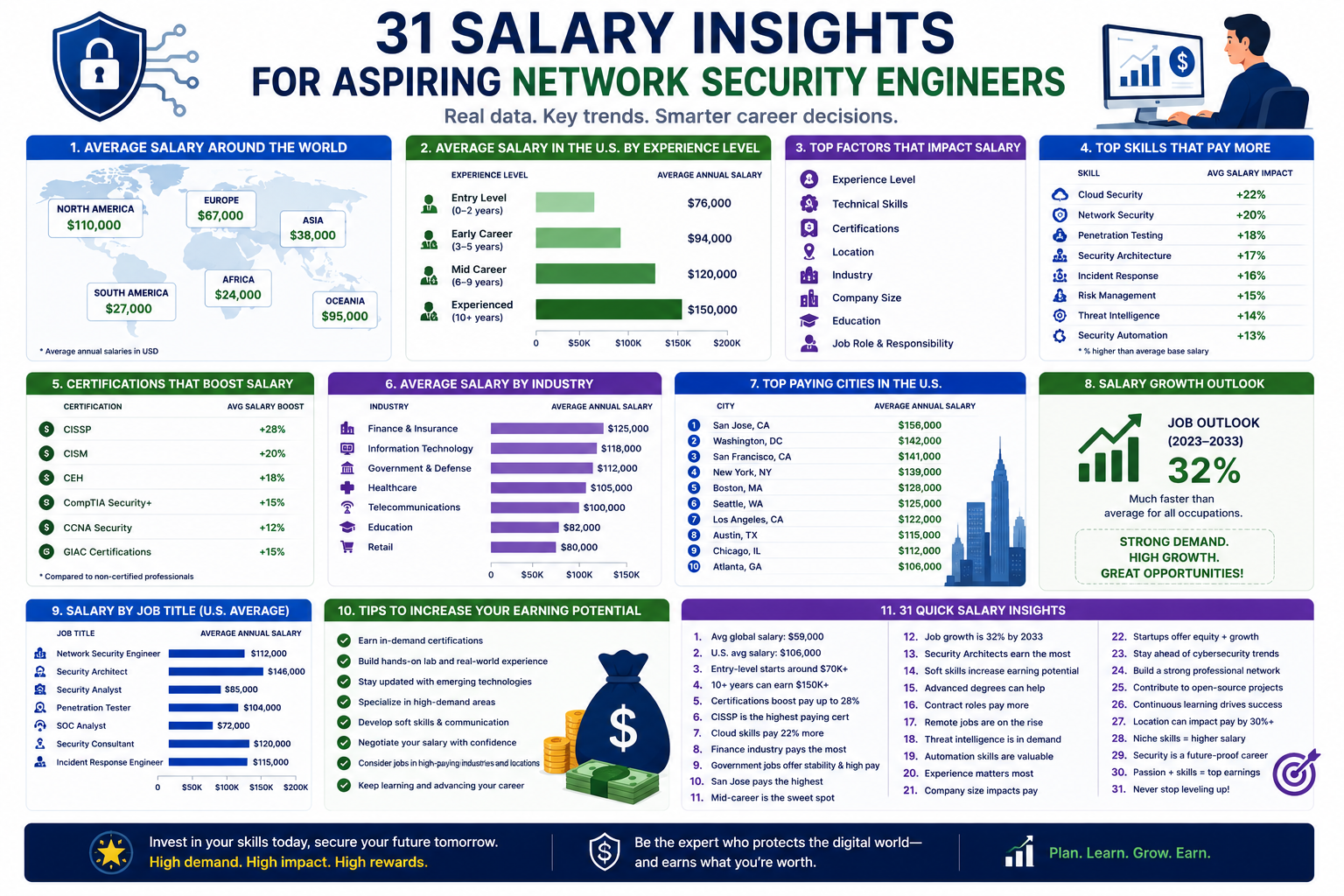
Cybersecurity has become one of the fastest-growing areas in the technology industry, and network security engineers are right at the center of that growth. As organizations continue expanding their digital operations, protecting networks and systems has become a top priority for businesses of every size. From small startups to global enterprises, companies rely on skilled professionals who can secure infrastructure, stop cyberattacks, and maintain safe communication across networks.
This increasing dependence on digital systems has created strong demand for network security engineers throughout the United States and around the world. The role offers excellent career stability, consistent job growth, and salaries that often reach six figures. Organizations are investing more money into cybersecurity than ever before because the cost of a security breach can be devastating both financially and operationally.
For professionals considering a career in network security, understanding salary trends is important. Compensation in this field varies depending on several factors including location, technical skills, certifications, years of experience, and industry specialization. Some engineers begin their careers earning modest salaries but quickly move into high-paying senior roles as they develop advanced expertise.
At the same time, the profession itself continues evolving. Traditional network defense is no longer enough in today’s cloud-first environment. Employers increasingly seek engineers who understand cloud security, automation, compliance requirements, and modern threat detection techniques. Professionals who continuously improve their skills often see significant increases in salary and career opportunities.
The role is also attractive because it offers multiple career paths. Some network security engineers specialize in firewall management or incident response, while others move into cloud architecture, penetration testing, compliance leadership, or cybersecurity management. This flexibility allows professionals to shape their careers around their interests and strengths.
Understanding the realities of the profession requires looking beyond salary numbers alone. It also involves understanding what the role includes on a daily basis, why demand continues growing, and which skills employers value most. Many professionals enter the field because of strong salaries, but long-term success depends on technical knowledge, adaptability, and continuous learning.
Network security engineering combines networking expertise with cybersecurity principles. Professionals in this field must understand how data moves through systems while also knowing how attackers exploit vulnerabilities. They are responsible for protecting sensitive information, securing infrastructure, and helping organizations reduce risk.
As cyber threats become more sophisticated, businesses increasingly depend on engineers who can anticipate attacks before they happen. Security is no longer viewed as optional. It is now considered a fundamental business requirement. Companies that fail to invest in strong security measures risk downtime, legal penalties, data loss, and reputational damage.
This growing importance explains why network security engineers are among the most sought-after professionals in IT today. Organizations need individuals who can design secure systems, respond to incidents quickly, and support long-term cybersecurity strategies.
What a Network Security Engineer Actually Does
A network security engineer focuses on protecting an organization’s network infrastructure from unauthorized access, cyberattacks, and security vulnerabilities. Their responsibilities involve designing, implementing, monitoring, and maintaining secure communication systems across the organization.
The role combines elements of networking, systems administration, cybersecurity, and risk management. Engineers must understand how networks function while also knowing how attackers attempt to compromise those networks.
One of the primary responsibilities is managing firewalls and access controls. Firewalls help filter network traffic and block unauthorized activity. Engineers create security rules that determine which traffic is allowed and which traffic should be denied. Proper firewall configuration is critical because poorly configured rules can expose systems to attackers.
Network security engineers also manage VPN technologies that allow secure remote access for employees. As remote and hybrid work environments continue growing, secure connectivity has become more important than ever.
Monitoring network activity is another major responsibility. Engineers use security monitoring tools to analyze traffic patterns, identify suspicious behavior, and detect potential threats before they escalate into serious incidents.
When alerts occur, network security engineers investigate the cause and determine whether the activity represents a genuine threat. This process may involve reviewing logs, analyzing packets, isolating systems, or coordinating with incident response teams.
Many engineers are also responsible for vulnerability management. They conduct security assessments, identify weaknesses in systems, and coordinate remediation efforts to reduce exposure to threats.
In larger organizations, network security engineers may participate in designing enterprise-level security architectures. They help determine how systems should be segmented, which technologies should be deployed, and how sensitive data should be protected.
Documentation is another important part of the role. Engineers often maintain security policies, incident reports, compliance records, and infrastructure documentation.
The position requires both technical and analytical thinking. Engineers must understand complex systems while also thinking strategically about risk reduction and security planning.
Why Demand for Network Security Engineers Keeps Rising
The demand for network security engineers continues increasing because organizations face growing cybersecurity challenges. Modern businesses rely heavily on internet-connected systems, cloud platforms, mobile devices, and remote access technologies. Each of these creates potential entry points for attackers.
Cybercriminals are constantly developing new attack methods. Ransomware attacks, phishing campaigns, credential theft, and data breaches have become common concerns for businesses in nearly every industry.
As attacks become more sophisticated, organizations need professionals who can proactively strengthen defenses rather than simply reacting after incidents occur.
Another reason demand continues growing is regulatory pressure. Industries such as healthcare, finance, and government must comply with strict security and privacy requirements. Organizations failing to meet these standards may face major fines and legal consequences.
Cloud computing has also increased the need for skilled security professionals. Many organizations now operate hybrid environments that combine on-premises infrastructure with public cloud services. Securing these environments requires specialized expertise.
Businesses also recognize that cybersecurity is directly tied to customer trust. Consumers expect organizations to protect sensitive personal and financial information. Security failures can damage a company’s reputation for years.
The rise of remote work has further expanded cybersecurity responsibilities. Employees now access company systems from homes, coffee shops, hotels, and mobile devices. Engineers must ensure secure connectivity regardless of location.
Artificial intelligence and automation are also changing the cybersecurity landscape. While automation improves efficiency, it also introduces new risks and attack surfaces that require careful management.
The shortage of qualified cybersecurity professionals continues contributing to high salaries and strong job demand. Many organizations struggle to fill security positions because experienced candidates are limited.
For professionals entering the field, this shortage creates strong career opportunities. Skilled engineers often receive competitive salaries, signing bonuses, flexible work arrangements, and rapid advancement opportunities.
Understanding Salary Growth in Network Security Engineering
Salary growth in network security engineering can be substantial, especially for professionals who continuously build technical expertise and gain real-world experience.
Entry-level professionals usually begin in support-oriented positions where they learn core networking and security concepts. Responsibilities may include monitoring alerts, assisting with firewall changes, reviewing logs, and helping senior engineers during incident response situations.
At this stage, employers focus more on foundational knowledge and willingness to learn than advanced expertise. Many entry-level engineers hold certifications such as Security+ or possess networking experience gained through help desk or systems administration roles.
As engineers gain experience, they become capable of handling more complex responsibilities independently. Mid-level professionals often manage security projects, conduct vulnerability assessments, tune intrusion detection systems, and participate in infrastructure planning.
Mid-level salaries tend to increase significantly because engineers at this stage contribute directly to operational security and risk reduction. Employers value professionals who can solve problems without constant supervision.
Senior-level engineers typically handle strategic responsibilities. They may design enterprise security architectures, lead major projects, mentor junior staff, and collaborate with executives on cybersecurity planning.
These professionals often possess expertise in specialized areas such as cloud security, zero trust architecture, threat intelligence, or compliance frameworks. Their advanced knowledge allows them to command much higher salaries.
Leadership opportunities can increase compensation even further. Security managers, architects, consultants, and SOC leaders frequently earn well above standard engineering salaries.
Continuous learning plays a major role in salary growth. Engineers who stay updated on emerging technologies and evolving threats remain more valuable to employers.
Changing employers can also accelerate salary progression. Many professionals receive substantial pay increases when moving into new positions with greater responsibilities.
Geographic flexibility is another factor. Engineers willing to relocate to major technology or government markets often gain access to higher-paying opportunities.
How Location Affects Network Security Engineer Salaries
Location remains one of the biggest factors influencing salary levels for network security engineers. Different regions offer different compensation ranges based on local demand, cost of living, industry concentration, and competition for talent.
Major technology hubs generally offer the highest salaries. Cities with large numbers of technology companies, financial institutions, or government contractors tend to pay significantly more than smaller markets.
San Francisco remains one of the highest-paying locations because of its concentration of major technology companies and cybersecurity startups. Employers in the region compete aggressively for experienced talent, pushing salaries upward.
New York also offers strong compensation, particularly within the financial sector. Banks and investment firms require highly secure systems and are willing to pay premium salaries for experienced professionals.
Seattle continues attracting cybersecurity talent because of its cloud computing and enterprise technology industries. Large organizations operating cloud platforms require engineers capable of protecting massive infrastructures.
Washington, DC stands out because of government and defense-related opportunities. Security clearances can dramatically increase salary potential in this region.
Boston, Los Angeles, and Chicago also provide strong compensation due to their large enterprise markets and growing technology sectors.
However, high salaries in major cities are often balanced by higher living expenses. Housing, transportation, and taxes can significantly reduce purchasing power in expensive metropolitan regions.
Mid-sized cities such as Austin, Denver, Raleigh, and Charlotte have become increasingly attractive alternatives. These locations often provide excellent salaries combined with lower living costs.
Remote work has also changed salary dynamics. Many companies now hire security professionals nationwide, allowing engineers in lower-cost regions to access high-paying remote positions.
Some employers still adjust salaries based on employee location, while others offer standardized compensation regardless of geography. This trend continues evolving as remote work becomes more common.
The Technical Skills Employers Value Most
Technical expertise directly influences salary potential in network security engineering. Employers pay higher salaries to professionals who possess specialized skills that are difficult to replace.
Strong networking knowledge remains foundational. Engineers must understand routing, switching, TCP/IP, DNS, VPN technologies, and network segmentation principles.
Firewall expertise is highly valuable because firewalls remain central to enterprise security strategies. Engineers familiar with platforms from Cisco, Palo Alto, Fortinet, and Check Point often qualify for higher-paying roles.
Cloud security has become one of the most important skill areas. Organizations increasingly seek professionals who understand AWS, Azure, and hybrid cloud security models.
Identity and access management expertise is also highly valued. Proper authentication and authorization controls are critical in modern security environments.
SIEM platforms such as Splunk and QRadar are widely used for threat detection and log analysis. Engineers who can manage and optimize these systems often command stronger salaries.
Automation skills continue growing in importance. Organizations want engineers capable of scripting repetitive tasks and integrating automated security workflows.
Programming knowledge in languages such as Python, Bash, or PowerShell helps engineers automate monitoring, incident response, and configuration management processes.
Threat detection and incident response expertise are also valuable because organizations need professionals capable of responding quickly to attacks.
Compliance knowledge can significantly increase earning potential in regulated industries. Understanding frameworks such as HIPAA, PCI-DSS, NIST, or FedRAMP makes professionals more attractive to employers.
Soft skills matter as well. Engineers who communicate effectively, collaborate with teams, and explain technical risks clearly often advance faster into leadership roles.
Why Continuous Learning Is Essential in Cybersecurity
Cybersecurity changes constantly. Attack methods evolve, technologies shift, and new vulnerabilities emerge every day. Because of this, continuous learning is essential for long-term success in network security engineering.
Professionals who stop learning often find their skills becoming outdated. Employers increasingly prioritize candidates who stay informed about modern tools, cloud platforms, and emerging security strategies.
Training can come from many sources including certifications, online courses, hands-on labs, conferences, and real-world experience.
Many engineers build home labs to practice configuring firewalls, analyzing traffic, and testing security tools. Practical experience is often more valuable than theoretical knowledge alone.
Industry certifications help professionals validate expertise and stay competitive in the job market. They also expose engineers to updated technologies and best practices.
Following cybersecurity news and threat intelligence reports helps engineers understand evolving attack trends. Awareness of current threats improves defensive planning and incident response capabilities.
Professional networking is also important. Engaging with cybersecurity communities allows engineers to exchange knowledge, discuss emerging technologies, and learn from peers.
Organizations value professionals who actively invest in their own growth because cybersecurity requires adaptability. The ability to learn quickly is often just as important as existing technical knowledge.
Network security engineering offers strong long-term career potential for individuals willing to continuously improve their skills and adapt to changing technologies.
Tools, Certifications, Industries, and Career Advancement
Network security engineering continues to rank among the most rewarding careers in information technology because organizations of every size now rely heavily on secure digital infrastructure. Businesses store enormous amounts of sensitive data online, employees connect remotely from multiple locations, and cloud environments have become central to everyday operations. These changes have dramatically increased the need for skilled professionals who can defend systems against modern cyber threats.
While strong salaries attract many professionals to cybersecurity, long-term success in network security engineering depends on much more than basic networking knowledge. Employers increasingly look for engineers who understand advanced security tools, compliance frameworks, cloud infrastructure, automation, and incident response strategies. The professionals who master these areas often gain access to higher-paying opportunities and faster career growth.
The modern cybersecurity environment is far more complex than it was a decade ago. Attackers now use sophisticated techniques that target organizations through phishing campaigns, ransomware attacks, cloud vulnerabilities, and supply chain compromises. As a result, network security engineers are expected to work with a wide range of technologies that help organizations identify, prevent, and respond to threats quickly.
At the same time, many industries face increasing regulatory pressure. Businesses must comply with security standards designed to protect customer data, financial records, healthcare information, and government systems. Engineers who understand these requirements often become especially valuable because they help organizations avoid fines, lawsuits, and operational disruptions.
Career growth within network security engineering is also heavily influenced by specialization. Some professionals focus on cloud security, while others develop expertise in compliance, threat intelligence, penetration testing, or security operations. The ability to specialize allows engineers to increase their value and move into advanced technical or leadership positions.
One of the reasons the field remains attractive is because demand continues rising faster than the supply of experienced professionals. Organizations frequently struggle to find qualified engineers who possess both practical experience and modern technical skills. This talent shortage contributes directly to higher salaries and increased opportunities for advancement.
Understanding which tools, certifications, and industries influence salary potential can help professionals make smarter career decisions. Engineers who invest time in the right technologies and skills often position themselves for stronger compensation and long-term career stability.
The Most Important Tools Used by Network Security Engineers
Network security engineers rely on a wide range of tools to monitor systems, detect threats, secure infrastructure, and investigate suspicious activity. These tools form the foundation of modern cybersecurity operations and are often central to daily responsibilities.
Firewalls remain one of the most important technologies in network security. They act as barriers between trusted internal networks and external systems, filtering traffic based on security rules. Engineers must know how to configure, maintain, and troubleshoot firewall platforms effectively.
Cisco firewalls are widely used across enterprise environments, especially in organizations with large Cisco networking infrastructures. Palo Alto Networks firewalls are also extremely popular because of their advanced application awareness and next-generation security capabilities. Fortinet products remain common as well because of their performance and integrated security features.
Understanding how to manage firewall policies is critical because improperly configured rules can create serious vulnerabilities. Engineers must balance security with usability, ensuring that authorized users maintain access while threats remain blocked.
Traffic analysis tools are another major component of network security operations. Wireshark remains one of the most widely used packet analysis tools in the industry. It allows engineers to capture and inspect network traffic in detail, making it useful for troubleshooting, threat analysis, and protocol investigation.
Intrusion detection and intrusion prevention systems help organizations identify malicious activity across their networks. Snort and Suricata are commonly used solutions that analyze traffic patterns and generate alerts when suspicious behavior is detected.
SIEM platforms have become central to modern cybersecurity operations. Security Information and Event Management systems aggregate logs from firewalls, servers, endpoints, and applications into centralized dashboards for monitoring and analysis.
Splunk is one of the most recognized SIEM platforms and is heavily used in enterprise environments. IBM QRadar and LogRhythm are also common solutions that help organizations detect anomalies and investigate incidents more efficiently.
VPN technologies remain extremely important because remote and hybrid work environments continue expanding. Engineers frequently configure and maintain secure remote access systems using solutions such as Cisco AnyConnect and OpenVPN.
Cloud security tools are increasingly valuable as businesses migrate workloads to cloud platforms. AWS Security Hub, Azure Defender, and other cloud-native solutions help organizations monitor cloud environments, detect threats, and maintain compliance.
Vulnerability scanning tools are another essential part of security operations. Nessus is widely used to identify weaknesses in systems and applications before attackers can exploit them. Engineers use vulnerability reports to prioritize remediation efforts and strengthen infrastructure security.
Network discovery and monitoring tools also play major roles. Nmap helps engineers scan networks and identify active hosts, open ports, and services. SolarWinds assists with network performance monitoring and infrastructure management.
The more comfortable an engineer becomes with these tools, the more valuable they typically become to employers. Practical experience often matters more than theoretical understanding alone because organizations need professionals capable of operating real-world security environments effectively.
Why Cloud Security Skills Increase Salaries
Cloud computing has transformed the cybersecurity industry. Organizations increasingly store data, applications, and infrastructure within cloud environments instead of relying entirely on traditional on-premises systems.
This transition has created strong demand for professionals who understand how to secure cloud platforms properly. Engineers with cloud security expertise often earn significantly more because businesses urgently need specialists capable of protecting cloud-based infrastructure.
Cloud security differs from traditional network security in several important ways. In cloud environments, organizations must manage identity permissions, cloud-native monitoring tools, virtual networking, and shared responsibility models.
AWS remains the dominant cloud platform in many industries, making AWS security expertise particularly valuable. Engineers familiar with AWS Identity and Access Management, security groups, logging systems, and encryption controls often qualify for premium roles.
Microsoft Azure also plays a major role in enterprise cloud deployments. Organizations using Microsoft ecosystems frequently seek professionals who understand Azure Defender, Azure Sentinel, and hybrid identity management.
Google Cloud security expertise is growing as well, especially in organizations adopting multi-cloud strategies.
Container security has become another important specialization. Businesses increasingly deploy applications through Kubernetes and Docker environments, creating new challenges related to workload isolation, image scanning, and orchestration security.
Cloud security professionals must also understand automation and infrastructure-as-code principles. Modern cloud environments rely heavily on automated deployments and policy management systems.
The reason cloud security professionals command higher salaries is simple: the skills are difficult to replace. Many experienced network engineers understand traditional infrastructure but lack practical cloud expertise.
Organizations migrating to cloud platforms often need engineers who can bridge both worlds. Professionals who understand networking, cybersecurity, and cloud infrastructure simultaneously become especially valuable.
Cloud certifications can further strengthen salary potential. AWS Certified Security Specialty and Microsoft Azure security certifications help validate expertise and demonstrate specialized knowledge to employers.
How Compliance Knowledge Impacts Compensation
Compliance plays a major role in modern cybersecurity because many industries face strict regulatory requirements regarding data protection and privacy.
Organizations operating in healthcare, finance, government, and e-commerce must comply with specific frameworks designed to protect sensitive information. Failure to meet these requirements can lead to severe financial penalties and reputational damage.
Network security engineers who understand compliance frameworks often receive higher salaries because they help organizations reduce legal and operational risks.
Healthcare organizations must comply with HIPAA regulations that protect patient information. Engineers working in healthcare environments need to understand secure access controls, data encryption, audit logging, and risk management practices.
Financial institutions frequently operate under PCI-DSS requirements related to payment card security. Engineers responsible for securing payment systems must understand network segmentation, monitoring requirements, and vulnerability management procedures.
Government agencies and defense contractors often follow NIST frameworks and other federal cybersecurity standards. Professionals familiar with these environments may also require security clearances, which can dramatically increase salary potential.
FedRAMP has become increasingly important for cloud service providers working with government agencies. Engineers who understand FedRAMP compliance requirements are highly sought after in cloud-focused organizations.
Compliance expertise goes beyond understanding regulations alone. Engineers must know how to implement technical controls, conduct audits, maintain documentation, and support remediation efforts.
Organizations value professionals capable of communicating effectively with auditors, executives, and regulatory bodies. Technical expertise combined with compliance understanding creates a powerful combination in cybersecurity careers.
Because compliance requirements continue expanding globally, professionals with regulatory knowledge are likely to remain highly valuable for years to come.
The Value of Security Clearances
Security clearances can significantly influence salary levels for network security engineers, particularly in government and defense-related sectors.
Many federal agencies and defense contractors require engineers to hold active clearances before they can access classified systems or sensitive information.
The clearance process itself can be lengthy and expensive, which makes already-cleared professionals especially attractive to employers.
Secret and Top Secret clearances are particularly valuable in cybersecurity roles related to defense, intelligence, and national security operations.
Organizations often pay premium salaries to cleared professionals because the talent pool is smaller and hiring flexibility is limited.
Engineers working in cleared environments may focus on highly secure networks, military systems, critical infrastructure protection, or classified communications platforms.
These roles often involve stricter security protocols and more specialized technologies than traditional enterprise environments.
The combination of cybersecurity expertise and an active clearance can create exceptional career stability because demand consistently exceeds supply in many government-related sectors.
Why Certifications Continue to Matter
Certifications remain one of the most effective ways for network security engineers to demonstrate expertise and improve career opportunities.
Employers frequently use certifications as validation that candidates possess recognized technical knowledge and professional commitment.
CompTIA Security+ is often considered an excellent entry point into cybersecurity. It covers foundational concepts such as network security, risk management, cryptography, and incident response.
Cisco security certifications remain highly respected because Cisco equipment is widely used across enterprise environments. Engineers familiar with Cisco firewalls, VPNs, and access control systems often qualify for stronger opportunities.
The Certified Ethical Hacker certification appeals to professionals interested in understanding offensive security techniques. Employers value engineers capable of thinking like attackers because this perspective improves defensive planning.
CISSP is one of the most recognized advanced cybersecurity certifications in the world. It focuses on leadership, governance, architecture, and enterprise security strategy.
Professionals pursuing management or architecture roles often obtain CISSP because many senior positions list it as a preferred qualification.
Vendor-specific certifications from Palo Alto Networks, Fortinet, and Check Point also carry significant value because many organizations rely heavily on those platforms.
Cloud certifications have become increasingly important as businesses migrate to cloud infrastructure. AWS and Azure security certifications help validate modern technical expertise.
Certifications alone do not guarantee high salaries, but they frequently help professionals stand out in competitive hiring environments.
Combined with real-world experience, certifications can accelerate career growth and open doors to specialized opportunities.
Industries That Pay the Highest Salaries
Not all industries pay network security engineers equally. Certain sectors consistently offer stronger compensation because cybersecurity directly impacts business operations, regulatory compliance, and national security.
Financial services often provide some of the highest salaries in cybersecurity. Banks, investment firms, and insurance companies rely heavily on secure systems to protect financial transactions and customer data.
Healthcare organizations also invest heavily in cybersecurity because patient information is highly sensitive and heavily regulated.
Defense contractors and government agencies frequently pay premium salaries, particularly for cleared professionals working on classified systems.
Technology companies often provide strong compensation packages because their businesses depend directly on secure digital infrastructure and cloud operations.
E-commerce companies require strong security measures to protect payment systems and customer accounts. Large online retailers frequently maintain extensive cybersecurity teams.
Energy and critical infrastructure sectors also offer strong opportunities because cyberattacks targeting utilities and infrastructure systems can have severe real-world consequences.
Consulting firms represent another major employer category. Security consultants often work across multiple industries, helping organizations improve defenses, conduct assessments, and implement compliance programs.
Industry specialization can significantly influence long-term salary growth. Engineers who develop expertise in highly regulated or technically demanding sectors often become difficult to replace.
The Importance of Automation Skills
Automation has become increasingly important in cybersecurity because organizations manage enormous amounts of data, alerts, and infrastructure changes every day.
Manual security operations are no longer sufficient in large environments. Engineers capable of automating repetitive tasks help organizations improve efficiency and reduce response times.
Python is one of the most valuable programming languages for network security engineers because it supports scripting, automation, and security tool integration.
Bash and PowerShell are also commonly used for automation tasks related to system administration, monitoring, and configuration management.
Automation skills are particularly valuable in DevSecOps environments where security controls are integrated directly into development pipelines.
Engineers who understand APIs, orchestration tools, and automated incident response systems often qualify for advanced positions.
Automation also reduces human error, which remains one of the leading causes of security incidents.
Organizations increasingly seek professionals who can improve operational efficiency through scripting and process automation.
Because automation expertise intersects with cloud security and infrastructure engineering, professionals possessing these skills often enjoy stronger salary growth and broader career opportunities.
Career Growth, Leadership Paths, and the Future of Cybersecurity
Network security engineering has evolved into one of the most important and respected careers in the technology industry. As businesses continue expanding their digital operations, the responsibility of protecting networks, systems, and sensitive data becomes more critical every year. Organizations now face a constant stream of cyber threats ranging from ransomware attacks and phishing campaigns to insider threats and advanced persistent attacks. Because of this, companies are investing heavily in cybersecurity talent, and network security engineers remain at the center of those investments.
The profession offers more than just strong salaries. It also provides long-term stability, continuous learning opportunities, flexible career paths, and the chance to work with some of the most advanced technologies in the world. Professionals who develop strong technical expertise and adapt to industry changes can build highly successful careers that continue growing over time.
One of the biggest reasons network security engineering remains attractive is that cybersecurity affects nearly every industry. Financial institutions, hospitals, government agencies, manufacturers, cloud providers, universities, and retailers all need professionals capable of defending digital infrastructure. This widespread demand creates strong job security and consistent opportunities for advancement.
The field also rewards specialization. Engineers who become experts in cloud security, compliance, automation, security architecture, or incident response often gain access to higher-paying positions and leadership opportunities. As organizations become more dependent on secure infrastructure, professionals with advanced skills become increasingly difficult to replace.
At the same time, cybersecurity never stays still. New technologies create new risks, and attackers constantly change their tactics. Engineers who succeed long term are usually those who remain curious, continue learning, and stay adaptable throughout their careers.
The future of network security engineering looks extremely promising because digital transformation continues accelerating globally. Artificial intelligence, cloud computing, remote work, and connected devices are all expanding the cybersecurity landscape. Every advancement creates both opportunities and new challenges for security professionals.
Understanding where the profession is heading can help engineers make smarter decisions about certifications, specializations, and long-term career goals. The professionals who prepare for future trends now will likely become some of the highest-paid and most influential cybersecurity experts in the coming years.
How Network Security Engineers Move Into Leadership Roles
Many network security engineers eventually transition into leadership positions as they gain experience and technical credibility. Leadership opportunities can dramatically increase salary potential while allowing professionals to influence broader cybersecurity strategies within organizations.
Early in their careers, engineers usually focus heavily on technical execution. They configure firewalls, monitor security alerts, respond to incidents, and support infrastructure projects. Over time, experienced engineers often become trusted advisors within their teams.
As organizations recognize their expertise, these professionals may begin leading projects, mentoring junior staff, and helping shape security policies. This gradual shift from purely technical work to strategic responsibilities often marks the beginning of leadership progression.
Security team leads commonly coordinate incident response activities, oversee daily operations, and guide junior engineers through troubleshooting and remediation efforts. These positions require both technical knowledge and communication skills.
Managers within cybersecurity departments typically handle staffing, budgeting, compliance coordination, and long-term planning. While technical expertise remains important, leadership roles also demand strong organizational and interpersonal abilities.
Security architects represent another advanced career path. These professionals design enterprise-level security strategies and infrastructure models that align with organizational goals. Architects often work closely with executives, cloud teams, and compliance departments.
Security operations center leadership roles have also become increasingly common. SOC managers and directors oversee monitoring operations, threat detection teams, and incident response programs. These positions often involve high-pressure decision-making and coordination during active security events.
Chief Information Security Officer roles represent the highest leadership level in many organizations. CISOs shape enterprise cybersecurity strategies, manage security budgets, communicate with executive leadership, and guide overall risk management initiatives.
Transitioning into leadership usually requires more than technical knowledge alone. Engineers who communicate effectively, collaborate across departments, and understand business objectives often advance faster than those focused entirely on technical execution.
Leadership positions generally offer significantly higher salaries because organizations rely on these professionals to protect critical business operations and manage cybersecurity risks strategically.
The Role of Soft Skills in Cybersecurity Careers
Technical expertise is essential in network security engineering, but soft skills often determine how far professionals advance in their careers.
Cybersecurity engineers regularly interact with executives, compliance teams, developers, system administrators, auditors, and end users. The ability to communicate clearly with both technical and non-technical audiences is extremely valuable.
Strong communication skills help engineers explain security risks, justify infrastructure changes, and guide organizations during incident response situations. Professionals who simplify complex technical concepts often become more influential within organizations.
Problem-solving skills are equally important. Cybersecurity environments can change rapidly during active incidents, and engineers frequently need to analyze incomplete information under pressure.
Critical thinking helps professionals identify root causes, evaluate risks, and prioritize remediation efforts effectively. Organizations value engineers capable of making sound decisions in high-stress situations.
Teamwork also matters because cybersecurity rarely operates in isolation. Engineers frequently collaborate with networking teams, cloud architects, compliance officers, and application developers.
Adaptability remains another essential skill. Technologies, threats, and business requirements evolve constantly, so successful professionals must learn quickly and remain flexible throughout their careers.
Time management becomes especially important in larger organizations where engineers may handle multiple projects simultaneously while also responding to urgent incidents.
Leadership potential is often tied directly to soft skills. Professionals who build trust, communicate confidently, and mentor others frequently move into management and strategic roles more quickly.
Employers increasingly recognize that cybersecurity is not purely technical. It also involves business operations, risk management, and organizational coordination. Engineers who balance technical expertise with strong interpersonal abilities often enjoy stronger career growth and higher compensation.
Why Threat Detection and Incident Response Matter More Than Ever
Threat detection and incident response have become central components of modern cybersecurity operations because organizations face constant attack attempts.
Traditional perimeter-based security models are no longer sufficient. Attackers increasingly bypass defenses through phishing, credential theft, cloud vulnerabilities, and insider access.
As a result, organizations now focus heavily on detecting suspicious activity quickly and minimizing damage before incidents escalate.
Network security engineers play a major role in these efforts. They monitor SIEM platforms, analyze traffic patterns, review alerts, and investigate anomalies that could indicate malicious behavior.
Threat detection requires both technical expertise and analytical thinking. Engineers must distinguish between legitimate operational activity and potential attacks without generating excessive false positives.
Incident response responsibilities can include isolating affected systems, containing malware infections, restoring services, collecting forensic evidence, and coordinating recovery efforts.
Ransomware attacks have made incident response especially important. Organizations need professionals capable of responding rapidly to prevent operational disruptions and data loss.
Threat intelligence has also become increasingly valuable. Engineers who understand attacker tactics, techniques, and procedures can strengthen defenses proactively.
Behavioral analytics and machine learning tools now assist with threat detection by identifying unusual patterns across networks and cloud environments.
Organizations highly value engineers capable of improving detection capabilities because rapid response directly reduces financial and operational damage during security incidents.
Professionals specializing in threat detection and incident response often command higher salaries because these skills are difficult to automate and require significant practical experience.
How Remote Work Has Changed Cybersecurity Careers
Remote work has permanently changed the cybersecurity landscape. Organizations now support employees working from homes, hotels, airports, and mobile devices across multiple regions.
This shift has increased the complexity of network security engineering significantly. Engineers must secure systems outside traditional office environments while maintaining productivity and user accessibility.
VPN technologies, identity management systems, endpoint protection tools, and zero trust architectures have become critical components of modern security strategies.
Zero trust security models assume that no user or device should automatically receive trusted access. Engineers implementing these models often focus heavily on identity verification, segmentation, and continuous monitoring.
Remote work has also expanded attack surfaces because employees connect from less-controlled environments. Home networks, personal devices, and unsecured Wi-Fi connections all introduce additional risks.
Cloud adoption accelerated alongside remote work growth, further increasing demand for engineers with hybrid infrastructure expertise.
Many organizations now prioritize cybersecurity hiring because distributed workforces require stronger monitoring and access control systems.
Remote work has also created opportunities for cybersecurity professionals themselves. Many engineers now work remotely full-time, allowing them to access opportunities across the country without relocating.
This flexibility can improve work-life balance while expanding career options. Engineers in lower-cost regions may now qualify for higher-paying remote positions previously concentrated in expensive metropolitan areas.
At the same time, remote work requires strong self-management skills. Engineers must communicate effectively across distributed teams and maintain productivity independently.
The long-term impact of remote work on cybersecurity careers appears overwhelmingly positive because organizations continue investing heavily in secure remote infrastructure.
The Growing Influence of Artificial Intelligence in Cybersecurity
Artificial intelligence is rapidly transforming cybersecurity operations. Organizations increasingly use AI-driven systems to improve threat detection, automate analysis, and accelerate incident response processes.
Machine learning algorithms can analyze massive amounts of security data far more quickly than humans alone. These systems help identify suspicious patterns, detect anomalies, and prioritize alerts.
Network security engineers now work alongside AI-powered tools that assist with monitoring, behavioral analysis, and threat correlation.
Automation reduces repetitive tasks and allows engineers to focus on higher-level analysis and strategic decision-making.
However, artificial intelligence also introduces new challenges. Attackers increasingly use AI to automate phishing campaigns, generate convincing fake content, and identify vulnerabilities more efficiently.
This creates an ongoing technological arms race between defenders and attackers.
Engineers who understand AI-driven security technologies are likely to become increasingly valuable as organizations continue adopting advanced automation systems.
At the same time, human expertise remains essential. AI tools can support security operations, but they still require experienced professionals capable of interpreting results and making critical decisions.
Cybersecurity professionals who combine traditional security expertise with automation and AI knowledge may become some of the most sought-after specialists in the industry.
The Importance of Networking and Professional Communities
Professional networking plays a major role in cybersecurity career development. Many opportunities emerge through industry relationships, community involvement, and professional collaboration.
Cybersecurity conferences provide valuable opportunities to learn about emerging threats, technologies, and best practices. Events focused on networking, cloud security, and ethical hacking attract professionals from around the world.
Online communities also help engineers stay informed about industry developments. Security forums, technical groups, and professional organizations allow professionals to exchange knowledge and discuss challenges.
Mentorship can significantly accelerate career growth. Experienced engineers often provide guidance related to certifications, technical skills, interview preparation, and specialization choices.
Professional networking frequently leads to job referrals and career advancement opportunities. Many organizations prefer hiring candidates recommended by trusted industry contacts.
Community involvement also demonstrates passion for cybersecurity, which employers often value highly.
Engineers who actively contribute to open-source projects, write technical articles, or participate in security research may build strong professional reputations over time.
Networking is especially important in cybersecurity because the industry evolves rapidly. Learning from peers helps professionals stay updated on technologies, attack trends, and defensive strategies.
Why Burnout Is a Growing Concern in Cybersecurity
Although network security engineering offers excellent opportunities, the profession can also be demanding and stressful.
Cybersecurity teams often operate under constant pressure because organizations depend on them to prevent and respond to serious threats.
Incident response situations may require long hours, rapid decision-making, and overnight work during emergencies.
Alert fatigue has become another challenge. Engineers monitoring large environments may receive thousands of alerts daily, many of which turn out to be false positives.
The rapid pace of technological change also creates continuous learning pressure. Professionals must regularly update skills to remain effective in evolving environments.
Staffing shortages can worsen workload issues because many organizations struggle to hire enough qualified cybersecurity professionals.
Burnout can reduce job satisfaction, productivity, and long-term career sustainability if organizations fail to support employees properly.
Fortunately, many companies are now investing more heavily in automation, mental health support, flexible schedules, and workload management strategies.
Professionals can also reduce burnout risks by maintaining work-life balance, pursuing supportive work environments, and developing efficient operational processes.
Despite these challenges, many engineers remain highly satisfied with their careers because cybersecurity work is intellectually engaging and meaningful.
How Networking Knowledge Creates Stronger Security Engineers
Strong networking fundamentals remain essential for long-term success in cybersecurity.
Engineers who deeply understand routing, switching, DNS, TCP/IP, segmentation, and wireless technologies often troubleshoot problems more effectively and identify vulnerabilities more quickly.
Cybersecurity is fundamentally tied to how systems communicate. Professionals lacking networking knowledge may struggle to understand attack paths, traffic behavior, or infrastructure weaknesses.
Many successful network security engineers begin their careers in networking roles before transitioning into cybersecurity specializations.
This foundation helps them design more secure architectures and communicate effectively with infrastructure teams.
Cloud environments still rely heavily on networking principles, even though infrastructure models differ from traditional on-premises systems.
Professionals combining strong networking expertise with cybersecurity specialization often become especially valuable because they understand both infrastructure functionality and defensive strategy.
Conclusion
Network security engineering remains one of the strongest and most rewarding careers in modern technology. The profession offers excellent salaries, long-term stability, and continuous opportunities for advancement as organizations across every industry prioritize cybersecurity.
Demand for skilled professionals continues rising because businesses face increasingly sophisticated cyber threats, expanding cloud environments, remote work challenges, and stricter compliance requirements. Organizations need engineers capable of protecting critical infrastructure, securing sensitive information, and responding quickly to incidents before serious damage occurs.
Salary growth in this field is influenced by several important factors including experience, certifications, cloud expertise, compliance knowledge, automation skills, and geographic location. Professionals who continuously improve their technical abilities and adapt to industry changes often move into higher-paying specialized or leadership roles.
The future of network security engineering looks extremely promising. Technologies such as cloud computing, artificial intelligence, automation, and zero trust architecture will continue shaping cybersecurity strategies for years to come. Engineers who stay curious, continue learning, and build both technical and communication skills will remain highly valuable in the evolving job market.
More importantly, network security engineers play a critical role in protecting the digital systems that businesses, governments, and individuals depend on every day. Their work supports operational stability, customer trust, financial security, and national infrastructure protection.
For professionals willing to invest in continuous growth and technical excellence, network security engineering offers not only strong compensation but also a meaningful and future-focused career path.