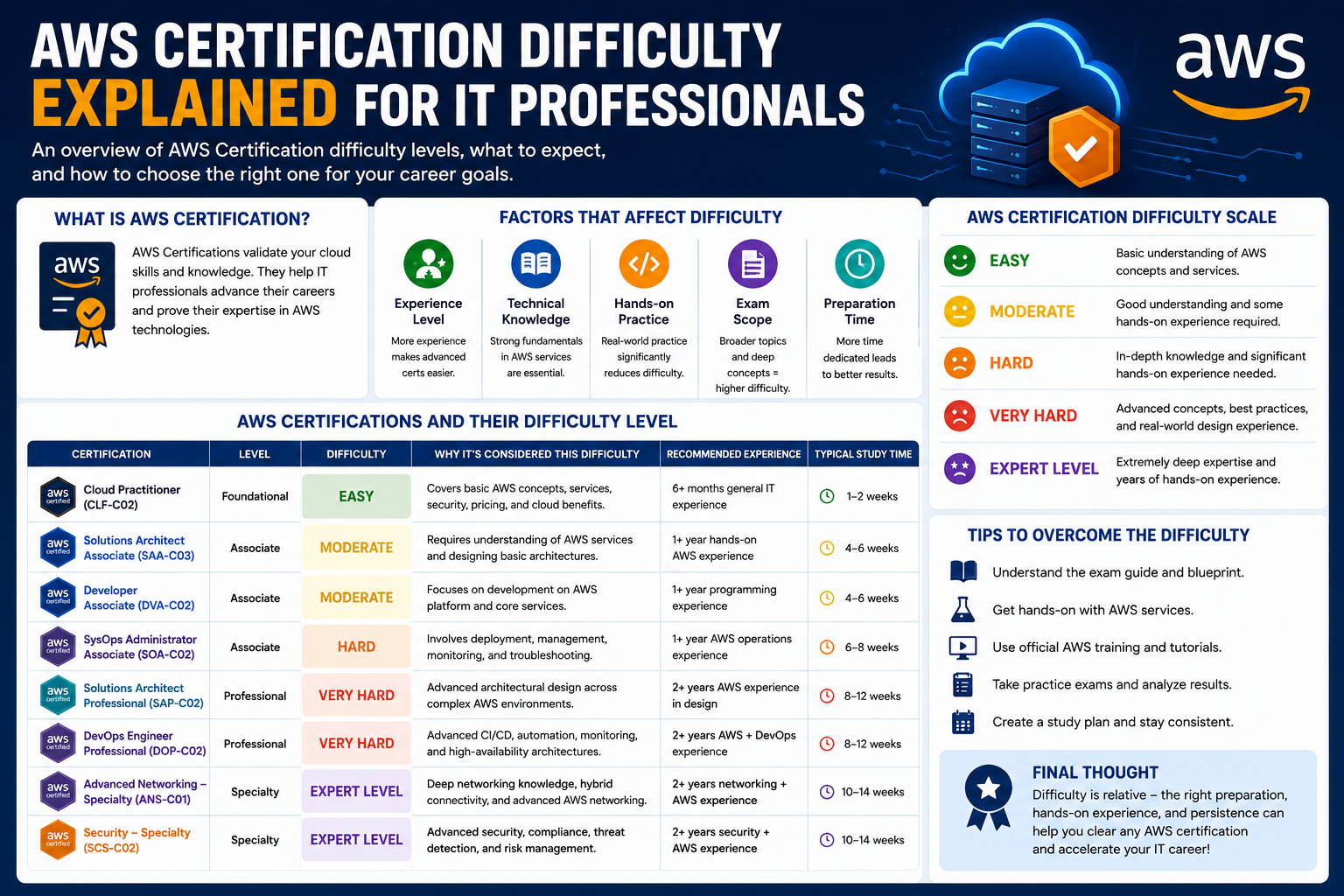
Cloud computing has completely transformed modern IT infrastructure, and Amazon Web Services remains one of the biggest players in the industry. As organizations continue migrating applications, databases, and workloads to the cloud, AWS certifications have become some of the most respected credentials in technology. Employers often view AWS-certified professionals as skilled individuals capable of designing, managing, and securing cloud environments at scale.
However, one question consistently appears among aspiring cloud professionals: how difficult are AWS certifications?
The answer depends on your technical background, experience level, and familiarity with cloud technologies. Some people enter AWS with years of networking or systems administration experience, while others are completely new to IT. Regardless of your starting point, AWS exams are known for being detailed, scenario-based, and highly practical.
AWS certifications are not simple memorization tests. They require real understanding of cloud architecture, deployment strategies, security practices, troubleshooting methods, and cost optimization techniques. Even entry-level exams demand knowledge of core cloud concepts and AWS terminology.
The AWS certification program is divided into several levels, including Foundational, Associate, Professional, and Specialty certifications. Each level introduces a higher degree of complexity, broader service coverage, and more challenging real-world scenarios.
Why AWS Certifications Are Considered Difficult
AWS certifications are challenging because the platform itself is enormous. AWS offers hundreds of cloud services covering computing, networking, storage, databases, analytics, machine learning, security, automation, and application development. Learning how these services interact requires both theoretical knowledge and hands-on practice.
One of the biggest challenges is understanding AWS terminology and architecture. Beginners often struggle with concepts such as Virtual Private Clouds, Availability Zones, Elastic Load Balancers, IAM policies, and auto scaling groups. These concepts are foundational, and without understanding them, more advanced topics become extremely difficult.
Another reason AWS exams are tough is their focus on scenario-based questions. Instead of asking direct factual questions, many exams present long business or technical situations and ask candidates to identify the best solution. Often, multiple answers appear technically correct, but only one aligns perfectly with AWS best practices, cost efficiency, scalability, and security requirements.
AWS exams also test depth and breadth simultaneously. Candidates must understand individual services while also knowing how to combine those services into complete cloud solutions. This requires more than memorization. It demands practical understanding and experience.
Time pressure adds another layer of difficulty. Many AWS exams contain long questions with multiple answer choices, forcing candidates to analyze scenarios quickly while maintaining accuracy throughout the exam.
Foundational Certifications: The Entry Point
The Foundational level is designed for beginners and individuals who want a broad understanding of cloud computing and AWS services. The most popular certification at this level is the AWS Certified Cloud Practitioner certification.
Although this is considered the easiest AWS certification, it can still feel overwhelming for people new to cloud technology. The exam covers topics such as cloud concepts, pricing models, AWS billing, security basics, support plans, and core services like EC2, S3, and RDS.
For experienced IT professionals, the Foundational exam is usually manageable. Individuals with networking, server administration, virtualization, or help desk experience often recognize many concepts because AWS services mirror traditional IT infrastructure in cloud form.
For complete beginners, however, the learning curve can be steep. AWS introduces an entirely new ecosystem filled with unique terminology and service names. Learning how regions, availability zones, identity management, and shared responsibility models work takes time and repetition.
Despite being an entry-level certification, the Cloud Practitioner exam still requires preparation. Candidates who attempt the exam without studying often underestimate the importance of understanding AWS billing models, security principles, and cloud architecture basics.
Hands-on practice makes a major difference at this level. Creating a free AWS account and experimenting with services helps transform abstract concepts into practical understanding.
Associate Certifications: Where Things Get Serious
The Associate level represents a major jump in difficulty. These certifications are designed for professionals who already understand AWS fundamentals and want to demonstrate technical competency in specific cloud roles.
Popular Associate certifications include:
- AWS Certified Solutions Architect – Associate
- AWS Certified Developer – Associate
- AWS Certified SysOps Administrator – Associate
- AWS Certified Data Engineer – Associate
Many candidates describe the Associate level as the point where AWS certifications become truly challenging. The exams cover a wide range of services and expect candidates to understand how those services work together in production environments.
The Solutions Architect Associate certification, for example, focuses heavily on designing scalable, fault-tolerant, and cost-efficient cloud solutions. Candidates must understand networking, storage options, compute services, databases, monitoring, and disaster recovery.
The Developer Associate certification emphasizes application integration, serverless technologies, APIs, deployment methods, and development workflows using AWS tools.
The SysOps Administrator certification is particularly difficult for many candidates because it combines operational management, monitoring, automation, security, and troubleshooting tasks.
At the Associate level, AWS expects candidates to think like real cloud engineers rather than students memorizing facts. Questions often include detailed scenarios involving performance issues, security requirements, cost limitations, and scalability demands.
A major reason these exams are difficult is the sheer number of AWS services covered. Candidates might spend weeks studying one service only to discover entirely different services appearing heavily on the actual exam.
This unpredictability forces candidates to prepare broadly. Relying on a single course or practice test is rarely enough. Successful candidates typically combine video training, hands-on labs, practice exams, whitepapers, documentation, and real-world experimentation.
The Importance of Hands-On Experience
One of the biggest mistakes candidates make is relying entirely on theoretical study. AWS certifications strongly reward practical experience.
Reading about EC2 instances or VPC networking is helpful, but actually configuring virtual machines, security groups, route tables, and IAM permissions creates much deeper understanding. Hands-on practice helps candidates remember service behavior, limitations, and deployment processes.
AWS exams frequently include troubleshooting scenarios that are difficult to solve through memorization alone. Candidates with real lab experience often recognize problems faster because they have encountered similar situations in practice.
Building projects in AWS can significantly improve exam readiness. Examples include:
- Deploying web applications
- Creating multi-tier architectures
- Configuring serverless applications
- Setting up monitoring and alerts
- Implementing backups and disaster recovery
- Managing cloud security policies
- Creating scalable load-balanced environments
Practical experience also helps candidates understand cost management, which appears frequently throughout AWS certification exams.
Professional Certifications: Advanced Cloud Expertise
Professional-level AWS certifications are widely considered some of the hardest certifications in the IT industry. These exams are designed for experienced cloud professionals capable of designing and managing enterprise-scale AWS environments.
The two major Professional certifications are:
- AWS Certified Solutions Architect – Professional
- AWS Certified DevOps Engineer – Professional
These certifications require advanced technical knowledge and significant practical experience. AWS recommends years of hands-on experience before attempting them.
Professional exams are difficult because they focus heavily on architecture design, migration strategies, automation, optimization, governance, and complex troubleshooting.
Questions at this level are extremely detailed. Candidates may face lengthy scenarios describing multinational organizations, hybrid cloud environments, compliance requirements, disaster recovery goals, and performance constraints.
The challenge is not simply identifying correct answers. Candidates must determine the best answer according to AWS best practices. Often, multiple options appear valid, but one provides superior scalability, reliability, cost efficiency, or operational simplicity.
The Solutions Architect Professional certification tests a candidate’s ability to design sophisticated cloud solutions capable of supporting large-scale enterprise workloads. Candidates must understand networking architectures, migration planning, multi-account environments, and high availability strategies.
The DevOps Engineer Professional certification focuses heavily on automation, CI/CD pipelines, infrastructure as code, monitoring, deployment strategies, and operational reliability.
Time management becomes a serious challenge at this level. The exams are long, mentally exhausting, and packed with dense technical information. Many candidates report leaving testing centers mentally drained after completing Professional-level exams.
Specialty Certifications: Deep Technical Focus
AWS Specialty certifications validate expertise in highly specific technical domains. These certifications are often pursued by experienced professionals working directly within specialized cloud disciplines.
Current Specialty certifications focus on areas such as:
- Advanced Networking
- Security
- Machine Learning
Unlike Associate and Professional exams, Specialty certifications are narrower in scope but much deeper technically. They assume strong experience in the chosen field.
The Advanced Networking Specialty certification is highly respected because it requires deep understanding of routing, hybrid connectivity, VPNs, Direct Connect, network security, and multi-region architecture.
The Security Specialty certification focuses on identity management, encryption, incident response, logging, governance, compliance, and advanced cloud security practices.
Machine Learning Specialty exams require understanding of data preparation, model training, deployment pipelines, and AWS machine learning services.
These certifications can feel extremely difficult because they test practical expertise rather than broad conceptual understanding. Candidates lacking real-world experience in the specialization often struggle significantly.
However, professionals already working in these areas may find Specialty certifications easier than Professional exams because the material aligns closely with their daily responsibilities.
How Long Does It Take to Prepare?
Preparation time varies dramatically depending on experience level.
Someone with strong cloud experience may prepare for an Associate certification in a few months. Beginners entering AWS for the first time may need significantly longer.
Professional and Specialty certifications often require extensive preparation lasting several months or more. Candidates frequently spend time building labs, reviewing documentation, completing practice exams, and revisiting weak technical areas.
Consistent study habits matter more than cramming. Studying a little each day while practicing in AWS environments tends to produce better long-term retention and exam performance.
Common Reasons People Fail AWS Exams
Many candidates fail AWS certifications on their first attempt. Common reasons include:
- Underestimating exam difficulty
- Relying only on memorization
- Avoiding hands-on practice
- Using outdated study materials
- Ignoring AWS documentation
- Focusing too narrowly on a few services
- Poor time management during exams
AWS exams are intentionally designed to test practical understanding rather than simple recall. Candidates who develop real cloud skills typically perform much better.
Are AWS Certifications Worth the Effort?
Despite their difficulty, AWS certifications remain extremely valuable. Cloud computing continues expanding rapidly across industries, and organizations consistently seek professionals with verified AWS expertise.
AWS certifications can improve career opportunities in roles such as:
- Cloud Engineer
- Solutions Architect
- DevOps Engineer
- Systems Administrator
- Security Engineer
- Network Engineer
- Cloud Consultant
These certifications also help professionals build confidence while developing practical cloud skills that apply directly to modern IT environments.
Employers often view AWS certifications as proof of technical dedication, problem-solving ability, and cloud competency.
Conclusion
AWS certifications are challenging at every level, but the difficulty depends heavily on your experience and preparation. Foundational certifications introduce cloud concepts and AWS basics, while Associate certifications demand practical technical knowledge across many services. Professional certifications push candidates into advanced architecture and operational expertise, and Specialty certifications require deep mastery within focused technical domains.
What makes AWS exams difficult is not simply the volume of information. The real challenge lies in understanding how AWS services interact to solve real-world business and technical problems efficiently, securely, and reliably.
Success with AWS certifications requires more than memorization. Hands-on practice, consistent study, real-world experimentation, and strong understanding of AWS best practices are essential.
Although the exams can be demanding, earning an AWS certification is often worth the effort. These credentials validate valuable cloud skills, strengthen career opportunities, and demonstrate expertise in one of the world’s leading cloud platforms.