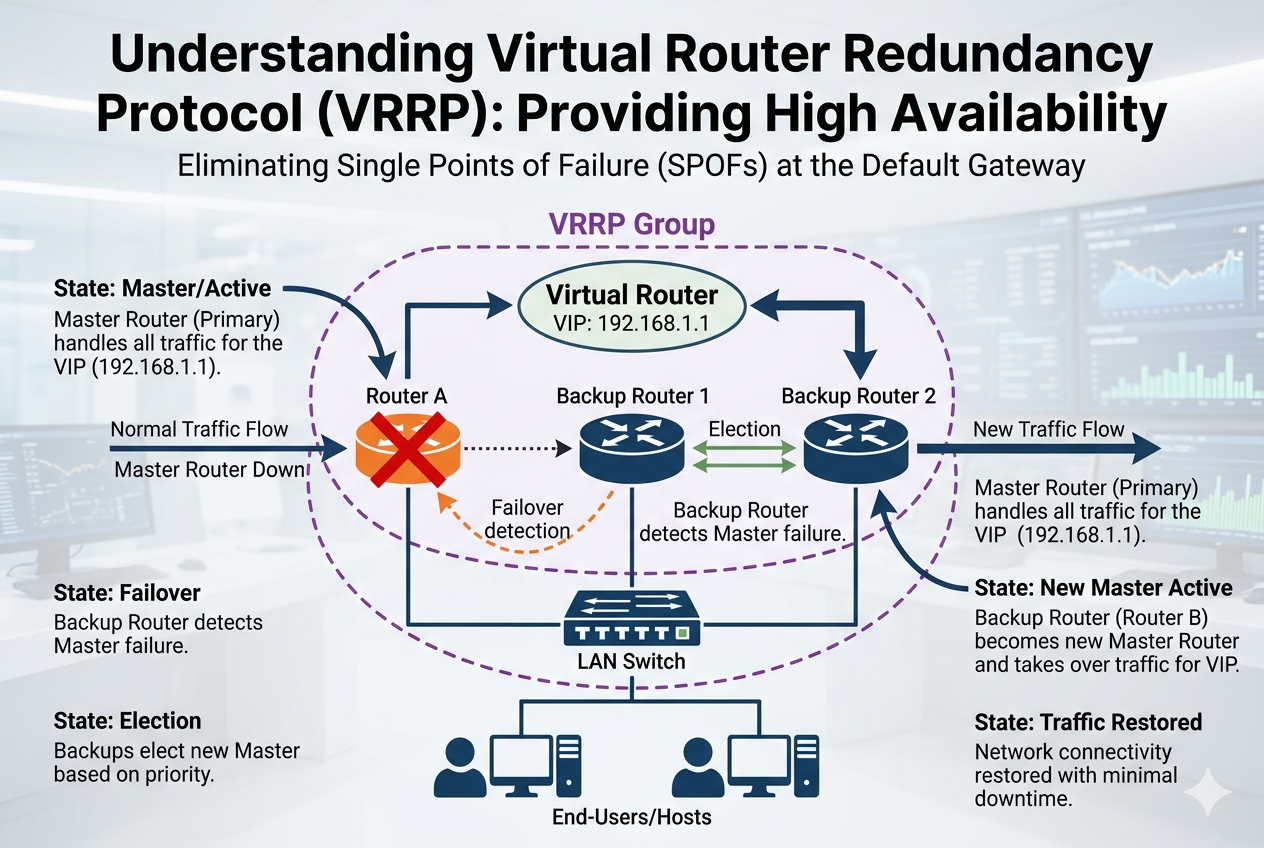
Virtual Router Redundancy Protocol (VRRP) is a network protocol designed to increase the availability and reliability of routing services within an IP network. Its primary purpose is to eliminate a single point of failure in a local area network by ensuring that if one router fails, another router can automatically take over its responsibilities without disrupting network traffic or requiring manual intervention.
In modern network environments, uninterrupted connectivity is essential for business operations, communication systems, cloud services, and data access. VRRP plays a crucial role in achieving high availability by allowing multiple routers to work together as a single virtual router. This virtual router is represented by a shared IP address that end devices use as their default gateway. If the active router becomes unavailable, another router in the group seamlessly assumes control of the virtual IP address, ensuring continuous network service.
Core Purpose of VRRP in Network Redundancy
The main purpose of VRRP is to provide redundancy at the default gateway level. In a typical network, all devices rely on a default gateway (usually a router) to communicate with devices outside their local subnet. If that gateway router fails, all outbound and inbound traffic is interrupted, causing network downtime.
VRRP addresses this problem by allowing multiple routers to share a virtual IP address. One router is elected as the primary or master router, while others act as backups. The master router handles all traffic sent to the virtual IP address, while backup routers remain in standby mode, ready to take over if the master fails.
This design ensures continuous availability of routing services without requiring end devices to change configurations or manually switch gateways. The transition is automatic and fast, minimizing downtime and maintaining seamless connectivity.
How VRRP Ensures High Availability
High availability is one of the key objectives of VRRP. It achieves this through continuous monitoring and automatic failover mechanisms. The master router periodically sends advertisements to inform backup routers that it is still operational. These messages act as heartbeat signals.
If backup routers stop receiving these advertisements within a specified time interval, they assume that the master router has failed. As a result, one of the backup routers is promoted to the master role and takes over the virtual IP address. This process happens quickly, often within seconds, ensuring minimal disruption to network traffic.
This automatic failover capability is what makes VRRP a critical component in enterprise networks, data centers, and service provider infrastructures where uptime is essential.
Virtual Router Concept and Its Importance
At the heart of VRRP is the concept of a virtual router. Instead of relying on a single physical router, VRRP creates a logical abstraction that represents multiple routers as one. This virtual router is identified by a virtual IP address and a virtual MAC address.
End devices such as computers, servers, and printers are configured to use the virtual IP address as their default gateway. They are unaware of which physical router is currently active. This abstraction simplifies network configuration and enhances resilience.
If the active router fails, another router in the VRRP group takes over the virtual identity. Because the virtual IP and MAC address remain unchanged from the perspective of end devices, there is no need to update routing tables or reconfigure network settings.
Master and Backup Router Roles
VRRP operates using a role-based system consisting of a master router and one or more backup routers. The master router is responsible for forwarding traffic sent to the virtual IP address. Backup routers remain in standby mode, continuously monitoring the master’s status.
The selection of the master router is based on priority values assigned to each router. The router with the highest priority becomes the master. If priorities are equal, the router with the highest IP address is selected.
Backup routers listen for periodic advertisements from the master router. These advertisements confirm that the master is still active. If these messages stop, a new election is triggered, and a backup router becomes the new master.
This structured role assignment ensures clarity, stability, and predictability in network behavior.
Failover Mechanism and Network Continuity
One of the most important purposes of VRRP is to ensure seamless failover. Failover refers to the process of switching from a failed router to a backup router without interrupting network traffic.
When the master router fails, VRRP quickly detects the failure using missed advertisement messages. A backup router then transitions into the master role and starts forwarding traffic using the virtual IP address.
This transition is designed to be fast and transparent. End users typically do not notice the change because the virtual gateway remains the same. Applications continue running without disruption, which is especially important for critical systems such as financial platforms, healthcare systems, and cloud-based applications.
Load Sharing and Network Optimization
Although VRRP is primarily designed for redundancy, it can also contribute to load distribution in more advanced configurations. By deploying multiple VRRP groups, network administrators can balance traffic across different routers.
For example, one router can act as the master for one virtual IP address, while another router acts as the master for a different virtual IP address. This allows traffic to be distributed more evenly across multiple devices, improving overall network efficiency and reducing congestion.
However, the primary goal of VRRP remains redundancy rather than load balancing.
Role of Timers and Advertisement Messages
VRRP relies on timing mechanisms to maintain synchronization between routers. The master router sends periodic advertisement messages to all backup routers. These messages contain information about its status and priority.
If a backup router does not receive these advertisements within a predefined time interval, it assumes that the master router is no longer available. This triggers the failover process.
The timing mechanism is carefully designed to balance speed and stability. If the interval is too short, unnecessary failovers may occur due to minor delays. If it is too long, failover may be slow. VRRP settings allow administrators to adjust these timers based on network requirements.
Preemption and Router Priority Behavior
VRRP also includes a feature known as preemption. Preemption allows a higher-priority router to take over the master role when it becomes available again after being offline.
For example, if a high-priority router fails and a lower-priority router becomes the master, the original router can reclaim the master role once it comes back online. This ensures that the most capable router is always in control of the virtual IP address.
However, preemption can be disabled in some configurations to maintain stability and avoid frequent role changes in dynamic environments.
Importance in Modern Networking
The importance of VRRP lies in its ability to maintain uninterrupted network services. In today’s digital world, even a few seconds of downtime can result in data loss, financial impact, or service disruption.
VRRP is widely used in enterprise networks, cloud infrastructures, data centers, and service provider environments. It ensures that critical applications remain accessible even in the event of hardware failure, maintenance, or unexpected outages.
By providing automatic failover, redundancy, and high availability, VRRP supports the reliability requirements of modern IT systems.
Conclusion
The purpose of VRRP (Virtual Router Redundancy Protocol) is to ensure continuous network availability by eliminating the risk of a single point of failure at the default gateway level. It achieves this by creating a virtual router composed of multiple physical routers, where one acts as the master and others serve as backups.
Through mechanisms such as priority-based elections, advertisement messages, failover detection, and preemption, VRRP ensures that network traffic is always routed through an active gateway without interruption. Its ability to provide seamless redundancy makes it a fundamental protocol in high-availability network design.
VRRP not only improves reliability but also enhances user experience by ensuring stable and continuous connectivity. In environments where uptime is critical, it serves as a backbone technology that supports resilient and fault-tolerant network architecture.