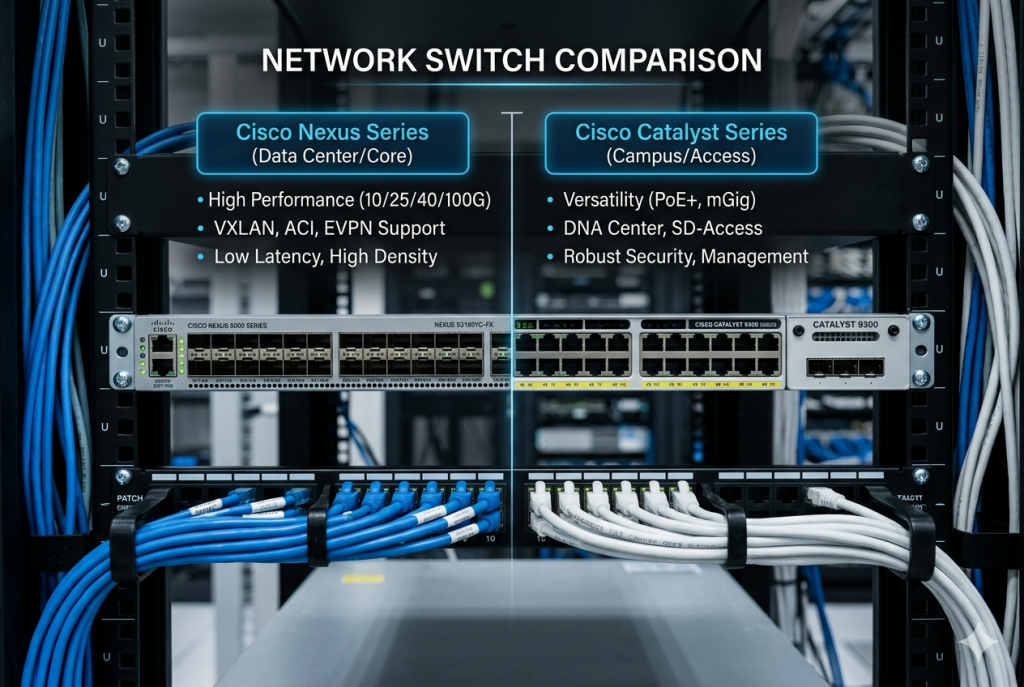
Choosing between Cisco Catalyst and Cisco Nexus switches starts with the network you are building, not a ranking of which family is “more powerful.” Catalyst commonly serves enterprise campus, branch and user-access networks. Nexus is chiefly associated with data center switching, including high-density server connectivity and spine-and-leaf fabrics. Both portfolios contain multiple generations and models, so their capabilities overlap in places and need to be checked at the exact SKU and software-release level.
What each switch family is designed to solve
Catalyst: Campus networks connect people and endpoint devices. Typical requirements include wired workstation access, wireless access-point uplinks, PoE budgets, VLAN segmentation, authentication, policy enforcement, campus redundancy and centralized operations. Catalyst access and core/distribution models address different parts of that design; a small branch and a multi-building campus do not require the same chassis.
Nexus: Data center networks connect servers, storage and virtualized applications at high port densities. The design often involves top-of-rack switching, resilient leaf-and-spine fabrics, high-speed optical links and automation. Many Nexus platforms use Cisco NX-OS; some deployments integrate with Cisco ACI. Whether VXLAN, EVPN, multicast, storage features and specific telemetry capabilities are available depends on the platform and software.
The family name is not a performance benchmark. Compare actual forwarding scale, buffering, latency characteristics, port speeds and license entitlements for the proposed devices. A modern Catalyst core switch can be highly capable, while a modest Nexus model may have a narrower role than a large modular Nexus system.
Catalyst versus Nexus at a glance
| Decision factor | Catalyst direction | Nexus direction |
|---|---|---|
| Primary design context | Campus, branch, user access and enterprise distribution/core | Data centers, server access and leaf/spine fabrics |
| Typical connected devices | PCs, phones, wireless access points, cameras and campus uplinks | Servers, storage systems, hypervisors and fabric links |
| Common priorities | PoE, multigigabit client access, endpoint controls and manageability | High-density data-center ports, east-west application traffic and fabric automation |
| Software and management | Often Cisco IOS XE and campus policy/management tooling | Often Cisco NX-OS or ACI-oriented workflows, depending on model and mode |
| Redundancy design | Varies by model: stacking, chassis, routed redundancy or StackWise Virtual | Varies by model: vPC, routing and fabric redundancy |
| Procurement constraint | Check PoE power, uplink optics, stacking, software and support | Check optics, interface density, fabric design, software licensing and support |
Do not confuse vPC with campus stacking
A Nexus virtual port-channel (vPC) lets a downstream device build a port-channel to two separate compatible peer switches while maintaining their own control planes. It relies on a peer-link, keepalive path and configuration consistency. It is not interchangeable with an arbitrary Catalyst stacking feature, and it is not automatically enabled by owning two Nexus switches. See the site’s guide to virtual port-channel peer architecture for the component roles and failure considerations.
In a campus design, assess whether physical stacking, a chassis design, a routed core or another high-availability arrangement meets the failure-domain requirement. In a data center, assess whether Layer 3 leaf/spine links, vPC access, or a platform-specific fabric is appropriate. These choices must account for operations during a switch upgrade or failure, not merely steady-state bandwidth.
Two realistic purchasing scenarios
Scenario A: a growing office with many wireless access points
The office needs secure access for users, PoE power for APs and phones, multigigabit edge ports, access authentication and an uplink path to the campus core. A suitable Catalyst access design is a more natural starting point than buying a Nexus fabric because the former aligns with the endpoint requirements. Confirm the exact power budget, port count, uplink speed, software features and support terms before selecting a model.
Scenario B: a virtualized data center adding more racks
The data center needs dense 25/100-Gigabit or faster links, resilient paths between server racks, predictable oversubscription and automated network provisioning. A Nexus leaf-and-spine approach may be appropriate. The engineering decision still depends on measured east-west traffic, required oversubscription, failure domains, telemetry and compatibility with the existing network. A brand family alone does not establish those design parameters.
Questions to answer before committing to a model
- Where is the switch in the topology? Access, distribution, campus core, top-of-rack or data-center spine?
- Which ports are needed? Include media type, optics, copper versus fiber, speeds and projected growth; count actual usable ports.
- How much power is required? PoE for access devices is a different requirement from power redundancy for rack infrastructure.
- Which features are mandatory? Confirm their availability and licensing in the specified software train and operating mode.
- How will it recover? Design for links, supervisors, peer switches, upgrades and maintenance without creating untested single points of failure.
- Who will operate it? Consider automation, monitoring, CLI expertise, change control, support contracts and spare hardware.
- What is the five-year cost? Hardware price alone omits transceivers, licenses, rack/power, support and operating effort.
Where to confirm current product capabilities
Use Cisco’s current network-switch portfolio to establish the campus/access role of Catalyst models, and its data-center switch portfolio for Nexus model families. Those manufacturer pages provide product context; verify final quantities and feature support in the actual model data sheet, configuration guide and release notes before purchasing.
Conclusion: Catalyst is generally the stronger starting point for user-facing campus networks; Nexus is generally the stronger starting point for data-center switching fabrics. The correct decision comes from the workload, topology, resiliency and operational requirements—not an unconditional claim that one line is faster, cheaper or more secure than the other.