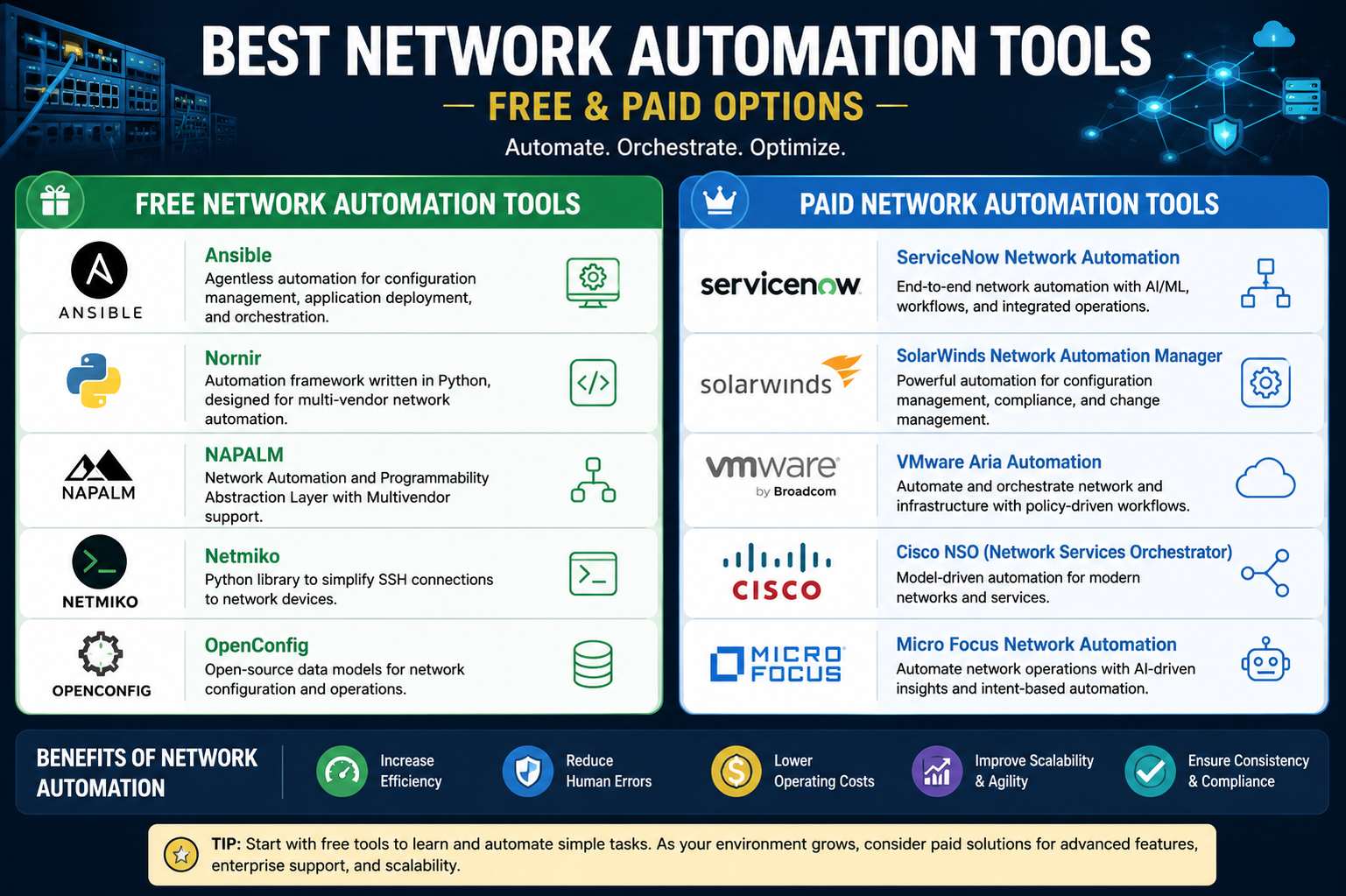
Network automation has become one of the most essential pillars of modern IT infrastructure. As networks continue to scale across cloud environments, data centers, remote offices, and hybrid systems, manual management is no longer sustainable. Engineers are expected to handle thousands of devices, complex configurations, frequent updates, and strict security requirements. In this environment, network automation tools help reduce operational burden, improve consistency, and minimize human error. These tools allow organizations to manage networks through scripts, APIs, and centralized platforms instead of logging into devices individually.
Understanding the Role of Network Automation Tools
Network automation tools are designed to simplify and streamline repetitive network tasks. These tasks include configuration deployment, device provisioning, policy enforcement, monitoring, troubleshooting, and compliance checks. Instead of manually executing commands on each device, engineers can use automation frameworks to apply changes across multiple systems at once. This not only saves time but also ensures uniformity across the entire network infrastructure.
Most modern tools support multi-vendor environments, meaning they can manage devices from different manufacturers within a single workflow. They typically use communication protocols such as SSH, SNMP, NETCONF, REST APIs, and CLI-based interactions. With increasing adoption of cloud computing and software-defined networking, automation has become a core requirement rather than an optional enhancement.
Why Network Automation is Important Today
The importance of network automation has increased due to several key factors. First, network complexity has grown significantly with hybrid cloud environments, remote work systems, and distributed applications. Second, downtime costs are extremely high, making fast recovery and proactive monitoring critical. Third, security threats are more advanced, requiring consistent policy enforcement across all devices.
Automation reduces configuration drift, where devices become inconsistent due to manual changes. It also improves scalability, allowing organizations to expand infrastructure without proportionally increasing staff. Additionally, automation enhances network reliability by ensuring that configurations are tested, standardized, and repeatable.
Ansible as a Leading Free Automation Tool
Ansible is one of the most widely adopted network automation tools due to its simplicity and flexibility. It is an open-source platform that uses a declarative language written in YAML format to define automation tasks. Instead of writing complex code, engineers define “playbooks” that describe what should be done rather than how it should be done.
One of Ansible’s strongest advantages is that it is agentless. It does not require installing software on network devices. Instead, it uses SSH or APIs to communicate directly with them. This makes it easy to deploy in environments with mixed vendors and legacy systems.
Ansible is commonly used for configuration management, firmware upgrades, network provisioning, and compliance auditing. It integrates with major networking vendors and supports large-scale automation across data centers and cloud environments. Its simplicity makes it a popular choice for both beginners and experienced engineers.
Netmiko for Python-Based Network Automation
Netmiko is a powerful Python library designed for SSH-based network automation. It is built on top of Paramiko and simplifies interaction with network devices through Python scripts. Netmiko allows engineers to connect to devices, send commands, and retrieve outputs programmatically.
It supports a wide range of vendors including Cisco, Juniper, Arista, HP, and others. This makes it highly flexible for multi-vendor environments. Engineers often use Netmiko for tasks such as bulk configuration changes, log collection, and automated troubleshooting.
Unlike full automation platforms, Netmiko is lightweight and highly customizable. It is often used as a building block within larger automation systems. Because it is code-based, it is best suited for engineers who are comfortable with Python programming and want full control over automation workflows.
Nornir for Scalable Python Automation
Nornir is another Python-based automation framework that focuses on scalability and performance. Unlike Ansible, which uses YAML, Nornir is fully Python-driven, giving developers more flexibility and power. It is designed to handle large-scale networks efficiently by executing tasks in parallel.
One of its key strengths is its ability to integrate with other libraries such as Netmiko and Napalm. This allows engineers to build highly customized automation pipelines that can perform configuration management, data collection, and validation checks.
Nornir is particularly useful in environments where automation needs to be highly dynamic and programmable. It is widely used by advanced network engineers who prefer writing custom Python scripts instead of relying on predefined playbooks.
Cisco DevNet for Learning and Automation Development
Cisco DevNet is a comprehensive ecosystem that provides tools, APIs, sandboxes, and learning resources for network automation. It allows engineers to experiment with Cisco technologies in a virtual environment without requiring physical hardware.
One of its most valuable features is the sandbox environment, where users can test automation scripts safely. This is extremely helpful for learning, testing new configurations, and developing automation workflows.
Cisco DevNet also provides access to REST APIs and SDKs that enable integration with Cisco devices and platforms. It is widely used by engineers preparing for certifications and those working in Cisco-heavy infrastructures.
Nagios Core for Monitoring and Basic Automation
Nagios Core is one of the oldest and most trusted open-source monitoring tools in network management. While it is primarily known for monitoring, it also plays a role in basic automation workflows.
Nagios continuously monitors network devices, servers, and services, and triggers alerts when issues occur. These alerts can be linked to automated scripts that perform corrective actions such as restarting services or notifying administrators.
Although powerful, Nagios requires significant manual configuration and is not as user-friendly as modern platforms. However, its flexibility and plugin-based architecture make it highly customizable for experienced engineers.
Zabbix for Integrated Monitoring and Automation
Zabbix is a robust open-source monitoring solution that also supports automation features. It provides real-time monitoring of network devices, servers, and applications, along with automatic discovery of new devices.
One of Zabbix’s strongest capabilities is event-based automation. When certain conditions are met, such as high CPU usage or network downtime, Zabbix can trigger predefined actions. These actions may include sending alerts, executing scripts, or restarting services.
Zabbix is widely used in enterprise environments because it combines monitoring and automation in a single platform. It is especially effective in large infrastructures where visibility and control are essential.
ManageEngine OpManager as a Paid Automation Platform
OpManager is a commercial network management solution that provides advanced automation and monitoring capabilities. It is designed for enterprises that require centralized visibility and control over their entire network infrastructure.
OpManager includes features such as automated discovery, configuration management, performance monitoring, and workflow automation. It allows IT teams to define rules and triggers that automatically execute actions based on network conditions.
Its user-friendly interface makes it accessible to teams that may not have deep scripting knowledge. It is widely used in corporate environments where simplicity, reliability, and centralized management are priorities.
SolarWinds Network Automation Platform
SolarWinds offers a comprehensive network automation solution that focuses on simplifying large-scale infrastructure management. It provides tools for configuration backup, compliance checking, performance monitoring, and automated provisioning.
One of its key strengths is configuration management, which allows engineers to track changes, restore backups, and enforce compliance policies. It also provides detailed insights into network performance and device health.
SolarWinds is widely used in enterprise and government environments due to its strong reporting capabilities and deep integration with network infrastructure.
Puppet for Infrastructure and Network Automation
Puppet is a configuration management tool that is widely used in IT automation, including network environments. It uses a declarative language to define system states and ensures that devices remain in the desired configuration.
Puppet is especially effective in maintaining consistency across large infrastructures. It continuously checks systems and automatically corrects deviations from defined policies.
Although originally focused on server automation, Puppet has expanded into network automation through integrations with major networking vendors. It is commonly used in environments that require strict compliance and governance.
Chef for Automation and Configuration Management
Chef is another popular automation platform used for infrastructure and network management. It uses a Ruby-based domain-specific language to define automation workflows.
Chef operates on a “desired state” model, ensuring that systems always match predefined configurations. It is highly scalable and is used in large enterprise environments.
Network engineers use Chef for tasks such as device configuration, policy enforcement, and infrastructure provisioning. It integrates well with cloud platforms and supports hybrid environments.
Conclusion
Network automation tools have become essential in modern IT environments where speed, reliability, and scalability are critical. Free tools like Ansible, Netmiko, Nornir, Zabbix, and Nagios provide powerful capabilities for engineers who prefer flexibility and open-source ecosystems. These tools allow deep customization and are ideal for organizations with strong technical expertise.
On the other hand, paid solutions like ManageEngine OpManager, SolarWinds, Puppet, and Chef offer enterprise-grade features, centralized dashboards, and advanced automation workflows. They are designed for organizations that prioritize ease of use, support, and integrated functionality.
Choosing the right tool depends on the complexity of the network, team expertise, budget, and long-term scalability requirements. In most real-world environments, organizations often use a combination of multiple tools to achieve full automation coverage. As networks continue to evolve, automation will remain a core foundation of efficient and secure IT operations.