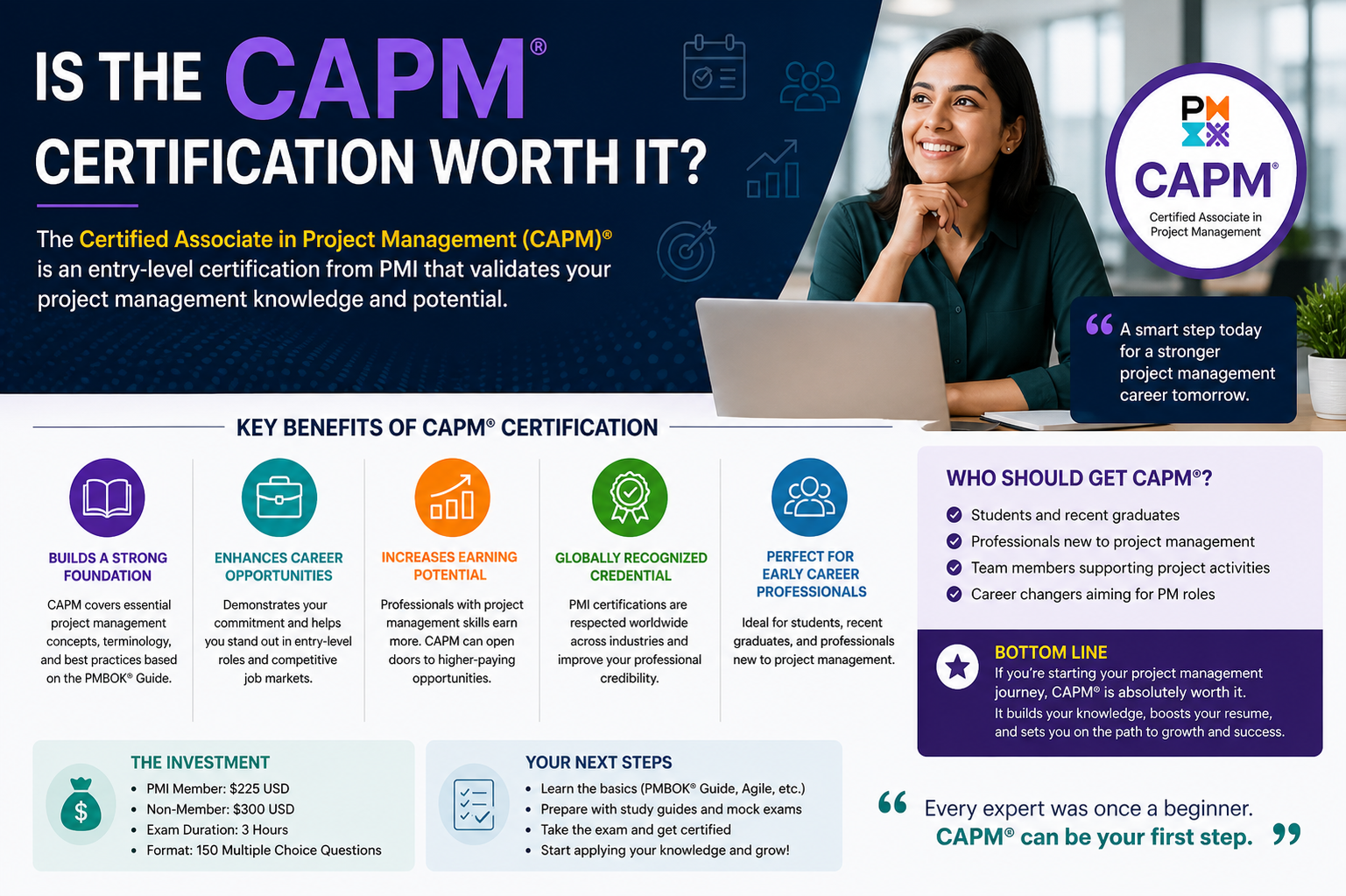
The Certified Associate in Project Management (CAPM) certification is often misunderstood as just another resume booster, but its real purpose goes deeper. It is designed to introduce individuals to the structured discipline of project management and provide them with a standardized understanding of how projects are initiated, planned, executed, monitored, and closed. In many ways, it acts as a bridge between academic knowledge and real-world project environments. For beginners, it helps transform abstract concepts into practical frameworks that can be applied in workplace scenarios. This makes it especially useful for students, fresh graduates, and professionals transitioning from unrelated fields into project management.
Growing Demand for Project Management Skills
In today’s global job market, project management skills are no longer limited to specific industries. Organizations across technology, construction, healthcare, finance, and even creative sectors increasingly rely on structured project management approaches to achieve efficiency and predictability. As a result, the demand for individuals who understand project management fundamentals continues to rise. The CAPM certification aligns with this demand by equipping candidates with standardized knowledge that is recognized across industries. Even if someone does not immediately step into a project manager role, having this foundational knowledge increases employability in team-based roles where coordination and structured execution are important.
How CAPM Differs from Advanced Certifications
One of the most important things to understand is that CAPM is not designed to compete with advanced certifications. Instead, it serves a different purpose entirely. While higher-level certifications focus on leadership, decision-making, and real-world project experience, CAPM focuses on learning the language and structure of project management. It introduces frameworks, terminology, and methodologies that professionals are expected to understand before taking on more complex responsibilities. This distinction is important because it sets realistic expectations. CAPM is not meant to make someone an expert project manager overnight; rather, it prepares them for that journey.
Exam Structure and Learning Approach
The CAPM exam is based on a structured syllabus that covers core project management knowledge areas. These include integration, scope, schedule, cost, quality, resource, communication, risk, procurement, and stakeholder management. The exam format typically tests theoretical understanding rather than practical experience, which makes it suitable for beginners. Preparing for the exam requires disciplined study, as candidates must familiarize themselves with standardized processes and definitions. Many learners find that the preparation itself is as valuable as the certification, because it builds a strong mental framework for understanding how projects operate in real environments.
Career Entry Opportunities After CAPM
Although CAPM alone may not guarantee senior positions, it can significantly improve entry-level opportunities. Many organizations value candidates who already understand project management concepts because it reduces training time and improves team efficiency. CAPM-certified professionals often find roles such as project coordinator, junior analyst, operations assistant, or team support roles within project-driven environments. These positions provide exposure to real projects, allowing individuals to gradually develop hands-on experience while building on their theoretical foundation.
Long-Term Career Growth Potential
The long-term value of CAPM becomes more visible when viewed as part of a broader career path. It is often the first step toward more advanced certifications and leadership roles. Once individuals gain practical experience, they can progress toward higher certifications that require documented project involvement. In this sense, CAPM acts as a foundation rather than a destination. Professionals who start with CAPM often find it easier to understand advanced concepts later because they already have a structured knowledge base.
Return on Investment Considerations
When evaluating whether CAPM is worth it, many people consider cost and time investment. Compared to advanced certifications, CAPM is relatively more accessible, but it still requires preparation, study time, and exam fees. The return on investment depends largely on the individual’s career goals. For someone actively seeking entry into project management, the benefits often outweigh the costs because it improves job prospects and foundational knowledge. However, for individuals already established in senior roles, the return may be less significant unless they are shifting into formal project management functions.
Industry Recognition and Employer Perception
Employers generally view CAPM as a positive credential, especially for entry-level candidates. It signals that the individual has taken the initiative to understand structured project management practices. While it may not be a decisive factor for hiring senior professionals, it can make a meaningful difference when comparing candidates with similar educational backgrounds. In competitive job markets, even small advantages can influence hiring decisions. CAPM helps demonstrate discipline, commitment, and familiarity with globally accepted standards.
Common Misconceptions About CAPM
There are several misconceptions surrounding CAPM that can lead to unrealistic expectations. One common misunderstanding is that it guarantees a high-paying job immediately after certification. In reality, CAPM is a foundational credential, not a shortcut to senior positions. Another misconception is that it is only useful within one industry. In truth, project management principles apply across multiple sectors, making the certification broadly relevant. Some also believe that CAPM is unnecessary if one already has a degree, but structured certification often provides a more practical and industry-aligned understanding than academic study alone.
Study Experience and Skill Development
Preparing for CAPM requires focused study and consistent effort. Candidates must learn standardized processes and understand how different project components interact. This learning experience strengthens analytical thinking, organizational skills, and attention to detail. It also improves communication skills because project management relies heavily on clear documentation and structured reporting. Even if a candidate does not immediately use these skills in a project manager role, they often find them useful in general workplace environments.
Global Relevance of CAPM Certification
One of the strengths of CAPM is its global recognition. The principles it is based on are widely accepted in international project management practices. This makes it useful for individuals who may want to work in multinational companies or pursue opportunities abroad. The standardized nature of the certification ensures that knowledge is transferable across borders, which adds long-term value for professionals seeking global career mobility.
Limitations of the CAPM Certification
Despite its benefits, CAPM does have limitations that should be considered. It does not replace real-world experience, which remains essential for advanced project management roles. Employers still prioritize hands-on experience when hiring for leadership positions. Additionally, CAPM alone may not be sufficient to secure high-level roles without further education or certifications. It is best viewed as an entry point rather than a complete career solution.
Who Should Consider CAPM
CAPM is most suitable for students, recent graduates, and professionals who are new to project management. It is also beneficial for individuals working in supporting roles who want to transition into project coordination or management. Those who are unsure about committing to a long-term project management career can also use CAPM as a way to explore the field without requiring prior experience. It provides clarity on whether this career path aligns with their interests and strengths.
Real-World Application of CAPM Knowledge
The true value of the Certified Associate in Project Management (CAPM) certification becomes clearer when its knowledge is applied in real workplace situations. While the certification itself is theoretical in nature, the concepts it teaches are directly linked to how projects are executed in professional environments. For example, understanding project scope helps employees avoid unnecessary work expansion, while knowledge of scheduling techniques improves time management across teams. Even individuals who are not directly managing projects benefit from this structured understanding because most modern workplaces operate in project-based or hybrid environments. This means that tasks are often interdependent, time-bound, and require coordination across departments.
CAPM and Workplace Confidence
One of the less discussed but highly important benefits of CAPM is the confidence it builds in early-career professionals. Entering the workforce without structured knowledge of project management can often feel overwhelming, especially in roles that involve deadlines, teamwork, and deliverables. CAPM helps reduce this uncertainty by providing a clear framework for understanding how work is organized and executed. When individuals understand why processes exist and how they contribute to project success, they tend to perform their responsibilities with greater clarity and confidence. This psychological advantage often translates into better communication and improved workplace performance.
Comparison with Practical Experience
While CAPM provides structured knowledge, it is important to recognize that it does not replace real-world experience. In fact, experience and certification complement each other. CAPM teaches the “what” and “why” of project management, while workplace experience teaches the “how.” For instance, understanding risk management in theory is different from identifying and responding to risks in a live project environment. Professionals who combine both tend to develop stronger judgment and decision-making abilities. Employers often value this combination because it produces well-rounded team members who can both understand frameworks and apply them effectively.
CAPM in Relation to PMP and Career Progression
Many individuals consider CAPM as a stepping stone toward more advanced certifications such as PMP. The key difference lies in experience requirements and depth of knowledge. CAPM focuses on foundational understanding, while PMP emphasizes leadership, strategy, and real-world application based on documented experience. Professionals who begin with CAPM often find the transition to PMP smoother because they are already familiar with core concepts and terminology. This progression reflects a natural career pathway in project management, where foundational learning leads to intermediate application and eventually advanced leadership roles.
Employer Expectations and Industry Perception
From an employer’s perspective, CAPM is generally seen as an indicator of initiative rather than expertise. Hiring managers understand that entry-level candidates may not have extensive experience, so certifications like CAPM help distinguish candidates who have taken the time to learn structured methodologies. However, employers also expect that CAPM-certified individuals will continue developing practical skills once they enter the workforce. In competitive industries, certification alone is rarely sufficient, but it can enhance a candidate’s profile when combined with internships, academic projects, or volunteer experience.
Salary Impact and Financial Value
The impact of CAPM on salary levels is indirect rather than immediate. Since it is an entry-level certification, it does not typically result in significant salary increases on its own. However, it can improve access to roles that offer better starting compensation compared to non-certified candidates. Over time, the knowledge gained from CAPM can contribute to faster career advancement, which indirectly influences earning potential. Professionals who build on CAPM with experience and additional certifications often see more substantial financial growth later in their careers.
Study Challenges and Learning Discipline
Preparing for CAPM requires consistent effort and disciplined study habits. The content is structured but dense, covering multiple knowledge areas that must be understood in detail. Many candidates initially underestimate the level of memorization and conceptual clarity required. Success in the exam often depends on developing a study routine, practicing scenario-based thinking, and repeatedly reviewing key concepts. This process itself builds discipline, which is a valuable professional skill beyond certification. Candidates who approach preparation seriously often find that their analytical and organizational abilities improve significantly.
Common Mistakes Candidates Make
One of the most common mistakes candidates make when preparing for CAPM is relying solely on memorization without understanding underlying concepts. While memorization may help in the short term, it does not support long-term retention or real-world application. Another mistake is underestimating the importance of structured study time. Because the exam covers a wide range of topics, last-minute preparation is often ineffective. Some candidates also fail to connect theoretical knowledge with practical examples, which makes it harder to retain information. A balanced approach that combines reading, practice, and conceptual understanding tends to be more effective.
Alternative Paths to Project Management Careers
Although CAPM is a recognized entry point, it is not the only way to enter project management. Some professionals move into the field through hands-on experience without formal certification, especially in industries where project work is common. Others may pursue different certifications or academic programs focused on business, operations, or management. The key difference is that CAPM provides a structured and standardized entry route, whereas alternative paths may rely more heavily on experience and informal learning. Each approach has its advantages, but CAPM offers clarity and formal recognition that can be beneficial in structured corporate environments.
Long-Term Skill Development Beyond Certification
The real long-term benefit of CAPM lies in the skills it helps develop rather than the certificate itself. These include structured thinking, process orientation, communication clarity, and risk awareness. Over time, these skills become part of a professional’s working style, influencing how they approach tasks and solve problems. Even if an individual moves away from formal project management roles, these abilities remain valuable in almost any professional context. This makes CAPM more than just an academic exercise; it becomes part of foundational career development.
Psychological and Professional Maturity
Another often overlooked aspect of CAPM is the way it contributes to professional maturity. Learning structured frameworks encourages individuals to think in terms of systems rather than isolated tasks. This shift in mindset helps professionals understand the broader impact of their work within an organization. It also fosters accountability, as project management principles emphasize responsibility, tracking, and evaluation. Over time, this can lead to stronger decision-making skills and a more strategic approach to work.
Limitations in Competitive Job Markets
Despite its benefits, CAPM has limitations in highly competitive job markets. In regions or industries where many candidates already possess advanced experience or higher-level certifications, CAPM alone may not be sufficient to secure interviews for competitive roles. In such cases, it functions more as a supporting credential rather than a primary qualification. Candidates may need to combine it with internships, technical skills, or additional certifications to stand out. Understanding this limitation helps set realistic expectations and encourages continuous professional development.
Evolving Relevance in Modern Work Environments
Modern workplaces are becoming increasingly dynamic, with agile methodologies and hybrid project structures gaining popularity. While CAPM is based on traditional project management frameworks, many of its principles remain relevant even in agile environments. Concepts such as stakeholder communication, risk management, and scope definition are still essential regardless of methodology. However, professionals may need to supplement CAPM knowledge with additional learning to stay aligned with evolving industry practices. This adaptability is key to long-term career success.
Final Reflection on Overall Worth
When evaluating whether CAPM is worth it, the answer depends heavily on individual goals, career stage, and expectations. For those entering the field, it provides structure, credibility, and a clear starting point in a competitive job market. For individuals already experienced in project environments, its value may lie more in formalizing existing knowledge rather than introducing new concepts. While it is not a shortcut to senior roles or high salaries, it plays a meaningful role in building a foundation for long-term growth in project management.
Perspective on Career Impact
In the broader context of career development, CAPM should be viewed as an investment in foundational understanding rather than an endpoint. It helps individuals enter the field with confidence, improves their ability to work within structured environments, and prepares them for more advanced learning in the future. Its true worth becomes most visible when combined with real-world experience and continuous professional development. For those committed to building a career in project management, CAPM represents a practical and strategic first step that supports both immediate employability and long-term growth.
Transitioning from CAPM to Real Project Environments
After completing the CAPM certification, many professionals face the challenge of moving from theoretical understanding to practical application. This transition is a crucial stage in career development because it determines how effectively the knowledge gained from the certification is used in real situations. In actual project environments, work is rarely as structured as textbooks suggest. Deadlines shift, priorities change, and unexpected risks arise. CAPM provides the conceptual tools to understand these situations, but applying them requires adaptability and experience. Professionals who actively seek opportunities to participate in real projects, even in supporting roles, tend to benefit the most from their certification.
Importance of Mentorship in Early Career Stages
One of the most effective ways to maximize the value of CAPM is by working under experienced project managers. Mentorship plays a critical role in translating theoretical knowledge into practical skill. Experienced professionals can demonstrate how project frameworks are adapted in real scenarios, how decisions are made under pressure, and how teams are coordinated effectively. For CAPM-certified individuals, this exposure helps bridge the gap between academic learning and workplace execution. Over time, this mentorship-driven learning builds confidence and prepares individuals for more independent responsibilities.
CAPM and Organizational Efficiency
Organizations benefit indirectly when employees possess CAPM-level knowledge, even if they are not in formal project management roles. Teams with a shared understanding of project structure tend to communicate more effectively and reduce misunderstandings. Tasks are completed with better alignment to project goals, and reporting becomes more structured. This improves overall efficiency and reduces wasted effort. In environments where multiple departments collaborate on complex initiatives, even basic project management knowledge can significantly improve coordination and workflow clarity.
Role of CAPM in Remote and Hybrid Work Environments
With the rise of remote and hybrid work models, structured communication and project tracking have become more important than ever. CAPM principles such as stakeholder communication, scheduling, and progress tracking are highly relevant in distributed work environments. When teams are not physically co-located, clarity in planning and execution becomes essential. Professionals who understand these principles are better equipped to work in virtual teams, manage digital tools, and maintain accountability across time zones. This makes CAPM particularly useful in modern work settings where digital collaboration is the norm.
Building Professional Identity Through Certification
Earning the CAPM certification also contributes to the development of a professional identity. It signals a commitment to structured thinking and a willingness to follow globally recognized standards. For early-career professionals, this identity can be important when entering competitive job markets. It helps establish credibility and shows potential employers that the individual has invested time in understanding their field. Over time, as experience grows, this identity evolves from learner to practitioner and eventually to leader, but CAPM often serves as the starting point for this progression.
Challenges Faced After Certification Completion
Many professionals assume that completing CAPM will immediately lead to better job opportunities, but the reality is more gradual. One of the main challenges after certification is translating knowledge into visible experience. Without practical application, the certification alone may not create strong career momentum. Another challenge is staying motivated after the exam is completed. Since CAPM is an entry-level credential, continuous learning becomes essential to avoid stagnation. Professionals who actively pursue projects, internships, or additional training tend to progress faster than those who rely solely on certification.
Developing Problem-Solving Skills Through CAPM Frameworks
Although CAPM is theoretical, it introduces structured problem-solving approaches that are valuable in real-world situations. For example, risk management frameworks teach individuals how to identify potential issues before they occur, while scope management principles help prevent unnecessary expansion of work. These structured approaches encourage logical thinking rather than reactive decision-making. Over time, professionals begin to apply similar structured reasoning even outside formal project environments, improving their overall problem-solving ability.
The Role of CAPM in Career Switching
CAPM is particularly useful for individuals transitioning from non-technical or unrelated fields into project management. Career switchers often lack formal exposure to project-based work environments, and CAPM provides a structured introduction to industry practices. It helps them understand terminology, workflows, and expectations before entering the field. This reduces the learning curve once they secure a role in project-driven environments. For many career changers, CAPM serves as a confidence-building step that makes the transition smoother and more predictable.
How CAPM Supports Lifelong Learning
One of the indirect benefits of CAPM is that it encourages a mindset of continuous learning. Project management is not a static field; it evolves with new methodologies, tools, and industry practices. By starting with CAPM, professionals are introduced to the idea that structured learning is essential for career growth. This mindset often leads individuals to pursue further certifications, workshops, and professional development opportunities. In this way, CAPM becomes the foundation of a long-term learning journey rather than a one-time achievement.
Limitations in Rapidly Changing Work Environments
Despite its structured approach, CAPM has limitations in fast-changing or highly agile work environments. Many modern organizations adopt flexible methodologies that require quick adaptation rather than strict adherence to predefined processes. In such cases, CAPM knowledge must be supplemented with practical understanding of agile frameworks and real-time decision-making. Professionals who rely solely on CAPM without adapting to evolving methodologies may find themselves limited in certain roles. This highlights the importance of combining certification knowledge with practical flexibility.
Emotional and Cognitive Benefits of Structured Learning
Beyond professional advantages, CAPM also provides emotional and cognitive benefits. Learning structured processes reduces uncertainty, which can lower stress levels in complex work environments. When individuals understand how projects are supposed to function, they are less likely to feel overwhelmed by ambiguity. This structured thinking also improves cognitive organization, making it easier to prioritize tasks and manage workload effectively. Over time, this contributes to better mental clarity and improved work-life balance.
Strategic Value in Competitive Job Markets
In competitive job markets, small differentiators can significantly impact career opportunities. CAPM serves as one such differentiator, especially for entry-level candidates. While it may not replace experience, it adds credibility to a resume and can increase the likelihood of being shortlisted for interviews. Employers often use certifications as an initial screening tool when evaluating large numbers of applicants. In this context, CAPM can help candidates move past initial selection barriers and enter interview stages where their skills and potential can be further assessed.
Balancing Certification with Practical Exposure
The most effective career strategy for CAPM holders is to balance certification knowledge with practical exposure. This can be achieved through internships, volunteer projects, academic assignments, or entry-level job roles. The combination of structured knowledge and hands-on experience creates a strong foundation for long-term growth. Professionals who focus only on certification without practical exposure may struggle to apply concepts effectively, while those who focus only on experience without structured knowledge may lack formal understanding of best practices.
Final Evaluation of CAPM’s Long-Term Worth
When viewed from a long-term perspective, CAPM serves as an important foundational step in a broader career journey. It is not designed to deliver immediate career transformation but rather to build the base upon which future skills and experiences are developed. Its value increases over time as professionals gain experience and begin to connect theoretical concepts with real-world challenges. For individuals committed to growing in the project management field, CAPM represents a structured and meaningful starting point that supports both professional development and long-term career progression.
CAPM as a Foundation for Structured Thinking
One of the most lasting impacts of the Certified Associate in Project Management (CAPM) certification is the development of structured thinking. This goes beyond memorizing processes or terminology and influences how individuals approach problems in general. Instead of reacting impulsively to tasks or challenges, CAPM-trained professionals are encouraged to think in terms of planning, execution, monitoring, and closure. This structured mindset becomes valuable not only in project environments but also in everyday professional decision-making. Over time, it helps individuals organize complex tasks into manageable steps, improving efficiency and reducing confusion in fast-paced work settings.
Adapting CAPM Knowledge to Different Industries
Another important aspect of CAPM’s value is its versatility across industries. Project management principles are not limited to a single sector; they are applied in IT, construction, healthcare, finance, marketing, and even education. CAPM provides a universal framework that can be adapted to different professional contexts. For example, in IT, it may help in managing software development cycles, while in healthcare it can support the coordination of patient care improvement projects. This adaptability makes CAPM a flexible credential, allowing professionals to explore various career paths without being restricted to one specific industry.
The Role of CAPM in Building Communication Skills
Effective communication is a critical part of successful project execution, and CAPM emphasizes this aspect through its focus on stakeholder engagement and information flow. Professionals learn the importance of clear reporting, active listening, and structured documentation. In real-world environments, these skills help reduce misunderstandings, improve collaboration, and ensure that everyone involved in a project remains aligned with its objectives. Over time, individuals with CAPM knowledge tend to communicate more precisely and professionally, which enhances their overall workplace effectiveness.
Developing Risk Awareness and Prevention Mindset
CAPM introduces candidates to the concept of risk management, which plays a crucial role in modern project environments. Instead of waiting for problems to occur, professionals are trained to identify potential risks early and take preventive actions. This proactive mindset is highly valuable in dynamic work environments where unexpected challenges are common. Even at an entry level, individuals who understand risk awareness contribute to smoother project execution by helping teams anticipate issues and prepare contingency plans.
CAPM and Time Management Improvement
Time management is another area where CAPM knowledge proves beneficial. The certification emphasizes scheduling, task sequencing, and resource allocation, all of which contribute to better control over timelines. Professionals learn how to break down large projects into smaller, manageable tasks and allocate time effectively to each phase. This structured approach helps reduce delays and improves productivity. Even outside of formal project roles, these time management skills are useful in personal and professional settings, making individuals more organized and efficient.
Professional Discipline and Work Ethics
CAPM also indirectly promotes professional discipline by encouraging adherence to structured processes and standards. This includes following defined workflows, maintaining documentation, and respecting project governance rules. Such discipline is essential in environments where multiple stakeholders are involved and accountability is critical. Over time, professionals develop a stronger sense of responsibility toward their tasks and better understand the importance of consistency and reliability in professional work.
Limitations in Leadership Development
While CAPM provides strong foundational knowledge, it has limitations when it comes to leadership development. It does not deeply focus on strategic decision-making, conflict resolution at higher levels, or organizational leadership skills. These areas are typically covered in more advanced certifications and through real-world experience. As a result, CAPM should not be viewed as a leadership qualification but rather as a preparatory stage that builds the groundwork for future leadership roles. Individuals aiming for senior positions will need to supplement CAPM with additional learning and experience.
Importance of Continuous Learning After CAPM
Completing CAPM should not be seen as the end of professional development but rather the beginning of a continuous learning journey. The field of project management evolves constantly, with new tools, methodologies, and frameworks emerging regularly. Professionals who stop learning after CAPM may find their knowledge becoming outdated over time. Continuous learning through experience, advanced certifications, and industry exposure is essential for staying relevant and competitive in the job market.
CAPM in Team Collaboration Environments
In team-based work environments, CAPM knowledge helps individuals understand their role within a larger system. It encourages awareness of how individual tasks contribute to overall project success. This perspective improves collaboration because team members are more likely to understand dependencies and respect timelines. It also reduces friction between departments by creating a shared understanding of processes and expectations. As a result, teams tend to work more cohesively and efficiently when even a few members are familiar with project management principles.
Psychological Impact on Career Confidence
Beyond technical skills, CAPM has a noticeable psychological impact on early-career professionals. Entering the workforce can often feel uncertain, especially in structured corporate environments. CAPM helps reduce this uncertainty by providing a clear mental model of how work is organized and executed. This clarity increases confidence when interacting with senior colleagues, participating in meetings, and contributing to project discussions. Over time, this confidence plays a significant role in career development, as individuals become more willing to take initiative and accept responsibility.
Balancing Theory with Real Experience
A key challenge for CAPM-certified professionals is balancing theoretical knowledge with practical experience. While the certification provides a strong framework, real-world projects often require flexibility and quick adaptation. Not all scenarios follow textbook processes, and professionals must learn how to adjust their knowledge to fit practical situations. This balance is developed over time through exposure to real projects, feedback from experienced colleagues, and continuous reflection on work experiences.
Career Positioning After CAPM
After earning CAPM, individuals typically position themselves in entry-level or support roles within project teams. These positions allow them to observe and participate in real projects while applying their theoretical knowledge. Over time, this experience helps them transition into more responsible roles. Career progression after CAPM is generally gradual, but it becomes more structured due to the foundational knowledge gained during certification preparation.
Long-Term Professional Development Pathway
CAPM fits into a broader long-term professional development pathway that includes experience accumulation, skill enhancement, and advanced certifications. It is often the first formal step in this journey. As professionals gain experience, they naturally progress toward more complex responsibilities and leadership opportunities. CAPM provides the initial structure that makes this progression smoother and more organized, helping individuals build their careers on a solid foundation.
Final Perspective on Its Overall Worth
When evaluating CAPM in a broader context, its worth is best understood as foundational rather than transformational. It does not instantly change career trajectories, but it significantly improves readiness for entering the project management field. It builds structured thinking, improves communication, enhances risk awareness, and supports professional discipline. While it has limitations in terms of leadership development and immediate financial impact, its long-term value becomes evident when combined with experience and continuous learning. For individuals committed to building a career in project management, CAPM remains a practical and meaningful starting point that supports steady and sustainable career growth.
Conclusion
The Certified Associate in Project Management (CAPM) certification is best understood as a foundational step rather than a final destination in a project management career. Its primary value lies in building structured knowledge, introducing globally recognized project management principles, and helping individuals develop a disciplined approach to planning, execution, and teamwork. For beginners and career switchers, it offers clarity in a field that can otherwise feel complex and unstructured at the start.
While CAPM does not replace real-world experience or guarantee senior roles and high salaries, it significantly improves employability at the entry level and creates a strong base for future growth. It helps professionals understand how projects function in real organizational environments and prepares them to contribute more effectively within teams.
Its long-term worth becomes more visible when combined with practical experience, continuous learning, and progression toward advanced certifications. In that sense, CAPM is not an endpoint but a starting framework that supports gradual and sustainable career development in project management.