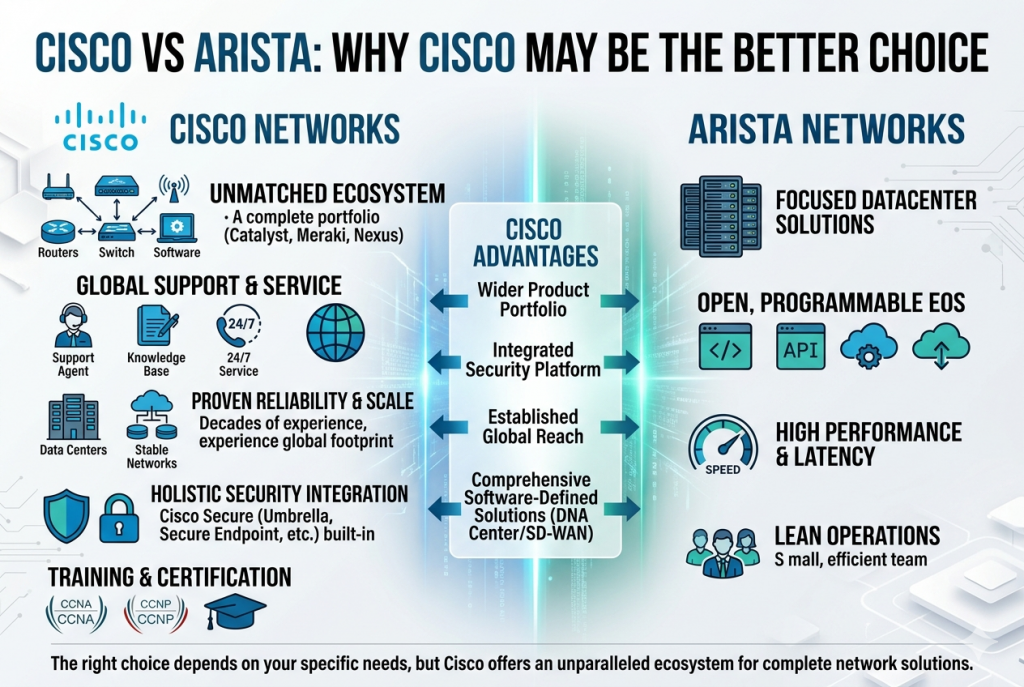
Cisco’s networking approach is deeply rooted in enterprise-grade architecture that prioritizes resilience, modularity, and long-term scalability. Over decades, Cisco has refined its hardware and software design to meet the demands of complex environments where downtime is not an option. This philosophy is reflected in how its switches, routers, and integrated platforms are engineered to handle high traffic loads while maintaining predictable performance.
A key strength of Cisco’s architecture is its tight integration between hardware and operating systems. Cisco develops its own silicon in many product lines, optimizing performance for routing, switching, and security tasks. This vertical integration allows better control over system behavior, latency, and throughput. For organizations running mission-critical applications, such consistency is a major advantage because it reduces unexpected performance variability.
Cisco also emphasizes redundancy and fault tolerance at every layer of its infrastructure. Features such as high-availability routing protocols, redundant power systems, and hardware failover mechanisms are designed to ensure continuous operation. In large enterprises where even a few minutes of downtime can lead to financial or operational losses, this design approach becomes a decisive factor.
Unified Networking Ecosystem
Another major reason Cisco is often preferred is its unified ecosystem that spans across almost every aspect of networking. Instead of relying on isolated solutions, Cisco provides an integrated stack that includes switching, routing, wireless networking, security, and cloud connectivity. This unified approach reduces fragmentation and helps IT teams maintain consistency across their entire infrastructure.
In practical terms, this means organizations can deploy end-to-end solutions where different components communicate seamlessly within the same architecture. For example, campus networks, data centers, and remote branches can all be managed under a consistent operational model. This reduces configuration complexity and minimizes the risk of compatibility issues that can arise when mixing multiple vendors.
Cisco’s ecosystem also extends into network automation and policy management. Centralized tools allow administrators to define policies once and apply them across the network, ensuring consistency in security and performance standards. This level of integration is particularly valuable in large organizations with distributed environments.
Operational Simplicity and Management Tools
While enterprise networks are inherently complex, Cisco places strong emphasis on simplifying operations through advanced management platforms. Tools designed for network visibility, monitoring, and automation help IT teams maintain control over large-scale infrastructures without being overwhelmed by manual configurations.
Cisco’s operating systems are built with structured command-line interfaces and graphical management tools that provide both flexibility and control. This dual approach allows experienced engineers to fine-tune configurations while also enabling broader teams to manage routine tasks efficiently. Over time, this balance contributes to reduced operational errors and improved network stability.
Automation is another area where Cisco has made significant progress. Policy-driven networking and intent-based management systems allow organizations to define desired outcomes rather than manually configuring every device. The system then translates these policies into actionable configurations across the infrastructure. This reduces human error and accelerates deployment cycles, especially in dynamic environments.
Security-First Networking Approach
Security is deeply embedded into Cisco’s design philosophy rather than being treated as an add-on feature. This integrated security approach helps organizations protect their infrastructure at multiple layers, including device, network, application, and cloud levels. By embedding security directly into networking hardware and software, Cisco reduces reliance on external tools and improves response times to threats.
Cisco’s security framework includes advanced threat detection, segmentation capabilities, and identity-based access control. These features help organizations limit exposure by ensuring that only authorized users and devices can access specific parts of the network. In environments where sensitive data is constantly being transmitted, this layered security model is critical.
Another advantage is Cisco’s continuous focus on threat intelligence. Its platforms are regularly updated to respond to emerging cyber threats, ensuring that enterprises remain protected against evolving attack vectors. This proactive approach to security makes Cisco particularly attractive for industries with strict compliance requirements.
Scalability for Hybrid and Multi-Cloud Environments
Modern enterprises increasingly operate across hybrid and multi-cloud environments, requiring networking solutions that can extend beyond traditional on-premises infrastructure. Cisco has developed its platforms to support this shift, enabling seamless connectivity between data centers, branch offices, and cloud providers.
This scalability is achieved through consistent networking policies that can be applied across physical and virtual environments. Whether workloads are running in private data centers or public cloud platforms, Cisco’s architecture ensures uniform performance and security standards. This reduces complexity for IT teams managing distributed systems.
Cisco also supports dynamic scaling, allowing networks to adapt to changing workloads without major reconfiguration. This is particularly important for organizations experiencing rapid growth or fluctuating demand, as it ensures infrastructure can expand without disrupting operations.
Global Support and Enterprise Reliability
One of Cisco’s strongest competitive advantages is its global support infrastructure. Enterprises operating in multiple regions benefit from access to consistent technical support, documentation, and professional services. Cisco’s support ecosystem is designed to assist organizations throughout the entire lifecycle of their network infrastructure, from initial deployment to ongoing optimization.
Technical support teams are available to assist with troubleshooting, performance tuning, and security incidents. This level of support reduces downtime and ensures that issues are resolved quickly, minimizing operational impact. For mission-critical environments, this reliability is often a deciding factor when choosing a networking vendor.
Cisco also offers extensive training and certification programs that help organizations build internal expertise. This ensures that IT teams remain capable of managing increasingly complex environments while staying aligned with best practices.
Ecosystem Maturity and Talent Availability
Another important factor in Cisco’s favor is the maturity of its ecosystem and the widespread availability of skilled professionals. Because Cisco technologies have been widely adopted for decades, there is a large global pool of engineers trained in its systems. This makes hiring and workforce development significantly easier for organizations.
The maturity of Cisco’s ecosystem also means that third-party integrations, documentation, and community knowledge are widely available. This reduces the learning curve for new deployments and helps organizations troubleshoot issues more efficiently. In contrast, newer or more specialized platforms may lack this depth of ecosystem support.
Cisco’s certification pathways further strengthen this ecosystem by creating standardized skill levels across the industry. These certifications ensure that professionals working on Cisco networks have validated expertise, which increases overall network reliability and operational confidence.
Lifecycle Management and Long-Term Stability
Cisco places strong emphasis on product lifecycle management, ensuring that hardware and software solutions remain supported and stable over extended periods. This is particularly important for enterprises that invest heavily in infrastructure and expect long-term return on investment.
Stable release cycles, predictable updates, and backward compatibility help organizations plan upgrades without disrupting operations. This long-term stability is a key reason many enterprises prefer Cisco for foundational network infrastructure.
Additionally, Cisco provides structured upgrade paths that allow organizations to transition between technologies smoothly. This reduces risk during modernization efforts and ensures that legacy systems can coexist with newer solutions when necessary.
Total Cost of Ownership Perspective
While initial costs for Cisco solutions can sometimes be higher compared to alternatives, many enterprises evaluate value based on total cost of ownership rather than upfront pricing alone. When considering factors such as reliability, reduced downtime, integrated management, and long-term support, Cisco often delivers strong overall value.
Operational efficiency plays a significant role in this calculation. Reduced troubleshooting time, fewer compatibility issues, and centralized management tools all contribute to lower long-term operational expenses. Additionally, the availability of skilled professionals reduces training costs and onboarding time for new staff.
For large-scale deployments, these efficiencies can significantly offset initial investment costs, making Cisco a strategically sound choice for organizations focused on long-term stability and predictable performance.
Strategic Fit for Enterprise Environments
Cisco continues to be a preferred choice in environments where stability, security, and scalability are critical. Its comprehensive ecosystem, mature architecture, and global support infrastructure make it particularly well-suited for enterprises with complex networking requirements.
Organizations that prioritize risk reduction and long-term operational consistency often find Cisco’s approach aligned with their needs. While alternative vendors may offer strong performance in specific areas, Cisco’s strength lies in delivering a complete, integrated, and proven networking foundation capable of supporting diverse and evolving enterprise demands.
High Availability and Network Resilience
Cisco’s approach to high availability is one of the key reasons it remains a preferred choice for enterprise environments. Networks built on Cisco infrastructure are designed to remain operational even in the presence of hardware failures, software issues, or unexpected traffic spikes. This is achieved through multiple layers of redundancy, intelligent failover mechanisms, and robust protocol support.
At the hardware level, Cisco devices often include redundant power supplies, modular components, and hot-swappable parts. These design choices allow organizations to replace or repair components without shutting down entire systems. In mission-critical environments such as banking systems, hospitals, and government networks, this capability significantly reduces operational risk.
On the software side, Cisco integrates advanced routing protocols and failover strategies that ensure traffic is automatically rerouted in case of failures. These mechanisms are not only reactive but also proactive, continuously monitoring network health and adjusting configurations in real time. This results in a highly stable network environment capable of maintaining uptime under diverse conditions.
Advanced Network Automation Capabilities
Cisco has made significant progress in network automation, enabling organizations to reduce manual intervention and streamline operations. Automation is increasingly important in modern IT environments where networks are large, dynamic, and distributed across multiple locations.
Cisco’s automation frameworks allow administrators to define policies that automatically configure and manage network devices. Instead of manually setting up each device, engineers can define intent-based policies that the system interprets and applies across the infrastructure. This reduces human error and improves consistency.
In addition, Cisco supports integration with orchestration platforms and APIs, allowing organizations to build custom automation workflows. This is especially useful in DevOps and cloud-native environments where infrastructure needs to adapt quickly to changing workloads. Automation also improves scalability, enabling networks to expand without proportional increases in operational complexity.
Performance Optimization in High-Traffic Environments
Cisco networking equipment is widely recognized for its ability to handle high volumes of traffic without degradation in performance. This is particularly important in data centers, large enterprises, and service provider environments where network congestion can have serious consequences.
Cisco achieves this through a combination of optimized hardware design and efficient software processing. Specialized chips and forwarding engines are used to accelerate packet processing, reducing latency and improving throughput. This ensures that even under heavy load, the network continues to perform predictably.
Quality of service (QoS) mechanisms further enhance performance by prioritizing critical traffic. For example, voice and video communications can be prioritized over less time-sensitive data transfers, ensuring smooth real-time communication. This level of traffic management is essential for modern organizations that rely heavily on digital collaboration tools.
Integration with Legacy Systems
One of Cisco’s strongest advantages in enterprise environments is its ability to integrate with legacy systems. Many large organizations operate hybrid infrastructures that include both modern and older networking technologies. Cisco’s solutions are designed to bridge this gap effectively.
Backward compatibility ensures that newer Cisco devices can communicate with older systems without requiring complete infrastructure replacement. This allows organizations to modernize gradually rather than undergoing disruptive full-scale migrations. It also protects previous investments in networking hardware and software.
Cisco also provides migration tools and frameworks that help organizations transition from legacy architectures to modern, software-defined networking models. These tools reduce complexity and minimize downtime during upgrades, making modernization more manageable and less risky.
Cloud Connectivity and Hybrid Architecture Support
As enterprises increasingly adopt cloud computing, Cisco has evolved its platforms to support hybrid and multi-cloud environments. This includes seamless connectivity between on-premises infrastructure and public cloud providers, enabling organizations to build flexible and scalable architectures.
Cisco’s networking solutions allow consistent policy enforcement across both cloud and physical environments. This ensures that security, performance, and access controls remain uniform regardless of where workloads are hosted. Such consistency is critical for organizations managing sensitive data across distributed systems.
Hybrid architecture support also enables workload mobility. Applications and services can be moved between environments based on performance, cost, or compliance requirements without requiring major network reconfiguration. This flexibility is a key advantage in modern IT strategies.
Enterprise Security Integration at Scale
Cisco’s security capabilities are designed to operate effectively at enterprise scale, where thousands of devices and users may be connected simultaneously. Security is not treated as a separate layer but is deeply embedded into the network architecture.
One of the core strengths is identity-based access control, which ensures that users and devices are authenticated before accessing network resources. This reduces the risk of unauthorized access and improves overall network security posture. Segmentation further enhances protection by isolating different parts of the network, limiting the spread of potential threats.
Cisco also incorporates continuous monitoring and analytics into its security framework. Network traffic is analyzed in real time to detect anomalies, potential intrusions, and suspicious behavior. This proactive approach allows organizations to respond to threats before they escalate into major incidents.
Global Enterprise Deployment Experience
Cisco’s extensive experience in global deployments gives it a unique advantage in supporting large-scale, geographically distributed networks. Many multinational organizations rely on Cisco infrastructure to connect offices, data centers, and remote sites across different regions.
This global reach ensures that Cisco solutions are tested and optimized for diverse network conditions, regulatory environments, and operational challenges. Whether dealing with high-latency connections, regulatory compliance requirements, or regional infrastructure differences, Cisco’s platforms are designed to adapt effectively.
The company’s experience also contributes to best practice frameworks that organizations can adopt when designing their own networks. These frameworks help ensure consistency, scalability, and reliability across global deployments.
Predictable Network Behavior and Stability
One of the most valued characteristics of Cisco networks is predictability. In enterprise environments, unpredictable network behavior can lead to downtime, performance degradation, and operational inefficiencies. Cisco addresses this through standardized configurations, tested protocols, and controlled software updates.
By maintaining strict control over software releases and hardware compatibility, Cisco ensures that new updates do not introduce instability into existing systems. This level of predictability is especially important for organizations that require strict uptime guarantees.
Predictable behavior also simplifies troubleshooting. Because Cisco environments are highly standardized, network engineers can quickly identify and resolve issues using established diagnostic tools and methodologies.
Training, Certification, and Skill Development Ecosystem
Cisco’s certification programs are a major part of its ecosystem strength. These programs provide structured learning paths for network engineers, from entry-level knowledge to advanced enterprise expertise. This helps ensure a consistent level of skill across professionals working with Cisco technologies.
Organizations benefit from this ecosystem because it reduces the learning curve associated with deploying and managing Cisco networks. Certified professionals are already familiar with best practices, configuration standards, and troubleshooting techniques.
The availability of structured training also helps organizations scale their IT teams more effectively. As network demands grow, new employees can be quickly trained and integrated into existing operations without significant productivity loss.
Long-Term Vendor Stability and Innovation Roadmap
Cisco’s long-standing presence in the networking industry provides a sense of stability that many enterprises value. The company has consistently evolved its product portfolio to align with emerging technologies such as cloud computing, automation, and cybersecurity.
This steady innovation roadmap ensures that organizations investing in Cisco infrastructure are not only addressing current needs but also preparing for future technological shifts. Cisco’s commitment to backward compatibility and gradual innovation helps protect existing investments while enabling modernization.
Enterprises often prefer vendors with predictable long-term strategies, and Cisco’s approach to development, support, and ecosystem expansion aligns well with this requirement.
Strategic Enterprise Alignment and Decision Factors
When organizations evaluate networking solutions, the decision is rarely based on performance alone. Factors such as risk management, operational complexity, support availability, and long-term sustainability play a significant role.
Cisco’s strength lies in its ability to address these broader enterprise concerns. Its comprehensive ecosystem, mature technology stack, and global support infrastructure make it a strong candidate for organizations prioritizing stability and scalability over niche optimization.
While different vendors may excel in specific technical areas, Cisco’s value proposition is centered around delivering a complete, reliable, and enterprise-ready networking foundation that supports long-term business objectives.
Simplified Troubleshooting and Network Visibility
Cisco places strong emphasis on making complex networks easier to understand and manage through advanced visibility and troubleshooting tools. In large enterprise environments, identifying the root cause of an issue quickly can make the difference between minor disruption and major downtime.
Cisco provides deep packet inspection capabilities, centralized logging, and real-time monitoring systems that give IT teams a clear view of network behavior. These tools allow engineers to track traffic flows, detect bottlenecks, and identify misconfigurations with greater accuracy. Instead of relying on fragmented data, administrators can access a unified view of the entire network.
This level of visibility is especially important in distributed environments where multiple devices, locations, and cloud services interact simultaneously. Cisco’s monitoring systems help correlate events across different layers of the network, making it easier to pinpoint the exact source of performance or connectivity issues.
Consistency Across Multi-Layer Network Architectures
Enterprise networks are rarely simple; they typically involve multiple layers such as access, distribution, and core networks. Cisco’s architecture is designed to maintain consistency across all these layers, ensuring that policies, configurations, and performance behaviors remain aligned.
This consistency reduces configuration drift, which is a common issue in large networks where multiple teams manage different segments. By standardizing configurations and operational models, Cisco helps organizations maintain a predictable and stable infrastructure.
Consistency also improves scalability. When new devices or locations are added, they can be integrated into the existing architecture without requiring major redesigns. This makes network expansion more efficient and less error-prone.
Advanced Routing and Switching Capabilities
Cisco is widely recognized for its advanced routing and switching technologies, which form the backbone of many global enterprise networks. These capabilities are designed to support complex traffic patterns, large-scale deployments, and high-performance requirements.
Routing protocols in Cisco environments are optimized for fast convergence, meaning the network quickly adapts to changes such as link failures or topology updates. This ensures minimal disruption and maintains consistent connectivity across the infrastructure.
Switching technologies are equally robust, supporting high-speed data transfer, VLAN segmentation, and intelligent traffic management. These features enable organizations to build segmented and secure network environments while maintaining high performance across all segments.
Support for Mission-Critical Applications
Many organizations rely on Cisco infrastructure to support mission-critical applications that require uninterrupted connectivity and consistent performance. These include financial transaction systems, healthcare applications, industrial control systems, and large-scale communication platforms.
Cisco’s networking solutions are engineered to meet strict performance and reliability requirements. Features such as low-latency processing, high-throughput forwarding, and redundant system design ensure that critical applications remain operational even under heavy network load.
This reliability is one of the primary reasons Cisco is often selected for environments where downtime is not acceptable. The ability to maintain stable performance under pressure makes it a trusted choice for essential business operations.
Policy-Driven Network Management
Cisco enables organizations to manage networks through policy-driven models rather than manual device-level configurations. This approach allows administrators to define high-level policies that are automatically enforced across the infrastructure.
Policy-driven management reduces complexity by abstracting underlying configurations. Instead of configuring each device individually, IT teams can define rules related to security, access, and performance that are applied consistently throughout the network.
This method not only improves efficiency but also reduces the likelihood of configuration errors. It ensures that network behavior aligns with organizational policies, improving both security and operational consistency.
Support for Virtualization and Software-Defined Networking
Modern enterprise environments increasingly rely on virtualization and software-defined networking (SDN) to improve flexibility and resource utilization. Cisco has integrated these concepts into its product portfolio to support evolving infrastructure needs.
Virtualization allows multiple network functions to run on shared hardware resources, improving efficiency and reducing costs. Cisco’s solutions support this by enabling virtual routing, switching, and security functions within the same physical infrastructure.
Software-defined networking further enhances flexibility by separating control and data planes. This allows centralized control over network behavior, making it easier to manage large and dynamic environments. Cisco’s SDN capabilities help organizations automate network provisioning and optimize resource allocation.
Reduced Operational Risk in Large Deployments
In large-scale deployments, operational risk increases due to the complexity and interdependence of systems. Cisco mitigates this risk through standardized architectures, proven design frameworks, and extensive testing across different environments.
Each Cisco solution undergoes rigorous validation to ensure compatibility, stability, and performance before being deployed in enterprise settings. This reduces the likelihood of unexpected failures and ensures predictable behavior under real-world conditions.
Additionally, Cisco’s documentation, best practices, and reference architectures help organizations implement networks in a structured and reliable manner. This reduces design errors and improves overall system resilience.
Strong Foundation for Digital Transformation
As organizations undergo digital transformation, networking infrastructure plays a critical role in enabling new technologies such as cloud computing, artificial intelligence, and Internet of Things (IoT). Cisco provides a strong foundation for these transformations by offering scalable and flexible networking solutions.
Cisco’s infrastructure supports high-density device connectivity, real-time data processing, and secure communication between distributed systems. This makes it suitable for modern digital initiatives that require reliable and high-performance networks.
The ability to integrate legacy systems with modern technologies also helps organizations transition gradually without disrupting existing operations. This balance between innovation and stability is a key advantage in long-term transformation strategies.
Vendor Ecosystem and Third-Party Integration
Cisco has developed a large ecosystem of partners, developers, and third-party integrations that extend the functionality of its networking solutions. This ecosystem allows organizations to customize and enhance their infrastructure based on specific business needs.
Third-party integrations include security tools, cloud platforms, analytics systems, and automation frameworks. These integrations help organizations build comprehensive solutions without replacing their core networking infrastructure.
The availability of a mature ecosystem also reduces implementation time and improves flexibility. Organizations can choose from a wide range of compatible solutions that have been tested and validated within Cisco environments.
Operational Efficiency at Scale
One of Cisco’s core strengths is its ability to maintain operational efficiency even in very large and complex environments. As networks grow, managing them becomes increasingly challenging, but Cisco’s standardized tools and processes help maintain control.
Centralized management platforms allow administrators to oversee thousands of devices from a single interface. This reduces administrative overhead and improves response times for configuration changes or troubleshooting tasks.
Efficiency is also improved through automation, policy enforcement, and predictive analytics. These capabilities reduce the need for manual intervention and allow IT teams to focus on strategic initiatives rather than routine maintenance.
Long-Term Infrastructure Investment Protection
Enterprise networking infrastructure represents a significant financial investment, and organizations expect long-term value from their deployments. Cisco’s approach to product lifecycle management ensures that customers receive consistent support and compatibility over extended periods.
Backward compatibility and structured upgrade paths allow organizations to evolve their infrastructure without replacing entire systems. This protects existing investments and reduces the total cost of ownership over time.
Cisco’s commitment to long-term support also provides confidence to enterprises planning multi-year infrastructure strategies. Predictable update cycles and stable product roadmaps help organizations plan future expansions with reduced risk.
Strategic Value of Cisco in Enterprise Networking
Cisco continues to stand out as a comprehensive networking solution for enterprises that prioritize reliability, scalability, and long-term stability. Its strengths lie not only in individual product performance but in the cohesion of its entire ecosystem.
From advanced routing and switching to integrated security and automation, Cisco provides a unified platform that supports complex and evolving IT environments. Its focus on consistency, visibility, and operational efficiency makes it particularly well-suited for large organizations with mission-critical requirements.
While alternative vendors may offer advantages in specific technical areas, Cisco’s overall value comes from its ability to deliver a stable, secure, and scalable foundation for enterprise networking at global scale.
Comprehensive Security Posture for Modern Threats
Cisco’s security framework is designed with a layered defense strategy that addresses threats at multiple points across the network. Rather than relying on isolated security tools, Cisco integrates protection directly into the networking infrastructure, allowing threats to be detected and mitigated closer to their source. This approach reduces response time and limits the potential spread of malicious activity.
A key element of this strategy is continuous threat intelligence integration. Cisco systems are constantly updated with global security data that helps identify emerging attack patterns. This allows organizations to stay ahead of evolving cyber threats without needing to manually update or reconfigure systems frequently. The result is a more adaptive and responsive security environment.
Cisco also emphasizes segmentation as a core security principle. By dividing networks into smaller, controlled zones, organizations can limit access between different systems and reduce the risk of lateral movement during a breach. This is particularly valuable in large enterprises where sensitive data may coexist with general operational traffic.
Identity-Centric Network Access Control
Modern enterprise environments require precise control over who and what can access network resources. Cisco addresses this through identity-centric access control systems that verify users, devices, and applications before granting access.
Instead of relying solely on IP-based rules, Cisco’s approach ties access permissions to identity and context. This means that access decisions can be influenced by factors such as user roles, device health, location, and behavior patterns. This dynamic model significantly enhances security compared to static rule-based systems.
Such granular control is especially important in environments that support remote work, bring-your-own-device policies, and cloud integration. It ensures that only trusted entities can interact with sensitive systems, reducing the risk of unauthorized access.
Enhanced Network Intelligence and Analytics
Cisco incorporates advanced analytics into its networking platforms to provide deeper insight into network performance and behavior. These analytics tools collect and analyze vast amounts of data generated by network devices, applications, and users.
By transforming raw data into actionable insights, Cisco enables IT teams to make informed decisions about network optimization, capacity planning, and troubleshooting. Patterns in traffic flow, latency, and device performance can be identified early, allowing proactive adjustments before issues escalate.
Predictive analytics is another important aspect, helping organizations anticipate potential problems based on historical trends. This shifts network management from a reactive model to a more proactive and preventive approach.
Support for Large-Scale Enterprise Growth
As organizations expand, their networking requirements become more complex. Cisco’s solutions are designed to scale seamlessly with business growth, supporting everything from small branch offices to global enterprise infrastructures.
Scalability is achieved through modular architectures and flexible licensing models that allow organizations to add capacity as needed. This ensures that infrastructure can grow without requiring complete redesigns or disruptive upgrades.
Cisco’s global deployment experience also ensures that scaling across different regions remains consistent in terms of performance, security, and management. This is particularly important for multinational organizations operating in diverse regulatory and operational environments.
High Performance Under Distributed Workloads
Modern enterprises often operate distributed workloads across data centers, cloud platforms, and edge environments. Cisco’s infrastructure is built to handle these distributed architectures efficiently while maintaining consistent performance.
Load balancing, traffic optimization, and intelligent routing ensure that workloads are distributed effectively across available resources. This reduces congestion and improves application responsiveness even under heavy demand.
Cisco’s ability to maintain performance consistency across distributed environments is a key advantage for organizations adopting hybrid IT strategies. It ensures that users experience reliable access regardless of where applications are hosted.
Simplified Compliance and Regulatory Alignment
Enterprises operating in regulated industries must comply with strict data protection and security standards. Cisco’s networking and security solutions are designed to support compliance requirements through built-in monitoring, reporting, and policy enforcement capabilities.
Audit trails, access logs, and configuration records provide detailed visibility into network activity, making it easier for organizations to demonstrate compliance during audits. Automated policy enforcement ensures that security and operational standards are consistently applied across the infrastructure.
This reduces the administrative burden associated with compliance management and helps organizations avoid penalties or operational disruptions caused by regulatory violations.
Consistent User Experience Across Networks
Cisco places strong emphasis on delivering a consistent user experience, regardless of where users connect from or what devices they use. This is achieved through centralized policy management and intelligent traffic handling.
Whether users are accessing applications from headquarters, branch offices, or remote locations, Cisco’s infrastructure ensures consistent performance and access control. This uniformity improves productivity and reduces user-related network issues.
Consistent user experience is particularly important in organizations that rely heavily on collaboration tools, cloud applications, and real-time communication systems.
Proven Track Record in Critical Industries
Cisco has established a strong presence in industries where reliability and security are non-negotiable. These include banking, healthcare, government, manufacturing, and telecommunications. In these sectors, even minor network disruptions can have significant consequences.
Cisco’s long-standing track record in these environments demonstrates its ability to meet strict operational requirements. Its solutions are often chosen not only for technical capabilities but also for their proven reliability under real-world conditions.
This industry trust reinforces Cisco’s position as a stable and dependable networking provider for mission-critical operations.
Extensive Research and Development Investment
Cisco consistently invests heavily in research and development to stay ahead of technological trends. This ongoing innovation ensures that its networking solutions evolve alongside emerging technologies such as artificial intelligence, edge computing, and advanced cybersecurity.
R&D efforts focus on improving performance, enhancing security, and simplifying network management. This continuous improvement cycle helps ensure that Cisco platforms remain relevant and competitive in rapidly changing IT environments.
By maintaining a strong innovation pipeline, Cisco ensures that enterprises adopting its solutions are prepared for future technological shifts.
Seamless Integration with Emerging Technologies
As new technologies emerge, Cisco works to ensure that its infrastructure remains compatible and adaptable. This includes integration with cloud-native platforms, IoT ecosystems, and AI-driven applications.
Cisco’s networking solutions are designed to support high-density device environments, making them suitable for IoT deployments where thousands of devices may need to communicate simultaneously. Similarly, integration with cloud platforms enables organizations to extend their infrastructure beyond traditional boundaries.
This adaptability ensures that Cisco networks remain relevant as organizations adopt new digital technologies.
Long-Term Operational Predictability
One of Cisco’s most valuable characteristics is operational predictability. Enterprises rely on consistent behavior from their networks to plan capacity, manage workloads, and maintain service levels.
Cisco achieves this through controlled updates, standardized configurations, and rigorous testing processes. This reduces unexpected changes in system behavior and ensures that networks operate in a stable and predictable manner.
Predictability is especially important in environments where service-level agreements must be maintained and downtime must be minimized.
Strategic Conclusion on Cisco’s Enterprise Strength
Cisco’s overall strength lies in its ability to deliver a complete, stable, and secure networking foundation for enterprises of all sizes. Its integrated ecosystem, advanced security framework, and scalable architecture make it particularly well-suited for complex IT environments.
While different vendors may offer advantages in specialized areas, Cisco’s value is rooted in its holistic approach to networking. It combines performance, security, management simplicity, and long-term reliability into a unified platform that supports enterprise growth and digital transformation.
For organizations seeking a dependable and future-ready networking solution, Cisco remains a strategically strong choice built on decades of proven enterprise experience.
Conclusion
Cisco stands out as a comprehensive and enterprise-focused networking solution that emphasizes stability, scalability, and long-term reliability. Its strength lies not just in individual technologies, but in the way all components—routing, switching, security, automation, and cloud integration—work together within a unified ecosystem. This integrated approach reduces operational complexity and provides organizations with a consistent and predictable networking environment.
For enterprises that prioritize uptime, security, and structured growth, Cisco offers a proven foundation supported by global expertise and mature management tools. Its ability to support mission-critical applications, large-scale deployments, and hybrid infrastructures makes it a dependable choice for organizations with demanding network requirements.
While other vendors may excel in specific performance areas, Cisco’s overall advantage comes from its balance of innovation, reliability, and ecosystem depth. This makes it a strong strategic option for businesses aiming to build resilient and future-ready network infrastructures.