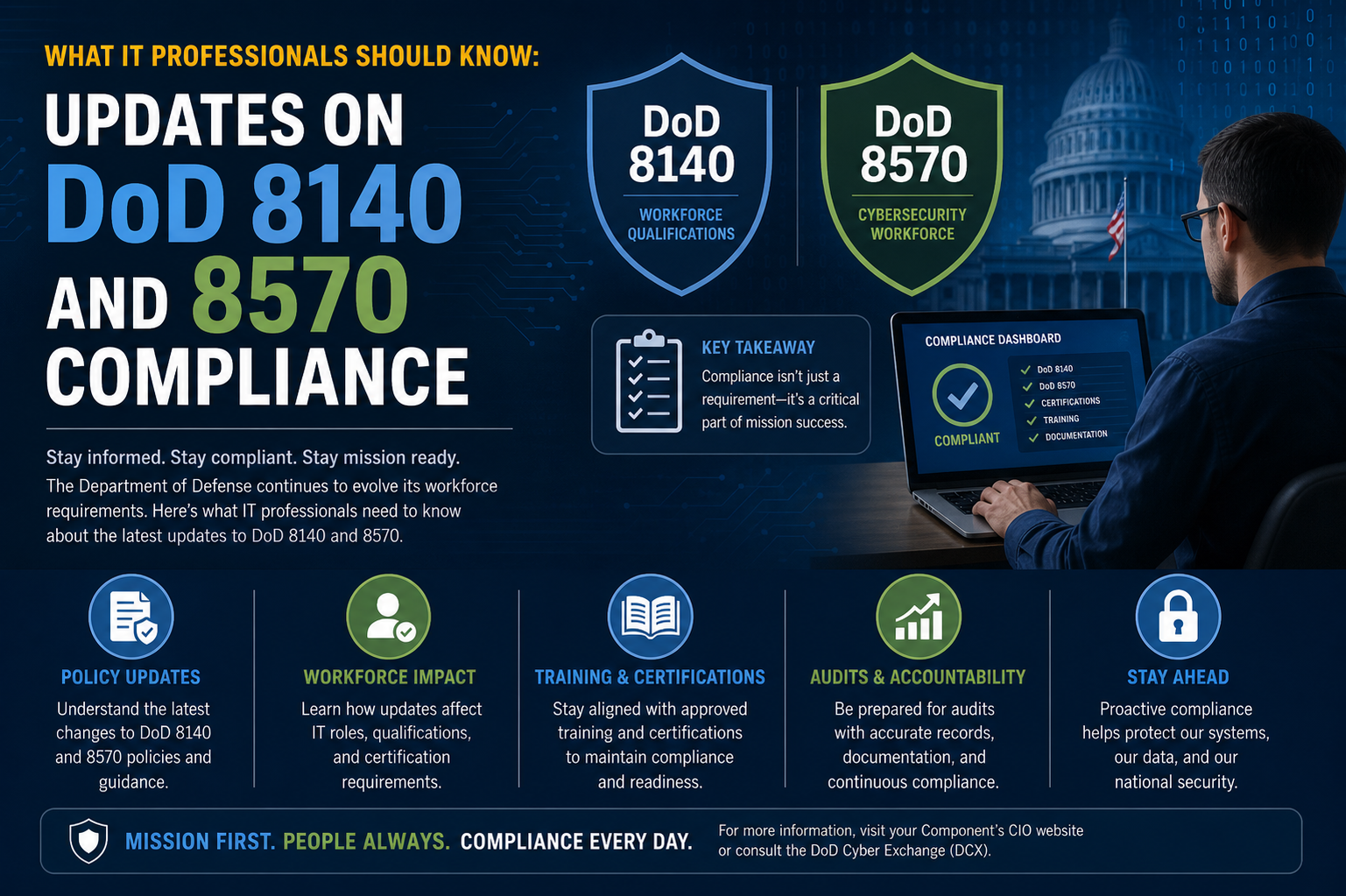
The transition from DoD 8570 to DoD 8140 represents one of the most significant structural changes in the Department of Defense cybersecurity workforce policy in recent years. While DoD 8570 established a standardized baseline for information assurance workforce certification, it was largely rigid in its approach and focused heavily on predefined certification requirements for specific job categories. DoD 8140 builds on that foundation but modernizes it to reflect the complexity, scale, and evolving nature of today’s cybersecurity environment. Instead of relying strictly on certification checklists, the updated framework introduces a more dynamic, competency-based model that aligns workforce skills with operational mission requirements.
This shift is not merely administrative. It reflects the growing recognition that cybersecurity roles are no longer static and cannot be effectively governed by fixed certification lists alone. Threat landscapes evolve rapidly, technologies change frequently, and job roles have become increasingly specialized. As a result, the Department of Defense has moved toward a system that prioritizes demonstrated skills, role-based qualifications, and continuous professional development over time-bound certification compliance.
Core Differences Between DoD 8570 and DoD 8140
Under DoD 8570, compliance was relatively straightforward. Individuals working in information assurance roles were required to obtain and maintain specific approved certifications depending on their assigned category and level. These certifications acted as both entry and maintenance requirements for employment in DoD-related cybersecurity positions. While effective in standardizing baseline qualifications, the system lacked flexibility and did not fully account for evolving job responsibilities or emerging cybersecurity disciplines.
DoD 8140 introduces a broader and more adaptive structure. Rather than focusing solely on certification categories, it defines cybersecurity work roles in greater detail and aligns them with specific knowledge, skills, and abilities. Certifications are still important, but they are now part of a larger qualification ecosystem that includes experience, training, performance, and continuous education. This approach allows professionals to qualify for roles through multiple pathways rather than a single rigid certification requirement.
Another key difference is the shift from static compliance to continuous validation. Under the new framework, maintaining qualification is not just about holding a certification but ensuring ongoing competency in a given role. This reflects the Department of Defense’s effort to create a more agile and resilient cyber workforce capable of responding to real-time threats.
Expanded Cyber Workforce Structure Under DoD 8140
One of the defining features of DoD 8140 is its expanded classification of cybersecurity work roles. Instead of broad categories, the framework breaks down the cyber workforce into more granular and clearly defined positions. These include areas such as cybersecurity defense analysis, cyber operations planning, incident response, cyber risk management, and system security engineering.
Each role is associated with a set of competencies rather than a fixed certification requirement. This allows for greater flexibility in how individuals qualify and progress within their careers. For example, two professionals working in similar roles may have different certification backgrounds but still meet the same competency standards through experience and training.
This restructuring also helps organizations better align personnel with mission-critical needs. By defining roles more precisely, the Department of Defense can ensure that individuals are assigned based on actual capability rather than simply holding a particular certification.
Certification Alignment and Role Mapping Changes
Under the DoD 8140 framework, certifications still play an important role but are no longer the sole determining factor for qualification. Instead, certifications are mapped to specific work roles based on relevance and competency coverage. This means that a certification that previously qualified an individual for a broad category under DoD 8570 may now only apply to certain aspects of a specific role under DoD 8140.
This mapping process is more detailed and requires ongoing updates as new certifications emerge and existing ones evolve. IT professionals must now pay closer attention to how their certifications align with their actual job responsibilities. In many cases, additional training or supplemental certifications may be required to fully meet role-based requirements.
This shift encourages professionals to think more strategically about certification selection. Rather than simply pursuing the most widely recognized credentials, individuals must evaluate how each certification contributes to their long-term career path and role alignment within the cybersecurity workforce structure.
Continuous Learning and Skill Maintenance Expectations
A major emphasis of DoD 8140 is the requirement for continuous learning. Unlike the previous framework, where certifications could be earned and maintained over fixed renewal cycles, the new model places greater importance on ongoing professional development. This includes formal training, hands-on experience, and participation in role-specific education programs.
The rationale behind this change is the rapidly evolving nature of cybersecurity threats. Static knowledge quickly becomes outdated in this field, making continuous skill development essential. IT professionals are expected to regularly update their knowledge base, not only through certification renewals but also through practical exposure to emerging technologies and threat vectors.
This approach also encourages organizations to invest more heavily in workforce development. Employers working with DoD environments are increasingly responsible for ensuring that their personnel maintain current competencies through structured training programs and career development initiatives.
Transition Challenges for IT Professionals
The transition from DoD 8570 to DoD 8140 presents several challenges for IT professionals, particularly those who have built their careers around the older certification model. One of the primary challenges is understanding how existing certifications map to the new role-based structure. While many certifications remain valid, their relevance may shift depending on how roles are redefined.
Another challenge is the need to adapt to a more fluid qualification system. Professionals accustomed to a checklist-based compliance model may find the new framework more complex, as it requires ongoing interpretation of role requirements and competency expectations. This can create uncertainty, particularly during the transition phase when both systems may be referenced simultaneously.
Additionally, professionals may need to pursue additional training to fill gaps between their current qualifications and updated role requirements. This can involve time, financial investment, and careful career planning to ensure alignment with long-term goals.
Organizational Impact and Workforce Planning Adjustments
Organizations operating within the DoD ecosystem must also adapt their workforce planning strategies to align with the new framework. Under DoD 8140, hiring, training, and role assignment processes must reflect competency-based evaluations rather than purely certification-based criteria.
This requires a more detailed understanding of each role’s requirements and a more structured approach to workforce development. Human resource and cybersecurity leadership teams must collaborate closely to ensure that personnel assignments align with both operational needs and compliance expectations.
Organizations must also maintain updated records of employee competencies, training progress, and certification relevance. This creates an increased administrative burden but ultimately leads to a more capable and adaptable workforce.
Role of Cybersecurity Framework Modernization
The introduction of DoD 8140 is part of a broader effort to modernize cybersecurity workforce management across federal agencies. As cyber threats become more sophisticated, traditional certification-based systems are no longer sufficient to ensure readiness. The new framework emphasizes adaptability, ensuring that cybersecurity personnel can respond effectively to emerging risks.
This modernization also supports interoperability between different agencies and organizations. By standardizing competencies rather than rigid certification lists, the Department of Defense creates a more unified approach to cybersecurity workforce development.
Practical Guidance for IT Professionals Navigating the Transition
For IT professionals, adapting to DoD 8140 requires a proactive approach to career management. The first step is understanding how current certifications align with updated role definitions. This involves reviewing competency requirements and identifying any gaps in skills or knowledge.
Professionals should also prioritize continuous education and seek out training programs that align with their target roles. Rather than focusing solely on certification accumulation, emphasis should be placed on practical skill development and real-world application.
Networking with peers and staying informed about policy updates is also critical. As the transition continues, guidance and interpretation of requirements may evolve, making it important to remain engaged with industry developments.
Long-Term Implications for Cybersecurity Careers
In the long term, DoD 8140 is expected to create a more flexible and resilient cybersecurity workforce. By focusing on competencies rather than rigid certification structures, the framework allows professionals to build more diverse and adaptable career paths.
This shift also increases the value of practical experience. Professionals who can demonstrate real-world capability in addition to formal certification will be better positioned for advancement within DoD-aligned roles.
At the same time, the increased emphasis on continuous learning means that cybersecurity careers will require sustained effort and ongoing development. Static career progression based solely on certification acquisition will become less common, replaced by dynamic growth based on evolving skills and responsibilities.
Implementation Timeline and Transition Phases of DoD 8140
The rollout of DoD 8140 is structured as a phased transition rather than a single immediate replacement of DoD 8570. This gradual approach is necessary due to the scale of the cybersecurity workforce affected across the Department of Defense and its supporting contractors. During the transition period, both frameworks may appear to overlap, with certain roles still referencing DoD 8570 baseline requirements while newer positions begin aligning with DoD 8140 competency-based standards.
This phased implementation allows organizations to adjust internal policies, retrain personnel, and update workforce documentation systems without disrupting operational readiness. It also provides IT professionals with time to reassess their qualifications and make necessary adjustments to align with evolving role expectations.
As the transition progresses, DoD 8570 requirements are expected to be fully phased out, leaving DoD 8140 as the primary governing framework for cybersecurity workforce qualification. However, during the overlap period, professionals must remain aware of both systems to ensure continued compliance and eligibility for their roles.
Reclassification of Cyber Workforce Roles Under DoD 8140
One of the most important structural changes introduced under DoD 8140 is the detailed reclassification of cybersecurity roles. Instead of broad categories that previously grouped multiple job functions together, the new system defines more precise and specialized roles based on actual job functions and required competencies.
These roles include technical areas such as cyber defense operations, incident response coordination, vulnerability analysis, cyber threat intelligence, and secure system engineering. Each role is defined by a set of expected knowledge areas, practical skills, and demonstrated abilities rather than a single certification requirement.
This reclassification improves workforce clarity by ensuring that job responsibilities are more accurately aligned with individual skill sets. It also enables more targeted training programs and clearer career progression pathways within the cybersecurity field.
Certification Relevance in the Updated Framework
Although DoD 8140 reduces reliance on rigid certification lists, certifications remain an important component of workforce qualification. However, their role has shifted from being mandatory gatekeepers to being one part of a broader competency validation system.
Certifications are now evaluated based on how well they align with specific job role requirements. Some certifications may cover foundational knowledge applicable to multiple roles, while others may support highly specialized functions. This mapping process ensures that certifications remain relevant but are no longer the sole determinant of eligibility.
For IT professionals, this means that certification planning must become more strategic. Instead of pursuing certifications solely for compliance, individuals must consider how each credential contributes to their overall competency profile and long-term career objectives.
Impact on Career Progression and Mobility
DoD 8140 introduces greater flexibility in career progression by allowing multiple pathways into and through cybersecurity roles. Under the previous framework, career mobility was often constrained by strict certification hierarchies. Professionals were required to obtain specific certifications before advancing to higher-level positions, regardless of their practical experience.
The new framework recognizes that skills and experience can be acquired through various means, including hands-on work, specialized training programs, and cross-functional assignments. This allows professionals to move between roles more fluidly, provided they demonstrate the required competencies.
As a result, career progression becomes more individualized. Two professionals with different backgrounds may reach the same role through different combinations of training, experience, and certification. This flexibility encourages a more diverse and adaptable workforce.
Employer Responsibilities Under DoD 8140
Organizations operating within the DoD ecosystem carry increased responsibility under the updated framework. Employers are no longer simply required to verify that employees hold specific certifications. Instead, they must ensure that personnel meet defined competency requirements for their assigned roles.
This requires a more structured approach to workforce management, including detailed tracking of employee skills, training completion, and role alignment. Organizations must also implement ongoing evaluation processes to ensure that employees maintain current competencies over time.
In addition, employers are expected to support continuous professional development. This includes providing access to training resources, encouraging participation in certification programs aligned with role requirements, and ensuring that workforce planning strategies reflect evolving cybersecurity needs.
Common Transition Challenges for Organizations
While DoD 8140 offers a more flexible and modernized framework, it also introduces several challenges for organizations. One of the primary challenges is updating internal compliance systems to reflect the new competency-based structure. Many existing workforce tracking systems were built around DoD 8570 certification categories and may require significant modification.
Another challenge involves interpreting the new role definitions and mapping them accurately to existing job descriptions. This process requires careful analysis to ensure that employees are correctly aligned with appropriate roles and competencies.
Training programs also need to be updated to reflect the new framework. Organizations must evaluate whether their current training offerings adequately support DoD 8140 role requirements or whether new programs need to be developed or sourced externally.
Strategic Approach for IT Professionals During Transition
For IT professionals, successfully navigating the transition requires a proactive and structured approach. The first step is conducting a thorough assessment of current certifications, skills, and experience in relation to updated role definitions. This helps identify any gaps that may need to be addressed.
Once gaps are identified, professionals should prioritize targeted skill development rather than broad or unrelated certifications. The focus should be on building competencies that directly align with desired career roles under the DoD 8140 framework.
It is also important to maintain awareness of ongoing policy updates. As the framework continues to evolve, additional clarifications and refinements may be introduced. Staying informed ensures that professionals can adjust their development strategies accordingly.
Long-Term Workforce Transformation Effects
Over time, DoD 8140 is expected to significantly transform the cybersecurity workforce landscape within defense-related environments. By shifting away from rigid certification requirements and toward competency-based evaluation, the framework promotes a more agile and responsive workforce structure.
This transformation encourages continuous improvement and lifelong learning, as professionals are required to maintain and update their skills throughout their careers. It also supports better alignment between workforce capabilities and operational mission needs.
Additionally, the framework enhances the ability of organizations to respond to emerging threats by ensuring that personnel are trained and qualified based on current rather than outdated standards.
Evolving Role of Experience and Practical Skills
One of the most notable changes introduced under DoD 8140 is the increased emphasis on practical experience. While certifications remain important, they are no longer sufficient on their own to demonstrate full qualification for many roles.
Hands-on experience in real-world environments is now considered a critical component of competency evaluation. This includes experience in areas such as incident response, threat analysis, system hardening, and operational cybersecurity support.
This shift benefits professionals who have developed strong practical skills through on-the-job experience, even if they do not hold extensive certification portfolios. It also encourages organizations to prioritize experiential learning opportunities within their workforce development programs.
Adapting to Continuous Policy Evolution
Cybersecurity policy within the Department of Defense is expected to continue evolving as threats and technologies change. DoD 8140 is not a static endpoint but part of an ongoing modernization effort.
IT professionals must therefore adopt a mindset of continuous adaptation. Rather than viewing compliance as a fixed requirement, it should be seen as an ongoing process of maintaining alignment with current standards and expectations.
This requires flexibility, ongoing learning, and a willingness to adjust career strategies as the framework evolves further over time.
Future of Cybersecurity Workforce Standards Under DoD 8140
The long-term direction of DoD 8140 reflects a broader transformation in how cybersecurity workforce standards are defined, measured, and maintained across defense environments. Unlike earlier frameworks that focused heavily on static compliance requirements, the updated model is designed to evolve continuously alongside emerging technologies and threat landscapes. This makes the framework less of a fixed rule set and more of a living structure that adapts to operational realities.
One of the most important outcomes of this shift is the creation of a workforce model that can respond more quickly to change. Cyber threats are no longer predictable or confined to traditional network boundaries. As a result, workforce requirements must also remain flexible enough to accommodate new attack surfaces, such as cloud environments, artificial intelligence systems, and interconnected supply chain infrastructures.
DoD 8140 supports this adaptability by emphasizing role-based competencies that can be updated as new risks emerge. Instead of waiting for formal certification revisions, the framework allows for more immediate adjustments to skill expectations within specific roles. This ensures that cybersecurity personnel remain relevant and effective even as the technical environment evolves rapidly.
Integration of Emerging Technologies into Workforce Requirements
Another major focus of the updated framework is the integration of emerging technologies into cybersecurity workforce expectations. As digital environments become more complex, cybersecurity professionals are increasingly required to understand not only traditional IT systems but also advanced technologies such as automation, machine learning, cloud-native architectures, and zero trust security models.
DoD 8140 reflects this shift by incorporating broader competency categories that extend beyond conventional network security concepts. Professionals are now expected to demonstrate familiarity with evolving technological ecosystems and understand how security principles apply within these environments.
This expansion of required knowledge areas means that cybersecurity roles are becoming more interdisciplinary. IT professionals are no longer confined to narrowly defined technical tasks but are instead expected to operate across multiple domains, including system architecture, data protection, operational security, and risk management.
Increased Emphasis on Operational Readiness
A key principle underlying DoD 8140 is operational readiness. The framework is designed not only to ensure that personnel are qualified on paper but also that they are capable of performing effectively in real-world operational environments.
This focus on readiness places greater importance on practical evaluation methods, such as scenario-based assessments, hands-on exercises, and performance-based validation. Rather than relying solely on theoretical knowledge or certification exams, the framework encourages continuous demonstration of applied skills.
This approach helps bridge the gap between academic learning and operational execution. It ensures that cybersecurity professionals are not only knowledgeable but also capable of responding effectively under real-world conditions, including active cyber incidents and high-pressure environments.
Changes in Certification Ecosystem Dynamics
The cybersecurity certification ecosystem is also undergoing significant change as a result of DoD 8140. While certifications remain relevant, their role within the broader qualification structure is being redefined. Instead of serving as primary gatekeepers, certifications are increasingly viewed as supporting components of a larger competency framework.
This shift is influencing how certification providers design and update their programs. There is a growing emphasis on aligning certification content with real-world job roles and operational requirements rather than purely theoretical knowledge domains.
As a result, certifications are becoming more specialized and role-focused. This benefits IT professionals by providing clearer pathways for targeted skill development, but it also requires more careful selection of certifications based on career goals and role alignment.
Workforce Flexibility and Talent Optimization
One of the most significant advantages introduced by DoD 8140 is increased workforce flexibility. By focusing on competencies rather than rigid certification structures, organizations gain greater ability to optimize talent deployment across different roles and missions.
This flexibility allows personnel to be reassigned more easily based on evolving operational needs. If an individual demonstrates the required competencies, they may be qualified to support multiple roles or transition between functions without needing to restart certification processes from scratch.
This approach enhances organizational agility and improves the overall efficiency of cybersecurity operations. It also enables better utilization of talent, ensuring that skilled professionals are placed in roles where they can have the greatest impact.
Evolving Role of Leadership in Cybersecurity Workforce Management
Leadership roles within cybersecurity organizations are also affected by the transition to DoD 8140. Managers and decision-makers must now take a more active role in workforce development, competency tracking, and role alignment.
Instead of simply verifying certification compliance, leaders are responsible for ensuring that teams collectively meet the operational requirements of their assigned missions. This requires a deeper understanding of both technical capabilities and workforce structure.
Cybersecurity leadership must also focus on building long-term development strategies that support continuous learning and skill progression. This includes identifying future skill requirements, anticipating emerging threats, and ensuring that training programs are aligned with evolving operational needs.
Standardization Across Defense and Contractor Environments
DoD 8140 also plays a key role in improving standardization across both internal defense teams and external contractor organizations. By establishing a unified competency-based framework, the Department of Defense ensures that all cybersecurity personnel operate under consistent expectations regardless of employment structure.
This standardization helps reduce discrepancies between different organizations and improves coordination during joint operations. It also simplifies the process of evaluating workforce readiness across multiple environments.
For contractors, this means closer alignment with federal cybersecurity standards and increased responsibility for maintaining workforce compliance. For internal teams, it provides greater clarity around role expectations and performance benchmarks.
Challenges in Maintaining Competency-Based Systems
While the competency-based model offers significant advantages, it also introduces new challenges. One of the primary difficulties lies in accurately defining and measuring competencies across diverse roles and technical domains.
Unlike certifications, which provide clear pass or fail criteria, competencies are often more nuanced and context-dependent. This requires more sophisticated evaluation methods and ongoing assessment processes.
Another challenge is maintaining consistency in how competencies are interpreted and applied across different organizations. Without careful standardization, there is a risk of variability in how roles are defined and assessed.
Organizations must therefore invest in robust governance structures to ensure that competency frameworks are applied consistently and effectively.
Impact on Workforce Development Strategy
DoD 8140 is fundamentally reshaping how workforce development strategies are designed and implemented. Instead of focusing primarily on certification attainment, organizations are increasingly adopting holistic development models that incorporate training, mentorship, hands-on experience, and continuous evaluation.
This shift encourages a more balanced approach to skill development. IT professionals are no longer expected to rely solely on formal certifications but are also encouraged to build experience through practical engagement and real-world problem solving.
Workforce development programs are becoming more integrated and adaptive, allowing individuals to progress through multiple learning pathways depending on their roles and career aspirations.
Long-Term Career Sustainability in Cybersecurity
From an individual perspective, DoD 8140 introduces new considerations for long-term career sustainability. The emphasis on continuous learning means that cybersecurity professionals must remain actively engaged in skill development throughout their careers.
This creates a more dynamic career environment where progression is based on ongoing capability rather than one-time certification achievement. While this increases expectations, it also provides greater opportunities for advancement based on demonstrated performance and adaptability.
Professionals who consistently update their skills and stay aligned with emerging technologies are likely to benefit the most under this framework. The system rewards adaptability, practical experience, and continuous improvement.
Strategic Importance of Adaptability
Adaptability has become one of the most critical attributes for cybersecurity professionals operating under DoD 8140. The ability to adjust to new requirements, learn emerging technologies, and transition between roles is now a core expectation.
This reflects the broader reality of cybersecurity as a constantly evolving field. Static knowledge is no longer sufficient, and professionals must be prepared to evolve alongside changing threat environments.
Adaptability also extends to career planning. Individuals must be willing to reassess their goals, update their skill sets, and pursue new opportunities as the cybersecurity landscape continues to develop.
Final Perspective on DoD 8140 Transformation
The implementation of DoD 8140 represents a fundamental modernization of cybersecurity workforce policy. By moving away from rigid certification-based requirements and toward a flexible, competency-driven model, the Department of Defense is creating a more resilient and future-ready cyber workforce.
This transformation benefits both organizations and individuals by improving alignment between skills and operational needs, increasing workforce flexibility, and supporting continuous professional growth.
For IT professionals, the key takeaway is that cybersecurity careers are no longer defined by static certification milestones. Instead, they are shaped by ongoing learning, practical experience, and the ability to adapt to an ever-changing technological landscape.
Those who embrace this shift and commit to continuous development will be best positioned to succeed in the evolving cybersecurity ecosystem shaped by DoD 8140.
Practical Steps for Achieving DoD 8140 Compliance
Successfully aligning with DoD 8140 requirements requires a structured and proactive approach rather than a reactive one. IT professionals must begin by evaluating their current position within the cybersecurity workforce framework and identifying how their existing certifications, experience, and training map to updated role definitions. This initial assessment is essential for understanding where gaps exist and what actions are needed to remain compliant under the new system.
Once this baseline understanding is established, the next step involves aligning personal development efforts with specific work roles. Instead of pursuing certifications in isolation, professionals should focus on how each learning activity contributes to role-based competency requirements. This ensures that time and effort are invested in skills that directly support career progression and organizational needs.
It is also important to maintain a flexible learning strategy. Since DoD 8140 is designed to evolve over time, professionals should avoid rigid planning and instead adopt an adaptive mindset. This means regularly reviewing updates to role definitions, certification mappings, and competency expectations to ensure continued alignment with current standards.
Building a Competency-Based Skill Portfolio
Under DoD 8140, a strong professional profile is no longer defined solely by certifications but by a well-rounded competency portfolio. This includes technical skills, operational experience, problem-solving capabilities, and familiarity with relevant cybersecurity frameworks and tools.
IT professionals should aim to document their skills in a structured way that reflects real-world application. This may include detailing hands-on experience with incident response, system hardening, threat analysis, or security architecture design. The goal is to demonstrate not just theoretical knowledge but the ability to apply that knowledge in operational environments.
In addition to technical expertise, soft skills such as communication, teamwork, and decision-making are increasingly important. Cybersecurity roles often require collaboration across multiple teams and rapid decision-making under pressure, making these competencies critical components of overall qualification.
Importance of Continuous Assessment and Validation
DoD 8140 emphasizes ongoing validation of skills rather than one-time certification achievement. This means that professionals must be prepared for periodic reassessment of their competencies as roles evolve and organizational needs change.
Continuous assessment can take many forms, including performance evaluations, practical exercises, scenario-based testing, and peer reviews. These methods ensure that individuals maintain their ability to perform effectively in real-world situations.
For IT professionals, this shift requires a mindset change. Instead of viewing certification as a final milestone, it should be seen as part of an ongoing cycle of learning, application, and validation. Maintaining readiness becomes a continuous responsibility rather than a periodic requirement.
Role of Mentorship and Professional Collaboration
Mentorship plays an increasingly important role in navigating the DoD 8140 framework. Experienced cybersecurity professionals can provide valuable guidance on how to interpret role requirements, select relevant training paths, and develop practical skills aligned with operational needs.
Collaborative learning environments also support better skill development. Working alongside peers in real-world scenarios helps reinforce competencies and provides exposure to different problem-solving approaches. This type of shared learning experience is particularly valuable in complex cybersecurity environments where no single solution fits all situations.
Organizations are encouraged to support mentorship programs and collaborative training initiatives as part of their workforce development strategy. These programs help bridge the gap between theoretical knowledge and practical application.
Adapting Certification Strategies for Long-Term Value
Certification strategies under DoD 8140 must be approached with greater intentionality than under previous frameworks. Rather than pursuing certifications based solely on recognition or popularity, professionals should evaluate how each certification contributes to specific role competencies.
Some certifications may serve as foundational knowledge, while others provide specialized expertise in areas such as cloud security, penetration testing, or risk management. Understanding this distinction is essential for building a balanced and effective certification portfolio.
It is also important to consider certification timing. In a competency-based framework, certifications are most valuable when they align with current or near-term role requirements. Strategic timing ensures that certifications remain relevant and immediately applicable to professional responsibilities.
Organizational Strategies for Supporting Workforce Transition
Organizations play a critical role in ensuring successful adoption of DoD 8140 standards. One of the most important responsibilities is updating internal workforce management systems to reflect competency-based role definitions. This includes revising job descriptions, updating training programs, and implementing new evaluation criteria.
Organizations must also invest in structured training programs that support continuous learning. These programs should be aligned with role-specific competencies and designed to address both current and emerging skill requirements.
In addition, leadership teams must ensure that employees have access to clear career progression pathways. By outlining how competencies map to advancement opportunities, organizations can help employees better understand how to grow within the cybersecurity workforce structure.
Managing Skill Gaps During Transition Periods
During the transition from DoD 8570 to DoD 8140, skill gaps are likely to emerge as roles are redefined and competency expectations evolve. Identifying and addressing these gaps is a critical priority for both individuals and organizations.
For professionals, this involves conducting regular self-assessments and seeking feedback from supervisors or mentors. Once gaps are identified, targeted training and hands-on experience can be used to address specific deficiencies.
Organizations, on the other hand, must take a broader view of workforce readiness. This includes analyzing team-level capabilities and ensuring that collective skills meet operational requirements. In some cases, additional hiring or cross-training may be necessary to fill critical gaps.
Long-Term Benefits of the DoD 8140 Framework
Although the transition to DoD 8140 introduces short-term complexity, the long-term benefits are significant. One of the most important advantages is improved alignment between workforce capabilities and mission requirements. By focusing on competencies rather than static certifications, organizations can ensure that personnel are better equipped to handle real-world challenges.
Another key benefit is increased workforce agility. The ability to reassign personnel based on demonstrated skills allows organizations to respond more quickly to changing operational demands. This flexibility is especially important in cybersecurity environments where threats evolve rapidly.
The framework also supports more meaningful career development for IT professionals. By emphasizing continuous learning and practical experience, DoD 8140 creates opportunities for sustained professional growth and long-term career progression.
Evolving Expectations for Cybersecurity Excellence
As DoD 8140 becomes fully implemented, expectations for cybersecurity professionals will continue to rise. The focus is shifting from minimum compliance to demonstrated excellence in role performance. This means that professionals will be evaluated not only on whether they meet baseline requirements but also on how effectively they perform within their roles.
This change encourages a culture of continuous improvement and high performance. Cybersecurity professionals are expected to actively seek opportunities to enhance their skills, contribute to organizational success, and adapt to emerging challenges.
Over time, this shift is expected to raise the overall standard of cybersecurity practice across defense-related environments.
Conclusion
The transition from DoD 8570 to DoD 8140 marks a major modernization in how cybersecurity workforce readiness is defined and managed within defense environments. It moves the focus away from rigid, certification-only compliance and toward a more flexible, competency-based model that better reflects the realities of today’s rapidly evolving cyber threat landscape. This shift recognizes that cybersecurity effectiveness depends not only on formal credentials but also on applied skills, real-world experience, and the ability to adapt to new technologies and operational challenges.
For IT professionals, this change introduces a more dynamic career structure. Instead of following a fixed certification path, individuals are now expected to develop role-based competencies that align directly with job functions. Continuous learning becomes a core expectation, and professional growth is increasingly tied to demonstrated performance rather than static qualifications. While this requires more ongoing effort, it also creates greater opportunities for career mobility and specialization across different cybersecurity domains.
Organizations also benefit from this updated framework through improved workforce alignment and operational flexibility. By focusing on competencies, they can better match personnel to mission-critical roles and respond more effectively to emerging threats. However, this also requires stronger workforce planning, updated training strategies, and consistent skill validation processes to ensure readiness across all levels.
Overall, DoD 8140 represents a forward-looking approach to cybersecurity workforce development. It strengthens the connection between skills and real-world responsibilities, encourages continuous improvement, and supports a more agile and resilient defense cybersecurity ecosystem. For professionals who embrace ongoing learning and adaptability, this framework offers a clear pathway toward long-term growth and relevance in an increasingly complex digital security environment.