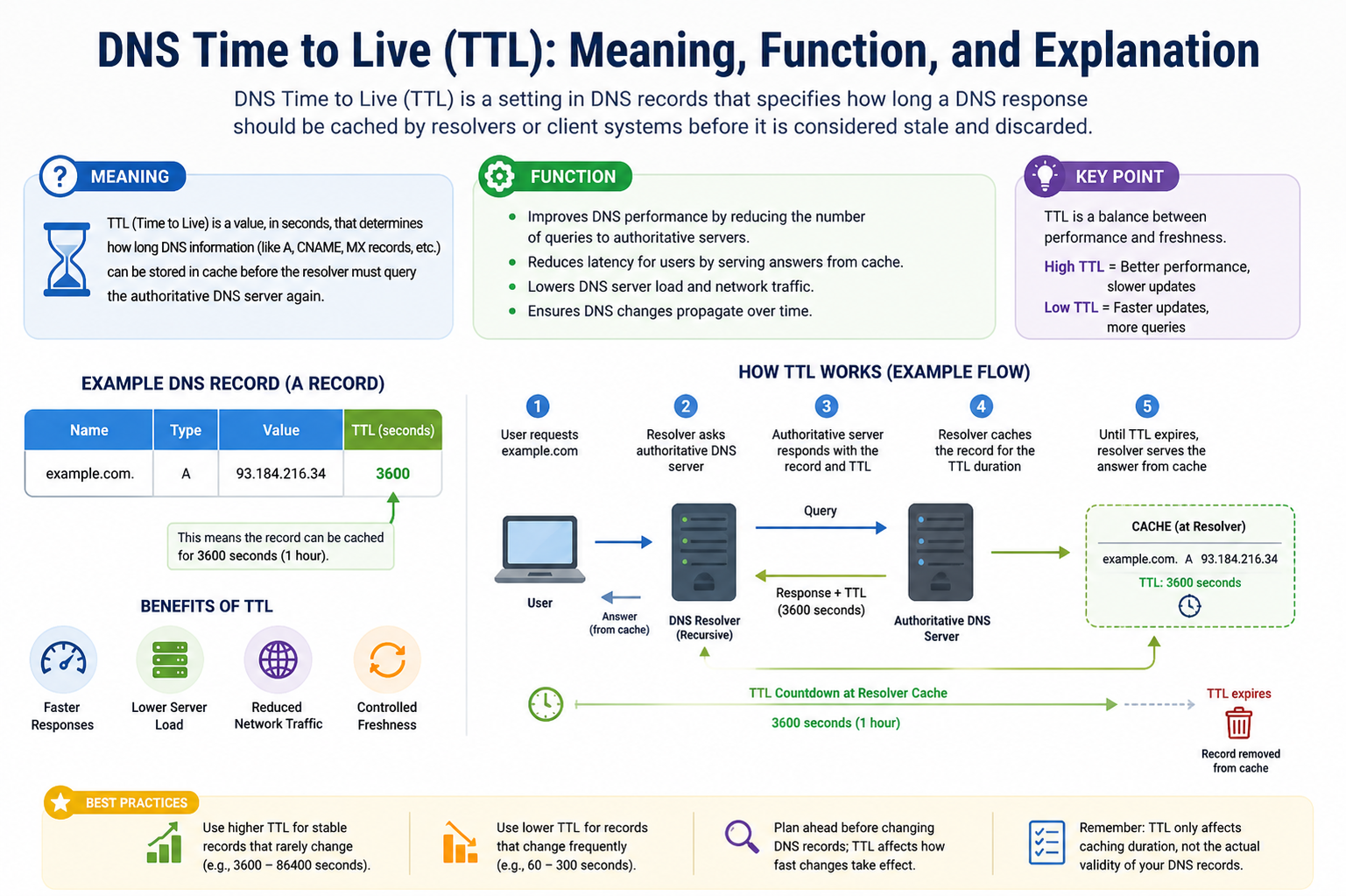
DNS Time to Live, commonly known as TTL, is a fundamental concept in how internet domain name systems operate. It refers to the time period during which a DNS record is stored in a temporary storage area called a cache before it is refreshed or checked again from the original source. This mechanism ensures that systems do not repeatedly request the same information from DNS servers, which helps improve speed and efficiency while browsing the internet.
When a user tries to access a website, the domain name is translated into an IP address through a DNS lookup process. Instead of performing this lookup every single time, the result is saved for a specific duration defined by the TTL value. This saved information is reused until the TTL expires, after which a fresh lookup is required to confirm whether the data is still valid or has changed.
How DNS TTL Works in Simple Terms
DNS TTL works like a countdown timer attached to every DNS record. Once a DNS query is resolved, the response is stored in a cache along with its TTL value. This value indicates how long the record should remain valid.
During this time, whenever another request is made for the same domain, the system uses the cached data instead of contacting the DNS server again. This reduces delay and improves performance significantly. Once the TTL reaches zero, the cached record is considered expired, and the system must retrieve fresh data from the authoritative DNS server.
This process ensures a balance between speed and accuracy. If there were no TTL system, every request would require a full DNS lookup, which would slow down internet performance considerably.
Purpose and Importance of DNS TTL
The main purpose of DNS TTL is to optimize internet traffic and reduce unnecessary load on DNS servers. Since millions of DNS queries happen every second across the world, caching responses for a limited time greatly improves efficiency.
TTL also plays a crucial role in ensuring scalability. Without it, DNS servers would struggle to handle the massive number of repeated requests. By storing responses temporarily, systems can serve users faster while reducing backend pressure.
Another important aspect is data freshness. TTL ensures that cached data does not remain outdated for too long. Once the time limit is reached, updated information is retrieved to reflect any changes made to a domain’s settings.
Role of TTL in DNS Caching
Caching is the process of storing data temporarily so that it can be accessed quickly when needed again. TTL directly controls how long DNS records remain in this cache.
When a DNS resolver receives a query response, it stores it along with the TTL value. If the same domain is requested again within that time frame, the cached record is used. This avoids repeated lookups and speeds up access.
However, once the TTL expires, the cached record is removed or marked invalid. The next request will then trigger a fresh DNS query. This cycle continues, ensuring that cached data is both useful and reasonably up to date.
Different Types of DNS Records and TTL Usage
Every DNS record type can have its own TTL value. These include records responsible for mapping domain names to IP addresses, handling mail routing, and managing other domain-related services.
Each record type may require different TTL settings depending on its purpose. For example, records that rarely change can have longer TTL values, while those that may change frequently often use shorter TTL values to ensure faster updates.
This flexibility allows administrators to control how long specific pieces of DNS information should remain cached across the internet.
How TTL Affects Website Performance
TTL has a direct impact on how quickly websites load for users. A well-configured TTL helps reduce the time needed for DNS resolution, which in turn speeds up page loading.
When a TTL value is set higher, the system relies more on cached data, which reduces the number of DNS queries. This leads to faster access times and improved performance for users who frequently visit the same website.
On the other hand, if the TTL is set too low, the system must perform DNS lookups more often. While this ensures more up-to-date information, it can slightly slow down performance due to increased query activity.
TTL and DNS Propagation
DNS propagation refers to the time it takes for changes made to a domain’s DNS records to be updated across all servers worldwide. TTL plays a major role in this process.
When a DNS record is updated, systems that have cached the old record will continue to use it until the TTL expires. Only after expiration will they request the updated information.
This means that TTL directly influences how quickly changes become visible globally. Lower TTL values can speed up propagation, while higher values may delay it.
Balancing Speed and Freshness with TTL
One of the key challenges in configuring TTL is finding the right balance between performance and data accuracy. A very high TTL improves speed because cached data is used more often, but it can delay updates when changes are made.
A very low TTL ensures that updates are reflected quickly, but it increases the number of DNS queries, which can add load to servers and slightly reduce performance.
This balance depends on the specific needs of a website or application. Static websites often prefer higher TTL values, while dynamic systems may require lower TTL settings.
Common TTL Values and Their Usage
TTL values are typically measured in seconds. Different systems use different values based on their requirements. Short TTL values are often used for frequently changing records, while long TTL values are used for stable configurations.
For example, some systems may use a few minutes for fast-changing records, while others may use several hours or even days for stable ones. The choice depends on how often the underlying DNS information is expected to change.
Impact of TTL on Network Traffic
TTL helps significantly reduce network traffic by minimizing repeated DNS queries. Without TTL, every user request would trigger a new lookup, resulting in massive unnecessary traffic across DNS servers.
By caching responses, TTL reduces the load on infrastructure and allows faster responses for users. This not only improves performance but also makes the entire DNS system more efficient and scalable.
TTL in Real-World Internet Usage
In everyday internet usage, TTL operates silently in the background. When users open websites, stream content, or use online applications, DNS TTL ensures that the connection process is quick and smooth.
Most users are unaware of TTL, yet it plays a crucial role in ensuring that websites load quickly and efficiently. It is one of the key components that makes modern internet browsing seamless.
Security Considerations of TTL
TTL also has indirect security implications. A well-managed TTL setting can help in controlling how quickly outdated or potentially harmful DNS records are removed from caches.
Short TTL values can help ensure that changes related to security updates are propagated quickly. This reduces the risk of users being directed to outdated or incorrect addresses.
However, TTL alone is not a security mechanism but rather a performance and caching control feature that contributes to overall system stability.
Challenges in TTL Configuration
One of the challenges in working with TTL is determining the optimal value. If set incorrectly, it can lead to performance issues or delayed updates.
Another challenge is understanding how different systems cache DNS records. Since multiple layers of caching exist, TTL behavior may vary depending on where the cache is stored.
This makes it important for system administrators to carefully plan TTL settings based on expected traffic patterns and update frequency.
Advanced Role of DNS TTL in Modern Networks
DNS Time to Live (TTL) is not only a simple caching timer but also an important control mechanism in modern internet infrastructure. In advanced network systems, TTL values are carefully planned to manage traffic flow, improve reliability, and ensure smooth communication between servers and users. Large-scale websites, cloud platforms, and content delivery systems rely heavily on optimized TTL settings to maintain performance under high demand.
In complex environments, DNS responses pass through multiple caching layers such as local device caches, internet service provider caches, and global resolver caches. TTL determines how long each of these layers can store a DNS record before refreshing it. This layered caching structure allows websites to serve millions of users efficiently without overwhelming authoritative DNS servers.
TTL and Content Delivery Optimization
Content delivery systems depend strongly on DNS TTL to distribute traffic efficiently across servers located in different regions. When a user requests a website, DNS resolution can direct them to the nearest or most optimal server based on cached records.
TTL ensures that this routing information remains valid for a specific duration, reducing the need for repeated lookups. This improves response time and reduces latency, especially for users accessing content from distant geographical locations. When TTL is properly configured, it helps maintain a balance between fast delivery and accurate routing updates.
In systems where content is frequently updated or shifted between servers, lower TTL values are often used to ensure that users are quickly directed to the latest server configuration. On the other hand, stable systems with consistent infrastructure benefit from higher TTL values for improved caching efficiency.
Impact of TTL on DNS Propagation Delays
DNS propagation delay is one of the most noticeable effects of TTL configuration. When changes are made to DNS records, such as updating an IP address or modifying routing settings, those changes do not instantly appear everywhere on the internet.
Instead, systems that have already cached the old DNS data will continue using it until the TTL expires. This delay can range from a few seconds to several hours or even days depending on the TTL value that was previously set.
Understanding this behavior is important for managing updates effectively. Lower TTL values are often used before making major changes to ensure faster propagation, while higher values are used during stable operations to reduce unnecessary DNS traffic.
Negative Caching and TTL Behavior
DNS systems also use a concept known as negative caching, which applies TTL principles to failed queries. When a DNS resolver tries to access a domain or record that does not exist, it stores this negative result for a certain period defined by a TTL-like value.
This prevents repeated unnecessary queries for non-existent records, improving overall system efficiency. However, it also means that if a record is newly created, it may take some time before systems recognize it, depending on how long the negative cache is stored.
Negative caching works alongside standard TTL behavior to reduce DNS load and improve response efficiency across networks.
TTL in Distributed and Cloud-Based Systems
In modern distributed systems and cloud environments, TTL plays a critical role in maintaining synchronization across multiple servers and data centers. These systems often operate across different regions, making consistent DNS behavior essential.
TTL helps ensure that updates are eventually reflected across all nodes without requiring constant synchronization. By controlling how long DNS data is stored locally, TTL allows distributed systems to operate efficiently while still adapting to changes over time.
Cloud-based architectures also use TTL strategically to manage failover systems. When a server becomes unavailable, DNS updates can redirect traffic to backup servers. The speed of this transition is influenced directly by TTL settings.
TTL and Load Distribution Strategies
Load balancing systems often rely on DNS TTL to distribute traffic evenly across multiple servers. By controlling how long clients use cached DNS records, system administrators can influence how frequently users request updated routing information.
Lower TTL values allow more frequent rebalancing of traffic, which can help during peak usage periods or when server loads need adjustment. Higher TTL values reduce DNS traffic but may result in less dynamic load distribution.
This trade-off is carefully managed in high-performance environments where both stability and responsiveness are required.
Common Mistakes in TTL Configuration
One common mistake in DNS management is setting TTL values without considering the nature of the service. For example, using very high TTL values for services that require frequent updates can lead to delayed changes and inconsistent user experiences.
Another mistake is using extremely low TTL values unnecessarily. While this ensures faster updates, it can increase DNS query traffic significantly and place additional load on DNS infrastructure without providing meaningful benefits.
Proper TTL configuration requires understanding how often DNS records change and how critical update speed is for the service.
TTL in Website Migration and Changes
When migrating a website from one server to another, TTL becomes a critical factor in ensuring a smooth transition. If TTL values are too high, users may continue accessing the old server for an extended period, even after migration has been completed.
To avoid this, system administrators often reduce TTL values before performing migration. This allows DNS caches to expire more quickly, ensuring that users are directed to the new server without significant delay.
Once the migration is complete and stable, TTL values are often increased again to improve performance and reduce DNS query overhead.
Monitoring and Managing TTL Effectively
Effective DNS management includes monitoring TTL behavior and understanding how it affects system performance. Administrators often analyze DNS logs and cache behavior to determine whether TTL settings are appropriate.
If updates are not propagating as expected, it may indicate that TTL values are too high. If DNS servers are under heavy load, it may suggest that TTL values are too low and causing excessive queries.
Adjusting TTL values based on real-world usage patterns helps maintain an optimal balance between performance and flexibility.
TTL and User Experience Impact
Although TTL operates in the background, it has a direct impact on user experience. Faster DNS resolution due to effective caching results in quicker website loading times and smoother browsing.
On the other hand, poorly configured TTL values can lead to delays in accessing updated content or occasional inconsistencies in website behavior. Users may experience outdated information or slow transitions during system changes.
By optimizing TTL, website owners can ensure a more consistent and responsive experience for users across different regions and devices.
Future Role of TTL in Evolving Internet Systems
As internet infrastructure continues to evolve, TTL remains an essential part of DNS functionality. With the increasing use of distributed networks, edge computing, and global content delivery systems, the importance of efficient DNS caching continues to grow.
Future systems are likely to rely even more on intelligent TTL management, where values are dynamically adjusted based on traffic patterns, system load, and real-time conditions. This will further improve efficiency and reduce manual configuration needs.
Despite advancements in technology, the core concept of TTL will remain a foundational element of DNS architecture.
Advanced Troubleshooting and Real-World Issues Related to DNS TTL
DNS Time to Live (TTL) can sometimes become a hidden factor behind unexpected website behavior, especially when changes are made to a domain but are not immediately visible everywhere. One of the most common issues is delayed propagation, where some users see the updated version of a website while others still see the old version. This happens because different systems and internet service providers may still have the previous DNS record cached until the TTL expires.
Another frequent issue occurs during server migration or IP address changes. If TTL was set too high before the change, cached records may persist longer than expected, causing traffic to continue being directed to the old server. This can lead to downtime confusion or inconsistent user experiences until all caches are refreshed naturally.
TTL and DNS Cache Inconsistency Problems
Cache inconsistency is another challenge linked with TTL behavior. Since DNS data is stored across multiple caching layers globally, each layer may expire at different times. This can create a temporary mismatch where some users are routed correctly while others are not.
This inconsistency is not an error in DNS itself but a natural outcome of distributed caching combined with TTL timing. Understanding this behavior helps in diagnosing issues where updates appear to be partially applied across different regions or networks.
In many cases, flushing local DNS cache or waiting for TTL expiration resolves these inconsistencies naturally over time.
Impact of TTL on Dynamic Websites and Applications
Dynamic websites and applications that frequently change data or infrastructure rely heavily on carefully tuned TTL settings. For example, systems that use auto-scaling servers or frequently changing backend resources need lower TTL values so that traffic is always directed to active and available nodes.
If TTL is too high in such environments, users may be directed to outdated or inactive servers, leading to errors or failed connections. On the other hand, if TTL is too low, it can increase DNS query load unnecessarily, affecting performance.
Therefore, dynamic systems require a carefully balanced TTL strategy that adapts to the changing nature of their infrastructure.
TTL in High Availability Systems
High availability systems, which are designed to remain operational even during failures, use TTL as part of their failover strategy. When a primary server goes down, DNS records are updated to redirect traffic to backup servers.
However, the effectiveness of this switch depends on TTL. If cached records still point to the failed server, users may experience temporary downtime until the TTL expires and updated records are fetched.
To minimize this delay, many high availability systems use shorter TTL values, allowing faster recovery during unexpected failures.
Role of TTL in Security and Threat Mitigation
TTL can indirectly contribute to security by controlling how quickly DNS changes propagate. In situations where a domain is compromised or needs urgent rerouting, lower TTL values allow administrators to update DNS records faster across the internet.
This can help mitigate certain types of attacks or misconfigurations by ensuring that outdated or harmful DNS entries are not retained in caches for long periods.
However, TTL is not a security tool by itself but rather a supporting mechanism that influences how quickly DNS-related security changes take effect.
DNS TTL in Mobile and ISP Networks
Different network environments handle TTL differently, especially mobile networks and internet service providers. Some providers may enforce minimum caching rules, meaning they may ignore very low TTL values and cache records longer than specified.
This can lead to situations where TTL behavior is not fully consistent across all users. Mobile networks, in particular, may optimize DNS caching aggressively to reduce data usage and improve response times, sometimes extending the effective TTL beyond its configured value.
Understanding this variability is important when analyzing DNS behavior across different regions or devices.
TTL and Browser-Level Caching Behavior
Web browsers also participate in DNS caching, which adds another layer influenced by TTL. When a user visits a website, the browser may store DNS information locally for quick access during subsequent visits.
Even if the system-level TTL expires, browser-level caching may still temporarily hold onto older DNS data. This can sometimes cause confusion when changes appear not to reflect immediately in the browser.
Clearing browser cache or restarting the browser can help refresh this layer of DNS storage.
Performance Optimization Through TTL Tuning
One of the most important uses of TTL is performance optimization. By adjusting TTL values based on traffic patterns, system administrators can significantly improve response times and reduce server load.
For frequently accessed and rarely changing resources, higher TTL values are often used to maximize caching efficiency. This reduces repeated DNS queries and allows faster access for returning users.
For rapidly changing systems, lower TTL values ensure that updates are reflected quickly, even if it means slightly higher DNS query traffic.
The key to optimization lies in understanding the behavior of the system and selecting TTL values that match its operational needs.
TTL in Hybrid Cloud and Multi-Region Architectures
Modern cloud systems often span multiple regions and data centers, creating complex DNS routing environments. TTL plays a central role in ensuring that these systems remain synchronized.
In hybrid architectures, DNS records may point to different servers depending on region, load, or availability. TTL ensures that these routing decisions are refreshed periodically so that users are always directed to optimal resources.
Without proper TTL management, users may experience outdated routing paths, leading to inefficient traffic distribution or increased latency.
Real-World Example of TTL Behavior
In practical scenarios, TTL becomes most noticeable during website updates or infrastructure changes. For example, when a website changes its hosting provider, DNS records must be updated to reflect the new server IP address.
If the TTL was previously set to a long duration, some users may continue accessing the old server even after the change. This is because their systems still trust the cached DNS data until it expires.
Over time, as TTL counts down and caches refresh, all users eventually transition to the updated server. This gradual transition is a direct result of how TTL controls DNS freshness.
Best Practices for Managing DNS TTL
Effective DNS management involves setting TTL values based on the specific use case. Stable websites with infrequent changes benefit from longer TTL values, which improve caching efficiency and reduce server load.
In contrast, systems that require frequent updates or dynamic routing benefit from shorter TTL values, ensuring faster propagation of changes.
It is also common practice to temporarily reduce TTL before making major changes and then increase it again after the system stabilizes. This approach helps minimize downtime and ensures smoother transitions.
DNS TTL Behavior and Importance
DNS Time to Live (TTL) is a critical yet often overlooked component of internet infrastructure. It influences how quickly changes are reflected, how efficiently systems operate, and how smoothly users experience websites and applications.
Through caching control, TTL reduces unnecessary DNS traffic, improves performance, and helps manage large-scale distributed systems effectively. At the same time, it introduces certain delays in propagation that must be carefully managed.
A well-planned TTL strategy ensures that systems remain both fast and flexible, allowing the internet to function efficiently while adapting to constant changes in infrastructure and user demand.
DNS TTL in Enterprise-Level Infrastructure Management
In large enterprise environments, DNS Time to Live (TTL) is treated as a strategic configuration element rather than just a technical setting. Enterprises often operate multiple applications, services, and servers distributed across regions, making DNS behavior a critical part of system stability. TTL is carefully adjusted to ensure that internal systems, customer-facing platforms, and backend services remain synchronized without unnecessary delays or overload.
Enterprise architects typically design TTL policies based on service criticality. Mission-critical systems that require rapid failover or frequent updates are assigned lower TTL values, while stable internal services that rarely change use higher TTL values to maximize caching efficiency. This structured approach ensures consistent performance while maintaining flexibility for operational changes.
TTL in Microservices and API-Driven Architectures
Modern software systems built on microservices rely heavily on dynamic communication between services. DNS TTL plays a subtle but important role in ensuring that service discovery remains accurate and efficient. When services are scaled, moved, or replaced, DNS records must reflect these changes without causing disruptions.
In API-driven architectures, TTL helps manage how quickly client applications recognize backend changes. If TTL values are too high, clients may continue sending requests to outdated service endpoints. If TTL values are too low, excessive DNS lookups can introduce unnecessary latency. Therefore, microservice environments often require carefully tuned TTL values to maintain both responsiveness and stability.
TTL Behavior in Failover and Disaster Recovery Systems
Failover systems are designed to automatically redirect traffic when a primary system becomes unavailable. DNS TTL directly affects how quickly this redirection takes place. When a failure occurs, updated DNS records must replace old ones across the internet, but cached records continue to exist until their TTL expires.
Disaster recovery strategies often involve setting shorter TTL values in advance so that, in the event of a failure, traffic can shift more quickly to backup systems. However, even with optimized TTL settings, there is always a short window where some users may still be routed to the failed system due to cached data. This is why TTL planning is a key part of resilience engineering.
TTL Influence on Global Content Accessibility
Global websites and applications rely on DNS to route users to geographically appropriate servers. TTL ensures that this routing information is periodically refreshed so that users receive optimal performance based on their location.
When content delivery systems update routing rules, TTL determines how quickly those changes spread across global networks. A carefully configured TTL ensures that users in different regions experience consistent access while still benefiting from localized performance optimization.
If TTL values are not properly aligned with global infrastructure changes, users in certain regions may experience delays in receiving updated routing information, leading to uneven performance across locations.
DNS TTL and Edge Computing Systems
Edge computing environments bring processing closer to the user, reducing latency and improving response times. DNS TTL is essential in these systems because it controls how frequently devices and local nodes update routing information.
In edge networks, TTL values must strike a balance between stability and adaptability. Since edge nodes are distributed across many locations, frequent DNS updates can help ensure optimal routing, but excessive updates may introduce overhead. TTL helps maintain efficiency by controlling update frequency while supporting dynamic edge infrastructure.
TTL and Internet of Things (IoT) Ecosystems
IoT systems often consist of thousands or even millions of connected devices that rely on DNS for communication with central servers. In such environments, TTL plays a critical role in managing network efficiency and reducing unnecessary traffic.
Since IoT devices may operate with limited processing power and bandwidth, DNS caching through TTL helps minimize repeated lookups. However, TTL must be carefully configured to ensure that devices still receive timely updates when server configurations or endpoints change.
Poor TTL configuration in IoT systems can lead to outdated connections, delayed updates, or inefficient communication patterns across the network.
TTL Impact on API Gateways and Load Balancers
API gateways and load balancers frequently rely on DNS to distribute incoming traffic across multiple backend servers. TTL determines how long clients or intermediate systems cache these routing decisions.
When TTL is set appropriately, traffic distribution remains efficient and balanced, ensuring that no single server becomes overloaded. If TTL is too long, load balancing adjustments may take longer to take effect. If TTL is too short, increased DNS queries may introduce overhead.
This balance is particularly important in high-traffic applications where stability and performance must coexist.
TTL in Hybrid and Multi-Cloud Strategies
Organizations that use multiple cloud providers or hybrid infrastructures must carefully manage DNS TTL to ensure seamless connectivity across platforms. TTL ensures that changes in one environment are reflected across others without requiring constant manual updates.
In multi-cloud environments, TTL helps coordinate traffic distribution and failover strategies between different providers. Proper TTL configuration ensures that users are always directed to the most optimal or available cloud region.
Without proper TTL management, inconsistencies between cloud environments may result in uneven performance or delayed failover behavior.
TTL and System Scalability Considerations
Scalability is one of the most important aspects of modern infrastructure design, and DNS TTL contributes directly to it. By reducing unnecessary DNS queries through caching, TTL helps systems handle larger volumes of traffic without increasing backend strain.
As systems grow, TTL configuration becomes increasingly important to maintain performance. Properly tuned TTL values ensure that scaling events, such as adding new servers or expanding regions, are reflected efficiently without overwhelming DNS infrastructure.
However, scalability also requires flexibility, meaning TTL values must be adjustable based on evolving system requirements.
Operational Strategies for TTL Optimization
Organizations often implement structured TTL strategies based on system behavior and traffic patterns. These strategies include adjusting TTL values during maintenance windows, scaling events, or infrastructure migrations.
A common operational practice is to temporarily lower TTL values before making significant changes. This allows updates to propagate quickly. After the system stabilizes, TTL values are increased again to reduce DNS query load and improve performance efficiency.
This dynamic approach ensures that TTL remains aligned with operational goals at all times.
Long-Term Importance of DNS TTL in Internet Architecture
Even as internet technologies continue to evolve, DNS TTL remains a foundational mechanism in global networking. Its role in caching, performance optimization, and update propagation ensures that it continues to be relevant in modern systems.
As networks become more distributed and complex, TTL will likely evolve further to support automated and adaptive configurations. Future systems may adjust TTL dynamically based on real-time conditions such as traffic load, server health, and geographic demand.
Despite these advancements, the core principle of TTL will remain unchanged: controlling how long DNS information is trusted before being refreshed.
DNS TTL Functionality
DNS Time to Live is more than just a technical parameter; it is a critical control mechanism that influences how efficiently the internet operates. It directly affects speed, reliability, update propagation, and system scalability.
By managing how long DNS records remain cached, TTL ensures that systems remain both fast and adaptable. It reduces unnecessary network traffic while allowing updates to gradually propagate across global infrastructure.
A well-designed TTL strategy enables stable, high-performance systems that can adapt to change while maintaining consistent user experience across diverse environments.
Conclusion
DNS Time to Live (TTL) is a key mechanism that controls how long DNS information is stored in caches before it is refreshed. It plays an essential role in balancing speed, efficiency, and data accuracy across the internet. By allowing DNS records to be reused for a specific period, TTL reduces repeated queries, lowers server load, and significantly improves browsing performance.
At the same time, TTL ensures that outdated information does not remain in the system indefinitely. Once the defined time expires, updated DNS data is fetched, helping systems stay current with any changes such as server updates, IP changes, or infrastructure modifications. This balance between caching and refresh cycles is what makes DNS operations both fast and reliable.
TTL also has a direct impact on how quickly changes propagate across the internet. While lower TTL values allow faster updates, higher values improve stability and reduce network traffic. Choosing the right TTL depends on the nature of the system, whether it is static, dynamic, or highly distributed.
In modern networks, from cloud systems to global applications, TTL remains a foundational part of DNS functionality. It supports performance optimization, ensures smoother user experiences, and helps maintain consistency across complex infrastructures. Understanding and managing TTL effectively is important for anyone involved in website management or network operations, as it directly influences both system behavior and end-user experience.