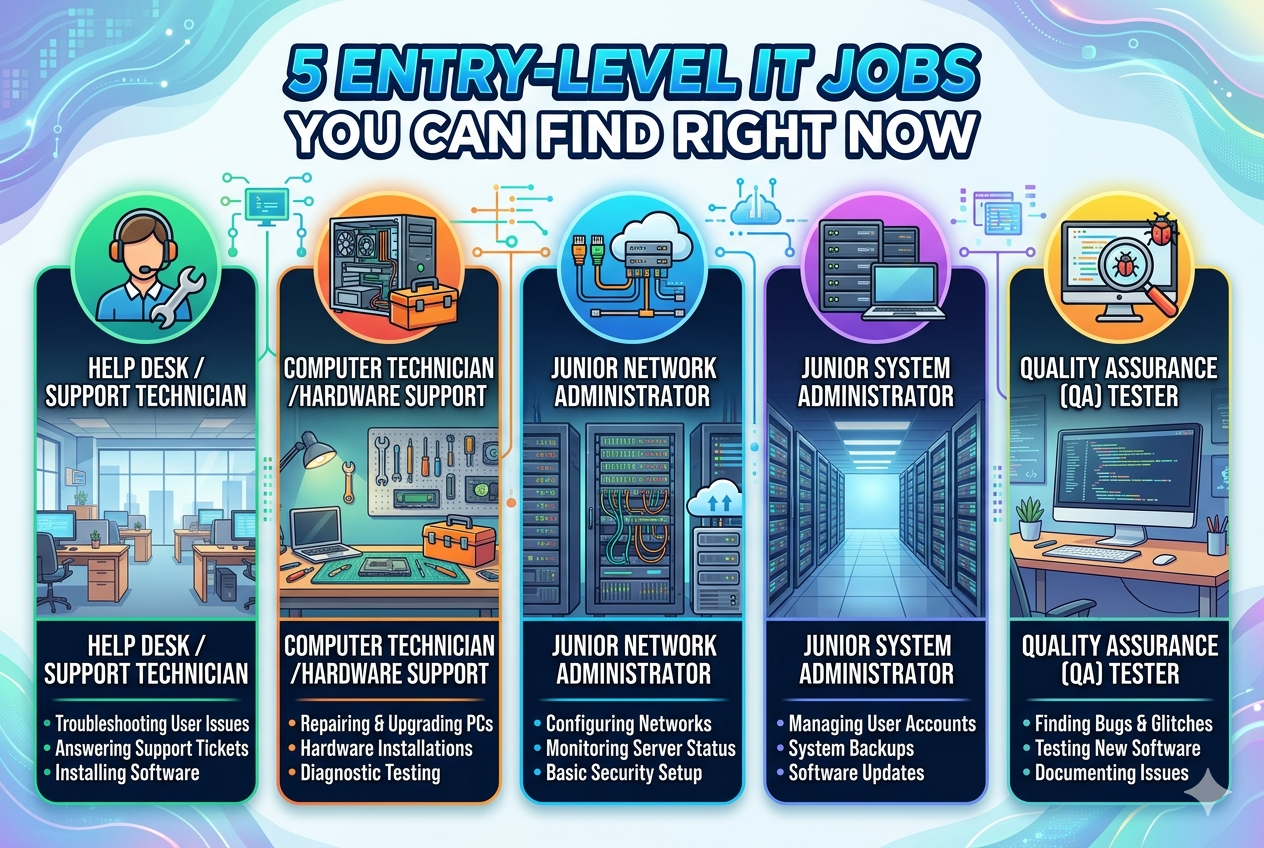
Help Desk Technician roles are among the most common entry points into the IT industry because they focus on solving everyday technical problems faced by users. These professionals typically handle support tickets, respond to phone calls or chat requests, and assist users who are struggling with hardware, software, or network-related issues. The work is often fast-paced, but it provides constant exposure to real-world IT problems, which helps build strong foundational skills.
In this role, strong communication is just as important as technical ability. Help Desk Technicians must be able to explain solutions in simple, non-technical language so that users can follow instructions easily. Common tasks include resetting passwords, installing basic applications, diagnosing system errors, and guiding users through step-by-step troubleshooting processes. Over time, technicians develop problem-solving speed and a deeper understanding of operating systems and business environments.
To start in this field, many employers look for basic certifications or familiarity with operating systems like Windows, macOS, or Linux. While a degree in computer science or IT can help, it is not always required. Many people enter this role through self-study, online courses, or short certification programs. As experience grows, Help Desk Technicians often move into specialized IT roles such as systems support, network administration, or cybersecurity.
Career progression in this field is strong because it builds core IT knowledge. With enough experience, professionals can advance into higher-paying technical support or infrastructure roles, making it a solid foundation for long-term IT growth.
IT Support Specialist
IT Support Specialist positions are designed for individuals who enjoy solving technical issues while working closely with users or employees. These professionals ensure that an organization’s technology environment runs smoothly by maintaining systems, resolving errors, and assisting with installations and updates. Unlike basic help desk roles, IT Support Specialists often deal with slightly more complex technical problems.
Their responsibilities may include configuring devices, setting up new user accounts, managing software updates, and diagnosing both hardware and network issues. They also play a key role in maintaining productivity within a company by ensuring employees have access to the tools and systems they need. This makes the role both technical and service-oriented.
To enter this field, candidates typically benefit from certifications such as CompTIA A+ or equivalent foundational IT training. Practical experience is highly valued, and many professionals begin in help desk positions before advancing. Familiarity with operating systems, basic networking concepts, and troubleshooting tools is essential.
One of the advantages of this job is the variety of tasks involved. No two days are exactly the same, and each issue provides a learning opportunity. Over time, IT Support Specialists build a strong understanding of enterprise systems, which can lead to career paths in system administration, cloud support, or IT management.
Junior Network Administrator
Junior Network Administrator roles focus on maintaining and supporting an organization’s network infrastructure. This includes local area networks, wide area networks, and sometimes cloud-based networking systems. These professionals assist in ensuring that communication between computers, servers, and devices runs efficiently and securely.
Typical responsibilities include monitoring network performance, identifying connectivity issues, assisting in the configuration of routers and switches, and supporting senior network engineers. They may also help implement security measures to protect data and prevent unauthorized access. This role requires attention to detail because even small configuration errors can impact system performance.
Beginners interested in this field often study networking fundamentals such as IP addressing, subnetting, and routing protocols. Certifications like CompTIA Network+ or Cisco’s entry-level certifications are commonly used to enter this profession. Hands-on practice with networking labs or simulations is extremely helpful.
This job is particularly valuable because networking is a core component of almost every IT system. As experience grows, Junior Network Administrators can advance into senior network engineering roles, cybersecurity positions, or cloud infrastructure careers. It is a technical pathway with strong long-term growth potential.
Technical Support Representative
Technical Support Representatives work directly with customers or clients to resolve technical issues related to products or services. This role blends technical knowledge with customer service skills, making it ideal for individuals who are comfortable communicating and problem-solving at the same time.
Their daily tasks often include answering support requests, diagnosing technical problems, providing step-by-step instructions, and escalating complex issues to higher-level technicians when needed. They may also document issues and solutions to improve future troubleshooting processes. Patience and clarity are essential because they often assist users who are not technically experienced.
This position is accessible to beginners because it does not always require deep technical expertise at the start. Instead, companies usually provide training on specific systems, tools, or products. Basic knowledge of computer systems and strong communication skills are often enough to begin.
Over time, Technical Support Representatives gain valuable experience in troubleshooting and customer interaction. This can lead to advancement into IT support, quality assurance, product specialization, or even training and documentation roles within technology companies.
Junior Systems Administrator
Junior Systems Administrators support the management and maintenance of an organization’s IT systems, including servers, applications, and internal infrastructure. This role is more advanced compared to basic support positions but is still accessible to entry-level professionals with the right training and dedication.
Responsibilities often include monitoring system performance, assisting in server maintenance, managing user accounts, performing software updates, and ensuring data backups are completed successfully. They also help troubleshoot system issues and support senior administrators in maintaining stability across IT environments.
To enter this field, foundational knowledge of operating systems, especially Windows Server or Linux, is important. Understanding virtualization, basic scripting, and system security principles can also be beneficial. Many professionals start in help desk or support roles before transitioning into systems administration.
This job is highly valuable because systems administrators play a critical role in keeping business operations running smoothly. As experience increases, individuals can move into senior systems administration, DevOps engineering, cloud architecture, or IT infrastructure management.
Skills You Need to Break Into Entry-Level IT Jobs
Success in entry-level IT roles depends less on advanced expertise and more on building strong foundational skills. Most employers expect candidates to understand basic computer operations, including file management, operating systems, and simple troubleshooting techniques. Familiarity with Windows and Linux environments is especially helpful since many organizations rely on these systems.
Problem-solving is one of the most important skills in IT. Whether you are resetting passwords or diagnosing network issues, you will constantly face situations where you need to identify the cause of a problem and apply logical steps to fix it. Being patient and methodical makes a big difference because IT issues are rarely solved instantly.
Communication skills are equally important, especially in roles that involve user support. You need to explain technical concepts in simple language so non-technical users can understand and follow instructions. Writing clear documentation is also valuable because many IT teams rely on shared knowledge bases to solve recurring problems efficiently.
Basic networking knowledge is another key area. Understanding how devices connect, how IP addresses work, and what routers and switches do can significantly improve your ability to troubleshoot issues. Even entry-level familiarity can make you stand out compared to other beginners.
Finally, adaptability is essential in IT because technology changes quickly. Tools, software, and systems are constantly evolving, so professionals who are willing to learn continuously tend to progress faster in their careers.
Certifications That Help You Get Hired Faster
Certifications are not always required for entry-level IT jobs, but they significantly improve your chances of getting hired. They show employers that you have structured knowledge and are serious about your career.
One of the most popular beginner certifications is CompTIA A+. It covers basic hardware, software, and troubleshooting skills, making it ideal for help desk and IT support roles. Many companies consider it a strong foundation for entry-level hiring.
CompTIA Network+ is another valuable certification for those interested in networking roles. It focuses on network configuration, infrastructure, and troubleshooting, helping you prepare for junior network administrator positions.
For individuals interested in systems administration, certifications related to Windows Server or Linux fundamentals can be useful. These demonstrate your ability to manage and maintain IT environments.
Some employers also value vendor-specific certifications, especially in companies that use specialized systems. While these are not mandatory, they can give you an advantage over other candidates applying for the same role.
How to Get Your First IT Job Without Experience
Breaking into IT without experience may seem challenging, but it is very achievable with the right approach. Many professionals start with no background in technology and gradually build their skills through learning and practice.
The first step is to build a basic understanding of IT concepts. This can be done through online courses, tutorials, or self-study resources. Focus on operating systems, basic networking, and troubleshooting techniques.
Next, practical experience is extremely important. Even if you do not have a job yet, you can create your own practice environment at home. Setting up virtual machines, experimenting with different operating systems, and simulating network setups can help you develop real skills.
Creating a simple resume that highlights your skills, certifications, and personal projects is also important. Even without job experience, you can showcase what you have learned and how you have applied it in practice.
Applying for internships or freelance support roles can also help you gain initial exposure. Many small businesses need basic IT support and are willing to hire beginners who show enthusiasm and willingness to learn.
Finally, consistency is key. Applying to multiple roles, improving your skills continuously, and staying updated with technology trends will eventually lead to your first opportunity.
Common Mistakes Beginners Should Avoid
Many beginners make mistakes that slow down their progress in IT careers. One of the most common mistakes is focusing only on theory without practicing real-world skills. IT is a hands-on field, and practical experience is just as important as knowledge.
Another mistake is ignoring soft skills. Even in technical roles, communication, teamwork, and problem-solving are essential. Professionals who can explain issues clearly and work well with others often perform better in the workplace.
Some beginners also try to learn too many advanced topics too quickly. Instead of mastering basics, they jump into complex areas like cybersecurity or cloud computing without a strong foundation. This can lead to confusion and slow progress.
Not building a portfolio or practical projects is another missed opportunity. Even simple projects like setting up a home network or documenting troubleshooting steps can demonstrate your skills to employers.
Finally, inconsistency in learning is a major barrier. IT requires continuous improvement, and those who stop learning often fall behind quickly.
Career Growth After Entry-Level IT Jobs
Entry-level IT jobs are not the final destination but the beginning of a long career path. Once you gain experience, you can move into more specialized and higher-paying roles.
Help Desk Technicians often progress into IT Support Specialists, System Administrators, or Network Engineers. With enough experience, some even transition into cybersecurity or cloud computing roles.
IT Support Specialists can advance into senior support positions, infrastructure management, or technical project roles. Their broad exposure to systems makes them versatile professionals.
Junior Network Administrators can grow into Network Engineers or Network Architects. As networks become more complex, skilled professionals in this area are always in demand.
Technical Support Representatives can move into product support engineering, quality assurance, or training roles. Their experience with users gives them strong communication and problem-solving abilities.
Junior Systems Administrators can advance into DevOps, cloud engineering, or IT infrastructure leadership roles. These positions often come with significantly higher salaries and responsibility.
Final Thoughts on Starting an IT Career
Starting a career in IT does not require perfection or advanced degrees. What matters most is consistency, curiosity, and willingness to learn. Entry-level roles are designed to teach you the fundamentals while giving you real-world exposure.
Every job in IT builds a different set of skills, and each experience adds value to your career journey. Whether you start in help desk support or systems administration, you are building a foundation that can lead to many advanced opportunities.
The IT industry continues to grow, and demand for skilled professionals remains strong. With the right mindset and continuous learning, entry-level roles can open the door to a stable, rewarding, and long-term career in technology.
Building a Strong IT Resume as a Beginner
Creating a strong resume is one of the most important steps when applying for entry-level IT jobs. Even without professional experience, you can still build a resume that shows your potential. The key is to focus on skills, learning efforts, and practical exposure rather than job history.
Start by clearly listing your technical skills. These may include operating systems like Windows or Linux, basic networking knowledge, troubleshooting abilities, and familiarity with common software tools. Employers in entry-level IT roles often prioritize skills over experience, especially if you can demonstrate real understanding.
Certifications should also be highlighted prominently. Even a single certification such as CompTIA A+ or Network+ can make your resume stand out. It shows that you have followed a structured learning path and understand core IT concepts.
If you have completed any personal projects, include them. For example, setting up a home lab, configuring virtual machines, or practicing network simulations can demonstrate hands-on experience. These projects show initiative and practical problem-solving ability.
Soft skills should not be ignored either. Communication, teamwork, time management, and adaptability are all important in IT environments. Many beginners underestimate how valuable these skills are, especially in support-based roles.
Finally, keep your resume clean and simple. Avoid unnecessary details and focus on clarity. Employers should be able to quickly understand your strengths and potential.
How to Prepare for Entry-Level IT Interviews
Interview preparation is essential for landing your first IT job. Even if your technical knowledge is basic, strong preparation can significantly improve your chances of success.
Most entry-level IT interviews include questions about troubleshooting scenarios. You may be asked how you would handle common issues like slow computers, network connectivity problems, or software errors. The goal is not to give perfect answers but to show logical thinking and structured problem-solving.
You should also be ready to explain basic IT concepts. This may include topics like what an IP address is, how the internet works, or the difference between hardware and software. Understanding fundamentals gives you confidence during interviews.
Behavioral questions are also common. Employers want to know how you handle pressure, how you communicate with users, and how you respond to difficult situations. Providing clear examples from your learning or personal experience can help.
Practicing mock interviews is a helpful strategy. You can rehearse answers aloud or with a friend to improve clarity and confidence. This also helps reduce nervousness during real interviews.
Finally, showing enthusiasm and willingness to learn is very important. Employers often hire beginners based on attitude and potential rather than complete technical mastery.
Where to Look for Entry-Level IT Jobs
Finding entry-level IT jobs requires using multiple sources and staying consistent. Many beginners limit themselves to a single platform, which reduces their chances of finding opportunities.
Online job platforms are one of the most common ways to find IT roles. These platforms list positions from companies of all sizes, including internships, support roles, and junior positions. Regularly checking new listings increases your chances of applying early.
Company career pages are also valuable. Many organizations post entry-level IT positions directly on their websites before listing them elsewhere. Checking these pages frequently can give you an advantage.
Networking is another powerful method. Connecting with professionals in the IT field can help you discover job opportunities that are not publicly advertised. Even simple conversations can lead to referrals or recommendations.
Local businesses sometimes need basic IT support and may hire beginners for part-time or contract roles. These opportunities can provide valuable real-world experience.
Staying active and applying consistently is key. Entry-level IT jobs are competitive, but persistence often leads to success.
How Hands-On Practice Improves Your IT Skills
Hands-on practice is one of the fastest ways to build confidence in IT. While theory is important, real understanding comes from doing actual tasks.
Setting up a personal computer lab at home is a great starting point. You can install different operating systems, experiment with settings, and learn how systems behave in different situations. This builds familiarity with real IT environments.
Virtual machines are also extremely useful. They allow you to simulate multiple systems on a single device, making it easier to practice networking, server management, and troubleshooting without risk.
You can also practice common troubleshooting scenarios. For example, intentionally creating small issues and then solving them helps develop problem-solving skills. This type of practice prepares you for real workplace situations.
Working with basic networking tools can also improve your understanding of how systems communicate. Even simple exercises like configuring IP settings or testing connectivity can be very valuable.
The more you practice, the more comfortable you become with technical concepts. Over time, this builds confidence and speeds up your career growth.
Understanding Career Stability in IT
One of the biggest advantages of starting a career in IT is long-term stability. Technology is used in almost every industry, which means IT professionals are needed everywhere.
Even entry-level roles provide a strong foundation for future growth. Once you gain experience, you can move into specialized areas such as cybersecurity, cloud computing, software support, or system administration.
The demand for IT professionals continues to grow as businesses rely more on digital systems. This creates consistent job opportunities across different sectors.
Another important factor is flexibility. IT skills can be used in many industries, including healthcare, education, finance, and government. This gives professionals more career options compared to many other fields.
With continuous learning, IT professionals can also increase their income significantly over time. Certifications, experience, and specialization all contribute to career advancement.
Overall, IT offers both stability and growth, making it one of the most reliable career paths for beginners entering the job market.
Starting Your IT Journey
Starting in IT is less about having perfect knowledge and more about building steady progress over time. Entry-level jobs are designed to teach you the fundamentals while giving you exposure to real systems and users.
Every role you take in IT adds value to your future career. Whether you begin as a help desk technician or a junior systems administrator, you are developing skills that can lead to advanced opportunities.
The key is to stay consistent, keep learning, and gain as much practical experience as possible. Over time, small improvements lead to major career growth.
IT is a field that rewards curiosity and persistence. Those who continue learning and adapting will always find new opportunities to grow and succeed.
Common Tools Used in Entry-Level IT Jobs
Entry-level IT professionals work with a variety of tools that help them troubleshoot, manage systems, and support users efficiently. One of the most commonly used tools is remote desktop software, which allows technicians to access and fix user systems without being physically present. This is especially useful in help desk and IT support roles where quick problem resolution is important.
Ticketing systems are another essential tool. These systems help organize and track user issues from the moment they are reported until they are resolved. Each problem is assigned a ticket, making it easier to prioritize tasks and maintain structured support workflows. Learning how to use ticketing platforms is a key part of most entry-level IT positions.
Basic command-line tools are also widely used. In Windows environments, tools like Command Prompt or PowerShell help perform system checks, network diagnostics, and administrative tasks. In Linux environments, terminal commands are used for similar purposes. Understanding these tools gives beginners a strong advantage.
Monitoring tools are important in network and system-related roles. They help IT professionals track system performance, detect issues early, and ensure that servers and networks are running smoothly. Even entry-level staff often assist in reviewing alerts and reports generated by these systems.
Finally, office productivity tools such as spreadsheets and documentation software are commonly used to record issues, create reports, and maintain technical documentation. These tools may seem simple, but they play a critical role in maintaining organization within IT teams.
Daily Responsibilities in Entry-Level IT Roles
The daily tasks in entry-level IT jobs vary depending on the role, but most positions involve a mix of troubleshooting, support, and system maintenance activities. A typical day often begins with checking support tickets or system alerts to identify urgent issues that need attention.
Help desk and support professionals spend much of their time assisting users with technical problems. This may include resolving login issues, fixing software errors, or helping users connect to networks and printers. Each problem requires careful analysis and step-by-step troubleshooting.
In network or systems-related roles, daily responsibilities may include monitoring system performance, checking logs for errors, and ensuring that servers or network devices are functioning correctly. Even small issues must be addressed quickly to avoid larger disruptions.
Documentation is another important part of daily work. IT professionals are expected to record solutions, update system logs, and maintain clear records of issues and resolutions. This helps teams share knowledge and improve efficiency over time.
There is also a learning component in most entry-level roles. Beginners are often encouraged to observe senior staff, attend training sessions, and gradually take on more complex tasks as their skills improve.
Challenges Faced by Beginners in IT
Starting a career in IT comes with several challenges, especially for those entering the field without prior experience. One of the most common difficulties is dealing with unfamiliar technical problems. At the beginning, many issues may seem complex, and it can take time to understand how systems work.
Another challenge is managing pressure in fast-paced environments. IT support roles often require quick responses, especially when users are unable to work due to technical issues. Learning how to stay calm and focused under pressure is an important skill to develop.
Beginners may also struggle with the large amount of information they need to learn. IT is a broad field that includes networking, systems, security, and software support. It can feel overwhelming at first, but breaking learning into smaller steps makes it more manageable.
Communication can also be challenging, especially when explaining technical solutions to non-technical users. Learning how to simplify explanations without losing accuracy takes practice and experience.
Finally, lack of confidence is a common issue. Many beginners doubt their abilities when facing real-world problems. However, confidence grows naturally with hands-on experience and consistent learning.
How to Improve Your IT Skills Faster
Improving IT skills quickly requires a combination of learning, practice, and consistency. One of the most effective methods is building a structured learning routine. Spending a small amount of time daily on IT concepts helps reinforce knowledge over time.
Hands-on practice is essential. Setting up virtual environments, experimenting with system configurations, and practicing troubleshooting scenarios can significantly improve understanding. Real experience builds confidence much faster than theory alone.
Watching tutorials and following guided labs can also be helpful. These resources provide step-by-step explanations that make complex topics easier to understand. However, it is important to actively practice rather than just watch.
Joining online communities or discussion groups can also accelerate learning. Engaging with others allows you to ask questions, learn from real experiences, and stay updated on industry trends.
Another effective method is teaching what you learn. Explaining concepts to others helps reinforce your own understanding and highlights areas where you need improvement.
Future Opportunities After Entry-Level IT Jobs
Entry-level IT jobs open the door to a wide range of future career opportunities. As you gain experience, you can specialize in different areas depending on your interests and skills.
One common path is moving into systems administration or network engineering. These roles involve managing more complex infrastructure and require deeper technical knowledge.
Another growing field is cybersecurity. With increasing digital threats, organizations need professionals who can protect systems and data. Entry-level experience in IT support or networking provides a strong foundation for this path.
Cloud computing is also a major career direction. Many companies are shifting to cloud-based systems, creating demand for professionals who understand cloud platforms and services.
Some professionals move into technical leadership or management roles. These positions focus more on planning, coordination, and overseeing IT operations.
There are also opportunities in specialized support roles, such as application support, database administration, or DevOps engineering. Each path offers different challenges and growth potential.
Building an IT Career
Building a career in IT is a gradual process that requires patience, practice, and continuous learning. Entry-level jobs are not just starting points but essential training grounds that shape your future career.
Every task you complete, every problem you solve, and every skill you learn contributes to your long-term growth. Even small improvements add up over time and lead to significant career advancement.
The IT industry continues to expand, creating opportunities for individuals who are willing to learn and adapt. With the right mindset, consistent effort, and hands-on experience, it is possible to build a stable and rewarding career in technology.
Salary Expectations in Entry-Level IT Jobs
Entry-level IT salaries can vary depending on location, company size, and specific role, but they generally provide a solid starting point compared to many other beginner careers. Help Desk Technicians and IT Support roles usually fall on the lower end of the IT pay scale at the start, but they still offer stable income with opportunities for quick growth as skills improve.
Technical Support Representatives may earn slightly differently depending on whether the role is customer-facing or internal. Companies that provide specialized technical products often pay more because the support requires deeper product knowledge. As experience increases, salary growth tends to be steady in this area.
Junior Network Administrators and Junior Systems Administrators typically start with higher pay compared to general support roles because of the more technical nature of their responsibilities. These positions involve working directly with infrastructure systems, which increases their value in organizations.
One important thing to understand is that IT salaries grow quickly with experience and certifications. Within a few years, entry-level professionals can move into mid-level positions with significantly higher income. Continuous skill development plays a major role in how fast this growth happens.
Work Environment in Entry-Level IT Roles
The work environment in IT jobs depends on the type of organization and role, but most entry-level positions offer a structured and collaborative setting. In many companies, IT teams work in offices or hybrid environments where support requests are handled both remotely and on-site.
Help desk and support roles are often fast-paced, especially in larger organizations where many users rely on IT systems. This creates a dynamic environment where problem-solving happens throughout the day.
Network and systems-related roles usually involve more focused work, such as monitoring systems, managing servers, and analyzing performance data. These positions may require quiet concentration but still involve teamwork when resolving larger issues.
Many IT departments follow shift-based schedules, especially in companies that require 24/7 support. This can include evening or weekend shifts, depending on the organization’s needs.
Overall, the IT work environment is professional, structured, and heavily focused on collaboration and problem resolution.
Growth Mindset Required for IT Success
A strong growth mindset is one of the most important factors for success in IT. Since technology constantly evolves, professionals must be willing to learn new tools, systems, and methods throughout their careers.
Beginners should expect challenges and mistakes as part of the learning process. Every issue encountered is an opportunity to improve problem-solving skills and technical understanding.
Being open to feedback is also essential. Senior professionals often provide guidance that helps beginners improve faster. Accepting and applying feedback leads to faster skill development.
Consistency is more important than speed. Even small daily learning efforts can build strong long-term expertise. Many successful IT professionals started with basic roles and gradually built their careers over time.
Adaptability is equally important. Tools, systems, and technologies change frequently, so professionals who adapt quickly tend to grow faster in their careers.
Why Entry-Level IT Jobs Are in High Demand
Entry-level IT jobs continue to be in high demand because almost every industry depends on technology. Businesses need reliable systems, secure networks, and technical support to operate efficiently.
As companies expand their digital infrastructure, the need for support professionals increases. This creates continuous opportunities for beginners entering the IT field.
Another reason for high demand is the increasing complexity of technology systems. Even basic tasks require trained individuals who understand how systems interact and how to solve technical issues.
Remote work and cloud-based systems have also increased demand for IT support. Employees working from different locations still need technical assistance, creating more job opportunities.
Additionally, many companies prefer hiring entry-level candidates and training them internally. This allows organizations to develop skilled employees who understand their systems from the ground up.
How to Stay Motivated While Starting in IT
Starting a career in IT can feel challenging at times, especially when progress seems slow. Staying motivated is important to continue learning and improving.
Setting small, achievable goals can help maintain focus. For example, learning a new concept each week or completing a small project can create a sense of progress.
Tracking your improvement is also helpful. Looking back at what you have learned over time can boost confidence and show how far you have come.
Connecting with others in the IT field can also improve motivation. Learning from peers, joining discussions, or sharing experiences helps reduce isolation and increases engagement.
It is also important to remember that IT is a long-term career path. Growth may not happen instantly, but consistent effort always leads to results.
Final Conclusion
Entry-level IT jobs provide one of the most accessible and rewarding starting points for a career in technology. Roles such as Help Desk Technician, IT Support Specialist, Junior Network Administrator, Technical Support Representative, and Junior Systems Administrator allow beginners to build essential skills while gaining real-world experience.
These positions are not just jobs but learning platforms that shape future career growth. They help individuals develop technical knowledge, problem-solving abilities, and communication skills that are valuable across the entire IT industry.
With consistent learning, practical experience, and a strong growth mindset, entry-level professionals can progress into advanced roles such as network engineering, cybersecurity, cloud computing, or systems architecture.
The IT field continues to expand rapidly, offering stability, flexibility, and long-term career opportunities. For anyone willing to learn and stay committed, entry-level IT jobs can be the first step toward a successful and fulfilling career in technology.