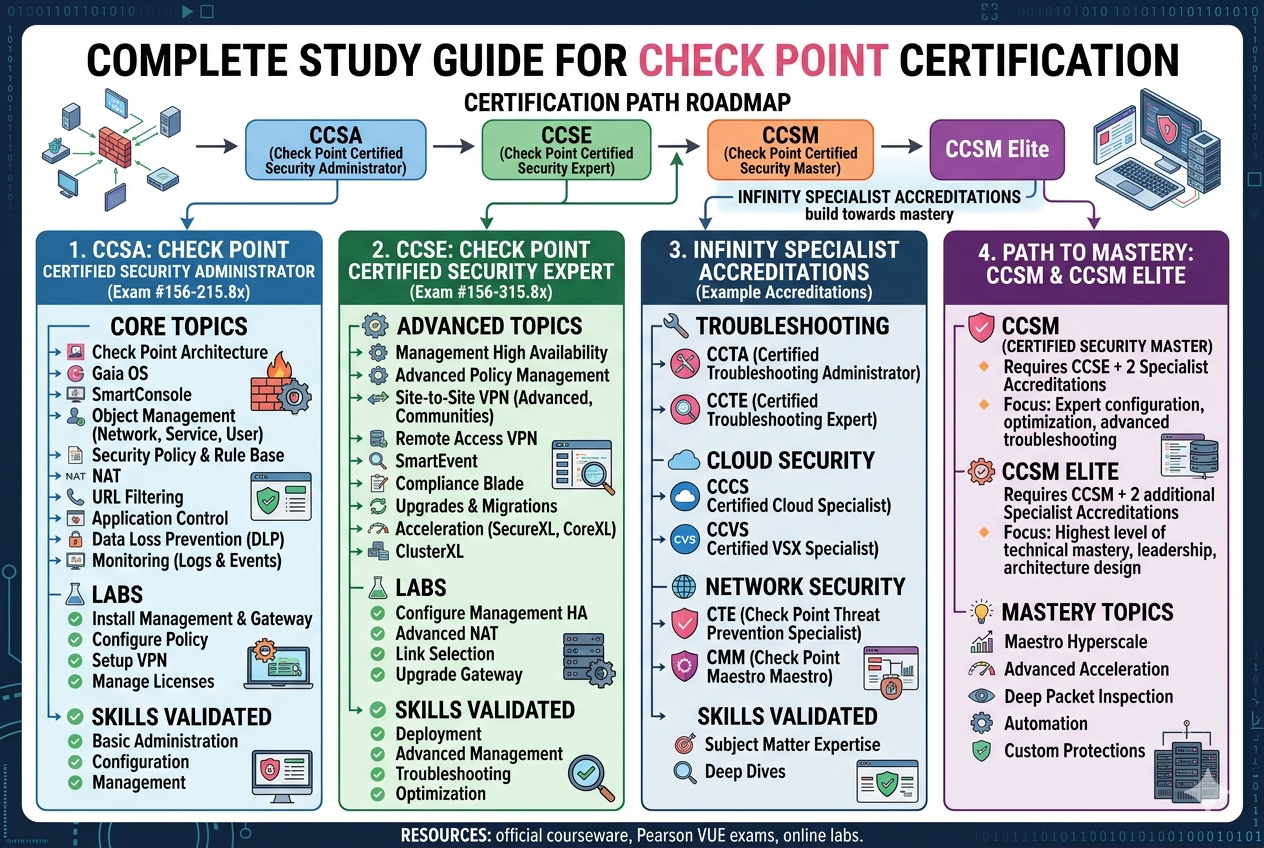
Check Point certification is one of the most recognized credentials in the cybersecurity industry for professionals working with network security, firewall administration, and enterprise protection systems. It is designed to validate both theoretical understanding and practical ability in managing security environments that protect organizations from modern cyber threats. The certification journey is not just about passing an exam, but about building a deep operational understanding of how enterprise-grade security infrastructures are designed, deployed, and maintained in real-world conditions.
In today’s digital landscape, organizations face increasingly complex threats, including ransomware, phishing attacks, advanced persistent threats, and unauthorized access attempts. Check Point technologies are widely used to defend against these risks, making certified professionals highly valuable in IT security teams. The certification helps learners develop structured thinking around security architecture, policy enforcement, traffic inspection, and system optimization.
Understanding Check Point Security Architecture
Check Point security architecture is built on a modular and scalable framework that enables organizations to secure networks of all sizes. At its core, it consists of security gateways, management servers, and policy control layers that work together to inspect and filter traffic based on predefined security rules. The architecture is designed to provide centralized control, allowing administrators to manage multiple security devices from a single interface.
A key strength of this architecture is its stateful inspection technology, which tracks the state of active connections and makes intelligent decisions about whether to allow or block traffic. This approach enhances performance while maintaining high security standards. Additionally, Check Point integrates threat prevention technologies that analyze traffic in real time to detect malicious behavior before it can cause harm.
Core Components of Check Point Environment
A typical Check Point deployment includes several essential components that candidates must understand in detail. The Security Gateway is responsible for enforcing security policies and inspecting traffic. The Security Management Server acts as the central brain where policies are created, managed, and distributed. SmartConsole is the graphical interface used by administrators to configure and monitor the entire system.
Each component plays a specific role in ensuring security consistency across the network. The communication between these components is encrypted and controlled, ensuring that administrative operations remain secure. Understanding how these elements interact is critical for both certification exams and real-world deployment scenarios.
Introduction to Gaia Operating System
The Gaia operating system is the foundation on which Check Point appliances run. It combines elements of Linux-based systems with specialized security functionalities designed for enterprise environments. Gaia provides a unified platform for network and security management, simplifying configuration and maintenance tasks.
Administrators use Gaia to configure interfaces, routing, system updates, and basic security settings. It also provides command-line and web-based interfaces for advanced configuration. A strong understanding of Gaia is essential because it serves as the operational layer that supports all security services in Check Point environments.
SmartConsole and Management Interface
SmartConsole is the primary management tool used in Check Point environments. It allows administrators to create security policies, monitor traffic logs, manage users, and deploy configurations to security gateways. The interface is designed to provide a centralized view of the entire security infrastructure.
Through SmartConsole, security policies are defined using rule-based structures that determine how traffic is handled. These rules include source, destination, service, action, and tracking parameters. Proper configuration of these rules is essential to ensure both security and performance efficiency.
The logging and monitoring features within SmartConsole allow administrators to analyze traffic patterns and detect suspicious activity. This visibility is crucial for maintaining a secure environment and responding quickly to potential threats.
Security Policies and Rule Management
Security policies form the backbone of Check Point’s protection system. They define what type of traffic is allowed or denied across the network. Each rule within a policy is evaluated in a top-down manner, meaning the order of rules significantly impacts system behavior.
Administrators must carefully design policies to balance security and usability. Overly strict rules can disrupt business operations, while overly permissive rules can expose the network to threats. Certification candidates are expected to understand how to create, optimize, and troubleshoot policy rules effectively.
Logging options within rules help track traffic behavior, making it easier to identify patterns and investigate incidents. Proper use of rule management techniques ensures a secure and efficient network environment.
Network Address Translation Concepts
Network Address Translation plays an important role in Check Point environments by allowing private networks to communicate with external systems securely. NAT modifies IP address information in packet headers to enable routing between different network segments.
There are different types of NAT configurations, including static NAT, dynamic NAT, and hide NAT. Each type serves a specific purpose depending on the network design and security requirements. Understanding how NAT interacts with security policies is essential for proper configuration.
Incorrect NAT settings can lead to connectivity issues or security vulnerabilities, making it a critical topic for certification preparation.
VPN Configuration and Secure Connectivity
Virtual Private Networks are a fundamental part of Check Point security solutions. They enable secure communication between remote users, branch offices, and centralized networks over public infrastructure.
Site-to-site VPNs are used to connect entire networks securely, while remote access VPNs allow individual users to securely connect to organizational resources. Encryption protocols ensure that data transmitted through VPN tunnels remains confidential and protected from interception.
Proper VPN configuration involves authentication methods, encryption settings, and tunnel management. Understanding how to troubleshoot VPN issues is also a key skill required for certification.
Threat Prevention Technologies
Check Point integrates advanced threat prevention technologies that go beyond traditional firewall capabilities. These include intrusion prevention systems, antivirus scanning, anti-bot detection, and application control.
These tools work together to analyze network traffic in real time and block malicious activities before they reach internal systems. Threat prevention is based on multiple layers of inspection, ensuring that even sophisticated attacks can be detected and mitigated.
Candidates must understand how to configure and optimize these features to ensure maximum protection without affecting network performance.
Identity Awareness and User Management
Identity awareness allows Check Point systems to associate network traffic with specific users rather than just IP addresses. This provides more granular control over security policies and enhances visibility into user activity.
User authentication methods can include directory services, identity agents, and captive portals. By linking identities to network actions, administrators can enforce policies based on user roles and responsibilities.
This feature is especially useful in enterprise environments where different departments require different levels of access control.
Logging, Monitoring, and Analysis
Logging is a critical component of Check Point security management. Every action taken by the system, including allowed and blocked traffic, is recorded for analysis. These logs provide valuable insights into network behavior and potential security threats.
Monitoring tools allow administrators to view real-time traffic and identify unusual patterns. Analysis of logs helps in forensic investigations and compliance reporting.
Effective use of logging systems ensures that organizations can respond quickly to incidents and maintain strong security posture.
Advanced Configuration Concepts
Beyond basic setup, Check Point certification requires understanding advanced configuration topics such as clustering, high availability, and performance optimization. Clustering ensures that multiple gateways work together to provide redundancy and load balancing.
High availability configurations ensure that security services remain operational even in the event of hardware or software failures. Performance tuning involves optimizing resource usage to maintain system efficiency under heavy traffic loads.
These advanced topics are essential for enterprise-level deployments where reliability and scalability are critical.
Practical Skills and Lab Experience
Hands-on experience is one of the most important aspects of preparing for certification. Working in lab environments allows learners to simulate real-world scenarios and practice configuration tasks without risk.
Practical exercises may include setting up security policies, configuring VPNs, analyzing logs, and troubleshooting connectivity issues. Repetition of these tasks helps build confidence and improves problem-solving abilities.
Understanding theoretical concepts alone is not enough; practical application is essential for mastering Check Point technologies.
Study Approach and Preparation Mindset
A structured study approach is necessary for success. Candidates should focus on understanding core concepts before moving on to advanced topics. Regular practice, revision, and scenario-based learning help reinforce knowledge.
Breaking down complex topics into manageable sections and revisiting them regularly improves retention. Consistency in study habits is more effective than last-minute preparation.
Developing a strong foundation in networking and cybersecurity principles also enhances understanding of Check Point systems.
Advanced Security Architecture Concepts
As learners progress deeper into Check Point certification topics, understanding advanced security architecture becomes essential. Modern enterprise environments are no longer simple perimeter-based systems; instead, they are layered, distributed, and highly dynamic. Check Point addresses this complexity through scalable security frameworks that include clustering, virtualization, and distributed policy management.
One of the key concepts is gateway clustering, which allows multiple security gateways to function as a single logical unit. This ensures both high availability and load balancing. If one gateway fails, traffic is automatically redirected to another active member of the cluster, minimizing downtime. This architecture is critical in environments where uninterrupted service is a priority.
Another important concept is policy distribution efficiency. In large organizations, policies may need to be applied across hundreds of gateways. Check Point optimizes this process through centralized management, ensuring consistency while reducing administrative overhead.
Cluster Technology and High Availability
High availability is a major focus in enterprise security design. Check Point ClusterXL technology ensures continuous network protection by synchronizing state information between cluster members. This synchronization allows seamless failover without interrupting active connections.
There are different cluster modes, including load sharing and high availability modes. Load sharing distributes traffic across multiple gateways, improving performance, while high availability prioritizes redundancy and failover readiness. Understanding when to use each mode is important for both certification and real-world implementation.
Proper cluster configuration also requires attention to synchronization networks, interface consistency, and failover detection mechanisms. Misconfiguration in these areas can lead to traffic disruption or inconsistent security enforcement.
Virtual System Extension Concepts
Virtualization is widely used in modern cybersecurity infrastructure, and Check Point supports multi-domain and virtual system architectures. These allow a single physical appliance to host multiple independent security environments.
Virtual systems enable organizations to segment security policies for different departments, clients, or environments without requiring separate hardware. This improves efficiency and reduces operational costs.
Each virtual system operates independently, with its own policies, logs, and configurations, while still sharing underlying hardware resources. Understanding how to manage these environments is essential for advanced certification topics.
Security Blades Architecture
Check Point uses a modular approach known as Security Blades, which allows organizations to enable specific security features based on their requirements. Each blade represents a dedicated security function such as firewall, VPN, intrusion prevention, application control, or anti-malware protection.
This modular design provides flexibility, allowing administrators to activate only the features they need. It also simplifies scaling, as additional security capabilities can be added without redesigning the entire infrastructure.
Understanding how security blades interact and complement each other is important because they collectively form a unified threat prevention system.
SmartEvent and Security Intelligence
Security monitoring becomes more effective when raw logs are transformed into actionable intelligence. SmartEvent provides advanced event correlation and analysis capabilities that help identify patterns across large volumes of security data.
Instead of analyzing individual logs, SmartEvent aggregates related events to highlight potential security incidents. This allows security teams to prioritize responses based on severity and impact.
This tool is especially useful in enterprise environments where thousands of events may be generated every minute. Proper use of SmartEvent enhances situational awareness and improves incident response times.
Management Automation and API Integration
Modern Check Point environments support automation through management APIs, enabling administrators to streamline repetitive tasks. Automation can include policy updates, object creation, system monitoring, and reporting.
Using automation reduces human error and improves operational efficiency. It also allows integration with other security tools and orchestration platforms, creating a more unified security ecosystem.
Understanding API-based management is increasingly important as organizations move toward automated and programmable infrastructure models.
Advanced VPN Troubleshooting
While basic VPN configuration is an important topic, advanced troubleshooting requires deeper understanding of encryption, negotiation phases, and tunnel behavior. VPN issues can arise from mismatched encryption settings, routing conflicts, or authentication failures.
One common area of focus is IKE (Internet Key Exchange) negotiation, which establishes secure communication channels between peers. Failures in this phase often indicate configuration mismatches or network connectivity issues.
Another important aspect is traffic routing through VPN tunnels. Incorrect routing can cause traffic to bypass the tunnel entirely or fail to reach its destination. Proper analysis of logs and connection states is essential for resolving such issues.
Performance Optimization Techniques
As network traffic increases, performance optimization becomes critical. Check Point systems provide several tuning options to ensure efficient operation under heavy loads.
Administrators can optimize CPU usage, memory allocation, and inspection settings to balance security and performance. In some cases, disabling unnecessary features or adjusting inspection depth can significantly improve throughput.
Hardware acceleration technologies may also be used to enhance packet processing efficiency. Understanding how to identify performance bottlenecks is a valuable skill for certification candidates.
Upgrade and Migration Strategies
Security systems must be regularly updated to maintain protection against evolving threats. Check Point environments support structured upgrade paths that ensure minimal disruption during version transitions.
Migration involves moving configurations from older systems to newer platforms while preserving security policies and operational consistency. This process requires careful planning, validation, and testing.
Rollback strategies are also important in case upgrades introduce unexpected issues. Understanding upgrade lifecycle management is essential for maintaining stable production environments.
Incident Response and Security Operations
Security operations teams rely heavily on Check Point tools for detecting, analyzing, and responding to incidents. Incident response involves identifying threats, containing them, and restoring normal operations.
Check Point logs and monitoring tools provide detailed insights into attack patterns, enabling faster investigation. Correlation of events helps determine the scope and severity of security incidents.
Effective incident response also requires coordination between technical teams and security policies to ensure consistent handling of threats.
Real-World Deployment Scenarios
In real-world environments, Check Point systems are deployed in various architectures including enterprise networks, cloud environments, and hybrid infrastructures. Each deployment scenario presents unique challenges.
For example, in distributed organizations, security gateways may be placed across multiple geographic locations, requiring centralized management and consistent policy enforcement. In cloud environments, virtual gateways are used to secure dynamic workloads.
Understanding these scenarios helps candidates apply theoretical knowledge to practical situations, which is essential for both exams and professional roles.
Common Configuration Mistakes
Many issues in Check Point environments arise from misconfiguration rather than system failure. Common mistakes include incorrect rule ordering, overly broad security policies, and improper NAT settings.
Another frequent issue is lack of proper logging configuration, which can make troubleshooting difficult. In some cases, administrators may also overlook synchronization settings in clustered environments, leading to inconsistent behavior.
Learning to identify and avoid these mistakes is a key part of becoming proficient in Check Point administration.
Exam Preparation Strategy
Successful certification preparation requires a balanced approach between theory and practice. Candidates should focus on understanding concepts rather than memorizing configurations.
Hands-on lab practice is essential for reinforcing theoretical knowledge. Simulating real-world scenarios helps develop problem-solving skills and builds confidence in handling complex configurations.
Regular revision of key topics such as security policies, VPNs, clustering, and troubleshooting ensures better retention and understanding.
Time Management and Study Discipline
Effective time management plays a significant role in certification success. Breaking study sessions into focused intervals helps improve concentration and reduces burnout.
It is also important to maintain consistency rather than studying in irregular bursts. A structured plan that covers all major topics ensures comprehensive preparation.
Tracking progress and revisiting weaker areas helps strengthen overall understanding.
Professional Benefits of Certification
Achieving Check Point certification opens up opportunities in cybersecurity, network administration, and security engineering roles. Certified professionals are often trusted with managing critical security infrastructure.
The certification demonstrates both technical expertise and commitment to professional development. It also enhances career growth opportunities in organizations that rely on advanced security systems.
In addition, it provides a strong foundation for further specialization in cybersecurity domains.
Cloud Security and Modern Deployments
Modern cybersecurity environments are increasingly shifting toward cloud-based infrastructures, and Check Point certification includes important concepts related to securing these environments. Cloud deployments introduce dynamic workloads, elastic scaling, and distributed architectures that require adaptive security controls. Check Point provides solutions that integrate with major cloud platforms to extend traditional security capabilities into virtual environments.
In cloud security models, security gateways are often deployed as virtual instances rather than physical appliances. These virtual gateways enforce the same policies and inspection mechanisms used in on-premises environments, ensuring consistent protection across hybrid infrastructures. Understanding how these virtual components operate is essential for managing modern enterprise networks.
Another key concept is dynamic scaling, where security resources adjust automatically based on traffic demand. This ensures performance is maintained even during peak usage periods. Proper configuration of cloud-based security systems helps organizations maintain visibility and control across all workloads.
Hybrid Network Security Design
Hybrid networks combine on-premises infrastructure with cloud environments, creating complex security challenges. Check Point solutions are designed to unify security management across these environments through centralized policy control and unified monitoring.
A major focus in hybrid environments is maintaining consistent security policies regardless of where resources are located. This ensures that users and applications are protected equally whether they are operating in physical data centers or cloud platforms.
Connectivity between environments is typically secured using encrypted tunnels and controlled routing policies. Understanding how traffic flows across hybrid systems is important for both configuration and troubleshooting.
Advanced Threat Prevention and Sandboxing
Threat prevention in Check Point environments goes beyond traditional signature-based detection. Advanced systems use behavioral analysis and sandboxing techniques to identify unknown threats. Sandboxing allows suspicious files and applications to be executed in a controlled environment where their behavior can be analyzed safely.
If malicious activity is detected during analysis, the threat is blocked before it reaches the production environment. This proactive approach helps prevent zero-day attacks and advanced persistent threats.
Behavioral analysis examines how files interact with the system, looking for patterns that indicate malicious intent. This layered approach significantly improves detection accuracy and reduces false positives.
Application Control and URL Filtering
Application control enables administrators to manage and restrict the use of specific applications within the network. Instead of relying solely on ports and protocols, Check Point identifies applications based on behavior and signatures.
This allows organizations to enforce policies such as blocking unauthorized file-sharing tools or limiting access to social media platforms during work hours. URL filtering further enhances control by restricting access to specific websites or categories of content.
Together, these features help organizations maintain productivity while reducing exposure to security risks associated with unauthorized applications and websites.
Identity-Based Security Enforcement
Identity-based security adds an additional layer of control by linking network activity to specific users or groups. This allows administrators to create policies that are based on user roles rather than static IP addresses.
Integration with directory services enables automatic identification of users as they log into the network. This simplifies policy enforcement and improves visibility into user activity.
Identity-based policies are especially useful in large organizations where different departments require different levels of access to network resources.
Logging Architecture and Data Retention
Check Point logging systems are designed to handle large volumes of data generated by security events. Logs are stored in a structured format that allows for efficient querying and analysis.
Proper log retention policies are important for compliance, auditing, and forensic investigations. Organizations often need to retain logs for extended periods to meet regulatory requirements.
Efficient log management ensures that storage resources are used effectively while maintaining access to critical historical data.
Advanced Troubleshooting Methodologies
Troubleshooting in Check Point environments requires a systematic approach. Instead of guessing solutions, administrators follow structured diagnostic steps to identify root causes.
This process typically begins with identifying the scope of the issue, followed by analyzing logs, checking configurations, and verifying network connectivity. Each layer of the system is examined to isolate the problem.
Common troubleshooting tools include packet capture utilities, log analysis interfaces, and diagnostic commands. Understanding how to use these tools effectively is essential for resolving complex issues.
Packet Flow Analysis
Packet flow analysis is a critical concept for understanding how traffic moves through Check Point systems. Every packet passes through multiple inspection stages, including routing, policy evaluation, and threat prevention checks.
By analyzing packet flow, administrators can determine where traffic is being allowed or blocked. This helps in identifying misconfigurations or performance bottlenecks.
A clear understanding of packet processing order is essential for both troubleshooting and optimization tasks.
Performance Monitoring and System Health
Monitoring system performance is essential for maintaining stable security operations. Check Point provides tools that track CPU usage, memory consumption, and traffic throughput.
Performance issues can arise due to high traffic volumes, complex policies, or inefficient configurations. Identifying these issues early helps prevent system degradation.
System health monitoring also includes checking disk usage, interface status, and synchronization between cluster members.
Security Compliance and Governance
Organizations must often comply with industry regulations and security standards. Check Point systems support compliance by providing audit logs, reporting tools, and policy enforcement mechanisms.
Governance involves defining security policies that align with organizational requirements and ensuring they are consistently applied across all systems.
Regular audits help ensure that security configurations remain aligned with compliance standards and internal policies.
Automation and Orchestration in Security Operations
Automation plays a growing role in modern cybersecurity environments. Check Point supports automation through APIs and integration with orchestration platforms.
Automated workflows can handle tasks such as policy updates, incident response actions, and system monitoring. This reduces manual effort and improves response times.
Orchestration connects multiple security tools into a unified system, enabling coordinated responses to security events.
Real-Time Threat Intelligence Integration
Threat intelligence integration allows Check Point systems to stay updated with the latest threat information. This includes data about malicious IP addresses, domains, and attack signatures.
By continuously updating security policies with real-time intelligence, organizations can proactively block emerging threats.
This dynamic approach significantly enhances overall security effectiveness.
Incident Investigation and Forensics
When security incidents occur, forensic analysis is used to understand how the attack happened and what systems were affected. Check Point logs provide detailed information that helps reconstruct events.
Investigators analyze traffic patterns, user activity, and system behavior to identify the source of the attack. This information is used to prevent similar incidents in the future.
Proper forensic procedures are essential for maintaining accountability and improving security posture.
Disaster Recovery and Backup Strategies
Disaster recovery planning ensures that security systems can be restored quickly after failures or attacks. Check Point supports backup and restore mechanisms for configurations and policies.
Regular backups are essential for minimizing downtime and data loss. Recovery procedures should be tested regularly to ensure they work as expected.
A strong disaster recovery strategy ensures business continuity even in critical failure scenarios.
Future of Check Point Security Technologies
Cybersecurity continues to evolve, and Check Point technologies are also advancing to meet new challenges. Future developments focus on artificial intelligence, machine learning, and deeper automation.
These technologies will enable faster threat detection, improved accuracy, and more efficient security operations. Integration with cloud-native environments will also continue to expand.
Understanding current technologies provides a strong foundation for adapting to future advancements in cybersecurity.
Security Policy Optimization and Best Design Practices
In advanced Check Point environments, designing efficient and scalable security policies is critical for maintaining both performance and protection. Poorly designed policies can slow down traffic inspection, create management complexity, and introduce security gaps. A well-structured policy is built with clarity, minimal redundancy, and precise rule definitions.
One of the key best practices is rule optimization, which involves organizing security rules in a logical order based on frequency of use and importance. Frequently matched rules are placed at the top to reduce processing overhead, while less common or specific rules are placed lower in the policy structure.
Another important principle is avoiding overly broad rules. Rules that allow excessive traffic can weaken security posture, while overly restrictive rules can disrupt legitimate business operations. Striking a balance between usability and protection is essential for enterprise environments.
Object Management and Configuration Efficiency
Check Point uses object-based configuration to simplify policy management. Instead of using raw IP addresses or ports repeatedly, administrators create reusable objects such as hosts, networks, services, and groups.
This approach improves consistency and reduces configuration errors. When changes are needed, updating a single object automatically applies changes across all policies that reference it.
Efficient object management also improves scalability in large environments, where hundreds or thousands of objects may be used across multiple policies.
Advanced NAT Configuration Scenarios
Network Address Translation in complex environments often requires advanced configurations beyond basic static or dynamic NAT. In enterprise deployments, NAT rules must be carefully aligned with security policies to ensure correct traffic flow.
One common scenario involves overlapping IP address ranges between different networks. In such cases, NAT is used to translate addresses and prevent conflicts. Another scenario involves hiding internal networks behind a single external IP address for security and simplification.
Proper ordering of NAT rules is essential, as incorrect placement can result in traffic mismatches or connectivity failures.
Secure Remote Access Design
Remote access has become a core requirement in modern organizations due to increased mobility and distributed workforces. Check Point provides secure remote access solutions that allow users to connect safely to internal resources from external networks.
Authentication methods play a key role in securing remote access. Multi-factor authentication is often used to ensure that only authorized users gain access. This adds an additional layer of protection beyond usernames and passwords.
Remote access policies must also define which resources users can access based on their roles. Limiting access reduces exposure and minimizes potential attack surfaces.
Advanced Log Analysis Techniques
Log analysis is one of the most powerful tools in Check Point environments. Beyond basic monitoring, advanced log analysis involves identifying patterns, correlations, and anomalies across large datasets.
Security analysts often use filtering techniques to isolate specific events, such as failed login attempts, blocked connections, or unusual traffic spikes. Correlating these events helps identify potential security incidents.
Understanding how to interpret logs effectively is essential for both troubleshooting and proactive threat detection.
Security Event Correlation and Pattern Recognition
Security event correlation helps identify relationships between seemingly unrelated events. For example, multiple failed login attempts followed by a successful login may indicate a brute-force attack.
Check Point systems use built-in correlation engines to group related events into meaningful alerts. This reduces noise and helps security teams focus on high-priority issues.
Pattern recognition plays a key role in identifying advanced threats that may not trigger individual alerts but become visible when analyzed collectively.
Advanced Routing and Traffic Engineering
Routing plays a fundamental role in how traffic flows through Check Point environments. Incorrect routing configurations can lead to security bypasses or network disruptions.
Static routing is commonly used in smaller environments, while dynamic routing protocols are used in larger, more complex networks. Understanding how routing decisions interact with security policies is essential for proper configuration.
Traffic engineering techniques help optimize data flow, ensuring that traffic passes through appropriate security checkpoints without unnecessary delays.
Multi-Domain Security Management
Large organizations often require separation of security environments for different business units, subsidiaries, or clients. Check Point’s multi-domain management allows administrators to manage multiple independent security domains from a single platform.
Each domain operates independently with its own policies, objects, and administrators. This ensures strong isolation while maintaining centralized oversight.
Multi-domain management is particularly useful in service provider environments where multiple customers must be securely separated.
Endpoint Security Integration
Endpoint security extends protection beyond the network perimeter to individual devices such as laptops, desktops, and mobile devices. Check Point integrates endpoint security solutions to ensure consistent protection across all devices.
Endpoint protection includes malware detection, device control, encryption, and behavioral analysis. These features help prevent threats from entering the network through compromised endpoints.
Integration between endpoint and network security provides a unified defense strategy that improves overall security posture.
Mobile Device Security Considerations
With the increasing use of mobile devices in enterprise environments, securing mobile endpoints has become critical. Check Point provides mobile security solutions that protect devices from malicious applications, unsafe networks, and data leakage.
Mobile security policies often include restrictions on application usage, network access control, and data encryption requirements. These policies ensure that mobile devices adhere to organizational security standards.
Proper mobile security implementation helps reduce risks associated with bring-your-own-device environments.
Advanced Encryption and Cryptography Concepts
Encryption is the foundation of secure communication in Check Point environments. It ensures that data transmitted across networks remains confidential and protected from unauthorized access.
Common encryption protocols include IPSec for VPN tunnels and SSL/TLS for secure web communications. Understanding how these protocols work is essential for configuring secure connections.
Key management is another important aspect of encryption. Proper handling of cryptographic keys ensures that encrypted communication remains secure over time.
Security Hardening Techniques
System hardening involves reducing the attack surface of security systems by disabling unnecessary services, applying strict access controls, and enforcing secure configurations.
In Check Point environments, hardening may include restricting administrative access, disabling unused interfaces, and enforcing strong authentication policies.
Regular system updates and patch management also play a key role in maintaining a hardened security posture.
Change Management in Security Environments
Change management ensures that modifications to security configurations are controlled, documented, and tested before deployment. This reduces the risk of introducing errors or vulnerabilities.
In Check Point environments, changes to security policies or system settings should follow a structured approval process. Testing in a lab environment before production deployment is considered best practice.
Proper change management improves system stability and reduces operational risks.
Scalability Challenges and Solutions
As organizations grow, their security infrastructure must scale accordingly. Check Point systems are designed to handle increasing traffic loads and expanding network environments.
Scalability challenges may include performance degradation, policy complexity, and management overhead. Solutions include clustering, virtualization, and policy optimization.
Understanding how to scale security systems efficiently is essential for long-term infrastructure planning.
Emerging Threat Landscapes
Cyber threats are constantly evolving, with attackers using more sophisticated techniques to bypass traditional security controls. These include polymorphic malware, fileless attacks, and social engineering tactics.
Check Point continuously updates its threat intelligence systems to detect and mitigate emerging threats. Staying informed about new attack methods is essential for maintaining effective security defenses.
Security professionals must adopt a proactive mindset to anticipate and respond to evolving risks.
Integration with Third-Party Security Tools
Modern security environments often include multiple tools from different vendors. Check Point supports integration with third-party systems such as SIEM platforms, endpoint protection tools, and cloud security services.
Integration enables centralized monitoring and coordinated response across different security layers. This improves visibility and enhances overall threat detection capabilities.
Understanding interoperability is important for building unified security ecosystems.
Operational Best Practices for Administrators
Effective administration of Check Point systems requires adherence to operational best practices. These include regular monitoring, documentation, backup management, and proactive maintenance.
Administrators should also maintain clear separation between testing and production environments to avoid unintended disruptions.
Continuous learning and staying updated with new features and security updates are essential for long-term success.
Conclusion
Check Point certification is a comprehensive pathway for building strong expertise in enterprise cybersecurity, network protection, and advanced security management. It covers a wide range of essential domains including firewall administration, VPN configuration, threat prevention, cloud security, automation, and incident response. Each topic contributes to a deeper understanding of how modern security infrastructures are designed and maintained.
Success in this certification depends on a clear grasp of core networking principles combined with consistent hands-on practice. The ability to configure security policies, analyze logs, troubleshoot issues, and optimize performance reflects real-world readiness rather than just theoretical knowledge.
As cyber threats continue to evolve, professionals with Check Point skills are better equipped to adapt and respond effectively. The certification not only validates technical competence but also strengthens problem-solving abilities and strategic thinking in security operations.
Overall, mastering Check Point technologies provides a solid foundation for a career in cybersecurity, opening opportunities in network security engineering, security administration, and advanced threat management roles.