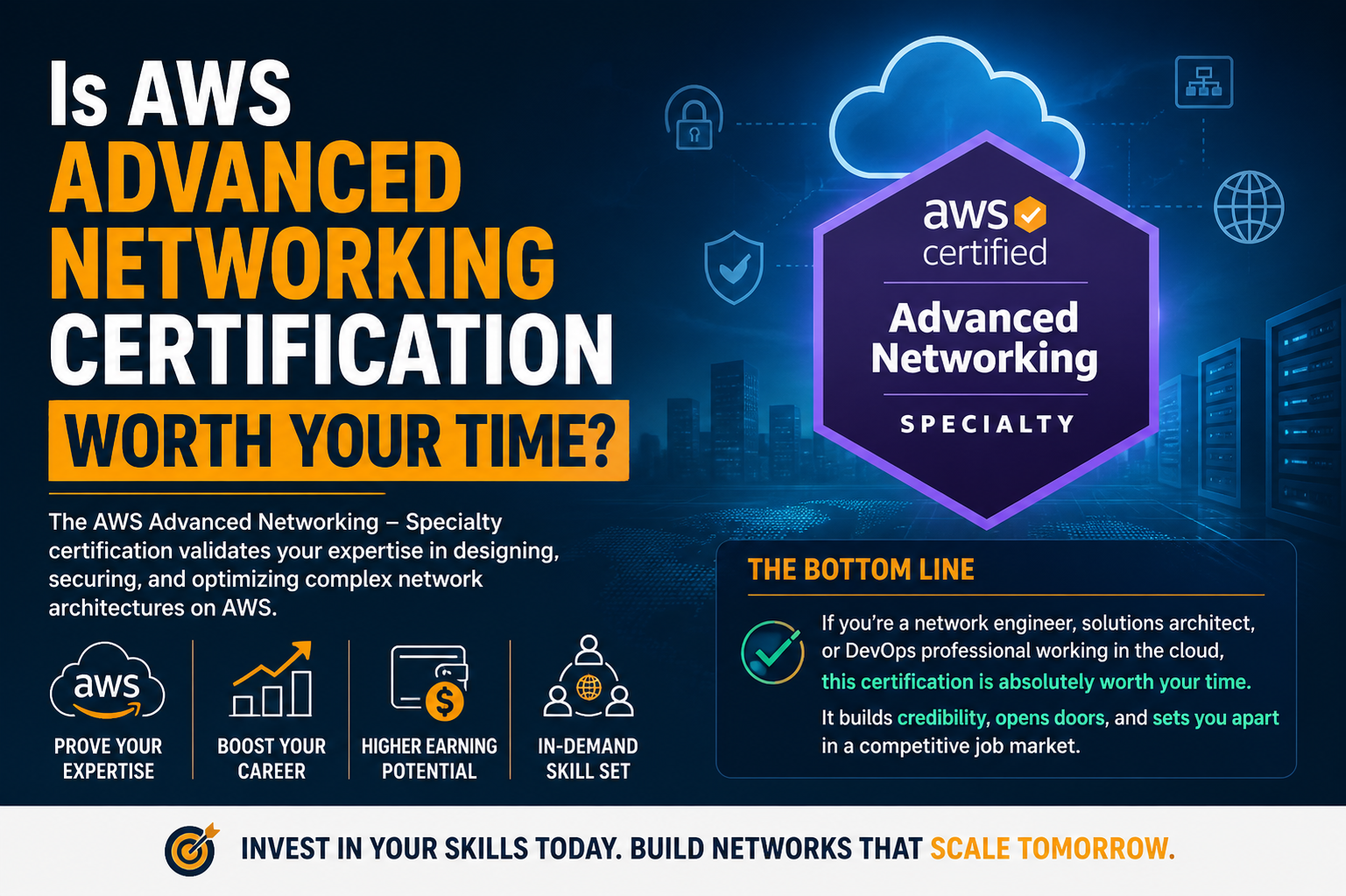
The AWS Advanced Networking certification plays a significant role in shaping careers for professionals working in cloud and network engineering domains. As organizations continue migrating to cloud-based infrastructure, the demand for individuals who can design, implement, and manage complex networking solutions has increased rapidly. This certification signals that a professional is capable of handling advanced networking challenges in large-scale cloud environments, which is highly valuable for employers.
In many cases, individuals holding this certification are considered for senior-level roles such as cloud network architect, senior network engineer, or cloud infrastructure specialist. These roles often come with greater responsibility, higher decision-making authority, and improved compensation. The certification does not just validate theoretical knowledge but also demonstrates practical understanding, which is crucial in real-world environments where network performance, security, and scalability are critical.
What makes this certification particularly impactful is its focus on hybrid networking environments. Many enterprises still operate a mix of on-premises and cloud systems, and professionals who can bridge this gap are in high demand. As a result, this certification can significantly improve job prospects and career stability in competitive IT markets.
Technical Depth and Skill Requirements
This certification is not intended for beginners. It requires a strong foundation in both traditional networking and cloud networking principles. Concepts such as routing protocols, VPNs, DNS, load balancing, and network security are not only expected but must be understood at an advanced level.
Candidates are also expected to be familiar with AWS-specific networking services and how they interact within complex architectures. This includes designing highly available systems, managing multiple network segments, and ensuring secure communication between distributed systems.
Beyond theoretical knowledge, hands-on experience is extremely important. Many of the exam scenarios are based on real-world problems where multiple solutions may exist, and the candidate must choose the most efficient, secure, and scalable option. This requires not only technical knowledge but also practical judgment developed through experience.
Without sufficient hands-on exposure, even highly knowledgeable candidates may struggle with the scenario-based nature of the exam. This is why professionals are advised to spend time working directly with cloud environments before attempting the certification.
Exam Complexity and Real-World Focus
One of the defining characteristics of the AWS Advanced Networking certification is its complexity. The exam is designed to test not just memorization but deep understanding and application of knowledge in practical situations.
Instead of simple questions, candidates are often presented with multi-layered scenarios involving network design challenges. These may include optimizing performance across regions, designing secure hybrid connectivity, or troubleshooting large-scale network issues. Each question typically requires careful analysis before selecting the best possible solution.
The difficulty level is significantly higher compared to foundational or associate-level certifications. It assumes that the candidate already understands basic AWS services and networking concepts. Therefore, it focuses more on advanced design decisions rather than introductory knowledge.
This complexity is intentional, as the certification is meant to validate professionals who can operate in enterprise-level environments. Organizations rely on certified individuals to make decisions that affect system reliability, cost efficiency, and security.
Preparation Strategy and Learning Approach
Preparing for the AWS Advanced Networking certification requires a structured and disciplined approach. Since the exam is heavily scenario-based, passive reading alone is not enough. Candidates must actively engage with cloud environments to understand how different networking components interact.
A strong preparation strategy includes building real or simulated cloud architectures, experimenting with routing configurations, and testing different connectivity options. This hands-on approach helps in developing intuition for solving complex problems under exam conditions.
It is also important to focus on understanding core networking principles deeply rather than superficially. Concepts such as subnetting, IP addressing, and routing behavior should be second nature before attempting the exam. Without this foundation, advanced AWS networking topics can become overwhelming.
Another effective strategy is practicing scenario-based problem solving. Instead of simply learning what each service does, candidates should focus on when and why to use a particular solution. This decision-making skill is crucial for success in the exam.
Consistency in preparation also plays a key role. Due to the depth of the syllabus, irregular study patterns can make it difficult to retain complex concepts. A steady, structured learning schedule is far more effective.
Challenges Faced by Candidates
Many candidates underestimate the difficulty of this certification. One of the biggest challenges is the depth of networking knowledge required. Unlike general cloud certifications, this exam expects a strong command of advanced networking concepts that many IT professionals may not use daily.
Another challenge is the complexity of scenario-based questions. These questions often include multiple valid answers, but only one is the most appropriate based on AWS best practices. Identifying the best solution requires not only technical knowledge but also experience in evaluating trade-offs between performance, cost, and security.
Time management during preparation and during the exam itself is also a common difficulty. Since scenarios can be lengthy and detailed, candidates may find it time-consuming to analyze each option carefully.
Additionally, staying updated with AWS networking services can be challenging because cloud technologies evolve rapidly. New features and updates can change best practices, requiring candidates to stay continuously informed.
Despite these challenges, overcoming them can significantly enhance professional capability and confidence in handling real-world networking environments.
Professional Benefits and Long-Term Value
The long-term value of this certification lies in the expertise it represents. Professionals who achieve this certification are often viewed as specialists in cloud networking, which can open doors to more advanced career opportunities.
In many organizations, certified individuals are trusted with designing and managing critical infrastructure components. This level of responsibility not only enhances professional credibility but also leads to exposure to complex and high-impact projects.
Another important benefit is skill validation. Even experienced professionals can benefit from formal recognition of their expertise. It provides proof of capability that can be useful during job transitions or promotions.
Over time, the knowledge gained while preparing for this certification also remains valuable. Cloud networking principles continue to be relevant as infrastructure becomes more distributed and complex. This makes the certification not just a short-term achievement but a long-term professional asset.
Is It Worth the Time Investment?
Whether the AWS Advanced Networking certification is worth the time depends largely on your current career stage and goals. For professionals already working in networking or cloud architecture roles, it can be a powerful tool for career advancement and specialization.
However, for beginners or those without a strong networking background, the time investment may feel overwhelming. In such cases, it is often more practical to build foundational knowledge first before attempting this advanced certification.
For experienced professionals, the certification offers strong returns in terms of career growth, skill recognition, and technical mastery. It helps position individuals as experts capable of handling enterprise-level networking challenges.
Ultimately, the certification is most valuable when aligned with long-term career goals in cloud infrastructure and networking.
Learning Curve and Knowledge Gaps
The AWS Advanced Networking certification has a steep learning curve, especially for professionals who come from general IT or basic cloud backgrounds. One of the biggest reasons for this is the depth of networking knowledge expected before even starting exam preparation. Unlike entry-level certifications that introduce cloud concepts in a simplified way, this certification assumes you already understand complex networking principles in detail.
Many candidates discover early that gaps in foundational knowledge can slow down their progress significantly. Topics like IP routing, network segmentation, BGP, and hybrid connectivity are not just briefly covered—they are deeply integrated into almost every exam scenario. If these areas are not already familiar, candidates often need to revisit core networking concepts before they can fully understand AWS-specific implementations.
Another common challenge is understanding how traditional networking concepts translate into cloud environments. In on-premises systems, networking is often hardware-driven, while in AWS it becomes software-defined and highly dynamic. This shift requires a different way of thinking, especially when designing scalable and fault-tolerant architectures.
The learning curve also includes mastering AWS-native services that may not have direct equivalents in traditional networking. Understanding how these services interact with each other is critical for success. Without this understanding, it becomes difficult to interpret exam scenarios correctly or choose the most efficient solution.
Importance of Hands-On Experience
Hands-on experience is one of the most important factors in successfully preparing for this certification. Reading documentation or watching tutorials alone is not enough to fully grasp the complexity of AWS networking environments. Real understanding comes from building, testing, and troubleshooting actual network configurations.
Working directly with AWS services allows candidates to see how different networking components behave under different conditions. For example, setting up a virtual private network, configuring routing tables, or experimenting with load balancing provides insights that theoretical learning cannot offer.
Practical experience also helps in developing problem-solving intuition. In the exam, many questions are designed around real-world scenarios where multiple solutions might appear correct. Candidates with hands-on experience are better able to identify subtle differences between options and select the most appropriate one.
Another benefit of practical learning is exposure to troubleshooting. Network issues in cloud environments can be complex and layered, involving multiple services and configurations. Learning how to diagnose and resolve these issues is an essential skill for both the exam and real-world job roles.
Without hands-on practice, candidates may find it difficult to connect theoretical concepts with practical application, which can significantly impact exam performance.
Real-World Application of Skills
One of the strongest advantages of pursuing the AWS Advanced Networking certification is the direct applicability of its skills in real-world environments. The certification is not designed purely for academic purposes; instead, it focuses heavily on practical scenarios that mirror enterprise-level challenges.
In modern organizations, network infrastructure is no longer limited to a single environment. Businesses often operate across multiple cloud regions, hybrid systems, and global networks. Professionals with advanced networking skills are responsible for ensuring seamless communication between these distributed systems.
This includes designing architectures that support high availability, low latency, and strong security. It also involves optimizing network performance while maintaining cost efficiency. These are not theoretical challenges but real operational concerns faced by companies every day.
Another important real-world application is security. As organizations move more workloads to the cloud, securing network traffic becomes increasingly critical. Professionals must understand how to implement secure communication channels, manage access control, and protect sensitive data across distributed systems.
Scalability is another key area where these skills are applied. Networks must be designed to handle increasing loads without performance degradation. This requires careful planning and understanding of AWS networking capabilities.
Because of these real-world applications, professionals who hold this certification often become key contributors in architecture decisions and infrastructure planning.
Comparison with Other AWS Certifications
When compared to other AWS certifications, the Advanced Networking certification stands out as one of the most specialized and technically demanding. While foundational and associate-level certifications focus on general cloud understanding, this certification dives deeply into a specific domain.
For example, foundational certifications introduce AWS services and basic cloud concepts, while associate-level certifications focus on solution design and implementation. In contrast, the Advanced Networking certification focuses entirely on networking architecture at an enterprise scale.
This specialization makes it more valuable for professionals who want to focus their careers specifically on networking or infrastructure design. However, it also means that it is not as broadly applicable as general certifications.
Another key difference is depth. While other certifications may cover networking as one part of a broader syllabus, this certification treats networking as the core subject. As a result, it requires a much deeper level of understanding.
In terms of difficulty, it is widely considered one of the hardest AWS certifications. This is due to both the complexity of the content and the level of experience required.
Despite this difficulty, it complements other AWS certifications well. Professionals often pursue it after completing foundational and associate-level certifications to deepen their expertise in a specific area.
Common Mistakes Candidates Make
Many candidates make predictable mistakes when preparing for this certification. One of the most common is underestimating the depth of networking knowledge required. Some assume that general AWS experience is enough, only to realize later that advanced networking concepts require much more study.
Another frequent mistake is relying too heavily on memorization. Because the exam is scenario-based, memorizing services and definitions is not sufficient. Candidates must understand how and when to apply different solutions in real-world contexts.
Skipping hands-on practice is another major error. Without practical experience, it becomes difficult to interpret complex scenarios or understand how different services interact.
Some candidates also focus too much on exam questions without building conceptual understanding. While practice questions are useful, they should not replace foundational learning.
Time management during preparation is also often overlooked. Due to the breadth of topics, last-minute preparation is rarely effective. A consistent, long-term study plan is far more successful.
Avoiding these mistakes can significantly improve the chances of success and reduce unnecessary frustration during preparation.
Long-Term Career Growth and Opportunities
The long-term career benefits of the AWS Advanced Networking certification extend beyond immediate job opportunities. It positions professionals as subject matter experts in a highly specialized field, which can lead to sustained career growth over time.
As cloud adoption continues to expand globally, networking remains one of the most critical components of IT infrastructure. Professionals who understand how to design and manage these systems are likely to remain in demand for many years.
This certification can also serve as a stepping stone to more advanced roles in cloud architecture and infrastructure leadership. It demonstrates the ability to handle complex systems, which is a key requirement for senior technical positions.
In addition, it can enhance credibility when working on large-scale projects. Organizations often prefer certified professionals for critical infrastructure decisions because it reduces risk and ensures adherence to best practices.
Over time, the knowledge gained through this certification continues to provide value, even as technologies evolve. Core networking principles remain relevant, making the skills highly transferable.
Job Roles and Industry Expectations
The AWS Advanced Networking certification aligns closely with job roles that demand deep expertise in cloud infrastructure and enterprise networking. In most organizations, professionals holding this certification are expected to work in roles that go beyond basic implementation tasks. They are often involved in designing large-scale network architectures, evaluating connectivity strategies, and ensuring seamless communication between distributed systems.
Common roles associated with this certification include cloud network architect, senior network engineer, cloud infrastructure architect, and enterprise solutions architect. In these positions, professionals are not only responsible for maintaining network systems but also for making critical design decisions that impact performance, security, and scalability.
Industry expectations for these roles are high. Employers typically look for individuals who can independently design hybrid cloud environments, optimize network traffic across regions, and troubleshoot complex connectivity issues. The certification helps validate that a professional has the theoretical knowledge and practical understanding required for such responsibilities.
In addition, organizations increasingly expect networking professionals to collaborate with security, DevOps, and application teams. This means that certified individuals must also understand how networking decisions affect other areas of cloud architecture. The certification indirectly prepares candidates for this cross-functional collaboration by exposing them to real-world architectural scenarios.
Salary Growth and Market Value
One of the key motivations for pursuing the AWS Advanced Networking certification is its impact on earning potential. While salary varies depending on location, experience, and job role, professionals with advanced cloud networking skills generally command higher compensation compared to those with only foundational certifications.
This is largely due to the scarcity of highly skilled cloud networking experts. As cloud environments become more complex, organizations are willing to invest more in professionals who can ensure reliability, performance, and security at scale.
The certification acts as a strong differentiator in competitive job markets. It signals to employers that a candidate possesses specialized expertise rather than general cloud knowledge. This can lead to better job offers, faster promotions, and access to more advanced technical roles.
However, salary growth is not automatic. The certification alone is not enough; it must be supported by real-world experience and continuous skill development. Professionals who combine certification with hands-on expertise tend to see the most significant financial benefits over time.
Relevance in Modern Cloud Architectures
Modern cloud architectures are increasingly complex, and networking plays a central role in ensuring their efficiency and reliability. With organizations adopting multi-cloud and hybrid cloud strategies, the need for advanced networking expertise has never been greater.
The AWS Advanced Networking certification is designed specifically to address these challenges. It covers concepts that are essential for building modern distributed systems, including cross-region connectivity, private network design, and secure data transfer between environments.
As applications become more distributed, latency and performance optimization also become critical concerns. Networking professionals must ensure that users experience minimal delays regardless of their geographic location. The certification helps develop the skills needed to design architectures that meet these requirements.
Another important aspect is automation. Modern cloud environments rely heavily on automation tools to manage networking configurations at scale. Understanding how networking integrates with infrastructure as code and automated deployment pipelines is increasingly important.
Because of these factors, the certification remains highly relevant even as cloud technologies evolve. It focuses on foundational principles that continue to apply in modern architectures, making it a long-term valuable credential.
Time Commitment and Study Duration
Preparing for the AWS Advanced Networking certification requires a significant time investment. The exact duration varies depending on prior experience, but most candidates spend several weeks to a few months preparing thoroughly.
For professionals with strong networking backgrounds, the preparation time may be shorter, as they already understand many of the core concepts. However, even experienced candidates need time to adapt to AWS-specific implementations and scenario-based question formats.
For those without strong networking experience, the preparation period can be much longer. This is because they must first build a solid understanding of foundational networking principles before moving into advanced cloud topics.
A structured study plan is essential for efficient preparation. Breaking down topics into manageable sections and combining theoretical learning with hands-on practice tends to be the most effective approach.
Consistency is more important than intensity. Studying regularly over a longer period is generally more effective than cramming large amounts of information in a short time.
Certification Maintenance and Continuous Learning
Cloud technologies evolve rapidly, and AWS frequently updates its services and features. As a result, maintaining relevance in this field requires continuous learning even after obtaining the certification.
While the certification itself remains valid for a period of time, professionals are encouraged to stay updated with new AWS networking features and best practices. This ensures that their knowledge remains aligned with current industry standards.
Continuous learning can include exploring new AWS services, working on real-world projects, and staying engaged with cloud architecture trends. Many professionals also pursue additional certifications to broaden their expertise across different domains.
This ongoing learning process is an important part of working in cloud networking. The certification should be viewed not as a final achievement but as part of a continuous professional development journey.
Limitations of the Certification
Despite its strong advantages, the AWS Advanced Networking certification does have certain limitations. One of the main limitations is its narrow focus. While it provides deep expertise in networking, it does not cover other important areas of cloud computing such as application development, data engineering, or security in depth.
This means that professionals may still need additional certifications or experience to become well-rounded cloud architects.
Another limitation is its difficulty level. The certification can be challenging for individuals without strong networking backgrounds, which may discourage some learners from pursuing it.
Additionally, while the certification is highly respected in cloud-focused organizations, its value may be less recognized in companies that do not heavily rely on AWS or cloud infrastructure.
It is also important to note that certification alone does not guarantee job success. Employers still prioritize practical experience, problem-solving ability, and communication skills alongside certification credentials.
Strategic Career Positioning
From a career strategy perspective, the AWS Advanced Networking certification is most effective when used as part of a broader learning path. It works best for individuals who already have foundational AWS knowledge and want to specialize in infrastructure and networking.
Professionals often use this certification to position themselves as experts in a specific technical domain. This specialization can be particularly valuable in large organizations where roles are highly segmented.
It can also serve as a stepping stone toward leadership roles in cloud architecture. By demonstrating deep technical expertise, professionals can gain credibility and move into positions that involve architectural decision-making and strategic planning.
However, strategic value depends on how the certification is applied. It should be combined with real-world experience and continuous skill development to maximize its impact.
Final Evaluation of Worth
When evaluating whether the AWS Advanced Networking certification is worth the time, the answer depends on individual goals and experience levels.
For professionals aiming to specialize in cloud networking, it offers strong long-term value, career growth potential, and industry recognition. It is particularly useful for those targeting senior technical roles in cloud infrastructure.
For beginners or those outside networking-focused roles, the certification may feel too advanced and time-consuming without prior preparation.
Ultimately, its worth is highest for individuals who are committed to deep technical expertise and long-term careers in cloud architecture and networking.
Preparation Resources and Study Approach
Preparing for the AWS Advanced Networking certification requires a carefully structured approach because the subject matter is both broad and deeply technical. A strong preparation plan usually combines conceptual learning, hands-on experimentation, and scenario-based practice.
The most effective candidates start by strengthening their understanding of core networking principles. Without this base, advanced AWS networking topics can feel overwhelming. Concepts such as routing, subnetting, VPN technologies, DNS behavior, and network security form the backbone of nearly every exam scenario.
Once the fundamentals are clear, the focus should shift toward AWS-specific networking services. The key is not just learning what each service does, but understanding how they interact in real architectures. For example, knowing how different connectivity options behave in hybrid environments is far more important than memorizing definitions.
Hands-on labs are essential at this stage. Building real environments helps reinforce theoretical knowledge and makes it easier to understand how different configurations affect performance, security, and scalability. Experimenting with network designs also improves problem-solving skills, which are heavily tested in the exam.
Scenario-based practice is another important part of preparation. The exam often presents complex situations where multiple answers may seem correct. Practicing these scenarios helps develop the ability to evaluate trade-offs and choose the most appropriate solution based on AWS best practices.
A consistent study routine is more effective than intensive short-term preparation. Spreading learning over time allows better retention and deeper understanding of complex topics.
Depth of Networking Knowledge Required
One of the defining aspects of this certification is the level of networking expertise it demands. It is not enough to have a surface-level understanding of cloud services. Candidates are expected to understand networking at an architectural level.
This includes advanced topics such as hybrid connectivity, multi-region architectures, network segmentation, and high availability design. These concepts are often interconnected, meaning a single decision in a network design can affect multiple components of the system.
Understanding how traffic flows through complex systems is particularly important. Candidates must be able to visualize how data moves between different environments and identify potential bottlenecks or security risks.
Security is also deeply integrated into the syllabus. Networking professionals must understand how to design secure communication channels, manage access control, and protect data in transit across distributed systems.
This depth of knowledge is what separates this certification from lower-level AWS certifications. It is designed for professionals who are already comfortable working with complex systems and want to specialize further.
Hands-On Labs and Practical Exposure
Practical experience is one of the most critical success factors for this certification. Without it, even strong theoretical knowledge may not be enough to handle exam scenarios effectively.
Working directly with cloud environments allows candidates to see how networking decisions impact real systems. For example, configuring virtual networks, setting up routing rules, and testing connectivity between different environments helps build a deeper understanding of system behavior.
Troubleshooting is another important aspect of hands-on learning. Network issues in cloud environments can be complex and layered, often involving multiple services. Learning how to diagnose and resolve these issues is essential for both the exam and real-world work.
Practical exposure also helps candidates understand performance trade-offs. In many cases, there is no single correct solution—only the most efficient one based on specific requirements. Hands-on experience helps develop the judgment needed to make these decisions.
Candidates who invest time in practical learning generally perform better in the exam because they can relate theoretical concepts to real-world behavior.
Common Misconceptions About the Certification
There are several misconceptions surrounding the AWS Advanced Networking certification that often lead to unrealistic expectations.
One common misconception is that AWS experience alone is sufficient to pass the exam. While familiarity with AWS services is helpful, it is not enough. A deep understanding of networking principles is equally important.
Another misconception is that the certification is purely theoretical. In reality, it is heavily practical in nature, focusing on real-world scenarios rather than memorized knowledge.
Some candidates also believe that passing practice exams alone is enough preparation. While practice questions are useful, they cannot replace hands-on experience or conceptual understanding.
There is also a misunderstanding that the certification is only useful for AWS-specific roles. In fact, the skills learned are transferable to broader cloud and networking environments.
Clearing these misconceptions early can help candidates approach preparation more realistically and effectively.
Impact on Problem-Solving Skills
One of the most valuable outcomes of preparing for this certification is the improvement in problem-solving skills. The exam is designed to test how well candidates can analyze complex scenarios and make optimal architectural decisions.
Each question typically involves multiple variables such as performance, cost, security, and scalability. Candidates must evaluate these factors and determine the best possible solution based on AWS best practices.
This process trains professionals to think more critically about system design. Instead of focusing on individual components, they learn to view infrastructure as a connected ecosystem.
Over time, this way of thinking becomes a valuable professional skill that extends beyond the exam. It helps in real-world decision-making, where similar trade-offs must be evaluated regularly.
The ability to approach problems systematically is one of the key benefits of this certification journey.
Industry Recognition and Professional Credibility
The AWS Advanced Networking certification carries strong industry recognition due to its difficulty and specialization. Employers understand that individuals who achieve this certification have invested significant effort in mastering complex technical concepts.
This recognition translates into increased professional credibility. Certified individuals are often trusted with more critical responsibilities and higher-level decision-making roles.
In team environments, they may be seen as technical experts in networking and infrastructure design. This can lead to greater influence in architectural discussions and project planning.
The certification also enhances credibility during job interviews. It demonstrates not only technical knowledge but also commitment to professional development and specialization.
However, credibility must be supported by practical experience. The certification opens doors, but long-term reputation is built through consistent performance in real-world scenarios.
Long-Term Skill Retention and Growth
One of the strengths of this certification is that the knowledge gained tends to be long-lasting. Networking principles do not change rapidly, even though technologies evolve. This means that the core concepts remain relevant over time.
Professionals who invest in this certification often retain a strong understanding of cloud networking architecture for years. This makes it a valuable long-term skill investment rather than a short-term achievement.
As cloud environments continue to grow in complexity, these skills become even more important. Professionals with a strong foundation in networking are better equipped to adapt to new technologies and architectural patterns.
Continuous learning is still necessary, but the foundational knowledge gained through this certification provides a stable base for future growth.
Final Reflection on Value and Effort
The AWS Advanced Networking certification represents a significant commitment of time, effort, and focus. It is not designed as an entry-level credential but as an advanced specialization for experienced professionals.
For those who are serious about cloud networking, it offers strong long-term benefits, including career advancement, technical mastery, and industry recognition.
However, its value depends heavily on preparation quality and existing experience. Without a solid foundation, the certification can feel extremely challenging. With the right background, it becomes a powerful tool for professional growth.
Ultimately, it is best viewed as a strategic investment in deep technical expertise rather than a simple credential.
Conclusion
The AWS Advanced Networking certification is a highly specialized credential that carries strong value for professionals aiming to build or advance a career in cloud networking and infrastructure design. It is not a beginner-friendly certification and demands a solid foundation in both traditional networking concepts and AWS cloud services.
Its real strength lies in validating advanced, practical skills needed to design, manage, and optimize complex network architectures in modern cloud and hybrid environments. Professionals who earn this certification are often better positioned for senior roles, increased responsibilities, and improved career opportunities in enterprise-level organizations.
However, the certification also requires a significant investment of time and effort. The learning curve is steep, and success depends heavily on hands-on experience, consistent preparation, and a strong understanding of real-world networking scenarios. Without this foundation, the certification can feel challenging and overwhelming.
For experienced networking or cloud professionals, it can be a powerful step forward that enhances both technical expertise and professional credibility. For beginners, it is more suitable as a long-term goal after building foundational AWS and networking knowledge.
Overall, its worth is high for those who are aligned with cloud infrastructure and networking careers, but it should be approached with realistic expectations, proper preparation, and a clear understanding of its depth and difficulty.